Named Entity Recognition for Question Answering
Diego Moll´a
and
Menno van Zaanen
and
Daniel Smith
Centre for Language Technology
Macquarie University
Sydney
Australia
{
diego, menno, dsmith
}
@ics.mq.edu.au
Abstract
Current text-based question answering (QA) systems usually contain a named en-tity recogniser (NER) as a core compo-nent. Named entity recognition has tra-ditionally been developed as a component for information extraction systems, and current techniques are focused on this end use. However, no formal assessment has been done on the characteristics of a NER within the task of question answering. In this paper we present a NER that aims at higher recall by allowing multiple entity labels to strings. The NER is embedded in a question answering system and the over-all QA system performance is compared to that of one with a traditional variation of the NER that only allows single entity la-bels. It is shown that the added noise pro-duced intropro-duced by the additional labels is offset by the higher recall gained, there-fore enabling the QA system to have a bet-ter chance to find the answer.
1
Introduction
Many natural language processing applications re-quire finding named entities (NEs) in textual doc-uments. NEs can be, for example, person or com-pany names, dates and times, and distances. The task of identifying these in a text is called named entity recognition and is performed by a named entity recogniser (NER).
Named entity recognition is a task generally associated with the area of information extrac-tion (IE). Firstly defined as a separate task in the Message Understanding Conferences (Sund-heim, 1995), it is currently being used in a varied
range of applications beyond the generic task of information extraction, such as in bioinformatics, the identification of entities in molecular biology (Humphreys et al., 2000), and text classification (Armour et al., 2005).
In this paper we will focus on the use of named entity recognition for question answering. For the purposes of this paper, question answering (QA) is the task of automatically finding the answer to a question phrased in English by searching through a collection of text documents. There has been an increase of research in QA since the creation of the question answering track of TREC (Voorhees, 1999), and nowadays we are starting to see the introduction of question-answering techniques in mainstream web search engines such as Google1, Yahoo!2 and MSN3.
An important component of a QA system is the named entity recogniser and virtually every QA system incorporates one. The rationale of incor-porating a NER as a module in a QA system is that many fact-based answers to questions are en-tities that can be detected by a NER. Therefore, by incorporating in the QA system a NER, the task of finding some of the answers is simplified consid-erably.
The positive impact of NE recognition in QA is widely acknowledged and there are studies that confirm it (Noguera et al., 2005). In fact, vir-tually every working QA system incorporates a NER. However, there is no formal study of the optimal characteristics of the NER within the con-text of QA. The NER used in a QA system is typically developed as a stand-alone system de-signed independently of the QA task. Sometimes
it is even used as a black box that is not fine-tuned to the task. In this paper we perform a step to-wards such a formal study of the ideal character-istics of a NER for the task of QA. In particular, section 2 comments on the desiderata of a NER for QA. Next, section 3 describes the QA system used in the paper, while section 4 describes the NER and its modifications for its use for QA. Section 5 presents the results of various experiments evalu-ating variations of the NER, and finally Section 6 presents the concluding remarks and lines of fur-ther research.
2
Named Entity Recognition for
Question Answering
Most QA systems gradually reduce the amount of data they need to consider in several phases. For example, when the system receives a user ques-tion, it first selects a set of relevant documents, and then filters out irrelevant pieces of text of these documents gradually until the answer is found.
The NER is typically used as an aid to filter out strings that do not contain the answer. Thus, after a question analysis stage the type of the expected answer is determined and mapped to a list of entity types. The NER is therefore used to single out the entity types appearing in a text fragment. If a piece of text does not have any entity with a type compatible with the type of the expected answer, the text is discarded or heavily penalised. With this in mind, the desiderata of a NER are related with the range of entities to detect and with the recall of the system.
2.1 Range of Entities
Different domains require different types of an-swers. Typically, the question classification com-ponent determines the type of question and the type of the expected answer. For example, the questions used in the QA track of past TREC con-ferences can be classified following the taxonomy shown in Table 1 (Li and Roth, 2002).
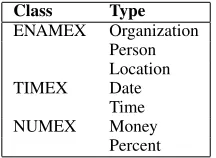
The set of entity types recognised by a stand-alone NER is typically very different and much more coarse-grained. For example, a typical set of entity types recognised by a NER is the one defined in past MUC tasks and presented in Ta-ble 2. The taTa-ble shows a two-level hierarchy and the types are much more coarse-grained than that of Table 1. Within each of the entity types of ble 2 there are several types of questions of
Ta-ABBREVIATION abb, exp
ENTITY
animal, body, color, creative, currency, dis.med., event, food, instrument, lang, letter, other, plant, product, re-ligion, sport, substance, symbol, technique, term, vehi-cle, word
DESCRIPTION
definition, description, manner, reason HUMAN
group, ind, title, description LOCATION
city, country, mountain, other, state NUMERIC
[image:2.612.317.523.51.208.2]code, count, date, distance, money, order, other, period, percent, speed, temp, size, weight
Table 1: Complete taxonomy of Li & Roth
Class Type
ENAMEX Organization Person Location TIMEX Date
Time NUMEX Money
Percent
Table 2: Entities used in the MUC tasks
ble 1.
A QA system typically uses both a taxonomy of expected answers and the taxonomy of named entities produced by its NER to identify which named entities are relevant to a question. The question is assigned a type from a taxonomy such as defined in Table 1. This type is then used to fil-ter out irrelevant named entities that have types as defined in Table 2.
A problem that arises here is that the granular-ity of the NEs provided by a NER is much coarser than the ideal granularity for QA, as the named en-tity types are matched against the types the tion requires. Consequently, even though a ques-tion classifier could determine a very specific type of answer, this type needs to be mapped to the types provided by the NER.
2.2 Recall
[image:2.612.367.475.240.319.2]we need in this context.
2.2.1 Multi-labelling
Recognising named entities is not a trivial task. Most notably, there can be ambiguities in the de-tection of entities. For example, it can well happen that a text has two or more interpretations. No-table examples are names of people whose sur-name takes the form of a geographical location (Europe, Africa) or a profession (Smith, Porter). Also, names of companies are often chosen after the name of some of their founders. The problem is that a NER typically only assigns one label to a specific piece of text. In order to increase recall, and given that NE recognition is not an end task, it is therefore theoretically advisable to allow to re-turn multiple labels and then let further modules of the QA system do the final filtering to detect the exact answer. This is the hypothesis that we want to test in the present study. The evaluations presented in this paper include a NER that assigns single labels and a variation of the same NER that produces multiple, overlapping labels.
3
Question Answering
QA systems typically take a question presented by the user posed in natural language. This is then analysed and processed. The final result of the sys-tem is ananswer, again in natural language, to the question of the user. This is different from, what is normally considered, information retrieval in that the user presents a complete question instead of a query consisting of search keywords. Also, in-stead of a list of relevant documents, a QA system typically tries to find an exact answer to the ques-tion.
3.1 AnswerFinder
The experiments discussed in this paper have been conducted within the AnswerFinder project (Moll´a and van Zaanen, 2005). In this project, we develop the AnswerFinder question answer-ing system, concentratanswer-ing on shallow representa-tions of meaning to reduce the impact of para-phrases (different wordings of the same informa-tion). Here, we report on a sub-problem we tack-led within this project, the actual finding of correct answers in the text.
The AnswerFinder question answering system consists of several phases that essentially work in a sequential manner. Each phase reduces the amount of data the system has to handle from then
on. The advantage of this approach is that progres-sive phases can perform more “expenprogres-sive” opera-tions on the data.
The first phase is a document retrieval phase that finds documents relevant to the question. This greatly reduces the amount of texts that need to be handled in subsequent steps. Only the bestn doc-uments are used from this point on.
Next is the sentence selection phase. From the relevant documents found by the first phase, all sentences are scored against the question. The most relevant sentences according to this score are kept for further processing.
At the moment, we have implemented several sentence selection methods. The most simple one is based on word overlap and looks at the number of words that can be found in both the question and the sentence. This is the method that will be used in the experiments reported in this paper. Other methods implemented, but not used in the ex-periments, use richer linguistic information. The method based on grammatical relation (Carroll et al., 1998) overlap requires syntactic analysis of the question and the sentence. This is done using the Connexor dependency parser (Tapanainen and J¨arvinen, 1997). The score is computed by count-ing the grammatical relations found in both sen-tence and question. Logical form overlap (Moll´a and Gardiner, 2004) relies on logical forms that can be extracted from the grammatical relations. They describe shallow semantics of the question and sentence. Based on the logical form overlap, we have also implemented logical graph overlap (Moll´a, 2006). This provides a more fine-grained scoring method to compute the shallow semantic distance between the question and sentence. All of these methods have been used in a full-fledged question answering system (Moll´a and van Zaa-nen, 2006). However, to reduce variables in our experiments, we have decided to use the simplest method only (word overlap) in the experiments re-ported in this paper.
recognition in QA, so we will not use any sentence selection method that finds possible answers.
The sentences remaining after the sentence se-lection phase are then analysed for named entities. All named entities found in the sentences are con-sidered to be possible answers to the user question. Once all possible answers to the questions are found, the actual answer selection phase takes place. For this, the question is analysed, which provides information on what kind of answer is expected. This can be, for example, country, river, distance, person, etc. as described in Table 1. The set of possible answers is now considered prefer-ring answers that match the question type.
The best answer (i.e. with the highest score and matching the question type) is returned to the user, which finishes a typical question answering inter-action.
4
Named Entity Recognition
The ability of finding exact answers by the An-swerFinder system relies heavily on the quality of the named entity recognition performed on the sentences that are relevant to the user ques-tion. Finding all named entities in the sentences is therefore of utmost importance. Missing named entities may mean that the answer to the question cannot be recovered anymore.
We have tried different NERs in the context of question answering. In addition to a general purpose NER, we have developed our own NER. Even though several high quality NERs are avail-able, we thought it important to have full control over the NER to make it better suited for the task at hand.
4.1 ANNIE
ANNIE is part of the Sheffield GATE (Gen-eral Architecture for Text Engineering) system (Gaizauskas et al., 1996) and stands for “A Nearly-New IE system”. This architecture does much more than we need, but it is possible to only ex-tract the NER part of it. Unfortunately, there is not much documentation on the NER in ANNIE. The named entity types found by ANNIE match up with the MUC types as described in Table 2.
ANNIE was chosen as an example of a typical NER because it is freely available to the research community and the named entity types are a subset of the MUC types.
4.2 AFNER
In addition to ANNIE’s NER, we also look at the results from the NER that is developed within the AnswerFinder project, calledAFNER.
4.2.1 General Approach
The NER process used in AFNER consists of two phases. The first phase uses hand-written reg-ular expressions and gazetteers (lists of named en-tities that are searched for in the sentences). These information sources are combined with machine learning techniques in the second phase.
AFNER first tokenises the given text, applies the regular expressions to each token, and searches for occurrences of the token in the gazetteers. Reg-ular expression matches and list occurrences are used as features in the machine learning classifier. These features are used in combination with token specific features, as well as features derived from the text as a whole. Using a model generated from the annotated corpus, each token is classified as ei-ther the beginning of (‘B’) or in (‘I’) a particular type of named entity, or out (‘OUT’) of any named entity. The classified tokens are then appropriately combined into named entities.
4.2.2 First Phase — Regular Expressions and Gazetteers
Regular expressions are useful for finding named entities following identifiable patterns, such as dates, times, monetary expressions, etc. As a result, the entities that can be discovered using regular expressions are limited. However, matching a particular regular expression is a key feature used in identifying entities of these partic-ular types. Gazetteers are useful for finding com-monly referenced names of people, places or or-ganisations, but are by no means exhaustive. The purpose of combining lists with other features is to supplement the lists used.
4.2.3 Second Phase — Machine Learning
The second phase involves the machine learn-ing component of AFNER. The technique used is maximum entropy, and the implementation of the classifier is adapted from Franz Josef Och’s YAS-MET.4The system is trained on the Remedia Cor-pus (Hirschman et al., 1999), which contains an-notations of named entities.
The regular expression and gazetteer matches are used as features, in combination with others
pertaining to both individual tokens and tokens in context. Features of individual tokens include those such as capitalisation, alpha/numeric infor-mation, etc. Contextual features are those that identify a token amongst surrounding text, or re-late to tokens in surrounding text. For example, whether a token is next to a punctuation mark or a capitalised word, or whether a token is always capitalised in a passage of text. Contextual fea-tures relating to global information have been used as described by Chieu and Ng (2002). In addition, features of previous tokens are included.
The features are then passed to a maximum en-tropy classifier which, for every token, returns a list of probabilities of the token to pertain to each category. The categories correspond with each type of entity type prepended with ‘B’ and ‘I’, and a general ‘OUT’ category for tokens not in any en-tity. The list of entity types used is the same as in the MUC tasks (see Table 2).
Preliminary experiments revealed that often the top two or three entity type probabilities have sim-ilar values. For this reason the final named entity labels are computed on the basis of the topn prob-abilities (provided that they meet a defined thresh-old), where nis a customisable limit. Currently, a maximum of 3 candidate types are allowed per token.
Classified tokens are then combined according to their classification to produce the final list of named entities. We have experimented with two methods named single and multiple. For single type combination only one entity can be associ-ated with a string, whereas for multiple type com-bination several entities can be associated. Also, the multiple type combination allows overlaps of entities. The multiple type combination aims at increasing recall at the expense of ambiguous la-belling and decrease of precision.
In the case of multiple type combination (see Figure 1 for an example), each label prepended with ‘B’ signals the beginning of a named entity of the relevant type, and each ‘I’ label continues a named entity if it is preceded by a ‘B’ or ‘I’ label of the same type. If an ‘I’ label does not appear after a ‘B’ classification, it is treated as a ‘B’ la-bel. In addition, if a ‘B’ label is preceded by an ‘I’ label, it will be both added as a separate entity (with the previous entity ending) and appended to the previous entity.
The single type combination (Figure 2) is
im-plemented by filtering out all the overlapping enti-ties of the output of the multiple type combination. This is done by selecting the longest-spanning en-tity and discarding all substring or overlapping strings. If there are two entities associated with exactly the same string, the one with higher prob-ability is chosen.
The probability of a multi-token entity is com-puted by combining the individual token probabil-ities. Currently we use the geometric mean but we are exploring other possibilities. IfPiis the proba-bility of tokeniandP1...nis the probability of the
entire sentence, the geometric mean of the proba-bilities is computed as:
P1...n=e Pn
i=1logPi
n
5
Results
To evaluate the impact of the quality of NER within the context of question answering, we ran the AnswerFinder system using each of the named entity recognisers, ANNIE, AFNERsand
AFNERm. This section first explains the
experi-mental setup we used, then shows and discusses the results.
5.1 Experimental setup
To evaluate AnswerFinder we used the data avail-able for participants of the QA track of the 2005 TREC competition-based conference5. This com-petition provides us with a nice setting to measure the impact of the NERs. We simply use the doc-uments and questions provided during the TREC 2005 competition. To determine whether a docu-ment or text fragdocu-ment contains the answer we use Ken Litkowsky’s answer patterns, also available at the TREC website.
The questions in TREC 2005 are grouped by topic. The competition consisted of 75 topics, with a total of 530 questions. These questions are di-vided into three different types: factoid, list, and other. In this paper, we only consider the fac-toid questions, that is, questions that require a sin-gle fact as answer. List asks for a list of answers and other is answered by giving any additional in-formation about the topic. There are 362 factoid questions in the question set.
In the experiments, AnswerFinder uses the TREC data as follows. First, we apply
BPER ILOC
IPER BLOC BLOC BDATE
BLOC IPER OUT OUT IPER OUT IDATE OUT
Jack London lived in Oakland in 1885 .
PERSON LOCATION LOCATION DATE
PERSON PERSON
[image:6.612.126.492.53.141.2]LOCATION
Figure 1: Named entities as multiple labels. The token-based labels appear above the words. The final NE labels appear below the words.
BPER ILOC
IPER BLOC BLOC BDATE
BLOC IPER OUT OUT IPER OUT IDATE OUT
Jack London lived in Oakland in 1885 .
[image:6.612.145.471.192.254.2]PERSON LOCATION DATE
Figure 2: Named entities as single labels. The token-based labels appear above the words. The resulting NE labels appear below the words.
ment selection (using the list of relevant docu-ments for each question provided by TREC). From these documents, we select the n best sentences based on word overlap between the sentence and the question.
We can now compute an upper-bound baseline. By taking the selected sentences as answers, we can compute the maximum score possible from a question answering perspective. By not requiring exactly matching answers, we can count the num-ber of questions that could be answered if the an-swer selection phase would be perfect. In other words, we measure the percentage of questions that can still be answered if the answer selection part of the system would be perfect.
Next, we run experiments with the same set-tings, but applying each of the NERs to the rele-vant sentences. All named entities that are found in these sentences are then considered possible an-swers to the question and again the percentage of questions that can be answered is computed.
Finally, we embed the NERs in a simplified ver-sion of AnswerFinder to test their impact in a base-line QA system.
5.2 Empirical results
In Table 3 we see the percentage of questions that can still be answered after document selection. The table reflects the intuition that, the smaller the number of preselected documents, the more likely it is that the document that contains the answer is left out. The documents are selected using a list of
# of documents % of questions
10 75.5%
20 81.6%
30 86.9%
40 89.5%
50 92.1%
Table 3: Percentage of factoid questions that can still be answered after document selection
# of sentences % of questions
5 42.4%
10 49.9%
20 62.0%
30 65.4%
40 68.8%
50 70.8%
60 73.0%
70 73.7%
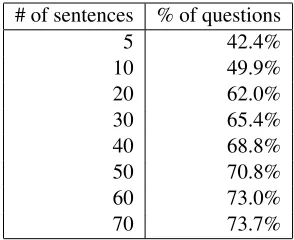
Table 4: Percentage of factoid questions that can still be answered after sentence selection from the top 50 documents
relevant documents provided for the competition. If we continue with 50 documents after docu-ment selection, we can select relevant sentences from the text in these documents using the word overlap metric. We end up with the percentages as given in Table 4.
[image:6.612.341.497.303.384.2] [image:6.612.346.493.425.545.2]# of % of questions
sentences ANNIE AFNERs AFNERm
5 27.9% 11.6% 27.7%
10 33.0% 13.6% 33.3%
20 41.4% 17.7% 41.9%
30 44.3% 19.0% 45.6%
40 46.2% 19.9% 47.4%
50 47.8% 20.5% 48.8%
60 49.3% 21.3% 51.0%
[image:7.612.318.521.180.300.2]70 50.5% 21.3% 51.5%
Table 5: Percentage of factoid questions that can still be answered after NE recognition from the top 50 documents
word overlap sentence selection is not extremely sophisticated. It only looks at words that can be found in both the question and sentence. In prac-tice, the measure is very coarse-grained. However, we are not particularly interested in perfect an-swers here, these figures are upper-bounds in the experiment.
From the selected sentences now we extract all named entities. The results are summarised in Ta-ble 5.
The figures of Table 5 approximate recall in that they indicate the questions where the NER has identified a correct answer (among possibly many wrong answers).
The best results are those provided by AFNERm
and they are closely followed by ANNIE. This is an interesting result in that AFNER has been trained with the Remedia Corpus, which is a very small corpus on a domain that is different from the AQUAINT corpus. In contrast, ANNIE is fine-tuned for the domain. Given a larger training cor-pus of the same domain, AFNERm’s results would
presumably be much better than ANNIE’s. The results of AFNERsare much worse than the
other two NERs. This clearly indicates that some of the additional entities found by AFNERm are
indeed correct.
It is expected that precision would be differ-ent in each NER and, in principle, the noise in-troduced by the erroneous labels may impact the results returned by a QA system integrating the NER. We have tested the NERs extrinsically by applying them to a baseline setting of An-swerFinder. In particular, the baseline setting of AnswerFinder applies the sentence preselection methods described above and then simply returns
the most frequent entity found in the sentences preselected. If there are several entities sharing the top position then one is chosen randomly. In other words, the baseline ignores the question type and the actual context of the entity. We decided to use this baseline setting because it is more closely re-lated to the precision of the NERs than other more sophisticated settings. The results are shown in Table 6.
# of % of questions
sentences ANNIE AFNERs AFNERm
10 6.2% 2.4% 5.0%
20 6.2% 1.9% 7.0%
30 4.9% 1.4% 6.8%
40 3.7% 1.4% 6.0%
50 4.0% 1.2% 5.1%
60 3.5% 0.8% 5.4%
70 3.5% 0.8% 4.9%
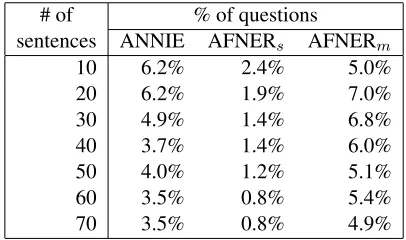
Table 6: Percentage of factoid questions that found an answer in a baseline QA system given the top 50 documents
The figures show a drastic drop in the results. This is understandable given that the baseline QA system used is very basic. A higher-performance QA system would of course give better results.
The best results are those using AFNERm. This
confirms our hypothesis that a NER that allows multiple labels produces data that are more suit-able for a QA system than a “traditional” single-label NER. The results suggest that, as long as re-call is high, precision does not need to be too high. Thus there is no need to develop a high-precision NER.
The table also indicates a degradation of the per-formance of the QA system as the number of pres-elected sentences increases. This indicates that the baseline system is sensitive to noise. The bottom-scoring sentences are less relevant to the question and therefore are more likely not to contain the answer. If these sentences contain highly frequent NEs, those NEs might displace the correct answer from the top position. A high-performance QA system that is less sensitive to noise would proba-bly produce better results as the number of prese-lected sentences increases (possibly at the expense of speed). The fact that AFNERm, which produces
higher recall than AFNERsaccording to Table 5,
of noise introduced by the additional entities does not affect negatively the process of extracting the answer.
6
Summary and Conclusion
In this paper we have focused on the impact of in-troducing multiple labels with the aim to increase recall in a NER for the task of question answering. In our experiments we have tested the impact of the ANNIE system, and two variations of AFNER, our custom-built system that can be tuned to pro-duce either single labels or multiple labels. The experiments confirm the hypothesis that allowing multiple labelling in order to increase recall of named entities benefits the task of QA. In other words, if the NER has several candidate labels for a string (or a substring of it), it pays off to out-put the most plausible alternatives. This way the QA system has a better chance to find the answer. The noise introduced by returning more (possibly wrong) entities is offset by the increase of recall.
Further work includes the evaluation of the impact of multi-label NE recognition on higher-performance QA systems. In particular we plan to test various versions of the complete An-swerFinder system (not just the baseline setting) with each of the NERs. In addition, we plan to re-train AFNER using more data and more relevant data and explore the impact of the single and mul-tiple methods on the resulting higher-performance NER.
Acknowledgements
This work is supported by the Australian Re-search Council under the ARC Discovery grant DP0450750.
References
[Armour et al.2005] Quintin Armour, Nathalie Japkow-icz, and Stan Matwin. 2005. The role of named entities in text classification. InProceedings CLiNE 2005, Gatineau, Canada.
[Carroll et al.1998] John Carroll, Ted Briscoe, and An-tonio Sanfilippo. 1998. Parser evaluation: a survey and a new proposal. InProc. LREC98.
[Chieu and Ng2002] Haoi Leong Chieu and Hwee Tou Ng. 2002. Named entity recognition: A maximum entropy approach using global information. In Pro-ceedings COLING 2002.
[Gaizauskas et al.1996] Robert Gaizauskas, Hamish Cunningham, Yorick Wilks, Peter Rodgers, and
Kevin Humphreys. 1996. GATE: an environment to support research and development in natural lan-guage engineering. InProceedings of the 8th IEEE International Conference on Tools with Artificial In-telligence, Toulouse, France.
[Hirschman et al.1999] Lynette Hirschman, Marc Light, Eric Breck, and John D. Burger. 1999. Deep Read: A reading comprehension system. InProc. ACL’99. University of Maryland.
[Humphreys et al.2000] Kevin Humphreys, George Demetriou, and Robert Gaizauskas. 2000. Two applications of information extraction to biological science journal articles: Enzyme interactions and protein structures. In Proceedings of the Pacific Symposium on Biocomputing’ 00 (PSB’00), pages 502–513. Honolulu, Hawaii.
[Li and Roth2002] Xin Li and Dan Roth. 2002. Learn-ing question classifiers.Proc. COLING 02.
[Moll´a and Gardiner2004] Diego Moll´a and Mary Gar-diner. 2004. Answerfinder - question answering by combining lexical, syntactic and semantic infor-mation. In Ash Asudeh, C´ecile Paris, and Stephen Wan, editors,Proc. ALTW 2004, pages 9–16, Syd-ney, Australia. Macquarie University.
[Moll´a and van Zaanen2005] Diego Moll´a and Menno van Zaanen. 2005. Learning of graph rules for ques-tion answering. In Tim Baldwin and Menno van Za-anen, editors,Proc. ALTW 2005. ALTA.
[Moll´a and van Zaanen2006] Diego Moll´a and Menno van Zaanen. 2006. Answerfinder at TREC 2005. In Ellen M. Voorhees and Lori P. Buckland, editors, Proc. TREC 2005. NIST.
[Moll´a2006] Diego Moll´a. 2006. Learning of graph-based question answering rules. In Proc. HLT/NAACL 2006 Workshop on Graph Algorithms for Natural Language Processing, pages 37–44.
[Noguera et al.2005] Elisa Noguera, Antonio Toral, Fernando Llopis, and Rafael Mu˜noz. 2005. Re-ducing question answering input data using named entity recognition. InProceedings of the 8th Inter-national Conference on Text, Speech & Dialogue, pages 428–434.
[Sundheim1995] Beth M. Sundheim. 1995. Overview of results of the MUC-6 evaluation. InProc. Sixth Message Understanding Conference MUC-6. Mor-gan Kaufmann Publishers, Inc.
[Tapanainen and J¨arvinen1997] Pasi Tapanainen and Timo J¨arvinen. 1997. A non-projective dependency parser. InProc. ANLP-97. ACL.