langid.py
for better language modelling
Paul Cook♥and Marco Lui♥♣
♥Department of Computing and Information Systems
The University of Melbourne Victoria 3010, Australia
♣NICTA Victoria Research Laboratory {paulcook,mhlui}@unimelb.edu.au
Abstract
Large corpora are crucial resources for building many statistical language technol-ogy systems, and the Web is a readily-available source of vast amounts of linguis-tic data from which to construct such cor-pora. Nevertheless, little research has con-sidered how to best build corpora from the Web. In this study we consider the impor-tance of language identification in Web cor-pus construction. Beginning with a Web crawl consisting of documents identified as English using a standard language identi-fication tool, we build corpora of varying sizes both with, and without, further filter-ing of non-English documents with a state-of-the-art language identifier. We show that the perplexity of a standard English corpus is lower under a language model trained from a Web corpus built with this extra language identification step, demonstrating the importance of state-of-the-art language identification in Web corpus construction.
1 The need for large corpora
Corpora are essential resources for building lan-guage technology (LT) systems for a variety of ap-plications. For example, frequency estimates for n-grams — which can be used to build a language model, a key component of many contemporary LT systems — are typically derived from corpora. Furthermore, bigger corpora are typically better. Banko and Brill (2001) show that for a classifi-cation task central to many LT problems, perfor-mance increases as a variety of models are trained on increasingly large corpora.
The Web is a source of vast amounts of linguis-tic data, and the need for large corpora has mo-tivated a wide range of research into techniques
for building corpora of various types from the Web (e.g., Baroni and Bernardini, 2004; Ferraresi et al., 2008; Kilgarriff et al., 2010; Murphy and Stemle, 2011). In stark contrast to manual cor-pus construction, such automatic methods enable large corpora to be built quickly and inexpen-sively. Moreover, large Web crawls have recently been produced which are readily-available to the LT community (e.g., ClueWeb091 and
Common-Crawl2) and can easily be exploited to build
cor-pora much larger than those currently available (and indeed Pomik´alek et al. (2012) have already done so); based on the findings of Banko and Brill, such corpora could be exploited to improve LT systems.
Despite the importance of large Web corpora, the issue of how to best derive a corpus from a Web crawl remains an open question. Once a large collection of documents is obtained (from, e.g., either a Web crawl or the results of issuing queries to a commercial search engine) they must be post-processed to remove non-linguistic docu-ment portions, for example, boilerplate text such as menus; filter unwanted content such as docu-ments in languages other than that intended for the corpus, and spam; and finally remove dedu-plicate or near-dudedu-plicate documents or document portions to produce a corpus. Furthermore, this document post-processing can potentially have a tremendous impact on corpus quality (Kilgarriff, 2007). For example, if texts in languages other than the target language(s) are not reliably identi-fied and removed,n-gram frequency estimates for the target language will be less accurate than they would otherwise be, potentially having a negative
impact on LT systems trained on such a corpus. Similar problems are encountered with the pres-ence of boilerplate text, and duplicate or near-duplicate documents or text segments.
Although document post-processing is clearly important to corpus construction, little work has studied it directly, with the notable exception of CleanEval (Baroni et al., 2008), a shared task on cleaning webpages by removing boilerplate and markup. Liu and Curran (2006) and Vers-ley and Panchenko (2012) compare Web corpora with standard corpora in task-based evaluations, but do not specifically consider the impact of doc-ument post-processing. Web corpus construction projects have tended to rely on readily-available tools, or simple heuristics, to accomplish this post-processing. This is not a criticism of these projects — their goals were to build useful lan-guage resources, not specifically to study the impact of document post-processing on corpora. Nevertheless, because of the immediate opportu-nities for improving LT by building larger Web corpora, and the importance of post-processing on the quality of the resulting corpora, there appear to be potential opportunities to improve LT by im-proving Web corpus construction methods.
In this paper we consider the importance of lan-guage identification — which has already been shown to benefit other LT tasks (e.g., Alex et al., 2007) — in Web corpus construction. We build corpora of varying sizes from a readily-available Web crawl (the English portion of ClueWeb09) using a standard corpus construction methodol-ogy. This dataset contains only documents clas-sified as English according to a commonly-used language identification tool (TEXTCAT).3 We then
produce versions of these corpora from which non-English documents according to a state-of-the-art language identification tool (langid.py,
Lui and Baldwin, 2012) are filtered. In this pre-liminary work, we measure the impact of lan-guage identification in a task-based evaluation. Specifically, we train language models on the Web corpora, and demonstrate that, for corpora built from equal amounts of crawl data, the perplex-ity of a standard (manually-constructed) corpus is lower under a language model trained on a corpus filtered using langid.py, than a model trained on a corpus without this filtering.
3http://odur.let.rug.nl/vannoord/
TextCat/
2 Materials and methods
This section describes the language identification tools, corpus construction methods, and language modelling approach used in this study.
2.1 Language identification
The initial language identification for ClueWeb09 was performed using TEXTCAT, an
implementa-tion of the language identificaimplementa-tion method of Cav-nar and Trenkle (1994),4 which is based on the
relative frequencies of byte n-grams. The re-ported language identification precision is over 99.7% across all 10 languages in ClueWeb09. However, the method of Cavnar and Trenkle has been shown to perform poorly when applied to test data outside the domain of the training data (Lui and Baldwin, 2011), as was the case for ClueWeb09 where the training data was drawn from newswire and European parliament corpora.
langid.py is an implementation of the
method described in Lui and Baldwin (2011), which improves on the method of Cavnar and Trenkle (1994) in a number of ways; both clas-sifiers are based on relative frequencies of byte n-grams, but langid.py uses a Naive Bayes
classifier and cross-domain feature selection, al-lowing it to ignore non-linguistic content such as HTML, without the need to explicitly model such content. Lui and Baldwin (2012) show that
langid.pysignificantly and systematically
out-performsTEXTCATon a number of domains, and
we therefore use it in this study.
2.2 Corpora
We build corpora from subsets of the English portion of ClueWeb09, a Web crawl consisting of roughly 500 million webpages crawled from January–February 2009 that has been used in a number of shared tasks (e.g., Clarke et al., 2011). We build corpora of two types: corpora based on subsets of all documents in this crawl (which include only documents classified as English by
TEXTCAT, but a small proportion of non-English
documents according tolangid.py) and corpora
based on subsets of only those documents identi-fied as English usinglangid.py.
Similar to Ferraresi et al. (2008), we select
4http://boston.lti.cs.cmu.edu/
documents of MIME type text/html with size be-tween 5K and 200K bytes. Also following Fer-raresi et al. we extract the textual portions of the selected HTML documents using the body text extraction algorithm (BTE, Finn et al., 2001) which heuristically removes removes boilerplate based on the frequency of HTML tags.5 We use
Pomik´alek’s (2011) implementation of BTE. We remove duplicate and near-duplicate paragraphs using onion (Pomik´alek, 2011) — the same tool used by Pomik´alek et al. (2012) — with its de-fault settings. In this configuration onion makes a single pass through a corpus, and eliminates any paragraph which shares more than 50% of its 7-grams with the portion of the corpus analysed so far. Finally we tokenise and sentence split our cor-pora using tools provided by the Stanford Natural Language Processing Group.6
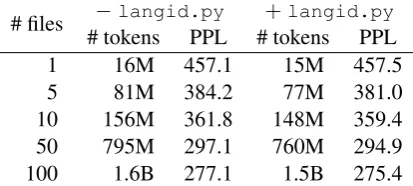
ClueWeb09 is broken into a number of files, each containing approximately 100M of com-pressed crawl data; we apply the above method to build corpora from the first 1, 5, 10, 50, and 100 files in English ClueWeb09.7 The sizes, in tokens,
of the resulting corpora are shown in Table 1.
2.3 Language modelling
We construct language models using SRILM (Stolcke, 2002), a commonly-used, off-the-shelf toolkit for building and applying statistical lan-guage models. For each corpus built from ClueWeb09, we build an open-vocabulary lan-guage model using the default settings of SRILM, which correspond to an order 3 language model with Good-Turing smoothing. All language mod-els were built using the make-big-lm script provided with SRILM.
We evaluate our language models by measur-ing the perplexity of the written portion of the British National Corpus (BNC, Burnard, 2000), a
5We do not consider JusText (Pomik´alek, 2011), a recent
alternative to BTE, because it incorporates rudimentary lan-guage identification in the form of stopword frequency; our specific goal is to study the effects of state-of-the-art lan-guage identification in corpus construction. We leave study-ing the interaction between various steps of corpus construc-tion — including text extracconstruc-tion and language identificaconstruc-tion — for future work. Furthermore, BTE has been widely used in previous corpus construction projects (e.g., Baroni and Bernardini, 2004; Sharoff, 2006; Ferraresi et al., 2008).
6http://nlp.stanford.edu/software/
tokenizer.shtml
7We use the files in en0000, the first section of
ClueWeb09.
# files # tokens−langid.pyPPL # tokens+langid.pyPPL
1 16M 457.1 15M 457.5
5 81M 384.2 77M 381.0
10 156M 361.8 148M 359.4
50 795M 297.1 760M 294.9
[image:3.595.307.514.73.166.2]100 1.6B 277.1 1.5B 275.4
Table 1: Number of tokens in each corpus built from increasing numbers of ClueWeb09 files, with and with-out document filtering usinglangid.py. The per-plexity (PPL) of the BNC under a language model trained on the corresponding corpus is also shown.
corpus of roughly 87 million words of British En-glish from the late twentieth century, spanning a variety of genres and topics. Perplexity is a stan-dard evaluation metric for language models, with lower perplexity indicating the model better fits the test data. Perplexities were calculated using the ngram program from SRILM, and are nor-malized counting all input tokens, including end-of-sentence tags.
3 Experimental setup and results
We train language models on each corpus derived from ClueWeb09, and then measure the perplex-ity of the written portion of the BNC (as described in Section 2.3). Results are shown in Table 1.
We begin by noting that for all corpus sizes considered with the exception of the smallest, the perplexity of the BNC is lower under a language model from the corpus filtered usinglangid.py
than under a language model trained on a corpus built from the same original data but without this extra language identification step. This suggests that state-of-the-art language identification can in-deed enable the construction of better corpora — at least for training language models for the BNC. To assess whether the observed differences are significant, for each corpus size (i.e., number of ClueWeb09 files) we measure the perplexity of each BNC document under the language model from the corpus with, and without, filtering with
langid.py. For a given corpus size this then
gives us independent paired measurements, which we compare using a Wilcoxon rank sum test. For each corpus size the difference with and without
langid.py filtering is highly significant (p < 10−23in each case).
cor-pus size considered, the perplexity is quite high in both cases, suggesting that the language model is under-fitting due to insufficient training data. It seems that in such cases — which correspond to corpora far smaller than one would typically build from a Web crawl — there is little to be gained from improved language identification (at least for the task of building trigram language models considered here).
With the exception of the smallest corpus, as corpus size increases, the absolute reduction in perplexity with and without langid.py
de-creases. In future work we plan to build much larger corpora to further examine this trend.
In addition to the BNC, we considered a num-ber of other corpora for evaluation, including the Brown Corpus (Francis and Kucera, 1964) and a sample of texts provided with NLTK (Bird et al., 2009) from Project Gutenberg,8and found the
re-sults to be consistent with those on the BNC.
4 Discussion
In addition to demonstrating the importance of language identification in Web corpus construc-tion, the results in Table 1 confirm Banko and Brill’s (2001) findings about corpus size; in par-ticular, for corpora built using the same method (i.e., with or without langid.py) bigger is
bet-ter. However, for each corpus size (i.e., each num-ber of files from ClueWeb09) the corpus filtered with langid.py is roughly 5% smaller — and
yet produces a better language model — than the corresponding corpus not filtered in this way. Fur-thermore, because of their smaller size, the cor-pora filtered withlangid.pyhave lower storage and processing costs.
Based on these findings, it appears we can im-prove corpora in two ways: by getting more data, and by better processing the data we have. Al-though it is certainly possible to build a larger Web crawl than ClueWeb09, doing so comes at a substantial cost in terms of bandwidth, pro-cessing, and storage (although Suchomel and Pomik´alek (2012) have recently considered how to more-efficiently crawl the Web for linguis-tic data). Resources which are readily-available at relatively-low cost (such as ClueWeb09) are likely to serve as the basis for many corpus con-struction efforts, and it is therefore important to
8http://www.gutenberg.org/
determine how to best exploit such a fixed re-source in building corpora.
The largest language-filtered corpus built in this study consists of roughly 1.5B tokens. Al-though we eventually intend to build much larger corpora, this corpus size is on par with that of the ukWaC (Ferraresi et al., 2008) — a corpus that has been widely used in computational linguistics and as the basis for lexicographical analysis (e.g., Atkins, 2010). Our findings are therefore help-ful in that they demonstrate the possibility for im-proving Web corpora of a size already shown to be of practical use. Nevertheless, in future work we intend to explore the impact of language identifi-cation on much larger corpora by building corpora from roughly an order of magnitude more data.
In an effort to better understand the differences between the language identifiers, we examined 100 documents from English ClueWeb09 classi-fied as non-English by langid.py. We found that 33 were entirely non-English, 30 contained some text in English as well as another language, 27 were in fact English, and 10 contained no lin-guistic content. The prevalence of multilingual documents suggests that language identification at the sub-document (e.g., paragraph) level, or lan-guage identification methods capable of detecting mixtures of languages could lead to further im-provements.
5 Conclusions
Acknowledgments
NICTA is funded by the Australian Government as represented by the Department of Broadband, Com-munications and the Digital Economy and the Aus-tralian Research Council through the ICT Centre of Excellence program.
References
Beatrice Alex, Amit Dubey, and Frank Keller. 2007. Using foreign inclusion detection to improve parsing performance. In Proceed-ings of the 2007 Joint Conference on Empiri-cal Methods in Natural Language Processing and Computational Natural Language Learn-ing (EMNLP-CoNLL 2007), pages 151–160. Prague, Czech Republic.
B. T. Sue Atkins. 2010. The DANTE Database: Its contribution to English lexical research, and in particular to complementing the FrameNet data. In Gilles-Maurice De Schryver, editor,A Way with Words: Recent Advances in Lexical Theory and Analysis. A Festschrift for Patrick Hanks. Menha Publishers, Kampala, Uganda. Michele Banko and Eric Brill. 2001. Scaling to
very very large corpora for natural language disambiguation. In Proceedings of 39th An-nual Meeting of the Association for Compu-tational Linguistics (ACL 2001), pages 26–33. Toulouse, France.
Marco Baroni and Silvia Bernardini. 2004. Boot-CaT: Bootstrapping corpora and terms from the Web. In Proceedings of the Fourth Interna-tional Conference on Language Resources and Evaluation (LREC 2004). Lisbon, Portugal. Marco Baroni, Francis Chantree, Adam
Kilgar-riff, and Serge Sharoff. 2008. Cleaneval: A competition for cleaning Web pages. In Pro-ceedings of the Sixth International Conference on Language Resources and Evaluation (LREC 2008), pages 638–643. Marrakech, Morocco. Steven Bird, Edward Loper, and Ewan Klein.
2009. Natural Language Processing with Python. O’Reilly Media Inc., Sebastopol, CA. Lou Burnard. 2000. The British National
Cor-pus Users Reference Guide. Oxford University Computing Services.
William B. Cavnar and John M. Trenkle. 1994. N-gram-based text categorization. InProceedings
of the 3rd Annual Symposium on Document Analysis and Information Retrieval (SDAIR-94), pages 161–175. Las Vegas, USA.
Charles L. A. Clarke, Nick Craswell, Ian Sobo-roff, and Ellen M. Voorhees. 2011. Overview of the TREC 2011 Web Track. In Proceed-ings of the Twentieth Text REtrieval Conference (TREC 2011), NIST Special Publication: SP 500-295.
Adriano Ferraresi, Eros Zanchetta, Marco Ba-roni, and Silvia Bernardini. 2008. Introduc-ing and evaluatIntroduc-ing ukWaC, a very large web-derived corpus of English. In Proceedings of the 4th Web as Corpus Workshop: Can we beat Google, pages 47–54. Marrakech, Morocco. Aidan Finn, Nicholas Kushmerick, and Barry
Smyth. 2001. Fact or fiction: Content clas-sification for digital libraries. In Proceed-ings of the Second DELOS Network of Ex-cellence Workshop on Personalisation and Recommender Systems in Digital Libraries. Dublin, Ireland.
W. Nelson Francis and Henry Kucera. 1964. Man-ual of Information to accompany A Standard Corpus of Present-Day Edited American En-glish, for use with Digital Computers. Brown University.
Adam Kilgarriff. 2007. Googleology is bad sci-ence. Computational Linguistics, 33(1):147– 151.
Adam Kilgarriff, Siva Reddy, Jan Pomik´alek, and Avinesh PVS. 2010. A corpus factory for many languages. InProceedings of the Seventh Inter-national Conference on Language Resources and Evaluation (LREC 2010), pages 904–910. Valletta, Malta.
Vinci Liu and James Curran. 2006. Web text corpus for natural language processing. In Proceedings of the 11th Meeting of the Euro-pean Chapter of the Association for Compu-tational Linguistics (EACL 2006), pages 233– 240. Trento, Italy.
Marco Lui and Timothy Baldwin. 2012. langid.py: An off-the-shelf language identifi-cation tool. InProceedings of the 50th Annual Meeting of the Association for Computational Linguistics (ACL 2012) Demo Session, pages 25–30. Jeju, Republic of Korea.
Brian Murphy and Egon Stemle. 2011. Pad-dyWaC: A minimally-supervised Web-corpus of Hiberno-English. In Proceedings of the First Workshop on Algorithms and Resources for Modelling of Dialects and Language Vari-eties, pages 22–29. Edinburgh, Scotland. Jan Pomik´alek. 2011. Removing Boilerplate and
Duplicate Content from Web Corpora. Ph.D. thesis, Masaryk University.
Jan Pomik´alek, Miloˇs Jakub´ıˇcek, and Pavel Rychl´y. 2012. Building a 70 billion word cor-pus of English from ClueWeb. InProceedings of the Eighth International Conference on Lan-guage Resources and Evaluation (LREC 2012), pages 502–506. Istanbul, Turkey.
Serge Sharoff. 2006. Creating general-purpose corpora using automated search engine queries. In Marco Baroni and Silvia Bernardini, editors, Wacky! Working papers on the Web as Corpus, pages 63–98. GEDIT, Bologna, Italy.
Andreas Stolcke. 2002. SRILM - an extensible language modeling toolkit. InProceedings of the International Conference on Spoken Lan-guage Processing, volume 2, pages 901–904. Denver, USA.
Vit Suchomel and Jan Pomik´alek. 2012. Efficient Web crawling for large text corpora. In Pro-ceedings of the seventh Web as Corpus Work-shop (WAC7), pages 39–43. Lyon, France. Yannick Versley and Yana Panchenko. 2012. Not