Synchronous Data Link Control
Concepts
(
Synchronous Data Link Control
Concepts
Note ---, Before using this document, read the general information under "Notices" on page vii.
Fifth Edition (May 1992)
This edition replaces and makes obsolete the previous edition, GA27-3093-03. For a detailed list of changes, see "Summary of Changes" on page 85.
Order publications through your IBM representative or the IBM branch office serving your locality. Publications are not stocked at the address given below.
A form for readers' comments is provided at the back of this publication. If the form has been removed, address your comments to:
IBM Corporation Dept. E15 P.O. Box 12195
Research Triangle Park, NC 27709-9990 U.S.A.
When you send information to IBM, you grant IBM a non-exclusive right to use or distribute the information in any way It believes appropriate without incurring any obligation to you or restricting your use of it.
@ Copyright International Bu.lne •• Machine. Corporation 1979, 1992. All rights reserved.
Note to U.S. Government Users - Documentation related to restricted rights - Use, duplication or disclosure is subject to restrictions set forth in GSA ADP Schedule Contract with IBM Corp.
c
(
'-'
c
Contents
Notices . . . vi i
Preface . . . ix
Chapter 1. Introduction . . . 1
Data Links and Their Components . . . 3
Configurations and Operating Characteristics . . . 4
Bit Synchronization and Invert-on-Zero Coding . . . 11
Chapter 2. Basic Concepts . . . 15
Primary and Secondary Link Stations . . . . . . . . . . . . .. 17
Transmission States . . . 17
Transient State . . . 17
Idle State . . . 18
Active State . . . 18
Transmission Frames . . . 19
Frame Format . . . 19
Flags . . . 20
Address Field . . . 20
Control Field . . . 21
Information Field . . . . . . . . . . . .. 22
Frame Check Sequence (FCS) Field . . . 22
Frame Numbering . . . 23
Zero Insertion . . . 24
Timeouts . . . 25
Idle Detect . . . 25
Nonproductive Receive;-" . . . . . . . . . . . .. 27
Abort Conditions ., . . . . . . . . . . . . .. 27
Recovery from Errors and Special Conditions . . . 27
Link-Level Recovery . . . 28
Higher-Level Recovery . . . 28
Chapter 3. Further Concepts, Applications, and Examples . . . 31
Secondary-Station Mode Definitions . . . 33
Command and Response Definitions . . . 34
Unnumbered (U) Format .... . . . . . . . . . . . . . .. 36
Supervisory ($) Format . . . 38
Information (I) Format . . . 39
SDLC on a Switched Link . . . 39
SDLC in a Loop Configuration . . . 40
Loop Operation . . . 40
Loop Commands . . . 44
Loop Responses . . . 46
Examples of SDLC Exchanges . . . 47
Two-way Alternate Exchanges on Nonswitched Point-to-Point Links . . . 48
Two-way Simultaneous Exchanges on Nonswitched Point-to-Point Links .... 50
Two-way Simultaneous Exchanges on Nonswitched Multipoint Links . . . 52
Two-way Alternate Exchanges on Switched Point-to-Polnt Links . . . 53
Two-Way Alternate Exchanges on SDLC Loops . . . 54
Appendix B. SDLC Computation of the FCS Field . . . 59
Appendix C. IBM SDLC and Data Link Control Standards . . . . 63
C
. -J Appendix D. Asynchronous SDLC . . . . 69Format of an Asynchronous SOLe Frame . . . . 70
Asynchronous SOLe Elements of Procedure . . . . 70
Asynchronous SOLe Transparency Modes and Levels . . . . 71
Transmitting and Receiving Algorithms . . . . 74
List of Abbreviations . . . . 79
Glossary . . . . 81
Summary of Changes 85
Index 87
~ \,
\'-....~/
c
Figures
1. Components of a Data Link . . . 3
2. Channels and Transmission Media . . . 4
3. Link Connection Configurations . . . . . . . .. 5
4. Link Connection Configurations and Link Station Operation . . . 7
5. Data Conversion for Data Link Transfer . . . 9
6. Some Data Link Control Activities-I . . . 10
7. Some Data Link Control Activities-II . . . 11
8. Discrete Transmission Coding . . . 13
9. Invert-on-Zero Transmission Coding . . . 13
10. Period of the Transient State . . . . . . . . . . . . . . .. 17
11. Period of the Active State . . . 18
12. SDLC Transmission Frame . . . 19
13. Fields of the SDLC Transmission Frame, As Transmitted . . . 20
14. SDLC Frame: Control Field . . . 21
('
15. Example of Modul0-8 Frame Numbering . . . 2416. Zero Insertion and Deletion . . . 25
17. Examples of Telecommunication Facilities . . . 26
18. Transmitting Station Aborts Transmission . . . 27
19. Summary of Command and Response C Fields as Present in Storage ... 35
20. Information Field of the FRMR Response, as Transmitted . . . 38
21. Loop Configuration . . . 40
22. SDLC Loop Exchanges: Primary Station Transmitting . . . 41
23. SDLC Loop Exchanges: Secondary Stations Transmitting . . . 43
24. Format of Examples of SDLC Exchanges . . . 47
25. Two-way Alternate Exchanges on Nonswitched Point-to-Point Links .... 48
26. Two-way Simultaneous Exchanges on Nonswitched Point-to-Point Links . 50 27. Two-way Simultaneous Exchanges on Nonswitched Multipoint Links .... 52
28. Two-way Alternate Exchanges on Switched Point-to-Point Links . . . 53
29. Two-Way Alternate Exchanges on SDLC Loops . . . 54
30. SDLC Frames, As Transmitted . . . 58
31. An Example of Cyclic Redundancy Checking . . . 60
32. CRC Operation with SDLC . . . 61
33. HDLC Unbalanced Normal Class of Procedures . . . 66
34. HDLC Commands and Responses . . . 67
35. Asynchronous SDLC Layering . . . 69
36. Asynchronous Bit Stream: Start, Data, Parity, and Stop Bits . . . 70
c
c
c
('
C:
Notices
From time to time, changes are made to the information in IBM systems
publications. Before using this publication in connection with the operation of IBM systems, consult your IBM representative or IBM branch office to determine which editions are applicable and current. For information pertaining to a specific IBM machine or system, refer to the appropriate IBM publication for that machine or system.
Any reference to an IBM licensed program or other IBM product in this publication is not intended to state or imply that only IBM's program or other product may be used. Any functionally equivalent program or other product that does not infringe any of IBM's intellectual property rights may be used instead of the IBM product, program, or service. Evaluation and verification of operation in conjunction with other products, except those expressly designated by IBM, is the user's
responsibility.
IBM may have patents or pending patent applications covering subject matter described in this document. The furnishing of this document does not give you any license to these patents. You can send license inquiries, in writing, to the IBM Director of Commercial Relations, IBM Corporation, Purchase, New York, 10577,
U.S.A ..
References in this publication to IBM products, programs, or services do not imply that IBM intends to make them available in all countries in which IBM operates.
I~
I
~j
c
o
(
o
Preface
This book describes IBM Synchronous Data Link Control (SDLC). It includes a brief communications overview, a basic description to familiarize the reader with the terminology and concepts of SDLC, and some representative examples of the uses of SDLC.
Readers who are not familiar with IBM's Systems Network Architecture (SNA) should first read Systems Network Architecture Concepts and Products, GC30-3072.
A reader who is familiar with other data link control procedures should not assume that familiar terms have the same definitions in SDLC procedures, or that familiar functions have the same names. The IBM Dictionary of Computing, GC20-1699, is a useful reference for the definitions of terms used in this book.
This book does not provide instructions for implementing SDLC, nor does it describe any specific equipment or programs that may be needed to implement SDLC. For specific information about an IBM SDLC implementation, refer to the appropriate IBM publication for that machine or system. For information on Systems Network Architecture (SNA), within which SDLC is a data link control, refer to Systems
Network Architecture Technical Overview, GC30-3073 and Systems Network
Architecture Formats, GA27-3136.
This book contains three chapters and four appendixes:
Chapter 1, "Introduction," contains general information on telecommunications and data link control.
Chapter 2, "Basic Concepts," presents the elementary information you need to understand SDLC.
Chapter 3, "Further Concepts, Applications, and Examples," presents additional concepts, defines the SDLC commands and responses, and shows some
applications and examples of the use of SDLC for specific link configurations.
Appendix A, "SDLC Frame Summary," contains the binary codes for SDLC commands and responses.
Appendix B, "SDLC Computation of the FCS Field," describes the operation of cyclic redundancy checking and its use in the SDLC frame check sequence.
Appendix C, "IBM SDLC and Data Link Control Standards," shows the relationship between SDLC and data link control standards and explains IBM's conformance to these standards.
Appendix D, "Asynchronous SDLC," explains a form of SDLC that uses asynchronous rather than synchronous clocking.
(
(
Chapter 1. Introduction
This chapter introduces the various link configurations with which SDLC can be used and describes some of their operating characteristics.
c
C:
('
[
Synchronous Data Link Control (SOLe) is a discipline for managing synchronous, code-transparent, serial-by-bit information transfer between nodes that are joined by data links. Data may be sent simultaneously in both directions (referred to as
two-way simultaneous transmission) or alternately, in one direction at a time (referred to as two-way alternate transmission).
The link connection may have a point-to-point, multipoint, or loop configuration; a point-to-point link may be nonswitched or switched. SDLC includes comprehensive detection and recovery procedures for transmission errors that may be introduced onto the link.
Readers who are familiar with the concepts of information transfer over the various link configurations may skip to Chapter 2, "Basic Concepts." Other readers should continue reading here or refer to the preface of this manual for reading references.
Data Links and Their Components
This book uses the term data link and a number of related terms whose relationship is described in the next paragraphs. (The terms are defined fully in the Glossary at the back of this book.) Figure 1 shows the relationship graphically.
Node
DTE LS
tfr
Transmission MediumI ..
DCE Data Circuit-terminating Equipment DTE Data Terminal Equipment
LS Link Station
Figure 1. Components of a Data Link
Channel Link Connection
Data Link
Node
~-
LS DTE..I
Each SNA node that communicates with another SNA node over transmission media (such as telephone wires, microwave beams, fiber optic links, or satellite links, or combinations of these media) requires a link station and data circuit-terminating equipment (DCE).
A link station is the hardware and software that allows a node to attach to and provide control for a link. The link station is part of the data terminal equipment
(DTE)-the general term for equipment, such as processors, controllers, and terminals, that communicate over data links.
them, but not the link stations, is called the link connection. (Another term for link connection is data circuit.)
A data link consists of (1) the link stations at the SNA nodes it connects, (2) the OCEs associated with each link station, and (3) the channel that connects the OCEs
together. In this book the term channel refers to the path provided by the transmission media that a link connection uses; the channel includes whatever signal conversion equipment is necessary to transfer data from one transmission medium to another within the channel. In this context, a channel is
bidirectional-that is, it can transfer data in both directions.
Although Figure 1 and other figures in this book show a link connection and its channel extending over only one transmission medium, in practice they sometimes encompass more than one medium. Figure 2 shows an example in which the channel between a pair of OCEs uses both wires and optical fibers as transmis.sion media. This figure also shows that the same transmission media may provide a number of separate channels.
Figure 1 shows a point-to-point configuration joining two SNA nodes; as described shortly, multipoint configurations can be used as well.
Wire
DCE DCE
'---v---J
Optical Fiber
Channel
• Transmission Medium
DCE Data Circuit-terminating Equipment
Figure 2. Channels and Transmission Media
Configurations and Operating Characteristics
4
SDLC ConceptsThe remainder of this chapter explains the various link connection and data link configurations for which SOLC can be used, and mentions some operating characteristics related to each.
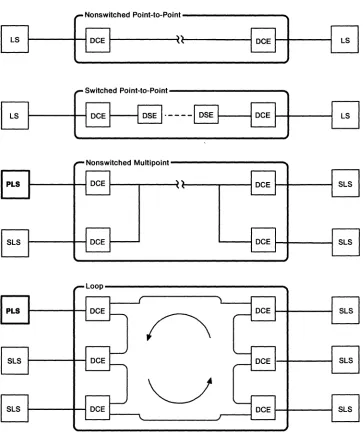
A link connection can have one of the following basic configurations, as shown in Figure 3:
• Nonswitched point-to-point • Switched pOint-to-point • Nonswitched multipoint • Loop.
c
(.
C
Link Connections
G
[ No",wHched Polol-I~Polol
IDCE
I
n
G
[SWitch'" 1'0101-I0-I'0'01
~·----I
DSEI
Nonswitched Multipoint
DCE Data Circuit-terminating Equipment DSE Data Switching Exchange
[image:16.612.181.544.81.524.2]LS Link Station PLS Primary Link Station SLS Secondary Link Station
Figure 3. Link Connection Configurations
I DCE I
]
G
I DeE
I
]
G
In a nonswitched configuration, the link connection exists for a period of time independent of whether it is being used to transmit data. This period of time may be continuous-that is, 24 hours a day, seven days a week-as when the user owns the facilities used or contracts with a public data network for the facilities. Alternatively, the duration may be shorter, as when the user contracts for the facilities to be available eight hours a day, five days a week.
6
SOLC ConceptsIn a switched configuration, a connection is established each time there is data to be transmitted, and the connection is broken after transmission is completed. Each time a switched connection is established it is likely to use a different combination of channels and transmission media.
A point-to-point configuration has two link stations; a multipoint configuration has three or more link stations. One link station on a multipoint link is called the
primary link station; it controls use of the link by all the link stations attached to it.
The rest of the link stations on the link are called secondary link stations. Chapter 2 describes the differences between primary and secondary link stations in more detail.
In a multipoint configuration, the secondary link stations communicate only with the primary link station-never with each other. The primary and each secondary form a pair logically distinct from each other pair; thus, each pair can be viewed as comprising a single point-to-point link sharing the same multipoint configuration with other point-to- point links. Only the primary link station, in its scheduling of the shared configuration, is aware of the multiple use of the common connection. The term link can then be applied to each pair of communicating link stations,
independent of the underlying configuration.
Half-Duplex and Duplex
In all but the loop configuration, data and control signals can flow in either direction over the link connection. Whether they can flow simultaneously in both directions, or in only one direction at a time, depends on the equipment (such as amplifiers) in the channel, upon the data circuit-terminating equipment (DCE) in the link
. connection, and upon the link station that uses the link connection.
The term duplex refers to the capability of the channel and the link connection to transfer data in both directions at once. The term half-duplex refers to the capability of the channel and the link connection to transfer data in both directions, but not at the same time.
To the basic non-loop configurations listed above, the qualifiers duplex and
half-duplex can be applied. The possible configurations are then:'
• Half-duplex, nonswitched point-to-point • Duplex, nonswitched point-to-point • Half-duplex, switched point-to-point • Duplex, switched pOint-to-point • Half-duplex, nonswitched multipoint • Duplex, nonswitched multipoint.
Two-Way Alternate and Two-Way Simultaneous Link Station
Operation
If either the channel or the DCE is capable only of half-duplex operation, then the link stations on the link must send and receive data alternately-this is called
two-way alternate transmission. If the channel and the DeE are both capable of
duplex operation, then the link stations may send and receive data
simultaneously-this is called two-way simultaneous transmission. Or they may send and receive data alternately, as for half-duplex operation.
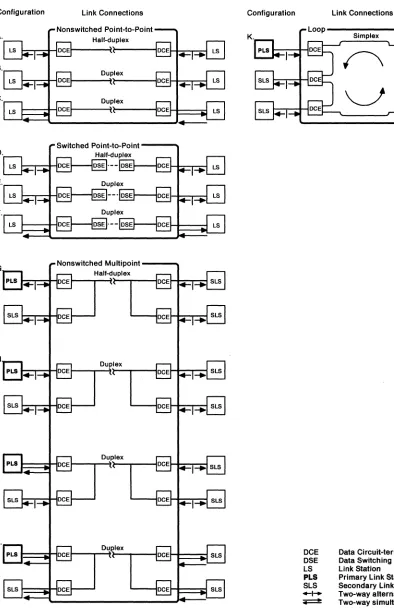
Figure 4 shows the possible variations of link station operation for each of the link connection configurations shown in Figure 3. The configurations in this figure are
labeled A through K.
rl.
c
(~
('
(~
c
Configuration Link Connections Configuration
A. Half-duplex
B.
Duplex
C. Duplex
D.
E. F.
G
H
I.
J.
DCE DSE LS PLS SLS
-I-
•
•
Link Connections
Simplex
{ \
~
Data Circuit-terminating Equipment Data Switching Exchange
[image:18.612.87.481.66.681.2]Link Station Primary Link Station Secondary Link Station Two-way alternate transmission Two-way simultaneous transmission
Figure 4. Link Connection Configurations and Link Station Operation
8
SOLe Conceptsconfiguration can accommodate either two-way alternate or two-way simultaneous transmission, as shown in configurations Band C, respectively.
Configurations D, E, and F are switched point-to-point configurations. Configuration D is half duplex and therefore allows only two-way alternate transmission. A duplex configuration can accommodate either two-way alternate or two-way simultaneous transmission, as shown in configurations E and F, respectively.
Configurations D, E, and F are equivalent in data link operation to configurations A, B, and C, respectively; they differ only in that they use switched rather than
nonswitched link connections. After a switched link connection is established, data link operation is the same as for nonswitched connections.
Configurations G through J are nonswitched multipoint. The link connection in configuration G is half duplex and therefore allows only two-way alternate transmission. The link connections in configurations H through J are duplex, but link station operation differs for these three configurations, as follows.
In configuration H, transmission is two-way alternate for the primary link station and for each secondary link station.
In configuration I, the primary link station can send to one of the secondary link stations while althe same time receiving from another secondary link station. Transmission is thus two-way simultaneous for the primary link station but two-way alternate for the secondary link stations.
In configuration J, the primary link station can send to and receive from the same secondary link station at the same time. Each secondary link station in this
configuration can thus simultaneously send to and receive from the primary station, but only one of them at a time can do so.
The term duplex-multipoint operation is sometimes applied to configurations I and J.
In configuration K, the link connection is a loop. Although transmission on the loop is always in the same direction (referred to as simplex transmission), logically all the link stations use two-way alternate transmission.
In all of the configurations of Figure 4, the choice of two-way simultaneous or two-way alternate transmission is determined for each link station through control program parameters specified at the time the network is configured.
(Loop configurations are not further considered until Chapter 3, under "SDLC in a Loop Configuration" on page 40.)
Signal Conversion
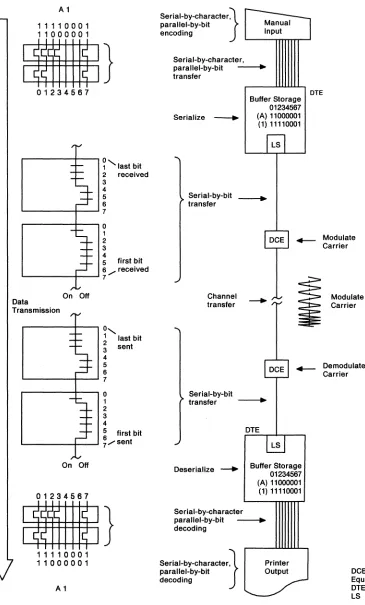
When analog telecommunication facilities are used for data links, the binary digital information that is characteristic of information processing machines must be converted to a form similar to that used for transmitting speech signals. Two fundamental conversions are necessary, as shown in Figure 5:
• All data and control information are converted (serialized) to a serial stream of binary digits (O's and 1's). Data terminal equipment (DTE) makes this
conversion.
• The binary signals are made compatible with analog transmission equipment by data circuit-terminating equipment (DCE).
c
c
Receiving equipment reverses both processes: binary information is recovered from received signals by DeE, and is then regrouped (deseria/ized) by DTE into the original data and control information.
A1
11110001 11000001
as}
01234567
~'Iast
bit2 received
3 4 5 6
' - - - 1 - - - ' 7
...---1----.0
1 2 3 4
5 first bit
6 /received ' - - - 1 - - - ' 7
On Off Data
Transmission
0,
~ last bit
3 sent
4 5 6
' - - - 1 - - - ' 7
.---11---,0
1 2 3 4
~ first bit '---Ir---' 7 / sent
On Off
11110001 11000001 A1 serial-by-character} parallel-by-bit encoding Serial-by-character, parallel-by-bit
- +
transferBuffer Storage 01234567 Serialize ---+ (A) 11000001 (1) 11110001
Serial-by-bit
- +
transfer LS DTE+--
Modulate Carrier Channeltransfer Modulate Carrier
+--
Demodulate CarrierSerial-by-bit
transfer
- +
Deserialize --+
DTE
LS
Buffer Storage 01234567 (A) 11000001 (1) 11110001
Serial-by-character parallel-by-bit
- +
decodingserial-by-character} parallel-by-bit decoding
Printer
Output DCE Data Circuit Terminating Equipment
[image:20.612.87.452.111.716.2]10
SDLC ConceptsData Link Control Activities
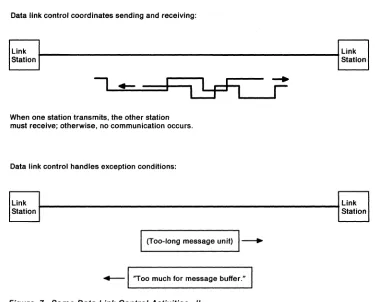
The actual transfer of data requires nondata transmissions for setting up, controlling, checking, and terminating the information exchange. Such
transmissions are a part of data link control. (System control information, such as input/output device controls, is not considered data link control information.)
The following are data link control activities (see Figures 6) and 7).
• Synchronizing-getting the receiver in bit synchronism and character synchronism with the transmitter
• Detecting and recovering from transmission errors
• Controlling send/receiv~using a primary station to manage each data link (others are secondary stations)
• Reporting unacceptable conditions such as buffer overrun at the receiver.
Data link control keeps transmitter and receiver synchronized:
~ Data flow
1 0 0 0 0 0 1 1 1 0 0 0 1 1 1 1
Bit state: l
-I I I I I I I I
Character: A
\
-The receiver and the transmitter must be in bit and character synchronism (lack of synchronism resuHs in inability of receiver to determine if incoming character is A, \, G, or T).
Data link control detects transmission errors:
I I I I
G
T
~ Data flow I
I
I1
4
Line "hit"1 1 0 0 0 0 1 1 1 0 0 0 1 1 1 1
Bit state:
L-
I I I
~I
IHIf--t1
I
I
Character:
A single binary digit is changed by a transmission error. The receiver must recognize that the error has occurred.
Figure 6. Some Data Link Control Activities-I
I I I
c
('
Data link control coordinates sending and receiving:
I Link t---fILink I
Station StationWhen one station transmits, the other station must receive; otherwise, no communication occurs.
Data link control handles exception conditions:
I Link t---fILink I
Station Station (Too-long message unit) - + [image:22.612.171.546.65.367.2]. - "Too much for message buffer."
Figure 7. Some Data Link Control Activities-II
Bit Synchronization and Invert-on-Zero Coding
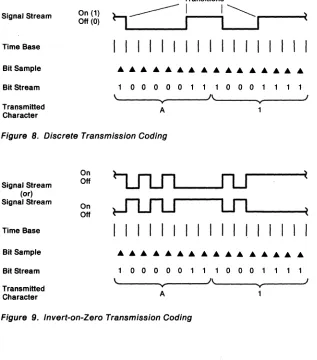
A synchronous transmission is time based to enable the DCE or DTE to identify the sequential binary digits (see Figure 8). SDLC procedures assume that bit
synchronization is provided by either the DCE or the DTE.
A receiving DTE or DCE samples the value of the incoming signal at the same rate the transmitting DCE used to transmit the signal. There may be minor variations in timing between transmitter and receiver, however, that make it necessary for the receiver to dynamically adjust sample timing to keep sample times midway between bit transitions. DCEs that provide received-data timing to the DTE perform this function.
If the DCE does not provide received-data timing, the DTE must provide and adjust the sample timing. In this case, an invert-on-zero transmission coding method (also known as NRZI, non-return to zero inverted) is used, in which the DTE holds the signal condition in the same state to send a binary 1. To send a binary 0, the DTE changes the signal condition to the opposite state (see Figure 9). Thus, the long periods of binary 0 data that sometimes occur have successive transitions in the transmitted bit stream. (Zero insertion, a characteristic of SDLC procedures that is explained in Chapter 2, creates transitions when extended periods of binary 1 transmission occur.) Invert-on-zero transmission coding, if used on a link, must be used by all DTEs attached to the link.
12
SOLC Conceptssynchronism. Invert-on-zero coding may be required for certain DCEs that have specific bit-pattern sensitivities. Invert-on-zero coding may be prohibited for other
DCEs that have different bit-pattern sensitivities.
c
c:
c
c
(""
Signal Stream
Time Base
Bit Sample
Bit Stream
Tral)smitted Character
Transitions
g~!~l ~--- ~
I
~I
l
I I I I I I I I I I I I I I I I I
0 0 0 0 0 1 1 1 0 0 0 1 1
[image:24.612.179.496.84.444.2]\~ ______ ~y~ ______ ~J\~ ______ ~v~ ______ ~J A
Figure 8. Discrete Transmission Coding
Signal Stream (or) Signal Stream
Time Base
Bit Sample
Bit Stream
Transmitted Character
On Off
On Off
I I I I I I I I I I I I I I I I I
0 0 0 0 0 1 1 1 0 0 0 1 1
\~ ______ ~y~ ______ ~J\~ ______ ~y~ ______ ~J A
c
c
Chapter 2. Basic Concepts
This chapter describes some basic concepts of SDLC and explains some SDLC procedures that help in recovery from transmission errors.
c
c
c
Four concepts are fundamental to an understanding of SOLe:
• The definitions and responsibilities of primary and secondary link stations • The definitions of the transmission states that affect information transfer • How information is formatted into transmission frames
• How transmission frames are organized into larger sequences.
Primary and Secondary Link Stations
A link station comprises procedures and control information that coordinate the transfer of data between two nodes joined by a link connection.
A primary link station has the responsibility for controlling a data link; it issues commands. Secondary link stations receive commands from the primary link station and return responses to it. Each transmission on a link connection is from the primary station to one or more secondary stations, or from a secondary station to the primary station.
Transmission States
Transient State
A link connection can be in one of three states:
• Transient state • Idle state • Active state.
A link connection can be in only one of these states at a time.
The transient state exists when the link connection is being conditioned before initial transmission and after each transmit-receive reversal (or turnaround); see Figure 10.
LS LS
Time
~---~~~---~~~---~
~--~ ~--~
Transient state
1 LS signals request-to-send
t---~ 2 DCE signals move over
link connection 3 DCE detects
1---...
data line signal(Timed pause)
DCE Signals 5 clear-to-send
4 - - o r - - 4 DCE or LS adjusts bit synchronism
DCE Data Circuit-terminating Equipment LS Link Station
Idle State
Active State
18
SOLC ConceptsWhen a link connection is operational, but no SOLC control or information is currently being transmitted, it is in the idle state.
A link station detects the existence of the idle state when, after receiving an idle
pattern-a succession of 15 consecutive binary 1's-it continues to receive binary
1's.
Note: A station that is not transmitting SOLC control or information data may, nevertheless, send signals onto the link connection.
The link connection configuration used determines the appropriate link station action in the idle state, as follows:
LInk Connection
Half-duplex pOint-to-point Duplex point-to-point Half-duplex multipoint Duplex multipoint
Primary LInk Station Carrier off
A1I1's Carrier off Aill's
Secondary Link Station Carrier off
A1I1's Carrier off Carrier off
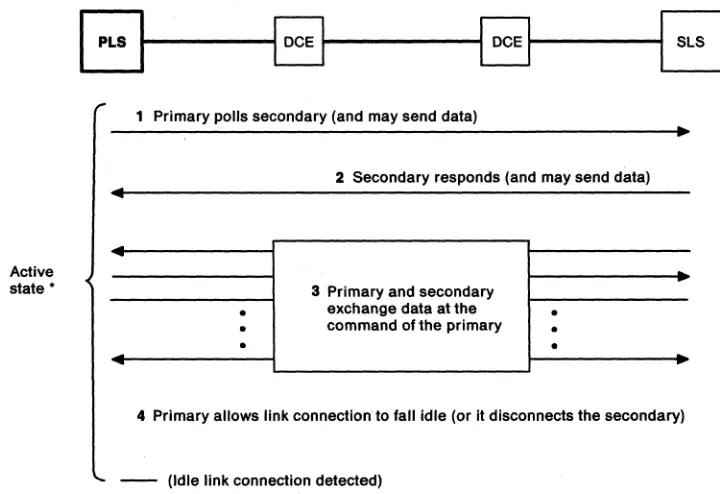
A link connection is in the active state when a link station is transmitting or receiving either information or data link control signals (via transmission frames described in the next section, "Transmission Frames" on page 19). The active transmission state is the nonidle, nontransient state. The link connection is also in the active state when a series of flags (also described in the next section) is being transmitted. In this case no information is exchanged, but the link connection is held in the active state (see Figure 11). A duplex link connection may be active in one direction and idle in the other.
Active state·
'LS
~I---~~~---~~~---~~S_LS~
1 Primary polls secondary (and may send data)
2 Secondary responds (and may send data)
3 Primary and secondary
•
exchange data at the•
•
command of the primary•
•
•
4 Primary allows link connection to fall idle (or it disconnects the secondary)
- - (Idle link connection detected)
[image:29.612.155.515.426.673.2]• A half-duplex link connection is in transient state during each line turnaround
Figure 11. Period of the Active State
c
('
('
Transmission Frames
Frame Format
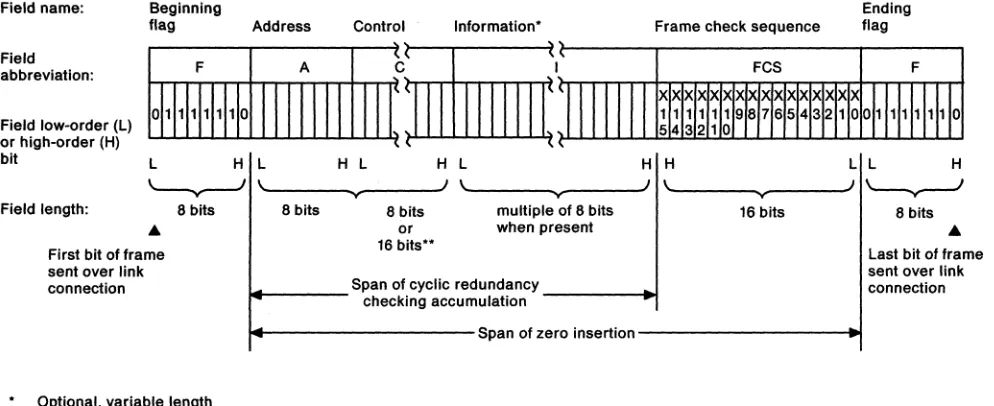
All data and control transmissions on an SOLC data link are organized in a specific format called a transmission frame-also called SDLe frame. or simply frame (see Figure 12). This format carries control information and user data between a transmitting station and a receiving station and allows a receiving station:
• To determine where the frame starts and ends.
• To determine whether the frame is intended for that station
• To determine what actions to perform with the information received
• To detect the occurrence of transmission errors in received frames
• To acknowledge its receipt of frames to the transmitting station.
Receiver Sender
Link connection
LS LS
Frame starts Frame ends
Figure 12. SDLe Transmission Frame
Each SOLC transmission frame has the same specific format. Each frame is made up of:
• A beginning flag (F) that marks the beginning of the frame
• An address (A) field that identifies the secondary station that is sending (or is to receive) the frame
• A control (C) field that specifies the function of the particular frame • An optional information field that contains information data
• A frame check sequence (FCS) field that allows the receiving station to check the transmission accuracy of the frame
• An ending flag (F) that signals the end of the frame.
Each of these fields contains either 8 bits or a multiple of 8 bits (see Figure 13).
Field name: Beginning Ending flag Address Control Information" Frame check sequence flag
Field
F A C FCS F
abbreviation:
Field low-order (L) or high-order (H)
bit L HL HL HL HH LL H
"--v--I '" ... - - -...
v .... - - - , '" ... - - -... v .... - - - . . J ) ' " ' - - - -... y .... - - - ,"--v--I
Field length: 8 bits 8 bits 8 bits multiple of 8 bits 16 bits 8 bits
...
First bit of frame sent over link connection
or when present 16 bits""
1 + - - - -Span of cyclic redundancy _ _ _ _ -+I checking accumulation
1 4 - - - S p a n of zero insertion---~
...
Last bit of frame sent over link connection
Optional, variable length
[image:31.612.61.558.61.264.2]"" 8 bits for modul0-8 operation, 16 bits for modu10-128 operation
Figure 13. Fields of the SDLe Transmission Frame, As Transmitted
Flags
Address Field
20
SOLC ConceptsThe beginning flag and the ending flag enclose the SOLC frame. The beginning flag serves as a reference for the position of the A (address) and C (control) fields and initiates transmission error checking; the ending flag delimits the end of the FCS field and marks the end of the frame.
Both beginning and ending flags have the binary format 01111110. The ending flag for one frame may serve as the beginning flag for the next frame. Alternatively, the ending 0 of an ending flag may serve as the beginning 0 of a beginning flag, thus forming the pattern 011111101111110. Also, the transmitting link station inserts multiple flags between frames to maintain the active state if time fill is required. Zero insertion, described under "Zero Insertion" on page 24, prevents the flag pattern from occurring anywhere else in the frame.
Any ending flag may be followed by a frame, by another flag, or by an idle condition.
The address field of an SOLC frame follows immediately after the beginning flag. It serves the same purpose as the address or return address on a letter mailed through the post office. The address that is sent is always the address of the secondary station on the link connection. If the primary station is transmitting the frame, the address is similar to the main address on a letter-it tells where the message is to go. If a secondary station is transmitting the frame, the address is similar to the return address on a letter-it tells where the message originated.
For application purposes, it may be useful to have special addresses specified that direct frames to a number of stations or to all the stations on the link connection. In this case, a secondary station may have three types of address:
• Its own individual address: a station address.
• An address that is common to a number of stations: a group address.
---.~---.~~~~~~-C
c
c
(
Control Field
(~'
(
",
--(
" /c
- An address that all stations on the link connection will accept: a broadcast
address (sometimes called an all-stations address). An address field of all1's is
reserved for use solely as the broadcast address.
Note: An all-O's address field is reserved as a "no station's address"; therefore, no secondary station is assigned this as one of its addresses.
The control field (C field) follows the address field. The control field defines the function of the frame and can be in one of the three formats shown in Figure 14:
unnumbered (U) format, supervisory (S) format, or information (I) format. (The
corresponding frame is similarly named.)
The control field bits shown as "Code" in the figure represent the SOLC command or response indicated by the frame. The commands and responses are explained in "Command and Response Definitions" on page 34, and are summarized in
Appendix A.
Supervisory Format
Modulo
8
11 1
0C~de
I
P/FI
RC~.
ct.
!Nr)I
L H L
Modulo
128
o
I
C~de
0 01
0 0Ilp/F
1
Informa6on Format
Modulo 8
L Modulo
128
Unnumbered Format
Modulo 8 Modulo
128
L
L Low-order bit (first bit in each byte transmitted) H High-order bit (last bit in each byte transmitted)
Figure 14. SDLC Frame: Control Field
Unnumbered (U) Format
H L
H
Unnumbered frames are used for such functions as:
- Establishing and disconnecting the data link -Reporting' certain procedural errors
H
~cv.
ft.
<+
H
Supervisory (S) Format
Supervisory frames assist in the transfer of information, though they do not carry information themselves. They are used to acknowledge received frames, to convey ready or busy conditions, and to report frame numbering errors (indicating that a numbered information frame was received out of its proper sequence).
Information (I) Format
Information frames transfer information. Besides indicating the format, the control field contains send and receive counts (Ns and Nr). SOLC procedures use the Ns count to ensure that these frames are received in their proper order; they use the Nr count to confirm that received information frames are accepted.
The Ns count indicates the number of the information frame within the sequence of information frames transmitted. The Nr count transmitted ina frame is the number
(Ns) of the information frame that the station transmitting the Nr count expects to receive next. "Frame Numbering" on page 23 gives more details about this process.
Note: The Ns count is present only in a control (C) field of the information format. An Nr count appears in C fields of information and supervisory frames. Neither the
Nr nor the Ns count is present in a C field of unnumbered frames.
The P/F Bit
All three C field formats contain a poll/final (P/F) bit. A P (poll) bit is sent to a secondary station to require that it initiate transmission; an F (final) bit is sent to a primary station by a secondary station in the last frame of a transmission. (Do not confuse the F (final) bit with the F (flag) frame delimiter pattern.) Only one P bit may be outstanding (unanswered by an F bit) at one time on ,any of the data links
described thus far.
Information Field
Following the control field, there mayor may not be an information field. The supervisory frame does not contain an information field.
Data to be transferred on the data link is contained in the information field of a frame. The information field does not have a set length, but must be a multiple of 8 bits. In each 8-bit grouping (octet), the low-order bit is sent first and the high-order bit is sent last.
Frame Check Sequence (FCS) Field
22
SOLe ConceptsFollowing the information field (or control field if no information field is present) is the frame check sequence (FCS) field. The purpose of this field is to check the received frame for errors that may have been introduced by the link connection. This field contains a 16-bit check sequence that is the result of a computation on the contents of the A, C, and information fields at the transmitter. The computation method used is called cyclic redundancy checking (CRC).
The receiver makes a similar computation on the received frame. If the frame is received with an error, the receiver rejects the frame and discards it. Thus, the receiver accepts no frame that it finds to be in error.
The FCS field is followed by the ending flag, closing the frame.
See Appendix B, "SOLC Computation of the FCS Field," for more details on the FCS field and on CRC.
c
~
!
c'
c
C-\
/Frame Numbering
,.
A station that is transmitting numbered information frames numbers each one by placing its number in the Ns count field of the frame. The receiving station checks this number to determine if any frames are missing or duplicated.
A station that is receiving numbered information frames accepts each one that is error free and in sequence and advances its receive count (Nr) for each such frame. If the received frame is error free, a receiving station's Nr count is the same as the
Ns count that it will receive in the next numbered information frame-that is, a count of 1 greater than the Ns count of the last frame accepted. The receiver confirms its acceptance of numbered information frames by returning its Nr count to the
transmitting station.
The Nr count at the receiving station advances when the station checks the frame and finds it to be error free and in sequence; Nr then becomes the count of the "next-expected" frame and should agree with the next incoming Ns count. If the incoming Ns count does not agree with the Nr count, the frame is out of sequence and Nr does not advance. The receiver does not accept out-of-sequence frames. It does, however, accept the incoming Nr count (for confirmation purposes) if the out-of-sequence frame is otherwise error free.
The counting capacity for Nr and Ns is 8, using the numbers 0 through 7 (for modul0-8 operation); or 128, using the numbers 0 through 127 (for modu10-128 operation). These counts "wrap around"; that is, 7 (or 127) is sequentially followed by O. Up to seven (or 127) unconfirmed, numbered information frames may be outstanding (transmitted but not confirmed) at the transmi-tter.
The restriction that, at most, modulus-minus-1 frames (that is, 7 or 127 frames) may be outstanding at any time prevents ambiguity when error recovery results in retransmissions. For example, if eight I frames (numbered 0 through 7) were transmitted and a response were returned with an Nr count of 0, the transmitter could not determine whether the response confirmed the most recent I frames 0 through 7 or indicated that retransmission was required.
All unconfirmed frames must be retained by the transmitter, because some or all of them may have to be retransmitted if transmission errors or buffering constraints occur. The reported Nr count is the number of the next frame that the receiver expects to receive, so if, at a checkpoint, the Nr count is not the same as the transmitter's next frame (Ns) number, some of the frames already sent must be retransmitted. (See Figure 15 for an example of modul0-8 frame numbering.)
Zero Insertion
24
SOLC ConceptsB
I
SLSI
B's B's
+ -
Data flowNr count Ns count
0 0 Frame number (Ns)
0
101112131415161
2 0
3 0
...
Poll4 0 Data flow
---+
5 0
6 0 Frame number (Ns)
[1J
next[QJ
[QJ
•
•
•
[1J
UJ
If B responds to the poll with Nr = :
7 (as above. all frames check. OK) 6 (frame 6 discarded because of error) 5 (error on frame 5. 5 and 6 discarded) 4 (error on frame 4. 4-6 discarded) 3 (error on frame 3. 3-6 discarded) 2 (error on frame 2. 2-6 discarded) 1 (error on frame 1. 1-6 discarded)
o (error on frame O. no frames accepted)
Figure 15. Example of Modul0-8 Frame Numbering
A
I
PLSA's A's
Nr count Ns count
0 0
0
0 2
0 3
0 4
0 5
0 6
[QJ
nextIT!
•
•
•
UJ
ILl
A may send Ns frames:
7.0.1.2.3.4.5 (continue)
6.7.0.1.2.3.4 (retransmit and continue) 5,6.7,0.1.2,3 (retransmit and continue) 4,5.6.7.0,1,2 (retransmit and continue) 3,4,5,6,7,0,1 (retransmit and continue) 2,3,4,5,6,7,0 (retransmit and continue) 1,2,3.4.5,6,7 (retransmit and continue) 0,1,2.3,4,5,6 (retransmit)
A frame is identifiable because it begins and ends with a flag and contains only nonflag bit patterns between the flags. This characteristic does not restrict the contents of a frame because SOLC procedures require that the transmitter insert a binary 0 after any succession of five contiguous 1's within the frame. (This action is sometimes called "bit stuffing.") Thus, no pattern of 01111110 (a flag) is ever transmitted between the beginning and ending flags.
Zero-bit insertion is disabled when the flag is being transmitted. After testing for flag recognition, the receiver removes a 0 that follows five contiguous 1's (see Figure 16). A 1 that follows five contiguous 1's is not removed; it signifies a frame abort (if it is followed by one or more 1's) or the arrival of a flag (if it is followed by a 0). Inserted and removed O's are not included in the frame check sequence
computation.
Note: When invert-on-zero transmission coding is used, zero insertion eliminates
the remaining possibility of prolonged transitionless periods (continuous 1 bits) in the active state (see "Bit Synchronization and Invert-on-Zero Coding" on page 11).
c
('
c
Timeouts
Idle Detect
Receiver Sender
~L_S~~ ___________________ L_i_nk __ co_n_n_e_~_io_n ______________________ ~
_
+ -
Data flow0
• Recognize flags
• Delete a 0 after each five I's between flags • Check for transmission errors
• Deserialize characters
• Serialize chara~ers
• Compute FCS • Generate flags • Insert a 0 after each
five I's between flags
Bit stream, for
CRC computation
'''''100
,,~'"''
J
Transmitted bit
stream 01111110111110111110000000111110100111110101
& & & & Inserted O's
Deleted O's Received bit
stream 01111110111110111110000000111110100111110101
Bit stream, for CRC computation
11111100 11111101
~
~~...L.----..,;..I
~r-J
Figure 16. Zero Insertion and Deletion
The primary link station is responsible for the orderly, continuous operation of a data link, and it must check for responses to its commands. Two timeouts are operated by a primary link station for these purposes: (1) idle detect and (2) nonproductive receive.
When the primary station transmits a frame with the P bit on in the C field, the station expects a response to be initiated within a certain period of time. In two-way alternate operation, the link connection is normally in the idle state when no
transmission is taking place. If the idle state (or non response condition) continues past the time when a response should have been received (for example, if the secondary station does not respond to a frame), the primary station will detect the protracted idle condition and should initiate recovery action.
The interval that should be allowed before recovery action includes:
1. Propagation time to the secondary station 2. Clear-to-send time at the secondary station DCE 3. Appropriate time for secondary station processing 4. Propagation time from the secondary station.
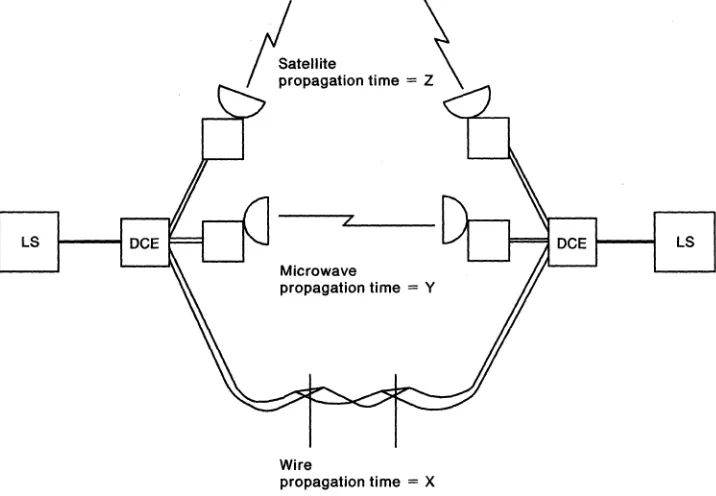
Link Connection (see Figure 17) Secondary Approximate Two-Way Station DCE Propagation Time (see Clear-to-Send Figure 17)
Delay
Switched (through local exchange Oms to 25 ms 2 ms per 15 miles (23 km.)
only) or very short (distance) (X)
nonswitched
Long (distance) duplex (nonswitched) Oms to 25 ms 2 ms per 150 miles (230 km)
+
24 ms (Y)Long (distance) half-duplex (switched 75 ms to 250 ms 2 ms per 150 miles (241 km)
or nonswitched) (Y)
Satellite duplex (switched or Oms to 250 ms 600 to 700 ms per hOpl plus
nonswitched) propagation time for
connecting terrestrial links
(Z)
With each type of link connection configuration, the minimum timeout includes an allowance for processing time at the secondary station. The sum of other times may be as great as 850-900 milliseconds (for a satellite link). If a response is received or is being received before the timeout expires, the timeout is reset.
LS
. )Sate""
\
/ •
~:opagation
time = Z \z
Microwave
propagation time = Y
Wire
[image:37.612.165.523.328.576.2]propagation time = X
Figure 17. Examples of Telecommunication Facilities
LS
1 A satellite hop is one uplink and one downlink.
26
SOLC ConceptsC
[
C.'"
..Nonproductive Receive
When bits are being received that do not result in frames, a nonproductive receive condition exists. This condition could be caused by secondary station malfunctions that cause continuous transmission. The primary station must provide a time-out period when a nonproductive receive condition occurs. The usual timeout period ranges from 3 to 30 seconds. If the nonproductive receive condition continues after the the problem is normally not recoverable at the data link control level and must be handled by some method above the data link control level.
Abort Conditions
The act of prematurely terminating the transmission of a frame is called aborting the transmission.
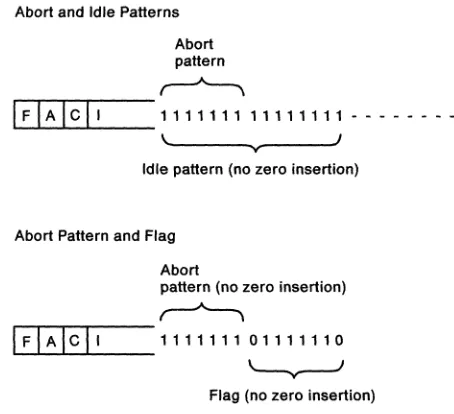
The transmitting station aborts a transmission by sending a minimum of seven consecutive binary 1's with no zero insertion (see Figure 18). This sequence is called an abort pattern. (Unintentional aborting is prevented by zero insertion.) The abort pattern terminates the frame without an FCS field or an ending flag.
Following transmission of the abort pattern, the link connection may be permitted to go to the idle state or it may remain in the active state.
Abort and Idle Patterns
Abort pattern
I"""""T--r-,..---
~
1 - 1
F....IIL-A...JI,-c..J.I_
I _ _ 1 1 1 1 1 1 1 1 1 1 1 1 1 1 1 -\. ... ---.v,---JIdle pattern (no zero insertion)
Abort Pattern and Flag
Abort
pattern (no zero insertion)
~~.---~
IFIAlcl1
111111101111110 [image:38.612.177.404.348.555.2]Flag (no zero insertion)
Figure 18. Transmitting Station Aborts Transmission
Either a primary or a secondary station may abort a transmission. An abort pattern of seven 1's may be followed by eight (minimum) additional1's (a total of at least 15 contiguous 1's), which idles the data link as long as the 1's continue, or it may be followed by a frame. Seven to fourteen 1's constitute an abort pattern; fifteen or more 1's constitute an idle pattern.
Recovery from Errors and Special Conditions
recovery actions. When unable to provide recovery from errors or special conditions, SOLC reports them to higher levels of SNA for resolution. The term
higher-level recovery is applied to recovery actions outside SOLC.
Link-Level Recovery
At the link level, SOLC procedures detect discrepancies that may be recovered from by retransmitting the frame. For example:
• A busy station is temporarily unable to continue to receive. It reports this condition to the transmitting station.
• A received Nr count does not confirm the appropriate numbered information frames previously transmitted. Retransmission is initiated.
• A receiving station discards a frame because:
it contains a CRC error
it is out of numerical order
the station cannot accept it because of a busy condition (I frames only)
the ending flag is not displaced from the beginning flag by a multiple of 8 bits.
it is less than 32 bits long.
• A response to a poll is not received; the poll is normally repeated.
• An attempt to bring a secondary station online does not succeed; the command is repeated.
Retransmissions may be counted to detect that the situation is not considered to be recoverable at the link level. The counting of retransmission attempts is not specified by SOLC procedures. Usually, they are counted within the transmitting OTE and, at some planned number n, correct link station action is reported as unrecoverable at the link level. Among those actions that should be retried are attempts to:
• Obtain acknowledgment of a command • Resume communication with a busy station
• Achieve initial, online status of a secondary station.
Higher-Level Recovery
Link-level error detection applies to the address, control, information, and FCS fields of the frame. Some detected errors cannot be recovered from at the link level; for example:
• If a secondary station responds by rejecting a command with which the station is not compatible, only an acceptable alternative command can relieve its error condition. Intervention from a higher level is required to analyze and act upon the status report in the secondary station's response.2 •
• If the transmitting station has aborted transmission because of an internal malfunction or an expended retransmission count, intervention from a higher level is required to analyze and act upon the situation.
• If a secondary station response to the exchange of station identification (described under "SOLC on a Switched Link" on page 39) contains the wrong
2 Rejecting a command is described under "FRMR (Frame Reject)" on page 37
28
SOLC Concepts~-~--~---
-c
c
c
identification, intervention from a higher level is required to analyze and act upon the situation.
The type of intervention required depends upon the station's decision-making power at a level higher than the link level. At a terminal, for example, operator
c
C,·
. .Chapter 3. Further Concepts, Applications, and Examples
This chapter describes additional concepts, defines the SDLC commands and responses, and shows applications and examples of SDLC command and response flows for specific configurations.
Secondary-Station Mode Definitions . . . 33 Initialization Mode . . . 33 Normal Response Mode (NRM) and Normal Response Mode Extended
('
c
Secondary-Station Mode Definitions
A secondary link station may be in one of three modes: initialization mode, normal
response mode, or normal disconnected mode. The meanings of these modes are as follows.
Initialization Mode
Initialization mode is the mode for initializing or reinitializing a link station with the appropriate link protocols.
Normal Response Mode (NRM) and Normal Response Mode
Extended (NRME)
A secondary station in either normal response mode (NRM) or normal response mode extended (NRME) does not initiate unsolicited transmissions. It transmits only in response to a poll, which is a frame received from the primary station, with the P bit on in the C field.
The secondary station may respond with one or more frames. The F bit is on in the last (or only) frame of the response. A primary station will not poll any other secondary station until (1) it receives the F bit response to an outstanding P bit or (2) a timeout has completed.
Normal Response Mode: A secondary link station assumes normal response mode when it receives a SNRM (Set Normal Response Mode) command from the primary link station. The SNRM command causes modul0-8 operation of the link. In modul0-8 operation, each S frame and each I frame contains a 1-byte control field that includes 3 bits for the Nr count (and, for I frames only, 3 bits for the Ns count). The use of 1-byte control fields allows up to seven SDLC frames to be outstanding (that is, unacknowledged) on a link.
When in normal response mode, the secondary (1) expects every control field it receives in a command to be 1 byte long, and (2) sends only 1-byte control fields in its responses.
Normal Response Mode Extended (NRME): A secondary link station assumes normal response mode extended when it receives a SNRME (Set Normal Response Mode Extended) command from the primary link station. The SNRME command causes modu10-128 operation of the link. In modu10-128 operation, each S frame and each I frame contains a 2-byte control field that includes 7 bits for the Nr count, (and, for I frames only, 7 bits for the Ns count). The use of 2-byte control fields allows up to 127 SDLC frames to be outstanding (that is, unacknowledged) on a link.
When in normal response mode extended, the secondary (1) expects every control field it receives in a supervisory (S) or information (I) command to be 2 bytes long, and (2) sends only 2-byte control fields in its supervisory and information responses. Unnumbered (U) commands and responses contain 1-byte control fields.
Normal Disconnected Mode (NOM)
A secondary station that receives and accepts a DISC (Disconnect) command assumes normal disconnected mode; it also assumes this mode:
• When power is turned on, or when the station is enabled for data link operation • Following a transient disabling condition (such as a power failure)
In NDM,a secondary station will respond only as the result of receiving a command with the P bit
on
and may accept only a TEST, XID, CFGR, SNRM, SNRME, or SIM command from the primary station. One of these commands that is not accepted, or any other command in which the P bit ison,
causes a disconnected secondary station to respond with a disconnected mode status or an initialization request.Command and Response Definitions
34 SOLC Concepts
This section describes the commands and responses contained in the C field of an SDLC frame. When received by a secondary station, a frame is a command; when received by a primary station, a frame is a response.
Commands and responses in the unnumbered (U) format have a 1-byte control field for both modul0-8 and modu10-128 operation of the link over which they pass. Commands and responses in the supervisory (S) and numbered information (I) formats have a 1-byte control field for modul0-8 operation of the link and a 2-byte control field for modu10-128 operation of the link.
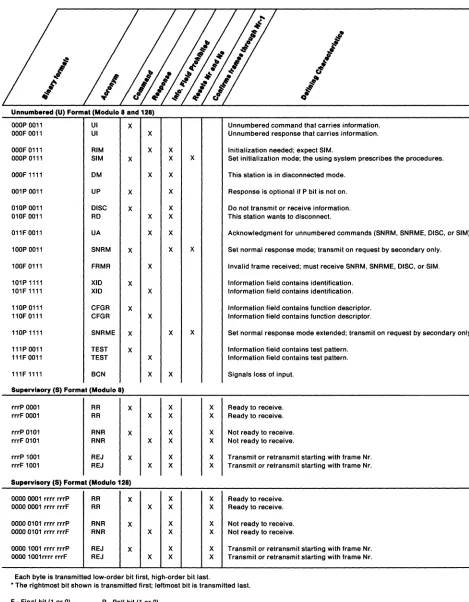
Figure 19 summarizes all SDLC commands and responses.
(
c
(:
/
/
6
I
.t
,
~
Unnumbered (U) Format (Modulo 8 and 128)
OOOP 0011 UI X Unnumbered command that carries information.
OOOF 0011 UI X Unnumbered response that carries information.
OOOF 0111 RIM X X Initialization needed; expect SIM.
OOOP 0111 SIM X X X Set initialization mode; the using system prescribes the procedures.
OOOF 1111 OM X X This station is in disconnected mode.
001P 0011 UP X X Response is optional if P bit is not on.
010P 0011 DISC X X Do not transmit or receive information.
010F 0011 RD X X This station wants to disconnect.
C
/ ' 011F 0011 UA X X Acknowledgment for unnumbered commands (SNRM. SNRME. DISC. or SIM).100P 0011 SNRM X X X Set normal response mode; transmit on request by secondary only.
100F 0111 FRMR X Invalid frame received; must receive SNRM. SNRME. DISC. or SIM.
101P 1111 XID X Information field contains identification.
101F 1111 XID X Information field contains identification.
110P0111 CFGR X Information field contains function descriptor.
110F 0111 CFGR X Information field contains function descriptor.
(:'
110P 1111 SNRME X X X Set normal response mode extended; transmit on request by secondary only.111P 0011 TEST X Information field contains test pattern.
111F 0011 TEST X Information field contains test pattern.
111F 1111 BCN X X Signals loss of input.
Supervisory (S) Format (Modulo 8)
rrrP 0001 RR X X X Ready to receive.
rrrF 0001 RR X X X Ready to receive.
rrrP 0101 RNR X X X Not ready to receive.
rrrF 0101 RNR X X X Not ready to receive.
(~
rrrP 1001 REJ X X X Transmit or retransmit starting with frame Nr.rrrF 1001 REJ X X X Transmit or retransmit starting with frame Nr.
Supervisory (S) Format (Modulo 128)
0000 0001 rrrr rrrP RR X X X Ready to receive.
0000 0001 rrrr rrrF RR X X X Ready to receive.
00000101 rrrr rrrP RNR X X X Not ready to receive.
00000101 rrrr rrrF RNR X X X Not ready to receive.
0000 1001 rrrr rrrP REJ X X X Transmit or retransmit starting with frame Nr.
0000 1001 rrrr rrrF REJ X X X Transmit or retransmit starting with frame Nr.
Each byte is transmitted low-order bit first. high-order bit last.
• The rightmost bit shown is transmitted first; leftmost bit is transmitted last.
[image:46.612.81.550.66.668.2]F - Final bit (1 or 0) P - Poll bit (1 or 0) r - Nr (receive count 1 or 0) 5 -Ns (send count 1 or 0)
rrrP sssO rrrF sssO
Information (I) Format (Modulo 128)
ssss sssO rrrr rrrP ssss sssO rrrr rrrF
x x
/
:I
( jI
Sequenced I frame. Sequenced I frame.
X Sequenced I frame. X Sequenced I frame.
Each byte is transmitted low-order bit first, high-order bit last.
• The rightmost bit shown is transmitted first; leftmost bit is transmitted last.
[image:47.612.54.539.56.299.2]F - Final bit (1 or 0) P - Poll bit (1 or 0) r - Nr (receive count 1 or 0) s - Ns (send count 1 or 0)
Figure 19 (Part 2 of 2). Summary of Command and Response C Fields as Present in Storage
Unnumbered (U) Format
A C field in the unnumbered (U) format (see Figure 14) has the two low-order (first-sent) bits on (binary 11). Unnumbered frames are not sequence checked and do not use Nr or Ns counts. Excluding the P/F bit, the other five C field bits are available for encoding the commands and responses of U frames. These commands and responses are:
BCN CFGR DISC DM FRMR RD RIM SIM SNRM SNRME TEST UA UI
UP
XID3. Formerly ROL-Request Online.
4 Formerly CMDR-Command Reject. 5 Formerly ROO-Request Disconnect. 6 Formerly RQI-Request for Initialization.
Beacon (response)
Configure (command or response) Disconnect (command)
Disconnected Mode (response)3 Frame Reject (response)4 Request Disconnect (response)5 Request Initialization Mode (response)6
Set Initialization Mode (mode-setting command) Set Normal Response Mode (mode-setting command)
Set Normal Response Mode Extended (mode-setting command) Test (command or response)
Unnumbered Acknowledgment (response)1
Unnumbered Information frame (command or response)8. Unnumbered Poll (command)9
Exchange Station Identification (command or response)
7 Formerly NSA-Nonsequenced Acknowledgment. S Formerly NSI-Nonsequenced Inlormation frame 9 Formerly NSP-Nonsequenced Poll.
36
SOLC Conceptsc
c
c
c
(
'". /
c
Note: For descriptions of UP, BCN, and CFGR, see "SDLC in a Loop Configuration" on page 40.
As a command or a response, a UI frame is the format for transmitting information without sequence numbers.
Note: UI frames are not used in IBM products.
SNRM (Set Normal Response Mode) or SNRME (Set Normal Response Mode Extended): This command places the secondary station in normal response mode (NRM) or normal response mode extended (NRME) for information transfer. SNRM indicates that the transmissions on the link will be modulo 8 (that is, the Nr and Ns
counts range in value from 0 to 7) and that each C field in a frame is 1 byte long. SNRME indicates that the transmissions on the link will be modulo 128 (that is, the
Nr and Ns counts range in value from 0 to 127) and that each C field is 2 bytes long.
In either case, the maximum number of I frames that can be sent before an
acknowledgment is required is the modulus minus 1-that is, 7 or 127. This means that consecutive Nr counts can be the same only if they confirm the same block of frames. See "Frame Numbering" on page 23 for additional information on Nr and
Ns counts.
UA is the expected response. The primary and secondary station Nr and Ns counts are reset to O. No unsolicited transmissions are allowed from a secondary station that is in NRM or NRME. The secondary station remains in NRM or NRME until it receives a DISC or SIM command.
DISC (Disconnect): This command terminates other modes an,d places the
receiving (secondary) station in disconnected mode. The expected response is UA. (A link station on a switched link then disconnects, which is similar to hanging up a telephone.) A secondary station that is in disconnected mode cannot receive or send supervisory or information frames.
RD (Request Disconnect): This request is sent by a secondary station desiring to be disconnected (by a DISC command).
UA (Unnumbered Acknowledgment): This is the affirmative response to an SNRM, SNRME, DISC, or SIM command.
RIM (Request Initialization Mode): An RIM frame is transmitted by a secondary station to notify the primary station of the need for an SIM command.
SIM (Set Initialization Mode): This command initiates system-specified procedures that initialize link-level functions. UA is the expected response. The primary and secondary station Nr and Ns counts are reset to O.
DM (Disconnected Mode): A secondary station sends this response to indicate that it is in disconnected mode.
FRMR (Frame Reject): A secondary station that is in NRM or NRME sends this response only when it receives an invalid frame. A received frame may be invalid for any of several reasons:
• The function specified by its C field is not implemented at the secondary station. This category includes unassigned commands.
• The C field in the received frame does not allow an information field to be included with the frame, but an information field is present.
• The Nr count that was received from the primary station is invalid.
The secondary station cannot release itself from the FRMR condition, nor does it act upon the frame that caused the condition. It sends FRMR in response to any further commands it receives other than an acceptable mode-setting command (SNRM, SNRME, DISC, or SIM), which rese