Tracking Information Flow in Financial Text
Will Radford
†‡Ben Hachey
‡James R. Curran
†‡Maria Milosavljevic
‡School of Information Technologies
†Capital Markets CRC
‡Centre for Language Technology
University of Sydney
55 Harrington Street
Macquarie University
NSW 2006, Australia
NSW 2000, Australia
NSW 2109, Australia
{
wradford,james
}
@it.usyd.edu.au
{
bhachey,maria
}
@cmcrc.com
Abstract
Information is fundamental to Finance, and un-derstanding how it flows from official sources to news agencies is a central problem. Readers need to digest information rapidly from high vol-ume news feeds, which often contain duplicate and irrelevant stories, to gain a competitive ad-vantage. We propose a text categorisation task over pairs of official announcements and news stories to identify whether the story repeats an-nouncement information and/or adds value. Us-ing features based on the intersection of the texts and relative timing, our system identifies infor-mation flow at 89.5% F-score and three types of journalistic contribution at 73.4% to 85.7% F-score. Evaluation against majority annotator de-cision performs 13% better than a bag-of-words baseline.
1
Introduction
Financial news is an important resource for capital market participants and plays a central role in how they interact with the market. Companies must contin-uously disclose any information “a reasonable person would expect to have a material effect on the price or value of the entity’s securities” (ASX, 2008). News agencies publish Finance stories that report on a broad range of events. Some stories report facts directly from announcements and may add value by present-ing background knowledge, expert analysis or edito-rial commentary. The financial environment rewards participants that are alert and responsive to incoming information (Zaheer and Zaheer, 1997) and automated analysis of information flow is highly advantageous.
We define information flow between a pair of docu-ments as when one document repeats information from the other. Textual similarity is central to this and has been addressed in a variety of research areas. Plagia-rism detection concentrates on verbatim duplication of sections of text (Brin et al., 1995; Wise, 1996), while
Information Retrieval techniques assess similarity at the broader topic level (Manning et al., 2008). Text Reuse examines a finer-grained notion of similarity (Metzler et al., 2005) between the verbatim copying and topic similarity. Topic detection and tracking (Al-lan et al., 1998a) focuses on tracking emerging events at a topic level over a news feed.
We examine two sources: the Australian Securi-ties Exchange (ASX)1official announcements and the
Reuters NewsScope Archive (RNA)2, both of which
release time-stamped documents tagged with one or more company stock ticker codes. In this research,
ASX-RNA document pairs that share the same ticker and were published within a time window are ex-tracted. TheASX-RNApairs are annotated to indicate information flow (LINK) and, if so, whether the story is the first to report an announcement (FIRST), back-ground (BACK) or analysis (ANLY) content. We for-mulate four tasks classifying whether each label ap-plies toASX-RNApairs.
We design textual and temporal features to model information flow between the ASX-RNA pairs. The intersection of unigrams and bigrams from their texts and titles provides a baseline approach. Set-theoretic bags-of-words, similarity scores, sentence and num-ber matches, and common sequence counts are used to capture textual similarity. Temporal features such as the pair publication times and lag represent the market news cycle. In theLINK classification exper-iments using Maximum Entropy models, we achieve 89.5% F-score and between 73.4% and 85.7% F-score in theBACK,FIRSTandANLYexperiments. Evaluated against annotator majority decision, the system scores 13 points above a bag-of-words baseline F-score. With this new task and dataset, we demonstrate that it feasi-ble to track information flow in financial markets.
1http://asx.com.au
2http://thomsonreuters.com/products_
2
Background
Global news agencies operate on a 24 hour news-cycle in a highly competitive environment and are under pressure to report events as quickly as possible. Apart from timely reporting, they must isolate the salient facts from source material, simplifying them if nec-essary. Commonly available background information about people or events is provided to place the story in context. As well as reporting existing information, news sources generate novel information in the form of analysis, editorial content and commentary.
Identifying and measuring the value and timeliness of their contribution is a principal goal of our study. Textual similarity is the core of our approach to the information flow problem and has been explored by many research areas. In the information flow context, we propose that textual similarity will modelASX an-nouncement facts and figures reported inRNAstories. Information Retrieval provides many fundamental techniques for textual similarity. Perhaps the most simplistic of these isbag-of-words, which represents a document as an unordered collection of its words that acts as “a quantitative digest” (Manning et al., 2008). Stopword filtering and weighting functions such asTFIDF(Sp¨arck Jones, 1973) attempt to empha-sise information-bearing, or unusual, words. Having represented the text in these ways, vector space mod-els treat them as vector parameters to a cosine function to quantify their similarity (Salton et al., 1975). De-spite their simple model of language, these methods are robust and effective.
Plagiarism Detection uses concepts of textual sim-ilarity to identify wholesale copying of text or source code that indicates academic misconduct (Brin et al., 1995; Wise, 1996). Although the pathological case of verbatim copying is reasonably easy to detect, ex-act matching methods can be circumvented by simply reordering sections or changing a few words. Finger-print techniques have separated documents into mean-ingful chunks, typically sentences, and sequences of these are hashed for later comparison against new doc-uments. This reduces the complexity of the matching operation and allows the system to scale to large num-bers of documents.
Fingerprinting techniques are also used in Co-derivative Document Detection which identifies doc-uments that share a common antecedent. Rather than direct copies, co-derivative documents are those where “long blocks of text are largely preserved, but possibly with intermittent modifications, and some original text is added” (Hoad and Zobel, 2003).
Text Reuse explores the reformulation and restate-ment of short phrases, part of a similarity spectrum between the specific matches of plagiarism detection and IR’s topic similarity (Metzler et al., 2005).
Mo-tivated by the concentration of research at either end of this spectrum, the authors aim to track text and facts through corpora at sentence granularity using a variety of similarity measures. Clough et al. (2002) use similarity scores as features to classify newspa-per stories aswholly,partiallyornotderived from UK Press Association newswires. They achieve their best wholly/partially F-score of 88.2% at the expense of 64.9%notF-score using Na¨ıve Bayes classifiers.
Topic Detection and Tracking (TDT) was part of theTRECprogramme and focussed on events: “some-thing that happens at a particular time and place” (Al-lan et al., 1998b). Subtasks, including Event Track-ing and Link Detection, encouraged a wide range of approaches including relevance models (Lavrenko et al., 2002) and linguistic features such as noun phrase heads, synonyms and verb semantic classes (Hatzivas-siloglou et al., 1999).
Novelty Detection was a laterTRECtask and models “an application where a user is skimming a set of doc-uments, and the system highlights new, on-topic in-formation” (Soboroff, 2004). Rather thanTDT’s docu-ment oriented approach, the input data is a sequence of sentences related to a topic and is a finer-grained task. Interestingly, the notion of novelty is often encoded as textdissimilaritywith the already topic-related set of preceding sentences.
The Sentence Alignment task uses a loose notion of textual similarity to align sentences and their transla-tions in parallel corpora and is typically a preprocess-ing step for Machine Translation trainpreprocess-ing. Differpreprocess-ing languages rule out word matching and so approaches tend to address structural features. Brown et al. (1991) report good results using sentence word length to align English and French sentences from Canadian Parlia-mentary Hansards, as do Gale and Church (1991), who use sentence character length.
News stories and announcements are inextricably linked to their release time and modelling tempo-ral features is important. “Information streams” can be modelled as a ‘bursty’ time-series using a Hid-den Markov Model over hidHid-den states that specify an emission rate (Kleinberg, 2003). Highly-ranked bursts tend to reveal emerging technical terms and language change and the “landmark” documents these appear in is analogous to TDT. Gruhl et al. (2004) consider in-formation flow as an epidemic, using hyperlinks and weightingTFIDFas word use changes.
Our approach appropriates some of these textual similarity techniques and, with temporal features, ef-fectively models information flow.
3
Data
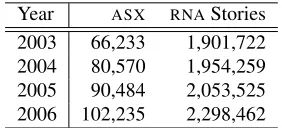
cov-Year ASX RNAStories
[image:3.612.306.534.60.328.2]2003 66,233 1,901,722 2004 80,570 1,954,259 2005 90,484 2,053,525 2006 102,235 2,298,462
Table 1: Document count per year.
Source Count Text (%)
ASX 10,404 83.9
RNA 8,277 99.6
Table 2: Document type distribution and text coverage.
ering the same time span and tickers. Sirca3provides ASX official announcements and RNA stories to sub-scribers. Table 1 shows the document count per year for our entire dataset. The overarching trend is that the volume ofASXandRNAdata increases with time, though it is worth noting that the count forRNA data includes all Reuters stories released globally, which explains the disparity in size.
Table 2 describes our experimental dataset: a subset of the ASX andRNA datasets, all chosen from an 18 month period from the beginning of 2005. We show the counts of documents in each source and the pro-portion of those documents which yielded usable text. To filter the RNA stories specific to theASX market, we select only those marked withASXtickers and the English language tag. We choose 403 tickers from the
ASX200 index4 over the last day of each year from
2002 to 2008 to identify large and newsworthy com-panies.
The broad scope of theASX’s continuous disclosure rules means that almost any type of document can ap-pear as an announcement. While these are all in PDF
format, the dataset includes short letters, corporations law forms, long annual reports and presentation slides. In addition to these differences in length and form, companies’ different industries mean that a wide va-riety of genres and topics can appear. For any content-level processing, the announcement text must be ex-tracted from thePDFfile, which may include scanned or faxed documents. Text for 83.9% of documents was extracted using the PDFBox5Java libraries. Plain-text metadata is also included, specifying the publishing timestamp, title and related tickers of each announce-ment.
The RNA data collects together stories taken from the global Reuters news feed and represents a unique multi-lingual resource. Each story is made up of a se-quence of distinct eventsbased on the Reuters
work-3http://www.sirca.org.au
4http://www.standardandpoors.com 5http://incubator.apache.org/pdfbox
Figure 1: The evolution of anRNAstory.
Link Text
FIRST . . . Record BHP profit of $2.45 million. . .
BACK . . . BHP has been moving into NSW. . .
ANLY . . . The profit exceeds expectation, said. . .
Table 3: Examples of RNAstory journalistic contribution given the ASX announcement information: BHP posted record annual profits of$2.45 million..
flow. Figure 1, taken from the RNA documentation, shows an example of the evolution of a story. A news-worthy event might consist of alerts concisely stating the main information, followed by a newsbreak with a headline, two to four paragraphs and then any num-ber of updates to Reuters’ coverage. We use a unique ‘story key’ found in each event to aggregate them into a story, reconstituting the text to its final, canonical form. In addition to the text and title, each story is tagged with lists of relevant tickers, languages, topics and geographical areas. Only 55.7% ofRNAstories are tagged with one ticker, in contrast to the 92.7% ofASX
announcements. RNAstories, as such, are more likely to report about more than one company and possibly contain different threads of information.
4
Annotation Scheme
We developed a scheme that codifies information flow in Finance text. The scheme describes two phenom-ena: whether anRNAstory contains information from
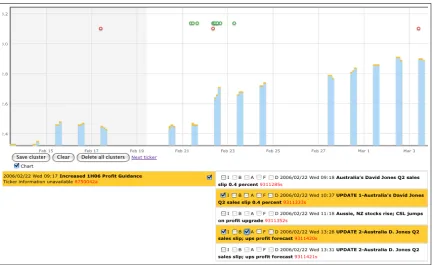
[image:3.612.110.251.63.127.2]journal-Figure 2: Ascreenfrom the annotation interface showing links between an announcement and two stories
istic contribution that theRNAstory makes. TheLINK
label applies if the story in anASX-RNApair contains information from the announcement. In this case, in-formation is defined as company details that are legally required to be disclosedfirstthrough an announcement to the ASX (i.e., continuous disclosure). Journalistic contribution mainly concerns the RNA story and can be indicated by any ofFIRST,BACKorANLY. FIRST
indicates that the story is the first to cover the infor-mation in the announcement. BACK refers to back-ground information regarded as common knowledge and publicly available before the release of the an-nouncement. ANLYdescribes new information added by the news source, such as analysis, editorial con-tent and new quotes from industry commentators. Ta-ble 3 shows examples of the link types. The distinc-tion betweenBACKandANLYis subjective since it the annotator must decide whether information is already known (i.e.,BACK) or whether it is novel analysis.
The scheme also defines an annotation unrelated to information flow: DIGEST. The Reuters dataset in-cludes stories that contain snippets of news that relate to multiple events and companies, often a daily mar-ket report of reviews of ‘Hot stocks’. TheseRNA sto-ries would be likely to report information from many sources and theDIGESTannotation allows their
exclu-sion (although we do not do so in our experiments).
5
Annotation Task
The annotation task and interface were designed to allow annotators to read ASX-RNApairs and identify any information flow. A pilot annotation team of Fi-nance PhD students assisted in the development of the scheme and interface by participating in a shared anno-tation task. The initial scheme specified that the links were mutually exclusive but resulted in low Cohen’s Kappa agreement scores (Cohen, 1960). After several iterations of relaxing and refining the scheme, Kappa inter-annotator agreement was sufficient to begin the main annotation phase.
A second team of Finance students was hired and af-ter completing a shared task, the seven annotators with consistently high average Kappa score were chosen to continue. An 18 month period from 2005 to mid-2006 was used to create screens. Ascreen consists of the
[image:4.612.83.516.61.326.2]an-Task Mean Kappa
LINK 0.75
FIRST 0.71
BACK †0.66
ANLY †0.55
Table 4: Mean Kappa inter-annotator agreement scores (N=5).†indicates lower than acceptable Kappa.
notated for use as training data and 42 shared screens for evaluation.
Figure 2 shows ascreenfrom the annotation tool. A screen consists of three main sections: a time-aligned navigation panel spanning the top, then two vertical document lists below. The top timeline panel shows the fortnight of interest and a context week either side (though the right context week is not shown in this fig-ure), showing stories that might be related to the an-nouncements at the edges of the target fortnight.
The panel displays the stock price and rows of dots indicating anASXannouncement orRNAstory. In this example, the ASXannouncements on the bottom row are followed by a burst ofRNAstories on the top row and this visualisation helps annotators to quickly navi-gate large complex screens with many announcements and stories.
The two time-ordered lists of documents on the bot-tom of the panel show the ASX announcements on the left and RNA stories on the right. The titles and timestamp are always visible and annotators can click to reveal the RNA story text or open the ASX PDF
file. Checkboxes corresponding to the information flow link types are arranged towards the middle of the lists.
Although all evaluation here applies to ASX-RNA
pairs, the list presentation format allows annotators to cluster related documents. We define a cluster as an announcement and one or more stories related to that same announcement. The highlighted cluster in Figure 2 consists of the ASX announcement on the left and second and fourthRNAstories on the right hand side. The RNAI checkboxes show cluster membership and the A checkbox shows the ANLY link for the second story. The main benefit of this strategy is efficiency since the top-down view allows annotators to easily isolate clusters without re-reading documents and see which clusters they had previously created.
It is also possible to add multiple ASX announce-ments to the same cluster, for example when a meet-ing announcement is followed by a set of presenta-tion slides. However, the main constraint is that clus-ters be as minimal as possible and any announcements containing new information should form new clusters. For example, a company takeover might span several months of offer and counter-offer but our annotation
Label Count % ASX RNA
LINK 6,380 4.71 17.1 33.6
FIRST 2,638 1.95 16.7 17.7
BACK 4,707 3.47 15.1 27.2
[image:5.612.333.496.63.127.2]ANLY 1,759 1.30 7.2 9.9
Table 5: Count and percentages of links in both training and evaluation datasets (135,537 pairs,lagmax= 7days).
Per-centage of linked documents for each source.
should pick out the individual stages of the overarch-ing process. Moreover, the minimality constraint en-courages conceptual clarity and mirrors the way infor-mation is released piecemeal while still allowing later aggregation of clusters if required.
Inter-annotator agreement for our five annotators is assessed using Cohen’s Kappa over the shared task of 42 screens. Table 4 shows that acceptable Kappa scores are achieved forLINKandFIRSTwith border-line Kappa scores forBACK– relative to the threshold at 0.67 (Carletta, 1996). ANLY was annotated with lower agreement and is consistent with annotator feed-back during scheme development, where ANLYlinks were the most difficult to disambiguate from BACK
since the distinction between existing and new infor-mation proved subjective.
We placed an upper bound of a week on the time lag between ASX andRNA publishing time. Though primarily an optimisation step to reduce the number of pairs for comparison, it is also consistent with the clus-ter minimality constraint; annotators were encouraged to split clusters that spanned too long a time.
Table 5 shows the count of links (with a maximum lag of a week) across the individual and shared screens and, in the second column, the distribution of the link types.BACKis the most frequent type beyond the pre-requisiteLINKlink, followed byFIRSTand thenANLY. While the lowANLYproportion might be due to sto-ries that emphasise topic and background, low Kappa scores forBACKandANLYmakes it difficult to rule out annotator confusion. Table 5 also indicates that while roughly even proportions of documents are linked by
FIRSTandANLY, far moreRNAstories are linked by
LINKandBACK. Indeed, no more than a third of each journalistic contribution link type appear without an-other (they all co-occur withLINK) , indicating that the annotators applied them with a high degree of overlap.
6
Features
[image:5.612.133.230.63.125.2]both tokenised using theNLTK’s word tokeniser (Bird et al., 2009) and implementation of the Punkt sentence tokeniser (Kiss and Strunk, 2006). Unigram and bi-gram features are extracted, ignoring punctuation and any n-grams that include a token inNLTK’s list of 127 English stopwords.
To model fine-grained textual similarity, we define three set-theoretic classes of bag-of-words features de-pending on where content is found: intersection (ASX
∩RNA),onlyin the announcement (ASX\ RNA) and onlyin the story (RNA\ASX). These methods are ap-plied to unigrams and bigrams in the title and body text of the ASX-RNA pair. The intersection text/title features are used for a baseline approach. The set-theoretic features are mainly designed to model infor-mation flow’s similarity, and the story’s contribution (RNA\ASX).
The information flow problem requires tracking of short units of text such as distinctive terms and figures. We encode this using Text Reuse similarity scores over text unigrams, title unigrams and tokens containing one or more digits (Metzler et al., 2005). The scores calculated are symmetric overlap, asymmetric overlap favouring theRNAstory with and without inverse doc-ument frequency weighting, aTFIDFoverlap score and two cosine similarity scores, one unweighted and one
TFIDFweighted.
To capture longer units of reused text, we take tokens including stopwords from each sentence and count the number of exact sentence matches between the ASX-RNA pair. Common token sub-sequences are found using Python2.6’s difflib library6. The sequences include stopwords and have a minimum length of three since we already calculate bigrams. Both the lengths and counts of these sub-sequences are rounded into bins to produce features such as:seq-len andseq-len-count indicating that there were matches oflenand that there werecountof them respectively.
We also extract features to represent the precision of financial figures mentioned in both texts: the more precision used, the more important the figure. For each number string appearing in both texts, if it consists of a non-zero digit followed by any number of zeros or periods, the characters are replaced with0. Otherwise, the characters were replaced with #. For example, a round number like5000would be replaced by0000
and a more interesting number like 45.3would be replaced with####. The set of these precision-hashed numbers are used as features.
Time is an important factor in news and we pro-pose that the placement of announcements and stories in the news cycle is significant. The temporal fea-tures consist of thetime lagbetween the release time
6http://docs.python.org/library/difflib.
html
Label Training % Evaluation %
Total pairs 30,249 100.0 1,621 100.0
LINK 5,596 18.5 231 14.3
FIRST 2,394 7.9 81 5.0
BACK 4,118 13.6 166 10.2
ANLY 1,472 4.9 72 4.4
Table 6: Distribution of links in the training (30,249 pairs) and evaluation (1,621 pairs) datasets - both use a lag of less than 1 day.
of the story and the announcement, mapped to bins that increase in size either side of zero (to account for stories that occur before announcements). For example, the bins around zero are: [-15...-5), [-5...0), [0...5), [5...15) and are left-closed and right-open so that a pair released at the same time will have a feature value of[0...5). In addition to this, the time of each document release is rounded to the half-hour, generating a feature to repre-sent theASX’s news cycle.
7
Experimental Methodology
The information flow problem is framed as four bi-nary text categorisation tasks over theASX-RNApairs – one task for each link type. The development ex-periments use 10-fold cross validation and we report precision, recall and F-score for classifying pairs as labelled. We do not report scores for classifying unla-belledpairs since these are far more common than the labelled pairs. The experiments use the MegaM Max-imum Entropy classifier (Daum´e III, 2004) with the
binomialoptions to represent the binary features. To compare to human performance, a model is trained using the development data and used to clas-sify the pairs from the shared annotation task. Gold standardmajoritydata is created by positing atruelink where it is marked by a majority of the five annotators – a more difficult task. Each annotator is compared against the majority and the mean result is used as the upper bound on system performance.
Table 5 showed a highly skewed annotation label distribution in the ASX-RNA pairs released within a week of one another. However, approximately 92% of the links occur within 24 hours of one another and Ta-ble 6 shows that applying theshort time lagimproves the class distribution. We still consider all pairs in the evaluation dataset, though our system only classifies pairs within the 24 hour lag and thus classifies the 30
Task Features P (%) R (%) F (%)
LINK Baseline 85.0 73.1 78.6
LINK Best 90.9 88.1 89.5
FIRST Baseline 66.0 43.9 52.7
FIRST Best 77.0 70.1 73.4
BACK Baseline 83.4 67.1 74.4
BACK Best 88.4 83.2 85.7
ANLY Baseline 78.9 56.0 65.5
[image:7.612.305.547.62.323.2]ANLY Best 86.7 75.0 80.4
Table 7: Precision, recall and F-score for cross-fold valida-tion experiments.
8
Results
Table 7 summarises the experimental results, showing baseline and best precision, recall and F-score fortrue link classification. Text intersection unigrams and bi-grams, title intersection unigrams and bigrams were used as baseline features and those scores were ex-ceeded for all link types. While higher F-scores were achieved, for the most part, in the tasks with higher prior link probabilities, scores in ANLYwere surpris-ingly high given its low prior of 4.9.
Table 8 shows the best performing (by F-score) fea-ture combinations for each link type. To test the con-tribution of each feature, subtractive analysis was per-formed on the best performing feature set for each link type. An experiment is conducted that uses all but one feature and the results compared to best using ap-proximate randomisation (Chinchor, 1995) to assess whether adding the omitted feature results in a sta-tistically significant improvement.7 Features used are marked with·, while features are marked with?or??
if their removal results in significantly worse F-score (at p<0.05 and p<0.01 respectively).
The first observation to make from the table is that the tasks can be separated into two groups on the set of features that was most successful: LINK/BACKand
FIRST/ANLY, though this may also be related to the different prior link probabilities, higher and lower for each group in this case.
Features based on the text play perhaps the broad-est role, both modelling information flow and jour-nalistic contribution. Although intersection unigrams and bigrams appeared in all feature sets, text intersec-tion bigrams were only significant inLINKandBACK. One reason might be that they more effectively model topic-level textual similarity while being less suscepti-ble to single words appearing by chance in both texts. The textual similarity measures were significant for the LINK,FIRST andBACKexperiments, perhaps be-cause they are able to weight terms more effectively.
7We adapt a parsing evaluation script http://www.cis.
upenn.edu/˜dbikel/software.html
Features LINK FIRST BACK ANLY
ASX∩RNA TEXT-1G · · · · ASX∩RNA TEXT-2G ?? · ?? ·
ASX\RNA TEXT-1G ASX\RNA TEXT-2G
RNA\ASX TEXT-1G · · RNA\ASX TEXT-2G · ?? ASX∩RNA TITLE-1G · · · · ASX∩RNA TITLE-2G · · · · ASX\RNA TITLE-1G ?? ?? ASX\RNA TITLE-2G ?? ?? RNA\ASX TITLE-1G · · ?? ·
RNA\ASX TITLE-2G ?? · ? ·
TEXT SIMILARITY ?? ?? ? ·
TITLE SIMILARITY · ?? · ·
SENTENCES · · · ·
SEQUENCES · ?? · ·
NUM SIMILARITY · ·
NUMBER PRECISION ? ·
TIME LAG ?? ?? ?? ·
TIME OF DAY · · · ?
Table 8: Feature combinations for the best performing devel-opment experiments. Features significant from subtractive analysis are annotated?(p<0.05) and??(p<0.01)
Common sequence matching proved significant in de-tectingFIRSTand no other experiments. Reported fig-ures and information are more likely to be reported verbatim, rather than be subject to editing, and this may play a role in the features’ success. Of the text set difference features, only bigrams that appeared in the
RNAstory and not theASXannouncement were signif-icant and only then forANLY, suggesting that the fea-ture effectively represents commentary. Interestingly, text present only in the ASX announcement was not used in any well-performing experiment. One poten-tial explanation is that the wide variety of text sizes is simply too noisy a feature for the model to generalise.
Titles play an important role in announcements and stories, summarising the event that they report on. Rather than intersection, the ASX and RNA set dif-ferences proved to be more significant features. The
[image:7.612.85.278.64.180.2]Task Baseline Best Upper
LINK 62.5 ??76.7 86.4
FIRST 38.8 53.0 83.1
BACK 56.7 ??68.0 80.8
[image:8.612.102.263.63.130.2]ANLY 38.2 45.7 72.5
Table 9: Model F-score agreement withmajority. Upper is the mean of the F-scores for each annotator andmajority.?? indicates significance (p<0.01)
non-indicative terms. Title similarity was important in
LINKand FIRST, the only significant title-based fea-ture for the latter task. Further exploration would be required to measure how much information is trans-ferred in the titles alone.
Numbers are central to information flow in Finance and the two features based on numbers, similarity measures and precision were present in theFIRSTand
ANLYexperiments. The number precision feature was significant for theFIRSTexperiments, while similarity and precision were just under significance forANLY. Though these initial results are encouraging, the im-portance of number to information flow means that more work is required.
Finally, news has a strong temporal dimension and we expected the lag feature to be significant for all link types. While it was for LINK,FIRSTandBACK, the time-of-day feature was more significant forANLY.
That the analysis and commentary are the only link types sensitive to their placement in the news cycle points, potentially, to less time critical stories released at regular times.
Table 9 shows performance between the baseline and majorityin the evaluation task. While the lack of significant results forFIRSTandANLYis somewhat discouraging, reasonable results for LINKand BACK
indicate the feasibility of our approach to the informa-tion flow problem.
9
Conclusion
Our paper presents a formalisation of the information flow problem in the Finance domain. We present an annotation scheme that codifies flow of facts from pri-mary to secondary sources and apply it to ASX an-nouncements andRNAstories. Moreover, the scheme models three types of journalistic contribution and, de-spite its difficulty, can be applied with high agreement. We explore a range of features from diverse fields and combine them to classify the different information flow types. Textual features based on the intersection and differences of document texts and titles prove use-ful, while number features show promise at identifying financial figures. Temporal features allow modelling of the news cycle and news source responsiveness to identify linked documents.
This paper presents a new approach to the informa-tion flow problem in the Finance domain, essentially text categorisation over thepairof documents. While bag-of-words performs predictably well in this task, we are able to take advantage of temporal and textual features to classify information flow at 89.5% F-score and journalistic contribution from 73.4% to 85.7% F-score. In evaluation against human performance of 86% F-score, our system scores 77% for flow classi-fication; demonstrating we can feasibly track informa-tion flow in Finance text.
10
Acknowledgements
We would like to thank all reviewers, both anonymous and from the Sydney Language Technology Research Group for their feedback. We also thank Dominick Ng, Silvio Tannert, Amy Kwan and Ingo Wiegand at the Capital Markets CRC for their assistance preparing the corpora and managing the annotation project. This research was conducted with the support of a Capital Markets CRC High Achiever’s Scholarship.
References
James Allan, Jaime Carbonell, George Doddington, Jonathan Yamron, and Yiming Yang. 1998a. Topic detec-tion and tracking pilot study final report. InIn Proceed-ings of the DARPA Broadcast News Transcription and Understanding Workshop, pages 194–218.
James Allan, Ron Papka, and Victor Lavrenko. 1998b. On-line new event detection and tracking. In SIGIR ’98: Proceedings of the 21st annual international ACM SIGIR conference on Research and development in information retrieval, pages 37–45, New York, NY, USA. ACM. ASX. 2008. Continuous disclosure. ASX Listing Rules,
Chapter 3.
Steven Bird, Edward Loper, and Ewan Klein. 2009. Natural language processing with python.
Sergey Brin, James Davis, and H´ector Garc´ıa-Molina. 1995. Copy detection mechanisms for digital documents. In
SIGMOD ’95: Proceedings of the 1995 ACM SIGMOD international conference on Management of data, pages 398–409, New York, NY, USA. ACM.
Peter F. Brown, Jennifer C. Lai, and Robert L. Mercer. 1991. Aligning sentences in parallel corpora. Proceedings of the 29th annual meeting on Association for Computa-tional Linguistics.
Jean Carletta. 1996. Assessing agreement on classification tasks: The kappa statistic. Computational Linguistics, 22:249–254.
Nancy Chinchor. 1995. Statistical significance of muc-6 re-sults. InMUC6 ’95: Proceedings of the 6th conference on Message understanding, pages 39–43, Morristown, NJ, USA. Association for Computational Linguistics. Paul Clough, Robert Gaizauskas, Scott S. L. Piao, and
Yorick Wilks. 2002. Meter: Measuring text reuse. In
Association for Computational Linguistics, pages 152– 159, Morristown, NJ, USA. Association for Computa-tional Linguistics.
Jacob Cohen. 1960. A coefficient of agreement for nomi-nal scales. Educational and Psychological Measurement, 20(1):37–46, April.
Hal Daum´e III. 2004. Notes on cg and lm-bfgs optimization of logistic regression. Aug.
William A. Gale and Kenneth W. Church. 1991. A program for aligning sentences in bilingual corpora. In Proceed-ings of the 29th annual meeting on Association for Com-putational Linguistics, pages 177–184, Morristown, NJ, USA. Association for Computational Linguistics. Daniel Gruhl, R. Guha, David Liben-Nowell, and
An-drew Tomkins. 2004. Information diffusion through blogspace. InWWW ’04: Proceedings of the 13th inter-national conference on World Wide Web, pages 491–501, New York, NY, USA. ACM.
Vasileios Hatzivassiloglou, Judith L. Klavans, and Eleazar Eskin. 1999. Detecting text similarity over short pas-sages: Exploring linguistic feature combinations via ma-chine learning. InProceedings of the 1999 Joint SIGDAT Conference on Empirical Methods in Natural Language Processing and Very Large Corpora, pages 203–212, Col-lege Park, Maryland, June. SIGDAT.
Timothy C. Hoad and Justin Zobel. 2003. Methods for iden-tifying versioned and plagiarized documents. Journal of the American Society for Information Science and Tech-nology, 54(3):203–215.
Tibor Kiss and Jan Strunk. 2006. Unsupervised multilingual sentence boundary detection.Computational Linguistics, 32(4):485–525.
Jon Kleinberg. 2003. Bursty and hierarchical structure in streams. Data Mining and Knowledge Discovery, 7(4):373–397.
Victor Lavrenko, James Allan, Edward DeGuzman, Daniel LaFlamme, Veera Pollard, and Stephen Thomas. 2002. Relevance models for topic detection and tracking. In
Proceedings of the second international conference on Human Language Technology Research, pages 115–121, San Francisco, CA, USA. Morgan Kaufmann Publishers Inc.
Chris Manning, Prabhakar Raghavan, and Hinrich Sch¨utze. 2008. Introduction to information retrieval. Cambridge University Press New York, NY, USA, Jan.
Donald Metzler, Yaniv Bernstein, W. Bruce Croft, Alistair Moffat, and Justin Zobel. 2005. Similarity measures for tracking information flow. InCIKM ’05: Proceedings of the 14th ACM international conference on Information and knowledge management, pages 517–524, New York, NY, USA. ACM.
Gerard Salton, A Wong, and Chung-Shu Yang. 1975. A vec-tor space model for automatic indexing.Communications of the ACM, 18(11):613–620.
Ian Soboroff. 2004. Overview of the trec 2004 novelty track. InThe Thirteenth Text Retrieval Conference (TREC 2004).
Karen Sp¨arck Jones. 1973. Index term weighting. Informa-tion Storage and Retrieval, 9(11):619–633.
Michael J Wise. 1996. Yap3: improved detection of similar-ities in computer program and other texts.SIGCSE Bull., 28(1):130–134.