Refurbishing a Morphological Database for German
Petra Steiner
Institute for Information Science and Natural Language Processing Hildesheim University
Abstract
The CELEX database is one of the standard lexical resources for German. It yields a wealth of data especially for phonological and morphological applications. The morphological part comprises deep-structure morphological analyses of German. However, as it was developed in the Nineties, both encoding and spelling are outdated. About one fifth of over 50,000 datasets contain umlauts and signs such asß. Changes to a modern version cannot be obtained by simple substitution. In this paper, we shortly describe the original content and form of the orthographic and morphological database for German in CELEX. Then we present our work on modernizing the linguistic data. Lemmas and morphological analyses are transferred to a modern standard of encoding by first merging orthographic and morphological information of the lemmas and their entries and then performing a second substitution for the morphs within their morphological analyses. Changes to modern German spelling are performed by substitution rules according to orthographical standards. We show an example of the use of the data for the disambiguation of morphological structures. The discussion describes prospects of future work on this or similar lexicons. The Perl script is publicly available on our website.
Keywords:morphology, word structure, deep-structure morphological analyses, CELEX, orthography
1.
Introduction and related work
While the number of existing digital linguistic data in-creases, sustainability is growing more and more impor-tant within the field of language resources. Whereas some approaches favor the exploitation of multi-authored and distributed knowledge such as Wiktionary (Sagot, 2014; Sylak-Glassman et al., 2015), others’ work also uses older and more established sources (Borin et al., 2009). The current project aims at updating a part of CELEX, which is a database of Dutch, English, and German lexical in-formation (Baayen et al., 1995). Besides inin-formation on orthographic, phonological and syntactic features, it also contains ample information on word-formation, especially manually annotated multi-level word structures.
Current morphological analyzers for German yield flat structures of morphs or word constituents on different lev-els, e.g. SMOR (Schmid et al., 2004), Gertwol (Haa-palainen and Majorin, 1995), MORPH (Hanrieder, 1991; Hanrieder, 1996), TAGH (Geyken and Hanneforth, 2006) but no hierarchical parses which can provide important in-formation for word sense disambiguation. Only W¨urzner and Hanneforth (2013) present an approach for full mor-phological parsing of German, which is, however, restricted to adjectives.
By contrast, the German part of the CELEX database comprises word tree information for a lexicon containing words of all parts of speech and is therefore an important source for deep-structure morphological analyses of Ger-man, which are not available elsewhere. The linguistic in-formation is combined with frequency inin-formation based on corpora (Burnage, 1995) which makes it useful for au-tomated morphological analysis of unknown words. However, the German part of the database has some draw-backs which impair its usefulness: About one fifth of the 51,728 lemmas contain letters such as ¨aorß. As the data-base was created at a time before modern encoding, um-lauts are represented as ae, oe etc. Unfortunately, these
strings cannot be recovered by simple substitutions, as (1) demonstrates, while for (2) the replacement of an umlaut is required.
(1) Lemma:Oboe- representationOboe‘oboe’
(2) Lemma:b¨ose- representationboese‘bad’
Also, while the orthographic information for the lemmas of headwords and stems can be extracted easily from the lexicon, this is not the case for some parts within the mor-phological analyses.
Another problem is the use of an out-dated spelling conven-tion which makes the lexicon partially incompatible with text written after 1996 when spelling reforms were imple-mented in Austria, Germany and Switzerland. For instance, the modern spelling of the originally CELEX entry Ab-schluß‘conclusion’ isAbschluss.
As the database was created according to the standard-ized spelling conventions of its time, there are only a few spelling mistakes which call for corrections and no spelling variants as in older historical German texts. The changes are very regular and do not have to be tackled by using variants of Levenshtein Distance as done by Bollmann et al. (2012).
2.
German in the CELEX Database
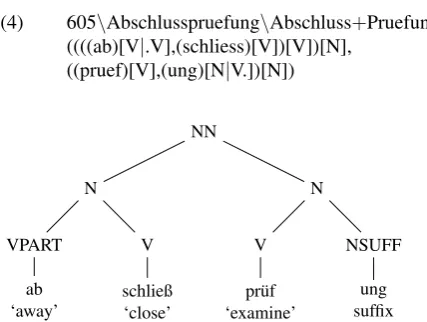
For each of the languages of the CELEX Database (Baayen et al., 1995), three types of linguistic information are pro-vided: orthographic data, information on word formation, and syntactic information. For our purposes, only the first two parts for the German language are of interest.1 The orthographic information (German orthography lem-mas, henceforth GOL) contains information on umlauts and other special characters, corpus frequency and syllabic segmentation for headwords and stems. Special charac-ters are represented by diacritical marks or other symbols. (3) shows an extract of a typical entry with such an en-coding. Morphological information (German morphology lemmas, henceforth GML) as in (4) comprises, among oth-ers, the corpus frequency, the word-formation type, the sin-gular and plural inflectional patterns, and the immediate constituents. ForAbschlußpr¨ufung‘final exam’ the imme-diate constituents areAbschluß ‘conclusion’ and Pr¨ufung‘exam’. Furthermore, complete morphological parses are provided, as in (4), which is rendered in tree form in Figure (1).
(3) 605\Abschlu$pr”ufung\14\Ab” schlu$” pr”u” fung \N\Abschlu$pr”ufung\Ab-schlu$-pr”u-fung\N (4) 605\Abschlusspruefung\Abschluss+Pruefung\
((((ab)[V|.V],(schliess)[V])[V])[N],
Figure 1: Morphological analysis ofAbschlußpr¨ufung ‘fi-nal exam’
In GML, non-ascii letters are represented by ascii substi-tutes such asaefor ¨a or ssforß. While the information about these special characters of a lemma can be easily ex-tracted from the related entry in GOL, this is not always possible for the morphological analysis of the deepest mor-phological layer. In (4),Abschlußis a derivative of the verb
schließen‘to close’. It is a result of ablaut alternation and by this leads to spelling variants ofssvs.ß, at least in Ger-many and Austria since the orthographic reforms.2
3.
Revision of the data
In most cases, the orthographic information of lemmas and their constituents could be retrieved from GOL, as the head-words of verb stems such asschließcan be retrieved.
How-1
For an exhaustive description of the database see Gulikers et al. (1995).
2The spelling conventions for Swiss German prescribe thatss is used instead ofß.
ever, for root formations such asf¨otal‘fetal’ with the seg-mentation (f¨ot|al) there is no entry for the root form f¨ot
(here spelled asfoet). A simple substitution to umlauts is not possible, as other roots such asaero‘aero’ do not re-quire this change.
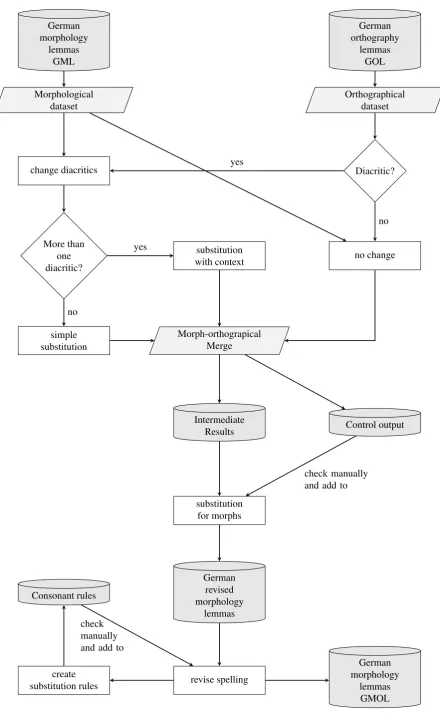
Therefore, in order to avoid time-consuming post-editing, the components of morphological analyses have to be adapted by heuristics and manually checked. Finally, the lexical database can be generated according to the most re-cent spelling rules. Figure 2 provides an overview of the procedure for changing the German morphology part of the CELEX database to modern standards. The implementa-tion was done in Perl 5.14 on Linux.
3.1.
Merging orthographic and morphological
information
The procedure starts with processing pair-wise entries from the orthographic data (GOL) and the morphological part of the database (GML). If the orthographic representation contains one or more diacritics, the generation of the mod-ern encoding is called. If there is just one diacritic char-acter within the word, the charchar-acter substitution is trivial and also performed on its morphological analyses adjusting for variation between upper-case and lower-case initials of constituents and headwords.
Otherwise, the surrounding characters are added to the replacement patterns. This prevents incorrect substitu-tions for words such as Zuschauertrib¨une ‘grand stands’ with two strings ofuein the morphological database entry
Zuschauertribuene, of which only one has to be changed. If however the contexts of one character are equal too, as for
Ausschuss‘commission’, where only the secondssis to be transformed according to the old spelling rules, the lemmas are added to a control output file, to be manually checked and, if necessary, treated in the next step. For the current state of the database this holds for only 14 entries. All of them can be transformed in the correct way for a context of two characters preceding (forss) or following the ambigu-ous string.
3.2.
Changing morphs within morphological
analyses
The produced datasets with the revised lemmas and some of the morphological analyses are used as input for the changes of the morphological analyses. Some morphs in the analyses contain diacritics while the lemmas do not. For example, in (5) the first immediate constituent of Singular-itaet (Singularit¨at) ‘singularity’ is the adjectivesingulaer (singul¨ar)‘singular/unique’.
(5) Singularitaet ((singulaer)[A],(itaet)[N|A.]) For other morphs, lists of substitution rules have to be com-piled. For instance, while the character sequenceoescannot be generally converted to ¨os, that change is always appro-priate when it concerns the suffix ¨os.
German morphology
lemmas GML
German orthography
lemmas GOL
Morphological dataset
Orthographical dataset
change diacritics Diacritic?
no change yes
no
More than one diacritic?
substitution with context
simple substitution
yes
no
Morph-orthograpical Merge
Intermediate
Results Control output
substitution for morphs
check manually and add to
German revised morphology
lemmas
revise spelling Consonant rules
create substitution rules
German morphology
lemmas GMOL check
manually and add to
Moreover, certain typographical errors can be corrected in this step as well as some overgeneralizations from the first step. The procedure contains 257 substitution rules of words and strings.
3.3.
Changes to modern German spelling
The old spelling can be changed to the modern spelling ver-sion of German as it is used in Germany. This in particu-lar concerns words with short vowels preceding former in-stances ofßas in (7). Another difference results from the former rule to delete one of three identical consonants if no different consonant follows as in (8). The words concerned are usually compounds.
(7) a. Prozeß‘prozess’ (old spelling) b. Prozess(new spelling)
(8) a. Schiffahrt‘shipping (ship ride)’ (old spelling) b. Schifffahrt(new spelling)
88 substitution rules for the first type of change were de-rived according to the rules of Dudenredaktion (2013). The lemmas for which the second rule applies are diffi-cult to identify in a list of over 50,000 entries. Therefore, the substitution rules for double to triple consonant clus-ters are derived semi-automatically and incrementally from the morphological part of the lexicon. For example, in (9) the numbers off in the lemma and immediate constituents differ.
(9) Schiffahrt - Schiff+Fahrt
This leads to the production of the substitution rule in (10) (10) $stransformed=˜ s/Schiffahrt/Schifffahrt/g; After the new spelling variantSchifffahrthas been entered into the substitution rules, the old variant Flussschiffahrt
‘river navigation’ can be found in the next step as a candi-date for another substitution rule, as the numbers off in the lemma and immediate constituents differ now (11). This entry is transformed in the next step.
(11) Flussschiffahrt - Fluss+Schifffahrt
This procedure is manually supervised and continues until no further substitution rules can be found. We refer to the refurbished data as GMOL.
4.
Results
10,106 of the 51,728 GML entries contain diacritics, in most cases within both the lemma and their morphological analyses. The merging of GOL and GML information leads to the revision of 9,980 entries with 9,072 umlauts (e.g. ¨a), 1,491 instance of ß and 9 letters with acute accent. The procedure for revising the morphological analyses yields 613 changes. All of them are correct. The adaption of the modern spelling to the headwords and the components of their morphological analyses leads to 576 updated entries, of which 526 involve changes ofßtoss.
Three cycles of the generation of double consonants rules yield 41 substitution rules and 46 changes within the en-tries. All in all, 10,197 entries from the morphological database were updated.
We tested GMOL on the 1,101 lexical items of Cap’s (2014, 95) gold standard for the task of compound splitting, who uses part of the test set of the 2009 Workshop on statistical machine translation.3
Of these, we created a list of (best) morphological analy-ses produced by a combination of SMOR and an heuris-tical approach (Steiner and Ruppenhofer, 2015). We ex-tracted all types of constituents and compared this list with all constituents of GML’s respectively GMOL’s morpho-logical analyses. Table 1 provides an overview of our in-vestigation.
Sum GML GMOL
Types 1265 1010 1111
Overall Recall 0.80 0.88
Unfound diacritics 121 121 11
Recall for diacritics 0 0.91
Simple substitution 121 36 36
Recall for simple subst. 0.70 0.70
Table 1: Recall for the old and the refurbished database The eleven constituents with the unfound diacritics were either missing in the CELEX database (e.g. Ara¨ ‘era’) or wrongly analysed parts of syntagmatic compounds which are erroneously segmented as endocentric compounds such asj¨ahrig‘*year-ig(suffix)’ of50-j¨ahrig‘50-years old’. If a simple substitution of all instances ofaeto¨aetc. is used, the wrongly generated forms would produce a recall of 0.70 for the forms including diacritics and 0.86 for all items. As 256 words of the gold standard comprise diacritics, the impact on the word level is actually higher.
5.
Application
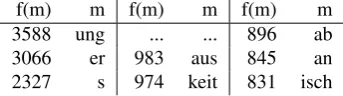
The morphological database can be used to obtain reliable frequency information on morphs and constituents. Table 2 presents some of the most frequent morphs in the database.
f(m) m f(m) m f(m) m
3588 ung ... ... 896 ab
3066 er 983 aus 845 an
2327 s 974 keit 831 isch
Table 2: Frequencies of morphsmfrom GMOL
As frequencies we used the counts of morphs and immedi-ate constituents of the revised German CELEX data. Fig-ures (3) and (4) give two possible analyses of the Ger-man compound Anbaumenge‘cultivation amount’. Only the first tree represents a sensible decomposition.
Anbaumenge
Figure 3: Correct analysis ofAnbaumenge
]Anbaumenge
Figure 4: False analysis ofAnbaumenge
The numbers of the constituents of Anbaumenge as re-trieved from the CELEX database are x1 = 366 for an,
x2 = 53for bau, x3 = 8 for Menge, x4 = 7 for
An-bau, andx5 = 0.1forBaumenge, as this is the heuristical value of strings for which no entry in the CELEX database could be found. The values of the geometric means are
gm(An|bau|Menge) = 53.74 andgm(An|Baumenge) = 6.05. This leads to the preference for the first analysis. Steiner and Ruppenhofer (2015, 56) find an overall recall of 81.11 and a weak recall of 96.15 for such weighted decisions.
6.
Discussion and future prospects
Changing one fifth of a German morphological database according to modern encoding and spelling yields a wealth of 38,397 morphological analyses on the level of immedi-ate constituents as well as deeper analyses, and information on exactly 200 different word-formation types. As the CELEX Database (Baayen et al., 1995) is under license from the European Language Resources Association, the revised version cannot be made publicly available. However, the script for the refurbishment of the data can be downloaded athttps://www.uni-hildesheim. de/media/fb3/informationswissenschaft/ IWiSt-CL/Steiner/OrthCELEX.pl.
Some drawbacks of the data are:
• The Mannheim Corpus which was used for the fre-quency counts (Gulikers et al., 1995, 102ff.) is rather small.
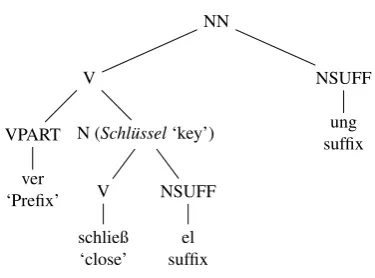
• Some of the derivations have a strong emphasis on di-achronic derivation as shown forVerschl¨usselung ‘en-cryption’ in Figure (5) where the nounSchl¨ussel‘key’ is analysed as a derivation from the verb schließen
‘close’ which is certainly justified but not adequate for every task.
N (Schl¨ussel‘key’)
V
Figure 5: Morphological analysis ofVerschl¨usselung
Therefore, the frequencies should be augmented or re-placed by ones from reliably lemmatized corpora. The derivational descriptions could be revised by an interested group of collaborators.
The refurbished CELEX database yields a sound basis for further developments in large-scale resources for morphol-ogy. We intend to use the lexicon and its frequencies to analyse morph boundaries within complex German words to analyse complex word structures, as done previously in Steiner and Ruppenhofer (2015). Other applications could be the development of a gold standard for morphological analyzers and parsers or as an training data for statistical approaches to hierarchical morphological parsing. So far, gold standards for German morphology as used by Cap (2014) and Steiner and Ruppenhofer (2015) provide only chains of morphs.
Last but not least, some parts of the script can be used for other purposes, especially for the transfer of existing Ger-man corpora from old to new spelling or the normalization of newer corpora with inconsistent spelling.
Acknowledgements
The author was supported by the German Research Foun-dation (DFG) under grant RU 1873/2-1.
7.
Bibliographical References
Bollmann, M., Krasselt, J., and Petran, F. (2012). Manual and semi-automatic normalization of historical spelling – case studies from early new high German. InIn Proceed-ings of KONVENS 2012 (LThist 2012 workshop, pages 342–350.
Toward Swedish FrameNet++. InFrameNet Masterclass and Workshop.
Burnage, G. (1995). CELEX: A Guide for Users. In Har-ald Baayen, et al., editors,The CELEX Lexical Database (CD-ROM). Linguistic Data Consortium, Philadelphia, PA.
Cap, F. (2014). Morphological processing of compounds for statistical machine translation. Ph.D. thesis, Univer-sit¨at Stuttgart.
Dudenredaktion. (2013). Duden - die deutsche Recht-schreibung. Der Duden / in zw¨olf B¨anden; das Standard-werk zur deutschen Sprache 1. Dudenverlag, Berlin, 26 edition.
Geyken, A. and Hanneforth, T. (2006). TAGH: A Com-plete Morphology for German based on Weighted Fi-nite State Automata. InFinite State Methods and Nat-ural Language Processing. 5th International Workshop, FSMNLP 2005, Helsinki, Finland, September 1-2, 2005. Revised Papers, volume 4002, pages 55–66. Springer. Gulikers, L., Rattink, G., and Piepenbrock, R. (1995).
Ger-man Linguistic Guide. In Harald Baayen, et al., edi-tors,The CELEX Lexical Database (CD-ROM). Linguis-tic Data Consortium, Philadelphia, PA.
Haapalainen, M. and Majorin, A. (1995). GERTWOL und morphologische Disambiguierung f¨ur das Deutsche. In
Proceedings of the 10th Nordic Conference on Compu-tational Linguistics, Helsinki, Finland.
Hanrieder, G. (1991). Robustes Wortparsing. Lexikon-basierte morphologische Analyse (komplexer) deutscher Wortformen. Master’s thesis, Universit¨at Trier.
Hanrieder, G. (1996). MORPH - Ein modulares und ro-bustes Morphologieprogramm f¨ur das Deutsche in Com-mon Lisp. In Roland Hauser, editor,Linguistische Veri-fikation Dokumentation zur Ersten Morpholymics 1994, pages 53–66. Niemeyer, T¨ubingen.
Sagot, B. (2014). DeLex, a freely-available, large-scale and linguistically grounded morphological lexicon for German. In Nicoletta Calzolari (Conference Chair), et al., editors, Proceedings of the Ninth International Conference on Language Resources and Evaluation (LREC’14), Reykjavik, Iceland, may. European Lan-guage Resources Association (ELRA).
Schmid, H., Fitschen, A., and Heid, U. (2004). SMOR: A German computational morphology covering derivation, composition and inflection. InProceedings of the Inter-national Conference on Language Resources and Evalu-ation (LREC).
Steiner, P. and Ruppenhofer, J. (2015). Growing trees from morphs: Towards data-driven morphological parsing. In
Proceedings of the International Conference of the Ger-man Society for Computational Linguistics and Lan-guage Technology, University of Duisburg-Essen, pages 49–57.
Sylak-Glassman, J., Kirov, C., Yarowsky, D., and Que, R. (2015). A language-independent feature schema for in-flectional morphology. In Proceedings of the 53rd An-nual Meeting of the Association for Computational Lin-guistics and the 7th International Joint Conference on Natural Language Processing of the Asian Federation
of Natural Language Processing, ACL 2015, July 26-31, 2015, Beijing, China, Volume 2: Short Papers, pages 674–680.
W¨urzner, K. and Hanneforth, T. (2013). Parsing morpho-logically complex words. In Mark-Jan Nederhof, editor,
Proceedings of the 11th International Conference on Fi-nite State Methods and Natural Language Processing, FSMNLP 2013, St. Andrews, Scotland, UK, July 15-17, 2013, pages 39–43. The Association for Computer Lin-guistics.