Semantic Role Features for Machine Translation
Ding Liu
Department of Computer Science University of Rochester
Daniel Gildea
Department of Computer Science University of Rochester
Abstract
We propose semantic role features for a Tree-to-String transducer to model the re-ordering/deletion of source-side semantic roles. These semantic features, as well as the Tree-to-String templates, are trained based on a conditional log-linear model and are shown to significantly outperform systems trained based on Max-Likelihood and EM. We also show significant im-provement in sentence fluency by using the semantic role features in the log-linear model, based on manual evaluation. 1 Introduction
Syntax-based statistical machine translation (SSMT) has achieved significant progress during recent years (Galley et al., 2006; May and Knight, 2007; Liu et al., 2006; Huang et al., 2006), showing that deep linguistic knowledge, if used properly, can improve MT performance. Semantics-based SMT, as a natural extension to SSMT, has begun to receive more attention from researchers (Liu and Gildea, 2008; Wu and Fung, 2009). Semantic structures have two major advantages over syntactic structures in terms of helping machine translation. First of all, semantic roles tend to agree better between two languages than syntactic constituents (Fung et al., 2006). This property motivates the approach of using the consistency of semantic roles to select MT outputs (Wu and Fung, 2009). Secondly, the set of semantic roles of a predicate models the skeleton of a sentence, which is crucial to the readability of MT output. By skeleton, we mean the main structure of a sentence including the verbs and their arguments. In spite of the theoretical potential of the semantic roles, there has not been much success in using them to improve SMT systems.
Liu and Gildea (2008) proposed a semantic role based Tree-to-String (TTS) transducer by adding semantic roles to the TTS templates. Their ap-proach did not differentiate the semantic roles of different predicates, and did not always improve the TTS transducer’s performance. Wu and Fung (2009) took the output of a phrase-based SMT sys-tem Moses (Koehn et al., 2007), and kept permut-ing the semantic roles of the MT output until they best matched the semantic roles in the source sen-tence. This approach shows the positive effect of applying semantic role constraints, but it requires re-tagging semantic roles for every permuted MT output and does not scale well to longer sentences. This paper explores ways of tightly integrating semantic role features (SRFs) into an MT system, rather than using them in post-processing or n -best re-ranking. Semantic role labeling (SRL) sys-tems usually use sentence-wide features (Xue and Palmer, 2004; Pradhan et al., 2004; Toutanova et al., 2005); thus it is difficult to compute target-side semantic roles incrementally during decoding. Noticing that the source side semantic roles are easy to compute, we apply a compromise approach, where the target side semantic roles are generated by projecting the source side semantic roles us-ing the word alignments between the source and target sentences. Since this approach does not per-form true SRL on the target string, it cannot fully evaluate whether the source and target semantic structures are consistent. However, the approach does capture the semantic-level re-ordering of the sentences. We assume here that the MT system is capable of providing word alignment (or equiva-lent) information during decoding, which is gener-ally true for current statistical MT systems.
fea-ture designed to penalize missing semantic roles in the target sentence. To use these features during de-coding, we need to keep track of the semantic role sequences (SRS) for partial translations, which can be generated based on the source-side semantic role sequence and the corresponding word align-ments. Since the SRL system and the MT sys-tem are separate, a translation rule (e.g., a phrase pair in phrase-based SMT) could cover two partial source-side semantic roles. In such cases partial SRSs must be recorded in such a way that they can be combined later with other partial SRSs. Deal-ing with this problem will increase the complexity of the decoding algorithm. Fortunately, Tree-to-String transducer based MT systems (Liu et al., 2006; Huang et al., 2006) can avoid this problem by using the same syntax tree for both SRL and MT. Such an arrangement guarantees that a TTS template either covers parts of one source-side se-mantic role, or a few complete sese-mantic roles. This advantage motivates us to use a TTS transducer as the MT system with which to demonstrate the use of the proposed semantic role features. Since it is hard to design a generative model to combine both the semantic role features and the TTS templates, we use a log-linear model to estimate the feature weights, by maximizing the conditional probabil-ities of the target strings given the source syntax trees. The log-linear model with latent variables has been discussed by Blunsom et al. (2008); we apply this technique to combine the TTS templates and the semantic role features.
The remainder of the paper is organized as fol-lows: Section 2 describes the semantic role fea-tures proposed for machine translation; Section 3 describes how semantic role features are used and trained in a TTS transducer; Section 4 presents the experimental results; and Section 5 gives the conclusion.
2 Semantic Role Features for Machine Translation
2.1 Defining Semantic Roles
There are two semantic standards with publicly available training data: PropBank (Palmer et al., 2005) and FrameNet (Johnson et al., 2002). Prop-Bank defines a set of semantic roles for the verbs
in the Penn TreeBank using numbered roles. These roles are defined individually for each verb. For example, for the verbdisappoint, the role name
arg1meansexperiencer, but for the verbwonder, role namearg1meanscause. FrameNet is moti-vated by the idea that a certain type of verbs can be gathered together to form aframe, and in the same frame, a set of semantic roles is defined and shared among the verbs. For example, the verbs
boil,bake, andsteamwill be in frameapply heat, and they have the semantic roles ofcook,food, and
heating instrument. Of these two semantic stan-dards, we choose PropBank over FrameNet for the following reasons:
1. PropBank has a simpler semantic definition than FrameNet and thus is easier for auto-matic labeling.
2. PropBank is built upon the Penn TreeBank and is more consistent with statistical parsers, most of which are trained on the Penn Tree-Bank.
3. PropBank is a larger corpus than FrameNet.
Note that the semantic standard/corpus is not cru-cial in this paper. Any training corpus that can be used to automatically obtain the set of semantic roles of a verb could be used in our approach.
2.2 Semantic Role Features
Ideally, we want to use features based on the true semantic roles of the MT candidates. Consider-ing there is no efficient way of integratConsider-ing SRL and MT, accurate target-side semantic roles can only be used in post-processing and re-ranking the MT outputs, where a limited number of MT candidates are considered. On the other hand, it is much easier to obtain reliable semantic roles for the source sentences. This paper uses a com-promise approach, where the target-side semantic roles are projected from the source-side semantic roles using the word alignment derived from the translation process. More specifically, we define two types of semantic role features:
1. Semantic Role Re-ordering (SRR)This
semantic roles (including the predicate) in the target side. It takes the following form:
SrcP red:SrcRole1, ..., SrcRolen
⇒T arRole1, ..., T arRolen
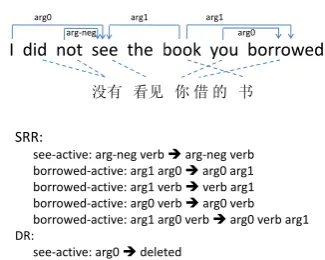
where SrcP red and SrcRole denotes the central verb and semantic roles in the source side, and T arRole denotes the target-side roles. The source/target SRSs do not need be continuous, but there should be a one-to-one alignment between the roles in the two sides. Compared to the general re-ordering models used in statistical MT systems, this type of feature is capable of modeling skeleton-level re-ordering, which is crucial to the fluency of MT output. Because a predicate can have different semantic role sequences in different voices,passive/activeare tagged for each oc-currence of the verbs based on their POS and preceding words. Figure 1 shows examples of the feature SRR.
2. Deleted Roles (DR)are the individual source-side semantic roles which are deleted in the MT outputs, taking the form of:
SrcP red:SrcRole⇒deleted
DR is meant to penalize the deletion of the semantic roles. Though most statistical MT systems have penalties for word deletion, it is still useful to make separate features for the deletion of semantic roles, which is con-sidered more harmful than the deletion of non-core components (e.g., modifiers) and deserves more serious penalty. Examples of the deletion features can be found in Figure 1.
Both types of features can be made non-lexicalized by removing the actual verb but retaining its voice information in the features. Non-lexicalized fea-tures are used in the system to alleviate the problem of sparse verbs.
3 Using Semantic Role Features in Machine Translation
This section describes how to use the proposed se-mantic role features in a Tree-to-String transducer,
I did not see the b
没有 看见 arg0
arg‐neg arg1
SRR:
see‐active: arg‐neg verb borrowed‐active: arg1 a borrowed‐active: arg1 ve borrowed‐active: arg0 ve borrowed‐active: arg1 a DR:
see‐active: arg0 Îdelet
book you borrowed
你 借 的 书 arg1
arg0
Îarg‐neg verb rg0 Îarg0 arg1 erb Îverb arg1 erb Îarg0 verb rg0 verb Îarg0 verb arg1
ted
Figure 1: Examples of the semantic role features
assuming that the semantic roles have been tagged for the source sentences. We first briefly describe the basic Tree-to-String translation model used in our experiments, and then describe how to modify it to incorporate the semantic role features.
3.1 Basic Tree-to-String Transducer
A Tree-to-String transducer receives a syntax tree as its input and, by recursively applying TTS plates, generates the target string. A TTS tem-plate is composed of a left-hand side (LHS) and a right-hand side (RHS), where the LHS is a sub-tree pattern and the RHS is a sequence of variables and translated words. The variables in the RHS of a template correspond to the bottom level non-terminals in the LHS’s subtree pattern, and their relative order indicates the permutation desired at the point where the template is applied to translate one language to another. The variables are further transformed, and the recursive process goes on un-til there are no variables left. The formal descrip-tion of a TTS transducer is given by Graehl and Knight (2004), and our baseline approach follows theExtended Tree-to-String Transducerdefined by Huang et al. (2006). For a given derivation (de-composition into templates) of a syntax tree, the translation probability is computed as the product of the templates which generate both the source syntax trees and the target translations.
P r(S|T, D∗) = Y
t∈D∗
P r(t)
functionDECODE(T)
fortree nodevofTin bottom-up orderdo fortemplatetapplicable atvdo
{c1, c2}=match(v, t);
s.lef tw=c1.lef tw;
s.rightw=c2.rightw;
s.val=c1.val×c2.val;
s.val×=P r(t);
s.val×=P r(c2.lef tw|c1.rightw); addstov’s beam;
Figure 2: Decoding algorithm for the standard Tree-to-String transducer. lef tw/rightw denote the left/right boundary word ofs.c1,c2denote the descendants ofv, ordered based on RHS oft.
TTS system includes a trigram language model, a deletion penalty, and an insertion bonus. The bottom-up decoding algorithm for the TTS trans-ducer is sketched in Figure 2. To incorporate the n-gram language model, states in the algorithm denote a tree node’s best translations with different left and right boundary words. We use standard beam-pruning to narrow the search space. To sim-plify the description, we assume in Figure 2 that a bigram language model is used and all the TTS templates are binarized. It is straightforward to generalize the algorithm for largern-gram models and TTS templates with any number of children in the bottom using target-side binarized combination (Huang et al., 2006).
3.2 Modified Tree-to-String Transducer with Semantic Role Features
Semantic role features can be used as an auxiliary translation model in the TTS transducer, which focuses more on the skeleton-level permutation. The model score, depending on not only the in-put source tree and the derivation of the tree, but also the semantic roles of the source tree, can be formulated as:
P r(S |T, D∗) = Y
f∈F(S,T.role,D∗)
P r(f)
where T denotes the source syntax tree with semantic roles, T.role denotes the seman-tic role sequence in the source side and F(S.role, T.role, D∗)denotes the set of defined semantic role features overT.roleand the target side semantic role sequence S.role. Note that given T.role and the derivation D∗, S.role can
VP
NP [giving:
VBG [giving: verb]
giving
VP [giving: arg
TTS template: (VP (VBG givin
Triggered SRR: giving‐active: a
Triggered DR: giving‐active: v
NP [giving:
VBG [giving: verb]
giving
arg2]
NP [giving: arg1]
g2 arg1]
g ) NP#1 NP#2 ) ÎNP#1 NP#2 arg2 arg1 Îarg2 arg1 verb Îdeleted
arg2]
NP [giving: arg1]
Figure 3: An example showing the combination of the se-mantic role sequences of the states. Above/middle is the state information before/after applying the TTS template, and bot-tom is the used TTS template and the triggered SRFs during the combination.
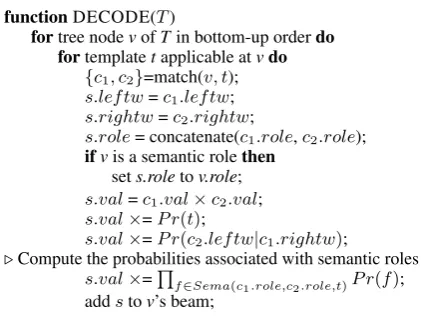
be easily derived. Now we show how to in-corporate the two types of semantic role features into a TTS transducer. To use the semantic role re-ordering feature SRR, the states in the decod-ing algorithm need to be expanded to encode the target-side SRSs. The SRSs are initially attached to the translation states of the source tree
con-给 PP VBZ 新 考验
VP
VBZ [bring: verb]
NP [bring: arg1]
PP [bring: arg3] NNP NN
new test
0 3 4
^
Combined SRS arg3 verb arg1
Median = 3 arg1
stituents which are labeled as semantic roles for some predicate. These semantic roles are then accumulated with re-ordering and deletion oper-ations specified by the TTS templates as the de-coding process goes bottom-up. Figure 5 shows the decoding algorithm incorporating the SRR fea-tures. The model component corresponding to the feature SRR is computed when combining two translation states. I.e., the probabilities of the SRR features composed based on the semantic roles of the two combining states will be added into the combined state. See Figure 3 for examples. The theoretical upper bound of the decoding complex-ity is O(N M4(n−1)R(PiC=0Ci!!)V), where N is the number of nodes in the source syntax tree,M is the vocabulary size of the target language,nis the order of then-gram language model,Ris the maximum number of TTS templates which can be matched at a tree node,Cis the maximum number of roles of a verb, andV is the maximum number of verbs in a sentence. In this formula,PC
i=0Ci!! is the number of role sequences obtained by first choosing iout ofC possible roles and then per-muting theiroles. This theoretical upper bound is not reached in practice, because the number of possible TTS templates applicable at a tree node is very limited. Furthermore, since we apply beam pruning at each tree node, the running time is con-trolled by the beam size, and is linear in the size of the tree.
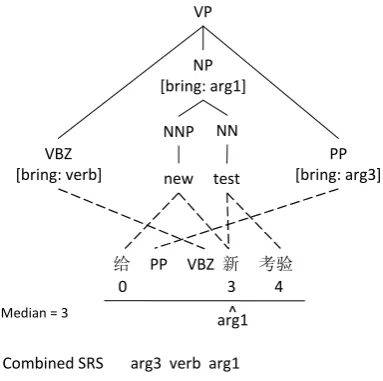
The re-ordering of the semantic roles from source to target is computed for each TTS template as part of the template extraction process, using the word-level alignments between the LHS/RHS of the TTS template (e.g., Figure 3). This is usu-ally straightforward, with the exception of the case where the words that are aligned to a particular role’s span in the source side are not continuous in the target side, as shown in Figure 4. Since we are primarily interested in the relative order of the semantic roles, we approximate each seman-tic role’s target side position by the median of the word positions that is aligned to. If more than one semantic role is mapped to the same position in the target side, their source side order will be used as their target side order, i.e., monotonic transla-tion is assumed for those semantic roles. Figure 4 shows an example of calculating the target side
functionDECODE(T)
fortree nodevofTin bottom-up orderdo fortemplatetapplicable atvdo
{c1, c2}=match(v, t);
s.lef tw=c1.lef tw;
s.rightw=c2.rightw;
s.role= concatenate(c1.role,c2.role);
ifvis a semantic rolethen
sets.roletov.role; s.val=c1.val×c2.val;
s.val×=P r(t);
s.val×=P r(c2.lef tw|c1.rightw);
.Compute the probabilities associated with semantic roles s.val×=Q
f∈Sema(c1.role,c2.role,t)P r(f); addstov’s beam;
Figure 5: Decoding algorithm using semantic role features. Sema(c1.role, c2.role, t) denotes the triggered semantic role features when combining two children states, and ex-amples can be found in Figure 3.
SRS based on a complicated TTS template. The word alignments in the TTS templates are also used to compute the deletion feature DR. Whenever a semantic role is deleted in a TTS template’s RHS, the corresponding deletion penalty will be applied.
3.3 Training
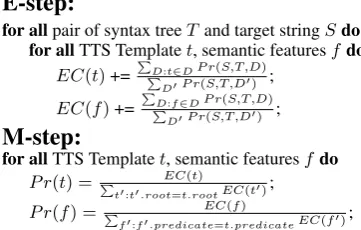
We describe two alternative methods for training the weights for the model’s features, including both the individual TTS templates and the semantic role features. The first method maximizes data likelihood as is standard in EM, while the second method maximizes conditional likelihood for a log-linear model following Blunsom et al. (2008).
3.3.1 Maximizing Data Likelihood
The standard way to train a TTS translation model is to extract the minimum TTS templates us-ing GHKM (Galley et al., 2004), and then normal-ize the frequency of the extracted TTS templates (Galley et al., 2004; Galley et al., 2006; Liu et al., 2006; Huang et al., 2006). The probability of the semantic features SRR and DR can be computed similarly, given that SRR and DR can be derived from the paired source/target sentences and the word alignments between them. We refer to this model as max-likelihood training and normalize the counts of TTS templates and semantic features based on their roots and predicates respectively.
E-step:
for allpair of syntax treeT and target stringSdo for allTTS Templatet, semantic featuresfdo
EC(t)+=
for allTTS Templatet, semantic featuresfdo P r(t) = P EC(t)
t0:t0.root=t.rootEC(t0);
P r(f) =P EC(f)
f0:f0.predicate=t.predicateEC(f0);
Figure 6: EM Algorithm For Estimating TTS Templates and Semantic Features
framework (May and Knight, 2007). We can es-timate the expected counts of the TTS templates and the semantic features by formulating the prob-ability of a pair of source tree and target string as:
Though the above formulation, which makes the total probability of all the pairs of trees and strings less than 1, is not a strict generative model, we can still use the EM algorithm (Dempster et al., 1977) to estimate the probability of the TTS templates and the semantic features, as shown in Figure 6.
The difficult part of the EM algorithm is the E-step, which computes the expected counts of the TTS templates and the semantic features by sum-ming over all possible derivations of the source trees and target strings. The standard inside-outside algorithm (Graehl and Knight, 2004) can be used to compute the expected counts of the TTS templates. Similar to the modification made in the TTS decoder, we can add the target-side semantic role sequence to the dynamic programming states of the inside-outside algorithm to compute the ex-pected counts of the semantic features. This way each state (associated with a source tree node) rep-resents a target side span and the partial SRSs. To speed up the training, a beam is created for each target span and only the top rated SRSs in the beam are kept.
3.3.2 Maximizing Conditional Likelihood
A log-linear model is another way to combine the TTS templates and the semantic features to-gether. Considering that the way the semantic
functionCOMPUTE PARTITION(T)
fortree nodevofTin bottom-up orderdo fortemplatetapplicable atvdo
for{s1, s2}=Match(v, t)do
Figure 7: Computing the partition function of the conditional probabilityP r(S|T).Sema(s1, s2, t)denotes all the seman-tic role features generated by combinings1ands2using t.
role features are defined makes it impossible to design a sound generative model to incorporate these features, a log-linear model is also a theoreti-cally better choice than the EM algorithm. If we directly translate the EM algorithm into the log-linear model, the problem becomes maximizing the data likelihood represented by feature weights instead of feature probabilities:
P r(S, T) =
where the features f include both the TTS tem-plates and the semantic role features. The numer-ator in the formula above can be computed using the same dynamic programming algorithm used to compute the expected counts in the EM algorithm. However, the partition function (denominator) re-quires summing over all possible source trees and target strings, and is infeasible to compute. In-stead of approximating the partition function using methods such as sampling, we change the objective function from the data likelihood to the conditional likelihood:
selected only among the possible candidates which can be generated from the input source tree using TTS templates.
The derivative of the logarithm of the objective function (over the entire training corpus) w.r.t. a feature weight can be computed as:
∂logQ
S,TP r(S|T) ∂λi
=X
S,T
{ECD|S,T(fi)−ECS0|T(fi)}
whereECD|S,T(fi), the expected count of a
fea-ture over all derivations given a pair of tree and string, can be computed using the modified inside-outside algorithm described in Section 3.2, and ECS0|T(fi), the expected count of a feature over
all possible target strings given the source tree, can be computed in a similar way to the partition function described in Figure 7. With the objective function and its derivatives, a variety of optimiza-tion methods can be used to obtain the best feature weights; we use LBFGS (Zhu et al., 1994) in our experiments. To prevent the model from overfitting the training data, a weighted Gaussian prior is used with the objective function. The variance of the Gaussian prior is tuned based on the development set.
4 Experiments
We train an English-to-Chinese translation system using the FBIS corpus, where 73,597 sentence pairs are selected as the training data, and 500 sentence pairs with no more than 25 words on the Chinese side are selected for both the development and test data.1Charniak (2000)’s parser, trained on
the Penn Treebank, is used to generate the English syntax trees. To compute the semantic roles for the source trees, we use an in-house max-ent classifier with features following Xue and Palmer (2004) and Pradhan et al. (2004). The semantic role labeler is trained and tuned based on sections 2–21 and section 24 of PropBank respectively. The standard role-based F-score of our semantic role labeler is 88.70%. Modified Kneser-Ney trigram models are trained using SRILM (Stolcke, 2002) on the Chinese portion of the training data. The model 1The total 74,597 sentence pairs used in experiments are those in the FBIS corpus whose English part can be parsed using Charniak (2000)’s parser.
(n-gram language model, TTS templates, SRR, DR) weights of the transducer are tuned based on the development set using a grid-based line search, and the translation results are evaluated based on a single Chinese reference using BLEU-4 (Papineni et al., 2002). Huang et al. (2006) used character-based BLEU as a way of normalizing inconsistent Chinese word segmentation, but we avoid this prob-lem as the training, development, and test data are from the same source.
The baseline system in our experiments uses the TTS templates generated by using GHKM and the union of the two single-direction align-ments generated by GIZA++. Unioning the two single-direction alignments yields better perfor-mance for the SSMT systems using TTS templates (Fossum et al., 2008) than the two single-direction alignments and the heuristic diagonal combination (Koehn et al., 2003). The two single-direction word alignments as well as the union are used to generate the initial TTS template set for both the EM algorithm and the log-linear model. The ini-tial TTS templates’ probabilities/weights are set to their normalized counts based on the root of the TTS template (Galley et al., 2006). To test seman-tic role features, their initial weights are set to their normalized counts for the EM algorithm and to 0 for the log-linear model. The performance of these systems is shown in Table 1. We can see that the EM algorithm, based only on TTS templates, is slightly better than the baseline system. Adding semantic role features to the EM algorithm actu-ally hurts the performance, which is not surprising since the combination of the TTS templates and semantic role features does not yield a sound gen-erative model. The log-linear model based on TTS templates achieves significantly better results than both the baseline system and the EM algorithm. Both improvements are significant at p < 0.05 based on 2000 iterations of paired bootstrap re-sampling of the test set (Koehn, 2004).
TTS Templates + SRF + Verb Class
Union 15.6 – –
EM 15.9 15.5 15.6
Log-linear 17.1 17.4 17.6
Table 1: BLEU-4 scores of different systems
equal better worse With SRF vs. W/O SRF 72% 20.2% 7.8%
Table 2: Distribution of the sentences where the semantic role features give no/positive/negative impact to the sentence fluency in terms of the completeness and ordering of the semantic roles.
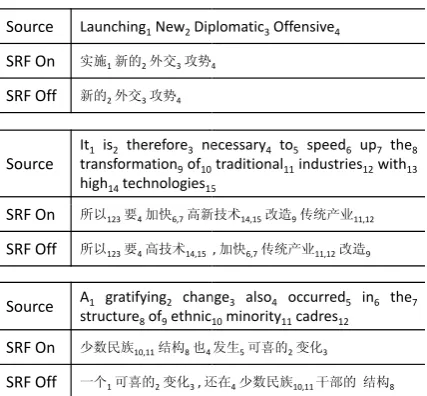
classes in VerbNet (Dang et al., 1998). Unfortu-nately, VerbNet only covers about 34% of the verb tokens in our training corpus, and does not im-prove the system’s performance. We then resorted to automatic clustering based on the aspect model (Hofmann, 1999; Rooth et al., 1999). The training corpus used in clustering is the English portion of the selected FBIS corpus. Though automatically obtained verb clusters lead to further improvement in BLEU score, the total improvement from the se-mantic role features is not statistically significant. Because BLEU-4 is biased towards the adequacy of the MT outputs and may not effectively evaluate their fluency, it is desirable to give a more accurate evaluation of the sentence’s fluency, which is the property that semantic role features are supposed to improve. To do this, we manually compare the outputs of the two log-linear models with and without the semantic role features. Our evaluation focuses on the completeness and ordering of the semantic roles, andbetter,equal,worseare tagged for each pair of MT outputs indicating the impact of the semantic role features. Table 2 shows the manual evaluation results based on the entire test set, and the improvement from SRF is significant atp <0.005based on a t-test. To illustrate how SRF impacts the translation results, Figure 8 gives 3 examples of the MT outputs with and without the SRFs.
5 Conclusion
This paper proposes two types of semantic role features for a Tree-to-String transducer: one mod-els the reordering of the source-side semantic role sequence, and the other penalizes the deletion of a source-side semantic role. These semantic features
Source Launching1New2Dip
SRF On 实施1新的2外交3攻势4
SRF Off 新的2外交3攻势4
Source
It1 is2 therefore3 ne
transformation9of10
high14technologies15
SRF On 所以123要4加快6,7高新
SRF Off 所以123要4高技术14,15
Source A1 gratifying2 chan
structure8of9ethnic
SRF On 少数民族10,11结构8也4
SRF Off 一个1可喜的2变化3,还
plomatic3Offensive4
4
ecessary4 to5 speed6 up7 the8
traditional11industries12with13 5
新技术14,15改造9传统产业11,12
,加快6,7传统产业11,12改造9
nge3 also4 occurred5 in6 the7
10minority11cadres12
发生5可喜的2变化3
还在4少数民族10,11干部的 结构8
Figure 8: Examples of the MT outputs with and without SRFs. The first and second example shows that SRFs improve the completeness and the ordering of the MT outputs respectively, the third example shows that SRFs improve both properties. The subscripts of each Chinese phrase show their aligned words in English.
and the Tree-to-String templates, trained based on a conditional log-linear model, are shown to sig-nificantly improve a basic TTS transducer’s per-formance in terms of BLEU-4. To avoid BLEU’s bias towards the adequacy of the MT outputs, man-ual evaluation is conducted for sentence fluency and significant improvement is shown by using the semantic role features in the log-linear model. Considering our semantic features are the most ba-sic ones, using more sophisticated features (e.g., the head words and their translations of the source-side semantic roles) provides a possible direction for further experimentation.
Acknowledgments This work was funded by
NSF IIS-0546554 and IIS-0910611.
References
Blunsom, Phil, Trevor Cohn, and Miles Osborne. 2008. A discriminative latent variable model for statistical machine translation. InProceedings of the 46th An-nual Meeting of the Association for Computational
Linguistics (ACL-08), Columbus, Ohio.
Charniak, Eugene. 2000. A
maximum-entropy-inspired parser. InProceedings of NAACL-01, pages 132–139.
Joseph Rosenzweig. 1998. Investigating regu-lar sense extensions based on intersective Levin
classes. InCOLING/ACL-98, pages 293–299,
Mon-treal. ACL.
Dempster, A. P., N. M. Laird, and D. B. Rubin. 1977. Maximum likelihood from incomplete data via the EMalgorithm.Journal of the Royal Statistical Soci-ety, 39(1):1–21.
Fossum, Victoria, Kevin Knight, and Steven Abney. 2008. Using syntax to improveword alignment pre-cision for syntax-based machine translation. In Pro-ceedings of the Third Workshop on Statistical
Ma-chine Translation, Columbus, Ohio. ACL.
Fung, Pascale, Zhaojun Wu, Yongsheng Yang, and Dekai Wu. 2006. Learning of Chinese/English
se-mantic structure mapping. InIEEE/ACL 2006
Work-shop on Spoken Language Technology, Aruba.
Galley, Michel, Mark Hopkins, Kevin Knight, and Daniel Marcu. 2004. What’s in a translation rule?
InProceedings of NAACL-04, pages 273–280.
Galley, Michel, Jonathan Graehl, Kevin Knight, Daniel Marcu, Steve DeNeefe, Wei Wang, and Ignacio Thayer. 2006. Scalable inference and training of
context-rich syntactic translation models. In
Pro-ceedings of COLING/ACL-06, pages 961–968, July.
Graehl, Jonathan and Kevin Knight. 2004. Training tree transducers. InProceedings of NAACL-04. Hofmann, Thomas. 1999. Probabilistic latent semantic
analysis. InUncertainity in Artificial Intelligence,
UAI’99, Stockholm.
Huang, Liang, Kevin Knight, and Aravind Joshi. 2006. Statistical syntax-directed translation with extended
domain of locality. In Proceedings of the 7th
Bi-ennial Conference of the Association for Machine
Translation in the Americas (AMTA), Boston, MA.
Johnson, Christopher R., Charles J. Fillmore, Miriam R. L. Petruck, Collin F. Baker, Michael Ellsworth, Josef Ruppenhofer, and Esther J. Wood. 2002.
FrameNet: Theory and practice. Version 1.0,
http://www.icsi.berkeley.edu/framenet/.
Koehn, Philipp, Franz Josef Och, and Daniel Marcu. 2003. Statistical phrase-based translation. In
Pro-ceedings of NAACL-03, Edmonton, Alberta.
Koehn, Philipp, Hieu Hoang, Alexandra Birch, Chris Callison-Burch, Marcello Federico, Nicola Bertoldi, Brooke Cowan, Wade Shen, Christine Moran, Richard Zens, Chris Dyer, Ondrej Bojar, Alexandra Constantin, and Evan Herbst. 2007. Moses: Open source toolkit for statistical machine translation. In
Proceedings of ACL, Demonstration Session, pages
177–180.
Koehn, Philipp. 2004. Statistical significance tests for
machine translation evaluation. InProceedings of
EMNLP, pages 388–395, Barcelona, Spain, July.
Liu, Ding and Daniel Gildea. 2008. Improved tree-to-string transducers for machine translation. In ACL Workshop on Statistical Machine Translation
(ACL08-SMT), pages 62–69, Columbus, Ohio.
Liu, Yang, Qun Liu, and Shouxun Lin. 2006. Tree-to-string alignment template for statistical machine
translation. In Proceedings of COLING/ACL-06,
Sydney, Australia, July.
May, Jonathan and Kevin Knight. 2007. Syntactic re-alignment models for machine translation. In
Pro-ceedings of EMNLP.
Palmer, Martha, Daniel Gildea, and Paul Kingsbury. 2005. The Proposition Bank: An annotated corpus of semantic roles. Computational Linguistics, 31(1):71– 106.
Papineni, Kishore, Salim Roukos, Todd Ward, and Wei-Jing Zhu. 2002. BLEU: A method for automatic evaluation of machine translation. InProceedings of
ACL-02.
Pradhan, Sameer, Wayne Ward, Kadri Hacioglu, James Martin, , and Dan Jurafsky. 2004. Shallow semantic
parsing using support vector machines. In
Proceed-ings of NAACL-04.
Rooth, Mats, Stefan Riezler, Detlef Prescher, Glenn Carroll, and Franz Beil. 1999. Inducing a semanti-cally annotated lexicon via EM-based clustering. In
Proceedings of the 37th Annual Meeting of the ACL,
pages 104–111, College Park, Maryland.
Stolcke, Andreas. 2002. SRILM - an extensible lan-guage modeling toolkit. InInternational Conference
on Spoken Language Processing, volume 2, pages
901–904.
Toutanova, Kristina, Aria Haghighi, and Christopher Manning. 2005. Joint learning improves semantic role labeling. InProceedings of ACL-05, pages 589– 596.
Wu, Dekai and Pascale Fung. 2009. Semantic roles
for smt: A hybrid two-pass model. InProceedings
of the HLT-NAACL 2009: Short Papers, Boulder,
Colorado.
Xue, Nianwen and Martha Palmer. 2004. Calibrating features for semantic role labeling. InProceedings
of EMNLP.