Automatically Learning Source-side Reordering Rules for Large Scale
Machine Translation
Dmitriy Genzel
Google, Inc.
Abstract
We describe an approach to automatically learn reordering rules to be applied as a preprocessing step in phrase-based ma-chine translation. We learn rules for 8 dif-ferent language pairs, showing BLEU im-provements for all of them, and demon-strate that many important order trans-formations (SVO to SOV or VSO, head-modifier, verb movement) can be captured by this approach.
1 Introduction
One of the major problems of modern statisti-cal machine translation relates to its difficulties in producing the correct word order on the target side of the translation where the source side or-der is not the same as the target side. In many cases where the translation is spectacularly bad, if one only enters the source sentence in the word or-der of the target language the translation becomes near-perfect (largely because the language model can now make sense of it). The word order prob-lems are especially extensive for languages that have major differences, such as SOV vs. SVO languages, but also cause insidious, but entirely avoidable errors for the language pairs where the word order is almost right, but not quite1. For practical reasons all phrase-based decoders limit the amount of reordering allowed and thus are completely unable to produce correct translations when the necessary movement is over a large dis-tance. Furthermore, where the actual systematic reordering for the two languages is within the de-coder’s search space, it is penalized just as any
1For example of the latter kind, verb movement for English-German and similar language pairs often causes verbs to be aligned to nothing and to be altogether dropped in translation.
other kind of reordering, whereas doing anything other than this systematic reordering should in fact be penalized.
It has been argued that this is a fundamental flaw in phrase-based decoding systems and hier-archical and syntax-based systems have been pro-posed to solve this problem. These systems can in principle resolve a part of this problem, but at a significant time cost during training, and even worse, during translation, making it less practical for realtime systems. Instead we propose a system for learning pre-ordering rules automatically from data and demonstrate that it can capture many dif-ferent kinds of reordering phenomena and do so at no additional online cost.
2 Related Work
Many solutions to the reordering problem have been proposed, e.g. syntax-based models (Chi-ang, 2005), lexicalized reordering (Och et al., 2004), and tree-to-string methods (Zhang et al., 2006). All these methods try to solve the reorder-ing problem in different ways, but have the fol-lowing problems in common: word alignment is not affected by them and they tend to introduce significant additional work to be done at transla-tion time. Most state of the art systems use HMM or IBM Model 4 word alignment, both of which have a penalty term associated with long distance jumps, and tend to misalign words which move far from their expected positions.
some of the previously mentioned approaches. The downside of these methods is that the reorder-ing is fixed, and if it is wrong it can hurt the quality of translations. We will discuss solutions for this problem later.
Even in the relatively limited space of preprocessing-based reordering solutions, there has been a large amount of previous work, as far back as Brown et al. (1992). Most approaches focus on utilizing manually written rules for dif-ferent languages. A common language pair for which rules were proposed is German-English (Nießen and Ney, 2001; Collins et al., 2005). There is similar work for Chinese-English (Wang et al., 2007) and quite a few other languages. Clearly, such methods work quite well, but require linguistic expertise to produce. Our goal, how-ever, is to learn reordering from parallel data that is already available to an MT system in an entirely unsupervised manner.
We are not the first to attempt this task. In particular, Xia and McCord (2004) proposed a way to automatically learn reordering patterns for French-English. Their system parses parallel data both on the source and target side and then uses a variety of heuristics to extract reordering rules which are then applied during training. More recently, Li et al. (2007) use a maximum en-tropy system to learn reordering rules for binary trees (i.e., whether to keep or reorder for each node). An approach most similar to ours is that of Rottmann and Vogel (2007) where they learn reordering rules based on sequences of part-of-speech tags (but do not use parse trees). All of these approaches show improvements in transla-tion quality, but are applied on a single language pair. Our goal is to find a method that works well for many language pairs, regardless of the word order transformations needed, and without language-specific tuning. Unlike our predeces-sors, we use a systematic search through the space of possible permutation rules to minimize a spe-cific metric, related to the monotonicity of result-ing alignments.
3 Our Approach
We limit ourselves to reorderings of the source side of training and test data. To constrain our
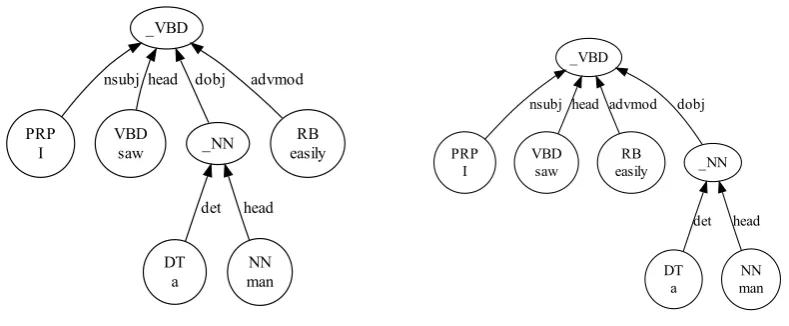
reorderings, we first produce a parse tree, using a dependency parser similar to that of Nivre and Scholz (2004). The above parser is much faster than the time spent in translating the same sen-tence and thus creates almost no overhead. In our experiments where the source language is En-glish the training data for the parser is the Penn Treebank (Marcus et al., 1993). For German, we use TIGER treebank (Brants et al., 2002). We then convert the dependency tree to a shallow con-stituent tree. The trees are annotated by both Penn Treebank part of speech tags and by Stan-ford dependency types (de Marneffe et al., 2006; de Marneffe and Manning, 2008). For an exam-ple, see Figure 1a.
Our reorderings are constrained by reordering of nodes in a parse tree of the source sentence. Thus, the full space of reorderings we consider consists of all reorderings that would produce a parse tree with the same set of child-parent rela-tionships. For an example of a valid reordering, see Figure 1b.
Each reordering is described by a series of rules and we learn one such series for each lan-guage pair automatically. Each source sentence is parsed, and the tree is transformed sequentially, one rule at a time applying to the entire tree, top down. The reordered sentence is read off the leaves of the tree and training and evaluation pro-ceeds as normal. We are using a state-of-the-art phrase-based statistical machine translation sys-tem to perform the actual translation. The syssys-tem is itself capable of further local reordering during translation limited by the maximum distance of 4 words.
3.1 Rule Space
_VBD
PRP I
nsubj
VBD saw
head
_NN dobj
DT a
det
NN man head
RB easily advmod
(a) A sample parse tree
_VBD
PRP I
nsubj
VBD saw
head
RB easily advmod
_NN dobj
DT a
det
NN man head
(b) After reordering (moving RB over NN)
Figure 1: Parse tree of a sentence and its reordering
Feature Description
nT POS tag of this node nL Syntactic label of this node pT POS tag of the parent of this node pL Syntactic label of the parent 1T POS tag of the first child 1L Label of the first child 2T POS tag of the second child 2L Label of the second child ... ...
Table 1: Set of features used as conditioning vari-ables
later in the sequence.
A conditioning context is a conjunction of con-ditions. Each condition is a (feature, value) pair. List of features is given in table 1. In practice, we limit ourselves to no more than 4 conditions in a given context to avoid combinatorial explosion and sparsity as well as contexts that fail to gen-eralize. However, we may exhaustively generate every possible conjunction of up to 5 conditions from this list that covers up to 4 children that we actually observe in training.
For example, the following contexts would be valid for transformation in Fig. 1:
• nT = VBD
• 1T = PRP
• 1L = nsubj
• 3T = dobj
• etc.
or any conjunction of these. The action performed in this example is swapping children 3 and 4 of the VBD node, and can be denoted as the permu-tation (1,2,4,3).
When processing a rule sequence, once a rule applies, the action is performed, and that rule is no longer applied on the same node or its descen-dants (but can be further applied elsewhere in the tree). Another rule (even an identical one) starts from the top and can apply to nodes modified by previous rules.
3.2 Reordering metrics
To evaluate the quality of a given reordering rule, we need to have reliable metrics that, for each sen-tence pair, can evaluate whether an improvement in monotonicity has been made.
I have a dog
have’ dog’ I’
Figure 2: Counting crossing alignment links
to cross, moving it farther away from its correct position would cause more links to cross. We will refer to this metric ascrossing score.
An ideal metric would be the actual BLEU score that the system would obtain under this re-ordering rule on the development set. However, since each rule affects word alignment, phrase extraction, optimal feature weights, and the ac-tual translation, it would be necessary to retrain the entire phrase-based system for each possible rule, which is impractical. It is, however, practi-cal, to retranslate the development set, keeping the phrase table and feature weights constant. Nor-mally, however, phrase tables contain multi-word phrases, such as “a b” which may no longer match after the reordering, and this biases the system to-ward the original word order. To avoid this, for this computation only, we use a phrase table that only contains single words and is therefore inde-pendent of the source sentence word order. This lets us test whether a given reordering improves the search space for the phrase-based decoder at the relatively small computational cost of trans-lating the development set. We obtain a differ-ence of the BLEU scores with and without a given rule, which we hope to be a reasonable estimate of the true gain in BLEU score that one would ob-tain, by retraining the full system, including word alignment, full-length phrase extraction, and tun-ing the feature weights. We refer to this score as estimated BLEU gain.
Note that these two scores are used to obtain an estimate of utility of any given rule, and are not used for evaluation of the entire system. Those metrics are discussed in detail in the evaluation section.
3.3 Algorithm
We propose a straightforward algorithm to au-tomatically learn reordering rules. The input data for all algorithms is word-aligned sentence pairs. We have found that sophisticated align-ment models introduce a bias toward alignalign-ment between certain kinds of nodes (usually ones that are close), and this has undesirable effects. In practical terms this means that neither HMM nor Model 4 alignments are useful (even though they are better as alignments), but Model 1 alignments are. However, to compensate for poor quality of the alignments, we simply delete those alignment links that have posterior probabilities under 0.52 and remove sentence pairs which have very few alignments left. The crossing score works quite well even when only a portion of the words in a sentence are aligned.
The algorithm’s outline is given as Alg. 1. The algorithm proceeds by considering all rules after the best sequence of rules so far, and ap-pends the best new rule (according to the metric) to the sequence. In practice, some changes are needed, and we describe some variations. Each of these variations produces a different sequence of rules, but they are interchangeable, and we can simply pick one that performs best on the devel-opment set, or to combine them through multi-source translation or consensus.
In all variations, we are unable to generate all possible rules for every sentence, as the number can easily be104-106per sentence. It is sufficient, however, to take a random sample of the input, extract top candidates, and reevaluate those on the entire set.
We also limit the kinds of rules we are allowed to generate. The number of possible actions on a node withn children isn!−1and our trees are
quite shallow, often containing 5, 6, or even more children per node. To avoid dealing with explo-sion of rules and the resulting sparsity of the rule space, we modify the process slightly, so that in-stead of matching a node, we match a node and a consecutive subsequence of its children of a given size, as a sliding window. For example, in Figure 1a, node VBD has 4 children. If we limit
Algorithm 1Optimizing alignment links input: A set of aligned sentence pairs base =<empty sequence>;
forseveral iterationsdo
candidate rules = GenerateAllCandidateRules(input, base); base.append(MinCost(candidate rules))
end for
selves to 3 children at a time we would attempt to match this node twice: with its children 1,2,3 and 2,3,4. In other words, we pretend to consider two nodes, one with the first set of children, and one with the second, proceeding left to right. If either one matches, we apply the action to the subset of children in the window and stop processing the node further.
It is also useful to produce more than one rule per iteration, although this can be problematic, since the rules may interfere with each other.
3.3.1 Variant 1: Optimizing crossing score
We start with the initially empty base sequence. As described above, we generate every possible rule from a subset of sentences, and evaluate them on the entire input, with the base sequence always applied first. We use crossing score as a met-ric. However, instead of extracting only one best-scoring rule, we extract K best. Now we need to obtain a decorrelated set: for every pair of rules, we count the number of sentences where they both apply. For every rule we consider all rules that are ranked higher, and if the percentage of matches between these two rules is high, the rules may interfere with each other, and the current rule is dropped. We thus obtain a small ordered set of rules that tend to apply on different sentences, and should not interfere with each other. From this ordered set we produce all candidate rule subse-quences and evaluate them, to ensure there really is no interference. The one with the best score is then appended to the base sequence. The process is then repeated with a new base sequence.
3.3.2 Variant 2: Optimizing Estimated BLEU gain
We proceed as in the previous variant, but final evaluation of potential sequences to be appended is done differently. Instead of using a crossing
score, we reorder the development set with each candidate rule sequence and score it using a trans-lation system with a fixed phrase table with sin-gle word phrases only (to avoid bias for a spe-cific word order). The sequence with the highest BLEU is then appended to base sequence, and the process is repeated.
3.3.3 Variant 3: Optimizing Estimated BLEU gain in sequence
In this variant, once we obtain a set of decorrelated candidate rules {a1, a2, . . . an}
or-dered by crossing score, we evaluate the fol-lowing rule sequences (where b is base
se-quence): (b),(b, a1),(b, a1, a2). . .(b, a1, . . . an)
using estimated BLEU gain, as above. If we find that for some k, score(b, a1, . . . ak−1) >
score(b, a1, . . . ak−1, ak), that means that ak
in-terferes with preceding rules. We remove all suchak, and retranslate/rescore until the score
se-quence is monotonically non-decreasing. At this point, we append all surviving rules to the base sequence, and repeat the process.
4 Evaluation
sys-tem is a production-quality syssys-tem used by a large number of users.
For the first set of experiments for German-English and German-English-German we use WMT-09 data sets for development and testing (Callison-Burch et al., 2009). We report BLEU scores for each of the algorithms along with the best score from the WMT-09 workshop for reference in Ta-ble 2.
Unfortunately, there is no standard data set for most of the languages we would like to experi-ment with. For the second set of experiexperi-ments, we use an unpublished data set, containing data in En-glish and 7 languages mentioned above. Our test data comes from two sources: news articles from WikiNews3 (996 sentences) and a set of random sentences from the web (9000 sentences). From these, we create 3 sets:dev1: 3000 sentences from weband 486 sentences fromwiki;dev2: 1000 sen-tences fromweb; andtest: the remainder ofweb (5000 sentences) and wiki (510 sentences). The dev1set is used for tuning the system, bothdev1 anddev2for tuning consensus, and thetestset for evaluation. These sets are the same for all 7 lan-guages.
Discriminative minimum error rate training (Macherey et al., 2008) was applied to optimize the feature weights for each system.
We evaluate the three variants of the algorithm mentioned above. Each algorithm outputs a re-ordering rule sequence (40-50 rules long) which is applied to all the training and test data, and a complete system is trained from scratch.
There is no need for us to pick a single al-gorithm for all language pairs, since each algo-rithm produces rules that are compatible with each other. We are able to pick the algorithm that works best on the development set for each language pair.
In addition, we can use a decoder that is capa-ble of performing a multi-input translation which is given the unreordered input as well as the three reordered inputs produced by the above algorithm. This decoder is able to learn separate feature weights for each feature/algorithm combination.
Finally, we can use consensus translation
3http://en.wikinews.org
Table 4: Manual vs. automatic reordering. Auto-maticscore is the combined score from Table 3.
Language Base Manual
Auto-matic Diff Hindi 16.85 19.25 19.36 0.11 Japanese 25.91 28.78 29.12 0.34 Korean 23.61 27.99 27.91 -0.08
(Macherey and Och, 2007) to produce the best possible translation for each sentence.
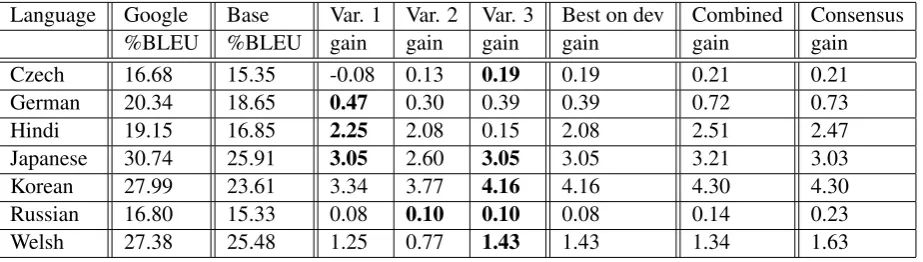
Results using BLEU score (character-level for Japanese and Korean, word-level for other lan-guages) for English to X systems are given in Ta-ble 3, along with the score of Google Translate as of Feb 15, 2010, for expected quality reference. All gains in the combined and consensus columns are statistically significant using a bootstrap re-sampling test (Noreen, 1989).
We should also note that the parsing and re-ordering overhead was an average of 10msec per sentence, and had no appreciable impact on the speed of the system.
4.1 Comparison with manual reordering
We also compared our automatic method with a manually written reordering rule set for SOV lan-guages (Xu et al., 2009) (rules initially written for Korean) for comparison with our approach. The results are given in Table 4. The results are mostly comparable, with automatic rules being better for two of the three languages.
4.2 Turning off decoder reordering
All of the above experiments allowed the decoder to further reorder the sentence as needed. Re-ordering in the decoder creates an exponential in-crease in the search space, and for a typical de-coding strategy can lead to increase in dede-coding time, search errors, or both. Since we already pre-order the sentence, it should be possible to avoid reordering in the decoder altogether.
possi-Table 2: Results for 3 algorithms on WMT-09 data with best individual system score from the workshop: for EN to DE, Edinburgh, for DE to EN, Google
Language Base Var. 1 Var. 2 Var. 3 Best workshop EN to DE 16.09 16.30 16.35 16.40 14.76
DE to EN 21.00 22.45 22.13 22.05 20.23
Table 3: Results on internal test set for 3 systems (Variant 1,2,3), the variant which performed best on the development set, the combined system, and the consensus run, along with Google Translate scores (Feb 15, 2010) for reference
Language Google Base Var. 1 Var. 2 Var. 3 Best on dev Combined Consensus %BLEU %BLEU gain gain gain gain gain gain Czech 16.68 15.35 -0.08 0.13 0.19 0.19 0.21 0.21 German 20.34 18.65 0.47 0.30 0.39 0.39 0.72 0.73 Hindi 19.15 16.85 2.25 2.08 0.15 2.08 2.51 2.47 Japanese 30.74 25.91 3.05 2.60 3.05 3.05 3.21 3.03 Korean 27.99 23.61 3.34 3.77 4.16 4.16 4.30 4.30 Russian 16.80 15.33 0.08 0.10 0.10 0.08 0.14 0.23 Welsh 27.38 25.48 1.25 0.77 1.43 1.43 1.34 1.63
Table 5: Disallowing decoder reordering: differ-ence against baseline in %BLEU gain
Language Decoder
reordering No decoderreordering Czech 0.21 0.08
German 0.72 0.55 Hindi 2.51 2.27 Japanese 3.21 3.21 Korean 4.30 4.15 Russian 0.14 -0.10 Welsh 1.34 0.98
ble to avoid decoder reordering altogether which leads to a significant speedup.
5 Analysis
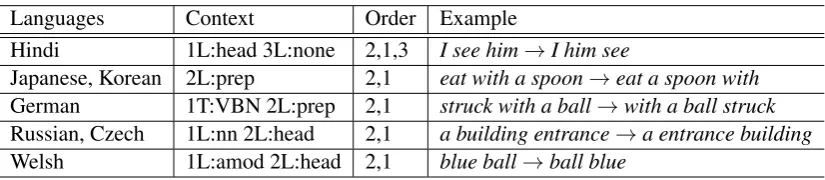
We looked at the rules being learned as well as at the differences in the output to see if the gains in BLEU are in fact due to the reordering phenomena being resolved. The top rules for each language are given in Table 6.
One can observe that the top rules for German and Slavic languages are as expected: verb move-ment and noun modifier reordering. Other top rules for German cover other specific cases of verb
movement, other rules for Czech include, for ex-ample, movement of the subject of the passive sentence to the right and movement of the pos-sessive (which is similar to the noun compound case).
The rules for Welsh include movement of the adjective modifier over its head (given in the ta-ble above) and other rules moving noun modifiers, moving a modal verb left over its subject, moving determiners to the right of nouns, etc.
For Japanese and Korean, there are many rules with dramatic impact, such as a rule moving all heads to the right, reversing a sequence of three nodes starting with a modal (e.g. can do some-thing to something do can), moving numerical modifiers to the right of their heads, and many oth-ers.
Hindi is also an SOV language, but its gram-mar is not as similar to Japanese or Korean as they are to each other. Still, Hindi also has some simi-lar rules, but there are many more involving verb movement, such as a rule directly moving the verb to the final position.
Table 6: Examples of top rules and their application
Languages Context Order Example
Hindi 1L:head 3L:none 2,1,3 I see him→I him see
Japanese, Korean 2L:prep 2,1 eat with a spoon→eat a spoon with
German 1T:VBN 2L:prep 2,1 struck with a ball→with a ball struck
Russian, Czech 1L:nn 2L:head 2,1 a building entrance→a entrance building
Welsh 1L:amod 2L:head 2,1 blue ball→ball blue
but more interestingly, most German sentences now have a verb where the baseline had none. An-other profound effect can be observed for Rus-sian: the baseline almost invariably translated noun compounds incorrectly: e.g. group leaders may be translated as group of-leaders since this requires no reordering and no preposition inser-tion. This is especially problematic, since the user of the translation system often cannot detect this: the resulting sentence is not ungrammatical and can even make sense. Our algorithm learns a rule that prevents this from happening. Now the de-coder must pay a cost to keep the order the same as in English.
6 Discussion and Future Work
We have demonstrated a general technique which requires only access to a parser for the source lan-guage (in addition to parallel data which already exists for an MT system) and is capable of re-ducing reordering problems endemic in a phrase-based system. No linguists or even native speakers of any of these languages were needed to write the rules. The algorithm is quite robust and performs well on noisy web data, much of it being ungram-matical.
All variants turned out to perform well, al-though variants 1 and 3 were better most of the time. We consider all variants to be useful, since they find different local maxima under different objective functions, and in practice use all of them and pick a rule sequence that performs best on the development set for any specific language pair.
We plan to explore this research area further in several ways. First, it would be interesting to ex-periment with applying rules learned for one lan-guage to a related lanlan-guage, e.g. Portuguese for Spanish or German for Dutch. This would let us
use rules learned from a major language for a mi-nor one with less available training data.
We have only used English and German as source languages. There is training data for parsers in other languages, and this approach should work well for most source languages. Where a source language parser is not available, we can still improve quality, by learning rules from the target side and applying them only for the purpose of improving word alignment. Improv-ing word alignment alone would not help as much as also using the reordering in the decoder, but it will probably help in extracting better phrases. We also plan to use parser projection to induce a rea-sonable quality parser for other languages.
References
Sabine Brants, Stefanie Dipper, Silvia Hansen, Wolf-gang Lezius, and George Smith. 2002. The tiger treebank. In In Proceedings of the Workshop on
Treebanks and Linguistic Theories, pages 24–41.
Peter F. Brown, Stephen A. Della, Pietra Vincent, J. Della Pietra, John D. Lafferty Robert, and L. Mer-cer. 1992. Analysis, statistical transfer, and syn-thesis in machine translation. In Proceedings of the Fourth International Conference on Theoretical
and Methodological Issues in Machine Translation,
pages 83–100.
Chris Callison-Burch, Philipp Koehn, Christof Monz, and Josh Schroeder. 2009. Findings of the 2009 Workshop on Statistical Machine Translation. In Proceedings of the Fourth Workshop on Statistical
Machine Translation, pages 1–28, Athens, Greece,
March. Association for Computational Linguistics. David Chiang. 2005. A hierarchical phrase-based
model for statistical machine translation. In
Pro-ceedings of the ACL’05, pages 263–270, Ann Arbor,
Michigan, June.
translation. In Proceedings of the ACL’05, pages 531–540, Ann Arbor, Michigan, June.
Marie-Catherine de Marneffe and Christopher D. Man-ning. 2008. The Stanford typed dependencies rep-resentations. In COLING’08 Workshop on
Cross-framework and Cross-domain Parser Evaluation,
Manchester, England, August.
Marie-Catherine de Marneffe, Bill MacCartney, and Christopher D. Manning. 2006. Generating typed dependency parses from phrase structure trees. In
LREC.
Chi-Ho Li, Minghui Li, Dongdong Zhang, Mu Li, Ming Zhou, and Yi Guan. 2007. A probabilistic approach to syntax-based reordering for statistical machine translation. InProceedings of the ACL-07, pages 720–727, Prague, Czech Republic, June.
Wolfgang Macherey and Franz J. Och. 2007. An em-pirical study on computing consensus translations from multiple machine translation systems. In
Pro-ceedings of the EMNLP-CoNLL’07, pages 986–995,
Prague, Czech Republic, June.
Wolfgang Macherey, Franz Och, Ignacio Thayer, and Jakob Uszkoreit. 2008. Lattice-based minimum er-ror rate training for statistical machine translation.
In Proceedings of the EMNLP-2008, pages 725–
734, Honolulu, Hawaii, October.
Mitchell P. Marcus, Beatrice Santorini, and Mary Ann Marcinkiewicz. 1993. Building a large annotated corpus of english: The Penn Treebank.
Computa-tional Linguistics, 19(2):313–330.
Sonja Nießen and Hermann Ney. 2001. Morpho-syntactic analysis for reordering in statistical ma-chine translation. InMachine Translation Summit, pages 247–252, Santiago de Compostela, Spain, September.
Joakim Nivre and Mario Scholz. 2004. Deterministic dependency parsing of English text. InProceedings
of Coling 2004, pages 64–70, Geneva, Switzerland,
Aug 23–Aug 27. COLING.
Eric W. Noreen. 1989. Computer-Intensive
Meth-ods for Testing Hypotheses. John Wiley & Sons,
Canada.
Franz Josef Och and Hermann Ney. 2004. The align-ment template approach to statistical machine trans-lation. Computational Linguistics, 30(4):417–449.
Franz Josef Och, Daniel Gildea, Sanjeev Khudanpur, Anoop Sarkar, Kenji Yamada, Alex Fraser, Shankar Kumar, Libin Shen, David Smith, Katherine Eng, Viren Jain, Zhen Jin, and Dragomir Radev. 2004. A smorgasbord of features for statistical machine
translation. InHLT-NAACL 2004: Main Proceed-ings, pages 161–168, Boston, Massachusetts, USA, May 2 - May 7.
Kay Rottmann and Stephan Vogel. 2007. Word re-ordering in statistical machine translation with a pos-based distortion model. InProceedings of TMI, Skovde, Sweden.
Chao Wang, Michael Collins, and Philipp Koehn. 2007. Chinese syntactic reordering for statistical machine translation. InProceedings of the
EMNLP-CoNLL’2007, pages 737–745, Prague, Czech
Re-public, June.
Fei Xia and Michael McCord. 2004. Improving a statistical MT system with automatically learned rewrite patterns. In Proceedings of Coling 2004, pages 508–514, Geneva, Switzerland, Aug 23–Aug 27. COLING.
Peng Xu, Jaeho Kang, Michael Ringgaard, and Franz Och. 2009. Using a dependency parser to improve SMT for subject-object-verb languages. In
Pro-ceedings of NAACL-HLT’09, Boulder, Colorado.
Hao Zhang, Liang Huang, Daniel Gildea, and Kevin Knight. 2006. Synchronous binarization for ma-chine translation. In Proceedings of the Human Language Technology Conference of the NAACL,
Main Conference, pages 256–263, New York City,