Scholarship at UWindsor
Scholarship at UWindsor
Electronic Theses and Dissertations Theses, Dissertations, and Major Papers
2012
A model to predict and analyze protein-protein interaction types
A model to predict and analyze protein-protein interaction types
using electrostatic energies
using electrostatic energies
Gokul Vasudev University of Windsor
Follow this and additional works at: https://scholar.uwindsor.ca/etd
Recommended Citation Recommended Citation
Vasudev, Gokul, "A model to predict and analyze protein-protein interaction types using electrostatic energies" (2012). Electronic Theses and Dissertations. 4845.
https://scholar.uwindsor.ca/etd/4845
This online database contains the full-text of PhD dissertations and Masters’ theses of University of Windsor students from 1954 forward. These documents are made available for personal study and research purposes only, in accordance with the Canadian Copyright Act and the Creative Commons license—CC BY-NC-ND (Attribution, Non-Commercial, No Derivative Works). Under this license, works must always be attributed to the copyright holder (original author), cannot be used for any commercial purposes, and may not be altered. Any other use would require the permission of the copyright holder. Students may inquire about withdrawing their dissertation and/or thesis from this database. For additional inquiries, please contact the repository administrator via email
A MODEL TO PREDICT AND ANALYZE PROTEIN-PROTEIN
INTERACTION TYPES USING ELECTROSTATIC ENERGIES
by
Gokul Vasudev
A Thesis
Submitted to the Faculty of Graduate Studies through the School of Computer Science in Partial Fulfillment of the Requirements for
the Degree of Master of Science at the University of Windsor
Windsor, Ontario, Canada 2012
c
by
Gokul Vasudev
APPROVED BY:
Dr. Siyaram Pandey, External Reader Department of Chemistry and Biochemistry
Dr. Alioune Ngom, Internal Reader School of Computer Science
Dr. Luis Rueda, Advisor School of Computer Science
Dr. Xiaobu Yuan, Chair of Defense School of Computer Science
Declaration of Co-Authorship
I hereby certify that I am the sole author of this thesis and that no part of this thesis has
been published or submitted for publication.
I certify that, to the best of my knowledge, my thesis does not infringe upon anyone’s
copyright nor violate any proprietary rights and that any ideas, techniques, quotations, or
any other material from the work of other people included in my thesis, published or
oth-erwise, are fully acknowledged in accordance with the standard referencing practices.
Fur-thermore, to the extent that I have included copyrighted material that surpasses the bounds
of fair dealing within the meaning of the Canada Copyright Act, I certify that I have
ob-tained a written permission from the copyright owner(s) to include such material(s) in my
thesis and have included copies of such copyright clearances to my appendix.
I declare that this is a true copy of my thesis, including any final revisions, as approved
by my thesis committee and the Graduate Studies office, and that this thesis has not been
submitted for a higher degree to any other University or Institution.
Prediction and analysis of types of protein-protein interactions (PPI) is an important
prob-lem in molecular biology because of its key role in many biological processes in living cells.
In this thesis, I propose a model called PPIEE (Protein-protein interaction using
electro-static energies) to predict and analyze protein interaction types using electroelectro-static energies
as properties to distinguish between these types of interactions. This prediction approach
uses electrostatic energies for pairs of atoms and amino acids present in interfaces where the
interaction occurs. Using this approach, the results on well-known datasets confirms that
electrostatic energy is an important property to predict obligate and non-obligate protein
interaction types. The classifiers used are support vector machines and linear
dimensional-ity reduction. Since electrostatic interactions are long ranged, some other experiments are
performed by changing the threshold values, which are the distances calculated between
atom pairs of interacting chains, ranging from 7 ˚A to 13 ˚A. This information will be helpful
for researchers to understand how different physiochemical properties contribute to
under-standing about stability of protein complexes and their function.
Dedication
I would like to dedicate this thesis to my parents and Sai Babaji. My father always wanted
to see me reaching the highest levels of success. I am very happy today that I am able to
him feel proud of myself. Also thanks to my maa for all her prayers. It is because of their
good wishes, I am able to do this thesis work. I would also like to mention my elder brother
Mudit for his unconditional support.
I would like to take this opportunity to express my sincere gratitude to Dr. Luis Rueda, my
supervisor, for his steady encouragement, patient guidance and enlightening discussions
throughout my graduate studies. Without his help, the work presented here would have not
been possible. Dr. Luis Rueda will always remain like a father figure to me.
I also wish to express my appreciation to Dr. Alioune Ngom, School of Computer
Science and Dr. Siyaram Pandey, Department of Chemistry and Biochemistry for being
in the committee and spending their valuable time. In addition, I would like to thanks Dr.
Nathan Baker and his team for the tools, PDB2PQR and APBS, that helped me enormously
in this thesis. Finally, in reviewing this thesis, I would like to thank Manish Kumer Pandit,
Sonia Bhatti, Navid Shakibapour, Manoj Gajjarapu, Mina Maleki and all my friends for
their consistent moral support.
Contents
Author’s Declaration of Originality iii
Abstract iv
Dedication v
Acknowledgements vi
List of Figures x
List of Tables xiii
1 Introduction 1
1.1 Protein-protein Interaction . . . 1
1.2 Motivation and Objectives . . . 7
1.3 Problem Statement . . . 8
1.4 Hypothesis . . . 8
1.5 Contributions . . . 9
1.6 Thesis Organization . . . 10
2 Obligate and Non-obligate PPI Prediction 11 2.1 Proteins . . . 11
2.2 Protein Structures . . . 12
2.3 Protein-protein Interactions . . . 16
2.3.1 Domains . . . 18
2.3.2 Motifs . . . 19
2.3.3 Protein-protein Interaction types . . . 21
2.4 Protein-protein Interaction Prediction Approaches . . . 24
3 Feature Extraction and Prediction 27 3.1 Pattern Recognition . . . 27
3.1.1 Classifiers . . . 28
3.2 Features Used for PPI Prediction . . . 28
3.2.1 Tools Used to Calculate Electrostatic Energies . . . 29
3.3 Proposed Features on Electrostatic Energies . . . 32
3.4 Feature Generation . . . 33
3.4.1 Classifiers Used in This Work . . . 35
3.4.2 Support Vector Machine . . . 39
3.4.3 Prediction Evaluation . . . 43
4 Proposed Methodology 48 4.1 The Proposed Model . . . 48
4.2 Datasets . . . 52
4.3 Pre-processing Algorithim . . . 55
4.4 Complexity of the Pre-processing Algorithm . . . 57
CONTENTS ix
5.1.1 Experimental Settings . . . 61
5.1.2 Classification Results and Comparisons . . . 62
5.1.3 Analysis of Distance Threshold . . . 65
5.1.4 Visual Analysis . . . 70
5.1.5 Discussions . . . 74
6 Conclusion 76 6.1 Summary of Contributions . . . 76
6.2 Future Work . . . 77
A Explanation of the code 79
Bibliography 83
1.1 A non-obligate complex PDB ID 1avw with its interacting chains A and B,
shown in different colors. . . 3
1.2 Differentiating between Obligate and Non-obligate protein complexes on
the basis of the interface area. Part (a) of the figure shows an obligate
complex while the other part (b) depicts a non-obligate complex. . . 4
2.1 Primary structure of a typical protein- a linear sequence of amino acids
beginning from amino-terminal N to carboxyl-terminal C. . . 13
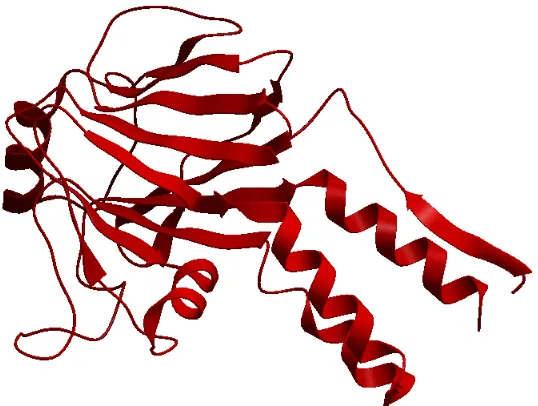
2.2 Representation of the secondary structure of PDB ID 1ava, a non-obligate
complex, showing an alpha helix and a beta sheet which are the main
com-ponents. The figure was generated with the help of ICM browser [48]. . . . 13
2.3 Tertiary structure as one sub-unit of PDB ID of 1dev (Chain A), a
non-obligate complex. The structure is a combination of alpha helices shown as
ribbons and beta sheets shown as arrow heads. . . 15
2.4 Quaternary structure of PDB ID 1a3n, hemoglobin, consisting of Chains
A, B, C and D respectively. The four different chains are represented in
different colors for clarity. . . 16
LIST OF FIGURES xi
2.5 Protein-protein interaction for complex PDB ID 1cli. The highlighted area
indicates the interface or the place where interaction occurs between the
two chains. . . 17
2.6 Representation of domains in complex PDB ID 1ava (chain A). . . 18
2.7 One short, linear motif found in both chains of Cytoplasmic Malate
Dehy-drogenase (PDB ID 4mdh) at position 233. The regular expression of this
SLiM is[RN][YDG]I[GRW][YF]G. . . 20
2.8 Homo-oligomer complex PDB ID 2gbl. . . 22
2.9 Hetero-oligomeric complex PDB ID 1a3n. . . 22
3.1 An obligate complex PDB ID 1b8j with its interacting chains A and B as
shown in different colors, red and blue. This figure was generated with the
help of ICM browser. [48]. . . 32
3.2 Optimal separating hyperplane in the two dimensional space. . . 40
4.1 Proposed PPIEE model for prediction of protein interaction types. . . 49
5.1 Classification accuracy plots for SVM and LDR on ZH-AA and ZH-AT
datasets. . . 70
5.2 Classification accuracy plots for SVM and LDR on MW-AA and MW-AT
datasets. . . 70
5.3 Electrostatic potential of an obligate complex, PDB ID 2min, plotted over
solvent accessible surface area before and after the interaction takes place.
5.4 Electrostatic potential of a non-obligate complex, PDB ID 1a2k, plotted
over solvent accessible surface area before and after the interaction takes
List of Tables
3.1 Atom type table. . . 45
3.2 Atom conversion table (a). . . 46
3.3 Atom conversion table (b). . . 47
4.1 Dataset description. . . 52
4.2 Description of the datasets used in this study. . . 52
4.3 Non-obligate complexes in the MW dataset. . . 53
4.4 Obligate complexes in the MW dataset. . . 53
4.5 Obligate complexes in the ZH dataset. . . 54
4.6 Non-obligate complexes in the ZH dataset. . . 54
4.7 List of complexes from the ZH dataset with their corresponding types ob-ligate (O) or non-obob-ligate (NO), for which the electrostatic energies could not be computed. . . 54
4.8 List of complexes from the MW dataset with its corresponding types ob-ligate (O) or non-obob-ligate (NO), for which the electrostatic energies could not be computed. . . 55
5.1 Comparison of PPIEE with desolvation energies as properties for ZH and MW datasets . . . 62
5.2 Prediction results and comparison with other approaches and properties on
the ZH-AA dataset. . . 63
5.3 Results of prediction and comparison with other approaches and properties
on the MW-AA dataset . . . 64
5.4 Comparison with the desolvation energy approach for AA and
MW-AT datasets. . . 65
5.5 Classification results for the MW and ZH datasets for a threshold value of
7 ˚A. . . 65
5.6 Classification results for MW and ZH datasets for a threshold value of 8 ˚A. . 66
5.7 Classification results for MW and ZH datasets for a threshold value of 9 ˚A. . 66
5.8 Classification results for MW and ZH datasets for a threshold value of 10 ˚A. 66
5.9 Classification results for MW and ZH datasets for a threshold value of 11 ˚A. 67
5.10 Classification results for MW and ZH datasets for a threshold value of 12 ˚A. 67
5.11 Classification results for MW and ZH datasets for a threshold value of 13 ˚A. 68
Chapter 1
Introduction
1.1
Protein-protein Interaction
Molecular biology is the study of biology at a molecular level. It overlaps biology and
chemistry and studies vital processes and chemical substances in living organisms. This
branch mainly deals with different types of interactions among various molecules such as
different types of DNA, RNA and protein complexes. Understanding these interactions
are also included in this branch of biochemistry. Molecular biology revealed the original
convergence of geneticists, physicists and structural biochemists on a common problem;
the structure and function of biological complexes. It focus heavily on function, role and
structure of biomolecules. The history of molecular biology provides the importance of the
discovery of macromolecular mechanisms [20]. Recently, a lot of work has been done at the
interface of molecular biology and computer science in bioinformatics and computational
biology.
Bioinformatics can be seen as an application of statistics, maths and computer science.
It is actually, the application of computer science techniques to molecular biology [47], an
indispensable field for modern biology. Commonly used tools and technologies in this field
are, Java, Python, Perl, Cuda, Octave, Matlab and Microsoft Excel among others. The main
purpose of bioinformatics is to have better and lucid understanding of biology. It involves
computationally intensive techniques such as pattern recognition, data mining,
visualiza-tion and machine learning algorithms. Major research efforts are in the fields of structure
prediction, drug design, drug discovery, protein structure alignment, gene expression and
protein-protein interactions.
Proteins control all biological systems in a cell including nutrient uptake, gene
expres-sion, cell growth, proliferation, inter cellular communication, among others. The main
rea-son behind their interaction is to perform some biological function. Many proteins perform
their function independently. Prediction of protein-protein interaction (PPI) and analyzing
relevant properties for prediction have been studied from various perspectives. Proteins
bind to each other through a combination of hydrophobic bonding, van der Waals forces
and salt bridges at specific binding domains on each protein. The strength of the binding
is dependent on the size of binding domains. These domains can be large surfaces, small
binding clefts, a few peptides or hundreds of amino acids.
Prediction of protein interaction has gained much interest in recent years with over 20
different proposed methods [37]. To characterize the properties of protein-protein
inter-action types can be done by studying their structural information. Thus, structure-based
prediction methods including computational approaches, homology modelling,
threading-based methods and protein-protein docking are more accurate than those which do not
employ structural data [37]. These studies have been carried out mostly by relying on
bio-logical knowledge about the atoms or molecules, which normally are selected manually by
CHAPTER 1. INTRODUCTION 3
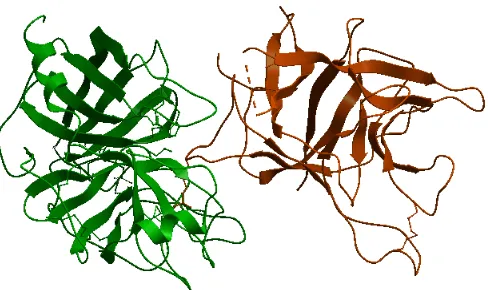
Figure 1.1: A non-obligate complex PDB ID 1avw with its interacting chains A and B, shown in different colors.
Figure 1.1 shows a non-obligate complex (PDB ID 1avw) an its two interacting chains
with different colors. This figure was generated with the help of ICM browser [48]. It
reflects how two chains of the protein complex interact with each other. The part of interest
is the interacting atoms. The complex is taken from one of datasets used in the proposed
model which is referred to as the Zhu dataset [50].
An important aspect in studying prediction of PPI is to predict different types of
com-plexes, including similarities between subunits (homo/hetero-oligomers), number of
sub-units involved in the interaction (dimers, trimers, etc.), duration of the interaction (transient
vs. permanent) [31], stability of the interaction (non-obligate vs. obligate) [50], among
others; but I focus on the problem of prediction protein interaction types (obligate and
non-obligate).
Obligate interactions are usually considered as permanent, while non-obligate
interac-tions can be either permanent or transient [33]. Non-obligate and transient interacinterac-tions are
and permanent interactions last for a longer period of time, and hence are more stable [22].
The study of [2] suggested that mobility differences of amino acids are more significant for
obligate and large interface complexes than for transient and medium-sized ones.
(a) Obligate complex PDB ID 1luc (b) Non-obligate complex PDB ID 1tab
Figure 1.2: Differentiating between Obligate and Non-obligate protein complexes on the basis of the interface area. Part (a) of the figure shows an obligate complex while the other part (b) depicts a non-obligate complex.
Figure 1.2 depicts an obligate complex (PDB ID 1luc) and a non-obligate complex
(PDB ID 1tab). It shows how obligate and non-obligate complexes differ from each other.
Observing part (a), the two chains of the complex are shown in different colors, i.e, yellow
and green. Since it is an obligate complex, it has larger interface area as compared to the
other complex. On the other hand, it is a non-obligate complex (PDB ID 1tab) with two
chains interacting with each other but with comparatively smaller interface area. Thus, on
the basis of the interface area one would be able to differentiate between the two types of
complexes. However, this is not the general case, since other properties may empower the
prediction, as shown in this thesis.
Non-covalent interactions are very common between macromolecules (including
CHAPTER 1. INTRODUCTION 5
i) Electrostatic interactions - they occur between electrically charged atoms having both
positive and negative interactions.
ii) Vander waal interactions - they occur between any pair of charged atoms that are close
to each other.
iii) Non-polar interactions - these are attractive interactions occurring between atoms that
do not have charges.
Two atoms that are either partially or fully electrostatically charged will interact with
each other. Each interacting atom generates an electric field that surrounds the atom. Also,
there are a few types of electrostatic interactions which are dominant in proteins :
i) Ionic interactions: they occur between fully charged atoms.
ii) Hydrogen bonds: they occur between atomic dipoles. They involve atoms with partial
charge, one of which is a hydrogen atom.
To predict the interaction types, every prediction method needs observed properties of
the known class samples called f eatures. Features are generally nominal or numeric, and
the process of calculating the features for each sample from the input dataset is called
fea-ture generation. Physiochemical properties of proteins are very powerful for prediction and
have been extensively reported in literature. Interacting regions can be characterized by
diverse sets of physiochemical properties [37], topological properties [10] and conserved
residues [27]. In addition, other properties have been used for PPI prediction such as
anal-ysis of solvent accessibility [50], geometry [25], hydrophobicity [44], sequence-based
fea-tures and desolvation energy [4],[44]. Based on interface properties such as interface area
and ratio of area [50], Zhuet al.predicted biological and crystal packing interactions using
properties, prediction of types (obligate and non-obligate) was reported using SVM and
linear dimensionality reduction (LDR) [43]. A very recent work presented by Ruedaet al.
shows the use of desolvation energies to solve the same prediction problem using the above
mentioned classifiers [30].
To reduce the size of the generated features from the input, feature extraction methods
have been used. Feature extraction is a popular pattern recognition method [18]. It is a
spe-cial form of dimensionality reduction. When the length of the feature vector is very large,
there might be a need to apply feature extraction methods to find the lower dimensional
representation of that original feature vector. The transformation of high dimensional data
to lower dimensional data is also called feature extraction [18]. There are many feature
ex-traction methods such as principal component analysis (PCA) [21], non-linear dimension
reduction, independent component analysis and linear dimensionality reduction (LDR). For
classification purpose, I use LDR methods [41] coupled with Bayesian classifiers (details
discussed in Chapter 3), which are the following:
• Fisher’s discriminant analysis (FDA) [12, 15].
• Heteroscedastic discriminant analysis (HDA) [28].
• Chernoff discriminant analysis (CDA) [41].
Lower dimensional data obtained by these three LDR methods are then passed through
quadratic Bayesian (QB) and linear Bayesian (LB) classifiers [12] for final prediction. For
each classifier, prediction accuracy and time taken for that prediction are very important. It
actually depends on the dataset used as well the behaviour of the classifier on a particular
CHAPTER 1. INTRODUCTION 7
1.2
Motivation and Objectives
Since PPI plays important role in many biological processes occurring in cells such as
cellular motion, gene regulation and transduction, many researchers are working to
un-derstand these different biological functions based on protein sequence or their structure.
Researchers are conducting their research work either by following labour intensive
experi-mental or computational approaches. Thus, understanding these biological functions, helps
understand diseases and develop drugs for their cure. Valuable knowledge generated by
these computational methods about these interactions greatly helps biological research.
During their life span, proteins interact with each other or even within themselves to
change their shape or other complexes to perform a specific biological function.
Previ-ously labour intensive approaches were available such as affinity chromatography or
co-immunoprecipitation. These days, high throughput methods such as tandem affinity
pu-rification, mass spectroscopy, yeast two hybrid, bimolecular fluorescence complementation
are available. But these methods are not applicable to all the proteins in all the organisms as
they suffer from some system errors [1, 16, 40]. Therefore, new computational approaches
are attracting more researchers for studying protein-protein interactions due to the fact that
these are cost effective. I propose a computational model, which I call PPIEE
(protein-protein interaction using electrostatic energy), to predict and analyze (protein-protein interaction
types (obligate and non-obligate) using electrostatic energies as properties. Thus, studying
these two types of PPIs will help researchers gather more information for understanding
and explaining biological processes and mechanisms for complex formation. It may also
help in drug development for curing diseases related to PPI.
Different features and prediction methods can be used to solve this specific problem. In
better than previously used properties such as NOXclass features (interface area, interface
area ratio, amino acid composition of the interface, correlation between amino acid
com-positions of interface and protein surface, gap volume index and conservation scores of the
interface) [50], desolvation energies [4], and others. With the proposed properties, I also
implement a model grouping by amino acids or by atom types for prediction purposes.
1.3
Problem Statement
In this thesis, I study the problem of predicting and analyzing protein-protein interaction
types (obligate and non-obligate) using electrostatic energies as properties. The aim is to
distinguish between two types of complexes, i.e. obligate and non-obligate, as mentioned
above. It is a very important problem in the field of proteomics.
1.4
Hypothesis
The thought for using electrostatic energies as properties in the proposed PPIEE is due to
the fact that electrostatic interactions are long ranged. These may go upto 10 ˚A or even
more. Thus, they cover wider interface area yielding more knowledge about atoms present
in the interface. There has been a lot of research in field of electrostatic energies. But the
idea of using these energies as properties to predict the protein interactions types (obligate
and non-obligate) is innovative and a framework has been designed to evaluate and validate
CHAPTER 1. INTRODUCTION 9
1.5
Contributions
I focus on prediction of two types of protein-protein interactions, namely obligate and
non-obligate to evaluate the results efficiently. The main contributions in this thesis are:
• To calculate the electrostatic energies for the Zhu dataset [50] and the Mintseris
dataset [32] using computer tools knowns as PDB2PQR [11] and APBS [5].
• To propose PPIEE that uses electrostatic energies as properties to predict
protein-protein interaction types.
• To integrate data from four different file formats, namely PDB, PQR, OUT and
IN-TERFACE.
• The use of electrostatic energies on these datasets with different grouping criteria
such as by atom types and amino acids.
• Visual analysis using electrostatic potential for some complexes in order to analyze
interactions from a different perspective.
In summary, I propose PPIEE to solve this type of problems efficiently and effectively.
The development of an automatic tool is important, which downloads the structural
infor-mation from PDB [7], and calculates the pairs of atoms in the interface for a particular
threshold distance and then, computes their electrostatic energies. Then, it arranges the
data in the form of features so that classification can be applied to predict the interaction
1.6
Thesis Organization
The thesis is organized in six chapters. Chapter II provides a survey of obligate and
non-obligate PPI and the prediction methods used to determine those types. Chapter III presents
different feature generation methods that can be used for prediction. Chapter IV describes
the proposed PPIEE model and features, and all required methods for the experiments.
Chapter V discusses the experimental results with the proposed approach and comparisons
with some of the existing methods. Finally, Chapter VI concludes the thesis with some
Chapter 2
Obligate and Non-obligate PPI
Prediction
2.1
Proteins
In 1838, Dutch chemist Gerhardus Johannes Mulder first described proteins, which were
named by Swedish chemist J ¨ons Jakob Berzelius [46]. Proteins are the most important
class of biochemical molecules, although lipids and carbohydrates are also essential for
life. Proteins are the basis for the major structural components of human and animal tissue.
Proteins are natural polymer molecules consisting of amino acids. The number of amino
acids in a protein may range from a few to several thousands. In general, a protein is an
organic compound, made of an arranged chain of amino acids which forms a globular or
fibrous form [46].
2.2
Protein Structures
A protein is a polymer of amino acids that has four levels of structure [38]:
1. Primary
2. Secondary
3. Tertiary
4. Quaternary
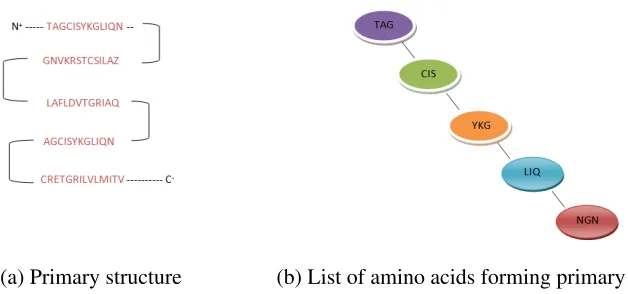
Figure 2.1 shows the primary structure of a typical protein which is made up of a
se-quence of amino acids along their backbone. Figure 2.1 (a) shows the linear sese-quence
of amino-acids that starts from amino terminal (N) end to the carboxyl-terminal (C) end.
Counting the residues always starting at the N terminal ((NH2)group), which is the place
in which the amino group is not involved in the peptide bond. The sequence of the protein
is unique to that protein and also defines its structure and function. Figure 2.1 (b) shows a
representation of primary structure of a portion of the protein in a different format. It shows
some of the 20 standard amino-acids such as alanine, proline, valine etc, in the three letter
code format. The structure is held together by peptide bonds which take place during the
CHAPTER 2. OBLIGATE AND NON-OBLIGATE PPI PREDICTION 13
(a) Primary structure (b) List of amino acids forming primary structure
Figure 2.1: Primary structure of a typical protein- a linear sequence of amino acids begin-ning from amino-terminal N to carboxyl-terminal C.
The secondary structure as shown in Figure 2.2 consists alpha helices, beta sheets and
turns. These were suggested in 1951 by Linus Pauling and are defined by patterns of
hy-drogen bonds among the main chain peptide groups.
(a) Alpha helix (b) Beta sheet
Figure 2.2(a) represents an alpha helix in which it is coiled like a loosely coiled spring.
The coiling occurs in clockwise direction as it goes away from us. The main criteria for
the alpha helix is that the amino acid side chain should cover and protect the backbone
(H-bonds). Attractive forces between different atoms cause formation of specific structures.
Figure 2.2(b) shows beta-pleated sheets in which chains are folded so that they lie along
with each other. These sheets are actually anti-parallel in nature. The folded chains are
held together by hydrogen bonds that makes them more stable in nature. The figures were
generated with the help of ICM browser [48] by entering complex PDB ID 1ava, which is
obtained from the Zhu dataset [50].
Tertiary structure is the three-dimensional structure of a single protein molecule. The
alpha helices and beta sheets are folded into globular form. This folding is mainly due to
the hydrophobic interactions. Figure 2.3 shows the tertiary structure of PDB ID 1dev, chain
A. It is a combination of alpha helices as ribbons and beta sheets as arrow heads. It is
made up of several domains and each domain has its own function. The bits of the protein
chain which are just random coils or loops are shown as bits of strings. These structures are
diverse and more complex and largely determined by the biomolecule’s primary structure
or the sequence of amino acids. Its amino acids are capable of performing diverse functions
ranging from molecular recognition to catalysis. The figure was generated with the help of
CHAPTER 2. OBLIGATE AND NON-OBLIGATE PPI PREDICTION 15
Figure 2.3: Tertiary structure as one sub-unit of PDB ID of 1dev (Chain A), a non-obligate complex. The structure is a combination of alpha helices shown as ribbons and beta sheets shown as arrow heads.
Quaternary structure is the arrangement of multiple folded proteins in a multi-subunit
complex. The quaternary structure of a protein can be determined by experimental
tech-niques by placing a sample protein in different experimental positions. Most of the proteins
in the human body are found in this state. Examples of proteins in that state include DNA
polymerase, hemoglobin and ion channels.
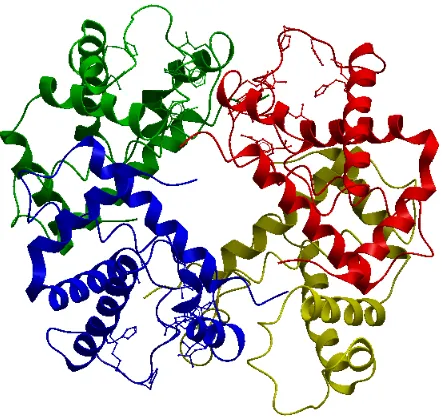
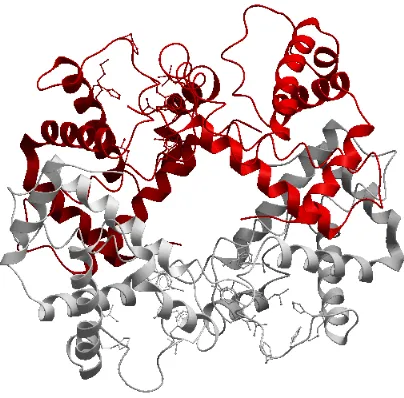
Figure 2.4 shows an example of a protein in its quaternary structure. The four different
colors represents four different chains for 1a3n, i.e., Chains A, B, C and D. These sub-units
yield a stable structure. This structure involves the clustering of several individual protein
chains into a specific shape. PDB ID 1a3n (hemoglobin) is a type of Globular quaternary
protein which is clumped into a ball shape as shown. Other examples are insulin and most
of the enzymes. This structure may fall apart in a high salt environment. This figure was
Figure 2.4: Quaternary structure of PDB ID 1a3n, hemoglobin, consisting of Chains A, B, C and D respectively. The four different chains are represented in different colors for clarity.
2.3
Protein-protein Interactions
To perform biological functions, one or more proteins may bind to each other or to DNA
or RNA. This is the main reason why protein interaction takes place inside human body.
Protein-protein interaction involves [33]:
• Direct contact association of molecules, which means that different molecules
be-longing to specific amino acids within a protein may interact with each other if they
are close to each other under a certain threshold distance. Generally, for direct
asso-ciation molecules, they should be within 7 ˚A distance from each other [8].
• However, if I consider the role of electrostatic interactions, these are considered to be
CHAPTER 2. OBLIGATE AND NON-OBLIGATE PPI PREDICTION 17
take place, if the molecules are within the distances of 10 ˚A or even more [23].
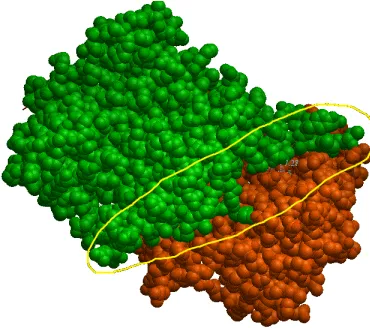
Figure 2.5: Protein-protein interaction for complex PDB ID 1cli. The highlighted area indicates the interface or the place where interaction occurs between the two chains.
Figure 2.5 shows two interacting chains, Chains A and B of PDB ID 1cli. The
inter-acting chains are shown in green and red respectively. The highlighted portion shows the
interface where the actual interaction takes place. This figure gives a clear idea how two
chains interact with each other, forming a complex. This region is the area of interest,
since electrostatic energies for the pairs of atoms present in this region are calculated using
available software packages. This figure was generated using ICM browser [48].
There is a need to understand how proteins interact with each other. Since proteins
per-form different biological processes in a cell including cell growth, nutrient uptake, motility,
intercellular communication and apoptosis. Critical aspects required to understand
func-tions of proteins include [17]:
• Protein sequence and structure- used to discover motifs that predict protein func-tion.
• Interactions with other proteins- functions may be predicted by knowing the func-tion of binding partners.
• Post translational modifications - even some changes after the interaction take place.
2.3.1
Domains
The concept of domains was first proposed in 1973 by Wetlaufer [29]. A domain is a three
dimensional structure that is part of a protein. It evolves, functions and exists independently
from the rest of the protein chain. Domains may vary in length from 25 to 5,000 amino
acids. Physical interaction between proteins is also analysed on the basis of the residues of
their structural domains. The presence of multiple domains gives rise to great flexibility and
mobility. As a result, domain-domain interactions, these properties can be used to predict
protein-protein interaction types [29].
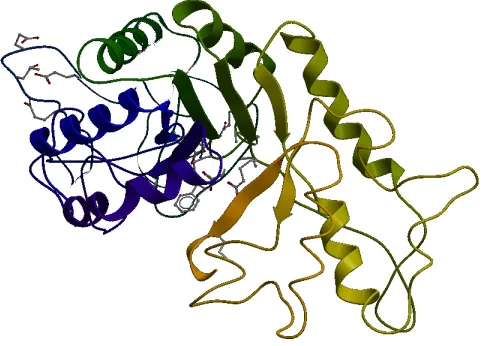
Figure 2.6: Representation of domains in complex PDB ID 1ava (chain A).
CHAPTER 2. OBLIGATE AND NON-OBLIGATE PPI PREDICTION 19
domains were discovered using the Pfam server [39], which represent protein families or
domains. The server helps in determining the domains and it carries its architecture. The
residues belonging to Chain A beginning from 17 and ending at 324 were found to be a
domain and is shown in the figure. This figure was generated using ICM browser [48].
2.3.2
Motifs
A motif refers to a particular amino acid sequence that is characteristic of a particular
bio-logical function. An example is the zinc finger motif, which is a functional motif. In other
words, it is a set of contiguous secondary structure elements that has specific functional
significance or defines a portion of an independently folded domain. Identifying motifs
from a sequence is not straightforward since they have functional implications. Some
mo-tifs such as the zinc finger motif are easy to identify since they are continuous but other
might be discontinuous and might be then difficult to predict. Short linear motifs are short
stretches (also known as SLiMs or minimotifs) of a protein sequence that help mediate
protein-protein interaction. The main role of SLiMs is to target specific interactions with
other protein domains [9].
The sequence logo is a useful graphical representation of the protein motifs. It shows
how well amino acids are conserved at each position; the higher the frequency of amino
acids, the higher the letter will be, because the better the conservation is at that position.
Different amino acids at the same position are scaled according to the information content
of that amino acid.
Figure 2.7 shows the sequence logo for the short, linear motif found on the chains of
Cytoplasmic Malate Dehydrogenase (PDB ID 4mdh) complex at position 233. The Regular
-axis which represents the positions of the SLiM, and they-axis that reflects the information
content of that specific position. The information content of they-axis is given by (2.1):
Figure 2.7: One short, linear motif found in both chains of Cytoplasmic Malate De-hydrogenase (PDB ID 4mdh) at position 233. The regular expression of this SLiM is [RN][YDG]I[GRW][YF]G.
Ri=log2(20)−(Hi+en). (2.1)
whereHiis the uncertainty of a positioniandHiis defined as:
Hi=−
∑
fa,i log2 fa,i. (2.2)Here, fa,iis the relative frequency of amino acidaat positioni, enis the small-sample
correction for an alignment ofnletters. The height of letterain columniis given by (2.3):
en=
(s−1)
CHAPTER 2. OBLIGATE AND NON-OBLIGATE PPI PREDICTION 21
For proteins, the value ofsis 20 andnthe length of the SLiM.
2.3.3
Protein-protein Interaction types
Another important aspect in studying PPI is to predict different types of complexes,
includ-ing similarities between subunits (homo/hetero-oligomers), number of subunits involved in
the interaction (dimers, trimers, etc.), duration of the interaction (transient vs. permanent)
[31], stability of the interaction (non-obligate vs. obligate) [50]. Based on physiological
functions, specificity and evolution, PPIs can be divided into four broad categories [33]:
1. Homo and hetero-oligomeric interactions
2. Non-obligate and obligate interactions
3. Transient and permanent interactions
4. Crystal packing and biological interactions
Homo-oligomer and hetero-oligomeric interactions: If the two interacting protein chains of an oligomer have structural symmetry, then those kinds of PPIs are called
homo-oligomeric protein-protein interactions. If the two interacting protein chains of an oligomer
have differences in their structure, those kinds of PPIs are called hetero-oligomeric
Figure 2.8: Homo-oligomer complex PDB ID 2gbl.
CHAPTER 2. OBLIGATE AND NON-OBLIGATE PPI PREDICTION 23
Figure 2.8 depicts the quaternary structure of PDB ID 2gbl which is a homo-oligomer
complex. This complex contains six identical units, all reflected in different colors which
are structurally similar to each other.
Figure 2.9 shows another complex, PBD ID 1a3n, Hemoglobin. It is made up of two
homo-dimers as shown in different colors, red and white.
Obligate and Non-obligate interactions: Obligate interactions are usually considered as permanent, while non-obligate interactions can be either permanent or transient [33].
Non-obligate and transient interactions are more difficult to study and to understand due to
their instability and short life, while obligate and permanent interactions last for a longer
period of time, and hence are more stable [22].
Transient and permanent protein-protein interactions: These kinds of interactions are differentiated on the basis of the lifetime of the interacting protein complexes.
Perma-nent interactions are stable interactions, while transient interactions are less stable
interac-tions.
Crystal packing and biological interactions: During the process of crystallization protein complexes form solid crystals [50]. These kinds of interactions do not serve the
biological purpose because they are incapable of performing any biological activity. This
type of packing is called crystal packing interaction. All other PPIs that occur perform
some biological functions and are called biological PPI.
PPIs can take place between identical or non-identical chains which are based on their
structural similarity. If the interacting chains of an oligomer has structural symmetry, then
it is called homo-oligomeric PPI, otherwise it is called hetero-oligomeric PPI. While
con-sidering the life time of a complex, it can be a transient and permanent PPI. Permanent PPIs
chang-ing their shapes until they dissociate or result in permanent complexes. To find out about
the biological functions performed by different types of complexes, it is important to know
about the PPIs.
2.4
Protein-protein Interaction Prediction Approaches
Many researchers worked on predicting protein-protein interaction types with different
ap-proaches. These approaches are mainly divided into two main categories, namely:
1. Experimental Approaches
2. Computational Approaches
Traditionally, prediction of PPI was limited to experimental techniques such as
co-immunoprecipitation or affinity chromatography [1, 16, 40]. These methods are
labor-intensive and often the results of these approaches contain systematic errors. Since the data
for prediction is growing, these experimental processes become less applicable.
Compu-tational approaches are more popular these days because they are less expensive to use.
Computational approaches can be further divided into two classes.
1. Methods based on evolutionary conservation information
2. Those solely structure based on geometrical and physiochemical properties of the
proteins.
Modern multiple sequence alignment algorithms including residue substitution
matri-ces allow detection of conservation signal. One type of prediction depends on the algorithm
for deriving scores from the alignment [34]. But the main problem is that many protein
CHAPTER 2. OBLIGATE AND NON-OBLIGATE PPI PREDICTION 25
assumption that protein interfaces are quite different from the rest of the surface, since they
vary in their geometrical and physiochemical properties from rest of the surface. The
phys-ical properties of the interface are highly diverse [36]. To decide between which approach
is better depends upon the nature of the protein of interest and available resources.
To predict obligate and non-obligate PPIs, many classifiers including random forest (RF),
Bayes, decision trees, logistic regression, neural networks, SVM and LDR have been used.
Different classifiers achieve different performances based on the type of data and
prop-erties used. Some research in [12, 15, 41] achieved a classification accuracy of 70% for
the problem of distinguishing obligate and non-obligate interactions with a wide range of
parameters and different types of features such as desolvation energy, amino acid
composi-tion, conservation scores, electrostatic energies, and hydrophobicity.
Descriptors based on the 3D structure of proteins used for the prediction are as follows
[24]:
1. Neighbour list: Residues in the spacial vicinity to the residue in question. Generally, 9-20 residues are taken into consideration.
2. β Factor: It is the crystallographic measure that approximates the flexibility of the residue.
3. Secondary structure: This structure represents alpha helices, beta sheets and loops. 4. Sequence distance: The separation between residues within the same patch. Some results shows that structurally contiguous residues are more likely to form interaction
sites.
1. Sequence profile: Extracted from multiple sequence alignment, profiles reveal pat-terns of evolutionary conservation.
2. Conservation Score: A quantification of the level of conservation of an individual position.
3. Conservation of physiochemical traits: If the position is not conserved, scoring conservation of traits such as charge, hydrophobicity, or size may improve prediction.
Descriptors based on physiochemical properties:
1. Hydrophobicity: It is the physical property of a molecule that is repelled from mass of water. Hydrophobic molecules often cluster together in water to form micelles.
Several different scales are available.
2. Electrostatic potential: It co-relates with the dipole moment, electro-negativity and partial charges. In other words, it is the potential energy of the protons at a particular
location near a molecule. It requires the 3D structure of the protein.
3. Atom propensities: It serves as a way to sum physiochemical properties across residues in a patch.
4. Desolvation energies: Used in prediction of protein interaction types and rigid-body docking.
The proposed PPIEE model uses LDR and SVM methods for classification. PPIEE uses
LDR coupled with Bayesian both linear and quadratic. The details of these classifiers are
Chapter 3
Feature Extraction and Prediction
3.1
Pattern Recognition
Pattern recognition is the scientific field whose goal is clustering, feature selection and
extraction and classification of objects into a number of categories or classes [45]. An
example of pattern recognition is classification whose aim is to assign labels to unknown
objects. A simple example can be whether to determine that a given email is spam or
non-spam. Generally speaking, the objects can be protein sequences, signal waveforms or
images. There are several application areas of pattern recognition in today’s world. It is the
most important part for the machine learning systems built for decision making. Typical
applications are automatic speech recognition, classification of text in several categories
and automatic recognition of images of human faces.
In machine learning and pattern recognition, one of the key factors is to include and
select the right features for successful prediction. These are the observed properties of each
sample that are used for prediction. The value of the features are usually numeric, but other
types such as strings and graphs are also used.
3.1.1
Classifiers
In pattern recognition, classification is the procedure for identifying unknown samples on
the basis of training sets of known samples. The classification problem is known as
super-vised learning in pattern recognition. In supersuper-vised learning, the training set is provided
with labels attached to each sample. Then, the classifier is trained on these samples. After
the classifier is well trained, it can classify unknown samples. On the other hand,
unsu-pervised learning assumes that training data do not have labels attached to the samples and
attempts to find the inherent patterns in the data that can hopefully determine the correct
output value for new unknown instances. There are various classifiers available [14]:
1. Linear classifiers
2. Quadratic classifiers
3. Support vector machine
4. Decision tree
5. Neural Networks
6. Hidden Markov Models
Among these, I use SVM, linear classifiers and quadratic classifiers for prediction of
obligate and non-obligate types of interactions.
3.2
Features Used for PPI Prediction
CHAPTER 3. FEATURE EXTRACTION AND PREDICTION 29
β-factor : It is the flexibility of the protein complexes during the interaction.
Solvent Accessibility : It is the exposed surface area that affects contact of atoms during the interaction.
Geometric features : The shape index, planarity or curvedness of the interacting com-plexes can also be used as features.
Evolutionary features : They include conservation scores or sequence profiling informa-tion.
Physicochemical features : They include hydrophobicity, electrostatic and desolvation energies.
3.2.1
Tools Used to Calculate Electrostatic Energies
Electrostatic interactions are important in understanding intermolecular interactions. These
interactions control the structure and binding of biomolecules. Electrostatics are important,
since they are long ranged interactions and because of their influence in charged molecules
[5]. This motivated me to focus on electrostatic energies and hence use them as properties
for predicting interaction types.
In order to compute electrostatic energies, software packages including PDB2PQR [11]
and APBS [6] were used. PDB2PQR was written by Todd Dolinsky while working with
Nathan Baker at Washington University in St. Louis, USA. PDB2PQR is a tool that
auto-mates common tasks for preparing structures for electrostatic calculations. Its purpose is
to add missing heavy atoms, place missing hydrogen atoms and assign charge and radii to
PDB files. The output of this package is a PQR structure file, which is the input for APBS.
the software can be run with customized parameters. The command line argument which
executes the Python script is in (3.1).
$ python pdb2pqr.py [options] –ff={forcefield} {path} {output path} (3.1)
This software provides many parameters which can be customized as per needs which
are as follows:
• forcefield: Currently this software supports AMBER, CHARMM, PARSE and TYL06 forcefields.
• path: It requires the input path to the PDB complex. The software will execute this PDB file to output PQR file format.
• output-path: It requires the desired name of the PQR file. The file will be saved on the path or location specified here in this parameter.
• chain name(optional): It keeps the chain ID in the output of the PQR file format. • –asign-only(optional): It only assigns charge and radii. It does not add atoms, or
debump, or optimize.
• –noopt(optional): It does not perform hydrogen bonding network optimization. • –apbs-input(optional): It creates the template APBS input file based on the
gener-ated PQR file. It further has some parameters that can be changed to run APBS.
CHAPTER 3. FEATURE EXTRACTION AND PREDICTION 31
APBS is a software package used for calculating electrostatic energies for interactions
between solutes in salty and aqueous media [6]. It solves the Poisson-Boltzmann equation
numerically and evaluates electrostatic calculations ranging from tens to millions of atoms.
It basically uses Fekt (Finite element toolkit) which solves the Poison-Boltzmann
equa-tion for electrostatic calculaequa-tions. It is used for modelling bio-molecular solvaequa-tion through
solution. This software was written by Nathan Baker in collaboration with J.Andrew
Mc-Cammon and Michael Holst. APBS is also integrated with other programs such as Jmol,
which help visualize the complexes for better understanding.
APBS can be run either through the web-server or it can be installed on a local machine.
The advantage of installing it and running it on a local machine is that it provides the
freedom to use more parameters. For PPIEE, electrostatic energies per atom were calculated
using APBS. The command line used to run APBS is in (3.2).
f or i in∗.in; do
echo ”Running $i...”
(apbs $i2>&1)∥tee ${i%.in}.out
done
(3.2)
Some of the parameters which need to be taken care of while running APBS are in the
elecsection as follows:
• Calcenergy: Changing the parameter Calcenergy “total” to Calcenergy “comps”. The software produces the electrostatic energies per atom.
3.3
Proposed Features on Electrostatic Energies
I consider the interaction between theithatom of the first interacting chain and the jthatom
of the second interacting chain. Then, I calculate the distance between all possible atom
pairs. If an atom pair is separated by a distance less than or equal to a certain threshold,
that pair is considered to be in the interface of that complex [23]. In most studies,
inter-atom distances are not greater than 7 ˚A. But in order to achieve an in-depth analysis for
electrostatic energies as properties, in this work, the threshold was varied from 7 ˚A to 13 ˚A.
It is to be noticed that even the atoms that are under the surface of proteins pose electrostatic
forces towards the stability of the protein complex.
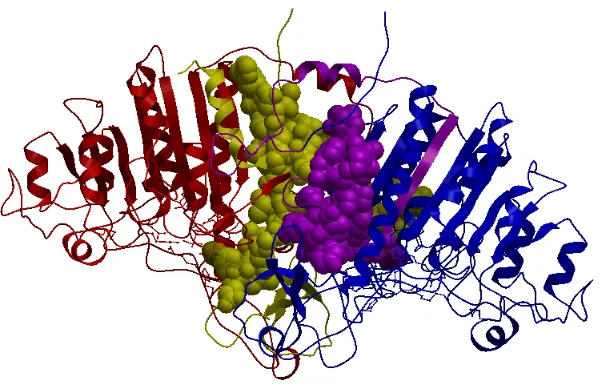
Figure 3.1: An obligate complex PDB ID 1b8j with its interacting chains A and B as shown in different colors, red and blue. This figure was generated with the help of ICM browser. [48].
Figure 3.1 depicts an obligate complex, PDB ID 1b8j, along with its interacting chains
CHAPTER 3. FEATURE EXTRACTION AND PREDICTION 33
of distance act as interface atoms and are represented as yellow and purple spheres
respec-tively. An atom pair is considered to be in the interface if atoms are under certain threshold
distance apart from each other for this complex. Since electrostatic interactions are long
ranged, a larger interface area is observed.
3.4
Feature Generation
For each complex in the datasets, structural data from PDB [7] were collected. Two
inter-acting chains were extracted from each PDB file. I consider 18 different atom types as in
[49]. Thus, for each protein complex a feature vector with18C2+18 = 171 values were
ob-tained, where each feature contains the cumulative average of electrostatic energies for all
pairs of atom of the same type in the interface. Since the order of interacting atoms in the
pairs is not important, the final length of the feature vector for each complex is 171 which
corresponds to the number of unique pairs [42]. I have also considered pairs of amino acids,
and for this, I computed20C2+20 = 210 values for all pairs of amino acids and by
accumu-lating the electrostatic values of the corresponding atoms for each pair of amino acids. The
final length of the feature vector for each complex is 210 which corresponds to the number
of unique pairs for 20 standard amino acids. This is how I obtain feature vectors for both
atom types (171) and amino acid types (210). Averages for electrostatic values for the pairs
of atom types and amino acids are calculated as follows:
Σ(ei+ej)/2. (3.3)
whereeistands for the electrostatic value for theithinterface atom from the first interacting
interacting chain.
Using Equation (3.3), for each complex in the datasets, the averages of electrostatic
values were computed for the pairs of atoms on the interface. There are 18 unique type of
atoms and 20 amino acids. Table 3.1 [49] is an 18×18 matrix, where all possible
combi-nations of 18 unique atom types are represented. If the interacting chains of a complex are
known, the very first task is to find the interacting atoms from both chains under a certain
threshold value. Then, the conversion for all the interface atoms to their corresponding
unique types is done. The method of conversion is derived from the conversion table that is
discussed in [49]. Based on PPIEE experiments and the study of [49], Tables 3.2 and 3.3 are
used for atom type conversion. In these conversion tables, the first row of each amino acid
contains the original atoms that are inside them and the second row contains the converted
unique atom-types. When the unique types are determined, I simply find that pair in the
table and obtain the unique types for the atoms. In order to find the interface atoms, I find
the Euclidian distance between the two atoms from two interacting chains, which is to be
computed from their structural data that can be found in PDB files [7].
Table 3.1 shows an example for the atom-type table. The averaged electrostatic values
for the pairs of atoms are stored in their respective positions as shown in the table. With the
help of Table 3.2 [49], I was able to determine a unique type for every atom in the interface.
Just as an example, if I know that atom Nitrogen belongs to amino acid Alanine, then its
CHAPTER 3. FEATURE EXTRACTION AND PREDICTION 35
3.4.1
Classifiers Used in This Work
3.4.1.1 Bayesian Decision Theory
Bayesian decision theory is a fundamental statistical approach for pattern classification. It
assumes that decision problems are based on probabilistic terms. The main focus of this
work is about the discriminant function for normal densities. The expression for the
multi-variate normal distribution is [13]:
gi(x) =−12(x−µµµi)t ∑−i 1(x−µµµi)−d2 ln 2π− 1
2 ln|∑i|d+ ln P(ωi). (3.4)
wherex is a d−component column vector, µµµ is a d− component mean vector and Σ is thed × d covariance matrix, which is always symmetric and positive semidefinite, and
P(ωi)are the prior probabilities.
Some special cases for the discriminant functions are the following:
Case 1: This case is when the features are statistically independent and have the same
variance, σ2. Geometrically, this case is when samples fall on equal-sized clusters. The
discriminant function is:
gi(x) =−2σ12[xtx−2µµµti x+µµµtiµµµi] + ln P(ωi). (3.5)
Case 2: When the covariance matrices for all the classes are identical but otherwise
arbitrary. Geometrically, in this situation all the samples fall on hyper ellipsoidal clusters
gi(x) =−12(x−µµµi)t Σ−1(x−µµµi) + ln P(ωi). (3.6)
where for two classesΣican be obtained as:
Σ= 12[Σ1 + Σ2]. (3.7)
In (3.6)P(ωi)is the prior probability of classωi. To classify each feature vectorx, one
measures the squared Mahalanobis distance from eachxto each of thecmean vectors and assignxto the category of the nearest mean.
Case 3: It is the general multivariate normal case, in which the covariance matrices are
different for each category. This is called quadratic Bayesian classifier (QB). The
classifi-cation function is as follows [13]:
gi(x) = xtWix+wti x+ωi0. (3.8)
whereWiis:
CHAPTER 3. FEATURE EXTRACTION AND PREDICTION 37
andwiis:
wi=∑−i 1µµµi. (3.10)
3.4.1.2 Linear Dimensionality Reduction
The basic idea of LDR is to represent an object of dimensionn (171 or 210) as a
lower-dimensional vector of dimension d, achieving this by performing a linear transformation.
Consider two classes, obligate asω1and non-obligate as ω2, represented by two normally
distributed random vectorsx1∼N(m1,S1)andx2∼N(m2,S2), respectively, with p1 and
p2thea prioriprobabilities. After the LDR is applied, two new random vectorsy1=Ax1
andy2=Ax2, wherey1∼N(Am1; AS1At)andy2∼N(Am2; AS2At)withmiandSi
be-ing the mean vectors and covariance matrices in the original space, respectively. The aim of
LDR is to find a linear transformation matrixAin such a way that the new classes (yi=Axi)
are as separable as possible. LetSW =p1S1+p2S2andSE = (m1−m2)(m1−m2)t be the
within-class and between-class scatter matrices respectively. Various criteria have been
proposed to measure separability between the classes [41]. I focus on the following three
LDR methods:
Fisher’s discriminant analysis (FDA) [12, 15] : Its optimization criterion is as follows:
JFDA(A) =tr
{
(ASWAt)−1(ASEAt)
}
(3.11)
eigenvalue ofSFDA=S−W1SE.
Heteroscedastic discriminant analysis (HDA) [28] : It aims to obtain the matrixA that maximizes the function:
JHDA(A) =tr
{
(ASWAt)−1[ASEAt −AS
1 2
W p1log(S
−1 2
W S1S
−1 2
W )+p2log(S
−1 2
W S2S
−1 2
W )
p1p2 S
1 2
WAt
]}
(3.12)
This criterion is maximized by obtaining the eigenvectors, corresponding to the largest
eigenvalues, of the matrix:
SHDA=SW−1
[
SE−S
1 2
W p1log(S
−1 2
W S1S
−1 2
W )+p2log(S
−1 2
W S2S
−1 2
W )
p1p2 S
1 2
W
]
(3.13)
Chernoff discriminant analysis (CDA) [41] : It aims to maximize the following func-tion:
JCDA(A) =tr{p1p2ASEAt(ASWAt)−1
+log(ASWAt)−p1log(AS1At)−p2log(AS2At)}
(3.14)
In this work I use the gradient-based algorithm proposed in [41], which maximizes the
function in an iterative way. For this gradient algorithm, a learning rate, αk needs to be
computed. In order to ensure that the gradient algorithm converges, αk is maximized by
using the secant method. One of the keys in this algorithm is the random initialization of
CHAPTER 3. FEATURE EXTRACTION AND PREDICTION 39
3.4.2
Support Vector Machine
I also use SVM, which is widely used in bioinformatics for classification. It takes the set of
input vectors and predicts the possible classes of output based on the support vectors [19].
The kernel trick allows one to map the original vectors onto a much higher dimensional
space that hopefully makes class separation easier. Basically, there are two kinds of
mar-gins in SVM. The first one is called hard margin and the second one is called soft margin.
In the hard margin SVM, the training data is linearly separable in the input space while in
soft margin data can be either be linearly or non-linearly separable. If the training data is
not linearly separable they can be mapped onto a higher dimension feature space to increase
separability.
3.4.2.1 Hard-Margin Support Vector Machine
LetXi(i = 1, ....n)bed-dimensional training input vectors which belong to class 1 or class
2 and the corresponding labels beyi = 1 for class 1 andyi = −1 for class 2. For linearly
separable data the the decision function is as follows [3]:
Figure 3.2: Optimal separating hyperplane in the two dimensional space.
Figure 3.2 shows the optimal hyperplane which best classifies between two classes. As
shown in the figure, the hyperplane in blue has the maximum margin with respect to both
classes and is the calledoptimal separating plane.
The optimal separating hyperplane can be obtained by minimizing :
Q(w) = 1/2∥w∥2
with respect towandbsubject to the constraints:
yi(wTxi+b)>=1 fori = 1, ....M
The square of the Euclidean norm∥w∥is to make the optimization problem solvable by quadratic programming. The data is linearly separable, if there existswand bthat satisfy the above equation. In order to map the input vectors to a higher dimensional feature
space, with infinite dimensions, the above mentioned constraints are converted into the
unconstrained problem [3]:
Q(w,b,α) =12WTw− ∑n
i=1α
i[yi(wT)xi+b)−1]. (3.15)
whereα = α1, ....αmare the non-negative Lagrange multipliers. Then, the
CHAPTER 3. FEATURE EXTRACTION AND PREDICTION 41
Q(α) =∑mi=1αi − 12∑Mi,j=1αiαjyiyjxTi xj. (3.16)
with respect toaisubject to the constraints:
∑M
i=1yiαi = 0 (3.17)
whereαi≥0 fori=1, ...M
All data associated withaiare known as support vectors and from the standard point of
precision of calculations, the average is calculated among the support vectors which is:
b = ∥1S∥∑i∈S(yi−wTxi) (3.18)
Now the unknown datumxcan be classified into:
Class1i f D(x) > 0,
Class2i f D(x) <0
(3.19)
This function classifies the data into two different classes. In special case D(x) = 0, the sample is said to be unclassifiable.
3.4.2.2 Soft-Margin Support Vector Machines
Soft margin can also be used for the linearly separable data. But in case the data are
that aims to maximize the distance between the classes. Thus, following criteria is used [3]:
Q(w,b,β) =12 ∥w∥2+C∑Mi=1βip. (3.20) whereChas to be optimized.
3.4.2.3 The Kernel Trick
In SVM, the aim of the hyperplane is to maximize the separation between classes. But if
the training data are not linearly separable then the optimal hyperplane is not good enough.
Thus, to increase the separability, the original input vectors are mapped onto a higher
di-mensional dot product space called f eature space. For this, there is a mapping function
ϕ(x)that maps thexinto the dot-product feature space andg(x)satisfies [3]:
H(x,x′) = ϕt(x)ϕ(x′) (3.21)
Using the kernel trick, the problem in the feature space is as follows:
Q(a) = ∑M i=1α
i − 12 M
∑
i,j=1α
iαjyiyjH(xi,xj) (3.22)
and the problem is solved without explicitly mapping onto the feature space provided
that the kernel satisfies Mercer’s condition in (3.23). This whole procedure is calledkernel trick.
∑M
i,j=1hihjH(xi,xj) ≥0 (3.23)
Some kernels which are used in the SVM are as follows:
CHAPTER 3. FEATURE EXTRACTION AND PREDICTION 43
If a classification problem is linearly separable, then there is no need to map the data
onto higher dimensions. Thus, the linear kernel is as follows:
H(x,x′) = xtx′ (3.24)
• Polynomial kernel:
The polynomial kernel with degreed, wheredis a natural number, is given by:
H(x,x′) = (xtx′+1)d (3.25) Here one is added with degree equal to less thandare included.
• Radial Basis Function (RBF) kernels:
The RBF kernel is given by:
H(x,x′) = exp(−γ∥x−x′∥2 (3.26) whereγis a positive parameter for controlling the radius, which has to be optimized.
3.4.3
Prediction Evaluation
Cross validation plays an important role in validating prediction results. It is a technique for
assessing how the results of statistical analysis will generalize to unknown samples of any
dataset. It involves partitioning of sample data into subsets. The most common approach
used is theK fold cross validation. PPIEE uses 10-fold cross validation in classification.
Cross validation provides a framework for creating several train/test sets assuring that each