Artificial Intelligence in Predicting Stroke
Sushmitha Suresh
1, D Khasim Vali
2M.Tech Student, Department of Computer Science and Engineering, Vidyavardhaka College of Engineering, Mysuru, Karnataka, India1
Associate Professor, Department of Computer Science and Engineering, Vidyavardhaka College of Engineering, Mysuru, Karnataka, India 2
ABSTRACT: Artificial intelligence (AI), a computer system aiming to mimic human intelligence, is gaining
increasing interest and is being incorporated into many fields, including medicine. Stroke prediction is one such area of application of AI, for improving the accuracy of diagnosis and the quality of patient care. In this paper the current status of AI applications in stroke is reviewed and its future is discussed. AI can be applied to various types of healthcare applications. In the very near future, such AI techniques may play a pivotal role in determining the therapeutic methods and predicting the prognosis for stroke patients in an individualized manner. Popular AI techniques include Machine learning methods used for structured data. Modern deep learning, as well as natural language processing is used for unstructured data. Here AI applications in stroke are reviewed in detail.
KEYWORDS: Machine learning, Artificial intelligence
,
Stroke.I. INTRODUCTION
Artificial intelligence (AI) is machine intelligence that is meant to imitate human brain processes .With rapid advances in computer science, AI has recently been applied to many areas by large information technology companies AI techniques have its own impact in analysing and diagnosing critical and life threatening diseases in healthcare, even leading to an active discussion of whether AI doctors will eventually replace human physicians in the future. AI can definitely assist physicians to make better clinical decisions
.
The increasing availability of healthcare data and rapid development of big data analytic methods has made possible the recent successful applications of AI in healthcare. Guided by relevant clinical questions, powerful AI techniques can unlock clinically relevant information hidden in the massive amount of data, which in turn can assist clinical decision making.
AI is being used to help people in any field and walk of life work smarter and faster instead of harder. It is appearing in business with various decision support systems and knowledge bases, in bionics with various prosthetics which learn how its user moves, in warfare, in anti-terrorism efforts, in journalism, in anti-crime efforts, and even in video games. Artificial intelligence has been a very complex field and will remain so.
II. RELATEDWORK
In [1] Machine learning is a technique of AI that is widely used in interpreting medical images. It recognizes patterns of imaging information and renders medical diagnoses. Supervised and unsupervised learning are widely used typical machine learning types. Deep learning is a more recently developed technique, which mimics the human brain, using multiple layers of artificial neuronal networks. Supervised machine learning uses a training dataset labeled by humans to define the desired or known answers. Unsupervised Learning is implemented without any definedoutput for a given input set
With effective learning and adaptation model, it provides solutions to several engineering applications. These include techniques such as Artificial Neural Network modelling, Reasoning based decision algorithms, Simulation models, DNA computing and Quantum computing among several others. With computers becoming the necessity of modern era, it becomes imperative for machine to adapt to the recent trend in the consumer industry. There has been a steady growth in demand for machines that are intelligent and can autonomously react to situations and clearly explain the reasons or the logic behind it
.
In [2]Therefore in layman terms, Artificial Intelligence (AI) can naturally be explained as an action a machine performs which otherwise would have been done by a human using his intelligence Machine Learning is the form of AI that enables machine to learn without being specifically programmed for each instance. The fundamental aim in this context is to make decisions. At the root level, more than one neuron (the fundamental unit of a learning system) group together to form a network also called as a neural network is responsible for the Learning process. Clinical decision support systems (CDSS) were one of the first successful applications of AI, focusing primarily on the diagnosis of a patient’s condition given his symptoms and demographic information.
In [3] we get into some of the current uses of Artificial Intelligence now that you know its history. The ideas of AI from science fiction stories of long ago are pretty much a reality today. Who would have ever thought the story line from the Terminator trilogy would ever become a reality? We bring this up only because the military has incorporated the use of AI for several uses, of which I will explain later. Everywhere we look and go we run into some kind of device using artificial intelligence.
A. Deep Learning for Health Informatics With a massive influx of multimodality data
The role of data analytics in health informatics has grown rapidly in the last decade. This has also prompted increasing interests in the generation of analytical, data driven models based on machine learning in health informatics. Deep learning, a technique with its foundation in artificial neural networks, is emerging in recent years as a powerful tool for machine learning, promising to reshape the future of artificial intelligence. Rapid improvements in computational power, fast data storage, and parallelization have also contributed to the rapid uptake of the technology in addition to its predictive power and ability to generate automatically optimized high-level features and semantic interpretation from the input data.
Here we presents a comprehensive up-to date review of research employing deep learning in health informatics, providing a critical analysis of the relative merit, and potential pitfalls of the technique as well as its future outlook. Here we mainly focuses on key applications of deep learning in the fields of translational bioinformatics, medical imaging, pervasive sensing, medical informatics, and public health.
B. Confluences among Big Data, Finite Element Analysis and High Performance Computing
packages to complete complicated jobs quickly. Finite Element Method (FEM) is very powerful in scientific computation and engineering analysis.
It has created huge values in almost every area of engineering. In a lot of applications, Finite Element Analysis (FEA) strongly relies on advanced computer technology and HPC. Big Data will play an important role in FEA and HPC. This paper presents confluences among Big Data, FEA and HPC.
C. Artificial Intelligence in Biological Data
Artificial Intelligence or Machine learning in current times serves as the primary choice for data mining and big data analysis. With effective learning and adaptation model, it provides solutions to several engineering applications. These include techniques such as Artificial Neural Network modelling, Reasoning based decision algorithms, Simulation models, DNA computing and Quantum computing among several others. With the application of AI in Biomedical research, the fuzziness and randomness in handling such type of data has significantly reduced.
Rapid technological advancements have helped AI techniques evolve in manner which promotes handling such data fuzzy data effectively and much more conveniently. The review presents a comprehensive view of machine learning and AI computing models, advanced data analytics and optimization approaches used in Bioengineering such as Drug Designing and analysis, Medical imaging, biologically inspired learning and adaption for analytics, etc.
III.SYSTEMDESIGN
A. Existing system
The ideas of AI from science fiction stories of long ago are pretty much a reality today. Everywhere we look and go we run into some kind of device using artificial intelligence. AI is being used to help people in any field and walk of life work smarter and faster instead of harder. It is appearing in business with various decision support systems and knowledge bases, in bionics with various prosthetics which learn how its user moves, in warfare, in anti-terrorism efforts, in journalism, in anti-crime efforts, and even in video games and healthcare. Artificial intelligence has been a very complex field and will remain so.
B. Proposed system
With the technology adoption challenges brought on by meaningful use now overcome, the industry is well on its way to being more comfortable with the day-to-day use of healthcare. However, the argument can be made that we still need to focus on improving end-user satisfaction with the current healthcare capabilities before we shift our focus to the next era of innovation. While acknowledging the past successes of the healthcare industry, this year's healthcare information and management system society(HIMSS) event still emphasized the need to embrace innovation across the industry, focusing specifically on what is needed to help catapult healthcare into a higher level of care delivery while keeping escalating care costs down.
IV.IMPLEMENTATION
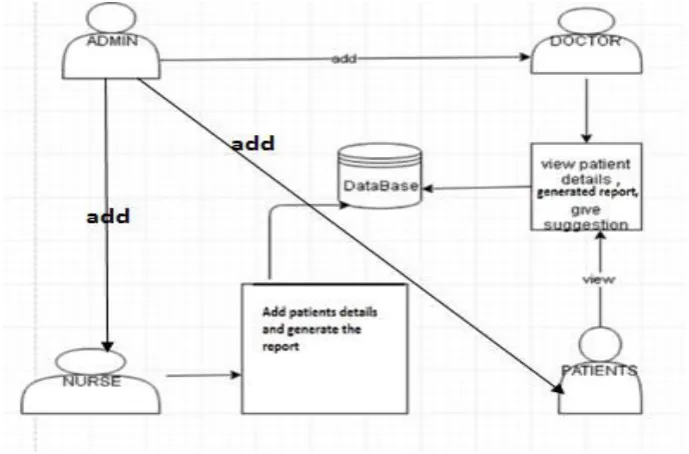
The proposed system contains four modules
i) Admin ii) Nurse iii) Doctor iv) Patient
Admin:
Admin will view the registrations
Admin will decide whether to accept the registration or else will reject the registration
Admin will verify all department (Doctor, Patient ,Nurse).
Nurse:
Nurse should register and will login through user id and the password.
Nurse will view the patient details and nurse generates the patient report and send to the doctor.
Doctor:
Doctor should register and will login through user id and the password.
Doctor will view the patient details and receive the report from nurse
After doctor will check the patient report details and give suggestions to patient
Patient:
Patient should register and login through user id and the password.
Patient will view the final reports details.
Patient can view the suggestions given by the doctor.
Algorithm Steps for predicting the chances of stroke occurrence
Step 1: Inputs related to stroke from patient report.
Step 2: Use decision tree concept to find out individual stroke category percentage of chances.
Step 3: Sum of all the percentage of all stroke category.
Step 4: Calculate the total percentage of similar kind of patients exists in past record.
Step 5: Input (step 3 and step 4 results) to linear regression algorithm.
Fig 1: System Architecture
V. CONCLUSION
This application is helpful for doctors as they are making use of the system for giving suggestions to the patients. This application is useful for the doctors who are in training period. Doctors can suggest the patients by making use of previous history. The uses of AI in healthcare were reviewed. Presented the various healthcare data that AI has analysed and surveyed the major disease types that AI has been deployed. A successful AI system must possess the ML component for handling structured data (images, EP data, genetic data) and the NLP component for mining unstructured texts. The algorithms then need to be trained through healthcare data before the system can assist physicians with disease diagnosis and treatment suggestions.
VI.FUTUREWORK
Despite of certain limitations, the advantages of these systems are numerous. With the aid of advanced AI and AmI, acute neurological emergencies may be timely managed, chronic neurological diseases may be recognized early, treatments may be individualized and the quality of life with neurological disability may be improved. In future, these type of AI techniques can be used to predict heart diseases, kidney and liver diseases. Initial monetary investments can eventually be paid by the numerous advantages of AI
REFERENCES
1. Darcy AM, Louie AK, Roberts LW. Machine Learning and the Profession of Medicine, vol.315, no.6, pp.315:551, JAMA 2016
2. Dilsizian SE, Siegel EL. Artificial intelligence in medicine and cardiac imaging: harnessing big data and advanced computing to provide personalized medical diagnosis and treatment, pp.16-441, Curr Cardiol Rep 2014.
4.S. Saria et al., “Integration of Early Physiological Responses Predicts Later Illness Severity in Preterm Infants,” Science Translational Medicine, vol. 2, no. 48, pp. 48–65, 2010
5. Y. LeCun, Y. Bengio, and G. Hinton, “Deep learning,”Nature, vol. 521, no. 7553, pp. 436–444, 2015
6. S.R. Levin et al., “Real-Time Forecasting of Pediatric Intensive Care Unit Length of Stay Using Computerized Provider Orders,”Critical Care Medicine, vol. 40, no. 11, pp. 3058–3064, 2012.
7. D. Lenat et al., “Cyc to Answer Clinical Researchers’ Ad Hoc Queries,”AI Magazine, vol. 31, no. 3, pp. 13–32, 2010.
8. D.B. Neill, “Fast Subset Scan for Spatial Pattern Detection,” J. Royal Statistical Soc. (Series B: Statistical Methodology), vol. 74, no. 2, , pp. 337– 360,2012
9. G. E. Hinton, S. Osindero, and Y.-W. Teh, “A fast learning algorithm for deep belief nets,”Neural Comput., vol. 18, no. 7, pp. 1527–1554, 2001. 10. H. R. Roth et al., “Improving computer-aided detection using convolutional neural networks and random view aggregation,”IEEE Trans.Med. Imag., vol. 35, no. 5, pp. 1170–1181, May 2016.
11. Y. Zhang and P. Szolovits, “Patient- Specific Learning in Real Time for Adaptive Monitoring in Critical Care,”J. Biomedical Informatics, vol.41, no. 3, pp. 452–460, 2008.