University of Windsor University of Windsor
Scholarship at UWindsor
Scholarship at UWindsor
Electronic Theses and Dissertations Theses, Dissertations, and Major Papers
2015
A Boolean based Question Answering System
A Boolean based Question Answering System
Jiayi Wu
University of Windsor
Follow this and additional works at: https://scholar.uwindsor.ca/etd
Recommended Citation Recommended Citation
Wu, Jiayi, "A Boolean based Question Answering System" (2015). Electronic Theses and Dissertations. 5280.
https://scholar.uwindsor.ca/etd/5280
This online database contains the full-text of PhD dissertations and Masters’ theses of University of Windsor students from 1954 forward. These documents are made available for personal study and research purposes only, in accordance with the Canadian Copyright Act and the Creative Commons license—CC BY-NC-ND (Attribution, Non-Commercial, No Derivative Works). Under this license, works must always be attributed to the copyright holder (original author), cannot be used for any commercial purposes, and may not be altered. Any other use would require the permission of the copyright holder. Students may inquire about withdrawing their dissertation and/or thesis from this database. For additional inquiries, please contact the repository administrator via email
A Boolean based Question Answering System
By
Jiayi Wu
A Thesis
Submitted to the Faculty of Graduate Studies through the School of Computer Science
in Partial Fulfillment of the Requirements for the Degree of Master of Science
at the University of Windsor
Windsor, Ontario, Canada
2015
A Boolean based Question Answering System
by
Jiayi Wu
APPROVED BY:
______________________________________________ Dr. G. Lan
Odette School of Business
______________________________________________ Dr. D. Wu
School of Computer Science
______________________________________________ Dr. J. Morrissey, Advisor
School of Computer Science
DECLARATION OF ORIGINALITY
I hereby certify that I am the sole author of this thesis and that no part of this thesis has been published or submitted for publication.
I certify that, to the best of my knowledge, my thesis does not infringe upon anyone’s copyright nor violate any proprietary rights and that any ideas, techniques, quotations, or any other material from the work of other people included in my thesis, published or otherwise, are fully acknowledged in accordance with the standard referencing practices. Furthermore, to the extent that I have included copyrighted material that surpasses the bounds of fair dealing within the meaning of the Canada Copyright Act, I certify that I have obtained a written permission from the copyright owner(s) to include such material(s) in my thesis and have included copies of such copyright clearances to my appendix.
I declare that this is a true copy of my thesis, including any final revisions, as approved by my thesis committee and the Graduate Studies office, and that this thesis has not been submitted for a higher degree to any other University or Institution.
ABSTRACT
DEDICATION
I would like to dedicate the thesis to my parents and my family members who always support and encourage me.
ACKNOWLEDGEMENTS
My greatest gratitude goes to my supervisor Dr. Joan Morrissey. Thanks for her support, beneficial suggestions and encouragement. I am so glad to be her student in the past two year and it is one of most wonderful experiences in my life.
My sincere appreciation also goes to my thesis committee: Dr. Dan Wu and Dr. George Lan for their suggestions about my thesis.
TABLE OF CONTENTS
DECLARATION OF ORIGINALITY ... iii
ABSTRACT ... iv
DEDICATION ... v
ACKNOWLEDGEMENTS ... vi
LIST OF APPENDICES ... viii
LIST OF FIGURES ... ix
LIST OF TABLES ... x
CHAPTER 1 Question Answering System and Boolean Retrieval Model ... 1
1.1 The development of Question Answering System ... 1
1.2 The important steps of Question Answering System ... 3
1.3 The classification of Question Answering System ... 6
1.4 Introduction of some well-developed Question Answering Systems ... 9
1.5 The future works in Question Answering Systems research area ... 11
1.6 Information Retrieval Model review ... 12
1.7 Boolean model ... 13
1.7.1 Evaluation of traditional Boolean query ... 14
1.7.2 Fuzzy set method ... 15
1.7.3 On extending the vector space model for Boolean queries ... 20
1.7.4 A logical formulation of weighted Boolean models ... 22
1.7.5 Evaluation of traditional Boolean query ... 24
1.7.6 Evaluation of Extended Boolean Operators ... 25
1.7.7 Effectiveness of Extended Boolean Model ... 27
CHAPTER 2 Techniques used in Boolean based Question Answering System ... 31
2.1 Introduction ... 31
2.2 Related works ... 40
2.2.1 The original Question Answering System ... 40
2.2.2 Google’s ranking algorithm performance ... 47
2.3 System Structure ... 54
2.4 Searching and document collecting ... 60
2.5 Question processing and document indexing strategy ... 66
2.6 Question reformulation ... 74
CHAPTER 3 Implementation ... 79
CHAPTER 4 Evaluation ... 87
4.1 The evaluation results for AND operator ... 88
4.2 The evaluation results for OR operator ... 91
4.3 The overall performance ... 93
CHAPTER 5 Conclusion ... 96
REFERENCES ... 98
APPENDIX A ... 102
VITA AUCTORIS ... 106
LIST OF APPENDICES
Appendix A: Testing question collection from TREC ... 102
LIST OF FIGURES
Figure 1 ... 50
Figure 2 ... 55
Figure 3 ... 70
Figure 4 ... 83
Figure 5 ... 84
Figure 6 ... 85
Figure 7 ... 86
Figure 8 ... 89
Figure 9 ... 90
Figure 10 ... 91
Figure 11 ... 92
Figure 12 ... 102
Figure 13 ... 95
LIST OF TABLES
Table 1 ... 89
Table 2 ... 90
Table 3 ... 92
Table 4 ... 93
Table 5 ... 94
Table 6 ... 95
CHAPTER 1
Question Answering System and Boolean Retrieval Model
1.1 The development of Question Answering System
In recent years, the continuous research and development of the Internet boosts the
need of network information resources. The network already became the information
and data exchange platform. It is not easy for users to find useful information in such
a large database. Thus, search engine was designed as the important tool for people to
find the information they want. Using search engines to find information is the
common method for most of the people in the world. The search engine works based
on the key words provided by users and it returns millions of related webpages back to
users (Gulli, A., and Signorini, A [2004]). However, among those webpages, some of
the information is not useful, so users will waste their time reading lots of unrelated
information and they need enough time to find out the direct information. There are
many popular search engines being used today such as Google, Yahoo and Bing.
The traditional search engine exists some disadvantages. First of all, it returns back
too much related information. Secondly, search engines still focus on key word
retrieval which is the base step of understanding and analyzing human language. It did
not apply any method to solve the semantic problem of human language, so it will not
promote the improvement of the results being retrieved. The last but not least, it
According to these reasons, it is hard for users to find the direct and correct
information quickly among huge network resources by only using the search engine.
Question Answering System was designed to solve this problem. It was considered as
the advanced information retrieval system. Instead of only sending back related
webpages, question answering system will give the accurate answer to the user. For
instance, suppose users want to know what is TCP/IP. The question answering system
will return the answers like: “(pronounced as separate letters) Short for Transmission
Control Protocol/Internet Protocol, TCP/IP is the suite of communications protocols
used to connect hosts on the Internet. TCP/IP uses several protocols, the two main
ones being TCP and IP. TCP/IP is built into the UNIX operating system and is used
by the Internet, making it the de facto standard for transmitting data over networks.
Even network operating systems that have their own protocols, such as Netware, also
support TCP/IP.”
The rise of the research topic on question answering system was promoted by the need
of achieving information in a quickly way. Recently, question answering system has
attracted increasingly attention from the researchers in information retrieval and
Natural Language Processing research field (Allan et al. [2002]). It can provide
accurate and concise answers to the questions asked in natural language. The first
Question Answering system is BASEBALL (Green, Wolf and Chomsky [1986]) that
of the users at that time. It has a high structured database and the database stores the
most common questions which were asked by users before. Although the traditional
question answering system can provide users direct answers, the data source is still
based on fixed document sets and it cannot satisfy all kinds of need from the users.
However, there are abundant information resources on the Internet and it provides
better data sets which are required by question answering system. Thus, the
combination of the question answering system and the Internet is necessary. It
promotes development on the web-based question answering system and this new type
of question answering system came out. The brand new question answering system
combines the techniques in different research areas that include Computational
Linguistics, Information Science and artificial intelligence. More specific, techniques
will be used in the system such as Natural Language Parsing, Question Classification,
Named Entity Recognition etc. It can solve the questions asked in natural language
instead of a list of key words. After searching and processing, it will provide users
direct answers instead of related webpages. The first web-based question answering
system is called START. It was created in MIT computer science department in 1993.
Compared with the search engine, question answering system will save time for users
searching information and satisfy users with the correct and high quality answers
which they need.
1.2 The important steps of Question Answering System
answering system basically includes three parts: question analysis, information
retrieval and answer extraction. In the question analysis step, question answering
system will analysis the question being asked by users and achieve the significant part
of it, then the system will prepare for the key words being used later. In the
information retrieval step, question answering system always uses the popular the
search engine such as Google to collect the resource. Apart from that, some
researchers also develop their own techniques to achieve the specific information
resource from the Internet. In the answer extraction step, question answer system will
extract the text information from those webpages and organized those pieces
information, then prepare the correct and concise answers for users. (Richardson, R.
and Smeaton, A. F. [1995])
Specifically, in the question analysis step, there are three important parts that should
be considered: question classification, key words extraction, and question expansion.
Among those parts, key words extraction will use the techniques in information
retrieval research area. There are three steps in this part: remove unimportant words,
stemming and conflation. Also, different regulations and algorithms will be used to
process this step efficiently. There are many different algorithms used in this step
because different languages have different structures. In the stemming step, there are
many famous algorithms used to process English such as Porter Stemming (Porter
[1980]) and Lovins stemmer (Lovins [1968]). After stemming, the longest possible
words that have same stems will not be used at the same time which means term used
for index will decrease, so that it improves the retrieval efficiency. Some of the
researchers in Computational Linguistics research area also mentioned Lemmatisation
in this step that is used to return the words into their original format. But it not
necessary used in this step, because the stemming step can almost solve the problems.
For the other languages there are many algorithms being used which were built up by
both language scientists and computer scientists. The question expansion is also a hot
research topic in the question analysis step. It was proposed in 1970s and three
methods were used on this topic: Global Analysis, Local Analysis and Local Context
Analysis. Among those methods, Global Analysis will evaluate the relevance of the
terms in the documents and realize the extension of the questions that are provided by
users. The techniques such as keywords clustering, basic semantic similarity
dictionary and snippets will be used in question extension step. After this step is
applied in the question answering system, it returns better results, achieve good
feedback from the users. However, these steps are impracticable when the applied
system is too large.
The question answering system gains a promising expectation and it will play a
significant role. The users of questions answering system are random, the users may
only ask some simple questions. Some of the users may be a customer who wants to
find the price and the features of a product. Some of the users may be a researcher
users may be a technician who wants to find some technique related information that
are very specific. Therefore, the answers are wide-ranging. The research has a
spacious future development because of the different and numerous users.
1.3 The classification of Question Answering System
According to knowledge area and the methods used to process the question the as well
as answers, the question answering system can simply classify as two types: close
domain question answering system and open domain question answering system.
In the close domain question answering system, the system needs to answer the
questions in a specific knowledge area such as: law, medical or mathematics, or it may
answer some question based on a particular fact such as World Cup or The Guinness
book of records. So, the close domain question answering system can be divided into
those two classes. The close domain question answering system will firstly generate a
best match according to the questions which were asked by users, the objects for the
best match are provided by the default question set and those default questions already
had existing answers. If the best match exists, the system will provide a correct answer.
Specifically, to answer the questions under a particular domain, the system will detect
with the specialized knowledge and then collect the information passages from
different kinds of references. Finally, the combination of those passages will organize
as the answers. The close domain question answering system has numerous of users
domain question answering system performs well in the specific knowledge area,
because it is easy to forecast and achieve the answers according to the statistics
method applied in the system. Also, it is easy to be implemented because the natural
language system can quickly solve the question under a particular knowledge area.
For the open domain question answering system, it can almost all kinds of questions.
In order to solve different types of question, open domain question answering system
will use some syntax and semantic methods in natural language research area to
process steps and find the direct answering from the web based document sets.
The difficulty for the implementation of open domain question answering system is
dealing with the large amount and different types of questions. The questions may be
in details such as the question collections were used by TREC and the questions may
also refer to some complexity facts. Because the wide range of the question types,
only giving classification towards the question is not enough. The retrieval results
may be different for the same question and the degree of difficulty is different in the
answer extraction step because the language structure is different in those documents,
which are used to prepare answers. For these reasons above, the classification is not
only applied in the question analysis step and answer extraction step but also has to be
applied to the whole question answering system classify. The open domain question
answering system can be classified as five simple types in details. For the first type,
system can extract passages from the document sets. It always retrieves the terms in
the query one by one and then achieves the answers from the documents directly. For
the second type, the question answering system that is focus on solving the question
contains basic inference format. This system needs to retrieve back the answers in
different documents’ passages and then find the relationships between those answers
according to basic inference format. Finally, combining those answers together. Under
this procedure, the system need to applied techniques in Ontology and Pragmatics
research area and the inference in answer extraction step will use these. Because the
simple explanation is not enough, the inference will use the world knowledge and
common sense. The third type is the question answering system that can combine and
achieve the answers from different document sets. The character of this system is that
it can collect parts of information in different documents and then organized as the
answers. The format of the answers will decide the complexity of the question
answering system. The fourth type of question answering system has the analogic
reasoning ability. The answers prepared by this system will not definitely show in
those documents but need to do analogy analysis with different answers and then
distinguish the same points as well as the differences. When the system processes the
analogy analysis step, it needs to divide the questions into small, which are used to
collect passages of the answers. Finally, it will prepare the answers used analogism.
The fifth type is the interactive question answering system. The questions provided by
users are based on the interaction of computer and users but not only asked by the
1.4 Introduction of some well-developed Question Answering Systems
It has not been a long time since the Question Answering System was created.
However, many researchers have designed some well-developed Question Answering
Systems.
In 1993, the Question Answering System named START has been created in the
Artificial Intelligence laboratory in MIT. This system is the first web-based Question
Answering System. START can provide the accurate information to users and it can
answer millions of English questions that include geographical questions, film related
questions, celebrities’ questions and some definition questions. This system can be
seemed as a combination system because it still remains two knowledge libraries:
“START KB” and “Internet Public Library”. Thus, the system can use the data from
these two libraries to find the candidate answers when users ask related questions.
Otherwise, START will firstly analyze the questions, then find the candidate answer
through the search engine and return the direct answers back to users. For example,
when user asks: “Who was Bill Gates?”, the system will return back: “Cofounder,
Microsoft. Born William H. Gates on October 28, 1955, Seattle, Washington.” The
system will also return the link which is the original source contains the answer. If
users want to find more information about the questions, they can simply click the
is the first automatic Question Answering System worked base on Internet. This
system does not apply any knowledge library and it searches the answers only used
the information from Internet. For each question, MULDER will send back a list of
candidate answers instead of only one answer. The system will use statistic method to
add weights for each answer and the weight is called “confidence level”. For example,
when user asks: “Who was the first American in space?”, MULDER will return a list
of answers. Among those answers, the answer “Alan Shepard” has 70% confidence
level and “John Glenn” has 15% confidence level. At the same time, the system will
show the summary of content for those answers and the links as well.
AskJeeves is a famous commercial Question Answering System. This system can
answer the questions asked in natural language and return back the answers in
paragraphs. There are also some related details of contents and links showing after the
answers. AskJeeves also support multimedia format answers. For example, when user
asks: “Who was Bill Gates?”, the system not only send back answers but also a photo
of Bill Gates. As a commercial Question Answering System, AskJeeves supports
different kinds of search such as achieve the information from the pictures and news.
The questions processing step of AskJeeves works based on manual operation.
AskJeeves has hundreds of employees who are focus on analyze the questions
provides by users, then, set up the templates of the questions and save some common
questions into the system. Although the templates of questions can be structured in
both create procedure and maintain procedure.
University of Michigan developed a Question Answering System called AnswerBus.
This system is a Multilanguage Question Answering System, which can answer the
question in different language such as Spanish, German, Portuguese, English and
Italian. For each question, AnswerBus will return back five links and give back the
possible answers in XML and TXT format. The Encarta created by Microsoft is an
online cyclopedia search engine and it also support with different languages.
LAMP is a Question Answering System created in Singapore. It provides a list of
question types that can be selected by users such as person, organization, location,
date, time, money and percent. This system only returns back the answers and does
not provides the related links.
Webclopedia created in University of Southern California and the Language
Computer system created by a company in USA have an excellent performance and
outstanding evaluation results in the competition of TREC.
1.5 The future works in Question Answering Systems research area
The research of Question Answering System has made lots of achievements by the
involvement of lots of researchers. However, there still exists some problem that need
application system and the range of solutions provides by these system is limited.
Some of the systems even need manual operation. From the current research results,
the Question Answering System can be improved in the following aspects.
Firstly, the improvement in the question processing step. This step should involve
more techniques in Natural Language Processing to solve the syntax and semantic
problems have generated. Secondly, the answer extraction technique have to be
completed which aim to extract the important information and provide users with
accuracy answers. Thirdly, the typing method for the question could be different. The
question could be inputted with voice or graph.
1.6 Information Retrieval Model review
In recent years, with the changing of information and knowledge environment, the
information retrieval raises higher requirements and the study of information retrieval
model has also been ongoing.
The Boolean model represents the query and document in a simple and understandable
way, their similarity based on whether or not they are meeting the Boolean expression.
Vector space model represents the document and the query which in the form of
vector, estimating the similarity between the query and document by computing the
they returned by querying. Probability model is based on the principle of probability
sort, which takes into account the intrinsic link between the entry and documentation,
and conducting information retrieval statistics based on the probability of similarity
between the entry and documentation. Whether classic Boolean model, vector space
model, probabilistic model, or the language model which emerged with the changing
of environment and technological developments, ontology-based information retrieval
model, they all enriched the content of the information retrieval model at different
levels (Jin, Hauptmann and Zhai [2002]).
1.7 Boolean model
Boolean retrieval mode1 based on Boolean expression and whether the similarity of
the query and document meets the Boolean expression. The Boolean expression
should be the queries connected by Boolean operator such as AND, OR. Thus, if a set
document collection D = (D1, D2, D3, …, Di ) and the terms in a specific document Di
are T! = ( T! , T! , T!,…,T! ). When the users give a question as Q
=T′! AND T′! AND…AND T′! and all of those terms belongs to the T!, the document
Di should be retrieved back as a result. When the users give a question as Q
=T′!OR T′!OR…OR T′! and one of those terms belongs to T!,the document Di
should be retrieved back as a result (Wang [1989]).
However, due to the results of the Boolean model disorder and the similarity of the
the existing research is mainly manifested in the improvement of the Boolean model,
or further optimizing the extended Boolean model (Akutsu, Miyano and Kuhara
[1999]).
1.7.1 Evaluation of traditional Boolean query
Patro and Malhotra estimated the success from characteristics of the Boolean web
search query (Patro and Malhotra [2005]). The authors state that whether the query
will successfully satisfy the users’ requirements are unknown. Similarly, whether the
Boolean query is efficient or not in finding the location of the best documents is
unknown. The authors state that this paper relates characteristics of the search results
which are meet the user’s requirement. A program which compares the performance
of humans and the search queries synthesized performed better than humans and gives
an objective judgment of the search queries. The author states that using the precision
and recall to measure the quality of queries is the common method. When search
query, using the number of relevant documents first returned 20 links as the precision
measurement. The authors uses the same range as precision to identify recall. The
authors collect data by using volunteers. Volunteers are students who have different
topics and some sample relevant documents. After they use the same search engine to
search their topic, they revised their query. Then compare the volunteer’s query and
the synthesized query. The authors use figures to show the relationship between recall
and precision of the volunteer queries; the relationship between recall and precision
number of attempts to improve query and relationship between number of terms and
precision. A good query returns higher values for precision and good recall which can
be used as evaluation results of the method applied to the Boolean model. A good
predictor of a successful Boolean web search query is four terms and above average
recall. The authors claim that they found the characteristics of good queries that may
give good sample of the query successfully achieved by users and their requirements.
1.7.2 Fuzzy set method
Bookstein proposes the fuzzy request which is an approach to weight Boolean search
query (Bookstein [1980]). The author states that using Boolean expressions permits
one to represent accurately the logical relationships among concepts involved in an
information need, but it has some loss in flexibility. When a user is able to express a
concept in a Boolean expression and its logical relationship to other concept, the user
is not able to express how important that concept is to him relative to the other
concepts represented in the query. The same situation will occur in documents
indexing. Therefore, it is more desirable to have an approach in which one provides
boolean queries with independently assigning weights to each term in the query to
indicate how important that term is. This paper refers to previous work by Zadeh
(Zadeh [1965]). Zadeh has worked on developing the concept of a fuzzy set to satisfy
the need for a set that permits partial membership. However, it is hard to determine
whether a given document should be indexed by a specific term sometime and thereby
The purpose of this paper is to propose a method for resulting information system
merges some of the Boolean and weighted systems being accomplished by relying on
a generalization of the traditional algebra of sets and by defining a weighting scheme
for requests that is consistent with this algebra. In this paper, the author gives a
general idea of fuzzy set which is a new extended expression and the manipulations on
fuzzy sets can be defined in terms of the membership functions: inclusion, union,
intersection and complementation. Then, the author analyses how the fuzzy set works
with the queries in which terms are weighted. The specific queries being analyzed
include four forms of Boolean expressions: the single index terms, the terms are
connecting by AND, the terms are connecting by OR and the terms are connecting by
NOT. The author states that allow transforming queries into more convenient forms is
one of characteristics of Boolean retrieval systems. In this paper, the author gives
some rules that permit one to change a fuzzy query into a different but equivalent one
and some relationships follow immediately from the properties of fuzzy sets in general.
The rules include: commutativity, associativity, distributivity, duality, idempotency,
weight distributivity, involution and weight manipulation. Bookstein gives some
example graphs of analysis of the four forms of Boolean expression and use tables
simply show the analysis results of them. Bookstein states that the weighted
assignment of index terms can be modeled in terms of fuzzy sets so as to accomplish
this goal in all four different Boolean expressions. Bookstein claims that it is possible
to assign weights to the new expression when it can be transformed into an equivalent
Kraft and Buell applied fuzzy sets into the generalized Boolean retrieval systems. The
authors state that the problem for traditional Boolean retrieval model can be seen as
decision theory problem (Kraft and Buell [1983]). The basic assumptions of the model
determine documents as relevant or totally non-relevant. It is not possible to consider
a document partially relevant and this situation may miss some important relevant
documents. According to this problem, there are some new approaches has been
generalized to allow for weights to be attached to individual terms, in either the
document indexing or the query representation, or both. This paper refers to previous
work by Salton and Wu (Salton and Wu [1980]). Salton has worked on vector model
which includes the weight on index terms but queries are not Boolean and are usually
discrete. This method does not allow for Boolean logic in the query structure that is
lacking in general. In this model, differences are precisely what the fuzzy threshold
approach emphasizes, while still allowing for Boolean logic in the query. The authors
state that the concept of a fuzzy subset can be applied to the document retrieval
situation. The membership function can describe terms with a weight in the interval [0,
1]. The traditional Boolean indexing has the weights with zero or one. If weights are
in the open interval (0, 1), then, the fuzzy indexing will be used. The probabilistic
approach used in the fuzzy retrieval is concerned with estimating the probability of
relevance of a given document to a query and it preserves the Boolean lattice
properties. The fuzzy subset retrieval allow user to generalize from single-term
queries. So, Boolean connectives are similar with the vector lattice. The generalization
indexing. The query representation can also be weighted. There are four types of
generalizations: Boolean indexing and Boolean queries with non-Boolean retrieval
status values, fuzzy indexing and Boolean queries with retrieval status values
computed using fuzzy subset rules, Boolean indexing and fuzzy queries with retrieval
status values and fuzzy indexing and fuzzy queries with the retrieval status value
being calculated by some general function. The last generalization has problem with
generating a "weight" for a term and document evaluation in terms of its relevance. A
new and alternative function for document relevance evaluation has been mentioned.
The authors use a threshold approach, rather than a weight. This can solve the last
generalization problem. A new function form conducted and several criteria which
specify necessary conditions for a proper document evaluation mechanism have been
mentioned. The function form implies that one is given some partial credit (F/a) for
the membership function's coming close but not exceeding the threshold. This credit is
weighted by an increasing function of the threshold. This implies that as the threshold
increases, a given percentage of partial is given more weight. The authors claim that
fuzzy subset theory applies to document retrieval systems allowing non-Boolean index
weights to be attached to the document and non-Boolean weights or thresholds to be
attached to the individual terms in the query representation. This is a generalization of
document and query representation and processing.
Bordogna, Carrara and Pasi proposed that query term weights as constrains in the
Boolean model is widely used in many traditional systems and it suitable for a flexible
query formulation; however, it also has some disadvantages. The Boolean model
retrieves information items only into two classes: relevant and irrelevant. Therefore
the model does not allows the ranking property of documents in descending order of
estimated by a query and does not provide a method to solve with the imprecision in
the query formulation. The author refers to previous work by Bookstein, Kantor, Buell,
Kraft and Buell (Bookstein [1980], Kantor [1981], Buell [1982], Kraft and Buell
[1983]). The authors state that Bookstein’s work on the fuzzy set model as the first
kind of semantics defines query weights as measures of the relative relevance of each
term with respect to other terms. This model defines the relevance semantics in all
aspects but the AND operator is associated with the lowest weighted term. This
situation generates contradiction with the semantics of relevance. The authors state
that Kantor’s works is another difficulty that the notion of complementation when
using relevance weights in the fuzzy set context. The authors state that Buell’s worked
on another approach with threshold semantics for query weights also have a problem:
the meaning of threshold weights is not clear when apply to Boolean expressions
rather than to single terms and this is a problem of semantics. The authors present an
extended Boolean model formally described by means of the fuzzy set theory and the
problem of query weighting in the existing models. In the author’s model, a query
term weight has the meaning of an ideal document-term relation value which be
considered as a constraint on the stored document representations. So, the system will
a term t in a query). This interpretation of query term weight as clear requirements of
ideal index term weights permits interpretation of a query as description of one or
more ideal documents for the user. The Retrieval Status Value (RSV) is expressed as
the degree to which all constrains has been satisfied by each document representation
in stored collection. The authors use fuzzy set theory to define the generalization of
the Boolean model and the constraint is expressed by the formalism of fuzzy
restrictions. RSV evaluation mechanism is defined and analyzed with respect to the
Cater and Kraft wish-list. The author use a function E* to evaluate the matching of a
query against a collection of documents. The authors state that function E* satisfies
these criteria for an RSV mechanism: separability, Boolean restriction,
Self-consistency, Term similarity, Weights of zero, Query weight volume, Binary
Boolean operations and Unary Boolean operation. The authors claim that an analytical
approach to the interpretation of weighted Boolean query has been presented in their
paper. A query becomes a means of describing classes of ideal documents and
expressing relativity criteria in order to distinguish query term weights from query
weights.
1.7.3 On extending the vector space model for Boolean queries
Wong, Ziarko and Raghavan introduced the idea of extending the vector space model
applies for Boolean queries (Wong et al. [1986]). The authors state that the Boolean
retrieval systems do not apply the incorporating term correlations into the retrieval
Boolean retrieval systems. The authors refer to previous work by Buell (Buell [1981]).
The authors state that Buell’s work on the strict Boolean retrieval systems has the
problem that there is no provision for weights of importance to the terms both in the
queries and documents. The representation is binary that lacks various index terms
and the output is not ranked. In most cases, the AND connectives tend to be too
restrictive. The authors introduce a new information retrieval model, named
Generalized Vector Space Model (GVSM). The new model solves the weights
problem in the Boolean model and the queries used in this model are seemed as an
extended Boolean expressions. In GVSM, a query is simply defined as a weighted
vector sum of term vectors. However, this form of query does not help the user to
explain clearly structure as can be done in Boolean systems. Therefore, the most
common language used to express query structure involves Boolean logic and the
query is considered to be a list of index term and weight pairs. This is the first
important variation queries that are called the basic GVSM. The other one is the called
unified GSVM which involves a scheme for expressing weighted Boolean queries as
vectors. Queries are specified as a weighted Boolean expression in which are
connected by AND, OR and NOT operators. The authors compare the unified model
with the p-norm model which was applied for extended Boolean retrieval model. The
authors use MEDLARS and CISI collections for experimental evaluation, because
other collections used for information retrieval do not provide Boolean queries. The
standard recall and precision measures are used for comparing the performance of
handle weighted Boolean queries, both reduce to VSM and strict Boolean retrieval
models under certain conditions, p-norm model involves the parameter p, which has to
be experimentally determined and the extended query language satisfies more
algebraic properties under unified GVSM. The unified GVSM is closer to the strict
Boolean model than it is to VSM which means the roles of Boolean operators are
rather strictly retained. However, p-norm model achieves more softening of the
operators. The authors claim that it would be advantageous to provide a prescription to
handle Boolean queries in the GVSM environment. The important part of basic
GVSM is generalizing VSM to incorporate term correlations and document
representation reduces to the vector sum of terms when terms are assumed to be
orthogonal. The unified GVSM reduces to the strict Boolean retrieval model when
each document is represented by its dominant atomic vector.
1.7.4 A logical formulation of weighted Boolean models
Pasi proposes a logical formulation of weighted Boolean models (Pasi [1999]). The
author states that in order to model IR in the logical framework there is a need for a
more general formal discipline. It is necessary to analyze the role of logic in IR by
defining a model of information retrieval based on modal logics, which provides a
general framework to define pre-existing IR models. The query evaluation process of
the Boolean model and of weighted Boolean models will be exploited by analyzing
the role of logic as a formal basis. The analysis will give better understanding of some
expresses the evaluation structure of the Boolean query. Fuzzy implications can be
employed to generalize the logical interpretation of the Boolean model and it is
necessary to describe the extension of the Boolean model. An extended Boolean
model gives a weighted indexing function that evaluating a query term and the index
term weight and it is interpreted as the degree of relevance of document with respect
to query term. To enrich the expressiveness of the Boolean query language, numeric
query weights have been introduced as an extension of the basic selection criteria,
which become then pairs term-weight. The author uses QT (t, q) as the terms
appearing in a given query q and IT (t, d) as the index terms belonging to the
representation of document d. So, the logical interpretation of a Boolean query is the
formal expression of the constraint imposed by a query term: QT(t, q) → IT (t, d).
“The expression representing the query evaluation structure of the Boolean query q =
(t1 AND t2 OR (NOT t3)) is the following: (QT (t1, q) → IT(t1, d) ˄ QT(t2, q) →
IT(t2, d)) ˅(┐QT(t3, q) → IT(t3, d)).” There is an extension of the logical
interpretation of the Boolean model to weighted Boolean models. The IMP and QW is
the importance of the index terms in document and in query representations. “A query
of the type q = < t1, w1 > AND < t2, w2 > OR < t3, w3 >, has an evaluation which is
formally expressed by the following logical expression: ((QW(t1, q) → IMP(t1, d)) ˄
(QW(t2, q) → IMP(t2, d))) ˅ (QW(t3, q) → IMP(t3, d)).” In the interpretation, the
weighted query is a part of the formulation. The constant symbols are terms in the
formulation and the logical connectives correspond to the Boolean connectives. The
connected with the semantics of the query term-weight. The author claims that the
approach is based on the following considerations: terms are the most essential
elements which evaluate the relevance in a query; the natural logical interpretation of
the Boolean model is important and the degree of relevance related to the truth of the
given interpretations. The author also claims that the most important part of this
approach is to make the bottom-up structure of the query evaluation procedure clear
and the implication connective is employed to express limitation controlled by a query
term on the document representations.
1.7.5 Evaluation of traditional Boolean query
Patro and Malhotra estimated the success from characteristics of the Boolean web
search query (Patro and Malhotra [2005]). The authors state that whether the query
will successfully satisfy the users’ requirements are unknown. Similarly, whether the
Boolean query is efficient or not in finding the location of the best documents is
unknown. The authors state that this paper relates characteristics of the search results
which are meet the user’s requirement. A program which compares the performance
of humans and the search queries synthesized performed better than humans and gives
an objective judgment of the search queries. The author states that use the precision
and recall to measure the quality of queries is the common method. When search
query, use the number of relevant documents first returned 20 links as the precision
measurement. The authors use the same range as precision to identify recall. The
area and some sample relevant documents. After they use the same search engine to
search their topic, they revise their query, then compare the volunteer’s query and the
synthesized query. The authors use figures to show the relationship between recall and
precision of the volunteer queries; the relationship between recall and precision after
the queries’ quality changed; the precision as function of terms in query and number
of attempts to improve query and relationship between number of terms and precision.
A good query returns higher values for precision and good recall which can be used as
evaluation results of the method applied to the Boolean model. A good predictor of a
successful Boolean web search query is four terms and above average recall. The
authors claim that they found the characteristics of good queries that may give good
sample of the query successfully achieved by users and their requirements.
1.7.6 Evaluation of Extended Boolean Operators
Lee, J. H., Kim, W.Y., Kim, M. H. and Lee, Y. J. evaluated the Boolean operators in
the Extended Boolean Retrieval Framework (Lee et al. [1993]). The authors state that
the Boolean retrieval systems have been the commonly used information retrieval
system because of the efficient retrieval results and easy query structure. But the
ranking is not supported and similarity coefficients cannot be calculated between
queries and documents in traditional Boolean retrieval systems. The fuzzy set model
and the extended Boolean model have been suggested providing the ranking function
to the traditional Boolean system and they are logical extensions of Boolean model
zero or one. But still two problems exist: incorrect ranked output in some case and
complex computation on Boolean operators. The authors refer to previous work by
Booksteinand Salton (Bookstein, [1980] and Salton [1989]). The authors state that
Bookstein’s work on the fuzzy set model generates incorrectly ranked output in
certain cases because the MIN and MAX operators have properties adverse to retrieval
effectiveness. T-Operators in the fuzzy set theory have the Single Operand
Dependency Problem and Negative Compensation Problem. Salton’s work on the
extended Boolean model has solve the problem of the former by apply the EAND and
EOR operators; however, it suffers from the complex computation. The authors give
the T-operators and the corresponding operator graphs, and also, the averaging
operators and corresponding operator graphs. Then using the graphs to describe that
one pair of the Averaging operators of Fuzzy Sets Model and the operators of
Extended Boolean Model overcomes the single operand dependency and negative
compensation problems. These operators are defined as positively compensatory
operators. The authors use two different document collections covering items the ISI
collection and the CACM collection. They compare the precision of each operator
such as T-operator and average operator to find the effectiveness of them. The authors
use the document term weights to evaluate rank documents in Extended Boolean
Retrieval Framework. “The weight of document is normalized as follow: Wik =
(TFik/maximum TF in document i)* (IDFk maximum/IDF in document i) where
Inverse Document Frequency define as IDF and Term Frequency define as TF.” The
effectiveness than the others. One pair of the Averaging operators of Fuzzy Sets
Model achieves similar retrieval effectiveness and higher retrieval efficiency in
comparison with the operators of Extended Boolean Model. The authors claim that the
extended Boolean model has overcome the single operand dependency problem of the
fuzzy set model by developing the operators for the evaluation of the AND and OR
operations.
1.7.7 Effectiveness of Extended Boolean Model
Lee analyzed the extended Boolean models (Lee [1995]). The author states that each
document is indexed with a set of keywords or terms, and each query contains terms
connected with the Boolean operators AND, OR and NOT in the traditional Boolean
model. However, the traditional model does not provide a document ranking function
because it cannot compute similarity coefficients between query and documents and
this function reflects the relevance between query and documents that has the same
objective with term weight. The author refers to previous work by Sachs, Radecki and
Buell (Sachs [1976], Radecki [1979] and Buell [1980]). The author states that MIN
and MAX operators have been developed to support ranking function in the past for
Boolean retrieval system. However, they do not correspond well with human behavior
for the calculation of query-document similarities and lead the fuzzy set model to
generate incorrect ranked output in some cases. The author analyzes the behavioral
aspects of different operators for AND and OR operations and the four important
compensation, double operand dependency and unequal importance. The author
describes them through examples and the four important could decrease retrieval
effectiveness in some circumstance. The author also suggests that the properties of
positive compensation retrieval and equal importance may help retrieval effectiveness.
The author defines an operator class called n-ary soft Boolean operators that is
suitable for achieving high retrieval effectiveness. The author evaluates the
effectiveness of sixteen different operators that can evaluate AND and OR operations
in extended Boolean models. The author uses a new large data collection to evaluate
the effectiveness of the different operators in extended Boolean models. The large
data collection includes one of the TREC sub-collections which is called WSJD2. The
author also uses document term weights to calculate document values and two famous
weighting schemes have been used which are Fox-weights and INQUERY-weights.
The author states that the experiment’s results suggest that the single operand
dependency problem may be more adverse to retrieval effectiveness than the negative
compensation problem. The double operand dependency problem as well as the single
operand dependency problem may be more adverse to retrieval effectiveness than the
negative compensation problem. INQUERY-weights give better retrieval
effectiveness to the fuzzy set and Waller-Kraft models than Fox-weights. Network
Boolean has the positively compensatory property in some operand values. The
effectiveness of the p-norm model is slightly better than the vector space model for the
well-formulated Boolean query. The author claims that this paper does not present
approach optimal operators.
Pohl, Moffat and Zobel also analyzed extended Boolean models (Pohl et al. [2012]).
Boolean queries have the disadvantage of being harder to formulate than ranked
queries. They have the drawback of generating answer lists of unpredictable length
and changes in the query that appear to be small might result in disproportionately
large changes in the size of the result set. The queries of Extended Boolean Retrieval
(EBR) models, such as the p-norm model, queries are slow to evaluate, because of
their complex scoring functions and none of the computational optimizations available
for ranked keyword retrieval have been applied to EBR. The authors describe a
scoring method for EBR models and adopts ideas from the max-score and wand
algorithms and generalize them to be applicable in the context of models with
hierarchical query specifications and monotonic score aggregation functions. The
authors also present the p-norm EBR model as an instance of such models and that
performance gains can be attained that are similar to the ones available when
evaluating ranked queries. Term-independent bounds are proposed in this paper,
which complement the bounds obtained from max-score. It can be employed in the
wand algorithm, also reducing the number of score evaluations. The authors evaluated
the efficiency of their methods on a large collection of biomedical literature using
queries and results derived from real searches. Three query sets were used against this
collection: 50 simple, short PUBMED queries consisting of a Boolean conjunction
least once in each query sampled from the same query log, 15 complex queries.
Properties of these queries were summarized. The authors counted the number of
scored documents with scores below the entry threshold and above the entry threshold.
The authors state that the proposed scoring method is often faster and it significantly
reduces the number of candidate documents scored, postings processed, and execution
times, for all query sets. Term-independent bounds method for short-circuiting
candidate document scoring reduce the number of score calculations, especially on
simpler queries and when combined with max-score. The query execution times of
Boolean execution will be faster, however, it must be remembered that the result of a
Boolean query is of indeterminate size. The authors claim that optimization techniques
developed for ranked keyword retrieval can be modified for EBR and this leads to
considerable speedups. Term-independent bounds provide added benefit when
complex scoring functions are used and it will as a mean for short-circuit score
calculations.
CHAPTER 2
Techniques used in Boolean based Question Answering System
2.1 Introduction
With the rapid development of the Internet, using quick and direct methods to achieve
information has become one of the hottest discussion topics in the information
technology research area. Currently, the search engine is an important tool using by
billions of users and it has already made great achievements. The search engine
searches the information according to the key words and provides users with related
webpage lists, so that users has to review and find the direct information among a
large number of links.
As a result, this drawback motivated the researchers to design a better searching tool
which can satisfy users with direct answers not only related information. The Question
Answering System was created as the solution to this problem and it can seem as an
“Advanced search engine”. A tradition Question Answering System is complex to be
implemented because it needs the techniques from both Natural Language Processing
research area and Information Retrieval research area. Question Answering System
provides users with paragraphs of direct answers, not the list of documents or
webpages. For example, when users ask a question “What is the location and
millions of results and users will read those webpages one by one to find actual
location and population of Windsor. But with asking the same question on the
Question Answering System, it will give back only paragraph of direct answers that
contain the details of the location and population of Windsor.
With the research involved in this topic, Question Answering System becomes more
flexible and practical. From the close domain question answering system that contains
high structured database to the web-based open domain question answering system,
the improvement is obvious to researchers as well as users. Because the researchers
focused on pioneering innovative, effective methods to develop the question
answering system and they always try to use techniques to make the system
understand the difficult questions properly, the Question Answering System can deal
with different types of questions now such as factoid questions, definition questions
and cross-lingual questions.
As an inseparable part of Question Answering System, Natural Language Processing
technique will provide an appropriate analysis method, which includes both semantic
and syntactic understanding of natural language. After applied this module, the
methods and algorithms will help the Question Answering System perfectly deal with
different class of questions. It is well known that Google search engine performs
excellent searching results and user experience. It is one of the most popular search
returned high quality related webpage back to users by using their own PageRank
technique. It also consist an efficient Natural Language Processing module which can
analyzes the questions provided by users. As, our experiment is mainly focus on the
Information Retrieval research area, thus, applying Google search engine to
preprocess the questions is the best way for our system to prepare proper candidate
answers to users.
Information retrieval model is one of the important parts of information retrieval,
which is an important module of Question Answering System (Kobayashi and Takeda
[2000]). These models use mathematical methods, language structures and algorithm
tools to process retrieval steps efficiently. The main elements of information retrieval
step are query and documents, and their degree of matching which can be defined as
relevance. The relevance of the query term and the document term is an approach to
evaluate the effectiveness of the information retrieval process.
Boolean model is one of the common models that we used in information retrieval. It
is based on Set theory (Salton, G., and McGill, M.J. [1984]) and Boolean algebra.
Westlaw is the largest commercial Boolean system used today. The Boolean model
represents the query and document in a simple and understandable way, their
similarity based on whether or not they are meeting the Boolean expression (Patro and
Malhotra [2005]). A Boolean expression should be a query consisting of terms/words
Boolean model is based on logical judgment, which defines a set of a binary variable
to represent document. For query “A AND B”, retrieval document should include both
A and B; for query “A OR B”, retrieval document should include either A or B; for
query “A NOT B”, retrieval document should include only A, B must not be included
in it. If there are more than one different Boolean operators in the query, the priority
order should be: NOT, AND, OR. For those queries tjat have more than one of the
same Boolean operator, the priority order should be: from the first left operator to the
right one. For example, with the query “Toronto AND bookstores NOT Indigo”, users
will find the information about Toronto bookstores that are not Indigo. Boolean
retrieval model is simple and effective. It can reduced the range of retrieval and return
better results when the AND operator being used as well as using OR operator to
improve recall which means users can retrieve more relevant documents. For example:
use University of Windsor AND School of Computer Science instead of only
University of Windsor; use breaststroke OR backstroke instead of only swimming.
To prepare for the experiment, firstly, we have designed a Boolean based Question
Answering System which can allow users to ask normal questions as well as the
questions contains with Boolean queries. The system is an English Question
Answering System that can answer the questions asked in English and it provides
users a friendly user interface. Thus, users can figure out how to use it quickly and it
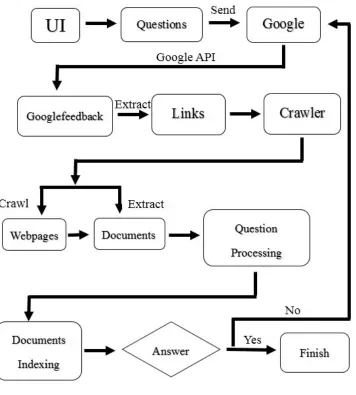
system will first save the question in a local document and then send those questions
to Google search engine. After Google’s analysis, the system will achieve the retrieval
results from Google and save it in the local document. Then, the system will extract
the top ranked links (URLs) and snippets that are used for query expansion. The
snippet results from the Google search results will provide rich related terms and then
add those terms to the original question to extend the question. In this way, the system
can improve the retrieval results because the range of existing relevant documents has
been extended.
After extracting the URLs from the results, the system will use a web crawler to
download the corresponding webpages and save them into the local folder according
to their order. The system will analyze those webpages and prepare the candidate
documents, which will be used as indexing documents later. To analyzing those
webpages, the system has to extract the text information from each of them. Then, the
system will separate the text information into paragraphs with the given structures and
save the results into ordered documents in another local folder.
Before the system indexes those documents, there is an important step applied in the
system that is the so-called “question processing step”. This step is a vital part in
information retrieval research area as well as Question Answering System. This step
guarantees the system uses correct query terms from the question to flit and index
The system will use a Stop list to remove high frequency words and low frequency
words, which are non-important words from the questions asked by users. The high
frequency words such as “a” or “the” may occurs in almost all documents, therefore,
these index terms do not help the system to distinguish the candidate documents while
process indexing step. For the very low frequency words, they may not always occurs
in the candidate documents and some of them even only occurs once among the
candidate documents. So, these words were seems as irrelevant terms and the system
will remove these terms from the index terms. These unimportant words such as “on”,
“under” and “that”, these words will also considered as the terms which decrease
index efficiency. Although these words are presented a high frequency in the
documents, they do not involve any meaning in the questions. Thus, these types of
words or terms should be removed during indexing, and then the system will use
significant terms to retrieve the candidate documents efficiently. Especially, the
technique performances excellent while the system deal with large amount of data.
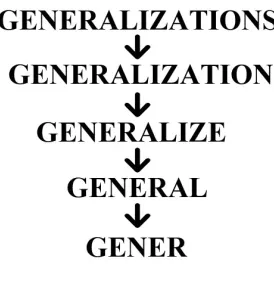
Another technique that will be applied in the system during indexing is Stemming.
With this method, the system will remove the suffixes that are the ending of words.
Because the words shared with same stems but different suffixes may have same
meaning in English, thus, to avoid the missing of indexing, the system will distinguish
those words and index those words as the same one. For example, “do”, “did”, “done”