MU MIMO Transmitter Power Constraint
Optimization Using Genetic Algorithm
C.Rajeswari, J.Rathna
Assistant Professor, Dept. of ECE, GKM College of Engineering and Technology, Chennai, India
M.E Student, Dept. of Communication Systems, GKM College of Engineering and Technology, Chennai, India
ABSTRACT: This paper proposes a method using genetic algorithm to reduce the PAPR (Peak-to-Average Power Ratio) in large Multi-user MIMO-OFDM. One of the major disadvantages of OFDM (Orthogonal Frequency Division Multiplexing) is high PAPR which can result in poor power efficiency and serious distortion in the transmitter amplifier, ATR (Adaptive Tone Reservation) scheme repeatedly perform the TR (Tone Reservation) scheme on the antenna with the maximum PAPR and reduce the PAPR of the antenna. Mutation and crossover of the genetic algorithm is used to reduce PAPR by eliminating the number of iteration with maximum power and process only the least powerful iterations.
KEYWORDS: MU-MIMO, OFDM, PAPR, Mutation, Crossover, ATR
I. INTRODUCTION
“Large-scale multi-user (MU) multiple-input multiple-output “(MIMO) has been popularly under research in recent years, because it can be sufficiently increased the capacity and the reliability of the wireless communication system. To deal with the frequency selective fading, large-scale MU-MIMO OFDM systems can be combined with the orthogonal frequency division multiplexing (OFDM) systems, and generates large scale MU-MIMO OFDM systems. The best way for reducing energy costs is to increase the efficiency of the high-power amplifier (HPA) in the radio frequency (RF) in the front end of the base stations. The efficiency of the HPA is directly proportional to the peak-to-average power ratio (PAPR) of the input signal. The PAPR problem intensifies further in orthogonal frequency division multiplexing (OFDM) multicarrier transmission, which has been extensively applied in most of the wireless standards such as the Third Generation Partnership Project (3GPP) Long- Term Evolution Advanced (LTE-A) standard. The current version of these technologies isnot capable to accomplish the original ITU-R needed data rates of approximately up to 1Gbit/s for 4G systems. Currently for marketing 4G is used as a representation for Mobile-WiMAX and LTE.
The methods which are currently available for PAPR reduction cannot be directly used extensively in MU-MIMO-OFDM systems, because the MU-MIMO-OFDM signals on each antenna are mutually coupled which would increase the calculation complexity by the order of magnitude. To solve this problem genetic algorithm is used. Genetic algorithm is used to generate set of signals with different power values. Mutation and cross over is used to select the best set of signal with minimum power and further reduce the PAPR values.
II. RELATED WORK
Many methods have been suggested to reduce PAPR over the years, with different levels of success and complexity.
set of tones which is reserved, by using this method PAPR is reduced around 4db for each subcarrier. It can be future improved by using “Adaptive Tone Reservation” method.
“Adaptive Tone Reservation” is the process in which performs the repeatedly the Tone Reservation to as to obtain the maximum best result possible. In this method a threshold value is given based on which the tones with maximum PAPR values are rejected and the tones with minimum value is subjected to further processing .It eliminates the processing in the receiver end which reduce the cost and complexity.Adaptive tone reservation base reduction of peak power for multi-user MIMO broadcast channel with M single-antenna users and N transmit antennas under the limitation that each antenna are mutually coupled with other antenna. Thereason for this is that to perform power-reduction all the antennas are jointly considered, when these schemes are used in extensively MU-MIMO-OFDM systems. MATLAB simulations and numerical results show that, MIMO conditions on the channel gains, adaptive tone reservation (ATR) scheme based large-scale multi-user (MU) multiple-input multiple output (MIMO).The method yield optimized performance results with threshold scheme and thus the existing peak-to-average power ratio (PAPR) problem is reduced to a considerably extend. The basic idea of the proposed ATR method repeatedly carries out the TR method on the antenna with the maximum PAPR. Here we compare simulation results of TR method over PTS method to validate the tone reservation methods and then the ATR method in PAPR reduction performance is analysed over multi user environments and its calculational complexity reduction is proved against conventional TR scheme.
III. PROPOSED ALGORITHM
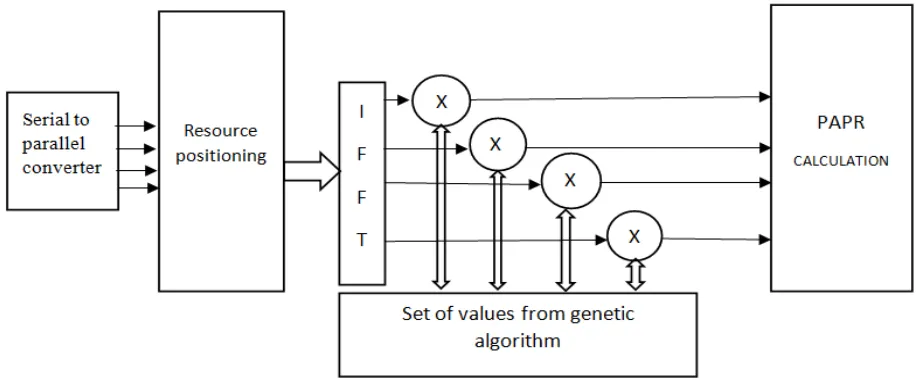
Genetic based approach is proposed to reduce PAPR in Multi-User-MIMO OFDM system along with ATR to achieve better optimization with lesser complexity. Genetic algorithm will give better performance regardless of the number of carriers used for sub carrier mapping. From the left side of block diagram, the data information in frequency domain X is separated into N non- overlapping sub-blocks and each sub-block vector has the same size P. These sub blocks are been given to IFFT and the output is mixed with the factor from optimization method.
Fig 1: PAPR reduction using Genetic Algorithm
A. PAPR Reduction
The PAPR of MU-MIMO-OFDM systems primarily depends on the maximum PAPR of all transmit antennas, and our target is to reduce the peak power all the transmit antennas. However, the TR method moderately carries out the TR iterations on every antenna.
Produce all potential combinations of weighting factor in the IFFT block.
Finally optimization will be attained.
……eq (1)
B. Genetic Algorithm
Among others biologically inspired optimization methods, genetic algorithms (GA) has been one of the best globally proved search technique to deal with different engineering and optimization problems. Three main genetic operators are sequence selection, crossover and mutation. Sequence selectionproduce initial population randomly. Each solution is then assessed and assigned a fitness value. Based on the fitness function, the most suitable solutions are chosen. After this process, crossover is carried out to produce new offspring.
“Mutation”is then applied with determinate probability intent to avoid falling of all solutions into a local optimum. While carrying out the GA has been repeated as far as the termination criterion (i.e. reached number of populations, of obtainedsolution with a described tolerance, etc.) is fulfilled. Crossover and mutations are among the most important operators that can increase the efficiency of GA. The “crossover” is used to produceoffspring by exchanging bits in a pair of parent’s chromosomes selected from the population. “Crossover” occurs with a crossover probability (crossover rate, xovr) that points out the ratio of how many couples will be selected for mating. The “mutation operator” changes some elements in chosen chromosomes with a mutation probability (mutation rate, mutr). The operator includes diversity which facilitates the genetic algorithm to get rid of local minimum. It is well known that optimal crossover and mutation rates vary for different problems and the success of GA depends on their choice.
IV. PSEUDO CODE
i. Generate a set of random solutions (genes in chromosomes set)
ii. Test the solution in the chromosome set
iii. Remove the bad solution using Adaptive Tone Reservation scheme
iv. Mutate the good ones
v. Further crossover the resultant sets
vi. Repeat until the good solution
V. SIMULATION RESULTS
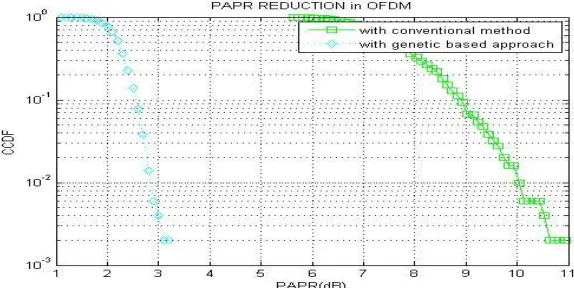
The simulation result is obtained as given in the below graph.The comparison between the conventional methods and our proposed method can be understood from this simulation result.The PAPR reduction is achieved better than the other methods by using genetic algorithm.
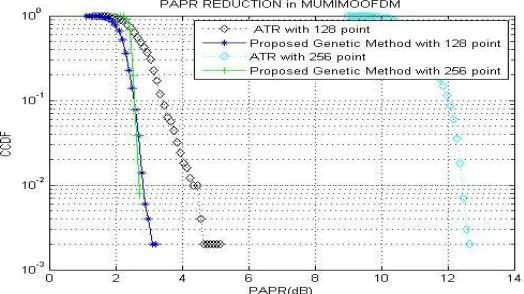
The simulation result forthe comparison between the ATR and Genetic algorithm is obtained as given in the below graph.From the simulation result we could infer that as the number of bits increase, the performance of genetic algorithm also increases.At lower bits genetic algorithm show less variations when compared with other methods but as the number of bits increased there is a drastic difference in reduction of PAPR in comparison with ATR.For the simulation purpose 128bits and 266 bits are taken and the performance of genetic algorithm is analysed in comparison with ATR.From this we can clearly observe that for 128bits the PAPR reduction is improved for a considerable extend by using genetic algorithm than by using ATR,whereas in 266 bits we could drastically see the difference in the performance of the two methods
Fig 3:PAPR Reduction in MU-MIMO OFDM
A. Performance comparison:
Parameters ATR-128 bits Genetic
algorithm-128bits
ATR-256 bits Genetic
algorithm-256 bits
ccdf value 0.1 0.1 0.1 0.1
PAPR reduction(dB) 3.6 1.9 12 2.3
Running time (s) 74.12 20.50 236.22 116.99
Table 1: Performance Comparison for 128 bits and 256 bits
The performance comparison between the Adaptive Tone Reservation and genetic algorithm for 128 bits and 256 bits is given as in the above tabulation. The ccdf value PAPR reduction and running time is analysed. From the performance comparison we can infer that Genetic algorithm show less variation than the ATR methods. Though it is less Genetic algorithm is better than the ATR even at lower bit levels. At higher bit levels genetic algorithm shows a drastic difference than the other method. Thus genetic algorithm is best suitable for the higher level bits.
VI. CONCLUSION AND FUTURE WORK
REFERENCES
1. IEEE WIRELESS COMMUNICATION LETTERS, VOL X, NO Y, JUNE 2016 A Novel Adaptive Tone Reservation Scheme for PAPR
Reduction in large scale multi user MIMO-OFDM Systems, Chunxing Ni, Yahuj Ma, and Tao Jiang, Senior Member, IEEE
2. IEEE SIGNAL PROCESSING MAGAZINE November 2013 1053-5888/12/31.00 2013IEEE. The PAPR problem in OFDM transmission.
3. International journal of science and research (IJSR) ISSN (Online): 2319-7064 Index Copernicus Value (2013):6.14.Impact factor (2015)6.391
volume 5 issue 6, June 2016 www.ijsr.net licensed under Creative Commons Attribution CC by A review paper on OFDM and PAPR Praveen Pawar1, Deepak Pancholi2 1PG Student ECE department, LNCT, Indore, Madhya Pradesh, India 2Assoc. professor ECE Department, LNCT, Indore, Madhya Pradesh, India.
4. International Journal of Computer Applications (0975-8887) volume 60-No 15, December 2012. An overview of PAPR reduction techniques in
OFDM Systems, Md Mahmudul Hasan, Electronics and Communication Engineering UITS, Dhaka 1212, Bangladesh S.S. Singh, PhD. School of ELECTRONICS Engineering KIIT University, Bhubaneswar 751024, India.
5. VOL 1, No 8, Nov 2008 ISSN 2222-9833 ARPN journal of system and software 2009-2011 AJSS Journal. All rights reserved comparative
study of PAPR reduction techniques in OFDM 1Md. Ibhraim Abdullah, 2Md Zulifiker Mahmud, 3Md Shamim Hossain, 4Md Nurul Islam 6. International Journal of Scientific Research in Computer Science (IJSRCS) Volume 2 issue 1. Jan 2014 implementation of tone reservation
techniques for PAPR Reduction in OFDM Nilesh m, Prajapathi and Priyanka P Prajapathi
7. Journal of communications vol. 9,No.12,december2014©2014 Engineering and Technology and publishing,A New weighed Tone Reservation
method for PAPR Reduction in OFDM Systems Xin Lv and Yiwan School of Information science&Engineering Lanzhou university,Lanzhou 730000,china
8. Proceedings of the Federated Conference on computer science and information systems pp.419-424 DOI:10.15439/2015f178ACSIS,Vol 5
Intercriteria Analysis of crossover and Mutation Rates Relationin simple generic algorithm Maria Angelova,olypia roeva,Tania Pencheva Institute of Biophysics and biomedical Engineering Bulgaria Acaedemy of science 105 Acad G.bonchev str,sofia 1113,Bulgaria.
9. 978-1-5090-0623-6/16$31.00_c_2016 IEEE Novel crossover and mutation operation in genetic algorithm for clustering A.H.Beg Md Zahidul
Islam school of computing and mathematics Charles sturt university panorama avenue,baturst 2795,Australia
10. V.Tarokh.H.Jafrhari and A.R.Calderbank”space-time blockcodes from orthogonaldesigns,”IEEE trans.inf.Theory.vol.45.pp
1456-1467.july,1999
11. H.jafarkhani,”A quasi-orthogonal space time block code,”IEEE trans.commun.,vol 49.,no.1,pp1-4,jan2001
12. CHAO-WANG HUANG,PANG-AN TING,AND CHIA-CHI HUANG”A novel Message Passing Based MIMO-OFDM Data Detector
With a progressive parallel ICI canceller.”IEEE Transactions on Wireless communications, vol.10, No 4,April 2011.
BIOGRAPHY
C.Rajeswari, M.E., is a faculty in Electronic and Communication, GKM College of Engineering and Technology her research interest is in wireless communication.