University of Windsor University of Windsor
Scholarship at UWindsor
Scholarship at UWindsor
Electronic Theses and Dissertations Theses, Dissertations, and Major Papers
2011
A Comparative Framework for Emotion Driven Agent Based
A Comparative Framework for Emotion Driven Agent Based
Modelling
Modelling
Dreama Jain University of WindsorFollow this and additional works at: https://scholar.uwindsor.ca/etd
Recommended Citation Recommended Citation
Jain, Dreama, "A Comparative Framework for Emotion Driven Agent Based Modelling" (2011). Electronic Theses and Dissertations. 324.
https://scholar.uwindsor.ca/etd/324
This online database contains the full-text of PhD dissertations and Masters’ theses of University of Windsor students from 1954 forward. These documents are made available for personal study and research purposes only, in accordance with the Canadian Copyright Act and the Creative Commons license—CC BY-NC-ND (Attribution, Non-Commercial, No Derivative Works). Under this license, works must always be attributed to the copyright holder (original author), cannot be used for any commercial purposes, and may not be altered. Any other use would require the permission of the copyright holder. Students may inquire about withdrawing their dissertation and/or thesis from this database. For additional inquiries, please contact the repository administrator via email
A Comparative Framework for Emotion Driven Agent Based Modelling
by
Dreama Jain
A Thesis
Submitted to the Faculty of Graduate Studies through Computer Science
in Partial Fulfillment of the Requirements for the Degree of Master of Science at the
University of Windsor
Windsor, Ontario, Canada
2011
A Comparative Framework for Emotion Driven Agent Based Modelling
by
Dreama Jain
APPROVED BY:
______________________________________________ Dr. Gokul Bhandari
Odette School of Business
______________________________________________ Dr. Xiaobu Yuan
School of Computer Science
______________________________________________ Dr. Ziad Kobti, Advisor
School of Computer Science
______________________________________________ Dr. Robert D. Kent, Chair of Defense
School of Computer Science
iii
DECLARATION OF ORIGINALITY
I hereby certify that I am the sole author of this thesis and that no part of this thesis has been published or submitted for publication.
I certify that, to the best of my knowledge, my thesis does not infringe upon anyone’s
copyright nor violate any proprietary rights and that any ideas, techniques, quotations, or any other material from the work of other people included in my thesis, published or otherwise, are fully acknowledged in accordance with the standard referencing practices. Furthermore, to the extent that I have included copyrighted material that surpasses the bounds of fair dealing within the meaning of the Canada Copyright Act, I certify that I have obtained a written permission from the copyright owner(s) to include such material(s) in my thesis and have included copies of such copyright clearances to my appendix.
iv ABSTRACT
Emotions are an integral part of human decision making so it is important to integrate emotions into artificial agents to make them more realistic. In this thesis we intend to design and implement an artificial emotional response agent simulation using three psychological models for emotions and develop a corresponding algorithm for each depicting its process in order to find a suitable algorithm.
After comparing the performance of the three algorithms we use Ortony, Clore and Collins(OCC) theory to generate emotions in a case study of a basic Hospital Simulation System. In this, there are patient and nurse agents who trigger emotions due to interaction with each other.
v
DEDICATION
To my loving parents whose immense patience and faith in me have got me this far in my
vi
ACKNOWLEDGEMENTS
First and foremost, I am grateful to my advisor Dr. Ziad Kobti for providing me the opportunity to work in an exciting and challenging field of research. His constant motivations, support, innovative ideas, own research and infectious enthusiasm have guided me toward successful completion of my thesis. My interactions with him have been of immense help in defining my research goals and in identifying ways to achieve them.
My sincere gratitude goes to Dr. Xiaobu Yuan for his valuable advice and helpful discussions during my thesis research. I would like to thank Dr. Gokul Bhandari for his valuable comments and suggestions that helped me in my research.
vii
TABLE OF CONTENTS
DECLARATION OF ORIGINALITY ... iii
ABSTRACT ... iv
DEDICATION ... v
ACKNOWLEDGEMENTS... vi
LIST OF TABLES ... xi
LIST OF FIGURES ... x
CHAPTER I. INTRODUCTION ARTIFICIAL EMOTIONS ... 1
CURRENT RESEARCH MOTIVATION ... 3
THESIS CONTRIBUTION...4
THESIS OUTLINE...5
II. LITERATURE REVIEW: AFFECTIVE COMPUTING EMOTIONAL AGENTS INTEGRATED WITH REACTIVITY AND GOALS ... 6
DEVELOPING EMOTIONS IN BEHAVIOURAL ANIMATION . 11 EMOTIONS AND OTHER MOTIVATIONS... 14
USE OF FUZZY LOGIC IN MODELING EMOTIONS... 16
EMOTIONS INTEGRATED WITH PERSONALITY IN A RATIONAL AGENT... 19
MODELING EMOTIONS USING DOMAIN INDEPENDENT FRAMEWORK... 25
EMOTIONAL AGENTS... 28
BUILDING EMOTIONAL AGENTS USING LOGICAL FORMALIZATION OF EMOTIONAL THEORIES... 30
CONCLUDING COMMENTS... 35
III. PSYCHOLOGICAL THEORIES THEORY OF ORTONY, CLORE AND COLLINS ... 38
FRIJDA'S THEORY ... 43
viii IV. COMPARATIVE STUDY
GENERAL ARTIFICIAL EMOTIONAL MULTI-AGENT MODEL
... 50
METHODOLOGY... 54
EXPERIMENTS ... 58
V. CASE STUDY: HOSPITAL SYSTEM INTRODUCTION ... 64
EMOTION INTEGRATION ... 65
BEHAVIOUR OF THE NURSE AGENT ... 65
EXPERIMENTAL SETUP... 69
VI. CONCLUSIONS AND RECOMMENDATIONS REFERENCES ... 80
ix
LIST OF TABLES
Table I: OCC Algorithm Definitions ... 41
Table II: Frijda Algorithm Definitions ... 45
Table III: Scherer Algorithm Definitions ... 48
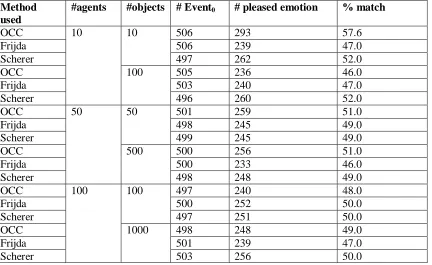
Table IV: Experiments with history and event impact enabled...…... 59
Table V: Experiments without history and event impact disabled...……...…..….. 60
Table VI: Experiment results with emotional intensity for pleased emotion ...…. 61
Table VII: Experiment results with emotional intensity for displeased emotion ... 62
x
LIST OF FIGURES
Figure 1: Tok architecture (Bates, Reilly and Loyall, [1998] page 56) ……...…...10
Figure 2: Actor Structure (Costa and Feijo, [1996], page 378) ………...………... 13
Figure 3: Global structure of emotion types (Ortony, Clore and Collins, [1988], page 19).…….39
Figure 4: OCC Algorithm………….………...….………… 42
Figure 5: The emotion process (Frijda, [1986], page 454) ………...….. 44
Figure 6: Frijda Algorithm ………...………….. 46
Figure 7: Scherer Algorithm ………...……… 49
Figure 8: Statistical variance of the percent match for the pleased emotion for 100 agents…….59
Figure 9: An example task showing the comparison of logical & emotional performance...….. 68
Figure 10: Algorithm used to miss a step while performing a task under the influence of negative emotions ………...……….68
Figure 11: Graph shows the number of nurses with negative emotions for every time step for Setting 1. X-axis represents time step and Y-axis represents number of nurses...………….. 70
Figure 12: Graph showing task attention vs. time for logical and emotional performance of the nurse for Setting 1……..………...……... 71
Figure 13: Graph shows the number of nurses with negative emotions for every time step for Setting 2. X-axis represents time step and Y-axis represents number of nurses………... 73
Figure 14: Graph showing task attention vs. time for logical and emotional performance of the nurse for Setting 2………..……...………... 74
xi
1
Chapter 1
Introduction
Emotions are complex and difficult to interpret. Emotions have many facets such as, feelings, experience, behaviour, cognition and so on. Emotions are psycho-physiological experience of an individual’s state of mind [Myers, 2004]. There has been a growing
interest in Computer Science to depict emotions and its role in human cognition and social interaction. Neuroscience and studies in psychology show that emotions have impact on the decision making in humans [Bechara, 2004]. Emotions have been depicted in artificial intelligence especially in Robotics and Human Computer Interaction in the past few years. Agent based modelling systems (ABMS) is one of the areas of Artificial Intelligence(AI) research, which deals with interactions of intelligent agents in an environment. ABMS are complex systems which are used in decision support systems. In decision making emotions play an important role. It is essential to take emotions into account while agents interact with one another in an environment to make them capable of reacting and making more realistic decisions.
1.1 Artificial emotions
2
is now becoming part of artificial agents as well. Concepts of emotion and various theories of emotion can be found in psychology books such as [Frijda, 1986], [Ortony, Clore and Collins, 1988] and [Lazarus, 1991]. The relationship between AI and psychology (emotion) has been very well described in the work of Sloman, [1990] and Rusell and Norvig, [1995]. The doctoral thesis by [Reilly, 1996] supports the merging of AI with emotion and social adaptation. Bates, Loyall and Reilly [1992] introduce the Tok architecture in the Oz project which implements emotional agents. In this, the authors’ aim is to imbibe emotions and reactivity with other capabilities of the agent which have goal-directed behaviour. In [El-nasr, Yen and Iorger, 2000] the authors, discuss the use of fuzzy logic in generating emotions. The researchers describe how they have mapped events to emotions and emotions to behaviours using fuzzy logic and used learning techniques to make agents adaptive.
3
1.2 Current research motivation
Design and implementation of emotional agents is closely linked to psychology. There are a number of psychologists who argue about the process of emotion generation in humans. In response to this there have been a lot of theories which explain the emotional process. The question arises whether these theories can be used in Computer Science to generate emotions for artificial agents or not. In order to make artificial agents capable of decision making similar to humans it is necessary to follow the same procedure of generating emotions in agents as it is in humans. If psychological theories can be used for agents, then the best theory to closely link with Computer Science needs to be decided as well. There has been no previous work which compares the various psychological theories for use in artificial agents.
4
1.3 Thesis contribution
In this research we aim to design and implement computer algorithms for each of the three different psychological theories in order to compare their performances. The three theories that we use are OCC (Ortony, Clore and Collins) [1988], Frijda [1986] and Scherer [1984a]. These three theories are closely linked to Computer Science in a way that these can be applied to artificial agents to trigger emotions. With the help of a general artificial agent simulation, we compare the performance of the three algorithms to understand their suitability for selecting them for an artificial agent simulation. Moreover we also implement the behaviour of the agents under the influence of emotions and compare their emotional behaviour to logical behaviour.
After comparing the performance of the three algorithms we use OCC to generate emotions in a case study of a basic Hospital Simulation System.
The main goals of this study are:
To develop algorithms for each of the three psychological theories and implement
them in a general artificial agent based simulation.
To compare the outcomes of each algorithm to understand their suitability for
selecting them for artificial agent model.
To compare the behaviour of social agents under emotional stress to their logical
behavior.
And to implement a case study to test the general agent emotion model in a
5
1.4 Thesis outline
The main aim of this research is to compare the performance of three psychological theories, implement them in a general artificial agent simulation and implement a case study. In order to discuss this we divide the thesis into following chapters.
In chapter 2 a literature review and survey is presented on emotional agents with goal-directed behaviour, emotions in behavioural animation, use of fuzzy logic in modelling emotions, and emotions integrated with personality and building emotions with logical framework of emotional theories.
Chapter 3 describes the three psychological theories, corresponding algorithm for each and their implementation.
Chapter 4 describes the comparative study for the three theories detailing on the test platform, methodology and discussion of the results of the comparison.
Chapter 5 presents the case study of the hospital simulation system explaining all the details of its implementation.
6
Chapter 2
Literature Review: Affective computing
This chapter includes a literature review on affective computing. The work that has been done till now in the sphere of emotion generation among agents can be classified into different methods researchers used to implement emotional agents. These methods are integrating emotional agents with reactivity and goals, developing emotions in behavioural animation, emotions and other motivations, use of fuzzy logic in modelling emotions, integrating emotions with personality, modelling emotions using a domain independent framework, building emotional agents using logical formalization of emotional theories.
2.1
Emotional agents integrated with reactivity and goals
7
2.1.1 Integrating Reactivity, Goals, and Emotion in a Broad Agent
Bates, Reilly and Loyall, [1992] begin by stating that no existing architecture is able to integrate the capabilities of emotions and ―goal-directed reactive behaviour‖ in agents for
8
create independent behaviours for an agent depending upon context conditions and success tests. The authors also claim that the idea of behavioural features can be used to model different personalities of the agent instead of building agents from scratch.
2.1.2 Building emotional agents.
Reilly and Bates, [1992]appear to be the first to identify the problem that emotion-based reaction is required in the agents of the Oz world. The agents should be able to react to the events and act according to their emotions and beliefs, and should have goal-directed behaviour. Moreover, the authors state that there is no existing architecture that can deal with the emotions and behavioural features in Tok, an architecture developed by the authors which works on ―sense-think-act cycle‖. The authors propose what they claim to
9
have emotions which lead to particular attitude towards the object. With the help of these emotions and attitudes recorded by Em the behaviour of the agent is affected. Moreover Em also keeps track of social knowledge and interpersonal relationship of agents with other agents as it is one of the important cause of emotions and vice versa. The authors state that the Em model is an extension of the work of Ortony, Collins and Clore [1988]. The authors claim that Em is able to model not only emotions but relationships, personality and attitudes of agents, and that the complete framework of an agent is influenced by Em and vice versa. The authors claim that Em can be used to model emotions in the agents of the Oz [Bates, 1992] project.
2.1.3 An architecture for action, emotion, and social behaviour.
10
emotions of the agent change depending upon the success or failure of the goal. The Em model of Reilly and Bates, 1992 is used for representing emotions of the agent with respect to goals and social relationships. With the help of Hap, the action performed, and Em, the emotional influence, behavioural features of the agent are adjusted. The authors claim that their architecture is able to perform actions based on emotions and agent has goal-directed behaviour. They also claim that they have improved Hap in terms of speed, multiple actions, etc. These changes have eventually improved the Hap architecture from what it was previously.
11
2.2 Developing emotions in behavioural animation
The work of Costa, Feijo and Schwabe, [1995] and [Costa and Feijo, [1996] focuses on developing emotions in agents which are used in animation. The authors state that a deliberative approach in developing agents is not enough and their architecture is reactive as well as deliberative, a hybrid architecture.
2.2.1 Reactive Agents in Behavioural Animation.
Costa, Feijo and Schwabe, [1995] begin by stating that earlier AI implementations of building agents are not reactive and deliberative architecture has been used for designing agents, which is not that good in representing agents’ interaction completely with other
12
The authors claim that the architecture they have built for the reactive agents is innovative for behavioural animation systems, and is efficient and supports most of the properties required by agents that deal with their interaction with each other. They also indicate the future work that can be done in improving and making agents more complex and formal methods such as procedural logic can be used.
2.2.2 Agents with emotions in behavioural animation.
Costa and Feijo, [1996] begin by stating that there has not been much work done in behavioural animation other than the work of Costa, Feijo and Schwabe [1995]. The authors claim to be the first to identify the problem of handling emotions in agents in behavioural animation. The main purpose of the authors in writing this paper is to introduce the Reactive Emotional Response Architecture, which has been used to generate emotions and behaviour corresponding to those emotions in agents. The authors propose a new architecture for reactive emotional response which is a complement to the work of Costa et al [1995]. The agent structure consists of a Sensory Centre which has functions of sending/receiving messages and perception functions. There is a Large Term Memory (LTM) which stores the facts that exist in the environment. These facts are acted upon by processes in the Cognition Centre which is a part of Sensory Centre. The external events which are stored as facts in LTM activate propositional network. Based upon the current emotional state, a decision is taken for the action to be performed such as ―go_to‖, ―follow_path‖, ―move‖, etc., the task is to reach a position by avoiding
13
reactive agents (cognition, emergence, situatedness, recursion and cooperation). The authors also state that their work deals with emergence, generic behaviour, emotion models, and is appropriate for reuse technology and parallel processing which, they claim, has not been done by anyone else till now. However, the authors give little evidence or argument to support these claims.
14
2.3 Emotions and other motivations
2.3.1 Modelling Emotions and Other Motivations in Synthetic Agents
15
time dependent or driven by a complex function. The Behaviour system in Cathexis model consists of network of behaviours, which consists of two components: Expressive component, it contemplates prototypical facial expression, body posture, and vocal expression. Experiential component, which considers motivation and action tendency. The selection behaviour is dependent upon releasers, which include emotions, moods, etc, and external stimuli.
In order to test Cathexis, the author used a testbed environment, Simon the Toddler. It includes five drive specialists such as hunger, thirst, etc., six emotion proto-specialists. A number of behaviours, with expressive component of facial expressions and experiential component of motivations and specific actions. Interaction with Simon is done with the help of some parameters which act as external stimuli for Simon on the basis of which Simon responds to the actions by giving different facial expressions and behaviours.
The author states that his model considers both cognitive as well as non-cognitive elicitors of emotion. It also models influence of emotion on agent’s behaviour and takes
16
2.4 Use of fuzzy logic in modelling emotions
2.4.1 PETEEI: A PET with Evolving Emotional Intelligence
El-Nasr, Yen and Ioerger, [1999] begin by stating that memory and experience play an important role in emotion generation process, so learning is essential to be incorporated in computer simulations which model emotional process. The purpose of the authors to write this paper is to introduce a PETEEI (a PET with Evolving Emotional Intelligence), which uses fuzzy logic to model emotions and learning techniques to make the agent adapt to the events with the help of its own experience. The authors introduce a new model of emotions which consists of learning mechanisms such as: learning about events for which desirability of specific events is measured by identifying the link between events and goals. This is done with the help of a reinforcement learning algorithm, Q-learning. The second learning is about the user by learning the sequence of actions a user takes in form of patterns to be learnt with the help of a probabilistic method. Next is learning about pleasing and displeasing actions which is learnt by external feedback. The recent action will be learned as the action evaluated. Last is the pavlovian conditioning, an object is associated with an emotion, which is then learnt by the agent. The learning about events is used in event predictions and event evaluation, which results in expectations and desirability of the event respectively, event predictions also use learning about user’s actions. Expectations and desirability is then used in generating emotion
17
depends upon emotional state but motivational state and the current situation. The authors have used fuzzy rules to map emotions to behaviours.
The authors implement a PET which interacts with the user with the help of a graphical user interface displaying various scenes and various actions. The authors use three different models in their experiment to emphasize on the role of learning. The first model produces random emotions and behaviours. Second model includes simulated emotions without learning and finally a third model with simulated emotions and learning mechanisms. The authors chose participants to interact with these models and capture their feedback using a questionnaire. The authors claim that learning is an important factor to be included in modelling of emotions which induces dynamic nature of emotional process. The authors also claim that their model can be used in various applications, like training applications, character animation, etc. The authors also claim that one of the limitations of their model is lack of personality component which is considered important in emotional process.
2.4.2 Flame – Fuzzy Logic Adaptive Model of Emotions
18
methods to incorporate adaptability and learning features in the agent to respond dynamically to situations.
The authors propose new agent architecture for modelling emotions called FLAME – Fuzzy Logic Adaptive Model of Emotions. The model consists of three main components: an emotional component, a learning component and a decision-making component. The agent perceives external events, which are passed to learning and emotional component. The learning component passes event-goal expectations according to the events perceived to the emotional component, which in turn uses perceptions and event-goal expectations to generate emotional behaviour. This emotional behaviour is passed to decision making component which generates action. In the emotional component the event perceived by the agent is evaluated by the importance of the goals affected by the event and the degree up to which these goals are affected by the event. Here the fuzzy rules are used to determine desirability of the event which is then passed to an appraisal process to determine the change in emotional state, which is done by calculating intensities of emotions. A mixture of emotions is triggered which is then filtered by inhibiting motivational and emotional states and calculating the mood. Next behaviour of the agent is selected again by using fuzzy logic. In the end decay of the emotion is done by providing feedback to the system and using a constant for decaying the emotions.
19
according to the goal, this is done using non-deterministic method of Q-learning. Next is probabilistic approach to learn patterns of the events based on the frequency of the actions performed. Last is the heuristic approach to learn the actions that please or displease the agent, this is done by using a learning algorithm which averages feedback and calculates the expected value of the actions. The authors claim that their model of emotions can be enhanced and used in various applications, such as responsive tutor agent training simulations, and human-computer interfaces. The authors claim to have some limitations in their model. The authors state that the parameters they have used in the model can be constrained to specific values before using the model for different applications. The authors state that FLAME does not incorporate personality which is regarded as an important factor in simulating emotional behaviour. Moreover authors state that their model is capable of interacting with the user but not with other agents in the simulation which is important in order to accomplish tasks.
2.5 Emotions integrated with personality in a rational agent
20
2.5.1 Motives for intelligent agents: computational scripts for emotion
concepts.
Lisetti, [1997] begins by stating that emotions are a very essential part of human intelligence and decision making, but emotions being very complex it becomes difficult to imbibe them in computer agents, as computers initiate actions on the command of the user. The author states that in order to display behaviour of humans in intelligent agents there is requirement of introducing emotion states in agents which motivates them to take decisions and perform actions. The author introduces computational scripts as a method to depict emotion concepts in agents. The author firstly defines some cognitive and bodily components of emotions, which according to the author act as parameters for defining the emotion state of the agent. These components are: time frame and planning, belief modality and goal generation, involvement and focus, intensity and salience determination, comparison and discrepancy detection, tempo and salience, criteria and attribution and size and chunking. With the help of these components emotion of the agent is obtained. The author states that almost every emotion acts as a signal, which is treated as the functional attribute of the emotion, as it generates some motive. The author uses five primitives which are helpful in characterizing functional attributes. These primitives are: prioritize, re-evaluate, release, search and chunk down, these are used in case of negative emotions such as guilt, anxiety, feeling overwhelmed, anger, frustration, feeling stuck, disappointment, which signals that agents’ motive at this point is to use
21
Computational scripts consist of causal chain, which is series of processes which take place in arousing of an emotion, and open roles which has the values for emotion components which lead to instantiation of a script. The author claims that computational scripts as described in the paper can be used to represent emotion concepts and generation of particular action with respective to the signal produced by the emotion, in other words, the functional attribute.
2.5.2 Emotions and Personality in Agent Design and Modelling.
Lisetti and Gmytrasiewicz, [2002] begin by stating that there are two different areas: cognitive science and artificial intelligence, the problem is combining the two and creating artificial agents which can deal with emotions. The authors’ purpose of writing
22
actions, 3) the results of the actions, and 4) the desirability of these results. Emotions are also associated with decision making. The authors regard personality as a set of emotional states of an agent, which is further defined as a finite state machine consisting of a set of emotional states, a set of environmental inputs, an emotional transformation function and an initial emotional state. Furthermore, they define a personality model of an agent which is capable of predicting the emotional state of the another agent, whose initial emotional state is given. The transformation of an action takes place depending upon the new emotional state developed by the agent. The utility functions are also transformed by emotional states, depending upon positive or negative feelings, to states that are desirable. The transformation of probabilities of states is achieved by changing probabilities and moving to the most likely state. The authors claim that they have been successful in merging the two areas of artificial intelligence and psychology and have been able to define how agents behave and make decisions depending upon emotions and personality. However, the authors give little evidence to support their claims.
2.5.3 Personality, Affect and Emotion Taxonomy for Socially Intelligent
Agents.
Lisetti, [2002] begins by referring to the work of Murphi, Lisetti et al [2002] and the problem identified by [Murphi, Lisetti et al, 2002]: emotions play a very important role in socially intelligent agents who are dependent upon their environment, which is complex and unpredictable, and do not have complete access to their resources. The author states that the problem is to develop a framework which takes into account the ―external
23
24
interface agents. The author claims that in their approach each emotion is described by a number of emotion components. The author also claims that their approach takes into consideration action tendency which is used to describe that the emotion experienced leads to this particular action to be performed.
2.5.4 Can a Rational Agent Afford to be Affectless? A Formal
Approach.
25
that they have modeled agents such that in the decision making process role of affect is also included. They also claim that they have described emotional transformations which indeed are formalization of these roles.
2.6 Modelling emotions using domain independent framework
[Gratch and Marsella, 2004] and [Gratch and Marsella, 2005] introduces a domain independent framework of emotion known as Emotion and Adaptation (EMA) which not only implements appraisal of events but also generates coping process for the event and the emotion generated.
2.6.1 A Domain-independent Framework for Modelling Emotion
26
The authors state that EMA algorithm has 5 stages. First is a causal interpretation which is recognized as agent’s current mental state and has three parts: causal history, current
world description and task network, which link to past actions of the agent that has lead to this state, interpretation of the environment and future plans respectively. The mechanism for updating the mental state or as the authors say causal interpretations, are the cognitive operators that is, planning, dialogue, execution, and monitoring operators. Second stage is of appraisal frames and variables, which are formed due to change in causal interpretations. In order to generate these appraisals there are some rules of perspective, agent’s interpretation for an event, relevance, significance of the event for an
27
coping strategies and can be used with Natural language processing and intelligent agents. The authors claim to have some limitations of the model such as, lack of unexpectedness, reasoning of causal attributions. The authors claim that EMA is able to maintain a balance between emotional instances and causal interpretation which conforms to behavioural consistency. The authors claim to have some differentiation between their model and Classical Decision Theory, such as difference in combining utility values with behaviour.
2.6.2 Evaluating a Computational Model of Emotion
28
reinterpretation, acceptance, denial, mental disengagement, shift blame, and seek/suppress information. The authors claim that their model has responded fairly close to the human behaviour. The authors claim that since they have used an outside source for evaluating human behaviour, so it proves that they have used a fair system to evaluate the model and the use of this system also considers emotional dynamics. But the authors also claim that the encoding of scenarios was done by them which are being bias with the model.
2.7 Emotional agents
2.7.1 Emotional agents: A modelling and an application.
Maria and Zitar, [2007]’s main purpose to write this paper is to introduce a new model
for multiagent system which uses emotions as part of decision making. The authors state that there is a very important role of emotions in artificial agents such as action selection, adaptation, learning, goal management, etc,. According to the authors there has been no such implementation in multi-agents which depicts emotion and relative decision making. The authors introduce their new model which consists of two agents one is a regular intelligence agent (RIA) and the other is emotional intelligence agent (EIA). The authors have used benchmark problem of ―the Orphanage Care problem‖. In this an agent has
29
emotions. The authors also describe the conditions and rules for the RIA to take decisions and behave towards a goal. For EIA also there are some conditions and rules to behave towards the goal but it also has emotion generation and normalization. Every time the emotions are checked it is checked on the basis of the goal and standard of EIA. The three kinds of emotions are linked with different goals and objects in the model. EIA depicts the intensity of the emotions but there is no such observation of how the emotions influence behaviour of EIA. Personality of EIA is influenced by the emotions which in turn influences appraisal hence leading to the behaviour of EIA. So if the intensity of emotions is on the happy state then EIA would work on the bright side of the life and vice versa. The authors perform experiments to compare the performance of RIA and EIA. They have used 3 different settings for the world and the agents, to test and verify their performance. In the first setting the average values of the salary, social and working capacities which are generated randomly are maximized. The second setting is an easy setting which increases the gains for the agents and reduces their expenses. In the third and final setting the world is made harder for the agents by decreasing the gains and increasing the expenses.
30
Orphanage and hence runs out of money. The authors claim that emotional agent can outperform a regular agent in real world applications also. The authors also claim that if the emotional agents have the capability of learning then it can enhance the behaviour of the agents and their decision-making skills.
2.8 Building emotional agents using logical formalization of
emotional theories
2.8.1 A logical framework for an emotionally aware intelligent
environment.
Adam, Gaudou, Herzig and Longin, [2006 a] begin by referring to the work of Aarts, Harwing and Shuurmans [2002] on Ambient Intelligence and the problem of applying emotional abilities in intelligent agents. The authors indicate that the problem is to manipulate emotions of the agents in an intelligent environment, in this case in an Ambient Intelligent System. The main purpose of the authors in writing this paper is to introduce the framework which they have developed which is based on BDI modal logic and deals with the emotional abilities in the intelligent environment.
31
authors formalize the emotions using appraisal criteria based upon agreement and probability. The emotions of the agents are only dependent upon the events that have occurred. The emotions can be Joy/Sadness, Hope/Fear and Satisfaction/Fear-confirmed/Relief/Disappointment based upon the event that has occurred and the way the agents appraise the events.
The authors present a formal analysis of their framework using a case study. This case study consists of four different scenarios. The first case is ―appraisal of an external event from the user’s point of view‖, in this case the agent is able to figure out the emotion of
the human by knowing the event that has occurred.
The second case is ―pre-evaluation of the emotional effect of an agent’s action on the user‖. In this case, if the agent knows that the human has some emotion of sadness
because of some event but actually the event has not taken place then the agent can inform the human about that. Also if the agent knows that the human is happy because he was expecting an event but now that event will not take place because of another event that has to take place before that event, and now the agent knows that the event that human was happy about can take place but with another event to take place before it then the agent should inform the human about it.
32
the emotions of the human and is able to explain how these emotions can vary depending upon the event.
The last case is ―observation, and explanation hypothesis‖. In this case, the agent finds
out that the human is sad but he does not know the reason. He will infer that the human is sad because of some event that was to take place and has not resulted in something good. The authors state that their framework is able to deal with four different scenarios. The authors mention that they have not depicted the results clearly in their paper. The authors claim that their framework deals with emotions and intelligent environments. The authors also claim that their model is simple to manipulate and is not complex. They also state that due to its construction it can be easily extended by adding more emotions, which can make it complex.
2.8.2 OCC's emotions: a formalization in a BDI logic.
33
and actions to the world. The authors define the belief and probability relation and other operators of which desirable and undesirable operators are important. With the help of these operators and mappings the authors extend the emotions built by [Ortony, Clore and Collins, 1988].The first branch being event-based emotions. The authors claim that, in this branch, there is well-being emotion which has concern with the agent’s joy or sadness depending upon the desirability of the event that happened. In prospect-based emotions, there is emotion attached to the likelihood of an event to happen, the prospect being that the event will be desirable. The fortune-of-others emotions have concern with an agent having liking, desirability or deservingness of an event for another agent. The second branch is agent-based emotions. In branch, the first kind is attribution emotions, which is concerned with approving of an agent’s action by itself and by other agents. The
second kind is composed emotions, combination of well-being emotions and attribution emotions. The authors claim that they have depicted twenty emotions. However, they state that their framework does not provide fine-grained differentiation between similar kinds of emotions and the emotions exist until a condition is true which is not realistic as emotions change with time and do not remain the same forever.
2.8.3 A logical formalization of the OCC theory of emotions.
Adam, Herzig and Longin, [2009] state that OCC theory [Ortony, Clore and Collins, 1988] does not represent different components of emotions and relationship between agents’ emotions and actions. The authors state that work has been done in triggering
34
35
reproach depending upon praiseworthy or blameworthy action. Next is compound emotion which consists of attribution and well-being emotions and hence corresponds to gratitude and admiration, anger and reproach, gratification and pride, or remorse and shame. With the help of these, the authors give various theorems and their proofs. The authors claim that their model has clear semantics, retains BDI logics, and that their model very well expresses mental states hence validating BDI logics. The authors claim their model can be a useful tool for psychologists. The authors claim that they have implemented a BDI framework for agent appraisal and coping strategies. The authors also claim that their model implements twenty emotions from the OCC theory and they will implement other theories of emotions in the future as well.
Also [Adam, 2007] a doctoral thesis describes logical formalization of emotions by defining semantics and axiomatics used in this framework, formal definitions of emotions, and formal properties of emotions.
2.9 Concluding comments
[Bates, Reilly and Loyall, 1992] appear to be the first to identify the problem of developing emotional agents. They developed the Tok architecture which integrates reactivity, goals, and emotion. The authors state that there is need for improvement and changes in the architecture which includes speed, sensing, multiple actions, etc. Moreover the authors believe that Tok needs to be extended.
36
satisfies such principles in animation. The authors also state that improvement can be done in order to create more complex agents.
The papers [Velasquez, 1997] and [Velasquez and Maes, 1997] identify emotions as well as other motivations of emotions such as moods and implement a Cathexis model which in a flexible way generates emotions using proto-specialists and model the influence of emotion on the behaviour of synthetic agents. Moreover [Velasquez, 1997] also takes into account cognitive and non-cognitive elicitors of emotion, emotion intensity and decay of emotion with time.
The papers [El-Nasr, Yen and Ioerger, [1999] and El-Nasr, Yen and Ioerger [2000] introduce FLAME generation of emotions using fuzzy logic. In this mapping of events to the emotions is done using fuzzy logic. The authors also take into account memory and experience of the agent which is implemented using various learning techniques. The authors claim that their model can be used in a number of applications to generate emotions with learning experience but the authors also claim that they have not considered role of personality in their model, which can be done in the improvement of their work.
37
psychology and have been able to define how the agents behave and make decisions depending upon emotions and personality. The authors state that in their future work they will use the definitions to design more personalities of agents and will find out the effect on abilities of agents in accomplishing their goals by modifying decision-making model. The papers [Gratch and Marsella, 2004] and [Gratch and Marsella, 2005] introduce a domain-independent framework which models emotion and adaptation. According to the authors their framework is able to appraise events and generate emotions using emotional instances. Moreover their framework also has the ability to produce coping strategies. The model is able to generate a coping process which produces some coping strategies out of which, one of the coping strategy is used. In [Gratch and Marsella, 2005], the authors have evaluated their model in comparison to the human behaviour with the help of stress and coping questionnaire. The authors claim that their model responded fairly close to that of human behaviour but there are some limitations which may lead to some different results. The authors also claim that their model can be used in various applications on Natural Language processing and intelligent agents.
38
Chapter 3
Psychological theories
In this research we compare three psychological theories to be implemented in artificial agents and select the best theory for generating emotions in artificial agents. The theories we used are OCC theory [Ortony, Clore, and Collins 1988], Frijda’s theory [Frijda 1986] and Scherer’s theory [Scherer, 1984a]. We chose these theories due to their close link
with computer science in a way that they can be converted into algorithms. So we designed algorithms for each of the theory and then implemented them in a general artificial agent simulation.
3.1 Theory of Ortony, Clore and Collins (OCC)
Ortony, Clore and Collins [1988] developed a cognitive structure of emotions. Their main aim of developing this theory was to be used in computer science. According to OCC emotions develop in consequence of certain cognitions and interpretations. The classes of emotions due to which the emotions are generated are: events, agents and objects. Reaction to these cognitions lead to some kind of emotion, in case of event either pleased or displeased, for agents approving or disapproving, and for objects liking or disliking. According to OCC a person’s appraisal of emotion inducing situation is based on three
39
proximity, unexpectedness, and arousal. Figure 3 shows the structure of emotion types according to OCC.
40
or displeased with the event that has occurred. Desirability variable is used to see how desirable the event was for the agent and whether the agent is pleased or displeased by it. Fortune-of-others emotion takes into account whether an agent is pleased or displeased for another agent when some event occurs. Now if the agent is of good-will then he will be pleased for a desirable event that has occurred to another agent or displeased for an undesirable event and this will satisfy his goal. If the agent is of ill-will, that is, the event does not satisfies his goal then he will be pleased if the event was undesirable by the other agent and displeased if it was desirable. In this case desirability and goal satisfaction variables are used. Prospect-based emotions consist of two parts. First when an event is expected to happen, the agent will have hope for a good event and fear emotions for a bad event to happen. In the second part, when the event has occurred, depending on hope or fear, confirmation or disconfirmation of prospect, emotions like satisfaction, fears-confirmed, relief or disappointment occur. We use a probability variable according to which prospect based emotions are generated.
The second category of emotion is reactions to agents. In this, there are attribution emotions for oneself and for other agents which are generated according to the action performed by the agents. If an agent approves of one’s own praiseworthy action, then he is pleased and generates gratification emotion. If the agent disapproves of one’s own blameworthy action and is displeased then it generates remorse emotion. In case of other agent’s actions, if the agent is pleased and approves someone else’s praiseworthy action
41
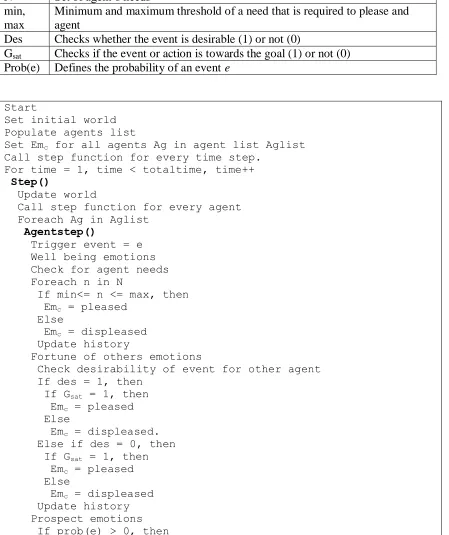
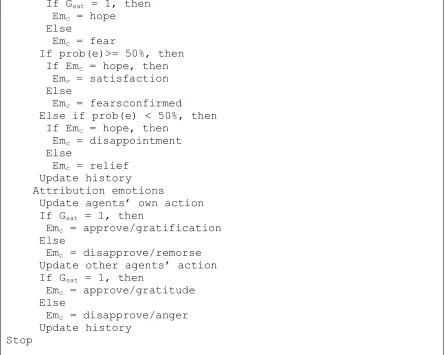
emotion of liking or disliking in reaction to objects. The algorithm we generated for this theory is shown in Figure 4. The Table I shows the definitions used for this algorithm. Table I: OCC Algorithm Definitions
Emc Current emotional state N Set of agent’s needs min,
max
Minimum and maximum threshold of a need that is required to please and agent
Des Checks whether the event is desirable (1) or not (0)
Gsat Checks if the event or action is towards the goal (1) or not (0) Prob(e) Defines the probability of an event e
Start
Set initial world Populate agents list
Set Emc for all agents Ag in agent list Aglist
Call step function for every time step. For time = 1, time < totaltime, time++ Step()
Update world
Call step function for every agent Foreach Ag in Aglist
Agentstep()
Trigger event = e Well being emotions Check for agent needs Foreach n in N
If min<= n <= max, then Emc = pleased
Else
Emc = displeased
Update history
Fortune of others emotions
Check desirability of event for other agent If des = 1, then
If Gsat = 1, then
Emc = pleased
Else
Emc = displeased.
Else if des = 0, then If Gsat = 1, then
Emc = pleased
Else
Emc = displeased
42
If Gsat = 1, then
Emc = hope
Else
Emc = fear
If prob(e)>= 50%, then If Emc = hope, then
Emc = satisfaction
Else
Emc = fearsconfirmed
Else if prob(e) < 50%, then If Emc = hope, then
Emc = disappointment
Else
Emc = relief
Update history Attribution emotions
Update agents’ own action If Gsat = 1, then
Emc = approve/gratification
Else
Emc = disapprove/remorse
Update other agents’ action If Gsat = 1, then
Emc = approve/gratitude
Else
Emc = disapprove/anger
Update history Stop
43
3.2 Frijda’s theory
According to Frijda [1986], more than just emotion, it’s the process of emergence of emotion that is important. Frijda describes six substantial characteristics of the emotion system which describe its function. These are concern relevance detection, appraisal, control precedence, action readiness change, regulation and social nature of environment. The core process of emotion generation has some components which combine to form a functioning emotional system. These components are as follows:
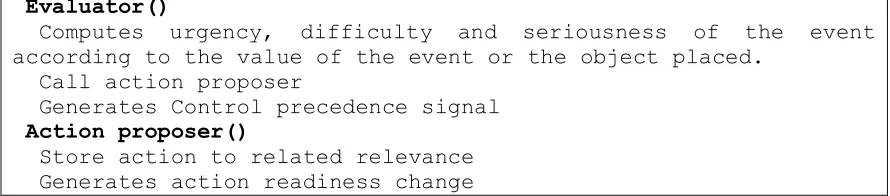
Analyzer: When the agent comes across a stimulus event, the input, in this case event, is scanned by analyzer and is checked if the event is one of the known types or the event gives some clue about its cause or consequence.
Comparator: In order to check the relevance of the event to the agent, comparator has the function to generate relevance signals. According to the relevance of the event it is classified as pleasure, pain, wonder or desire. We update the emotion of the agent according to the relevance of the event.
Diagnoser: The relevance signals from the comparator are passed on to diagnoser, which has the function to generate coping potential of the agent for that event. The coping potential generated the action possibilities for the event.
44
Action proposer: The function of action proposer is to generate action readiness change using the output from evaluator and finally one action is generated and performed by the agent.
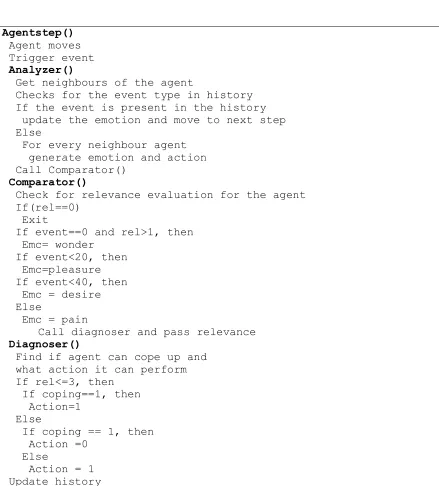
Figure 5 shows the emotion process, while Figure 6 is the algorithm designed for this theory with definitions in Table II. In the algorithm we concentrate just till the part where emotion generation takes place, the other components do not have much role to play in this implementation.
45 Table II: Frijda Algorithm Definitions
Emc Current emotional state
rel Relevance evaluation which varies from 0 to 6, where rel=0 means irrelevant
Coping Tells whether an agent is able to cope up with the event or not. 0=cannot cope, 1=can cope
Action Defines what the agent will do. Two defined actions: 1=move to a new location or, 0=stay at the same place
Agentstep() Agent moves Trigger event
Analyzer()
Get neighbours of the agent
Checks for the event type in history If the event is present in the history update the emotion and move to next step Else
For every neighbour agent generate emotion and action Call Comparator()
Comparator()
Check for relevance evaluation for the agent If(rel==0)
Exit
If event==0 and rel>1, then Emc= wonder
If event<20, then Emc=pleasure If event<40, then Emc = desire Else
Emc = pain
Call diagnoser and pass relevance Diagnoser()
Find if agent can cope up and what action it can perform If rel<=3, then
If coping==1, then Action=1
Else
If coping == 1, then Action =0
Else
46 Evaluator()
Computes urgency, difficulty and seriousness of the event according to the value of the event or the object placed.
Call action proposer
Generates Control precedence signal Action proposer()
Store action to related relevance Generates action readiness change
47
3.3 Scherer’s theory
According to Scherer [1984a], there are five functionally defined subsystems in an organism which are involved in an emotional process.
The first subsystem is an information processing subsystem which has the function to perceive a stimulus event and generate some stimulus evaluation checks (SECs). The stimulus event is evaluated through perception, memory, forecast and evaluation of available information. The SECs are checks or variables which are used to generate emotion. In this research we concentrate just on emotion generation so we designed and implemented only the information processing system.
The second subsystem is a supporting subsystem which deals with the internal regulation of the tasks and controls neuroendocrine, somatic and autonomic states. The executive subsystem has the task of decision making in order to take an action. Next the action subsystem actually controls the behaviour and expressions while an action is performed. Lastly the monitoring subsystem is responsible for controlling all the subsystems and their states.
48
standards of a person are met or not. Combination of SECs is useful in determining every emotion.
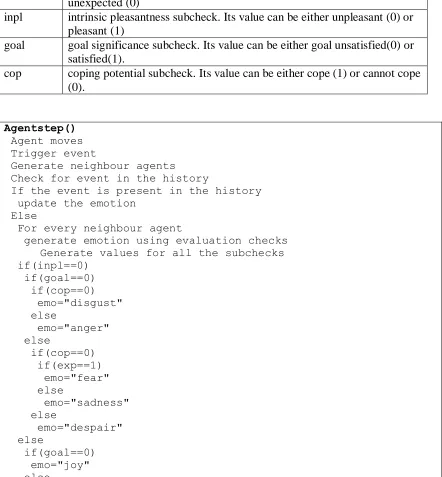
Figure 7 shows the algorithm designed for this theory and Table III shows the definitions for the variables used.
Table III: Scherer Algorithm Definitions
exp expectation sub-check. Its value can be either unexpected (1) or slightly unexpected (0)
inpl intrinsic pleasantness subcheck. Its value can be either unpleasant (0) or pleasant (1)
goal goal significance subcheck. Its value can be either goal unsatisfied(0) or satisfied(1).
cop coping potential subcheck. Its value can be either cope (1) or cannot cope (0).
Agentstep() Agent moves Trigger event
Generate neighbour agents Check for event in the history
If the event is present in the history update the emotion
Else
For every neighbour agent
49
emo="satisfaction" Update history
50
Chapter 4
Comparative study
4.1 General artificial emotional multi-agent model
The multi-agent system implemented in this research aims at a generic model and not a particular application. The aim of designing this general model is to compare the suitability of the three algorithms explained in previous chapter. We used Java platform and RepastJ library for multi-agent simulation.
4.1.1 Test platform
The model consists of agents and objects placed randomly on a two dimensional grid, which represents the world, during the initialization of the simulation. The objects retain a value varying from -10 to +10 which is generated randomly. This value is used as a parameter to test the liking or disliking of the object by the agent. The locations of the objects are managed in an array so that in future if any agent reaches the same location it may generate emotion in response to the object. The goal of the agents is to interact with other agents and to do this they move on the grid every time step. The parameters used to initialize the model, which can be changed during the initialization of the simulation, are given as following:
1. Numofagents: this represents the number of agents that will be placed on the grid for that simulation run.
51
3. Commdist: this represents the communication distance of the agents, the radius around the agent in which it interacts with the neighbour agents.
4. Movespeed: this represents the pixels the agent would move on the Cartesian grid world.
5. Worldsizex: this represents the size of the world to be initialized for the simulation run towards X-axis of the grid.
6. Worldsizey: this represents the size of the world to be initialized for the simulation run towards Y-axis of the grid.
7. Theory: this is drop down box used to select the algorithm to be used representing which theory for the particular simulation run.
For every time step, an agent moves on the grid with the move speed and randomly in any direction in order to interact with its neighbour agents and exchange emotions. An event is triggered for every agent every time step. According to this stimulus event agents generate emotions, taking into account emotions of neighbour agents as well. In general we assume that all the events have a constant impact on all the agents. Also we assume every agent knows what is desirable for other agents. When agent step is performed, the motive is to update emotion of the agent for that time step taking into account the event that has been triggered, neighbours around the agent and intensity of the emotion.
4.1.1 Neighbour impact
52
all the neighbours of the agent are close to the agent, as a result the agent would generate emotions for only those neighbours with whom it is close. So for every neighbour we generate a random impact according to which the agent will generate emotions. If the neighbour does not have any impact on the agent then it will not change its emotional state or remain neutral.
4.1.2 Impact of event
When an event occurs for the first time for an agent, the impact of the event will be highest. In order to store the events occurred the agents have a memory represented as a stack of events. For every event occurred it stores the corresponding emotion generated for that event and number of times that event has occurred. So every time step when an event is triggered, first of all the memory of the agent is checked, which is able to store last 10 events occurred. If the event is present in the memory then according to the occurrence of the event the impact of the event is calculated. Supposedly if the event has occurred for more than 10 times then the agent will not generate the same emotion as the repeated occurrence of the event makes the agent used to the same event.
4.1.3 Emotion intensity and mixture of emotions
53
agent generates blend of emotions. So we attach emotion intensity with each emotion varying between low, medium and high. Now at the end of the time step the emotion with highest intensity can be updated as current emotional state. If there are two emotions of same intensity and same valence that is either positive or negative, then the recent emotion is updated. In case the emotions with same intensity are of different valence positive and negative then we assume that negative emotion is dominating and hence it is updated as current emotional state.
4.1.4 Update history
Whenever an emotional state for the agent is updated, it is stored in the history or in this case memory of the agent, so that in the next time steps when the agent comes across same event it can check in its memory for its impact. If the impact is still high then the same emotion can be updated and there wouldn’t be any need to go through the process
54
4.2 Methodology
After the description of the general artificial emotional agent model, we describe the methodology used to generate emotions in the agents. We explained the three theories used to design algorithms and for comparison in the previous chapter. In this section we explain the implementation of each theory in the general model.
4.2.1 Implementation of OCC theory
According to this theory there are 22 emotions which are classified according to reactions to events, agents and objects. For objects we check, if there is any object in the proximity of the agent’s location. If an object is found then the value for that object is checked.
55
Well-being emotions: with global variables, a desirability variable is randomly updated and used to update emotion as pleased or displeased for event was desirable or not respectively.
Prospect-based emotions: in this case the probability of the event to occur is generated. Then according to desirability or goal satisfaction of the event the emotion of the agent is updated to hope or fear. Next in case the event occurs whose probability was generated then according to hope or fear emotion of agent and desirability the emotional state is updated to satisfaction, relief, fears-confirmed or disappointment.
Attribution emotions for oneself: here we randomly generate goal satisfaction/ praiseworthiness or blameworthiness of the action performed by the agent itself. According to global variables and this variable the emotion of the agent is updated as gratification or remorse.
Fortune-of-others emotions: deservingness and goal satisfaction variables are updated randomly on the basis of which the agent feels either pleased or displeased for neighbour agent.
Attribution emotions for other agents: goal satisfaction/degree of praiseworthiness or blameworthiness is updated randomly and according to that the emotional state of the agent is updated as gratitude or anger for a neighbour agent.
56
4.2.2 Implementation of Frijda’s theory
According to Frijda the emotion generation is a process with a number of components. We have implemented these components as described in the algorithm in previous chapter. First of all when the event is triggered it is checked for its impact in the history. Then the current location of the object is checked for objects. If any object is present then according to the value of the object emotion is updated as pain, pleasure, wonder or desire. Next the neighbours of the agent are retrieved and according to their impact emotion will be updated. These all functions are performed by the analyzer.
Comparator: Next after retrieving the neighbour agents and their impact, comparator checks the relevance of the event triggered. In this case relevance is a random integer. In case there is no relevance for the event then the emotional state remains neutral else according to the event and relevance emotional state is updated to pain, pleasure, wonder or desire.
Diagnoser: In this method the coping potential for the event is generated, which in turn is used to generate action.
Evaluator: This method is used to compute urgency, difficulty and seriousness of the event which combine to form control precedence signal.
57
4.2.3 Implementation of Scherer’s theory
According to Scherer there are Stimulus Evaluation Checks (SECs), combination of which is used to update emotional state of the agent. In our implementation we perform the check for impact of the event triggered and retrieve neighbours and their impact on the agent. According to the object value, if any object present at the location emotion is updated as joy or sad. The value for SECs is generated randomly. The SECs used are intrinsic pleasantness check, goal relevance sub check, expectation sub check, and coping potential check. If an event is unpleasant, does not satisfy goal and does not have coping potential then the event generates disgust emotion. If it has coping potential then anger emotion is updated. If an unpleasant event satisfies goal but was expected generates fear emotion. If the event was unexpected then is generates sadness. If the unpleasant event has coping potential then despair emotion is generated. If a pleasant event does not satisfy goal, it updates joy emotion and if it satisfies goal then satisfaction is updated as emotional state.
![Figure 1: Tok architecture (Bates, Reilly and Loyall, [1998] page 56)](https://thumb-us.123doks.com/thumbv2/123dok_us/1444171.1176930/22.612.100.466.309.577/figure-tok-architecture-bates-reilly-loyall-page.webp)
![Figure 2. Actor Structure (Costa and Feijo, [1996], page 378)](https://thumb-us.123doks.com/thumbv2/123dok_us/1444171.1176930/25.612.96.448.213.551/figure-actor-structure-costa-and-feijo-page.webp)
![Figure 3: Global structure of emotion types (Ortony, Clore and Collins, [1988], page 19)](https://thumb-us.123doks.com/thumbv2/123dok_us/1444171.1176930/51.612.73.498.126.587/figure-global-structure-emotion-types-ortony-clore-collins.webp)
![Figure 5: The emotion process (Frijda, [1986], page 454)](https://thumb-us.123doks.com/thumbv2/123dok_us/1444171.1176930/56.612.100.454.287.679/figure-emotion-process-frijda-page.webp)