Delay Tolerant and Energy Efficient Data
Aggregation for Heterogeneous WSN
Putraj, Venkatesh
M.E Student, Dept. of Software Engineering, University Visvesvaraya Collage of Software Engineering, Bangalore,
India
Professor, Dept. of Computer Science and Engineering, University Visvesvaraya Collage of Engineering, Bangalore,
India
ABSTRACT: The Energy resource especially in wireless sensor networks (WSNs) are major concerned. Since sensor nodes are normally more dense of data sampled by sensor nodes have more redundant of data and data aggregation became an adorable method to ignore redundancy, reducing frequent of transmission and then to conserving energy. Many applications can be assigned in WSNs and different sensors are employed in nodes, the data implemented by heterogeneous sensors or various applications have various attributes. The packet from various attributes does not be aggregated or most of the data aggregation methods handle static routing protocols, which cannot be dynamically or intentionally forward packet corresponding to network state or data types. To make data aggregation more efficiently, in this proposed method using an energy aware routing to implement a data transmission on their network Inspired by the concepts of energy aware routing technology along with data aggregation. The results estimate the performance in verifies that the routing ADA scheme can make the data improve the efficiency of data aggregation .and Take different parameters like throughput, delivery ratio, and delay and energy consumption on network.
KEYWORDS: Data Aggregation, WSN, Wireless, Nodes, Multihop, Sensor, Networks.
I. INTRODUCTION
A WSN is a collection of sensors interconnected by wireless communication channels. Each sensor node is a small device that is capable of collecting data from its nearly surrounding area. With this data simple computations are carried out and communicate with other sensor nodes or controlling authorities in the network. In ad-hoc network various routing protocols have been proposed and because of scalability, these protocols are not precisely suitable for WSN. And also WSN consists of large number of low power sensor nodes, operated in harsh environment with limited computational and sensing capabilities. Compared to the traditional sensor networks, WSN provides a flexible proposition in terms of deployment and multiple functionalities. The compact physical nature of the WSN permits a large number of sensor nodes to be randomly placed in inaccessible terrains. Also, the nodes in the WSN are capable of performing functions like data processing and routing.
Wireless sensor networks (WSNs) consist of a possibly large amount of wireless networked sensors required to operate in a possibly hostile environment for a maximum duration without human intervention. Typically, a sensor node is a miniature device that includes four main components: a sensing unit for data acquisition, a microcontroller for local data processing and some memory operations, a communication unit to allow the transmission/reception of data to/from other connected devices and finally a power source which is usually a small battery. WSNs support a wide range of applications such as target tracking, environmental monitoring, system control, health monitoring or exploration in hostile environment. For data gathering applications, which represent the main use of WSN applications, the goal is to detect any event occurring in the area of interest and to report it to the sink.
obvious that few nodes must have more residual energy than others. Therefore, over times a homogeneous network also becomes heterogeneous.
Data aggregation requires an ideal forwarding model, different from the classic routing, typically including the shortest path by some specific metric to forward data toward the base station. Unlike the classic routing approach, in data aggregation routing algorithms, the packets are routed based on their content and the nodes choose the immediate next hop that maximizes the overlap of routes in order to promote in network data aggregation. These protocols can be categorized into two parts: tree-based data aggregation protocols and cluster-based data aggregation protocols.
A. Tree- Based Approach:
In the tree-based approach, aggregation is done by constructing an aggregation tree, which could be a minimum spanning tree. In which sink is consider as root and source nodes are considered as leaves. Each children node has a parent node to forward its sensed data. Data flow starts from leaves nodes up to the sink and there data aggregation is done by parent nodes.
B. Cluster- based Approach:
In cluster-based approach, whole network is divided in to several clusters. Cluster is defined as group of sensor nodes. Each cluster has a cluster-head which is selected on the bases of high energy level among cluster members. The role of aggregator is done by the Cluster- heads which aggregate data received from cluster nodes locally and then transmit the result to observer (sink).
II. LITERATURESURVEY
Anuba Merlyn et al [1] in this paper propose method for Wireless Sensor Network (WSN) has sensor nodes which highly scalable and limited storage capability nodes. In the network, the nodes are in distributed manner and autonomous devices. The sensor node can communicate the information directly or indirectly. In WSN, the packets should be routed from source to destination within the limited power storage. The sensor nodes of WSN are highly mobile and based on the dynamic scenarios in the routing path and the network topology change frequently. A node in the routing path should be aware of the information regarding the nearest node. In traditional routing protocols, every node in the network exchanges periodic one-hop beacons. Beacons are short messages send periodically to indicate the neighbor nodes about their identification and position in the network.
Amandeep Kaur et al [2] described Sensor networks are collection of sensor nodes which co-operatively send sensed data to base station. As sensor nodes are battery driven, an efficient utilization of power is essential in order to use networks for long duration hence it is needed to reduce data traffic inside sensor networks, reduce amount of data that need to send to base station. As sensor nodes sense the data, process it, and send it to the base station, there are wide chances that the data generated from the neighboring sensors is often redundant and correlated. The unavoidable issue is that in large sensor networks, the amount of data generated is enormous for the base station to process. There is severe need of the methods for combining data into high quality information at sensors or intermediate nodes which can lead to the energy conservation by reducing the number of packets transmitted to base station. To achieve this, data aggregation approach has been explored and an in- network data aggregation strategy has been proposed that is showing better results in term of energy consumption.
Kiran Maraiya et al [3] this paper proposes for method a wireless sensor network is a resource constraint network, in which all sensor nodes have limited resources. In order to save resources and energy, data must be aggregated, and avoid amounts of traffic in the network. The aim of data aggregation is that eliminates redundant data transmission and enhances the life time of energy in wireless sensor network. Data aggregation process has to be done with the help of effective clustering scheme.
III. PROPOSEDSYSTEM
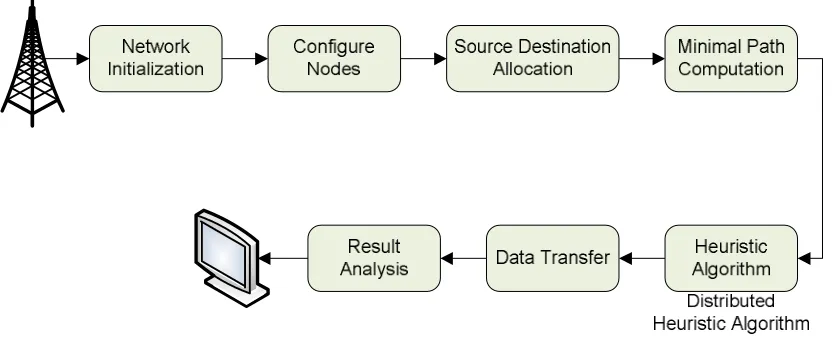
In this proposed system the Networks passes the different kind of nodes to respective path, so first it will initialize the respective nodes will be the particular designing (configure) nodes, and these are allocating by source to destination. After the nodes are checking the particular nearest path are available to transferring the nodes for using Heuristic Algorithm based on artificial B-colony.
a. Dijkstra’s Algorithm
Dijkstra’s algorithm is very similar to Prim’s algorithm for minimum spanning tree. Like Prim’s MST, we generate a SPT (shortest path tree) with given source as root. We maintain two sets, one set contains vertices included in shortest path tree, and other set includes vertices not yet included in shortest path tree. At every step of the algorithm, we find a vertex which is in the other set (set of not yet included) and has minimum distance from source.
Figure 1: Architecture of Proposed System
Below are the detailed steps used in Dijkstra’s algorithm to find the shortest path from a single source vertex to all other vertices in the given.
Algorithm:
Input: Graph G=(V,E) Directed or Undirected; positive edge length { : ∈ }; ∈ Output: for all vertex u reachable from s, dist (u) is set to the distance from s to u.
Procedure: DIJKSTRA (g,l,s) For all u∈ do
Dist (u) =∞ Prev (s) =0
H=MAKEQUEUE (v) While H is not empty do U=DELETEMIN (H) For all edges (u,v)∈ do If dist (v)>dist (u) + l (u,v) then Dist (v)= dist (u) +l (u,v) Prev (v) =u
DECREASEKEY (H,V)
b. Ant Colony
Ant colony optimization algorithm is a met heuristic algorithm which is inspired by foraging behavior of ants. Pheromone is a potent form of hormone that can be sensed by ants as they travel along trails. It attracts ants and therefore ants tend to follow trails that have high pheromone concentrations. Ants attracted by the pheromone will lay more pheromone on the same trail, causing even more ants to be attracted. The Main mechanisms on which ACO works are as follows:
Algorithm:
Step1: Set K for each variable Step 2: set ,
Step 3: Generate a Random Intial ant =
Step 4: Generate a Random initial Phenomene matrix F with the condition that all are the same. Step 5: Calculate pc following the Equation (6)
Step 6: for j=0 to j=(Iter_max-1) do Step 7: for i=1: Z do
Step 8: Generate an ant (based on equations (9-11)) = (1) Step 9: end for
Step 10: Update ( )
Step 11: Update the matrix F (based on Equation (7)) & matrix pc on equation (6)) Step 12: verify the stopping criteria
Step 13: end for
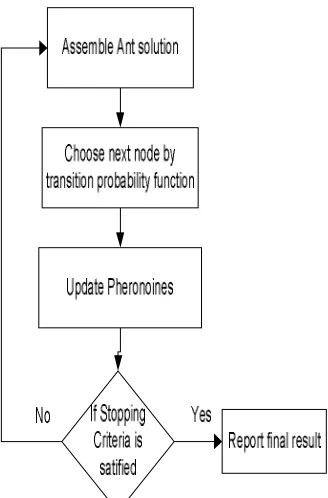
ant colony optimization algorithm (ACO) is a probabilistic technique for solving computational problems which can be reduced to finding good paths through graphs
Figure 2: Shows flowchart of ACO algorithm.
c. RSA Algorithm
Generation of key using RSA:
Step1: Choose two distinct large prime numbers p and q. Step2: Calculate the value of n.
= ∗ , will be used as the modulus for both public and private keys Step3: Find the totient of n, ( ) ( )= ( −1)∗( −1) (4).
Step4: Choose an e such that 1<e< ( ) and such that e and ( ) no divisors other than1. gcd , ( ) = 1 Step5: Calculate the value of d based on relation,
≡1( ( ))
Step6: keep d is private, Public key is (e,n) :public key is available to cluster members and CH. Private key is (d,n):private key is only available to the sink or base.
d. Heuristic Algorithm
Input: Topology Graph G, the source node s, the neighbor source node sets, and the deadline set D, the remaining time of packets RT, and the sink node t
Output: Constructed routes with ∈ S with the minimum insertion cost such that D is not violated 1. Run the ant colony based gossip to collect neighborhood status
2. Estimate the minimum path cost of s and all ∈ to the sink t using the Dijkstra’s algorithm.
3. Put all nodes in the source set S into the Candidate list L 4. Packet encryption
5. If DISTANCE(s,t) then 6. Go to 14
7. End if
8. If Route Construction packet rc is received then
9. Extract partially constructed route pr from rc, and the minimum remaining time of packets of pr 10. If s is already assigning a route then
11. Send a packet to inform the previous source node and terminate 12. End if
13. Remove n∈pr from S, and go to 14 14. End if
15. For all node ∈L do
16. Compute the incremental total delay =DELAY( ,t)
17. Compute the insertion cost at PATHCOST(s, )+ PATHCOST( ,t) 18. If the insertion cost is the lowest, and the delay ≤ , append to pr 19. Update the remaining time of each packet I as -= -DELAY(s, ) 20. Send a construction packet to ith payload pr and -min 21. Packet decryption
22. End for 23. If no candidate
24. Send construction package with empty route to each ∈S 25. End if
IV. RESULTS
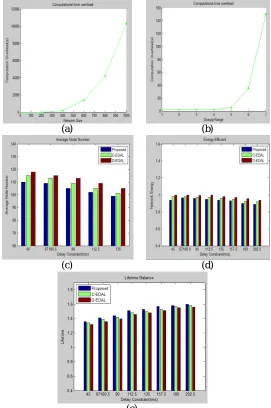
In this paper Figure 2: represents that is shows in figure (a) the results proved the energy of the route is used find out the total energy consumed over the entire route. The energy consumption between 2 nodes is given by =
2 + (1) after it will checked the nodes, if less consumption is there in results then its overhead
packet the successfully delivered to destination is that conserted.teh lower value of end to dealy means the better performance of the protocol. ∑(arrivetimesendtime) ∑Numberofconnection
Finally the results is comparing among both it will come to less proposed average nodes are shows our proposed method. Which are shows in figure (d)
(a) (b)
(c) (d)
(e)
Figure 3: (a) Computer time overhead for Network Size (b) Computation time overhead for Gossip Range, (c) Average Node Number, (d) Energy-Efficient, (e) Lifetime Balance. The scalability of the centralized heuristic,
is tightly correlated with the network size. In such case, it collected the time for finishing algorithm computation on each node with different gossip ranges on a uniform network of 256 nodes.
V. CONCLUSION
On this paper concluded An Energy-efficient Delay- Aware Lifetime-balancing protocol for data collection in wireless sensor networks, which is inspired by recent techniques developed for open vehicle routing problems with time deadlines (OVRP-TD) in operational research. The goal of EDAL is to generate routes that connect all source nodes with minimal total path cost, under the constraints of packet delay requirements and load balancing needs.
REFERENCES
[1]Anuba Merlyn, “Energy Efficient Routing (EER) For Reducing Congestion and Time Delay in Wireless Sensor Network”, International Journal
of Computer Networks and Applications, Vol 1, Issue 1, 2014.
[2]Amandeep Kaur, Rupinder Kaur, “Energy Efficient Routing for Wireless Sensor Network through Event-Based Clustering Mechanism”,
International Journal of Advanced Research in Computer Science and Software Engineering, Vol 4, Issue 6, 2014.
[3] Kiran Maraiya, Kamal Kant, Nitin Gupta, “Efficient Cluster Head Selection Scheme for DataAggregation in Wireless Sensor Network”,
International Journal of Computer Applications ,Vol 23, 2011.
[4] Monica R Mundada, Savan Kiran , Shivanand Khobanna, Raja Nahusha Varsha and Seira Ann George, “A Study on Energy Efficient Routing
Protocols in Wireless Sensor Networks”, International Journal of Distributed and Parallel Systems (IJDPS) Vol.3, 2012.
[5] Kiruthika.A, Sugandhi.N,” The Efficient Energy Aware Routing and Data Aggregation in Multi-Hop Wireless Sensor Network”, International
Journal of Innovative Research in Science, Engineering and Technology, Vol. 4, Issue 1, 2015.
[6] Yanjun Yao, Qing Cao, and Athanasios V. Vasilakos, “EDAL: an Energy-efficient, Delay-aware, and Lifetime-balancing Data Collection
Protocol for Heterogeneous Wireless Sensor Networks”.
[7] K. Nattar Kannan and B. Paramasivan, “Enhancing Energy Efficiency in Wireless Sensor Networks Using Optimal Gradient Routing
Protocol”, International Journal of Computer and Communication Engineering, Vol. 3, 2014.
[8] Siddhartha Chauhan, “Efficient Data Reporting Protocol for Wireless Sensor Networks”, Vol 03, Issue 05.
[9] Twinkle Gupta, Dharmender Kumar, “Optimization of Clustering Problem Using Population Based Artificial Bee Colony Algorithm: A