A Novel Algorithm for Improve Low Energy
Adaptive Clustering Hierarchy (LEACH)
Protocol in Wireless Sensor Network
Jyoti Rathi1, M S Dagar2
M. Tech Student, Department of CSE, Shri Ram College of Engg. & Mgmt, Palwal, Haryana, India 1
Asst. Professor, Department of CSE, Shri Ram College of Engg. & Mgmt, Palwal, Haryana, India 2
ABSTRACT: A Wireless Sensor Network is the set of huge no. of sensor nodes, which are economically or technically viable and evaluate the close condition in the atmosphere surrounding them. The difference between general wireless networks and WSNs is that sensors are sensible to energy consumption. Energy saving is the serious issue in developing the wireless sensor networks. In this paper, a changed algorithm for Low Energy Adaptive Clustering Hierarchy (LEACH) protocol is introduced. The changed protocol known as “K medoids clustering-LEACH protocol (KC-LEACH) for clustered WSN” is targeted for increasing the sensor networks lifetime by balancing the nodes energy consumption. The introduced protocol utilizes the k medoids clustering algorithm for uniform clustering and Euclidean distance and maximum residual energy (MRE) is utilized to choose the cluster head (CH). The KC-LEACH performance with that of the LEACH protocol is compared by using simulations. Simulation result represents that KC-LEACH enhances the network lifetime over KC-LEACH in terms if throughout. For performance evaluation we had taken Riverbed as an simulation tool.
KEYWORDS: LEACH, routing Protocols, Wireless sensor network, K-LEACH
I. INTRODUCTION
A wireless sensor network is described as being composed of a huge no. of nodes with processing, sensing and communication services which are deployed either inside the phenomenon or very near to it. Every node gathers data and forwards the information back to a sink node [5]. In recent years, Wireless sensor networks become the furthermost innovative networking techniques to provide the sensed gathered data to the BS with limited power capacity. Sensor nodes are battery driven devices with limited energy resources. Once installed, the small sensor nodes are often unreachable to the operator, and hence energy source auxiliary is not practicable. Increasing network lifetime for these nodes is a critical issue [7].Sensor networks may contain several different kinds of sensors i.e. seismic, low sampling rate magnetic, visual, thermal, infrared, radar and acoustic. Applications of the WSNs involve to scan a broad variety of ambient situations i.e. humidity, temperature, lighting condition, vehicular movement, soil makeup, pressure, noise levels, In Military for Earth Monitoring, target field imaging, Fire alarm sensors, Disaster management. Sensors planted underground for intrusion detection, precision agriculture and criminal hunting [5].
energy frequently. If there is no correlation between the data, MTE performs better than other protocols. But there is a high possibility that nodes within in suitable space have correlated data.
Generally, routing in WSNs can classified into flat-based routing (data-centric routing), hierarchical-based routing, and location-based routing based on the network structure. Inhierarchical-based routing, nodes will play several roles inthe network. The primary objective of hierarchical routing is toeffectively manage the energy consumption of sensor nodes by including them in multi-hop communication within a specific cluster. Here data aggregation and fusion is done for decreasing the no. of transferredmessages to the sink node. Here all nodes achieve an opportunity to become cluster head for the cluster period [2]. LEACH is one of the broadly utilized dynamic clustering hierarchical routing protocolfor sensors networks [2]. In the following section, we will explain LEACH protocol and it’s limitations. To ignore the limitations of LEACH protocol here new K-LEACH protocol is introduced to decrease average energy
consumption ofnetwork and improve the lifetime of network which assures highpresence of sensor nodes and so high
reliability of data transmission to sink node which finally builds the whole network flexible.
II . RELATED WORK
S.Ahmed, M., et al. [1]:-The main motive of this research paper is to introduced a clustering algorithm for sensor networks ,called Low Energy Adaptive Clustering) Hierarchy(LEACH). LEACH forms clusters by using distributed algorithm, where nodes make autonomous decisions without any centralized control. IMODLEACH protocol which is an extension to the MODLEACH protocol. Simulation results indicate that iMODLEACH in terms of network Life-time and packets transferred to base station; that can be further utilized in other clustering routing protocols for better efficiency. [1] proposed a hierarchical clustering algorithm for sensor networks, known as Low Energy Adaptive Cluster Hierarchy – protocol (LEACH). It is one of the most famous hierarchical routing algorithm[11]. The concept is to make clusters of the sensor nodes depending on the obtained signal strength and utilize local cluster heads (CHs) as routers to the sink node. This will save energy however the transmissions will only be performed by CHs instead of all sensor nodes. Optimum no. of CHs is evaluated to be 5% of the total no. of nodes [1]. All the data processing i.e. data fusion and aggregation are temporary to the cluster. CHs change arbitrarily over time for balancing the nodes energy dissipation. This decision is performed by the node by selecting a random no. between 0 and 1. The node becomes a CH for the current round if the no. is less than the following threshold:
III. LEACH PROTOCOL
LEACH protocol offers a round conception. LEACH protocol runs with several rounds. Every round contains two states: cluster setup state and Steady state. In cluster setup state, it makes clusters and chose CHs, in steady state, it transmits data. The time of second state is often longer than the time of first state to decrease the overhead. LEACH depends on rounds & system repeats clustering & transmission for every round.
There are two phases of the round [1] [3]: (1) Set-up phase:
Depending on T(n), threshold , CHs are chosen
All CHs broadcast ADV message to all non- CH nodes
All non-CH nodes choose their CHs, depending on RSSI of ADV message
After choosing cluster, it (non-CH node) forwards Join-REQ back to CH Now, CHs generate TDMA schedule
Fig.1: Clustering in LEACH
(2) Steady-state phase:
Sensor nodes start sensing & transferring data to CHs as per their TDMA Schedule
After obtaining data, CHs combines data to the Base station in one-hop way, hence decreasing the no. of transmissions & thus saving energy
After specified time, N/W goes back to set-up phase again & enters another round
Every cluster communication, utilizing different CDMA codes to decrease the disturbance from other cluster
nodes
B. Advantages of LEACH Protocol [1]:
(1) LEACH obtains over a factor of 7 reduction in energy dissipation in comparison of direct communication and a factor of 4-8 compared to the last transmission energy routing protocol
(2) The nodes die arbitrarily and dynamic clustering increases system lifetime. (3) LEACH is fully distributed and needs no global knowledge of network
C. Shortcomings of LEACH Protocol [13]:
(1) It considers that nodes always have data to forward & the nodes involving CH are began with the same initial energy
(2) Number of CHs are pre-specified i.e. 5% or 10% of total nodes. It might not be enough to cover whole area when sensor nodes are not uniformly dispersed
(3) The CHs are arbitrarily chosen rotationally and Residual Energy of the node is not taken for cluster formation (4) CHs in the network are not uniformly dispersed, so sometimes elected CHs will be focused in one part of network, thus some nodes in the network will not have any CH in their region, so it not offers proper CH location.
(5) CHs forward aggregated data to Base station in single hop way so LEACH is not applicable to networks deployed in huge regions
(6) It consist of rounds whereas in every round, all sensor nodes take part in re-building new clusters and this action consumes a lot of energy.
LEACH-Centralized (LEACH-C) utilizes a centralized clustering algorithm and same steady-state protocol. During the LEACH-C set-up phase, every node forwards information about current location and energy level to BS [3] [7]. The BS will find clusters, CH and non-CHs of every cluster. The BS uses its global information of the network to create better clusters that need less energy for data transmission.
IV. CLUSTERING
Nodes partition in clusters (cells) is the core of the LEACH protocol and its extensions (such as L, LEACH-M). Generally, combining a set of points (nodes) into clusters or cells is interested technique in modern researches and applications, particularly, in networking and scalability of the networks.
Where the cluster head can make in some systems a second tier of the network and hence, another hieratical level can be built, or it may be just the data to another point [28]. The clustering in theory has several benefits in addition to the network scalability support. Also, it decreased the size of routing table’s that recorded at individual nodes, and permits to secure the communication bandwidth because it restricts the cluster interactions scope to the clusters head, the redundancy avoiding would result and change between nodes is being enabled. Different techniques are being utilized in data clustering, some are analytical or numerical, and the most intelligent scheme is the fuzzy clustering technique. The most common, effective, and flexible fuzzy clustering technique is the Fuzzy C-Mean “FCM” algorithm. In WSN, the clustering procedure isolates the nodes of changes at the tier of inter-cluster heads level, hence, decreasing the maintenance configuration overhead. Optimized methods can be implemented by the cluster head for enhancing the network operation and increases the battery life time of the nodes. So, the clusters head schedules the whole activity of the clusters, hence, the nodes switch the sleep modes at the most of the time. That decreases the energy consumption. To decrease or even cancelation the data redundancy in the clusters, the usage of data aggregation or similar methods is being taken place. Additionally, the clustering increases the nodes connectivity to the cluster head and centre all cluster nodes on the cluster head. This decreases the delay of measurement transfer and interacting to the BS. It comprises the maximum network longevity.
III. PROBLEM IDENTIFICATION AND WORK DONE
The aim of this section is to introduce the enhanced routing method that is utilized to make most suitable clustering and selection of cluster heads, which decreases average energy consumption and improve the lifetime of network by balancing load of network among all active participant sensor nodes.
The shortcomings of LEACH protocol and the key concepts of introduced technique are as follows:
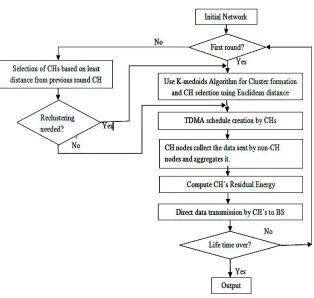
(1) The introduced protocol K-LEACH utilizes the K-medoids clustering algorithm to achieve highly uniform nodes clustering and very good choices of cluster heads and it is a very popular fact that energy retention of a WSN is highly based on the clustering or grouping of transferring and receiving nodes. In LEACH protocol, since, cluster formation is arbitrary and this may yield to non-uniform cluster sizes as well as poor clusters formation. Many clusters may have more nodes and some may have very few nodes.
(2) K-LEACH considers minimum distant from the cluster centre as a criterion for a node to be selected as a cluster head (CH) during cluster head selection method (from second round onwards), while LEACH protocol does random selection of CHs, this again may yield to poor to very poor selection of CHs which will finally lead to highly ineffective energy consumption by the network.
IV. THE PROPOSED CLUSTERING ALGORITHM
The EECA is an adaptive developed structural algorithm that positions the cluster head by cluster centroid localization of data set that contains geometric distribution of sensor-nodes in x-y plan or even able to be utilized in 3-D space of sensing. EECA depends on the original Fuzzy C-mean algorithm of clustering data in 2-D plan, and enhancing it that by the usage of “Potential” idea of the networks clusters and nodes. When computing the whole sensor-nodes potential to the centroid that is being achieved from FCM, the nodes will be scattered into clusters easily by the mean of its potential not Euclidean distance.
In the contributed EECA algorithm, once the potential of every node is computed, the cluster head (CH) will be localized through the conventional FCM algorithm. The clustering mechanism will adopt the last centroid (cluster head) determination phase. This will be detected and localized utilizing the current recommended modification (addition) to the fuzzy technique of clustering. The developed process in this thesis will create clusters that are equivalent in potential. Equation 1 represents the contributed potential mathematical form.
Where: P is the Potential. Eq: is the Euclidian distance.
K is the battery self-leakage.
This equation computes the node potential, and it shows a non-linear relation between the Euclidean distance (view Equation 2 above), and the sensor’s current working energy (which is the maximum initial energy minus the running cost energy), in addition to the energy cost (consider) of every data bit; the energy consumption is called (energy slope).
When the potential is considered into account, the specification of internal battery actually has leakage. Its leakage is expressed by the Equation 4.3 [9].
The above equation shows how to compute the Eq. Dist between target point “q” and destination pint “p”. Here the distance is “d”. The destination point may be the cluster head or normal node [9].
For communication objective with the BS (Base Station), several or different frequency levels and gaps may distinguish from area to area or from sensor to sensor. This thesis concentrates on clustering energy optimization, so, the communication and frequency power is being represented by the mean of energy slope for every sensor’s-node. This work implements Riverbed mechanism and functions to model the contributed EECA and comparing it with the famous LEACH algorithm and its extensions. The prolonging of the total time that the network can work in is clear from the simulation result. The introduced technique of the thesis contains of three steps. The bulk network of sensors should be partitioned into clusters and that procedure is so known as “Clustering”. The thesis considered to utilize the fuzzy logic method of clustering by what is known as C-mean. The phase one distribute the sensor points into separate clusters, every cluster has its own head. That clustering is potential-based as sown in this chapter above. Equation 2 is being utilized to compute the contributed potential. The data transfer (measurement physical variables data, protocol data, and status) will continue starting from every node in the cell or cluster to interact with the BS. This interaction doesn’t pass directly, the node interacts with CH (cluster head), and all heads will transfer data directly to/from the main unit (BS). After every single transmission round, the sensor loses a part of its energy. The power consumption is named above to be called as (slope of the energy). Communicating was the second step, while in the last step, the cluster head will be changed seamlessly with each communication round procedure. The contributed adaptive EECA considers the CH (head of cluster) to be changed for saving it the maximum power node. Those operational procedures should proceed running and re-choosing the clusters and clusters head. This introduced scheme will be active and running during all the network run time. The computing of new appropriate heads will be localized at each round. Those nodes can be classified in each of the two clusters without an important change in the cluster itself. In the fact, these small changes could be utilized to balance the clusters potential. The points that are positioned potentially between two heads will be called in this thesis as “In-Between Nodes”.
Fig. 2: Proposed (K-LEACH) Protocol Flowchart
The issue is that, the dead sensors will not be capable to evaluate the physical data and cannot transmit any data to the cluster head node. So, it should be assumed that, one of the two scenarios may occur once the first node is dead. The first scenario is that, the network still operating as it is, hence, one node cannot log the evaluated data. While the process proceeds, more nodes will initiate dead and hence, a non-negligible data will be dropped, and the network becomes un-useful. The second scenario is that, the network sensor nodes are being substituted in the start time of nodes death, hence, a high cost will be obtained. Then, the contributed EECA objective is to decrease the period between the first and last node death. This will hold the network running in balance measurements and data gathering, and also, it saves more power. Several researchers performed researches and experiments to save network energy, particularly the energy between the first and final node death. This thesis, implements a very efficient and adaptive methodology, that decreases importantly the energy lose and cost. Moreover that, the cluster head should be kept as it is the higher potential node over all running time. This needs re-clustering all of the data at every round. This builds an advantage of reducing the power consumption of the leave nodes where that is assumed to be head in the conventional LEACH process or its extensions. The wrong cell centre (clusters head) is almost leaks a big energy value. On the other side, the contributed Energy Efficient Clustering Algorithm “EECA” contributes intelligent solutions for that issue, and hence, saves an interesting value of the cell’s power.
V. SIMULATION AND RESULTS
TABLE I SIMULATION PARAMETERS
Parameter Value
Simulation time 3600 sec
Number of node 100 nodes
Topology size 1000 x 1000 m
Number of trials 20 trial
CH probability 0.2, 0.5, 0.1
Nodes distribution Nodes are randomly distributed Initial node power 5 Joule
BS position Located at 2000 x 950
In the simulation, we compared the performance of our introduced KC-LEACH algorithm and with LEACH protocol in under the seamless delivery model. Our performance metrics are total residual energy per round in the network and total lifetime of network, means no. of alive nodes per round. Network lifetime is the no. of round from beginning of operation until the last alive node die. The network connectivity which is based on the first node failure time is a meaningful measurement in the manner that a single node failure can build the network partitioned and further facilities be disrupted. The energy consumption because of communication will be computed utilizing the first order energy model. We consider that every sensor node produces one data packet per time unit to be transferred to the Base station.
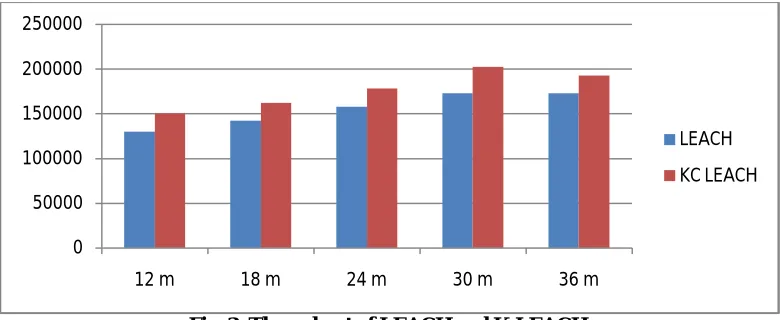
Fig. 3: Throughput of LEACH and K-LEACH
Following figure 3 represents the clustering after 1st round for KLEACH. When the nodes begin with the same initial energy and the total no. of nodes in a network is 100. It represents that the whole network throughput of our algorithm is larger in comparison of LEACH. During most of the throughput of network, K-LEACH runs with much more living nodes as compared to LEACH. To sum up, in our simulation we achieved a increased stability period and decrement in the instability region in the lifetime of network.
VI. CONCLUSIONS
Wireless sensor networks are increasingly being utilized for transportation, health care, manufacturing, and much more. Routing in sensor networks is an evolving research field. In this paper we show an enhanced version of LEACH protocol, K-LEACH, to increase the sensor network lifetime by uniform clustering through k-medoids algorithm and balancing the whole network load among all active nodes. It assures uniform clustering of nodes and provides proper location of CH. It utilizes the combination of clustering, maximum residual energy criterion and an arbitrary selection of CHs only after almost 50% of rounds of network operations gets over, while the LEACH protocol performs totally random selection of CHs, which yields to very poor selection of CHs and hence leads to highly ineffective lifetime and energy retention by the network. The simulation results represent that the introduced algorithm can manage a balanced energy consumption distribution among sensor network nodes and hence increase the lifetime of network.
0 50000 100000 150000 200000 250000
12 m 18 m 24 m 30 m 36 m
LEACH
REFERENCES
[1 S.Ahmed, “LEACH in wireless sensor networks”, Sensor network research group, Old Dominion University, Wireless Communication and Mobile Computing, Vol. 4,No 6,pp.623-637,2009.
[2] Harpreet Singh, Gurpreet Singh Josan, “Performance Analysis of AODV & DSR Routing Protocols in Wireless Sensor Networks”, International Journal of Engineering ,Vol. 2, Issue 5,pp,2212-2216, September- October 2012.
[3] Xuanxia Yao, XueFeng Zheng, “A Secure Routing Scheme for Static Wireless Sensor Networks”, IEEE Pacific-Asia Workshop on Computational Intelligence and Industrial Application, Vol.2, pp.776-780, 2008
[4] Rayala Upendar Rao, “Secure Routing in Cluster based Wireless Sensor Networks using Symmetric Cryptography with Session Keys”, International Journal of Computer Applications, Vol. 55, Issue. 7, pp.48-52, October 2012
[5] Bhoopathy, V. and R.M.S. Parvathi, “Securing Node Capture Attacks for Hierarchical Data Aggregation in Wireless Sensor Networks”, International Journal of Engineering Research and Applications (IJERA), Vol. 2, Issue 2, pp.466-474,Mar-Apr 2012.
[6] K.S.Arikumar, K.Thirumoorthy, “Improved User Authentication in Wireless Sensor Networks”, 2011 IEEE.
[7] Wassim Drira,” A Hybrid Authentication and Key Establishment Scheme for WBAN”, IEEE 11th International Conference on Trust, Security and Privacy in Computing and Communications, Vol. 2, No.3, pp.78-83, 2012
[8] Asha Rani Mishra, “Elliptic Curve Cryptography (ECC) for Security in wireless Sensor Network,” International Journal of Engineering Research & Technology (IJERT) ,Vol. 1 Issue 3, pp. 2-3,May-2012.
[9] Donnie H. Kim, “Exploring Symmetric Cryptography for Secure Network Reprogramming”, International conference on Information, Networking and Automation(ICINA),Kunming, IEEE, pp. 215-218, 2010.
[10] Shohreh Ahvar1, Mehdi Mahdavi, “ EEQR: An Energy Efficient Query-Based Routing Protocol for Wireless Sensor Networks”, Journal of Advances in Computer Research ,Vol. 2, No. 3, pp. 25-38, August 2011.
[11] Heissenbütte lM., T. Braun, M. Wälchli, and T. Bernoulli, “Optimized stateless broadcasting in wireless multi-hop networks,” in proceeding of 4th IEEE international conference on Infocom Barcelona,2006,pp. 234-250.
[12] Sommer, C.; Dietrich, I.; Dressler, F. “Realistic Simulation of Network Protocols in WSN Scenarios” in Proceedings of International Journal of Ad Hoc and Ubiquitous Computing, Vol. 3, 2008, pp. 217-223.
[13] TsengY.C., Y.S. Chen, and J.P. Sheu, "The broadcast storm problem in a Wireless Sensor Networks, " In Proceeding of the 5th ACM/IEEE International Conference on Mobile Computing and Networking, NY, USA,1999, pp. 51-162.
[14] KorkmazG., E. Ekici, F. Ozgüner, and U. Ozgüner, "Urban multi-hop broadcast protocolforWireless Sensor Networks," In Proceeding of the 1st ACM International Workshop on Ad Hoc Networks, NY, USA, 2004,pp. 76-85.
[15] Rajive Bagrodia, Richard Meyer, Mineo Takai, Yu an Chen, Xiang Zeng, Jay Martin, andHa Yoon Song. “A parallel simulation environment for complex systems”in Proceedings of the 1st ACM international workshop on ad hoc networks; 2004; Pages: 66 – 75.