SDLC Bug Tracking and Support System
Divya Sharma1, PalakGupta2, Supinder Kour3, Vamika Andotra4, Haneet Kour5
B.E.Students (8thSem), Department of Computer Science & Engineering, MBSCET, J & K, India1, 2, 3, 4
Assistant Professor, Department of Computer Science & Engineering, MBSCET, J &K, India5
ABSTRACT: Software Development Life Cycle (SDLC) is a process implemented by the software industry to design,
develop and test high quality software to solve one’s day to day problems within limited time, budget and resource constraints. It aims to make good quality software to meet the customer’s expectations. Whenever the software gets encoded, there emerges out new bugs or errors and the resolution of which takes a long time. Once the bug/error is resolved, it is necessary that it gets documented so that next time if such error occurs then it could be easily resolved. This paper discusses an approach to provide an online platform for the software development life cycle management and also to encounter the various bugs that occur during the development of software.
KEYWORDS: SDLC, Bugs, Bugzilla, Mantis BT, Jtrac.
I. INTRODUCTION
The basic idea of software development life cycle (SDLC) is that there is a well defined process by which an application is conceived, developed and implemented. System Development revolves around a life cycle that begins with the recognition of user needs.Project Management, Information Management, SRS Generation, Customer Communication and Problem Resolution are the most important aspects of Software Development Cycle. Every time the software is coded, there is need for managing the Development Life Cycle and the entire process along with the team; also in SDLC process the projects need to track on day-to-day basis by manager as well the customer [1][2].
As it is known that no software can have 100% accuracy, thus it means that some of the module in the software may contain some unnoticed or unchecked bugs / errors that are left in the software from time to time. These bugs get incorporated into the software during any phase of SDLC i.e. requirement analysis, design, coding, testing, implementation and maintenance of the system [3]. Thus, Bug Tracking and then resolution of these traced out bugs from the software system are the most important challenges for Software Developers [4].
II. AIMS AND OBJECTIVES
The objective of this paper is to provide an online platform for software development and also encounter the various bugs that may occur during the development of the software.
III.RELATED WORK
The main goal of SDLC is to develop good quality error free software within limited budget, time and resource constraints. But during the development of software, various bugs or errors may arise which interfere with the quality or development of the software. Thus the development of bug tracking tools is a need of the hour. A lot of research has been done on software development and bug tracking systems in recent years and many researchers are continuing their study in this domain. Some of them developed various bug tracking tools such as Flyspray [5], MantisBT [6], JTrac
[7], Redmine [8], e Traxis [9] etc. A survey has been done on the various bug tracking tools proposed by various researchers to mitigate bugs within the software.
Mantis, phpBugTracker and Web issues were evaluated. This comparison analysis has been done on the basis of platform (Programming language, OS, Database and Web server) as well as various parameters such as comments, create graphs, customized theme, dependencies, export files etc. Mantis has been found to be the best tool among all as per their analysis result.
Kanaklata and Shweta Sharma [11] analyzed various Bug Tracking and Logging Toolkits in order to provide innovative set of selection criteria that provide more gratifying solutions. They analyzedBugzilla, MantisBT, FlySpray, RedMine and BugZero and highlighted their limitations. They also proposed a criterion that doesn’t provide acceptable ends up in describing bug, but were employed in electronic equipment bug trailing systems and often vital to the designers of the longer term bug and defect trailing systems.
AkhileshBabuKolluriet. al. [12] proposed a framework with four directions that helped to improve bug tracking systems. The directions were iterative in nature and one or more loops of directions while following make the bug tracking systems perfect. To overcome the problem, they proposed four fundamental directions to enhance the effectiveness of bug tracking systems (Tool oriented, Information oriented, Process oriented, User oriented). These directions made the process of fixing bugs faster.
IV.EXPERIMENTAL SET UP
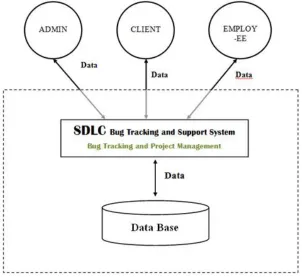
Fig. 2 Architecture of SDLC and Bug Tracking System
The whole process is managed by the admin. The admin is the person who will administer all the work so he will have his separate login page so that no one will hinder his working.
The various steps in this architecture are as under:
1. Client and Employees will register themselves in the website. 2. After registration, the client can login into the website.
3. After authentication by the web server, the client will be redirected to his home page where he enters the requirements details for the software he needs.
4. The admin will login into his home page. He will then analyze the requirement details for the software to be developed. The he will assign the project to a particular developer (employee) as per his technical skills. 5. The developer logins into this website and is redirected to his home page where he will see the details of the
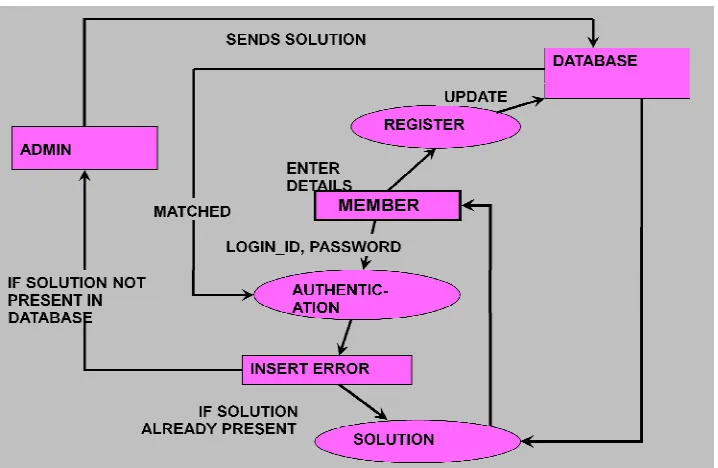
project assigned to him. He starts developing the software. During the coding of software if any bug arises then developer will raise a ticket to inform the admin and other employees about the bug to trace and resolve it out. Often developers can chat with other developers regarding the type of bugs they are facing while coding or any other bug and doesn't have any appropriate solution so they can raise the ticket if any other developer knows the solution that will be added to the knowledgebase that is we are documenting the solution.
6. The client can login into the website to see the status of the development of his software or he can chat with developer to discuss about his project.
A. TRACING OUT BUGS
Fig. 3. Bugs Resolution
V.RESULTANDDISCUSSION
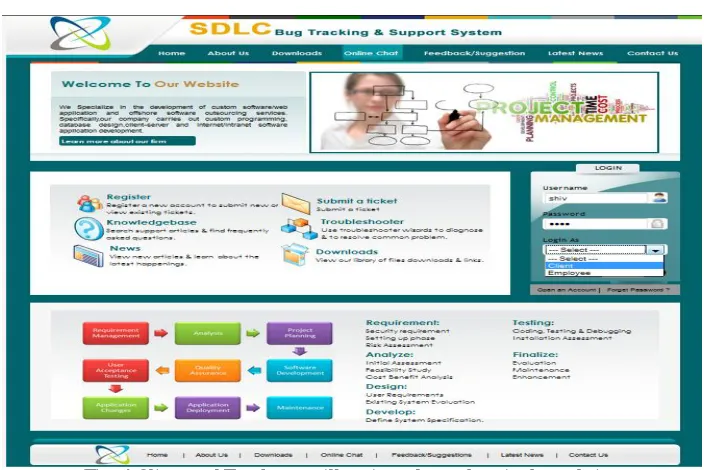
By performing these experiments on the local host, an online platform has been provided to manage the software development lifecycle as it is known that when a software is created there are so many shortcomings which are recovered later when the software is brought into market likewise we are documenting the solution of bugs that are arising to developer when the software is coded. The Fig. 4 depicts the main page of the website under study. Here client and employee can register themselves by clicking on “open an account” button and if any of them has forgotten the password then by clicking on the “forget password” can reset his password. In the menu-strip different menu-strip items has different functionalities.
They will enter their details and click on the register button all their details will be forwarded to admin and likewise reflected in the knowledgebase.
Fig. 5 Registration page
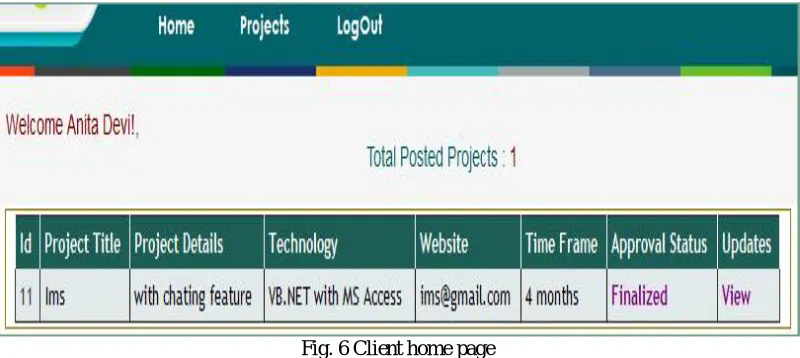
After authentication, the Client will be redirected to his home page as shown in figure 6. Whenever client wants to view the progress of his project, he will enter his username and password to login his home page. The client’s home page will contain information about project like project title, project details, technology, approval status, updates, etc.
Fig. 6 Client home page
Fig. 7 Admin logins into the website
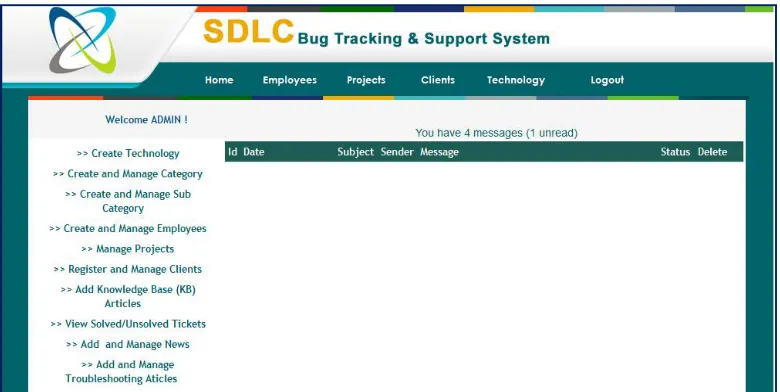
After authentication, the admin will be redirected to his home page as shown in Figure 8. From here only admin can keep an eye on the subordinates who are working under him. He can add technology in which employees are expertise, can manage employees, clients, if he has the solution about the raised bug can enter it directly to the knowledgebase, add recent news, etc.
Fig. 8 Admin is redirected to his home page
Fig. 9 Submit ticket
Whenever developer faces any bug or error (which he is not able to resolve) in his developing software, the he raise the ticket and also give the details of the along with snapshot of the bug (as shown in figure 10) to inform Admin and other developers to seek their help in resolving that particular bug.
Fig. 10. Developer informs about the bug to the Admin and other developers
VI.CONCLUSION
REFERENCES
1. Ms. Gajalakshmi P, “Software Development of Life Cycle Model incorporated with release management”, IRJET, Vol. 03 Issue 04, April 2016. 2. Richard H. Thayer, and Barry W. Boehm, “software engineering project management”, Computer Society Press of the IEEE, pp.130, 1986. 3. Apoorva Mishra and Deepty Dubey, “A Comparative Study of Different Software Development Life Cycle Models in Different Scenarios”,
IJARCSMS, ISSN 2321-7782 Vol. 1 Issue 5, pp. 64-69 October 2013.
4. V.B. Singh and Krishna KumarChaturvedi, “Bug Tracking and Reliability Assessment System (BTRAS)”, IJSEA, Vol. 5 Issue 4, October 2011.
5. Flyspray The bugkiller [Internet]: www.flyspray.org. [Jan, 2017]
6. MANTIS Bug Tracker Tutorial For Beginners [Internet]: http://www.guru99.com/mantis-bug-tracker-tutorial.html. [Feb, 2017] 7. JTrac [Internet]: https://java-source.net/open-source/issue-trackers/jtrac. [Feb, 2017]
8. Top 8 Open Source Bug Tracking Tools [Internet]: http://www.testingexcellence.com/top-8-open-source-bug-tracking-tools/. [Jan, 2017] 9. Top 10 Open Source Bug Tracking Systems: e Traxis[Internet]:
http://www.softwaretestingclass.com/top-10-free-open-source-bug-tracking-systems/. [March, 2017]
10. Yogita Sharma and Aman Kumar Sharma, “Comparative study of the Bug Tracking Tools”, IJARCSSE, ISSN 2277-128X (Online) Vol. 5 Issue 3, March 2015.
11. Kanaklata and Shweta Sharma,”Survey and study of various BugTracking and Logging Toolkits”, IJCA, ISSN 0975-8887(Online) Vol. 116 Issue 12, pp. 41-45, April 2015.