A People Counting Method Based on Head
Detection and Tracking
Sangamanath, Dr. Krishna A.N
M. Tech Student, Computer Engineer, SJBIT, Karnataka, India
ME (CSE), Ph. P (CSE) Professor & HOD, Dept. of Computer Science & Engineer, SJBIT, Karnataka, India
ABSTRACT: in this Paper proposes for a people counting method based on head detection and tracking, according to thePeople counting method based on head detection and tracking to evaluate the number of people who move under an over-head camera. There are four main parts in the proposed method: foreground extraction, head detection, head tracking, and crossing-line judgment. The proposed method first utilizes an effective foreground extraction method to obtain foreground regions of moving people, and some morphological operations are employed to optimize the foreground regions. Then it exploits a LBP feature based Adaboost classifier for head detection in the optimized foreground regions. After head detection is performed, the candidate head object is tracked by a local head tracking method based on Mean shift algorithm. Based on head tracking, the method finally uses crossing-line judgment to determine whether the candidate head object will be counted or not. Experiments show that our method can obtain promising people counting accuracy about 96% and acceptable computation speed under different circumstances...[1]
KEYWORDS: LBP, Adabbost, Feature Extraction, Morphological operation.
I.INTRODUCTION
In the setting of pervasive methods calculating the peoples will have broad scope of applications. Handling urgency situation to efficient assigning of resources in smart buildings comes under this application range. For people counting there is numerous vision based algorithms were present. For various indoor events every algorithm performs differently according to flexibility, efficiency and accuracy. Different application scenarios like camera orientations and environment conditions while examining this algorithm this scenarios will give better choice for actual deployment. With respect to different factors like camera orientation, lighting, occlusion etc in our paper we are evaluating the generally executing Frame Differencing, Circular Hough Transform and Histogram of Oriented Gradient based methods. Under various schemes the performance of this algorithm shows the need for more precise and faster people counting algorithms.
In many public places people counting system have been applied for example in subways, supermarkets and bus stations. From these scenes the people flow data will gives the information which is useful for public security, resource allocation and marketing decision. Automatic people counting systems is introduced because of increase need which is based on digital image processing and computer vision, effective people counting methods become remarkable and meaningful.
Moreover, using range data from a stereo camera we detected the head part this method is proposed in this paper. This method is supported on an approach that has been introduced in the domain of voxel data. The technique is extended for application in stereo cameras which is to be applicable to stereo data, and with respect noise it is powerful and variation in environmental settings. Foreground selection, head detection, and blob separation are present in the given method to improve results in case of misdetections incorporates a means for people tracking. The data is gathered from three distinct real-life scenarios in actual stereo data experiments in that experiment given method is tested. The proposed method performs well in terms of both precision and recall according to experimental results. In highly crowded situations method performs well. Proposed method gives a strong basis for head detection in applications that uses stereo cameras. [1][2] It is concluded from our results.
Kheir-Eddine AZIZ et al [1] this paper describes a new head detection method for people counting in crowded environments from a single camera. Our method adopts skeleton graph to distinguish person among people in crowded environments. The usage of skeleton graph is the main difference between this method and the traditional ones. Firstly, the skeleton graphs are calculated for each selected blob in the scene after foreground estimation. Then, we explore the structural property of each blob for head detection and to predict a number of people. Each detected head in a skeleton silhouette is identified as independent state or partially occluded state, and during tracking every state is updated. Finally, the experimental results are shown to demonstrate the robustness of our method.
Tim van Oosterhout et al [2] this paper proposes a novel method for rapid and robust human detection and tracking based on the omega-shape features of people’s head-shoulder parts. There are two modules in this method. In the first module, a Viola-Jones type classifier and a local HOG (Histograms of Oriented Gradients) feature based AdaBoost classifier are combined to detect head shoulders rapidly and effectively. Then, in the second module, each detected head-shoulder is tracked by a particle filter tracker using local HOG features to model target’s appearance, which shows great robustness in scenarios of crowding, background distractors and partial occlusions. Experimental results demonstrate the effectiveness and efficiency of the proposed approach.
Kowcika.A et al [3] this paper proposes for a People count Extraction is a crucial and challenging problem in visual surveillance. For instance an accurate and real-time estimation of number of people present in a shopping mall provides significant customer information for managers. Further, automatic monitoring of the people counts in public areas is essential for safety control and urban planning.[4]
III.PROPOSEDSYSTEM
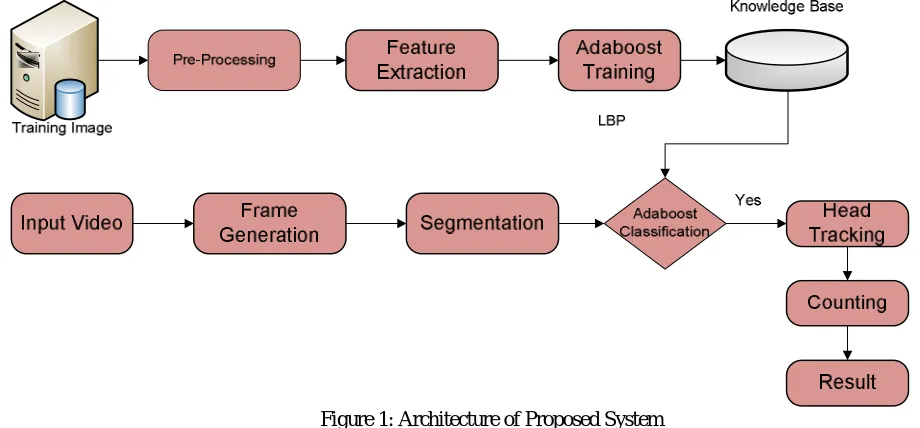
In this Propose System method has been presented in fig 1, first we give input image that pre processing, after processing training to convert the feature extraction, using adboost training method. In this adaboost training are uses LBP technique. After it will classified through the segmentation with frame generation
Figure 1: Architecture of Proposed System
1. Pre-Processing
uncontrolled scanning condition the brightness in the image may vary do to which the quality of the dot gets reduced hence adjusting the contrast to get the contrast enhancement is very necessary [05]. To the obtained enhanced image some kind of dilation is done to get proper circular dot present in the Braille character. Orientation of image is also adjusted for proper alignment of the scanned Image. [5],[6]
Grayscale = ((R+G+B)/3) (1)
a) Segmentation
Image segmentation is an important part of image processing and it also has various applications in engineering, biomedicine and other areas. So far, a number of methods have been developed with the aim to identify the distinct region of objects in the image. This paper is devoted to application of three different methods of segmentation which are the watershed distance transform, gradient watershed transform and region growing method on microscopic crystal image. Before segmentation, the image was enhanced by pre-processing methods, such as denosing and adjusting of intensity. Segmentation is considered for both overlapping and nono overlapping objects by all methods. Segmentation of the overlapping objects by the region growing method has been improved by certain mathematical processes that are described in this project.
2. Feature Extraction
The measurements of one or more functions are called as features. Quantifiable property of an object is specified by each of these features and only significant information’s are later picked from these features. Features are classified into different types which are listed below,
General feature – Features which are application independent are called general features. Features come under these category are Texture, shape and color features. These features are further divided based on the abstraction level: Pixel level features – These are the features calculated at each pixel. Features can be location or color features.
Local features- These are the features calculated on image segmentation or edge detection considering subdivision of the image bands. Global features- If the entire image or a sub area of an image is considered for feature extraction then it is global feature.
Domain specific feature – Features like finger prints, human face and conceptual features which are application independent are called as domain specific features. All these features are coarsely divided into two types called low level features and high level features.
Low level features- can be extracted directly from image whereas the extracted high level features should be based on low level features. Proposed methodology considers extrema, centroid and branched points kind of features after thinning the signature. These extracted features are then passed to BPNN block for further comparison.[7],[8]
3. SVM Classifier
Support vector machine (SVM) is the most popular learning model that analyzes data and recognizes patterns for supervised classification. However, SVM cannot deal with outliers and noises, i.e., its performance will decrease sharply when the data set either contains outliers or was contaminated by noises. Fuzzy SVM (FSVM) was an effective variant with the advantages of reducing the effect from outliers and noises. There are some other advanced variants of SVM, such as generalized Eigen value proximal SVM [40], twin SVM, least-square SVM.Where L represents the error penalty and e a vector of one’s of N-dimension. Therefore, the optimization turns to a trade-off between a small error penalty and a large margin. The constraint optimization problem is solved using “Lagrange multiplier”:
minmax
w,ε, bαβ 12 |w| 2 + ce ε − ∑ αn
yn Wt −b + &n−1 − &nβn}⃒ (5)
The min-max problem is not easy to solve, so dual form technique is commonly proposed to solve it as
max = αn−1
The main merit of the dual form is that the slack variables ξn disappear, with only the constant L be an additional
constraint on the Lagrange multipliers.
Image segmentation is the classification of an image into different groups. Many researchers have been done in the area of image segmentation using clustering. There are different methods and one of the most popular methods is k-means clustering algorithm. K -means clustering algorithm is an unsupervised algorithm and it is used to segment the interest area from the background. But before applying K -means algorithm, first partial stretching enhancement is applied to the image to improve the quality of the image. Subtractive clustering method is data clustering method where it generates the centroid based on the potential value of the data points. So subtractive cluster is used to generate the initial centers and these centers are used in k-means algorithm for the segmentation of image. Then finally medial filter is applied to the segmented image to remove any unwanted region from the image.[9]
4. Adaboost Training
AdaBoost is the “adaptive boosting” algorithm. The goal of boosting is to improve the accuracy of any given learning algorithm. First, a weak classifier with accuracy on the training set greater then a chance is created, and then new component classifiers are added to form an ensemble whose joint decision rule has arbitrarily high accuracy on the training set [10]. In AdaBoost each training pattern receives a weight that determines its probability of being selected for a training set for an individual component classifier.
If a training pattern is accurately classified; then its chance of being used again in a subsequent component classifier is reduced. Conversely, if the pattern is not accurately classified, then its chance of being used again is raised. In this way, the AdaBoost focuses in on the difficult patterns. Specifically, we initialize this weight across the training set to be uniform. On each iteration k, we draw a training set at random according to these weights, and train component classifier Ck on the patterns selected. Next, we increase weights of training patterns misclassified by Ck and decrease the weights of the patterns correctly classified by Ck. Patterns chosen according to this new distribution are used to train the next classifier, Ck+1, and the process is iterated.
IV.RESULTS
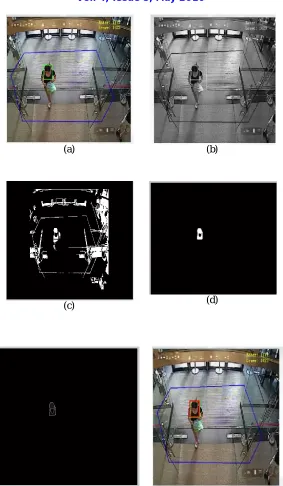
(a) (b)
(c) (d)
(e) (f)
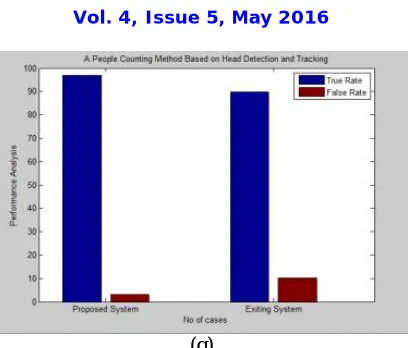
(g)
Figure 3: (g) performance Analysis
V.CONCLUSION
According to This paper presents a novel method for people counting based on head detection and tracking. The proposed method generally consists of four parts: foreground extraction, head detection, head tracking, and crossing-line judgment. To solve the problems of light variations, background interference and irrelevant objects, we firstly perform foreground extraction and morphological operations to get candidate regions. Then we apply LBP feature based Adaboost classifier to detect human heads in the candidate regions. The detected heads are tracked by a local head tracking method based on Mean shift algorithm. Finally we use crossing-line judgment based on tracking results and positions of head objects to determine whether the head object should be counted or not. The proposed system could give good accuracy of about 96.8 when compared to the existing system.
REFERENCES
[1] Bin Li, Jian Zhang, Zheng Zhang, Yong Xu, “A People Counting Method Based on Head Detection and Tracking”.
[2] Venkatesh Bala Subburaman, Adrien Descamps, Cyril Carincotte, “Counting people in the crowd using a generic head detector”.
[3] Kheir-Eddine AZIZ, Djamel MERAD and Bernard FERTIL, Nicolas THOME, “Pedestrian head detection and tracking using
skeleton graph for people counting in crowded environments”.
[4] Yaowu Hu, Ping Zhou, Hao Zhou, “A New Fast and Robust Method Based on Head Detection for People-Flow Counting System”,
International Journal of Information Engineering (IJIE).
[5] X. Liu P. H. Tu J. Rittscher A. G. A. Perera N. Krahnstoever, “Detecting and Counting People in Surveillance Applications”.
[6] Tim van Oosterhout, Sander Bakkes, Ben Kr¨ose, “Head Detection in Stereo Data for People Counting and Segmentation”.
[7] Min Li, Zhaoxiang Zhang, Kaiqi Huang and Tieniu Tan, “Rapid and Robust Human Detection and Tracking Based On Omega-Shape
Features”.
[8] Avita Verlekar,Dr. H. G. Virani,“Comparative Analysis of Human Detection Methods Using Combination of Hough Circle
Transform and Descriptors” International Journal of Advanced Research in Computer and Communication Engineering Vol. 3, Issue 5, 2014.
[9] Kowcika.A,” People Counting System- A Review”.
[10] Subra mukherjee, Karen Das, “Omega Model for Human Detection and Counting for application in Smart Surveillance System”,
(IJACSA) International Journal of Advanced Computer Science and Applications, Vol. 4, 2013.
[11] Poo Kuan Hoong, Ian K.T. Tan, and Chai Kai Weng, “A Comparison of People Counting Techniques via Video Scene Analysis” Vol. 10,
2015.
[12] Ya-Li Hou, Grantham K. H. Pang, “People Counting and Human Detection in a Challenging Situation” IEEE Transactions on