Evaluation of Irradiation Damage Effect by Applying Electric Properties Based
Techniques
B. Acosta, F. Sevini, L. Debarberis, M. Beers and C. McGirl
European Commission, Joint Research Centre, Institute for Advanced Materials, IAM, Petten, The Netherlands
ABSTRACT
The pressure vessel of the reactor (RPV) in light water reactors (LWR) is a key component for the safe operation of a nuclear power plant, being it part of the containment of the plant and non replaceable. Its life therefore largely delimits the life of the plant.
The most important effect of the degradation by radiation is the decrease in the ductility of the RPV ferritic steels. The main way to determine the mechanical behaviour of the RPV steels are tensile and Charpy impact tests, from which the ductile to brittle transition temperature (DBTT) and its increase due to neutron irradiation can be calculated. These tests are destructive and regularly applied to surveillance specimens to assess the integrity of RPV. The possibility of applying validated non-destructive aging monitoring techniques would however facilitate the surveillance of the materials that form the reactor vessel. On the one hand it would indeed allow in-situ inspection and on the other it would allow saving precious specimens for those surveillance programmes which have an insufficient amount of surveillance material available.
The JRC-IAM has developed two devices, focussed on the measurement of the electrical properties to assess non- destructively the embrittlement state of materials. The first technique, called STEAM (Seebeck and Thomson Effects on Aged Material), is based on the measurement of the Seebeck coefficient, characteristic of the material and related to the microstructural changes induced by irradiation embrittlement. With the same aim the second technique, named REAM, measures instead the resistivity of the material.
The purpose of these studies is to correlate the results of the Charpy tests, hardness, STEAM and REAM measurements with the change in the mechanical properties due to neutron irradiation. For this purpose different sets of alloys coveting a large spectrum of steels have been used. The alloys are characterised with parametric variation of the content of impurities such Phosphorus, Copper, and Nickel, elements that are known to play a significant role in material characteristic and degradation.
The STEAM and REAM techniques have been successfully applied to the model alloys irradiated in the High Flux Reactor of Petten (The Netherlands). The results of this study are shown in the paper and will enable a better understanding of the role and the influence of the above mentioned elements on the mechanical properties of steels. These results will make possible the improvement of such techniques based on the measurement of material electrical properties for their application to the irradiation embrittlement assessment.
B A C K G R O U N D
The assessment of material ageing requires normally extensive destructive testing by using different kind of testing and samples. A non-destructive determination of the embrittlement state would extend the usefulness of the surveillance material by reducing the material used for destructive studies and would benefit surveillance programs having an insufficient amount of available test material, and ultimately allowing tests to be performed directly on the component to evaluate.
Therefore there is a need of developing techniques that allow an early detection of microstructural changes due to embrittlement. In the particular case of nuclear power plants the effect of the neutron irradiation in the beltline area of the reactor pressure vessel should be assessed. Non destructive methods capable of identify the level of irradiation embrittlement should be the most desirable. Such NDE capabilities would provide substantial early warning of component deterioration and enable utilities to optimise their operating and maintenance practices, resulting in reduced costs and increased asset utilisation
[1].
There is not only the requirement of damage detection capability, but also the need of improving the non-destructive systems in the sense of simplicity of operation, speed and accuracy of the measurement, and of course commercial prizes. Another important feature needing more research on non-destructive evaluation is the possibility of forecasting the material degradation on the basis of the actual material condition. At first instance, relationships between the ageing conditions (temperature, time, irradiation fluence, etc), the material properties and the results of non-destructive analysis must be computed. Afterwards embrittlement trend curves similar to those produced for destructive testing (i.e. those provided in the Regulatory Guides of NRC) should be developed.
SMiRT 16, Washington DC, August 2001
Paper # 1359M E A S U R E M E N T S O F T H E R E L A T I V E S E E B E C K C O E F F I C I E N T - STEAM T E C H N I Q U E
The STEAM (Seebeck and Thomson Effects on Aged Materials) technique developed at the JRC-IAM, is a novel non-destructive method able to detect in a simple way degradation of materials, in particular to be applied on those steels that forms the reactor pressure vessels of nuclear power plants. The STEAM device is a laboratory prototype developed with the aim o f demonstrating the capability o f such technique in evaluating the ageing state in alloys and steels like those utilised in nuclear power plants and reactor vessels. STEAM method is based on the measurement of the thermoelectric voltage generated by the Seebeck and Thomson effects taking place in the material under test [2].
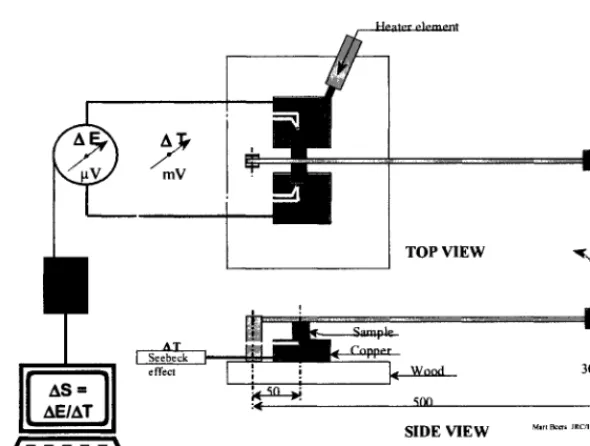
The STEAM measuring system consists on two copper blocks, on top of which the specimen to measure is placed. This makes the inhomogeneous circuit. When one of the blocks is being heated there exists a temperature difference (AT) between the two sample's tips. This causes the thermal flux across the specimen and therefore the Seebeck and Thomson effects. See Figure 1.
/
i !
T O P V I E W
W o o d 300.' gram
i
..t 5rio
S I D E V I E W . . . R . . .
Figure 1. STEAM Measuring Device
By means of a nanovoltmeter, connected to the ends o f the circuit, the thermoelectric tension (mainly caused by the Seebeck effect) can be measured. The AE values range in the microvolt scale BV. So that this nanovoltmeter acts as an amplifier, and the AE signal is multiplied by a factor of ten, to reach the required accuracy. The applied AT is measured in millivolts (mV) by a thermocouple, and is monitored using another nanovoltmeter. The Relative Seebeck Coefficient, AS, corresponds to the slope o f the AE - AT curve.
The analog outputs from the two nanovoltmeters are connected to a data acquisition system, which allow carry out the subsequent operations i.e. data recording and analysis by using a personal computer.
The surface condition of the test specimen is important for the measurements with the STEAM technique. STEAM results can be influenced by variations in contact surface cleanliness, foreign materials (such as decals), and the uniformity and condition of paint or other surface coating. A good practice is to clean the surface and remove or strip poorly adhering coatings (if present) to eliminate for example corrosion layers. This will allow uniform heat transfer into the sample and will also produce a reasonably uniform AS. Although it is not crucial, an isothermal and stable environmental conditions (no air currents or turbulence) in the area of the device is desirable.
The operation of the STE.MVI device is easy and rather quick, the copper block with a higher temperature can be already heated at the required temperature and then the testing of one sample takes around two minutes. The output measurements are, in general, stable and repeatable.
MEASUREMENTS OF R E S I S T I V I T Y - REAM T E C H N I Q U E
During the year 2000, a system named REAM focussed on the measurement of the electrical properties (resistivity) of the material has been design and developed to assess non-destructively the embrittlement state of steels.
A first prototype device has been built, and preliminary tests on irradiated materials have been conducted. Using the REAM technique the irradiated Model Alloys were also tested, the results are very promising as they show the capability of REAM in following the irradiation-induced changes on the material' s properties.
P E R F O R M A N C E OF STEAM AND REAM ON IRRADIATED MATERIALS
Materials
The material tested with the STEAM and REAM technique consists on MODEL ALLOYS offered by Kurchatov Institute, which are covering a large spectrum of ferritic steels with parametric variation of Copper, Nickel and Phosphorus, known to play a significant role in material characteristic and degradation.
In origin the alloys followed the same heat treatment: quenching at 980-100 °C, oil cooling, followed by tempering at 650-670 °C, during 1 Oh, and then cooled in air.
This material was machined as miniaturised Charpy specimens (3x4x27 mm) and fully characterised (Charpy impact test, hardness STEAM and REAM) at the JRC-IAM [5]. Afterwards the model alloys were irradiated in the HFR, at Petten (The Netherlands), in the LYRA irradiation rig designed for the AMES European Network irradiation programme [6]. Details about the irradiation history are given in the Table 1.
Table 1. Irradiation History of LYRA 3
Cycle Beginning / End Full Average
Power Temperature
Days °C (*)
99-06 01.07.99 / 26.07.99 25.25 270
(*) Thermocouples reading on the sample holder mid-plane.
Accumulated Accumulated
Fluence DPA
(nlTl "2)
6.11×10 22 0.0989
Results
For this study a set of 32 model alloys, covering a wide range of variation of content regarding the P, Cu and Ni elements, was selected. The Table 2 shows the Cu, Ni, and P contents as well as the grouping criteria used in the data analysis.
Table 2. Grouping Criteria of the Model AHoys
VLN
Grouping Very low Nickel
Content, wt% Ni~0.005
Ni--0.2
LN Low Nickel
MN Medium Nickel Ni=0.7 4 data sets
HN High Nickel Ni~l.2
Very High Nickel
Low Phosphorus VHN
LP
Ni~2.0
P~0.002
MP Middle Phosphorus P~0.012
HP LCu
High Phosphorus
Low Copper
P~0.035
Cu~0.005
MCu Middle Copper Cu~0.10
HCu High Copper Cu-~0.4
VHCu Very High Copper Cu~l.0
Remarks
11 data sets; range: 0.004+0.009 wt % 3 data sets
7 data sets; range: 1.14+ 1.21 wt % 7 data sets; range: 1.97+2.0 wt %
14 data sets; range: 0.001 +0.002 plus 1 data at 0.004 wt %
10 data sets; range: 0.006+0.014 wt % 8 data sets; range: 0.029+0.039 wt %
Measurements with STEAM and REAM techniques have been performed on the Model Alloys in both conditions, fresh and irradiated. For STEAM the sets of values obtained on each measurement were very stable, even for the irradiated material tested in a hot cell in different environmental conditions than in the laboratory. The standard deviation of the measurements vary in the range of 0.08 to 0.16 ~tV/°C, hence the maximum error of the measurement can be estimated at about 3 %.
S T E A M Measurements
The main objective of this analysis is to determine weather the STEAM technique is capable to detect the material degradation due to irradiation. It is observed that in most of the alloys irradiation increases the Relative Seebeck Coefficient value (AS or STEAM for easier understanding), so this difference between STEAM on fresh and irradiated can be correlated with the transition temperature shifts (ADBTT). On the basis of the major importance of Cu and Ni content on the irradiation embrittlement, the analysis was divided in sub-groups as a function of the Ni content, taking Cu and P as independent parameter, as described in the Table 2.
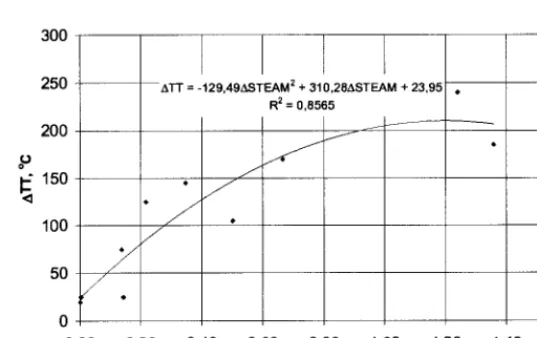
In Figure 2, Figure 3 and Figure 4 the existing correlation between ADBTT and the Relative Seebeck Coefficient value change (ASTEAM = STEAMirradiated - STEAMfresh) due to irradiation can be observed. This is done for the sub- groups of: very low, medium, and high nickel content on the selected alloys. For the remaining sub-groups not enough points were available to perform a regression analysis.
300
250
200
P
~
150 10050
J
f .
~ T T = - 1 2 9 , 4 9 A S T E A M 2 + 3 1 0 , 2 8 ~ S T E A M + 2 3 , 9 5 R 2 = 0,8565
j c J
J
j •
0
0,00 0,20 0,40 0,60 0,80 1,00 1,20 1,40 &STEAM, pV/°C
1,60
Figure 2. ADBTT versus ASTEAM for Very Low Nickel content
200 180 160
14o ~ , . . . . ~
120
ATT = 62,913&STEAM + 129,83 R 2 = 0,8933 U
o 100
80 60 40 20 0
0,00 0,10 0,20 0,30 0,40 0,50 0,60 0,70 0,80 &STEAM, p.Vl °C
0,90
200 180 160 140 120 ¢O o
~
100 ,¢I80
6O
~._..~ ~ i ~
- ~ ' ~ ' ' ~
z~TT = 111,78e °'ealAsrEAM R 2 = 0,7913
40
20
0
0,00 0,10 0,20 0,30 0,40 0,50 0,60 0,70 A S T E A M , p V / * C
Figure 4. ADBTT versus ASTEAM for High Nickel content 0,80
Although there is not enough quantity o f data to draw definitive conclusions, one effect can be clearly observed: the change in shape o f the correlation curve between ADBTT and ASTEAM as a function of the nickel content. The Figure 2 shows that for very low nickel content the best correlation is a second order polynomial. The Seebeck coefficient is mainly related to the matrix structure and for a very low nickel content the copper precipitation enhanced by nickel is possibly less powerful than for example the phosphorus segregation and this lead to a slower following o f ASTEAM than ADBTT in the neutron degradation detection. When the content in nickel increases the synergetic effects copper - nickel in matrix damage due to irradiation have bigger influence in the damage and the relationship ADBTT - ASTEAM is linear (Figure 3). For a high nickel content it is calculated an exponential correlation exhibiting the saturation on the microstructural changes that can be detected by STEAM technique, see Figure 4.
REAM Measurements
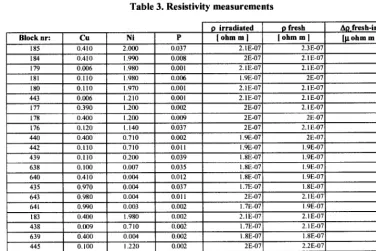
It was found that resistivity generally diminishes with neutron irradiation, as it is shown in Table 3"
Table 3. Resistivity measurements
B l o c k n r : Cu Ni
p i r r a d i a t e d [ o h m m i
p f r e s h [ o h m m ]
A R . f r e s h - i r r [It o h m m ]
| =
185 0.410 2.000 0.037 2.1E-07 2.3 E-07 0.016
184 0.410 ' 1.990 0.008 ' 2E-07 2.1E-07 0.0056
i |
! 79 0.006 1.980 0.001 2. I E-07 2.1E-07 0.0088
i i
181 O. 110 1.980 0.006 1.9E-07 2E-07 0.0048
i l
180 O. 110 1.970 0.001 2. IE-07 2. I E-07 0.0048
l l
443 0.006 1.210 0.001 2.1 E-07 2. ! E-07 0.0008
i i
177 0.390 1.200 0.002 2E-07 2.1 E-07 0.0104
i i
178 0.400 1.200 0.009 2E-07 2E-07 0.0016
i l
176 0.120 1.140 0.037 2E-07 2.1E-07 0.0064
i i
440 0.400 0.710 0.002 1.9E-07 2E-07 0.0168
i l
442 0.110 0.710 0.011 1.9E-07 1.9E-07 0.0024
i i
439 0.110 0.200 0.039 1.8E-07 1.9E-07 0.0048
i |
638 0.100 0.007 0.035 1.8E-07 1.9E-07 0.0064
| |
640 0.410 0.004 0.012 1.8E-07 1.9E-07 0.0112
i |
435 0.970 0.004 0.037 1.7E-07 1.8E-07 0.0088
l i
643 0.980 0.004 0.011 2E-07 2. l E-07 0.0048
= ~ ,
641 0.990 0.003 0.002 1.7E-07 1.9E-07 0.0208
183 0.400 i 1.980 0.002 2.1 E-07 2.1 E-07 0.0024
i l
438 0.009 , 0.710 0.002 , 1.7E-07 2.1 E-07 0.0432
639 0.400 0.002 1.8E-07 1.8E-07 0.008
445 0.100
0.004
1.220 0.002 2E-07!
1.8E-07
2.2E-07 0.0144
0.0048
175 0.1 ! 0 1.140 0.01 1.9E-07
| |
437 0.1 ! 0 0.200 0.002 1.7E-07 1.8E-07 0,0088
! i
This can possibly by justified by the microstructural changes occurring with irradiation, leading to the formation of copper rich precipitates which exhibit lower resistivity. This "bridging" in most alloys prevails on the lattice damage determined by formation of vacancies and interstitials.
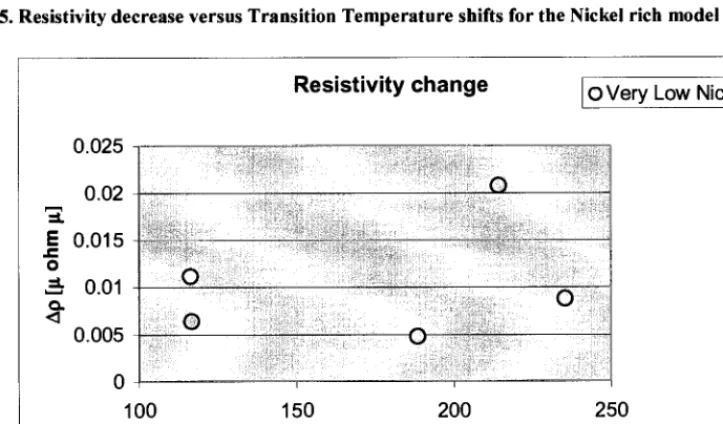
The direct correlation of the resitivitity changes with the Charpy transition temperature shits is however not straightforward. Figure 5 and Figure 6 show a plot of the two parameters, respectively for the Nickel rich and Very Low Nickel groups, which proved to give interesting trends with the STEAM technique.
0.025
0.02
0.015
O
,~, 0.01
0.005
Resistivity change High Nickel - - - - P o l y . (High Nickel)
o
i
100 120 140 160 180 200 220
TT Shift [°C]
Figure 5. Resistivity decrease versus Transition Temperature shifts for the Nickel rich model alloys
R e s i s t i v i t y c h a n g e O Very Low Nickel ]
0.025
0.02
= L E 0.015 J =
O
• ~. 0.01
0.005
-~:- _ ~.-':-~ :~:~ :. ~!.._ __ _- -~--.Ci:ii,::~.i! ~ .._ "-~7:;.;i ::~!:::,:::.i!~!-,..~ - -F ~i':! -~.~:;I ;;i~ .C. ... - : ,- i-~.,-: i. ... --7':!~i
• :- - :" ~ ~:,~:-~;:'(~:~-~-~:-: ..i~:: -~ ~)!:-~!~:!~--:,._.;:. ~--!-:: )~.~-i-- - - 0 ~ i
I I I
100 150 200 250
TT Shift [°C]
More difficult is the Very Low Nickel case of Figure 6, where the low number of results doesn't allow to draw meaningful conclusions.
New parameter
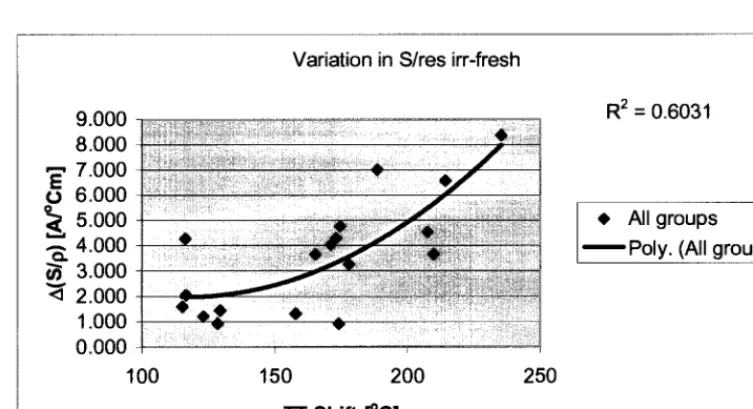
An interesting parameter was introduced combining the results of the two above described techniques, that is the ratio S / p between the relative Seebeck coefficient and resistivity, which has dimensions of a current per unit length and temperature.
Though this parameter needs further investigation and validation, it is the logical and physical link between two phenomena strictly related to each other, giving a quantification of the availability of conduction electrons when applying a driving force. The Seebeck effect is indeed the response of the material to a temperature gradient, while resistivity measurement require the application of a voltage difference.
Just like the two separate measurements, the ratio is sensitive to the microstructural changes induced by neutron irradiation, in a even more pronounced way, as it can be seen in Figure 7. The most interesting fact is moreover that the good correlation obtained is valid for most of the Model Alloys treated at the same time, without distinction according to Ni, Cu and P levels.
The applied regression curve is a second order polynomial, with a 60% Pearson coefficient showing a sensitive correlation between S/p and TT shift.
9.000
8.000
7.000
o
6.000
~ 5.000
4.000
3.000
<
2.000
1.000
0.000
Variation in Sires irr-fresh
100
150
200
25O
TT Shift [°C]
R 2 = 0.6031
• All groups
~ P o l y .
(All groups)
Figure 7. S/p ratio change versus Transition Temperature shift
CONCLUSION
It is confirmed the existence of a relationship between the observed ASTEAM, when comparing fresh and irradiated steels, and the changes in the mechanical properties due to irradiation. As for this study the irradiation parameters were the same for all the model alloys, as described above, the shifts in the transition temperature and in the Seebeck coefficient can be related directly to the alloy's chemical composition in particular the content of copper and nickel. According to what was previously exposed in this paper, the STEAM technique can be use as a non-destructive technique to assess and monitor materials ageing. This involves the evaluation of thermal ageing and irradiation damage in alloys and steels, such as those employed in nuclear power plants.
The application of resistivity measurements is also promising for some groups of model alloys. A new parameter combining the measurement results obtained with the two techniques, STEAM and REAM, is presented and validated at a preliminary stage.
F U R T H E R D E V E L O P M E N T S
At this stage two main research lines are proposed for the STEAM and REAM techniques.
In first instance, the available STEAM laboratory prototype needs to be modified and optimised in order to produce an industrial prototype. The laboratory device can be made portable for on-field direct measurements on components and structures. Future developments should focus on the following aspects:
Q The mechanical handling in order to allow an easy and safe use to perform measurements on field, and over a wide range of industrial steel types. This can include the automation of the device to scan components.
Q The measurement and data recording system in order to document the accuracy, backflash, and repeatability of the measurements over the full range of operation.
In the second research line, a new prototype of the REAM system is being designed in order to improve the accuracy of results and the accomplishment of the ASTM standards for the determination of the electrical resistivity of metallic materials. This new REAM will allow the evaluation of a wide range of materials with different dimensions.
REFERENCES
1. L. Debarberis and B. Acosta, Ageing Material Evaluation and Studies by Non Destructive Techniques - AMES-NDT Concerted Action, Final Report, AMES Report No. 14, JRC-Petten, EUR 19675/EN, 2000.
R. D. Barnard, University of Salford, Thermoelectricity in Metals and Alloys, Taylor and Francis LTD, 1972.
J.F. Coste, J.M. Leborgne, J.P. Massoud, O. Grisot, S. Miloudi and R. Borrelly, "Application of Thermoelectricity to NDE of Thermally Aged Cast Duplex Stainless Steels and Neutron Irradiated Ferritic Steels", EPRI Workshop on NDE for Damage Assessment. La Jolla, USA, October 1997.
4. B. Acosta, L. Debarberis, M. Beers and C. McGirl, STEAM: A Non-Destructive Evaluation for Assessing Materials Ageing, Safety for Industrial Components Unit, EC-JRC-IAM Petten, SIC/BA/9903.10/f, 1999.
5. B. Acosta, L. Debarberis, M. Beers, C. McGirl, and A. Kryukov, MODEL ALLOYS P R O J E C T - Material Characterisation at the AMES Laboratory, CEC-JRC-Institute for Advanced Materials, Petten, 2000.
6. B. Acosta, M. Beers, L. Debarberis and G. Sordon, IRRADIATION REPORT LYRA-03 Experiment, CEC-JRC-Institute for Advanced Materials, Petten, 1999.
.