Imroving Performance of WSN using Low
Latency SINR Based Data Gathering
Ashwini Kothavale
Assistant Professor, Dept. of EXTC, Viva Institute of Technology, Mumbai University, Maharashtra, India
ABSTRACT: Data gathering is an essential operation in wireless sensor network (WSN) where all nodes senses information and forwards that data to base station (sink node) by multihop wireless communication. Typically data in WSN relayed over a tree type of topology to sink for their effective data gathering. In scenarios of real-time data collection in long-term deployed Wireless Sensor Networks (WSNs), low-latency data collection and long network lifetime become key issue.We propose Low Latency SINR based data gathering scheme in wireless sensor networks.The objective of the proposed scheme is to minimize delays in the data collection processes of wireless sensor networks. In the first phase of our proposed scheme, Data gathering tree is constructed iteratively based on reliability model. In the second phase, active links are scheduled on the tree for data transmission and transmitting power is assigned to each active link accordingly. Since the reliability of a link is highly related to its signal to interference plus noise ratio (SINR), the SINR of all the currently used links on the data gathering tree should be greater than a threshold to guarantee high reliability.Simulation results show that, when comparing with other common network structures in wireless sensor networks, the proposed scheme is able to shorten the delays in the data collection process significantly
KEYWORDS:Wireless sensor networks (WSNs), data gathering, link scheduling, power assignment, SINR constraint,
adjacency constraint.
I. INTRODUCTION
Recently, wireless sensor networks (WSNs) have exhibited great potentials as a new information-gathering approach for many applications, such as structure monitoring, security surveillance, and wildlife preservation. Besides sensing interested information, the paramount task in WSNs is how to gather data from scattered sensors. Typical approaches for data gathering are to forward sensed data to a static data sink via a few selected relaying nodes or dynamic routing [1]. In more complex approaches, sensed data are aggregated or compressed at relaying nodes by exploring spatiotemporal correlation [2]–[4], which introduces extra delay and may not be applicable to all applications. Another approach is to employ a mobile collector that roams around the sensing field by moving sufficiently close to sensors so as to collect data from them via short-range or direct communications [7]– [10]. Though this approach can significantly reduce the energy consumption of multi-hop relaying, the limit on the velocity of mobile collectors makes it difficult to complete data gathering timely in large-scale WSNs.
On the other hand, constructing a tree rooted at the sink is a simple, yet effective approach for data gathering in WSNs, as no routing decisions need to be made at sensor nodes. In such a scheme, each node transmits its own data and the data received from its children to its parent. Several schemes have been proposed for constructing trees for data gathering with the objective of prolonging network lifetime [1]–[3]. However, these schemes are based on the assumption that all transmissions over the data gathering tree are successful, which is unrealistic in many cases. In fact, it has been shown via experiments that a significant percent of links in WSNs are unreliable and asymmetric even under interference free scenarios [11]. In other words, packets may need to be retransmitted multiple times over such links before they can be successfully delivered, which leads to extra latency and energy consumption in data gathering.
WSNs, where the MAC time is divided into time slots and links are active for transmission only in their assigned time slots, such that the SINR of each link in every time slot is deterministic. Given a set of wireless links, the problem of finding the minimum number of time slots such that traffic demands of all links are satisfied while the SINR of each link is greater than a threshold is called link scheduling problem, which is NP-hard. This problem is further complicated when sensor nodes can transmit data at various power levels.
In this paper, tree-based data gathering in WSNs is considered. To guarantee high reliability, TDMA will be used by all sensor nodes to access the wireless medium. Specifically, we select a subset of links from the network to form a data gathering tree, schedule links on the tree to be active for data transmission in different time slots, and assign transmitting power to active links in each time slot, such that sensed data from all nodes are delivered to the sink reliably within the smallest number of time slots. We divide the problem into two subproblems: (1) Construct a low-latency data gathering tree; (2) Given a data gathering tree, find a link scheduling and transmitting power assignment strategy to collect sensed data fast and reliably. For the first subproblem, a data gathering tree is constructed, where each node is connected onto the tree according to its impact on the distribution of traffic load and the introduced interference to tree links. For the second subproblem, a joint link scheduling and transmitting power assignment scheme is proposed which gives high priority to links that have heavy relaying traffic load or experience severe interference. The proposed schemes in this paper are effective in generalWSNs, where sensor nodes may have different sensing capabilities and be unevenly deployed. Moreover, we consider the transmitting power limitation of sensor nodes in the link scheduling and power assignment algorithm for the sake of feasibility. As will be seen from our extensive simulation results, the proposed algorithms require much shorter time for data gathering than the compared schemes. The network throughput is further improved as packet retransmissions are reduced by guaranteeing high reliability of each transmission, making the proposed algorithms desirable candidates for data gathering in WSNs.
The remainder of the paper is organized as follows. Section II reviews the related work. Section III introduces the system model, provides the formulation of the data gathering problem and proves the NP-hardness of the optimization problem. Section IV divides the problem into two subproblems and presents two heuristic algorithms to solve the two subproblems. Section V presents the performance evaluation results for the proposed algorithms and Section VI concludes the paper.
II. RELATED WORK
There has been extensive work on literature of data gathering schemes is WSNs. Most of the work studied static data gathering and focused on maximizing network lifetime by taking advantages of data aggregation . A distributed protocol for construction data gathering tree was presented in [1], where each node maintains its own data gathering link based in local communication . in [2], sensors are organized into cluster based on the correlation of their sensed data , to maximize the data aggregation level and minimize the number packets to be sent to the sink. Based on such an assumption , the problem of finding maximum lifetime data gathering tree in WSNs was found to be NP-hard I [3] and approximation algorithm was provided. In [4], an optimal algorithm(Maximum Lifetime Shortest path- MLT) was presented to find maximum lifetime tree from all shortest path trees rooted at the sink of data gathering under the scenario where nodes have different initial energy and they can do In-network aggregation.
To ensure the high link reliability , TDMA- based MAC mechanism can be used , which divides the MAC time into time slots and schedules a subset of links to transmit in each time slot. There has been some work on link scheduling for data gathering in WSNs. The problem of finding minimum length schedule for data gathering without aggregation was proved to be NP-hard in [5] and two distributed algorithms were proposed in [6] and [7], respectively. But in reality , interference among multiple links may be too severe for all links to transmit data simultaneously since the interference from multiple transmitters accumulated at each receiver. Therefore link schedules by these schemes have poor reliability.
There exist studies evaluating the performance of graph based and SINR based interference models [9], [10]. Gr¨onkvist etal. [9] report that the graph based models may result in serious interference since the model does not consider the accumulated interference.
Meanwhile link scheduling under different SINR model for general wireless networks has received much attention in recent years. It was proved [11] that problem of minimum time link scheduling where all links satisfy a SINR threshold is NP-hard , even when all nodes are scattered in Euclidean plane. And several algorithms were proposed in literature. Link scheduling under SINR reference model has been jointly studied with power control in literature [12]-[14].
III. SYSTEM AND INTERFERENCE MODEL
A. NETWORK MODEL
We model the multihop WSN as a graph G =(V, E) , where V is the set of nodes, E = {(i, j) | i, j ∈ V } and is the set of edges representing the wireless links. A designated node s ∈ V denotes the sink. The Euclidean distance among two nodes i and j is denoted by dij. . All the nodes except s are sources, which create packets and transmit them over a routing tree to s. We indicate the spanning tree on G rooted at s by T = (V, ET ), where ET ⊆ E represents the tree edges. Every node is assumed to be equipped with a single half-duplex transceiver, which stops it from sending and receiving packets concurrently. We consider a TDMA protocol where time is divided into slots, in addition to consecutive slots are grouped into equal-sized non overlapping frames. We use two types of interference models for our evaluation: the graph-based protocol model and the SINR based physical model.
In the protocol model, we guess that the interference range of a node is equal to its transmission range, i.e., two links cannot be scheduled at once if the receiver of at least one link is within the range of the transmitter of the other link. In the physical model, the unbeaten reception of a packet from i to j depends on the ratio between the received signal strength at j and the cumulative interference caused by all other concurrently transmitting nodes and the ambient noise level. So, a packet is received successfully at j if thesignal-to-interference-plus-noise ratio, SINRij, is
greater than a certain threshold β, i.e.,
SINR= .
∑ . (1)
where Pi is the transmitted signal power at node i, N is the ambient noise level, and gij is the propagation
attenuation (link gain)between i and j. We use a simple distance dependent path-loss model to calculate the link gains as gij= dijα, where the path-loss exponent α is a constant between 2 and 6, whose exact value depends on external
conditions of the medium (humidity, obstacles, etc.), as well as the sender-receiver distance.
B. JOINT SCHEDULING AND POWER CONTROL
El Batt et al. [12] introduced a cross layer method for joint scheduling and power control in wireless multi-hop networks. They proposed an optimal distributed algorithm to improve the throughput capacity of wireless networks. The aim is to find a TDMA schedule which can support as many transmissions as possible in each time slot. We use their algorithm to investigate the impact of power control on the scheduling performance. The solution is composed of 2 phases: scheduling and power control. It is to be executed at the beginning of each time slot in order to cope with excessive interference levels. The scheduling phase searches for a transmission schedule which is defined to be valid if no node is to transmit and receive simultaneously and no node is to receive from more than one neighbor at the same time. Power control phase iteratively searches for an admissible schedule which means that a set of transmission powers is available to satisfy the SINR (signal to interference and noise ratio) constraints for all links in the given valid schedule. In each iteration nodes adjust their transmission powers as follows:
Pnew= (β/SINR) ∗Pcurrent (2)
Pcurrent is the current transmission power level and
β is the SINR threshold.
IV. PROPOSED ALGORITHM
In WSNs, energy efficiency and low latency areconsidered as two key issues in designing routingprotocol. This paper proposes a data gathering tree based on a reliability model, schedule data transmissions for the links on the tree and assign transmitting power to each link accordinglyin WSNs, which can reduces a data gathering latency effectively. Simulation results show that proposed method of SINR based data gathering performs better in terms of latency than existing method.
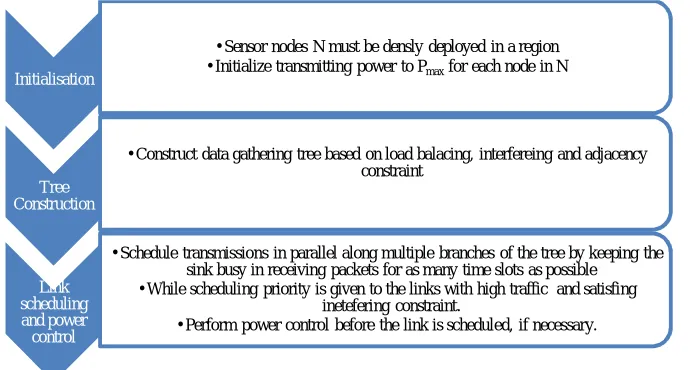
Figure 1. Flowchart of Operation of Low latency SINR based data gathering in cluster based WSN Fig 1 shows the operation of Low latency SINR based data gathering in WSN.
A. TREE CONSTRUCTION
In Low latency data gathering algorithm, the data gathering tree is constructed iteratively and a new node is added to the tree in each step. To determine the next node to join the tree and which tree node it should connect to, we define a weight to reflect the distribution of traffic load if a new node joins, as well as the incompatibility among links that are already on the tree and the potential links the new node may introduce.
B. LINK SCHEDULING AND POWER CONTROL
After obtaining a data gathering tree, the next step is to allocate time slots and transmitting power to links on the tree to minimize data gathering latency. When scheduling links for a new time slot, links with high traffic load should be considered first as they need more time slots to transmit the traffic than other links. Power control phase iteratively searches for an admissible schedule which means that a set of transmission powers is available to satisfy the SINR (signal to interference and noise ratio) constraints for all links in the given valid schedule. In each iteration nodes adjust their transmission powers as as per equation no (2) ,where Pnew is the new transmission power
level in the next iteration, Pcurrent is the current transmission power level and β is the SINR threshold.
Initialisation
• Sensor nodes N must be densly deployed in a region • Initialize transmitting power to Pmaxfor each node in N
Tree Construction
• Construct data gathering tree based on load balacing, interfereing and adjacency constraint
Link scheduling and power control
• Schedule transmissions in parallel along multiple branches of the tree by keeping the sink busy in receiving packets for as many time slots as possible
• While scheduling priority is given to the links with high traffic and satisfing inetefering constraint.
V. SIMULATION AND RESULTS
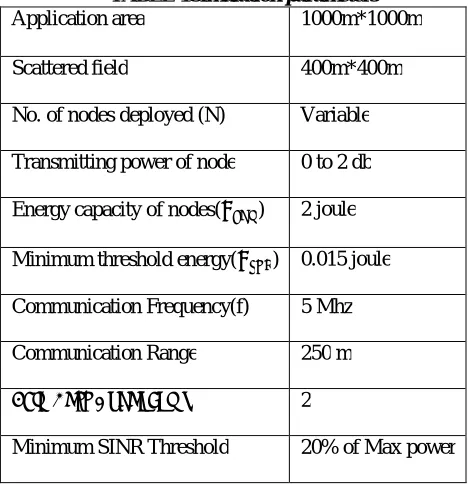
The simulation experiments is done to analyze whether the proposed Low latency data gathering schemeimproves the latency of the network and data collection rate achieved.In this study, the simulation programs were written by Java. To obtain more accurate results, all experimentswere performed 100 times to compute the average results. The parameters for the experiments are described inthe following. The size of the application area is 1000m * 1000m. The initial energy in each sensor node equals 2J, and the energy for sending and receiving data are the same. Moreover, all nodes communicate over a 5MHz frequency band .The log-distance path loss model is used as the propagation model, where the pass loss exponent αis 2. If not otherwise specified, the minimum SINR threshold is set to 20% of maximum power while the sink node is deployed at the corner of the field. All results are averaged over 100 runs.
In Low Latency SINR Based Data Gathering in WSN, we consider total number of time slots which are required to transmit the packets towards the sink node. Low Latency SINR Based Data Gathering in WSN uses randomly distribution of nodes where all nodes are randomly scattered in the field. The simulation parameters are given in Table 1
TABLE 1Simulation parameters Application area 1000m*1000m
Scattered field 400m*400m
No. of nodes deployed (N) Variable
Transmitting power of node 0 to 2 db
Energy capacity of nodes( ) 2 joule
Minimum threshold energy( ) 0.015 joule
Communication Frequency(f) 5 Mhz
Communication Range 250 m
Path Loss Exponent α 2
Figure 2 Initialization of nodes
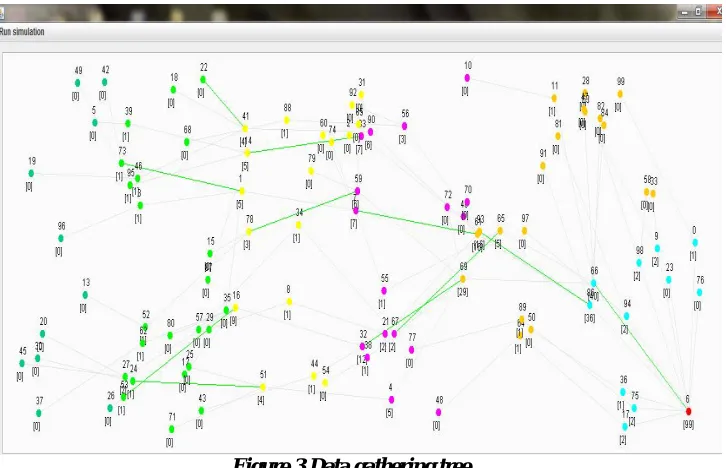
Figure 3 Data gathering tree
proposed algorithms need less data gathering time than the compared algorithm. Moreover, the advantage of proposed scheme is more obvious when the node density is relatively high. For example, when 200 nodes are deployed in the field, the result of the proposed algorithms is more than 25% to 30% compared to the existing algorithm. It verifies that our tree construction and link scheduling strategies are more capable of reducing data gathering latency while guaranteeing high reliability.
Fig 4: Number of required number of time slots for data gathering under different node densities
Next, the latency of the proposed algorithms under different minimum SINR thresholdsis examined, by varying the minimum SINR threshold from 0dB to 9 dB ina step of 2dB. The simulation results are shown in Fig. 5, where the number ofsensor nodes is fixed at 100. Clearly, the data gathering latency for all algorithms increases when the minimumSINR threshold grows, regardless of the type of node distribution. The reason isthat as links are more sensitive to interference at high SINR thresholds, fewer linkscan be scheduled in each time slot.
Fig5: Required No. of Time slots for Data gathering Data received by Sink node under different SINR Threshold
We can see that the average relaying traffic for proposed is lower than that of existing data gathering algorithm.We can see that the average relaying traffic for Proposed is lower than that of existing data gathering algorithm in fig (6)where the number of nodes varies from 50 to 200. The reason is that different from existing, proposed algorithm takes the subtree size into consideration when constructing trees such that the traffic load is more uniformly distributed over the network.
0 50 100 150 200 250
50 75 100 125 150 175 200
N o . O f Ti m e S lo ts
No. Of Nodes
Proposed Method Existing (without SINR) 0 50 100 150 200
0 3 5 7 9
N o . o f Ti m e S lo ts
SINR Threshold in dB
Fig.6 Average relaying traffic on each node for different data gathering strategies
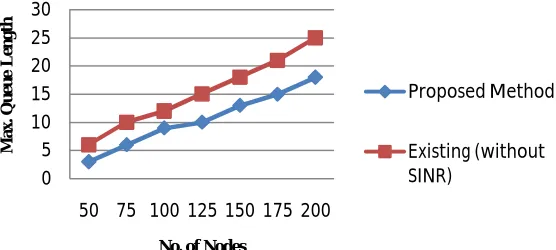
We also examine the maximum queue length on every node during data gathering, so as to determine the minimum buffer size for sensors. The simulation results are shown in Fig. (7). It is notable that the maximum queue length of proposed is much smaller than that of existing data gathering strategies.
.
Fig 7 Maximum queue length on each node for different data gathering strategies
VI. CONCLUSIONS
In this paper, we have studied tree-based data gathering in WSNs. Our objective is to gather data from all sensors withlow latency and high reliability, by carefully constructing a data gathering tree, scheduling links on the tree, and assigning transmitting power levels to active links in each time slot. We have conducted extensive simulations and the results demonstrate that the propose algorithms can significantly reduce the data gathering latency compared to other schemes under different node densities and minimum SINR thresholds, regardless of the location of the sink node. The results also show that the traffic load is more balanced throughout the network in our schemes, and thus the network lifetime is prolonged as well.
REFERENCES
1. N. Thepvilojanapong, Y. Tobe and K. Sezaki, “On the construction of efficient data gathering tree in wireless sensor networks,” IEEE ISCAS, pp. 648-651, May 2005.
2. C. Liu, K. Wu and J. Pei, “An energy-efficient data collection framework for wireless sensor networks by exploiting spatiotemporal correlation,” IEEE Trans. Parallel and Distributed Systems, pp. 1010-1023, Jul. 2007.
3. Y. Wu, S. Fahmy and N. B. Shroff, “On the construction of a maximum lifetime data gathering tree in sensor networks: NP completeness and approximation algorithm,” IEEE INFOCOM, pp. 356-360, April 2008.
0 5 10 15 20 25 30
50 75 100 125 150 175 200
Tr
a
ffi
c
No. of Nodes
Proposed Method Existing (without SINR) 0 5 10 15 20 25 30
50 75 100 125 150 175 200
M a x . Q u e u e Le n g th
No. of Nodes
Proposed Method
4. D. Luo, X. Zhu, X. Wu and G. Chen, “Maximizing lifetime for the shortest path aggregation tree in wireless sensor networks,” IEEE INFOCOM, pp. 1566-1574, April 2011.
5. H. Choi, J. Wang and E. A. Hughes, “Scheduling for information gathering on sensor network,” Wireless Networks, vol. 15, pp. 127-140,Jan. 2009.
6. W. C. Cheng, C. Chou, L. Golubchik, S. Khuller and Y. C. Wan, “A coordinated data collection approach: design, evaluation, and comparison,”
IEEE JSAC, pp. 2004-2018, Dec. 2004.
7. S. Gandham, Y. Zhang and Q. Huang, “Distributed time-optimal scheduling for convergecast in wireless sensor networks,” Computer Networks, vol. 52, Feb. 2008.
8. O. Durmaz Incel, A. Ghosh, B. Krishnamachari and K. Chintalapudi, “Fast data collection in tree-based wireless sensor networks,” IEEE Trans.Mobile Computing, vol. 11, no. 1, pp. 86-99, Jan. 2012.
9. J. Gr¨onkvist and A. Hansson, “Comparison between graph-based and interference-based stdma scheduling,” in Proceedings of ACM MobiHoc,2001, pp. 255–258.
10. A. Iyer, C. Rosenberg, and A. Karnik, “What is the right model for wireless channel interference?” in QShine ’06: Proceedings of the3rd international conference on Quality of service in heterogeneouswired/wireless networks, 2006, pp. 2–11.
11. L. Fu, C. Liew and J. Huang, “Joint power control and link scheduling in wireless networks for throughput optimization,” IEEE ICC, pp. 3066- 3072, May 2008.
12. T.ElBatt and A. Ephremides, “Joint Scheduling and Power Control for Wireless Ad-hoc Networks”, in INFOCOM ’02, pp. 976–984. 13. O. Goussevskaia, Y.A. Oswald and R. Wattenhofer, “Complexity in geometric SINR,” ACM MobiHoc, pp. 100-109, September 2007. 14. A. Behzad and I. Rubin, “Optimum integrated link scheduling and power control for multihop wireless networks,” IEEE Trans.
VehicularTechnology, pp. 194-205, Jan. 2007.
15. M. Andrews and M. Dinitz, “Maximizing capacity in arbitrary wireless networks in the SINR model: complexity and game theory,”
IEEEINFOCOM, pp. 1332-1340, April 2009.
BIOGRAPHY