Efficient Image Steganography Using
Advanced Pixel Value Differencing
Riddhiman Ghosh1, Jai Pratap Dixit2
Assistant Professor, Dept. of Information Technology, Ambalika Institute of Management & Technology, Lucknow, India 1, 2
ABSTRACT: Steganography is refer as hiding the information transmitting from sender(s) to receiver(r) and making invisible in the communication process. Now days hiding confidential data in digital images using the pixel-value differencing (PVD) method became very popular and efficient. This technique provides higher embedding capacity without very noticeable changes in the cover image. This paper includes technique, which based on pixel value differencing and also pixel value sum process. This change is so negligible that human eyes can’t detect it. The presence of hidden data can be revealed by a number of automatic approaches that can detect differences in statistical properties of the image due to embedding. One of the widely used approaches is histogram analysis. This proposed design is used for embedding large amount of data or data sets by changing the difference between two pixels, by which we also can able to increase the embedding capacity in Steganography. We tried to enhance the embedding capacity in a cover image using PVD in this work.
KEYWORDS: Steganography, Security, Capacity, Image Quality, Pixel-value-differencing, histogram analysis, RGB, PSNR.
I.INTRODUCTION
At present time, the Internet provide a common communication channel in worldwide so Communication media in public system means that there are different problems need to be faced time to time, such as copyright protection, data security etc.
ISSN(Online): 2320-9801
ISSN (Print): 2320-9798
I
nternational
J
ournal of
I
nnovative
R
esearch in
C
omputer
and
C
ommunication
E
ngineering
(An ISO 3297: 2007 Certified Organization)
Website:www.ijircce.com
Vol. 4, Issue 12, December 2016
the age of digital transmission of information using Internet. Two schemes are used to protect secret messages from being captured during transmission.
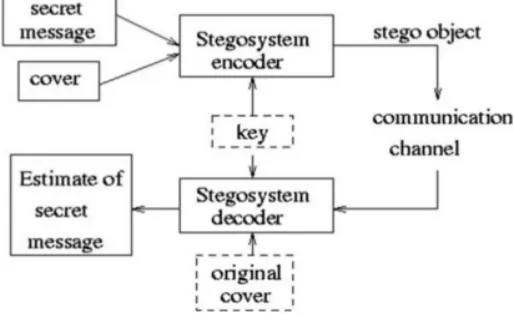
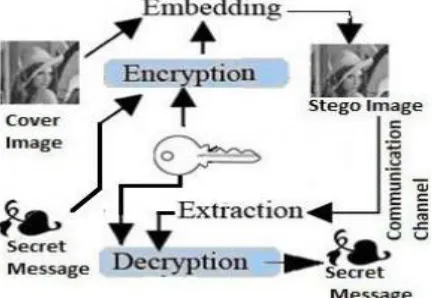
Fig 2: Secret Communication Channel
First one is encryption where the secret information is encrypted in another form by using public key before sending, which can only be decrypted with secret keys. The most used encryption techniques are DES, RSA etc. Other one is steganography which is a technique of hiding secret information into any other media or carrier known as cover media. If the cover media is a digital image, it is called cover image and the cover image with hidden data is called stego-image. Steganography can be used in military, commercial, anti-criminal and so on. There are various steganography techniques available where a digital image is used as a carrier. Wu and Tsai [1] proposed a new scheme to hide more data with outstanding quality of stego-image pixel-value-differencing (PVD) method. Thereafter, based on PVD method various approaches have been proposed [3, 4, 5, 8, and 10]. In this paper, a steganographic approach on colour images, using PVD has been proposed. The colour pixel-components may exceed the range 0~255 in the stego image when applying PVD method. In the proposed method a digital colour image has been used as a cover image. In this method more data can be hidden and also better stego image quality than Wu-Tsai’s method.
II. LITERATURE REVIEW
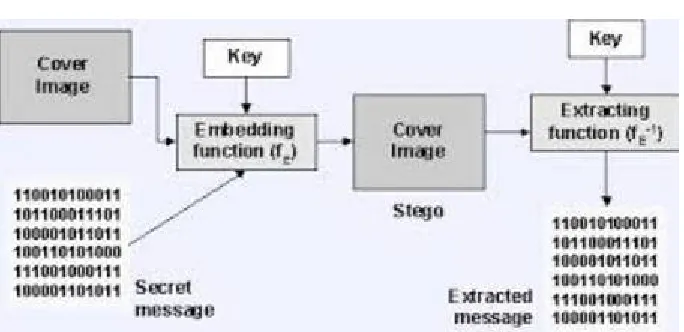
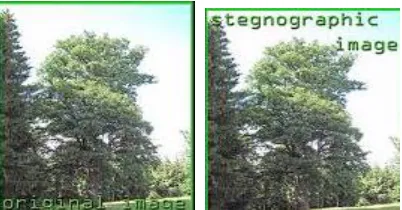
Fig 3: Stego Image with LSB structure
In this method, the secret data is embedding in the cover image. The cover image pixels and secret data is given. To hide the data by PVD, the difference value di is calculated from the two consecutive pixel values pi and pi+1 i.e. i 1 p i p i d . Then the various ranges is defined for 0-255 value such that Ri [li , ui] and li<di
The pixel value pi and pi+1 can be modified as:
ISSN(Online): 2320-9801
ISSN (Print): 2320-9798
I
nternational
J
ournal of
I
nnovative
R
esearch in
C
omputer
and
C
ommunication
E
ngineering
(An ISO 3297: 2007 Certified Organization)
Website:www.ijircce.com
Vol. 4, Issue 12, December 2016
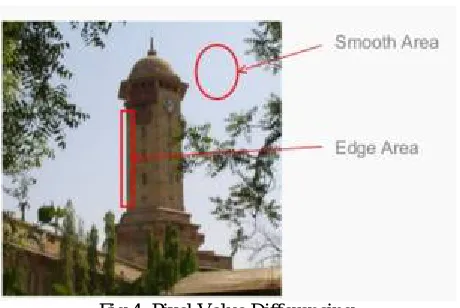
Fig 4: Pixel Value Differencing
In PVD method [1], grey scale image has been taken as a cover image with a long bit-stream as the secret data. At first the cover image is divided into non-overlapping blocks of two consecutive pixels, pa and pa+1. From each block the
ifferencing value da is evaluated by subtracting pa from pa+1. [22]The set of all differencing values may range from -255
to 255. Therefore, |da| ranges from 0 to 255. [19] The blocks with lesser differencing value known as smooth area
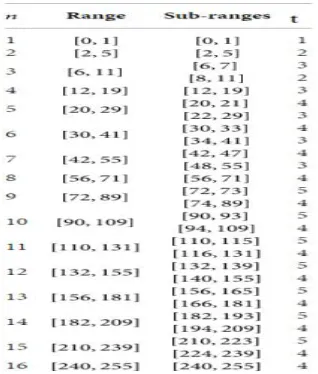
where block with large differencing values are the sharp edged area. According to the capability of vision of human eye, eyes can’t detect changes in sharp-edge area easily than smooth area. So, more data can be embedded into edge area than smooth areas. Therefore, in PVD method a range table has been prepared with n contiguous ranges Ri (where
i=1, 2,3… n) where the range can be 0 to 255. The lower and the upper bound are denoted as li and ui respectively, then
Ri∈ [li, ui]. The width of Ri is evaluated as wi=ui-li+1.wi defines how many bits can be hidden in a pixel block. For more
security purpose Ri is kept as a variable, as a result. Original range table is required to extract the embedded data. RGB
pixel value as the following.
III. PROPOSED APPROACH
Surveying the overall previous works on Steganography pixel value differencing method, there are few areas at where some modify can be made to make the procedure more relevant. The modification or some more work can be done on embedding and extracting areas. Here using modified pixel value differencing method, three secret images are hidden in a single cover image in three colour channels sequentially red, green and blue. Just the domain of three colour channels is specifically defined. The image is hidden in cover is extracted in a reversible manner. The locations the stored or remembered to extract the secret data and the amount of bits of that data is also calculated in reversible manner. The output after extraction is primarily received in binary form, and then it is changed in decimal form to get original hidden data. We here followed and taken the Wu-Tsai’s Calculation part for completing our work.Here we are using Data Embedding and Data extraction as per specified images
Table I: The quantized range table based on perfect square number Here we are using Data Embedding and Data extraction as per specified images
A. Data Embedding: There are the following steps
Read the cover image and partition it into non overlapping blocks of two consecutive pixels.
Insert the secret key by XORing the LSB with the 7th bit in each pixel.
Determine the capacity of pixels in the image.
If there is a match i.e. the XOR value is 0. Embed the n bits of secret message directly using Pixel value sum and Differencing.
Otherwise data is inverted before embedding.
Repeat the procedure until all the secret data bits is embedded.
Data is written in the form of image file to obtain a Stego-image.
B. Data Extraction : There are the following Steps as
Open the Stego-image and again partition it into non-overlapping blocks of two consecutive pixels. 2. Apply the secret key.
XOR the LSB with 7th bit of each pixel.
If the XOR value is 0. Extract the n bits of the secret data directly.
Otherwise the data is first extracted and the reverse of the string is done in order get the correct data. 6. Repeat the procedure until all the bits of the secret data are extracted.
IV. MODIFIED PVD ALGORITHM
A. EMBEDDING ALGORITHM:
ISSN(Online): 2320-9801
ISSN (Print): 2320-9798
I
nternational
J
ournal of
I
nnovative
R
esearch in
C
omputer
and
C
ommunication
E
ngineering
(An ISO 3297: 2007 Certified Organization)
Website:www.ijircce.com
Vol. 4, Issue 12, December 2016
table, and new difference value to calculate the new pixel values in case of overflow and underflow situation occurrence.
Evaluation work:
a. Calculate the difference values da of two consecutive pixels pa and pa+1 for each block of the cover image. This
is denoted by
da=|pa+1-pa |.
b. Calculate the optimal range where the difference lies in the range table by using da. This is calculated as
Ri =min (ui- da ), where ui ≥da for all 1≤ i≤ n
c. Calculate the number of bits “t” can be hidden in a pixel block can be defined as t=⎿log2 wi⏌. Where wi is the width of the range in which the pixel value difference (da) is belonging to [wi=ui-li+1]
d. Take “t” bits from binary secret data and convert it into its corresponding decimal value b. For instance if t=0101, then b=5
e. Calculate the new difference value da' which is given by da'=l i +b
f . Modify the values of pa and pa+1 by the following formula:
(pa,pa+1) = (pa+m/2,pa+1-m/2),if pa≥pa+1 and da'>da
(Pa,pa+1)=(pa-m/2,pa+1+m/2),if pa<pa+1 and da > da'
(Pa,pa+1)=(pa-m/2),pa+1+m/2), if pa≥pa+1 and da'≤da
(Pa,pa+1)= (pa+m/2, pa+1-m/2), if pa<pa+1 and da'≤da
Where m=|da'-da|
Now we get the pixel pair (pa',pa+1') after embedding the secret data into pixel pair (pa,pa+1). Repeat steps (4.a - 4.f) until
all secret data are embedded into the cover image. After embedding all the secret data we get the stego-image. When extracting the hidden information from the stego-image, original range table is needed. At first divide the stego-image into pixel blocks, having two consecutive non-overlapping pixels each. Calculate the difference value for each block as da'=|pa'-pa+1’|. Then find the optimum range Ri of di’. Then b' is obtained by subtracting li from di'. Convert b' into its
corresponding binary of “t” bits, where t=⎿log2 wi⏌. These t bits are the hidden secret data obtained from the pixel
block(pa',pa+1').
B EXTRACTION ALGORITHM :
The stego-image is taken and the colour component in which embedding was done is selected and domain is defined again.
Using the same previous calculations done in embedding and the conditions used in embedding, the consecutive pixel values between which the embedding is done is calculated. If overflow or underflow conditions aroused in case of embedding then these conditions are also checked.
After getting the pixel values, now the pixel value difference can be calculated. With this value and the width of range table calculated previously along with the other calculations the amount of data or the number of bits embedded is calculated.
Now the bits are converted into decimal and reshaped to get the original hidden message or secret message which was embedded.
V. RESULTS
between the duplicate and the original image, whereas PSNR value defines a measure of the peak error. The rate of error becomes lower as the MSE value becomes lower.
To evaluate the PSNR, the block first calculates the mean-squared error using the equation below:
In the equation, M and N are the number of rows and columns in the input images, respectively. Then the PSNR is evaluated using the following equation:
In the previous equation, R is the maximum deviation in the input image data type. For example, if the input image has a double-precision floating-point data type, then R is 1. If it has an 8-bit unsigned integer data type, R is 255, etc. Three different size images are taken for embedding and extraction for different colour components using our method. The value of MSE is low in case of lower size files and PSNR value is high at the same time.
Value of MSE
PSNR
Red 0.0817 59.0450 Blue 0.0320 63.1091
Green 0.0024 74.2748
Table 2: Differencing MSE and PSNR value of RBG
Fig:5 Differencing RGB and Gray Scale Cove Images
VI. DISCUSSION AND CONCLUSION
ISSN(Online): 2320-9801
ISSN (Print): 2320-9798
I
nternational
J
ournal of
I
nnovative
R
esearch in
C
omputer
and
C
ommunication
E
ngineering
(An ISO 3297: 2007 Certified Organization)
Website:www.ijircce.com
Vol. 4, Issue 12, December 2016
In this paper, we have discussed a Steganographic method for data hiding by using quantized tange table and local area pixel differencing. Experimental results show the proposed scheme has a much better performance than Tseng‟s scheme in terms of stego-image quality. The Steganographic capacity and imperceptibility represent the most important aspects of any steganography technique. Thus, this paper addresses and improves these two fundamental aspects of digital steganography methods: Steganographic capacity and stego image quality. This research proposed novel steganography methods in order to increase the Steganographic capacity and enhance the imperceptibility (i.e. stego image quality).
R
EFERENCES1. H.C. Wu, N.I. Wu, C.S. Tsai and M.S. Hwang, “Image steganographic scheme based on pixel value differencing and LSB replacement method”, IEEE Proceedings on Vision, Image and Signal processing, Vol. 152, No. 5,pp. 611-615, 2005.
2. Schneier B.'Applied cryptography'(John Wiley & Sons, New York, 1996, 2nd Edn.)
3. W. bender, D. gruhl, N. Morimoto, A.Lu, “Techniques for data hiding”, IBM Systems Journal Vol. 35(3-4),pp. -336, 1996.
4. F.A.P peticolas, R.J Anderson and M.G. Kuhn, “Information Hiding – a Survey” proceedings of the IEEE,VOL. 87,PP. 1062-1078, 1999. 5. Y.K. Lee, L.H. Chen, “High capacity image steganographic model”, IEEE Proceedings on Vision, Image and Signal processing, Vol. 147, No.3,pp. 288-294, 2000.
6. R.Z. Wang, C.F. Lin, J.C. Lin, “Image hiding by optimal LSB substitution and genetic algorithm”, Pattern Recognition Vol. 34, pp. 671-683, 2001.
7. Tseng, Y.C Chen Y.Y. Pan H.K.:'A secure data hiding scheme for binary images', IEEE Trans. Commune. , 2002, 50,pp. 1227-1231
8. C.C. Chang, J.Y. Hsiao, C.S. Chan, “Finding optimal least-significant -bit substitution in image hiding by dynamic programming strategy”, Pattern Recognition Vol. 36, Issue 7,pp. 1583-1595, 2003.
9. D.C. Wu, and W.H. Tsai, “A Steganographic method for images by pixel-value differencing”, Pattern Recognition Letters, Vol. 24, pp. 1613-1626, 2003.
10. C.K. Chan, L.M. Cheng,” Hiding data in images by simple LSB substitution” ,pattern recognition vol. 37, Issue 3,pp. 469-474, 2004.
11. C.M. Wang, Nan-I Wu, C.S. Tsai, M.S. Hwang, “A high quality Steganographic method with pixel value differencing and modulus function”, The journal of Systems and software, 2007.
12. Sukhjinder Singh, Kulbhushan Singla, Dr. Rahul Malhotra “A Robust Image Steganography Technique Using Quantized Range Table And Local Area Pixel Value Differencing”in (IJARECE) Volume 5, Issue 2, February 2016
13. J. K. Mandal and Debashis Das, “Steganography Using Adaptive Pixel Value Differencing (APVD) of Gray Images Through Exclusion of Overflow/Underflow.” CCSEA, SEA, CLOUD, DKMP, CS & IT 05, pp. 93–102, 2012.
14. C. Cachin, “An Information-Theoretic Model for Steganography”,in proceeding 2nd Information Hiding Workshop, vol. 1525, pp. 306-318, 1998.
15. Ker, A.D., 2007. Steganalysis of embedding in two least-significant bits. IEEE Transactions on Information Forensics and Security 2 (1), 46– 54.
16. Lee, Y.K., Chen, L.H., 2000. High capacity image steganography. IEE Proceedings on Vision Image and Signal Processing 147 (3), 288–294. 17. Li, X., Yang, B., Cheng, D.F., Zeng, T.Y., 2009. A generalization of LSB matching. IEEE Signal Processing Letter 16 (2), 69–72.
18. Liu, J.C., Shih, M.H., 2008. Generalizations of pixel value differencing steganography for data hiding in images. Fundamenta Informaticae 83 (3), 319–335.
19. Wang, C.M., Wu, N.I., Tsai, C.S., Hwang, M.S., 2008. A high quality Steganography method with pixel-value differencing and modulus function. Journal of Systems and Software 81 (1), 150–158.
20. S. M. Masud Karim, Md. Saifur Rahman, Md. Ismail Hossain, "A New Approach for LSB Based Image Steganography Using Secret Key", Proceedings of 14th International Conference on Computer and InformationTechnology, Bangladesh, 2011.
21. Da-Chun Wu , Wen-Hsiang Tsai, “A steganographic method for images by pixel-value ” Pattern Recognition Society, Published by Elsevier Science,pp. 1613-26, 2003.
22. J . K. Mandal and Debashis Das “Colour Image Steganography Based On Pixel Value Differencing In Spatial Domain” IJIST Vol.2, No.4, July 2012.
23. Himakshi, Verma,H.K., Singh, R.K., Singh,C.K., “ Bi Directional pixel-value differencing approach for RGB Color Image.”,Proceeding of IEEE, 2013.
24. Han-ling Zhang , Guang-zhi Geng and Cai-qiong Xiong “ Image Steganography using Pixel-Value Differencing” Second International Symposium on Electronic Commerce and Security ,IEEE, 2009.
25. Champakamala, B.S, Padmini.K and Radhika DK “Least Significant Bit algorithm for image steganography” IJACT Vol 3, No. 4, pp. 34-38, 2011.
26. V. S. Shirguppi, “A Novel Approach for hiding data in Image Steganography by using Three Pixel Pair Differencing Method”, International Journal of Advanced Research in Electronics and Communication Engineering , Vol. 4(12), pp. 2886-89, 2015.
27. A. Tyagi, R. Roy, S. Changder, “High Capacity Image Steganography based on Pixel Value Differencing and Pixel Value Sum,” Proceeding of IEEE, 2015.
BIOGRAPHY
Riddhiman Ghosh working as Assistant professor in Ambalika Institute of Management & Technology Lucknow. He received M.Tech (Software Engineering) from JIS college of Engineering, Kalyani under WBTU in year 2013. His Research Interest field are Image processing and Software Engineering.