78:12 (2016) 69–74 | www.jurnalteknologi.utm.my | eISSN 2180–3722 |
Jurnal
Teknologi
Full Paper
D
EACIDIFICATION OF
P
ALM
O
IL
U
SING
S
OLVENT
E
XTRACTION
I
NTEGRATED
W
ITH
M
EMBRANE
T
ECHNOLOGY
S. O. Lai
a*, S. L. Heng
a, K. C. Chong
a, W. J. Lau
ba
Universiti Tunku Abdul Rahman, Jalan Sungai Long, Bandar Sungai
Long, Cheras, 43000 Kajang Selangor, Malaysia
b
Advanced Membrane Technology Research Centre (AMTEC),
Universiti Teknologi Malaysia, 81310 UTM Johor Bahru, Johor,
Malaysia
Article history Received
25 August 2016
Received in revised form
3 October 2016
Accepted
27 October 2016
*Corresponding author
[email protected]
Graphical abstract
Abstract
In this work, the efficiency of crude palm oil (CPO) deacidification using solvent extraction integrated with membrane technology is studied. Different solvents including ethanol, hexane and methanol were selected to extract the palmitic acid from model fatty system in the model fatty system to solvent ratio of 1:2. Experimental results showed that ethanol was the best solvent to extract palmitic acid from the model fatty system, recording about 65.5% fatty acid reduction in the model fatty system. Three commercial solvent resistant nanofiltration (SRNF) membranes (SolSep NF010206, NF030306, and NF030705) were then selected to examine their respective performance in recovering ethanol from palmitic acid-rich ethanol solvent. The results revealed that the combination of solvent extraction and membrane technology is remarkable simple and waste-free approach to overcome major drawbacks of conventional refinery operation.
Keywords: Palm oil, membrane, solvent extraction, palmitic acid, deacidification
Abstrak
Tujuan penelitian ini adalah untuk menguji kecekapan penyahasidan minyak sawit mentah (MSM) dengan menggunakan kaedah pengekstrakan pelarut bersepadu dengan teknologi membran. Pelarut yang berbeza termasuk etanol, heksana dan metanol telah dipilih untuk mengekstrak asid palmitik daripada model lemak sistem dengan nisbah 1: 2 sistem model lemak kepada pelarut. Keputusan kajian ini menunjukkan bahawa etanol adalah pelarut terbaik untuk mengektrak asid palmitik dari sistem lemak model, mencatatkan sekitar 65.5% pengurangan asid palmitik dari model lemak sistem. Tiga membran nanofiltrasi komersial yang tahan terhadap pelarut (SolSep NF010206, NF030306 dan NF030705) telah dipilih untuk mengkaji prestasi masing-masing dalam etanol pemulihan daripada pelarut etanol yang kaya dengan asid palmitik. Dari penelitian ini menunjukkan bahawa kaedah gabungan pengekstrakan pelarut dengan teknologi membran adalah lebih mudah dan tiada lebihan sisa untuk mengatasi kelemahan penyahasidan MSM konvensional.
Kata kunci: Minyak sawit, membran, pengekstrakan menggunakan pelarut, asid palmitik,
penyahasidan
1.0 INTRODUCTION
Palm oil has often been described as one of the important contributors to Malaysia’s economy growth [1]. Crude palm oil (CPO) contains a small quantity but different amount of undesirable compounds and impurities such as free fatty acid (FFA), mono- and diacylglycerols, phospholipids or gum, trace metals, oxidation products, and odoriferous substances that need to be removed by a downstream process called refining. Of all the refinery operation, deacidification is the most critical and difficult step. This step is required to remove the FFA in order to produce favourable and quality edible oil [2]. Apart of greatly affecting the economic feasibility of the entire refinery process, the deacidification brings a great environmental impact as well [3]. The presence of FFA can result in huge loss of oil during the refining process and cause the difficulty in removal of other impurities in the following refinery operations [4-5].
Conventionally, the deacidification step in chemical refining, using sodium hydroxide, leads to excessive nutrient and neutral oil losses due to saponification. For the deacidification of crude rice bran oil with 5% of FFA, it was reported that the neutral oil losses could range from 12% to 40% [6]. Besides, conventional deacidification can also result in high energy, water, time and non-reusable chemicals consumption yet generate heavily polluted effluents [7]. Physical refining with high temperatures and low pressures on the other hand can cause the formation of unhealthy products for consume such as polymers and trans-isomers [8].
The removal of FFA in oil has been studied with various approaches such as solvent extraction, membrane technology, biological deacidification, etc. [2]. However, separation of triglyceride and FFA in CPO without any additive can be infeasible. CPO appears naturally semi-solid at room temperature
and contains of high quantity of other undesirable compounds. The molecular weight difference between fatty acid and triglyceride (oil) is too small if membrane alone is used in deacidification [9]. The calculated average molecular weight for refined palm oil is 847.78 g/mol while palmitic acid is only 256.43 g/mol [10]. In a recent study of CPO deacidification using PVA-cross-linked PVDF hollow fiber membrane, a FFA rejection of only 5.93% was achieved and the membrane also showed a significant flux decline from initial oil flux of 2 kg/m²h to 0.56 kg/m²h after 3 hours operation [11]. This is mainly due to fouling effect which creates greater transport resistance.
The limitations reported in the previous works drive to the further development of refining edible oil approach. The combination of solvent extraction and membrane technology is remarkably simple and economic to overcome major drawbacks of conventional refinery operation [12]. This integrated approach provides a few advantages: operate in ambient temperature, low-energy consumption, preservation of desirable heat-sensitive components in edible oil and eliminate of the needs of wastewater treatments. However, more efforts are needed to examine the suitable membrane that exhibits excellent stability, permeability and selectivity in solvent recovery after extraction.
In this work, the efficiency of crude palm oil (CPO) deacidification using solvent extraction integrated with membrane technology is studied.
2.0 METHODOLOGY
2.1 Materials
The raw material used in preparing model fatty solution was food-grade refined palm oil (Alif, Sime Darby) obtained from local market and palmitic acid
(Sigma-Aldrich). Palmitic acid was selected in this study because it is the major fatty acid composition (43.7%) in CPO and has smaller molecular weight, i.e., 256.42 g/mol. The FFA extraction experiments were performed using AR Grade n-hexane (Friendemann Schmidt), AR Grade methanol (RCI Labscan) and denatured absolute ethanol (HmbG Chemicals). Commercially available silicon base supported solvent-resistant nanofiltration (SRNF) SolSep membranes, i.e. NF010206, NF030306 and NF030705 [13] were used in this study. Table 1 summarizes the characteristics of these three SRNF membranes. However, the type of polymer for these three SRNF membranes remains unknown [14].
2.2 Solvent Extraction
The model fatty system was heated up to 55°C in shaking water bath (Model: Memmert) for 30 min. It was then treated with three different solvents which were ethanol, hexane and methanol in the ratio of model fatty system to solvent ratios of 1: 2 at 55 °C in the shaking water bath for 2 hours. The solvent treated model fatty system was then allowed to settle for another 2 hours followed by separating the triglyceride from the extractant (ideally containing solvent + palmitic acid). The solvent which exhibited the best palmitic acid extraction ability will be selected for membrane refining studies. All samples were prepared at least in triplicate for palmitic acid measurement.
2.3 Palmitic Acid Value In Raffinate Phase
The palmitic acid concentration in the model fatty system was determined by measuring the sample acidity using titration method. Indicator mixture with 400 ml of isopropyl alcohol (IPA) and 4 ml of phenolphthalein was heated until boiled. Three grams of each model fatty system and raffinate phase (appearing at bottom layer) was weighed in a conical flask, and mixed with 50 ml of indicator mixture. The sample was then heated until it boiled. The sample was then titrated with 0.1 N Potassium hydroxide (KOH) solution and stopped when the sample turned to reddish. The concentration of palmitic acid present in the model fatty system and raffinate phase was calculated by using the following equation (1):
𝑃𝐴 (%) = 25.6 𝑥 𝑁 𝑥 𝑉
𝑀 (1)
where N is the normality of KOH (mol/L), V is the volume of KOH consumed in titration (mL), M is the weight of sample (g) and 25.6 is the molecular weight of palmitic acid (256 g/mol) divided by 10 because of unit conversion process [15]. Then the FFA reduction (%) was calculated by Equation (2):
𝐹𝐹𝐴 𝑅𝑒𝑑𝑢𝑐𝑡𝑖𝑜𝑛 (%) = 𝑃𝐴𝑖− 𝑃𝐴𝑅
𝑃𝐴𝑖 𝑥 100
(2)
where PAi and PAr is palmitic acid concentration in
the model fatty system and raffinate phase, respectively. All measurements were carried out at least in triplicate and the standard deviations of the obtained results were recorded.
2.4 Membrane Filtration Setup
Figure 1 illustrates a schematic diagram of the experiment setup [9]. The membrane deacidification process was carried out using dead-end stirred cell (Sterlitech HP4750, Sterlitech Corporation, USA) with approximately 14.6 cm² active membrane area. A nitrogen cylinder equipped with pressure regulator was connected to the top of the dead-end stirred cells to supply desired pressure for filtration tests. A Teflon coated magnetic stirrer was used to minimize concentration polarization during the experiments, and was controlled at 1000 rpm on top of the active side of membrane.
Prior to the experiment, the membrane was pre-treated by soaking overnight in the selected solvent that exhibited the best palmitic acid extraction ability. The membrane was then underwent compact treatment with dead-end system at 25 bar with pure solvent for 30 minutes until the flux achieved steady state. Then, the performance of three selected membrane was investigated by measuring the flux,
JEtOH1 (L/ m².h) of pure ethanol at 20 bar for 30 min
with Equation (3):
𝐽𝐸𝑡𝑂𝐻1= 𝑉𝐸𝑡𝑂𝐻1
𝐴𝛥𝑇 (3)
The feed was replaced with 5 w/v% palmitic acid in ethanol. The flux for the palmitic acid was measured at the same pressure (20 bar) for 30 min and named as JPA as expressed in Equation (4):
𝐽𝑃𝐴(%) = 𝑉𝑃𝐴
𝐴𝛥𝑇 (4)
where VEtOH1(L)andVPA(L) are the volume of the
permeated pure ethanol and palmitic acid in ethanol, respectively, A (m²) represents the effective filtration area, and ΔT (h) is the recorded time. After the filtration, the membrane was thoroughly washed with pure ethanol, then the pure ethanol flux of the cleaned membrane (JEtOH2) was measured, data was
collected to evaluate the stability of the membrane. The rejection, R (%) of palmitic acid on the other hand was calculated by Equation (5):
𝑅(%) = (1 − 𝐶𝐶𝑝
𝑓) 𝑥 100% (5)
where Cp and Cf are the concentration of palmitic
acid in permeate and feed, respectively.
2.5 Palmitic Acid Removal
Using the same membrane filtration setup, palmitic acid flux, JPA and rejection (R) at different pressures
(8, 12, 16 and 20 bars) were studied. To determine the palmitic acid concentration, all samples were analysed using gas chromatography/flame ionization detector (GC/FID) (Perkin Elmer Claurus 500) under following experimental conditions: A Zebron™ ZB-FFAP, GC capillary column (30 m x 0.25 mm x 0.25 µm). Helium was used as carrier gas with the flow rate of 2.4 mL/min. The injector temperature was 160 °C. The oven temperature was programmed as 160 °C held for 2 min, then increased to 8 °C/min until 260 °C and maintained for 3 min. The flame ionization detector was set at 280 °C. The injection volume was 1 µL, and the split ratio was 10:1 [17]. Palmitic acid flux, JPA and rejection, R were calculated with the equations similar to Equation (3) and (5).
2.6 Hydrophobicity/Hydrophilicity Test
Hydrophobicity/hydrophilicity of all three selected membranes was evaluated with deionized water using contact angle goniometer (Model: C201 by Biolin Scientific). Smaller contact angle is formed when the affinity between water drop and the membrane surface is higher and this indicates that the membrane possesses higher degree of surface wetting is hydrophilic. Meanwhile, larger contact angle reveal the membrane is of hydrophobic [18].
3.0 RESULTS AND DISCUSSION
3.1 Solvent Extraction
Model refined palm oil added with 5 w/v% palmitic acid was extracted using hexane, ethanol and methanol. It was observed that hexane was miscible with both triglyceride and palmitic acid and did not have any separation phase, while methanol and ethanol formed two separated layers as extractant and raffinate phase as showed in Figure 2.
With phase separator and the highest extraction ability, the extractant from ethanol containing solvent with palmitic acid was selected for further study in membrane recovery process. Selection of ethanol as suitable solvent for extraction was also supported by many other works due to its high selectivity and low toxicity that are allowed to be used as solvent in food industry. Both ethanol and methanol permit the formation of two separation phase (a palmitic acid/ solvent-rich extractant phase and an oil-rich raffinate phase), which is particularly suitable for subsequent membrane-based ethanol recovery processing [19].
Figure 2 Formation of immiscible and miscible mixture in solvent extraction
In terms of palmitic acid extraction, ethanol showed the highest extraction ability followed by methanol and hexane. Palmitic acid concentration in raffinate was determined by titration method and results are showed in Figure 3.
Figure 3 Percentage of FFA reduction in different type of solvents
3.2 Flux Recovery
Figure 4 shows the permeate flux (L/ m².h) of three SRNF membranes with pure ethanol. JEtOH1 and JEtOH2
indicate the membrane solvent flux before and after palmitic acid filtration. NF030705 membrane exhibited the highest palmitic acid permeate flux (JPA), 65.42 L/m².h and was able to maintain the pure
ethanol flux, JEtOH2 after being washed thoroughly
Methanol
Ethanol Hexane
Extractant
Raffinate Raffinate
Extractant
Miscible
FF
A
Re
d
uct
ion
with pure ethanol. The membrane pure ethanol flux remained consistent as 34.52 L/m².h even after 15 runs. This showed that NF030705 membrane was stable in high pressure, solvent and slightly acidic condition and compliant with the permeability data provided by manufacturer.
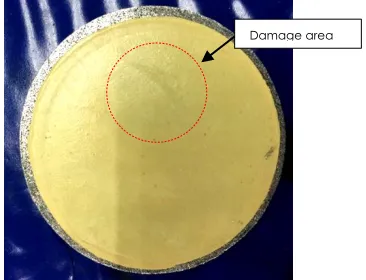
However, NF030306 membrane was not stable in this study. The membrane was damaged with slight tear-off and swelling (Figure 5) after 5 w/v% palmitic acid in ethanol filtration. The same damage was found when the filtration study was replaced by another two new pre-treated NF030306 membrane. The damage of membrane surface also resulted in dramatic increase in pure ethanol flux by 300% after palmitic acid filtration and washing. NF010206 membrane had the lowest permeate flux of 13.40 L/m².h.
Figure 5 Damage of SolSep NF030306 membrane after palmitic acid filtration
3.3 Palmitic Acid Removal
The recorded palmitic acid flux was quite stable for both NF010206 and NF030705 membranes under different pressures at room temperature. Meanwhile, only the performance of NF030306 membrane
deteriorated as a function of filtration time as shown in Figure 6. The highest permeate flux was found in NF030705 membrane, followed by NF030306 and NF010206 membranes. The results also indicated that membrane flux increased proportionally with pressure. NF010206 membrane was more stable when pressure increased, while NF030705 was very sensitive toward pressure change.
Figure 6 Permeate flux (L/ m².h) of SolSep NF010206, NF030306 and NF030705 at different pressure
In terms of separation efficiency, NF010206 membrane presented the highest palmitic acid rejection (31.59%), but its palmitic acid rejection reduced with the increase in pressure. Figure 7 depicted that NF030306 membrane had the lowest rejection ability and this could be explained by membrane swelling which led to the increase of the membrane pore size.
Figure 7 Effect of pressure on the palmitic acid rejection by SolSep NF010206, NF030306 and NF030705 membranes
Figure 4 Comparison of flux recovery using pure ethanol,
JEtOH1 and JEtOH2 before and after 5 w/v% palmitic acid in
ethanol, JPA filtration
3.4 Hydrophobicity/Hydrophilicity
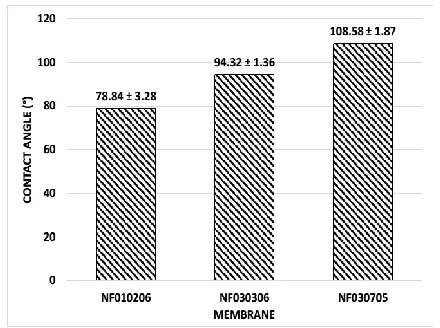
Hydrophobicity of three selected membranes was determined using contact angle goniometer and recorded in Figure 8. The results confirmed that all three studied membranes were hydrophobic in nature in which NF030705 membrane showed the highest value, followed by NF030306 and NF010206 membranes. It was found that hydrophobicity did not affect significantly the palmitic acid rejection. However, cross-linked modification of membrane with additive such as PVA can be studied in order to understand the effect of hydrophobicity/ hydrophilicity on the palmitic acid rejection.
Figure 8 Comparison of contact angle for three SRNF membranes
4.0 CONCLUSION
In this study, the results revealed that the combination of solvent extraction and membrane technology is feasible and remarkable simple and waste-free approach to overcome major drawbacks of conventional refinery operation. Solvent extraction showed that ethanol was able to extract 65.48% of palmitic acid in model fatty system, reducing its FFA content to less than 2.5%. It was reported that membrane technology using SRNF membrane could be used to recover solvent used in FFA extraction, but more effort is still needed to improve the solvent flux of SRNF membrane. Besides, a membrane with superior solvent stability and high removal rate against FFA removal is also required in order to make the membrane solvent extraction process more feasible.
References
[1] Rozario, M. 2013. National Biomass Strategy 2020: New Wealth Creation For Malaysia’s Palm Oil Industry. Agensi Inovasi, Malaysia, Kuala Lumpur, (June). 1-32.
[2] Bhosle, B. M., Subramanian, R. 2005. New Approaches In Deacidification Of Edible Oils - A Review. Journal of Food Engineering. 69(4): 481-494.
[3] Basiron, Y. 2005. Palm Oil, in Bailey’s Industrial Oil and Fat Products sixth. F. Shahidi, ed. Wiley Interscience. 2: 333-423.
[4] Rodrigues, C. E. C., Gonçalves, C. B., Batista, E., Meirelles, A. J. A. 2007. Deacidification of Vegetable Oils by Solvent Extraction. Recent Patents on Engineering. 1(1): 95-102. [5] Mba, O. I., Dumont, M.-J., Ngadi, M. 2015. Palm Oil:
Processing, Characterization and Utilization in the Food Industry – A Review. Food Bioscience. 10: 26-41.
[6] Orthoefer, F. T., Rice Bran Oil, in Bailey’s Industrial Oil and Fat Products sixth. F. Shahidi, ed. Wiley Interscience. 2(2.10): 465-489.
[7] Anderson, D. 2005. A Primer On Oils Processing Technology, In Bailey’s Industrial Oil And Fat Products Sixth. F. Shahidi, ed. Wiley Interscience. 1(1.1): 1-56.
[8] Sengupta, R., Bhattacharyya, D. K. 1992. A Comparative Study Between Biorefining Combined With Other Processes And Physical Refining Of High-Acid Mohua Oil.
J. Am. Oil Chem. Soc. 69: 1146-1149.
[9] Fornasero, M. L., Marenchino, R. N., Pagliero, C. L. 2013. Deacidification of Soybean Oil Combining Solvent Extraction and Membrane Technology. Advances in Materials Science and Engineering. 2013: 1-5.
[10] Gonçalves, C. B., Meirelles, A. J. A. 2004. Liquid–Liquid Equilibrium Data For The System Palm Oil + Fatty Acids + Ethanol + Water At 318.2 K. Fluid Phase Equilibria. 221: 139-150.
[11] Azmi, R. A., Goh, P. S., Ismail, A. F., Lau, W. J., Ng, B. C., Othman, N. H., Noor, A. M., Yusoff, M. S. A. 2015. Deacidification of Crude palm oil using PVA-crosslinked PVDF membrane. Journal of Food Engineering. 166: 165-173.
[12] Raman, L. P., Cheryan, M., Rajagopalan, N. 1996. Deacidification of Soybean Oil by Membrane Technology.
J. Am. Oil Chem. Soc. 73(2): 219-224.
[13] SolSep leaflet v10_2014. 2014. Membrane Processing in
Organic Solvents. SolSep BV, retrieve from:
http://www.solsep.com/datasheets/membranes/all.pdf. [14] Peeva, L. G., Malladi, S., and Livingston, A. G. 2010.
Nanofiltration Operations in Nonaqueous Systems. Elsevier B.V. 1-8.
[15] Chong, K. Y. 2016. Acidic Number Of Fatty Acid. Scribd,
Inc., retrieved from
https://www.scribd.com/doc/316542962/ acidic-number-of-fatty-acid.
[16] Zhao, Y. F., Zhang, P. B., Sun, J., Liu, C. J., Yi, Z., Zhu, L. P., Xu, Y. Y. 2015. Versatile Antifouling Polyethersulfone Filtration Membranes Modified Via Surface Grafting Of Zwitterionic Polymers From A Reactive Amphiphilic Copolymer Additive. Journal of Colloid and Interface Science. 448: 380-388.
[17] Phenomenex®. 2013. Chromatography Product Guide
13/14 of Zebron ™ columns ZB-FFAP. Phenomenex, Inc. 105.
[18] Darvishmanesh, S., Jansen, J. C., Tasselli, F., Tocci, E., Luis, P. 2011. Novel Polyphenylsulfone Membrane For Potential Use In Solvent Nanofiltration. Journal of Membrane Science. 379: 60-68.
[19] Oliveira, R. C., Barros, S. T. D., Gimenes, M. L. 2013. The Extraction Of Passion Fruit Oil With Green Solvents.Journal of Food Engineering.117: 458-463.
[20] Mariano, R. G. B., Silva, C. M., Couri, S., Nogueira, R. I., Freitas, S. P. 2011. Partition of Free Fatty Acids in Deacidification of Macaúba Pulp Oil by Liquid-Liquid Extraction using Ethanol/Water as Solvent. Defect and Diffusion Forum. 312-315: 554-559.
![Table 1 Summary of Characteristics of Three SolSep Solvent-Resistant Nanofiltration (SRNF) Membrane [14]](https://thumb-us.123doks.com/thumbv2/123dok_us/1347489.1167632/2.612.58.554.521.740/table-summary-characteristics-solsep-solvent-resistant-nanofiltration-membrane.webp)
![Figure 1 illustrates a schematic diagram of the experiment setup [9]. The membrane deacidification process was carried out using dead-end stirred cell (Sterlitech HP4750, Sterlitech Corporation, USA) with approximately 14.6 cm² active membrane area](https://thumb-us.123doks.com/thumbv2/123dok_us/1347489.1167632/3.612.332.553.302.446/illustrates-schematic-experiment-deacidification-sterlitech-sterlitech-corporation-approximately.webp)