DNA-BASED CLIENT PUZZLE FOR WLAN ASSOCIATION PROTOCOL AGAINST CONNECTION REQUEST FLOODING
ALI ORDI
A thesis submitted in fulfilment of the requirements for the award of the degree of
Doctor of Philosophy
Advanced Informatics School Universiti Teknologi Malaysia
Dedicated to
ACKNOWLEDGEMENT
ABSTRACT
ABSTRAK
TABLE OF CONTENTS
CHAPTER TITLE PAGE
DECLARATION ii
DEDICATION iii ACKNOWLEDGEMENT iv
ABSTRACT v
ABSTRAK vi TABLE OF CONTENTS vii
LIST OF TABLES xi
LIST OF FIGURES xii
LIST OF ABBREVIATIONS xiv
1 INTRODUCTION 1
1.1 802.11 Based Network Authentication 1 1.2 Wireless Threats 2 1.3 Background of the Problem 7
1.4 Problem Statement 9 1.4.1 Research Question 11 1.5 Research Aim 12 1.6 Research Objectives 12
1.7 Significance of the Study 13 1.8 Research Scope 13 1.9 Outline of the Thesis 15
2 LITERATURE REVIEW 17
2.1 Computer Network 17
2.1.1 Transmission Medium 19
2.1.3 Network Standards 21
2.1.3.1 IEEE Standard 802.11 22
2.2 New Trend in Computer Networks 24
2.3 WLAN Operational Mode 25
2.4 WLAN Architecture 26
2.4.1 Independent BSS 26
2.4.2 Infrastructure BSS 27
2.4.3 Extended service set 28
2.4.4 Hybrid Networks 29
2.5 WLAN Services 30
2.6 WLAN Management Operation 32
2.6.1 Scanning 32
2.6.2 Authentication 32
2.6.2.1 Open System Authentication 33
2.6.4 Association 34
2.7 WLAN Connection Procedure 34
2.7.1 Connection State and Class 37
2.8 Attack on WLAN 39
2.8.1 Identity Spoofing Attack 39
2.8.2 Eavesdropping Attack 40
2.8.3 Vulnerability Attack 40
2.8.4 Replay Attack 40
2.8.5 Rogue Access Point Attack 40
2.8.6 Denial of Service Attack 41
2.8.6.1 Connection Request Flooding Attack 43 2.8.6.2 Distributed Denial of Service Attack 44
2.9 Anti-DoS Flooding Methods 46
2.9.1 Client Puzzles 47
2.9.2 Puzzle Construction 48
2.9.3 Puzzle Properties 49
2.10 Protein Synthesizing 54
2.11 Related Works 57
2.11.1 Hash-Based Puzzles 58
2.11.3 Other Payment Schemes 65
2.12 Puzzle Challenges 75
2.13 Summary 78
3 RESEARCH METHODOLOGY 79
3.1 Assumption 80 3.2 Inception Phase of Proposed Puzzle 81
3.3 Design and Development Phase 83 3.3.1 Designing the Proposed Client Puzzle Protocol 84 3.3.2 Puzzle Development and Implementation 86 3.3.2.1 Idea behind the Proposed Puzzle 87
3.3.3 Puzzle Generation 89 3.3.4 Puzzle Solving 89 3.3.5 Puzzle Verification 90 3.3.6 Threshold Effect 90 3.3.7 Testing the Developed Puzzle 93 3.4 Security Evaluation Phase 93 3.4.1 Empirical Study 94 3.4.2 Analytical Study 95 3.4.3 Security Properties 95 3.5 Implementation Tools 96 3.6 Deliverables Table 97 3.7 Summary 98 4 DESIGN AND IMPLEMENTATION 99 4.1 OROD Puzzle Protocol 100
4.2 Puzzle Generation Phase 101
4.2.1 DoS Detector Module 101
4.2.2 Queue Manager Module 102
4.2.3 Puzzle Generator Module 102
4.3 Puzzle Solving Phase 106
4.3.1 tRNA Extractor Module 107
4.3.2 Unique Key Constructor Module 107
4.4 Puzzle Verification Phase 109
4.5 Generation Cost 111
4.6 Solving Cost 112
4.7 Verification Cost 115
4.8 Queue Manager Thresholds 117
4.9 Access Latency 124
4.10 Summary 126
5 RESULT AND DISCUSSION 128
5.1 OROD Puzzle Motivation 129
5.2 OROD Puzzle Generation Analysis 130
5.3 OROD Puzzle Solving Analysis 131
5.4 OROD Puzzle Verification Analysis 133
5.5 Performance Evaluation 134
5.6 Security Analysis 136
5.6.1 Formal Definition of OROD Puzzle 139
5.6.2 Puzzle Unforgeability 141
5.6.3 Puzzle Difficulty 143
5.7 Compare to Other Works 149
5.7.1 Efficiency 149
5.7.2 Immunity 150
5.7.3 Fairness 151
5.7.4 Other Properties 151
5.8 Summary 154
6 CONCLUSION 155
6.1 Research Summary and Conclusion 156
6.2 Contribution of the Study 159
6.6 Future Work 161
LIST OF TABLES
TABLE NO. TITLE PAGE
2.1 Classified interconnected processors by scale 20
2.2 A summary of existing client puzzles 76
3.1 Deliverables Table 97
4.1 Generation cost on AP 111
4.2 Solving cost on STAs 113
4.3 Finding valid-looking MAC Addresses 114
4.4 Verification cost 115
4.5 Computation power of AP for OROD puzzle verification 117
5.1 Solving cost on legitimate STA and attacker 132
5.2 Performance comparison 135
5.3 Efficiency Comparison 150
LIST OF FIGURES
FIGURE NO. TITLE PAGE
1.1 Different targets on which to launch DoS attacks in WLAN
deployment 6
1.2 The Narrow-down View of the Research Scope 14 2.1 Literature review Structure 18
2.2 Network Example 19
2.3 The IEEE 802 family 21
2.4 Components of 802.11 LANs 23
2.5 (a) Wireless network with an AP. (b) Ad hoc network 24
2.6 Independent BSS or IBSS 26
2.7 Infrastructure BSS 27
2.8 Extended service set or ESS 29
2.9 Distribution system or backbone 29
2.10 Hybrid networks 30
2.11 Open-system authentication exchange 34
2.12 802.11 authentication and association procedure 35
2.13 Association procedure 36
2.14 Relationship between state variables and services 38
2.15 Distributed Denial of Service (DDoS) 45
2.16 Interactive client puzzle protocol 49
2.17 Protein synthesis translation process 55
2.18 Elongation (Translation) process continues 56
2.19 Protein synthesis termination process 57
2.20 Client puzzle protocol in association procedure based on extracting square roots 60 2.21 Subset sum puzzle 66
2.23 Guided Tour puzzle 71
3.1 OROD Puzzle satisfies WLAN Puzzle properties 82 3.2 Development phase 83
3.3 How to obtain puzzle parameters for different attack level 86
3.4 An abstract Demonstration of Proposed Client Puzzle 88 3.5 A flowchart of thresholds determination 92 3.6 Network deployment to study proposed technique 94
4.1 OROD puzzle protocol 100
4.2 OROD puzzle solving process 106
4.3 Beacon frame 107
4.4 OROD Puzzle Verification Process 110
4.5 Generation cost on AP 111
4.6 Solving cost on STA 113
4.7 A logarithmic scale of finding valid-looking MAC address (6-bit AA) 114
4.8 Authentication frame 116
4.9 OROD Client Puzzle Protocol 119
4.10 Revenue of the attacker in a high-load attack with OROD Client Puzzle Protocol 122
4.11 Revenue of the attacker in a Medium-load attack with OROD Client Puzzle Protocol 123
4.12 Revenue of the attacker in a low-load attack with OROD Client Puzzle Protocol 123
4.13 Available AID during attack without OROD puzzle 124
4.14 Latency for a legitimate STA in the absence of OROD puzzle during attack 125
4.15 Available AID during attack with OROD puzzle 125
4.16 Latency for a legitimate STA in the presence of OROD puzzle during attack 126
LIST OF ABBREVIATIONS
AID - Association ID
AP - Access Point
ARP - Address Resource Protocol
BSA - Basic Service Area
BSS - Basic Service Set
CPP - Client Puzzle Protocol
CPU - Circuit Processing Unit
CSMA/CA - Carrier Sense Multiple Access with Collision Avoidance
DLS - Direct Link Setup
DNA - Deoxyribonucleic acid
DoS Attack - Denial of Service Attack
DSS - Distribution System Service
ESS - Extended Service Set
FH - frequency-hopping
GAN - Global Area Network
HDP - Hide difficulty Puzzle
HDX - Half Duplex
IBSS - Independent Basic Service Set
IEEE - Institute Electrical and Electronics Engineer
IRS - Internal Revenue Service
ITU-R - International Telecommunication Union-Radio communication sector
K/M/Gbps - Kilo/Mega/Giga bit per second
LAN - Local Area Network
LLC - Logical Link Control
MAC - Media Access Control
MAN - Metropolitan Area Network
MANET - Mobile Ad-hoc Network
MD5 - Message Digest
MSDU - MAC Service Data Unit
NIC - Network Interface Card
NS2 - Network Simulator version 2
NST - Neighborhood Signal Threshold
OFDM - orthogonal frequency division multiplexing
OSI - Open System Interconnection
OTCL - Object-Oriented Tool Command Language
PAN - Personal Area Network
PC - Personal Computer
PCS - Personal Communications Service
PDA - Personal Digital Assistant
PHY - Physical Layer Specification
POW - proof-of-work system
PSK - Pre-Shared Key
QoS - Quality of Service
RF - Radio Frequency
RSNA - Robust Security Network Association SAE - Simultaneous Authentication of Equals
SS - Station Service
SSID - Service Set Identifier
STA - Wireless-capable Station
TCP/IP - Transmission Control Protocol/Internet Protocol UAV - autonomous unmanned aerial vehicle
USB - Universal Serial Bus
VANET - Vehicular Ad-hoc Network
WAN - Wide Area Network
WiMAX - Worldwide Interoperability for Microwave Access
CHAPTER 1
INTRODUCTION
1.1 802.11 based Network Authentication
IEEE standard 802.11 defines two classes of security algorithms for 802.11 based networks (IEEE LAN/MAN Standards Committee, 2012):
i. Robust security network association or RSNA algorithm
ii. Pre-RSNA algorithm
This standard defines a number of authentication algorithms under both security classes. Open system and shared key authentication algorithms are classified under the pre-RSNA algorithm class, while the RSNA security class introduces 802.1x and SAE (simultaneous authentication of equals) as its authentication algorithms.
1.2 Wireless Threats
Due to the broadcast nature of wireless access, however, the future of WLAN, as they get more popular, presents challenges (Tupakul et al., 2011; Gherghina and Petrică, 2013) that can only be met by a reliable and secure wireless communication system (Arockiam et al., 2012).
In order to simplify the attachment of STAs to a wireless network, the connection procedure in wireless networks has been designed without providing an authentication mechanism on MAC frame header fields (Soryal and Saadawi, 2014) particularly in open authentication mode. This security hole makes forging the source address of an MAC frame so easy that identifying the source of traffic is virtually impossible. The following critical evaluations have been made:
i. While a number of security enhancements to the standard 802.11 have already been proposed and implemented to protect WLANs, a key challenge for defense is how to discriminate legitimate requests for service from malicious access attempts.
ii. In the public area, there is no mechanism to check the authorization of a source wishing to gain access to a service. Thus, to deliver MAC frames to their destination, only the AP - at the heart of the network - can decide whether or not these requests are accepted and served.
iii. The pervasiveness of wireless communication demands sophisticated resource sharing mechanisms - which unfortunately become security loopholes in the whole system.
Even though a series of security extensions to the standard 802.11 have already been proposed and implemented to protect WLANs, most of them are primarily effective against attacks seeking to create unauthorized APs, or to breach confidentiality. As we depend ever more on wireless access, the issue of availability must be also considered, thus becoming another important security requirement (Bicakci and Tavli, 2009; Singh and Sharma, 2015).
As in all information technologies, the three core security objectives for wireless networks are confidentiality, integrity, and availability. The first two are easier to resolve than the third. The confidentiality objective is mostly encountered through passive attacks, which are carried out by eavesdropping. Confidentiality can be solved by data encryption. Integrity is threatened by active attacks, while the availability is usually placed in the arena of active attacks (Jing and Wen, 2011).
The necessary availability of wireless networks means that it is vulnerable to denial of service (DoS) attacks (Eian and Mjølsnes, 2011). A DoS attack intends to deny legitimate users access to shared services or resources (Rangasamy et al., 2011). Because wireless networks rely on broadcasting signals, launching DoS attacks remains straightforward. Furthermore, there are numerous DoS vulnerabilities to the standard 802.11 – as demonstrated through experiments noted in the literature.
Guarding against DoS attacks should be a critical component of a security system in the current modern day era (Jerschow and Mauve, 2013). Threats like virus, worm, and malware are old school when compared to DoS attacks because DoS attacks in wireless data networks have a potential to undermine the advantages that come with wireless networks. A WLAN AP, in general, has limited capacity and limited resources like processing power and memory. Hence, an AP can easily fall prey to DoS attacks as its queue can be easily choked and flooded by attack packets (Sharma and Barwal, 2014). The aftermath of DoS attacks range from crippling the network performance to completely bringing it down. So for an organization that has critical operations like point of sales, security cameras over wireless network, surveillance systems and so on, any hiccups in the network can cause severe impact on their business (Hangargi, 2015; Ragupathy and Sharma, 2014). Easy availability of DoS attack tools and mechanisms deteriorates the situation (Singh and Sharma, 2015). For traditional wired networks DoS have been extensively studied but there has been a lack of research study to prevent such attacks on wireless data networks (Singh and Sharma, 2014).
Similarly with wired networks, DoS attacks are very commonplace in wireless networks (Mendyk-Krajewska et al., 2012; Jing and Wen, 2011) and no security mechanisms or standards to date can resist them (Fragkiadakis et al., 2014; Sharma and Barwal, 2014; Singh and Sharma, 2015). In order to demonstrate the potential severity of the problem, an overview will be conducted of the literature pertaining to DoS attacks on 802.11 standard wireless networks.
It is well-known that in the case of wireless LANs, Wi-Fi sniffer tools make it an easy task for attackers to learn authorized MAC addresses. Other available tools help him to change his MAC address accordingly. Thus authenticating STAs via their MAC is not a secure process.
Among WLAN security protocols, WEP and WPA have no consideration for DoS attacks. IEEE 802.11i does not give enough priority to AP security because of computational limitations and for accommodating a large number of existing authentication methods (Gherghina and Petrică, 2014). During initial entity authentication, the STA is authenticated to authentication server (AS) only, but not to the AP. Because of this, attacks like DoS pose a threat and deprive services to legitimate users (Singh and Sharma, 2015).
MAC layer DoS attacks are perpetrated by spoofing messages exchanged between a client and Access Point. There are vulnerabilities in the protocols at the MAC layer (Sharma and Barwal, 2014). Although protection for data frames is addressed through encryption, there is lack of protection methodologies implemented for control and management frames (Arockiam et al., 2012). 802.11 management frames like authentication/association and deauthentication/disassociation remained unprotected and unauthenticated; that is, they are neither authenticated nor encrypted. Also the first message of the four-way handshake proposed by standard 802.11i is not protected; it can be utilized in DoS attacks for blocking the protocol (Singh and Sharma, 2013). This means that these unauthenticated STA frames can be used to cause a DoS attack. In fact, there is no cryptographic mechanism to determine if a frame is sent by a genuine client or AP (Tupakul et al., 2011). IEEE 802.11w (2009) is developed as a solution against DoS conducted using management frames, but it is not useful against connection request flooding DoS attacks (Ahmad and Tadakamadla, 2011; Eian and Mjolsnes, 2012). Thus, no security protocol protects effectively against connection request flooding DoS attacks while various control frames and management frames are subject to manipulation by an intruder making it feasible for him to carry out connection request flooding DoS attacks.
number of wireless STAs with spoofed MAC addresses. Each one of these emulated STAs attempts association and authentication with the target AP, but exits the protocol transaction before completion. When the AP's client association table is filled up with these emulated STAs and their incomplete authentication states, legitimate STAs can no longer be serviced by the attacked AP – the DoS attack has succeeded.
Figure 1.1 Different targets on which to launch DoS attacks in WLAN deployment
Authentication methods such as Wired Equivalent Privacy (WEP), Wi-Fi Protected Access (WPA) and Wi-Fi-Protected Access 2 (WPA2) are standards used to authenticate users so that only authorized clients can access the network. Being computationally intensive process, however, there is evidence that shows when an AP accepts such authentication methods as the security protocol, it must deal with more of a load, thus can be overloaded with comparatively less traffic (Singh and Sharma, 2014; Singh and Sharma, 2015; Jerschow and Mauve, 2013). Moreover, frequent association requests are responded to by many APs when the requester is in the initial stages. This flaw allows the attacker to fill up the EAP packet identifier's capacity
AP SW
Gateway Server on the Internet
Server on the LAN
Public Area
Legitimate User
Attacker 1
4 2
2
(since it is only 8-bits long) by association request flooding (in situations where the standard 802.11i has been implemented (Arockiam et al., 2012)).
In wireless networks, various targets are threatened by connection request flooding DoS attacks. As shown in Figure 1.1, the wireless infrastructure, specific service, and mobile devices (STAs) are all vulnerable (Ratnayake et al., 2014).
1.3 Background of the Problem
Even though the impact of distributed denial of service attack (DDoS) is provably high (Sharma and Barwal, 2014), it needs tremendously more investment to launch than DoS attack. Despite of spreading mobile devices, gathering numerous zombies in a certain place at a certain time is not possible without paying a high cost. Consequently, launching connection request flooding DoS attack on WLANs is much more likely than DDoS attack. Hence, almost all researchers have mainly focused on WLAN connection request flooding DoS attack (Jerschow and Mauve, 2013; Soryal and Saadawi, 2014; Ragupathy and Sharma, 2014; Abraham and Vincent, 2012).
The cryptographic solution, such as authentication by WEP, is a promising way to treat DoS attacks by restricting connections to only authorized users. However, authentication itself is typically a computationally intensive process. Hence, the authentication protocol may become a valuable target for CRF DoS attacks as the attackers may force the AP to perform expensive operations by sending a large number of bogus connection requests (Hwanga et al., 2010). To eliminate any security hole in current protocols, backward compatibility is vital. However, undertaking efficient reparations are a serious challenge to any new standardization effort, without risking compatibility. IDS/IPS systems such as Cisco adaptive wireless intrusion prevention system (WIPS) detect DoS attacks based on attack signatures and trigger an alarm when bogus MAC addresses are noticed. However, these systems require a human interaction to react to DoS attacks. Moreover, false positive errors are significantly high in IDS/IPS systems (Morais and Cavalli, 2014). On top of this, attackers can easily bypass this system, just like a wired IDS. There are many signs that WIPS are vulnerable – they have become an epicenter of failure. Using RSSI (receiver signal strength indicator) measurements to identify spoofed MAC addresses is a practical and effective defense against CRF DoS attack (Faria and Cheriton, 2006). However, this technique is not applicable when all the STAs are served by a single AP. Moreover, distinguishing two devices in close physical proximity is almost impossible with an RSSI measurement. It is also unable to identify STAs that use multiple antennas.
enough to hinder attackers who might be undertaking a flooding attack. Some of the issues in existing client puzzles include CPU disparity, inefficiency, overloading legitimate STAs, forgeability, imposing attack on legitimate STAs, and impractical puzzle difficulty system.
1.4 Problem Statement
Despite promising role of client puzzle to combat DoS attack, there are several reasons which make client puzzle impractical in wireless environment.
i. Basically mobile devices are categorized in low end devices where resources are limited. Hence, a computational-intensive process like client puzzle is not a desirable countermeasure.
ii. Due to the broadcast nature of wireless access, exhausting the target resources are much easier than those in wired environment. Hence, applying puzzles designed for wired networks in a WLAN environment may allow an attacker to launch a secondary DoS attack on APs or STAs - where all three phases of the client puzzle protocol (puzzle generation, verification, and solving) become valuable targets for attackers.
iii. Often wireless networks host highly heterogeneous devices. Puzzle difficulty changes have a big impact on wireless network quality so that no wireless vendors accepted client puzzle so far to combat DoS attack.
The statement of the problem can be put as follows:
i. Designing a secure puzzle which imposes an extra cost only on the attacker is yet to be achieved. Solving puzzles demands more computational and/or memory resources from a legitimate STA. This situation becomes worse when an attacker increases the attack intensity, hindering or stopping legitimate STAs from joining the network (Singh and Sharma, 2015).
ii. Designing an efficient puzzle that eliminates the problem of CPU disparity in WLANs is yet to be achieved. CPU disparity is a serious issue in existing puzzles, particularly for implementation in wireless networks where highly heterogeneous devices are often hosted (Tang and Jeckmans, 2011). Even though some researchers have tried to remove the harmful effect of CPU disparity from their puzzles, they significantly increased the work overload of the AP (Wu et al., 2015).
iii. A secondary CRF DoS attack can be launched on client puzzle protocol if the puzzle is not efficient enough on the AP’s side (Abraham and Vincent, 2012; Jerschow and Mauve, 2013). Puzzle setup, generation, and verification must cost as little as possible to achieve the puzzle goal.
iv. A puzzle which maintains the property of uniqueness for requests while delegating the uniqueness of processing to the STA without any security breach is yet to be designed. Puzzle uniqueness is an important property to prevent bogus puzzle solutions (Wu et al., 2015). To achieve this, the AP has to produce a unique puzzle for every request, which leads to a security hole for the network. One solution is to delegate puzzle generation to client. However, that raises another issue called pre-computation attack (Jerschow and Mauve, 2012).
vi. A puzzle which is able to modify the current puzzle difficulty instantaneously based on the current attack status is yet to be designed. So far, for all existing puzzles, the modification of puzzle difficulty always suffers from a significant lag behind changes in attack intensity (Koh et al., 2013; Abraham and Vincent, 2012). Consequently, the current puzzle is solved with an old and inefficient difficulty level, while only the new puzzle generated in the next cycle will carry the new difficulty level.
1.4.1 Research Question
The main questions which this research aims to answer are:
i. What features should have a puzzle before it can be used in WLANs?
ii. How does a puzzle exhaust only attacker’s resources while legitimate STAs stay safe from any resource exhaustion?
iii. How does a puzzle consume the same resources in all types of devices while the operational environment, like WLANs, hosts a highly heterogeneous devices?
iv. Considering resource constraint, how should a WLAN puzzle be designed that all STAs, but attacker, can easily solve it even under sever attack?
v. Why is the puzzle uniqueness vital and how does it achieved?
1.5 Research Aim
The aim of this study is to examine and analyze a common DoS attack on wireless networks; namely resource depletion or connection request flooding attacks which are run through flooding connection requests including probe, authentication, and association requests on APs. Also, it aims to propose a solution based on a client puzzle protocol, which will protect the AP’s resources by forcing an attacker to exhaust their resources, while at the same time, allowing legitimate users to pass the association procedure with only a negligible payment.
1.6 Research Objectives
This research focuses mainly on connection request flooding DoS attacks on WLANs. Hence, the ultimate goal of this project will be to achieve the following objectives:
i. To determine which properties and features a client puzzle protocol (CPP) should have to suit WLANs
ii. To propose a WLAN puzzle to impose resource cost only on attacker while it takes the same time to solve for heterogeneous STAs.
iii. To develop a WLAN puzzle to protect all puzzle phases against a second CRF DoS attack while controlling the puzzle difficulty instantaneously
iv. To analyze the security of WLAN association and authentication procedure based on developed puzzle
1.7 Significance of the Study
Secure wireless communication is not only important in the military field, but has an equal significance in civilian and commercial fields as well. Wireless applications monitor national landmarks and critical infrastructures, wireless networks administer aviation traffic, and wireless communication allows for remote access of patients’ medical records. All of these uses of wireless communication need a robustness1 and security similar to that of a wireless reconnaissance mission on the battlefield, even if the immediate importance of the latter may be greater (Thapa, 2011; Rangasamy et al., 2012).
Finding and developing an efficient and effective puzzle improves and secures wireless communication, so users can safely connect to wireless networks whenever they need to get access to it (particularly the Internet). Additionally, implementing the proposed puzzle in a real wireless infrastructure will result in a significant increase in the cost of DoS attacks, so that it dissuades an attacker from launching them.
1.8 Research Scope
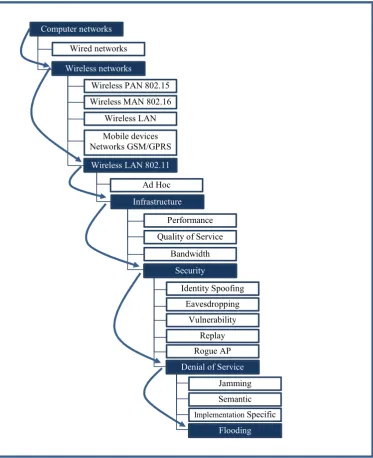
This research will focus mainly on the 802.11-based networks in infrastructure mode, where they are using open system authentication. It proposes a solution to protect WLANs against connection request flooding DoS attacks. Figure 1.2 demonstrates diagrammatically how this research has been narrowed down to cover the existing gap, the arrows show the path.
Figure 1.2 The Narrow-down View of the Research Scope
Based on the availability of the software and hardware, this research has been narrow down within the following scopes:
i. To implement and test the proposed solution, two open source device drivers are used, namely RT73_Linux_STA_Drv1.0.4.0 and hostapd-0.5.8, for wireless cards which use rt73 and prism chipset running on Linux operating systems. Other wireless NIC cards can be used as long as the device drivers for LINUX can be obtained.
Computer networks
Wired networks
Wireless networks
Wireless PAN 802.15
Wireless MAN 802.16
Wireless LAN
Mobile devices Networks GSM/GPRS
Wireless LAN 802.11
Ad Hoc
Infrastructure
Performance
Quality of Service
Bandwidth
Security
Identity Spoofing
Eavesdropping
Vulnerability
Replay
Rogue AP
Denial of Service
Jamming
Semantic
Implementation Specific
ii. The above drivers will be modified using C/C++ programming language to add the proposed solution to the wireless association procedure.
iii. The research will not target other DoS attacks on WLANs such as jamming attacks. Hence, it is assumed that the test environment is immune to other types of DoS attacks.
iv. This research will not support ad hoc wireless networks, but it will be recommended as a support for ad hoc wireless networks in future work.
v. This research targets those WLANs that have been deployed in public area so that no MAC filtering scheme is in place.
1.9 Outline of the Thesis
Chapter 1 introduce the WLAN security challenges and highlighted the harmful impact of connection request flooding (CRF) Denial of Service (DoS) attack on WLANs. In addition, the countermeasures were introduced and compelling reasons that why the current puzzle are not suitable to protect WLAN were provided. Ultimately, the chapter presented the objectives that this research is going to achieve. Chapter 2 provides a fact-finding mission on WLANs technologies and security challenges it has been faced. The client puzzles are studied deeply in three classified groups including hash-based puzzles, number theoretic puzzles, and other payment schemes ,while the weaknesses and strengthens of each are detailed. Moreover, the chapter presents the DNA protein synthesizing process in four steps: Transcription, Initiation, Elongation (Translation), and Elongation and Termination.
REFERENCES
Abadi, M., Burrows, M., Manasse, M., and Wobber, T. (2005, May). Moderately hard, memory-bound functions. ACM Transactions on Internet Technology (TOIT), 5(2), 299 - 327.
Abliz, M., and Znati, T. (2009). A Guided Tour Puzzle for Denial of Service Prevention. 2009 Annual Computer Security Applications Conference. IEEE Computer Society, 279-288.
Abraham, A. M., and Vincent, S. (2012). Defending DoS Attacks Using a Puzzle-Based Approach and Reduction in Traceback Time towards the Attacker . Communications in Computer and Information Science, Springer, 269, 425-433. Alruban, A., and Everitt, E. (2011). Two Novel 802.1x Denial of Service Attacks.
IEEE Computer Society, 183-190.
Anuradha, and Singhrova, A. (2011). A Host Based Intrusion Detection System for DDoS Attack in WLAN. International Conference on Computer &
Communication Technology (ICCCT)-2011. IEEE.
Arockiam, L., Vani, B., Sivagowry, S., and Persia, A. (2012). A Solution to Prevent Resource Flooding Attacks in 802.11 WLAN. Communications in Computer and Information Science, Springer, 269(1), 607-616.
Assoc., P. C. (2006). Test TCP (TTCP) Benchmarking Tool for Measuring TCP and UDP Performance. (Printing Communications Assoc.) Retrieved from PCAUSA Test Lab (PCATTCP "Classic" - PCAUSA's Port Of TTCP To Windows
Sockets): http://testlab.pcausa.com/ttcp/classic/pcattcp.htm
Aura, T., Nikander, P., and Leiwo, J. (2001). DOS-resistant Authentication with Client Puzzles. Sringer Lecture Notes in Computer Science: Security Protocols, 2133/2001, 170-177.
Beard, C., and Stallings, W. (2015). Wireless Communication Networks and Systems (1st ed.). Pearson.
Bicakci, K., and Tavli, B. (2009, September). Denial-of-Service attacks and countermeasures in IEEE 802.11 wireless networks. Computer Standards & Interfaces, 31(5), 931–941.
Boneh, D., and Naor, M. (2000). Timed Commitments. Advances in Cryptology , 1880(1), 236-254.
Burleigh, S., G. Cerf, V., Crowcroft, J., and Tsaoussidis, V. (2014). Space for Internet and Internet for space. Ad Hoc Networks, Elsevier, 23, 80-86. Cai, J.-Y., Lipton, R., Sedgewick, R., and Yao, A. C.-C. (1993). Towards
uncheatable benchmarks. Structure in Complexity Theory Conference. Carl, G., Kesidis, G., Brooks, R. R., and Rai, S. (2006). Denial-of-Service
Attack-Detection Techniques . IEEE Internet Computing, 10(1), 82- 89.
Chen, L., Morrissey, P., and Smart, N. (2009). Security Notions and Generic Constructions for Client Puzzles. ASIACRYPT '09 Proceedings of the 15th International Conference on the Theory and Application of Cryptology and Information Security: Advances in Cryptology, (pp. 505 - 523).
Chen, Y., Kowalik, K., and Davis, M. (2009). MeshScan: Performance of Passive Handoff and Active Handoff. International Conference on Wireless
Communications & Signal Processing, 2009. WCSP 2009. Nanjing : IEEE, 1-5. Chen, Y., Trappe, W., and Martin, R. P. (2007). Detecting and Localizing Wireless
Spoofing Attacks. 4th Annual IEEE Communications Society Conference on Sensor, Mesh and Ad Hoc Communications and Networks, ( SECON '07). San Diego, CA : IEEE, 193-202.
Chibiao, L., Chugui, X., Jinming, Q., and Changjing, L. (2011, December).
Experimental and Theoretical Study of Authentication Request Flooding Attack on 802.11 WLAN. Elsevier, 13, 6800-6808.
Dahshan, H., and Irvine, J. (2008). Analysis of Key Distribution in Mobile Ad Hoc Networks Based on Message Relaying. IEEE International Conference on Wireless & Mobile Computing, Networking & Communication . IEEE Computer Society, 538-542.
Das, R., and Doshi, S. (2004). Network Security Final Report Memory Bound Client Puzzles. Universty Project, John Hopkins University, Baltimore, Maryland. Dong, Q., Gao, L., and Li, X. (2010). A New Client-Puzzle Based DoS-Resistant
Scheme of IEEE 802.11i Wireless Authentication Protocol. 3rd International Conference on Biomedical Engineering and Informatics (BMEI 2010). IEEE, 2712-2716.
Dong, Q., Gao, L., and Li, X. (2010). A New Client-Puzzle Based DoS-Resistant Scheme of IEEE 802.11i Wireless Authentication Protocol. 3rd International Conference on Biomedical Engineering and Informatics (BMEI 2010). IEEE, 2712-2716.
Dong, Q., Li, L., and Li, X. (2011, December). Quadratic Residue Based Client Puzzle Distributed by Beacon Frame in DoS-Resistant Wireless Access
Authentication . Advances in Information Sciences and Service Sciences (AISS) , 3(11), 79-86.
Doshi, S., Monrose, F., and Rubin, A. D. (2006). Efficient Memory Bound Puzzles Using Pattern Databases. Applied Cryptography and Network Security, 3989, 98–113.
Dwork, C., and Naor, M. (1992). Pricing via processing or combatting junk mail. Springer-Verlag.A, 139-147.
Dwork, C., Goldberg, A., and Naor, M. (2003). On Memory-Bound Functions for Fighting Spam . Advances in Cryptology - CRYPTO 2003, 23rd Annual
International Cryptology Conference. Santa Barbara, California, USA. 426-444. Eian, M. (2012). Robustness in Wireless Network Access Protocols. Norwegian
University of Science and Technology.
Eian, M., and Mjølsnes, S. F. (2011). The modeling and comparison of wireless network denial of service attacks. Proceedings of the 3rd ACM SOSP Workshop on Networking, Systems, and Applications on Mobile Handhelds, (pp. 1-6).
Faria, D. B., and Cheriton, D. R. (2006). Detecting Identity-Based Attacks in Wireless Networks Using Signalprints. Proceedings of the 5th ACM Workshop on Wireless Security, 43–52.
Feng, W.-c., Kaiser, E., Feng, W.-c., and Luu, A. (2005). The Design and
Implementation of Network Puzzles. 24th Annual Joint Conference of the IEEE Computer and Communications Societies (INFOCOM 2005). Miami, Florida: IEEE, 2372- 2382 vol. 4.
Ferreri, F., Bernaschi, M., and Valcamonici, L. (2010). Research on the security of IEEE 802.1× authentication mechanism in wireless LAN. 2nd International Conference on Information Science and Engineering (ICISE). Hangzhou, China: IEEE, 2350-2353.
Fragkiadakis, A., Askoxylakis, I., and Chatziadam, P. (2014). Denial-of-Service Attacks in Wireless Networks Using Off-the-Shelf Hardware. Distributed, Ambient, and Pervasive Interactions, Springer, 8530(1), 427–438.
Gao, Y. (2005). Efficient trapdoor-based client puzzle system against DoS attacks. Technical Report.
Gast, M. (2005). 802.11 Wireless Networks The Definitive Guide. O'Reilly.
Gast, M. (2005). 802.11 Wireless Networks The Definitive Guide. Sebastopol, CA: O'Reilly.
Gherghina, C., and Petrică, G. (2013). Wireless LAN Security Issues (I). Types of Attacks. International Journal of Information Security and Cybercrime, 2(2), 61-68.
Groza, B., and Warinschi, B. (2013). Cryptographic puzzles and DoS resilience, revisited. Design, Codes and Cryptography - Springer.
Gu, Q., Liu, P., Lee, W.-C., and Chu, C.-H. (2009, JULY/SEPTEMBER). KTR: An Efficient Key Management Scheme for Secure Data Access Control in Wireless Broadcast Services. IEEE Transactions on Dependable and Secure Computing, 6(3), 188-201.
Hangargi, M. (2015). Denial of Service Attacks in Wireless Networks. Retrieved from Paket Storm Security:
https://packetstormsecurity.com/files/130092/DoS_attacks_in_wireless_
networks.pdf
Hlavacs, H., Gansterer, W., Schabauer, H., and Zottl, J. (2008). Enhancing ZRTP by using Computational Puzzles. Journal of Universal Computer Science, 14(5), 693-716.
Hofheinz, D. U. (2006). Simulatable security and polynomially bounded concurrent composability. IEEE Symposium on Security and Privacy. Berkeley/Oakland, CA: IEEE, 1081-6011.
Hwanga, M.-S., Chong, S.-K., and Chen, T.-Y. (2010, January). DoS-resistant ID-based password authentication scheme using smart cards. Journal of Systems and Software, Elsevier, 83(1), 163–172.
IEEE LAN/MAN Standards Committee. (2007, June 12). IEEE Std 802.11. New York, USA: IEEE Computer Society.
IEEE LAN/MAN Standards Committee. (2012). General description. In Part 11: Wireless LAN Medium Access Control , IEEE Std 802.11™-2012. New York, USA: IEEE, 44-91.
IEEE LAN/MAN Standards Committee. (2012). Overview. In Part 11: Wireless LAN Medium Access Control (MAC) and Physical Layer (PHY) S pecifications (p. 1). NY, USA: IEEE.
IEEE LAN/MAN Standards Committee. (2012). Security. In Part 11: Wireless LAN Medium Access Control , IEEE Std 802.11-2012. NY: IEEE, 1170-1191.
Jeckmans, A. (2009). Practical client puzzle from repeated squaring. Master Essay, University of Twente, Electrical Engineering, Mathematics and Computer Science.
Jerschow, Y. I., and Mauve, M. (2012). Secure Client Puzzles Based on Random Beacons. Networking, 7290(1), 184-197.
Jerschow, Y. I., and Mauve, M. (2013). Modular square root puzzles: Design of non-parallelizable and non-interactive client puzzles. Elsevier: computers & security, 35(1), 25-36.
Jerschow, Y., and Mauve, M. (2011). Non-parallelizable and non-interactive client puzzles from modular square roots. Sixth International Conference on
Availability, Reliability and Security, ARES 2011.
Jing, H., and Wen, W. (2011, March). A Solution to a Dos Attack in Wireless Networks. Energy Procedia, Elsevier, 13, 3932–3936.
Jules, A., and Brainard, J. (1999). Client Puzzle: A Cryptographic Countermeasure against Connection Depletion Attacks. Proceedings of the Network and Distributed System Security Symposium. San Diego: 151-165.
Karame, G. O., and Čapkun, S. (2010). Low-Cost Client Puzzles Based on Modular Exponentiation. Computer Security - Springer, 6345(1), 679-697.
Karumanchi, N., A, D. D., and M, D. S. (2014). Elements of Computer Networking: An Integrated Approach (1st ed.). CareerMonk Publications.
Koh, J. Y., Ming, J. T., and Niyato, D. (2013). Rate limiting client puzzle schemes for denial-of-service mitigation. Wireless Communications and Networking Conference . IEEE.
Koike, D. (2002, December 4). Client Puzzles as a Defense Against Network Denial of Service. ECS, 1-10.
Kuppusamy, L., Rangasamy, J., Stebila, D., Boyd, C., and González Nieto, J. (2012). Practical Client Puzzles in the Standard Model. ACM Computer and
Communications Security, 42-43.
Kurose, J. F., and Ross, K. w. (2010). Computer Networking, A Top-Down Approach (Fifth Edition ed.). Pearson.
Laishun, Z., Minglei, Z., and Yuanbo, G. (2010). A Client Puzzle Based Defense Mechanism to Resist DoS Attacks in WLAN. 2010 International Forum on Information Technology and Applications - IEEE Computer Society, 424-427. Lei, Y., Pierre, S., and Quintero, A. (2006). Client Puzzles Based on Quasi Partial
Collisions Against DoS Attacks in UMTS. Vehicular Technology Conference, 2006. VTC-2006 Fall. 2006 IEEE 64th, (pp. 1-5).
Lenstra, K., A., Lenstra Jr., H. W., and Lovász, L. (1982, December ). Factoring polynomials with rational coefficients. Mathematische Annalen, 261(4), 515-534.
Li, J.-y., and Yang, Y. (2012). Research on DoS Attacks and Resist Method Based on 4-way Handshake in 802.11i. In Electrical, Information Engineering and Mechatronics. Springer, 631-637.
Liu, C., and Yu, J. (2008). Rogue Access Point Based DoS Attacks against 802.11 WLANs. The Fourth Advanced International Conference on
Loukas, G., and Öke, G. (2010). Protection Against Denial of Service Attacks: A Survey. The Computer Journal (Oxford journal), 53(7), 1020-1037.
Malik, M., and Singh, Y. (2015). A Review: DoS and DDoS Attacks. International Journal of Computer Science and Mobile Computing, 4(6), 260-265.
Mao, W. (2001). Timed-Release Cryptography. Selected Areas in Cryptography, 2259, 342-357.
Martinovic, I., Zdarsky, F. A., Wilhelm, M., Wegmann, C., and Schmitt, J. B. (2008). Wireless Client Puzzles in IEEE 802.11 Networks:Security by Wireless. WiSec '08 Proceedings of the first ACM conference on Wireless network
security, (pp. 36-45).
Mendyk-Krajewska, T., Mazur, Z., and Mazur, H. (2012). Threats to Wireless Technologies and Mobile Devices and Company Network Safety. Internet - Technical Developments and Applications, Springer, 118, 209-225.
Merkle, R. C. (1978). Secure communications over insecure channels. Communications of the ACM, 21(4), 294 - 299 .
Moorthy, M., and Sathiyabama, S. (2012). Effective Authentication Technique for Distributed Denial of Service Attacks in Wireless Local Area Networks. Journal of Computer Science, 8(6), 828-834.
Morais, A., and Cavalli, A. (2014). A Distributed and Collaborative Intrusion Detection Architecture for Wireless Mesh Networks. Mobile Networks and Applications, 19(1), 101-120.
Moskowitz, R., Nikander, P., Jokela, P., and Henderson, T. (2008). RFC 5201 — Host Identity Protocol (HIP). Network Working Group. The Internet
Engineering Task Force (IETF). Retrieved from http://www.ietf.org/rfc/rfc5201.txt
Naqvi, A. (2013). Utilising Fuzzy Logic to Improve Wi-Fi Security. 11th International Conference on ICT and Knowledge Engineering (ICT&KE).
Bangkok : IEEE, 1- 5.
Narasimhan, H., Varadarajan, V., and Rangan, C. P. (2010). Game Theoretic Resistance to Denial of Service Attacks Using Hidden Difficulty Puzzles. ISPEC'10 Proceedings of the 6th international conference on Information Security Practice and Experience, (pp. 359-376 ).
Odom, W. (2008). CCENT/CCNA ICND1. Indiana: Cisco Press.
Orebaugh, A., Ramirez, G., and Burke, J. B. (2006). Wireshark & Ethereal Network Protocol Analyzer Toolkit (Fisrt ed.). Elsevior.
Perahia, E., and Stacey, R. (2013). Next Generation Wireless LANs: 802.11n and 802.11ac (2nd ed.). Cambridge University Press.
Ragupathy, R., and Sharma, R. (2014). Detecting Denial of Service Attacks by Analysing Network Traffic in Wireless Networks. International Journal of Grid Distribution Computing, 7(3), 103-112.
Rangasamy, J., Stebila, D., Boyd, C., and Nieto, J. (2011, March). An Integrated Approach to Cryptographic Mitigation of Denial-of-Service Attacks. ASIACCS '11 Proceedings of the 6th ACM Symposium on Information, Computer and Communications Security, 114-123.
Rangasamy, J., Stebila, D., Kuppusamy, L., Boyd, C., and Nieto, J. G. (2012). Efficient Modular Exponentiation-Based Puzzles for Denial-of-Service Protection. Information Security and Cryptology, Springer, 7259, 319-331. Ratnayake, D. N., Kazemian, H. B., and Yusuf, S. A. (2014). Identification of probe
request attacks in WLANs. Neural Computing & Applications, Springer, 25, 1-14.
Rehman, S. U., Ullah, S., and Ali, S. (2010). On Enhancing the WEP Security Against Brute-force and Compromised Keys. InternationalConference on Computer Information Systems and IndustrialManagement Applications (CISIM). IEEE, 250-254.
Rivest, R. L., Shamir, A., and Wagner, D. A. (1996, March 10). Time-lock Puzzles and Timed-release Crypto. Massachusetts Institute of Technology. Cambridge, USA: MIT/LCS/TR-684, MIT Laboratory for Computer Science.
Rosenthal, D. S. (2003, Nov). On The Cost Distribution of a Memory Bound Function. Computing Research Repository (CoRR), 1-7.
Sandberg, B. (2015). Networking The Complete Reference, Third Edition (3rd ed.). McGrow-Hill Education.
Sharma, N., and Barwal, P. N. (2014). Study of DoS Attacks on IEEE 802.11 WLAN and its Prevention/Detection Techniques. International Journal of Engineering Science and Innovative Technology, 3(3), 245-252.
Shi, T.-j., and Ma, J.-f. (2006). Design and analysis of a wireless authentication protocol against DoS attacks based on Hash function. Aerospace Electronics Information Engineering and Control, (pp. 122-126).
Shoup, V. (2004). Sequence of Games: A Tool for Taming Complexity in Security Proofs. IACR Cryptology ePrint Archive, Report 2004/332. Retrieved from http://eprint.iacr.org/.: http://eprint.iacr.org/
Singh, R., and Sharma, T. P. (2014). A Key Hiding Communication Scheme for Enhancing the Wireless LAN Security. Wireless Personal Communications, 77(2), 1145-1165.
Singh, R., and Sharma, T. P. (2015). On the IEEE 802.11i security: a denial-of-service perspective. Security and Communication Networks, Wiley, 8(7), 1378– 1407.
Smith, C., and Collins, D. (2014). Wireless Networks (3rd ed.). McGrow-Hill Education.
Smith, C., and Collins, D. (2014). Wireless Networks (3rd ed.). Mc Graw Hill Education.
Soryal, J., and Saadawi, T. (2014). IEEE 802.11 DoS attack detection and mitigation utilizing Cross Layer Design. Ad Hoc Networks, Elsevier, 14, 71-83.
Stapko, T. (2010). EETimes design. Retrieved October 10, 2012, from
http://www.eetimes.com/design/embedded-internet-design/4019862/Practical-Embedded-Security--Part-3-Wireless-technologies?pageNumber=1
Stebila, D., Kuppusamy, L., Rangasamy, J., Boyd, C., and Gonzalez Nieto, J. (2011). Stronger Difficulty Notions for Client Puzzles and Denial-of-Service-Resistant Protocols. Topics in Cryptology – CT-RSA 2011, springer, 6558, 284-301. Tanenbaum, A. S., and J. Wetherall, D. (2010). Computer Network (Fifth Edition
ed.). Prentice Hall.
Tang, Q., and Jeckmans, A. (2010). On Non-Parallelizable Deterministic Client Puzzle Scheme with Batch Verification Modes. University of Twente, Centre for Telematics and Information Technology, Netherland (Enschede). Retrieved from http://doc.utwente.nl/69557/
Tang, Q., and Jeckmans, A. (2011). Towards a security model for computational puzzle schemes. International Journal of Computer Mathematics, Taylor & Francis, 88(11), 2246–2257.
Thapa, B. (2011). Robust Wireless Communication in Adversarial Settings. PhD Thesis, Northeastern University, Boston, Massachusetts.
Thapa, B. (2012). Robust Wireless Communication in Adversarial Settings. Northeastern University. ProQuest. Retrieved from Lyrtech RD: http://lyrtechrd.com/en/products/view/+tunable-rf-modules
Tritilanunt, S., Boyd, C., Foo, E., and Nieto, J. M. (2007). Toward Non-parallelizable Client Puzzles. Cryptology and Network Security, 4856, 247-264.
Tupakul, U., Varadharajan, V., and Vuppala, S. K. (2011). Counteracting DDoS Attacks in WLAN. Proceedings of the 4th international conference on Security of information and networks , (pp. 119-126 ).
Von Ahn, L., Blum, M., Hopper, N. J., and Langford, J. (2003). CAPTCHA: Using Hard AI Problems for Security. Advances in Cryptology, 2656, 294-311.
Walfish, M., Vutukuru, M., Balakrishnan, H., and Karger, D. (2006). DDoS defense by offense. SIGCOMM '06 Proceedings of the 2006 conference on Applications, technologies, architectures, and protocols for computer communications. NY. Wan, M., Shang, W., Zhao, J., and Zhang, S. (2014). C2Puzzle: A Novel
Computational Client Puzzle for Network Security. Advanced Materials Research, 846-847, 1615-1619.
Wang, L., Srinivasan, B., and Bhattacharjee, N. (2011, March). Security Analysis and Improvements on WLANs. Journal of Networks, 6(3), 470-481.
Wang, X., and Reiter, M. K. (2008). A multi-layer framework for puzzle-based denial-of-service defense. International Journal of Information Security, 7(4), 243-263.
WiFi. (2015). Retrieved 2015, from http://www.wi-fi.org/who-we-are Wu, Y., Zhao, Z., Bao, F., and Deng, R. H. (2015). Software Puzzle: A
Countermeasure to Resource-Inflated Denial-of-Service Attacks. IEEE Transactions on Information Forensics and Security, 10(1), 168-177. Ying, X., and Yu, C. (2010). Research on Key Authentication Mechanisms of
Wireless Local Area Network. 2nd International Workshop on Intelligent Systems and Applications (ISA). Wuhan: IEEE, 1 - 4.
Zeynep Gurkas, G., Zaim, A. H., and Aydin, M. A. (2006). Security Mechanisms And Their Performance Impacts On Wireless Local Area Networks.
International Symposium on Computer Networks (pp. 1 - 5). Istanbul: IEEE. Zhang, Y., and Sampalli, S. (2010). Client-based Intrusion Prevention System for
802.11 Wireless LANs. EEE 6th Intemational Conference on Wireless and Mobile Computing. Networking and Communications. IEEE, 100-107.
Zhao, Y., Vemuri, S., Chen, J., Chen, Y., Zhou, H., and Fu, Z. (. (2009). Exception Triggered DoS Attacks on Wireless Networks. IEEE/IFIP International