Scholarship at UWindsor
Scholarship at UWindsor
Electronic Theses and Dissertations Theses, Dissertations, and Major Papers
2014
How Partial Transparency Influences the Processing of
How Partial Transparency Influences the Processing of
Compound Words
Compound Words
Alexandria Stathis
University of Windsor
Follow this and additional works at: https://scholar.uwindsor.ca/etd
Part of the Psychology Commons
Recommended Citation Recommended Citation
Stathis, Alexandria, "How Partial Transparency Influences the Processing of Compound Words" (2014). Electronic Theses and Dissertations. 5056.
https://scholar.uwindsor.ca/etd/5056
This online database contains the full-text of PhD dissertations and Masters’ theses of University of Windsor students from 1954 forward. These documents are made available for personal study and research purposes only, in accordance with the Canadian Copyright Act and the Creative Commons license—CC BY-NC-ND (Attribution, Non-Commercial, No Derivative Works). Under this license, works must always be attributed to the copyright holder (original author), cannot be used for any commercial purposes, and may not be altered. Any other use would require the permission of the copyright holder. Students may inquire about withdrawing their dissertation and/or thesis from this database. For additional inquiries, please contact the repository administrator via email
How Partial Transparency Influences the Processing of Compound Words
By
Alexandria Stathis
A Thesis
Submitted to the Faculty of Graduate Studies
through Clinical Psychology
in Partial Fulfillment of the Requirements for
the Degree of Master of Arts at the
University of Windsor
Windsor, Ontario, Canada
How Partial Transparency Influences the Processing of Compound Words
by
Alexandria Stathis
APPROVED BY:
______________________________________________ N. McNevin
Human Kinetics
______________________________________________ A. Baird
Psychology
______________________________________________ L. Buchanan, Advisor
Psychology
Author’s Declaration of Originality
I hereby certify that I am the sole author of this thesis and that no part of this thesis has
been published or submitted for publication.
I certify that, to the best of my knowledge, my thesis does not infringe upon anyone’s
copyright nor violate any proprietary rights and that any ideas, techniques, quotations, or any
other material from the work of other people included in my thesis, published or otherwise, are
fully acknowledged in accordance with the standard referencing practices. Furthermore, to the
extent that I have included copyrighted material that surpasses the bounds of fair dealing within
the meaning of the Canada Copyright Act, I certify that I have obtained a written permission
from the copyright owner(s) to include such material(s) in my thesis and have included copies of
such copyright clearances to my appendix.
I declare that this is a true copy of my thesis, including any final revisions, as approved
by my thesis committee and the Graduate Studies office, and that this thesis has not been
Abstract
Compound words are words with multiple constituents that individually have their own meaning
and that combine to make another meaning (e.g. doghouse). When these constituents help us
infer the meaning of the whole compound word, they are known as transparent constituents (e.g.
either constituent of blueberry). In contrast, opaque constituents do not help us infer the meaning
of the whole compound word (e.g. moonshine). The current study sought to describe the
processing of partially transparent words, in which one constituent relates to the total meaning,
whereas the other does not (like strawberry, which is a berry, but not made of straw).
Thirty-seven participants were asked to complete a lexical decision task in which they indicated whether
an item was a word or a nonword. The fully transparent compound words enjoyed a processing
advantage when compared to the monomorphemic words. This processing advantage
TABLE OF CONTENTS
AUTHOR’S DECLARATION OF ORIGINALITY iii
ABSTRACT iv
LIST OF TABLES vi
LIST OF FIGURES vii
CHAPTER
I. INTRODUCTION 1
II. METHODS 7
Participants 7
Materials 7
Procedures 9
III. RESULTS 10
IV. DISCUSSION 16
REFERENCES 21
APPENDIX A: Compound and Monomorphemic Words 25
APPENDIX B: Nonwords 31
LIST OF TABLES
LIST OF FIGURES
FIGURE 1: Mean Reaction Times by Word Type 13
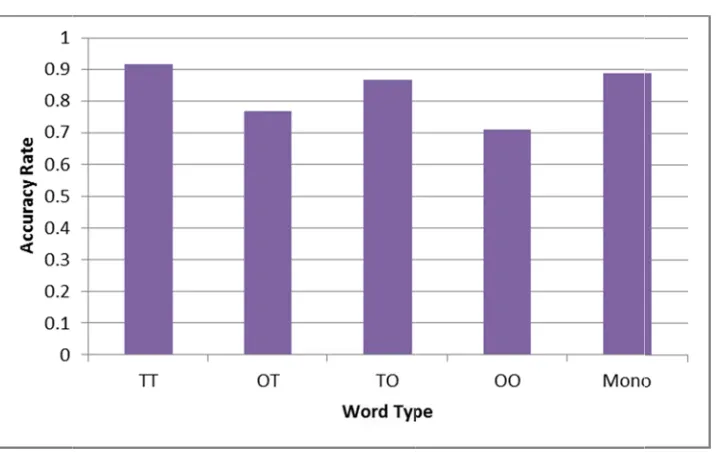
FIGURE 2: Mean Accuracy by Condition 14
How Partial Transparency Influences the Processing of Compound Words
The primary goal of psycholinguistics research is to learn how people process and
understand language. One important question is how meaning is derived from single words. In
psycholinguistic terms, a word's meaning reflects its morphemic content. A morpheme is the
smallest meaningful unit of a word, such as the word giraffe (Ji, Gagne, & Spalding, 2011). This
word cannot be divided into any smaller, meaningful units. A monomorphemic word is just that:
a word comprised of a single morpheme (Ji, Gagne, & Spalding, 2011). In contrast, a
multimorphemic word is comprised of multiple morphemes, for example giraffes has two
meaningful units (giraffe and 's' that designates more than one giraffe). A special case of
multimorphemic words is the compound word (Ji, Gagne, & Spalding, 2011). A compound word
traditionally contains two components, known as constituents, for example blueberry with its
constituents blue and berry.
Compound words are found in a multitude of languages. Each language contains its own
rules about the development and usage of these compound words. In Finnish, Dutch, and
German novel compound words are common and are developed spontaneously
(Hittmair-Delazer, Andree, Semenza, Blesser, & Benke, 1994; Juhasz, Starr, Inhoff, & Placke, 2003).
English is not such a spontaneous language and there are no systematic rules concerning how
free morphemes ultimately become paired to form a compound word (Juhasz et al, 2003).
In English compound words, the second constituent is generally the “head” of the word
(Libben & Jarema, 2006; McGregor, Rost, Guo, & Sheng, 2008). Essentially, the head of the
compound indicates something about the semantic (i.e., meaning) category of the word, and the
other constituent modifies it (McGregor et al, 2008). For example, houseboat describes a type of
Research by Juhasz et al (2003) supports the idea that the second constituent is used to
determine the semantic categorization of a compound word. In their study, the authors examined
the processing of compound words by studying eye fixation, naming, and lexical decisions. They
reported increased eye fixations, as well as faster lexical decisions and naming for the head, or
second constituent (Juhasz et al, 2003). Evidently, the meaning conveyed in the second
constituent holds comparably more weight than the first constituent.
Compound words offer psycholinguists a unique window into morphemic influences in
single word reading, and are consequently important for theoretical reasons. At a more applied
level, an understanding of normal compound word reading may assist educators charged with
helping students with specific language impairments (SLI). Previous research indicates that
children with SLIs have difficulty ordering noun-noun compound words (like doghouse). This
had been attributed to a lexical deficit (Grela, Snyder, & Hiramatsu, 2005), but McGregor et al's
(2008) expansion of this research suggests that the deficit may be one of compounding rather
than accessing.
This consideration of processing deficits as either compounding or accessing maps onto
one of the central theoretical debates in compound word research. There are two main theories of
compound word comprehension: whole word processing and decomposition (Libben & Jarema,
2006). In the whole word processing model, a compound word is represented and accessed as a
whole unit, just as monomorphemic words are (Butterworth, 1983). In the decomposition model,
however, the compound words are accessed and assembled via their two constituents (Andrews,
1986; Andrews, Miller, & Rayner, 2004; Libben, 1998; Pollastek, Hyona, & Bertram, 2000; Taft
Each theory entails a different combination of costs and benefits for the person
processing the compound word. The decomposition model has a processing burden, whereas the
whole word model has a storage burden. For the former, only the constituents are stored in the
lexicon, but the morphological parsing is associated with a time cost (Bertram, Laine, &
Karvinen, 1999). For the latter, the whole word representation must be stored in addition to its
constituents, but that storage eliminates the need for additional parsing (Butterworth, 1983;
Libben & Jarema, 2006). An argument in favour of the whole word model is that decomposition
is thought to be more error-prone than whole word access (Lehtonen et al, 2007). Despite this,
there have been a number of studies that have found that morphological decomposition occurs
regularly in compound words (Andrews, 1986; Andrews, Miller, & Rayner, 2004; Libben, 1998;
Pollastek, Hyona, & Bertram, 2000; Taft & Forster, 1975; Zwisterlood, 1994).
It may not be that decomposition and whole word access are opposing processes. A
number of researchers have proposed a horse race model (see Laine, Vainio, & Hyona, 1999),
whereby decomposition occurs at the same time as whole word processing, with the faster
method being determined by theoretically important variables, such as word presentation, word
frequency, and transparency as described below (Ji, Gagne, and Spalding, 2011; Libben et al.,
2003; Baayen, Dijkstra, & Shreuder, 1997; Bertram et al, 1999; Frauenfelder & Shreuder, 1991).
The transparency of a compound describes the semantic content of a constituent as it
relates to meaning of the whole word (Libben & Jarema, 2006). If a constituent is transparent,
then it is related to the whole meaning of the compound word. In the word blueberry, both
constituents are transparent because a blueberry is, indeed, a berry that is blue. A constituent can
also be opaque, which means that it does not explicitly relate to the whole compound word
form of alcohol, but it has nothing to do with either the moon or its shine. The matter is further
complicated by the fact that partial transparency exists. That is, one of the constituents is
transparent, while the other remains opaque (Libben & Jarema, 2006). Strawberry is a common
example, in which the head is transparent (because a strawberry is a berry), while the modifier is
opaque (because a strawberry is not a berry made of straw). Jailbird is another example where
the modifier is transparent and the head is opaque.
Laudana and Burani (1995) have suggested that semantic transparency determines
whether a compound word will be processed via whole word recognition or through
decomposition. Similarly, Schreuder and Baayen's (1995) meta-model of morphological
processing postulates that semantic transparency determines whether a compound word has its
own representation in the mental lexicon, or whether it is represented by its constituents. In this
model, totally opaque compound words must be stored as a whole word, because decomposing
the word into its constituents gives no information about the meaning of the word (Libben,
Gibson, Yoon, & Sandra, 2003).
Libben et al (2003) examined how transparency influences the processing of compound
words in a lexical decision task. Libben et al (2003) presented the participants with four types of
compound words based on constituent transparency: transparent-transparent (TT),
opaque-transparent (OT), opaque-transparent-opaque (TO), and opaque-opaque (OO). There were processing
differences across the word types, with responses to words with transparent heads (TT and OT)
being faster than to words with opaque heads (TO and OO). Importantly, the advantage
disappeared for the OT words in a second condition that presented the compound words with
spaces between the constituents. The spaces introduced between the constituents made
decomposition showed the advantage. Therefore, when decomposition was encouraged via the
addition of spaces, TO, OT, and OO words showed similar processing patterns.
Physiological support for the influences of transparency comes from research by Koester
et al. (2007) who studied compound words by tracking event-related brain potentials (ERPs).
They found that the ERP signals (N400) differed as a function of constituent transparency. Fully
transparent compound words elicited an increased negativity relative to opaque and partially
transparent compound words. This seems to indicate that the transparency of the constituents is
important in the accessing and understanding of compound words.
There is both behavioural and physiological support for a horse race model of compound
word processing that is influenced by transparency of the constituents. However, to the extent
that compound words have two pathways to recognition, they should show a processing
advantage over monomorphemic words. Ji, Gagne, and Spalding (2011) tested just this in their
lexical decision study contrasting transparent and opaque compound words with
monomorphemic words. It is important to note that the Ji, Gagne, and Spalding (2011) study
included both partially transparent and fully opaque words within their opaque group. Their
results indicated faster reaction times for both groups of compound words when compared to
monomorphemic words. Like Libben et al (2003), they also encouraged decomposition
processing in a second condition in which spaces were added. In that second condition, the
processing advantage for opaque words disappeared. They suggested that this might have
something to do with the conflict between the lexical representation of the whole word and the
meaning of the constituents. Of course, in the case of the fully transparent words this conflict
does not exist, so they still retained the processing advantage. These findings (Ji, Gagne and
compounds that are not fully transparent is likely to be, in most cases, the whole word route. For
fully transparent words, both routes are equally useful.
By contrasting responses for compound words to responses for monomorphemic words,
this research (Ji, Gagne, & Spalding, 2011) complements Libben's (2003) findings and adds to
our knowledge regarding how compound words are processed in English. However, a
consideration of the two studies reveals that a gap in the literature exists. The processing of
partially transparent compound words has never been compared to the processing of
monomorphemic words. While Libben's (2003) research did not reveal differences between any
of the groups with opaque constituents when the decomposition paradigm was used, they were
not compared to monomorphemic words. We are still faced with the query of whether words
with partial transparency are able to derive a processing advantage relative to monomorphemic
words. The question remains: compared to monomorphemic words, do compound words with
transparency of head or modifier alone give rise to advantages derived from having two
pathways to recognition? The purpose of this study is to answer this question.
To summarize, we know that there is a processing advantage associated with compound
words compared to monomorphemic words (Ji, Gagne, & Spalding, 2011). We also know that
this processing advantage disappears for opaque words when decomposition is forced by
incorporating spaces between words (Ji, Gagne, & Spalding, 2011). What we do not know is
whether partial transparency is sufficient to maintain this processing advantage over
monomorphemes in the forced decomposition paradigm.
This study has one main hypothesis: fully or partially transparent compound words that
accuracy than will monomorphemic words. In contrast, fully opaque words presented in the same
manner will not be.
Methods
Participants
Thirty-seven University of Windsor undergraduates were drawn from the Participant
Pool. The participants in this sample were predominantly female (83%) and predominantly in
their 20s (range = 18 to 43). Participants were granted bonus points towards the Participant Pool
in exchange for their participation. These points could be allotted towards eligible psychology
courses. As this study took approximately 30 minutes to complete, the participants were all
compensated with 0.5 bonus points, as is consistent with Participant Pool guidelines.
There was a single exclusionary criterion used for this study: participants were required
to be fluent in the English language. The purpose of this study is to look at how words are
perceived and understood. If a participant is not familiar with English words, then it will be more
difficult for them to decide whether an item a word or a non-word.
Materials
This study used a modified version of the word lists generated by Ji, Gagne, and Spalding
(2011). Expanding on this study the current compound word lists were divided into the four
transparency groups: transparent-transparent (TT), opaque-transparent (OT), transparent-opaque
(TO), and opaque-opaque (OO). Using similar word selection criteria (e.g. by matching each
item’s letters and syllables) as Ji, Gagne, and Spalding (2011), additional items were added to the
partially transparent lists so that there were an equal number of words in each category. The
monomorphemic words of Ji, Gagne and Spalding (2011) were used along with additional
(consistent with the broken presentation pattern), there was a mixture of component types. For
instance, there were an equal proportion of monomorphemic words that had two real component
(i.e. plank ton), words that had a real first component (i.e. con clude), words that had a real
second component (i.e. pron ounce), and words where neither of the components were real (i.e
chole sterol). These additional words were added using WordMine (Durda & Buchanan, 2006) and were selected according to the number of letters (range: 6 - 11) and syllables (range: 2 - 4),
as well as orthographic neighbourhood frequencies (ONF; whole ONF range: 0 – 2, but usually 0).
An orthographic neighbour is defined as a word of the same length as the target word that
differs by only one letter (Perea & Rosa, 2000). For instance, cat is an orthographic neighbour to
bat. The orthographic neighbourhood frequency describes the average frequency at which the
orthographic neighbours are encountered in presentations of text (Perea & Rosa, 2000). This is
important because research suggests that the number of orthographical neighbours a word has
may affect lexical access, which in turn may influence reaction times (Perea & Rosa, 2000).
Finally, an equal amount of nonwords were added to the word list. There were two types
of nonwords: those that had characteristics of monomorphemic words (i.e., flouch), and those
that had characteristic of compound words (i.e. topdrug). Compound nonwords were taken from
Taft and Forster (1976). These were constructed in such a way that nonword constituent pairs
used letter combinations that would very rarely be seen together in monomorphemic words (such
as k and b, which are rare consonant pairs). There were four types of compound nonwords. The
first is a word-word pair, in which both constituents are real words, but the total compound word
is not found in the English language (i.e. brief tax). The second is a word-nonword pair, in which
third is a nonword-word pair and the fourth is a nonword-nonword pair. Monomorphemic
nonwords were taken from the Ji, Gagne, and Spalding (2011) study, and additional ones were
also creating using Wuggy, the multilingual pseudoword generator (Keuleers and Brysbaert,
2010).
In summation, there were 40 compound words (10 each TT, OO, TO and OT), 80
monomorphemic words, 40 compound-like nonwords, and 80 monomorpheme-like nonwords for
a total of 240 words. There were twice as many monomorphemic words as compound words and
twice as many monomorpheme-like nonwords as compound-like nonword because this strategy
made controlling for compound words less difficult. With more monomorphemic words,
participants would probably remain unaware that this was a study about compound words and
would presumably be less inclined to quickly identify constituent nonwords and then reject the
word based on the first constituent.
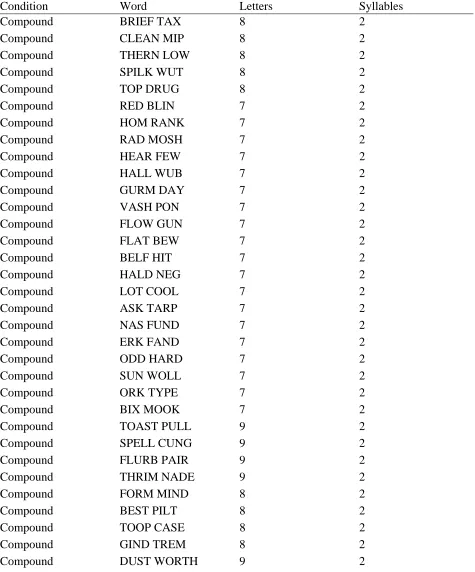
The items used in this study can be seen in the Appendices, as well as their respective
number of letters, syllables, and orthographic neighbourhood frequencies.
Procedures
The study began by having each participant fill out demographic information (age and
sex) on the computer. The participants then began the lexical decision task in which they were
asked to indicate as quickly and accurately as possible whether a presented letter string was a
real English word or a nonword (ignoring the spaces in the items). The lexical decision task was
run using DirectRT (Jarvis, 2012), which displayed the instructions, practice trials, and the
experimental trials on a computer screen. Each word was presented in the centre of the screen,
with size 24 Times New Roman font, in bright aqua on a black background. The keyboard
recorded with a timing resolution of 1 millisecond, which allows for an accurate capture of
lexical decision reaction times. Accuracy was also recorded.
The items were presented one at a time on the computer display in randomized order.
Each item followed a 300 ms presentation of a fixation cross at the center of the display and the
item remained on the display until a response was made. Participants made the lexical decision
by pressing the designated key on the button bar with their index finger (they were instructed to
press 1 for real words and 3 for nonwords). They were also instructed that after each decision,
they were to return their finger to the 2 key (located between buttons 1 and 3) in preparation for
the next trial. This was to reduce the potential influence of predictive hovering. Before the test
trials began, the participants were asked to complete a series of practice trials to ensure that they
understood the instructions. They received feedback as to whether their lexical decision was
correct immediately after each practice trial. Upon completion of the practice trials, the
participants were then able to continue onto the test trials.
Given the length of this lexical decision task, participants were allotted breaks every 50
words to prevent fatigue. When the participants were ready to proceed, they were able to press a
key to continue with the trials.
Results
To examine how partially transparent compound words behave relative to
monomorphemic words, reaction times and accuracy rates were evaluated using separate
Repeated Measures ANOVAs. Both reaction time and accuracy are thought to be estimates of a
word’s ease of processing. Indeed, words that are easy to process should be identified more
To help analyze reaction time and accuracy rate together, the inverse efficiency score
(IES; Townsend & Ashby, 1978) was calculated for each word type per participant. Inverse efficiency scores are calculated by dividing each participant's average reaction time by their average accuracy rate, per word type. As such, the IES is basically an estimate of reaction time
that has been adjusted according to accuracy. The lower the accuracy the more units it adds on to the adjusted time, whereas a perfect score means that the reaction time remains the same. It also
has the advantage of being a measure that accounts for both reaction time and accuracy in a single quantity. A study by Bruyer and Brysbaert (2011) describes that the unit of measurement attributed to IES is milliseconds.
The IES can be thought of as a measurement that gauges the average effort used by the system over time (Bruyer & Brysbaert, 2011; Townsend & Ashby, 1978). A higher IES value
can represent the idea that more effort was expended in the processing of a word, and consequently is processed less efficiently than items with lower IES values.
Correct reaction times were analyzed using a Repeated Measures ANOVA, followed with
a planned contrast (in which TT, OT, TO, and OO words were compared to the monomorphemic
words). Before conducting any analytical procedures, the data was examined for normality and
outliers. Three participants were excluded from data analysis due to low accuracy (less than
70%). Any reaction times that were greater than 2.5 standard deviations away from the mean per
condition were removed. One reaction time was removed for being less than 300ms. Altogether,
this led to the removal of 2.5% of the observations.
To assess for departures of normality, skewness, kurtosis, and the Shapiro-Wilk’s statistic
were all considered. Shapiro-Wilk’s was significant, indicating that normality cannot be
skewness and kurtosis, each word type showed a slight positively skewed distribution, while
kurtosis was roughly within normal limits (or slightly platykurtic). Homogeneity of variance was
evaluated by examining Levene’s test, which was not significant, indicating that the assumption
of homogeneity of variance was met.
Sphericity is the final assumption that must be considered when conducting a repeated
measures ANOVA. To determine whether any departures from sphericity were present,
Mauchley’s test (W = .235, p < .05) was used, and results indicated that the assumption of
sphericity was violated. Given that estimates of sphericity fell below 0.75, the
Greenhouse-Geisser correction was used when assessing within-subject effects. Cohen’s d was calculated
using Morris and DeShon’s (2002) equation, which corrects for dependence in within-subject
studies.
The results reveal a main effect of word type in the reaction time data, F1(2.57,84.65) =
4.650, p < .01. In particular, TT words were responded to faster than monomorphemic words,
F1(1, 33) = 18.954, p < .01, d = .712. In contrast, OT (F1(1,33) = .959, p = .335, d = .161), TO
(F1(1,33) = .225, p = .638, d = .078), and OO words (F1(1,33) = 1.743, p = .196, d = .218) were
not responded to at a different rate than monomorphemic words. Post-hoc analysis using
Bonferroni correction found no differences between the reaction times of TO and OT words, p >
0.05. A visual representation of the reaction time for each word type can be seen in Figure 1 below.
Figure 1
A
planned c
words). S
Homogen indicatin departure results in sphericity subject e R
28.881, p
7.507, p < and OT w between
analysis u
Accuracy rate
contrast (in w
Shapiro-Wilk
neity of vari
g that the as
es from sphe
ndicated that
y fell below
ffects.
Results indica
p < .01). Mo
< .05, d = .4
words (F1(1
monomorph
using the Bo
es were anal
which TT, O
k’s was sign
iance was ev
sumption of
ericity were p
the assumpt
0.75, the Gr
ate that word nomorphem
486), but mor , 33) = 21.70 hemic words
onferroni cor
yzed using a
OT, TO, and
nificant, indic
valuated by e
f homogeneit
present, Mau
tion of spher
reenhouse-G
d type had a mic words we
re accurately 07, p < .01, d
and TO wo
rrection reve
a Repeated M
OO words w
cating that n
examining L
ty of varianc
uchley’s test
ricity was vi
Geisser corre
main effect ere processed
y than OO (F
d = .879). No
rds (F1(1, 3
ealed that TO
Measures AN
were all com
normality can
Levene’s test
ce was met.
t (W = .460,
iolated. Give
ction was us
on accuracy d less accura
F1(1, 33) = 3
o significant
3) = .712, p
O words wer
NOVA, follo
mpared to mo
nnot be assu
t, which was
To determin
p < .05) was
en that estim
sed when ass
y rate (F1(2. ately than TT
34.813, p < t differences
= .402, d =
re processed
owed with a
onomorphem
umed.
not signific
ne whether a
s used, and
mates of
sessing with
83, 98.38) = T (F1(1, 33)
.01, d = .880 s were found .189). Post h
than OT
seen in F Figure 2 Graph of T followed monomo assumpti Greenhou R F1(2.486 scores th
(F1(1,33
revealed
efficiency
words, p < 0
Figure 2. 2
f Accuracy R
To analyze th d by a planne
rphemic wo on of spheri
use-Geisser Results indica
6, 82.051) =
an monomor
) = 10.118, p
higher inver
y scores of t
0.05. A visua
Rate by Word
he inverse ef ed contrast (i
rds). Assess icity was not
correction w ate that word 14.346, p <
rphemic wor
p < .01, d = rse efficienc
the TO word
al of represe
d Type
fficiency sco in which TT
ments of sph t met. Since
was used whe d type had a
.001. Specif
rds, F(1,33) 0.719) and y scores than
ds were not s
entation of th
res a Repeat , OT, TO, an
hericity (W = estimates of
en assessing main effect fically, TT w
) = 20.130, p
OO words (F
n monomorp
significantly
he accuracy r
ted Measure nd OO word
= .125, p<.0 f sphericity f
g within-subj on the inve words resulte
p < .001, d =
F1(1,33) = 1
phemic word
different fro
rates by wor
es ANOVA w ds were all co
05) indicated fell below 0.
ject effects. erse efficienc ed in lower i
= 0.774. In co 17.545, p < . ds. Finally, t
om monomo
rd type can b
was conduct ompared to
d that the 75, the
cy score, nverse effici
F(1,33) =
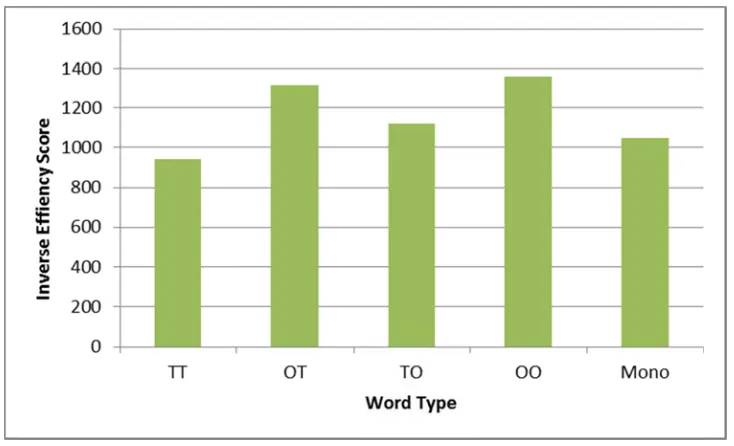
that OT w of each g
Figure 3 Graph of M word gro Table 1 Means an RT (ms) Accuracy IES
= 2.335, p =
words were p group’s inver
f Inverse Effi
Means and st
oup can be se
nd Standard
Mean
SD
y1 Mean
SD
Mean
.136, d = 0.2
processed le rse efficienc
ficiency Scor
andard devia
een in table
d Deviations
294. Post ho
ess efficiently y scores can
res by Word
ations for rea
1 below.
of Calculati
TT O
892.113 97
186.892 22
.935 .7
.101 .1
970.710 13
oc analysis u
y than TO w n be seen in f
Type
action times
ions by Word
OT 74.960 22.928 786 75 351.964
using the Bon
words, p < 0. figure 3 belo
s, accuracy ra
d Type Word Ty TO 966.820 223.451 .879 .151 1151.618 nferroni corr
.05. A visua ow.
ates, and IES
ype OO 932.379 235.277 .723 .194 1398.892 rection revea al representa
S units for e
SD 258.856 632.753 408.509 572.0136 273.419
1.Accuracy is represented as percentage correct.
Discussion
The aim of the current study was to evaluate how partially transparent compound words
are processed relative to monomorphemic words. Previous research (Ji, Gagne, & Spalding,
2011; Libben et al, 2003; Libben, 1998) has shown that compound words, regardless of
transparency, are processed with more ease than monomorphemic words in lexical decision
tasks. When decomposition processing is encouraged via the addition of spaces between the
constituents, Ji, Gagne, and Spalding (2011) found that opaque compound words lost their
processing advantage relative to monomorphemic words. The current study sought to examine
what would happen in the same paradigm under conditions where the number and position of
transparent constituents in the compound word was varied.
Consistent with previous literature (Ji, Gagne, & Spalding, 2011; Libben, 1998), semantic
transparency seems to facilitate compound processing relative to monomorphemic processing,
but only when both constituents are transparent. In the current study, fully transparent compound
words were processed more rapidly, more accurately, and consequently yielded a lower IES than
monomorphemic words (indicating comparably more processing efficiency).
Also as seen in Ji, Gagne, and Spalding (2011), fully opaque compound words did not
show a processing advantage relative to monomorphemic words. Opaque compound word
reaction times were not significantly different from monomorphemic words, while opaque
compound words were processed less accurately than monomorphemic words. Opaque
compound words showed a higher IES than monomorphemic words, thereby indicating
These results make sense in light of what is already known about how compound words
are processed. In the current study, decomposition was encouraged by adding spaces between the
constituents/components of both compound and monomorphemic words. In such a situation it
appears that participants read each of the constituents separately, combine them in their mental
lexicon, and then decide whether the item is a real word. When both constituents are transparent,
both are able to provide consistent semantic information about the meaning of the word (Libben
& Jarema, 2006). As such, the word should be identified more rapidly because the reader can
take advantage of the decomposition route. With fully opaque compound words, however, the
reader cannot readily take advantage of the decomposition route because the information in the
constituents indicate nothing about the total meaning of the word (Libben & Jarema, 2006).
Therefore, the reader needs additional time in order to process fully opaque compound words
using the whole word route. Consequently there is no advantage afforded to the processing of
fully opaque compound words relative to monomorphemic words
Having one transparent constituent was not sufficient to produce a processing advantage,
and, in fact, having a transparent head following an opaque modifier seemed to hinder processing
accuracy. This is an interesting finding, given that the head of the compound word describes the
primary semantic categorization about the whole compound (Libben & Jarema, 2006). Given
that the information contained in a transparent head is relevant to the total meaning of the word,
it should follow that participants would be able to use this information to help identify the word
as being real. OT and TO showed similar reaction times to monomorphemic words. Additionally,
OT words were processed less accurately than monomorphemic words, whereas TO words
maintained roughly the same accuracy as monomorphemic words. OT words showed a higher
words. To summarize, there was no situation using the decomposition paradigm in which partial
transparency provided any advantage to the processing of compound words as compared to
monomorphemic words.
The reason for this is not totally clear; however, it may be reasonable to speculate that the
processing affiliated with partial transparency follows the same processing pattern that it shows
with monomorphemic and opaque compound words. Being provided semantically relevant
information from only one transparent constituent is not enough to take advantage of the
decomposition route, and therefore the whole word route may still be necessary. In any case, a
single opaque constituent dissolves any potential processing advantage.
Another notable finding was that OT and TO words were processed differently; OT
words were processed less accurately and with less efficiency than TO words. This is surprising
given that, as previously mentioned, there should be a processing advantage afforded to words
with transparent heads. The current study seems to indicate that the addition of an opaque
modifier results in some sort of deficit when a participant tries to make a lexical decision with
the decomposition paradigm in place.
This can be considered using the horse race model of compound word processing (Laine,
Vainio, & Hyona, 1999). This model proposes that both whole word processing and
decomposition processing occur simultaneously, and the faster method is determined by a
number of variables (i.e., word frequency and transparency; Ji, Gagne, and Spalding, 2011;
Libben et al., 2003; Baayen, Dijkstra, & Shreuder, 1997; Bertram et al, 1999; Frauenfelder &
Shreuder, 1991). If decomposition is the processing method that is encouraged by the transparent
head, and it cannot proceed because the modifier is opaque, then the participant may be inclined
yet identified the word as real. This behaviour may have been encouraged by directions to
participants to respond as quickly as possible. Words with opaque heads would not be
encouraged to undergo decomposition processing, because there is no semantic information to
derive from them. As such, the participants may be displaying a processing error when OT words
are presented that would not necessarily be seen when presenting TT, OO, or TO words.
The current study hypothesized that a processing advantage would be apparent in words
that are either fully or partially transparent relative to monomorphemic words. The results were
partially in line with the hypothesis. No processing advantage was seen for fully opaque words,
and a distinct processing advantage was apparent for totally transparent words, as expected.
However, the hypothesis was not consistent with the results in terms of partially transparent
words. It was hypothesized that having at least one transparent constituent would be adequate to
produce a processing advantage over monomorphemic words, but that was not the case. Having
one transparent constituent was not advantageous when the decomposition processing route was
encouraged.
Future research would benefit from examining partial transparency effects using eye
tracking. It would be interesting to determine whether transparency influences how the eye scans
a word. Perhaps under conditions of opacity, one might initially scan each constituent separately,
and then re-scan the word holistically when meaning cannot be derived from the constituents
alone. It would also be beneficial for future compound word transparency research to compile a
database of transparency values, so that research across studies can use consistent values for
matching words and evaluating results.
In conclusion, the goal of the current study was to evaluate how partial transparency
compound words enjoyed a processing advantage when compared to the monomorphemic words.
This processing advantage was no longer apparent when even one constituent was opaque. This
study also revealed processing differences between the two types of partial transparencies (OT vs
TO). While the study’s main hypothesis was not entirely supported, the results help to advance
References
Andrews, S. (1986). Morphological influences on lexical access: Lexical or nonlexical effects?
Journal of Memory and Language, 25, 726–740.
Andrews, S., Miller, B., & Rayner, K. (2004). Eye movements and morphological segmentation
of compound words: There is a mouse in mousetrap. European Journal of Cognitive
Psychology, 16, 285–311.
Baayen, R. H., Dijkstra, T., & Schreuder, R. (1997). Singulars and plurals in Dutch: Evidence for
a parallel dual-route model. Journal of Memory and Language, 37, 94–117.
Bertram, R., Laine, M., & Karvinen, K. (1999). The interplay of word formation type, affixal
homonymy, and productivity in lexical processing: Evidence from a morphologically rich
language. Journal of Psycholinguistic Research, 28, 213–226.
Bruyer, R., & Brysbaert, M. (2011). Combining speed and accuracy in cognitive psychology: Is
the inverse efficiency score (IES) a better dependent variable than the mean reaction time
(RT) and the percentage of errors (PE)? Psychologica Belgica, 51(1), 5 – 13.
Burani, C., & Thornton, A. M. (2003). The interplay of root, suffix and whole-word frequency in
processing derived words. In H. Baayen & R. Schreuder (Eds.), Morphological structure
in language processing (pp. 157–208). Berlin: Mouton de Gruyter.
Butterworth, B. (1983). Lexical representation. Language production, 2, 257-294.
Durda, K., Buchanan, L. (2006). WordMine2 [Online] Available:
http://web2.uwindsor.ca/wordmine
Frauenfelder, U. H., & Schreuder, R. (1991). Constraining psycholinguistic models of
morphological processing and representation: The role of productivity. In G. Booji & J.
van Marle (Eds.), Yearbook of morphology (pp. 165–183). Kluwer: Dordrecht.
Empirisoft Corporation.
Ji, H., Gagne, C. L., & Spalding, T. L. (2011). Benefits and costs of lexical decomposition and semantic integration during the processing of transparent and opaque English
compounds. Journal of Memory and Language, 65, 406 – 430.
Juhasz, B. J., Starr, M. S., Inhoff, A. W., & Placke, L. (2003). The effects of morphology on the processing of compound words: Evidence from naming lexical decision and eye
fixations. British Journal of Psychology, 94, 223-244.
Hittmair-Delazer, M., Andree, B., Semenza, C., De Blesser, R. & Benke, T. (1994) Naming by
german compounds. Journal of Neurolinguistics, 8(1), 27-41.
Hyönä, J., Vainio, S., & Laine, M. (2002). A morphological effect obtains for isolated words but
not for words in sentence context. European Journal of Cognitive Psychology, 14, 417–
433.
Keuleers, E., & Brysbaert, M. (2010). Wuggy: A multilingual pseudoword generator. Behavior
Research Methods 42(3), 627-633.
Koester, D., Gunter, T. C., & Wagner, S. (2007).The morphosyntactic decomposition and
semantic composition of German compound words investigated by ERPS. Brain and
Language, 102(1), 64-79.
Laine, M., Vainio, S., & Hyönä, J. (1999). Lexical access routes to nouns in a morphologically
rich language. Journal of Memory and Language, 40, 109–135.
Laudanna, A., & Burani, C. (1995). Distributed properties of derivational affixes: Implications
for processing. In Feldman, L. B. (ed), Morphological Aspects of Language Processing.
Lawrence Erlbaum, Hillsdale, New Jersey.
Lehtonen, M., Cunillera, T., Rodriguez-Fornells, A., Hulten, A., Tuomainen, J., & Laine, M.
related potentials. Brain Research, 1148, 123–137
Libben, G. (1998). Semantic transparency in the processing of compounds: Consequences for
representation, processing, and impairment. Brain and Language, 61, 30–44.
Libben, G., Gibson, M., Yoon, Y. B., & Sandra, D. (2003). Compound fracture: The role of
semantic transparency and morphological headedness. Brain and Language, 84, 50 - 64
Libben, G., & Jerema, G. (2006). The Representation and Processing of Compound Words.
Oxford University Press Inc: New York.
Morris, S. B., & DeShon, R. P. (2002). Combining effect size estimates in meta-analysis with
repeated measures and independent-groups designs. Psychological Methods, 7, 105-125. Perea, M. & Rosa, E. (2000) The effects of orthographic neighbourhood in reading and
laboratory word identification tasks: A review. Psicologica, 21, 327-340.
Pollatsek, A., Hyönä, J., & Bertram, R. (2000). The role of morphological constituents in reading
Finnish compound words. Journal of Experimental Psychology: Human Perception and
Performance, 26, 820–833.
Raaijmakers, J. G. W., Schrijnemakers, J.M.C., & Gremmen, F.(1999). How to deal with the
“language-as-fixed-effect fallacy”: Common misconceptions and alternative solutions.
Journal of Memory & Language, 41, 416-426.
Schreuder, R. and Baayen, R. (1995) Modeling morphological processing. In Feldman, L. B.
(ed), Morphological Aspects of Language Processing. Lawrence Erlbaum, Hillsdale,
New Jersey, 131–154.
Taft, M., & Forster, K. I. (1975). Lexical storage and retrieval of prefixed words. Journal of
Verbal Learning and Verbal Behavior, 14, 638–647.
Townsend, J.T., & Ashby, F.G. (1978). Methods of modeling capacity in simple
(pp. 200-239). Hillsdale, N.J.: Erlbaum
Zwitserlood, P. (1994). The role of semantic transparency in the processing and representation of
Appendix A
Table A1
Words Used with their Lengths, Syllables, and Orthographic Neighbourhood Frequencies
Orthographic Neighbourhood Frequencies
Condition Word Letters Syllables Whole Word First Constituent Second Constituent
Compound TT SUN RISE 7 2 0 17 12
Compound TT TEA CUP 6 2 0 9 10
Compound TT HOME TOWN 8 2 0 11 6
Compound TT ANT EATER 8 3 0 7 8
Compound TT HOVER CRAFT 10 3 0 7 3
Compound TT KEY HOLE 7 2 0 6 15
Compound TT HAIR PIN 7 2 0 5 18
Compound TT NOTE PAPER 9 3 0 9 7
Compound TT BARN YARD 8 2 0 14 8
Compound TT PAY DAY 6 2 1 24 17
Compound TO LAW SUIT 7 2 0 19 6
Compound TO WED LOCK 7 2 0 12 15
Compound TO NAME SAKE 8 2 0 9 17
Compound TO HEAT WAVE 8 2 0 11 16
Compound TO TEN FOLD 7 2 0 21 12
Compound TO NEWS CASTER 9 3 0 9 10
Compound TO WAR FARE 7 2 0 16 19
Compound TO HONEY COMB 9 3 0 6 6
Compound TO JAIL BIRD 8 2 0 11 4
Compound TO STALE MATE 9 2 0 5 25
Orthographic Neighbourhood Frequencies
Condition Word Letters Syllables Whole Word First Constituent Second Constituent
Compound OT FORK LIFT 8 2 0 9 9
Compound OT GOD SON 6 2 0 13 21
Compound OT FOLK LORE 8 2 0 3 22
Compound OT PEPPER MINT 10 3 0 2 13
Compound OT QUICK SAND 9 2 0 2 11
Compound OT TRAP DOOR 8 2 0 6 6
Compound OT SKY LARK 7 2 0 7 10
Compound OT TURTLE NECK 10 3 0 1 5
Compound OT MAY FLY 6 2 0 22 6
Compound OT BACK LOG 7 2 0 16 17
Compound OO BILL FOLD 8 2 0 17 12
Compound OO MOON SHINE 9 2 0 13 11
Compound OO HEAD WAY 7 2 0 12 21
Compound OO RAG TIME 7 2 0 22 10
Compound OO SMALL POX 8 2 0 3 12
Compound OO PAN HANDLE 9 3 1 22 2
Compound OO HOLLY HOCK 9 3 0 9 13
Compound OO HOG WASH 7 2 0 16 12
Compound OO DUMB BELL 8 2 0 2 13
Compound OO SHOW DOWN 8 2 0 13 5
Monomorpheme PLANK TON 8 2 0 - -
Monomorpheme HIB ISCUS 8 3 0 - -
Monomorpheme ECLI PSE 7 2 1 - -
Monomorpheme BIL LIARD 7 2 0 - -
Orthographic Neighbourhood Frequencies
Condition Word Letters Syllables Whole Word First Constituent Second Constituent
Monomorpheme CRI PPLE 7 2 0 - -
Monomorpheme BUC KLE 6 2 2 - -
Monomorpheme SOPHO MORE 9 2 0 - -
Monomorpheme SHRAP NEL 8 2 0 - -
Monomorpheme TOURNI QUET 10 3 0 - -
Monomorpheme TUNG STEN 8 2 0 - -
Monomorpheme MAN DOLIN 8 3 0 - -
Monomorpheme MANNE QUIN 9 3 0 - -
Monomorpheme LIME RICK 8 2 0 - -
Monomorpheme PAN CREAS 8 3 0 - -
Monomorpheme LA RYNX 6 2 0 - -
Monomorpheme SCAR LET 7 2 1 - -
Monomorpheme TEM PEST 7 2 0 - -
Monomorpheme PHOE NIX 7 2 0 - -
Monomorpheme GIRA FFE 7 2 0 - -
Monomorpheme SCA LLOP 7 2 1 - -
Monomorpheme JAS MINE 7 2 0 - -
Monomorpheme MON GOOSE 8 2 0 - -
Monomorpheme TROM BONE 8 2 0 - -
Monomorpheme CASH MERE 8 2 0 - -
Monomorpheme BRO CCOLI 8 3 0 - -
Monomorpheme PORCU PINE 9 3 0 - -
Monomorpheme GUILLO TINE 10 3 0 - -
Monomorpheme CHOLE STEROL 11 4 0 - -
Orthographic Neighbourhood Frequencies
Condition Word Letters Syllables Whole Word Condition Word
Monomorpheme DAN DRUFF 8 2 0 - -
Monomorpheme RAC COON 7 2 0 - -
Monomorpheme CHEE TAH 7 2 0 - -
Monomorpheme CHIP MUNK 8 2 0 - -
Monomorpheme THERMO STAT 10 3 0 - -
Monomorpheme SEN TINEL 8 3 0 - -
Monomorpheme THROT TLE 8 2 0 - -
Monomorpheme MALI CIOUS 9 3 0 - -
Monomorpheme CON SOLE 7 2 0 - -
Monomorpheme SCOUN DREL 9 2 0 - -
Monomorpheme SYR INGE 7 2 0 - -
Monomorpheme MACK EREL 8 3 0 - -
Monomorpheme CAROU SEL 8 3 0 - -
Monomorpheme HOWL ING 7 2 0 - -
Monomorpheme GAZE LLE 7 2 0 - -
Monomorpheme ANT HEM 6 2 0 - -
Monomorpheme COM POST 7 2 0 - -
Monomorpheme VIC TOR 6 2 1 - -
Monomorpheme TUR QUOISE 9 2 0 - -
Monomorpheme TUR KEY 6 2 0 - -
Monomorpheme LAR VAE 6 2 0 - -
Monomorpheme AF RAID 6 2 0 - -
Monomorpheme SUP POSE 7 2 0 - -
Monomorpheme SYNO NYM 7 3 0 - -
Orthographic Neighbourhood Frequencies
Condition Word Letters Syllables Whole Word First Constituent Second Constituent
Monomorpheme TAT TOO 6 2 0 - -
Monomorpheme AD VERSE 7 2 0 - -
Monomorpheme SEW AGE 6 2 0 - -
Monomorpheme NURT URE 7 2 0 - -
Monomorpheme SYM BOL 6 2 0 - -
Monomorpheme SEV ERAL 7 3 0 - -
Monomorpheme CHUC KLE 7 2 0 - -
Monomorpheme MINI MUM 7 3 0 - -
Monomorpheme SNUG GLE 7 2 0 - -
Monomorpheme SABO TAGE 8 3 0 - -
Monomorpheme GOR GEOUS 8 2 0 - -
Monomorpheme TROU BLE 7 2 0 - -
Monomorpheme ILL NESS 7 2 0 - -
Monomorpheme PRON OUNCE 9 2 0 - -
Monomorpheme CON CLUDE 8 2 0 - -
Monomorpheme LEAK AGE 7 2 0 - -
Monomorpheme CON SENT 7 2 0 - -
Monomorpheme ASH AMED 7 2 0 - -
Monomorpheme JEA LOUS 7 2 0 - -
Monomorpheme SUM MARIZE 10 3 0 - -
Monomorpheme MAN AGE 6 2 0 - -
Monomorpheme SUFF ICIENT 10 3 0 - -
Monomorpheme WHE THER 7 2 0 - -
Monomorpheme OB TUSE 5 2 0 - -
Orthographic Neighbourhood Frequencies
Condition Word Letters Syllables Whole Word First Constituent Second Constituent
Monomorpheme ELE VEN 6 3 0 - -
Monomorpheme SOL DIER 6 2 0 - -
Monomorpheme BROW SER 7 2 0 - -
Monomorpheme FREE DOM 7 2 0 - -
Appendix B
Table B1
Nonwords Used with their Lengths and Syllables
Condition Word Letters Syllables
Compound BRIEF TAX 8 2
Compound CLEAN MIP 8 2
Compound THERN LOW 8 2
Compound SPILK WUT 8 2
Compound TOP DRUG 8 2
Compound RED BLIN 7 2
Compound HOM RANK 7 2
Compound RAD MOSH 7 2
Compound HEAR FEW 7 2
Compound HALL WUB 7 2
Compound GURM DAY 7 2
Compound VASH PON 7 2
Compound FLOW GUN 7 2
Compound FLAT BEW 7 2
Compound BELF HIT 7 2
Compound HALD NEG 7 2
Compound LOT COOL 7 2
Compound ASK TARP 7 2
Compound NAS FUND 7 2
Compound ERK FAND 7 2
Compound ODD HARD 7 2
Compound SUN WOLL 7 2
Compound ORK TYPE 7 2
Compound BIX MOOK 7 2
Compound TOAST PULL 9 2
Compound SPELL CUNG 9 2
Compound FLURB PAIR 9 2
Compound THRIM NADE 9 2
Compound FORM MIND 8 2
Compound BEST PILT 8 2
Compound TOOP CASE 8 2
Compound GIND TREM 8 2
Condition Word Letters Syllables
Compound FOOT MILGE 9 2
Compound TROW BREAK 9 2
Compound MOWD FLISK 9 2
Compound GAS BAY 6 2
Compound OIL RAD 6 2
Compound LIS FAT 6 2
Compound ROG CHY 6 2
Monomorpheme FOS TEN 6 2
Monomorpheme BAN GUL 6 2
Monomorpheme TEA REN 6 2
Monomorpheme ROF FLE 6 2
Monomorpheme GRE NCH 6 2
Monomorpheme HEL PRE 6 2
Monomorpheme DEB UINE 7 2
Monomorpheme MID MER 6 2
Monomorpheme CON COVER 8 3
Monomorpheme MAS TION 7 3
Monomorpheme IMPEC ULATE 10 4
Monomorpheme AUTHE BRIATE 11 4
Monomorpheme ATHO RATE 8 3
Monomorpheme NAN TOCK 7 2
Monomorpheme RUN COWL 7 2
Monomorpheme PAR LEEN 7 2
Monomorpheme TEM BLE 6 2
Monomorpheme TOT TLE 6 2
Monomorpheme WAN BASH 7 2
Monomorpheme HET TOM 6 2
Monomorpheme LIS TOP 6 2
Monomorpheme SON TARE 7 2
Monomorpheme DEB AND 6 2
Monomorpheme MES MIER 7 2
Monomorpheme RUT SINIC 8 3
Monomorpheme ANP IRE 6 2
Monomorpheme MEN NISE 7 2
Monomorpheme PAN COR 6 2
Monomorpheme REDU OUS 7 3
Condition Word Letters Syllables
Monomorpheme STR UCE 6 2
Monomorpheme ARB AND 6 2
Monomorpheme ERU SANT 7 3
Monomorpheme COS EER 6 2
Monomorpheme WOU GHT 6 2
Monomorpheme STR OPE 6 2
Monomorpheme PEN FRAND 8 2
Monomorpheme BIS HION 7 2
Monomorpheme EVER POL 7 3
Monomorpheme TOR ROW 6 2
Monomorpheme BRO MUS 6 2
Monomorpheme LAR BET 6 2
Monomorpheme COR AND 6 2
Monomorpheme BEN ALK 6 2
Monomorpheme SUMB TION 8 2
Monomorpheme DRAT SICAL 9 3
Monomorpheme TUNI LOUS 8 3
Monomorpheme LOM PLE 6 2
Monomorpheme DEB ORN 6 2
Monomorpheme SUN CHEL 7 2
Monomorpheme MOT USE 6 2
Monomorpheme NOM ETY 6 3
Monomorpheme RET OFT 6 2
Monomorpheme FOL LAP 6 2
Monomorpheme TEL LOW 6 2
Monomorpheme ORN EEL 6 2
Monomorpheme AIR UST 6 2
Monomorpheme FOM AND 6 2
Monomorpheme HOS ENT 6 2
Monomorpheme TUR POD 6 2
Monomorpheme TOR WAD 6 2
Monomorpheme TOSS ERATE 9 3
Monomorpheme FALIN RAN 8 3
Monomorpheme ANG EST 6 2
Monomorpheme ARB IST 6 2
Monomorpheme SPES TIC 7 2
Condition Word Letters Syllables
Monomorpheme ALS AVE 6 2
Monomorpheme INS ANCE 7 2
Monomorpheme RUS SAGE 7 2
Monomorpheme EXP LOM 6 2
Monomorpheme WAS TLE 6 2
Monomorpheme HOU PER 6 2
Monomorpheme TON ALL 6 2
Monomorpheme SPER ANE 6 2
Monomorpheme BOD DLE 6 2
Monomorpheme RUN STER 7 2
Monomorpheme SWAG MITE 8 2
Monomorpheme HEIS NER 7 2
VITA AUCTORIS
NAME: Alexandria Stathis
PLACE OF BIRTH: Windsor, ON
YEAR OF BIRTH: 1989