- - i ,
" i . , U / ' t . " J J i . ' t
, . e-.rr.{ qr
- d r ; " . .
f ^e?jl
l
The Use of Computer-Aided
Process
Design
and Simulation Tools in
Undergraduate
Research
Proiects
Sivakumar
Kumaresan",
Dominic C. Y. Fool Ramlan
A. Azizq', Mohamad
Roji Sarmidi"
'Chenical Ekgineenhg Pitu Platu, Unire5iti Te*noloei lttdlot'siL 3I 310 UfM siudai Jaho. M4LlfslA tschDl afchemica! Md Emircnnental EnSinenrA I'Wvtsttr ofNoninAhad Mabtsa C p6
Jalan Brcsq43500 &m.ntrh &lango tUL4vSll
T h i s p a p e r d e m o n s t r a t e s i h e u s e o f c o m p u r e F a i d e d p r o c e s s d e s i e n ( C A P D ) r o o l s i ' g u i d i n g l n d e r g m d u a k r e s e a r c h Droiects. over rhe past lwo yetus, superPro Designer, a balch process simulalion software has b€er inteSrat€d into the
onei-ye"r *a*gmd*te research projects at the Chemical Ensineering Pilot Plair, Universiti Teknologi Malavsia (cEip, urM). -Four different research projecs were successtully canied oul and ir was found out rhai rhe cApD rools ie e as eooi educatioiral concept in del'venng different modes of leaming. It war also found that throush tle use of simulation software thal the students undefrent all six levels ofBloon! Hierarchy oflearning
Kervof^: Engi&einE Edt@tioh, BIooN HierurclE, conPdetai.led deng4 Md4rgatuak resedrch Yoiect'
1. Introduction
Computer Aided Process D€sign (CAID) bois ha'e been widely used in the bulk and pehochenical indusf.ies since the early 1960's. lt involves the use of computels to perform steady_state bear and mass balmcing as well as sizing and costing calculations fof a process [1]. However, lhese CAPD lools have onlv emerged for balch chemical prodrctior in the past decade t21-t71, ma'y works .emain to be done on this
In this work, we focus on how usitg a process simulation software can help in th€ students' leamins of barch process modell'ng oprimhal;on ad engineering econobics. From our poinl of view, the aim of higher education in engine€ring canbe sunmed in the saving bv Contucius, "The $sence ofknowledse is in having it to apply". Thus when we embdked upon these stud€nt rcseech projects, our aim was to ensure that thev i{ere able 10 apply the knowledge they received rhrouSh clas$oom teaching into the real life itdstrial case srudie5 via fie use of a p'ocess simularion 50n$ are
The batch process siinulation soltware used in tbe various srudent rcseech projects is SuperPro Des'sner (SPD) developed by Inrelligen,Inc- SPD is a integrat€d softwde for ihe nodellins and optimisatio! of
' Correspor*ry odhar. Tel: 607-553I57 l: Fd: 607-5569706: Ekal: mlan@@PP tu nv
biochemical, ph€maceutical, food and enviromental processes, which de operated either in batch or colr'nuous mode. Il .an also handle economic evaluation for a given process desi8ll.
One factor that was used to evaluate the eff€ctiveness of the method was ro see if it allowed the students 10 go through most of ihe levels of Bloom's hierarchy of leaming I8l. To recap, Blootn catesonsed leaming achievement by the following six ascendmg levels and its associated abilities.
i. KnNledge - rccill ol d^t^
ii. Conplehension - Mdetstanding infomation i|l. Applicatioh - applyingkiowledse to a new situaiion iv. ,4"dtrir - separates information into part for betler
v. S.i,nrrerr - builds a patt€m fron diveBe elements ,!1. Evaluation - jdses be value of information
Four ditrerent utdergraduate research projects werc successtully canied out and the educaiional aspecis gained by each individual student are summarised in lhe fotlowing sections.
2, Simulation h pharmsceutical process debottl€necking
Td [9] applied balch process modelling to tbe decision making strategy for a local phamiaceulical plant in lheir expansion planning. The modelling was caried out on an anr;alle3ic cream produclion P,ocess ar rho.\n in Figure L The initial process was limited by tle e\renely lon8 cooling dme 'equired jn fie main blending section, which is also qxile ftlly occupied in size (90% size utilisation).
Iigue i. Anti'all€rgic @d prcdlction of a lool
Five altematives were considtred by the company to address the iime md tlroughput bottleneck such as incorporating a intennediate stoBge tank, changing lhe main blending lank itto a flultitunctioral tank wiih heatins ed cooking tunctions, and adding a new fillin8 m&hine. The final chosen allemarive inFigure2hadthe hishest cost-benefit ration (CBR). lower processins lide dd higher production rale.
From an educaiional poinl of view, the €ducatjonal aspects gained by the stud€nt include:
i- Real process modelling i.e. collecting process data and working wilhin a compey environment to do so ii. Applying econonic i exes such as CBR in
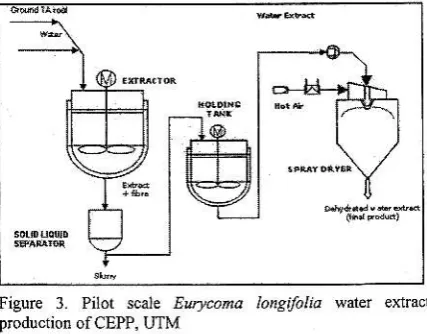
Athimulm 001 applied batch process modelling to lhe produclion of Tongkal A.li (Ewcoma lanEfotia) water extret. In his work, he modelled a pilot plmt scale operation run at the uTM, CEPP (Figure 3). The objectile of his projecl was to model the current process and propos€ alt€mative schenes that would render th€ process economically atlractive as the cunenl process was not economically viabl€ and would not attract leclnology investors nor buitd up small 10 medjum
conp&ing various process
iii. Coming up with mrlriple differing altematives based on availabl€ vendor equipnent suppli€s
3. Simrlrtion in feasibility strdies
Figure 3. Pilot scaL Eut!.a^a loryifulia wrrer exrler prcduclion ofCEPP, UIM
Th€ inirial producdon process sbown in Figue 3 produced a seml complete producl with lower value with extremely long operatinS time (due lo the long dlration of spny drying operalion). Batch process debonlenecking rechniques and en8ineering ecolomic evaluation were applied and five alt€matives were developed. Tbe alternative shown in Figure 4 with lhe hishest rare of investnent (ROl) due to the value added srep of producing fte nnal product of bottled exiJact capsules as well as shorter operatins tine was chosen.
Frcm m educational point of view, the ed cational aspects gained by the student include:
i. Re6l process modellirg i.e. the student had to gather real process and econonic data io integrate into ihe
ii. Applying engineering economics to rhe alternatives thus making the studert awde of lhe real applications of economic evaluation
4. Process sinulatiotr in life cycle rnalysis
Kuan [11] lat€r extended the wo* ofAlhimulam ll0lby looking ar the erviro nenral aspecl on tt'e Tongkat All water extract production, via life cycle malysis (LCA)
tool. Based on the optimal manufacturing scheme in Figure 5 n0l, Kuan 011 furthe. developed two altemative scbemes to consider for the reuse ofTongkat Ali root residue. In Altemative I, the .oot residlre is used as a feedstock for electriciry 3nd/o. sieam production to supplement fossil tuel. In Altemative 2, lhe residue is used as feedstock lor bio-ethanol production via fermentaiion route.
Both schemes are modelled using the sinulation sofiware and data from th€ simulation ate used in lhe LCA study. A conpdative environDental life cycle inventory assessment was conducted to quanlify and comp@ the comprehensive sels of environmental flows oftle rwo scbemes over the water €xtract production life cycle. Results of the LCA show that Altemative I (Figure 5) is the most "environmental frierdly" optiorL with the least environmenial emissions, as compred to the energy intensive alternative ofAllemative 2.
From an educational point of view, the educational aspects gained by the student include:
i. How to relate the two separate areas of sihulation and LCA, which de conventionally usually treated as two different topics.
ii. Sinulation software was a good source 10 obtain emiss;ons data as well as evaluating altematives.
5. Proc€ss simulation in prccess syuthesis
Figure 6 show the sirnulalion flowsheet oflhe polyvinyl chloride (PVC) manufacturinS process dev€loped by Chan [12]. This simulation Bodel has been dev€loped bded on the operating condition of an existing PVC nanufacturing facilily. It consists of 10 parallel balch polymerisation reaclors, blow-down vessel, ,rd two pamllel trains of downstream FocessinS equipment. Each downstrea.m processinS train oonsists of a stripper, two decanters srd a fluid bed dryer. The plant is operaled in a s€mi-batch mode where upst ean reaclon are scheduled to match the downstrean processing trains that are operated in continuous mode.
The simulation model was later used 6 the case study on wat€r ninimhation (v;a water pinch analysis). Water flowrates and lhe coresponding slart and end nme of each water-using opemtion were eximcted fron the simularion model. lwo 5cenarios were considered, :.e. netwo.k with dd withoul water stomge systems. Flowrate Lrgeting for both scenados were conducted using the recent dev€lop€d water pinch technique Il3l.
From an educational point of view, th€ educational aspects gained by the studert includel
i. How to model an existing batch PVC manufacturing plart based on the planl opemling condilion.
ii. The interaction between process analysis (sinulation) and synthesis (water pinch analysis) lools
6. Conclusion
In the lbur projects unden ken by the students il was clear lhat they all wenr through the six levels of the Bloon hierarchy. Through the use of the simulation sofrware, fiey had .o recall their knowledge such as critical process parameters as well as hav€ clear comp.ehension of the howledSe and the real indlstrial data lbey were seeking such as operaring conditions. They then applied their k owledge to the problem al bnd, such as when they drew the flowsheets, or analysed the findings fiom th€ simulator, etc. The synthesis dd waluarion of the proposed allematives l}len followed.
ln essence the process simulation sofiwaie sered to slrenglhen their understanding and application of lhe knowledge received during the undergladuat€ education. We believe that the incorporation of simulation tools as early as possible witbin the undergraduate career would further enhaDce their ability to comprehend process informafion, design feasible altematives and evalua,te process viabilily.
A simil€. conclusion can also be made for fte professioml training run by CEPP for pracrising engineers, where the same so{tware tool was used to guide engineers in modelljng and optimising batch plocess operations 04, 151 and wastewaler treatrnenl facilities n6l. Padicipants u'ho atterded the training were lrom the biochemical, lolyner, phmaceutical, and wastewater treatment sector.
Ref€r€rces
L Wsldbere, A. W., Hulclison, H. P.. Motrd, R. L. md Wi^rq,P.. Pnces FlowsheetrrA, Camb dee: Canbridge UdveB'ty ftss, 1979.
2. Petrides, D., Sapido\ E dd Calmdrmis, J., "Conpuler aid€d P.oce$ Analysis &d EcoroDic Ev6lualion for Biosynth€lic Humm L$lir lrotuclion - A Cde Sfirdy,' BioEchntos, atd Eioetgiheelihg, 48. 1995, pp. 529-s4I 3. Ewag, L, 'Batch Phmaceutical P!o@$ Design md
Sinulatiotr," Phdmaceical Ianvd! E ebtrEr 1991, pp. 28-43.
4. Er6t, S, Garo, O. A., winkler. S., VeDl.aftraltn, G., Ldger R, Cootrey, C. L and Saisetbdd, R., Procds SinDlaliob fo! Reconbiret Protei. Productioai cost Estisalior ed Sensitivity Analysis iJr Hepariss I Expre$od in Escldichia cali: Biote.htulog' and BiaeiEineding, val. 53, No. 6, 1991 , pp. 515.582. 5. Koutouk, A., CalddDnjs, J. dd ?eliid*, D. P.,
"Throrglpui Analysis and Deboltlenecking of Intograt€d Balch Chmic€l Prccesses: Codpttqt atd Chmicdl E hgi ne e t i k g, v o\. 24, 1000, W. 13 81 - 139 4.
6. Pelrides, D. P., Kodouis, A. and Sileni, C., 'TtroueltPut Analysis dd Debottlerecking of Bimuutuctui.g Facilities: A .Iob for Psce$ SiNlatoB," SroPn /2, August 2002, p!.2-7.
7. Petrides, D. P., Koulooris, A. dd Sileti, C-, "Tte Role or Pmess Simulation in Plm&eutical ?roes Developnat dd Producr Cosmercialization, ' Phatnrceurhal Engineetinc,val 22, No. 1,2002, pp. 56-65.
8. Bloon, B. S-, Mesi4 B. dd Knllwolrl, D. R. rdoturt, of Edrcationat Abject es: The Cl^si.frcation af
Ed'.ahmal Aoal' Nry Yorl( Dauid VcKay. 1464. 9. Te, J., ModeUing, Optinisatio! md Debottlene.ki!8 for
Phma@uticaf Ptuilcncif' UTM U'dzlgrddute Rqeatch Ptuject Repart, 2OO4.
10. Athbuld, A. "Mode[ing dd OptinisatioD of&4cotu bngilolid \Naner Extract Plodudiotr Plocess Utilising
Baicb Pm@s Sindaroi. UIM UndetEladuate Reseoch Pryect R.po ,2004. .
11. Kum, C. K., 'Life Cycle Analysis of Tongkai Ali tEtrcona longiklia) Warr lxracr Meufa.$rinc Pto@s{', UTM Underyrudwte Reseuch Pryect Repart, 2005.
12. Cha4 C. J., water Mininisation ofA Barcb Chenical Prc@s Pldf , UTM U'darytuduate Reseatch Plojecl Repox,2005.
13. loo, D. C. Y., M&d, Z. A. dd Tm, Y. L. "Synth€sis of Maxiqru Water Recovery N€twork for Batch Ptuess Systeas", Jotml ofcleaNt Ptodtcto,, vol. 13, No 15, 2 0 0 5 , l 3 8 l - r 3 9 4 .
i4. foo, D. C Y. &d Kunaresan, S. Couse Module or "A Two-day t{ands-o! Course o! Baich,tsioprc@ss Modelld& S(hedulug tud Opdd isato. . )005. CIPI. UTM.
15. CEP?, UTM, Batch Proce$ Modolline od Opdnisation: wwcept.lhl,pv&atcl
16. Hdse, M. A. A., Foo, D. C. Y. dd Yo€ng, B. Y. Couse Modtne of "A lou-day Course m WasteMter Treai.aenl llant Dsign, operalion &d Trotrbleshootind',2005, CEP}, UTM.
Prc.eedirys ofthe 2005 ReAjMl CMlsene u Engineenne &nrzDn Deenbet lrl3, 2045, Johoa
^,4alo!sio
*::
:l
--.
i-*'
ligurc 5. LCA ofTorelat AIi prcduction [11]
Figue 6. Simulation florshet for PVC prcduction