ISSN(Online): 2320-9801 ISSN (Print) : 2320-9798
I
nternational
J
ournal of
I
nnovative
R
esearch in
C
omputer
and
C
ommunication
E
ngineering
(An ISO 3297: 2007 Certified Organization)
Vol. 4, Issue 10, October 2016
LabVIEW Based Industrial Parameter
Supervision and Alert System
A.H.Utgikar1, Ajay Gardi2, Pratik Khule3, Kiran Dayma4
Assistant Professor, Department of E&TC, Maharashtra Institute of Technology, Aurangabad, Maharashtra, India1.
B. Tech Students, Department of E&TC, Maharashtra Institute of Technology, Aurangabad, Maharashtra, India2,3,4
ABSTRACT
:
The control of the parameters which causes deterioration the industrial and natural environment pattern is a great challenge and has received interest from industries especially in Petro chemical industries, Milk Industry, Paper making industries, Water treatment industries and Sugar manufacturing industries. The main objective of our paper is to design an efficient and robust system to control the parameters causing and to minimize the effect of these parameters without affecting the plant or natural environment. The proposed methodology is to model a system to read and monitor parameters and to inform control authorities when any of these factors goes higher than industry standards. A mechanism using LabVIEW is introduced in this proposed methodology, which will automatically monitor when there is a disturbance affecting the system. The system investigates level of tank in industry effluents, level of ammonia gas released during industry process and temperature of the machineries. Our proposed method is more accurate to derive the desired parameters. LabVIEW is the powerful and versatile programming language for supervision of industrial parameters. Automated monitoring of industrial variable parameters system plays an important role is to increase the productivity of the industry. If the operator window is opened then operator will be able to monitor all the required parameters and can set the threshold limit of the parameters, if any required parameters crosses the threshold limits then operator displays the visual message on Front Panel of LabVIEW and also giving audible alerts.KEYWORDS: LabVIEW, Temperature, Tank level, Ammonia gas, Arduinouno.
I. INTRODUCTION
LabVIEW (Laboratory Virtual Instrument Engineering Workbench) is a system design platform and development environment for a visual programming language from national instruments. The software is perhaps the most important component of the system. The main routine or VI, provides a front panel interface that allows the operator to control and monitor the system, it calls to perform functions that gather analog input, send analog output.
The front panel is what allow the operator to control and monitor the process it include software control and indicators mimic physical control such as buttons, sliders, LEDs , charts. The block diagram is the graphical representation of the software program. It consists of icons that represent typical programming elements such as constants, variables, subroutines and loops. LINX allows user to control sensors and acquire data through Arduino microcontroller using the graphical programming environment LabVIEW.
Arduino microcontroller acts as an I/O engine that interfaces with LabVIEWVIs through a serial connection. This helps to move information from Arduino pins to LabVIEW without adjusting the communication, synchronization. Using the common open, read, write, close convention in LabVIEW, we can access thus the digital analog pulse width modulated I2C and SPI signal of Arduino microcontroller. LabVIEW software package from national instruments is used to develop the custom data acquisition .the program measures the temperature, ammonia & tank level from the process
II. RELATED WORK
In [1] LabVIEW Interface for Arduino (LIFA) allows users to control sensors and acquire data through an Arduino
microcontroller using the graphical programming environment LabVIEW
.
In the industrialization especially where
ISSN(Online): 2320-9801 ISSN (Print) : 2320-9798
I
nternational
J
ournal of
I
nnovative
R
esearch in
C
omputer
and
C
ommunication
E
ngineering
(An ISO 3297: 2007 Certified Organization)
Vol. 4, Issue 10, October 2016
remotely and control the parameter which causes degradation. This system provides ideal solution for monitoring critical plant on different sites. Control of parameters can be computed and the data can be transferred online. The paper concludes that the method is more accurate to derive the desired parameters.This simulation creates the awareness in labours in the industries.This work proposes a PC based signal acquisition system. Its analysis can be efficient using LabVIEW and it is also cost effective method for industrialization pollution monitoring.
III.SYSTEM DEVELOPMENT
A. HARDWARE REQUIREMENTS:
1. Arduino:
Arduino is single board microcontroller intend to make the application of interactive objects or environments more accessible. It is an open source physical computing platform and development environment for writing software for the board. Arduino can be used to develop interactive objects taking inputs from a variety of switches or sensors, and controlling a variety of lights, motors and other physical outputs. Arduino has some advantages for educational and interested recreational over other system like inexpensive, open source and extensible software, extensible hardware.
2. Array of sensors:
The system under investigation realizes the design of system for monitoring of industrial parameters, the temperature, ammonia gas and tank level. For this purpose the deployment of sensors of promising feature is necessary. Therefore, as discussed earlier the sensor modules LM-35, MQ135 ammonia gas sensor and ultrasonic sensor (HC-SR04) are deployed as sensors. The details regarding these sensors are highlighted through following sub sections
2.1 Temperature Sensor (LM-35):
The temperature is the one of the most important parameter in industrial process. Precision measurement of temperature is essential for variety of industries such as agro industry, food industry, food storage houses, sugar-cane factories; automobile industry etc. The temperature of the process and environmental temperature are two different measured. Present system is designed for measurement of environmental temperature. The present wireless sensor network is implemented for monitoring temperature in the milk processing factory environment. Therefore, system is deployed to monitor the temperature of milk tanks and other sites of investigation. The LM-35 series is of precision integrated circuit temperature sensors, whose output voltage is linearly proportional to the temperature in degree Celsius. On investigation of its structural details, it is found that the LM-35 sensor is most suitable sensor for present. The LM-35exhibits typical accuracies of +/-0.25oC at room temperature and+/- 0.75oC over a full -550C to +150oC temperature range. The current consumption is less than 60μA. The change in emf produced by the sensor is extracted
and given to further processing. The temperature coefficient (α) exhibited by this sensor is 10 mV/0C.
2.2 Ammonia gas sensor(MQ135):
The ammonia gas sensor MQ135 has high sensitivity to ammonia, smoke and toxic gases. It canconvertsthe change of conductivity to correspond output signal of gas concentration through a simple circuit .The detection range of MQ135 is 10-1000ppm.
2.3 Ultrasonic sensor(HC-SR04):
The Ultrasonic Sensor sends out a high-frequency sound pulse and then times how long it takes for the echo of the sound to reflect back. The sensor has 2 openings on its front. One opening transmits ultrasonic waves, (like a tiny speaker), the other receives them, (like a tiny microphone). The ultrasonic sensor uses this information along with the time difference between sending and receiving the sound pulse to determine the distance to an object.
B. INTERFACING OF SENSORS WITH ARDUINO
ISSN(Online): 2320-9801 ISSN (Print) : 2320-9798
I
nternational
J
ournal of
I
nnovative
R
esearch in
C
omputer
and
C
ommunication
E
ngineering
(An ISO 3297: 2007 Certified Organization)
Vol. 4, Issue 10, October 2016
Fig.1. Block diagram of system
C. MODELLING AND SIMULATION OF THE SYSTEM USING LABVIEW (LINX)
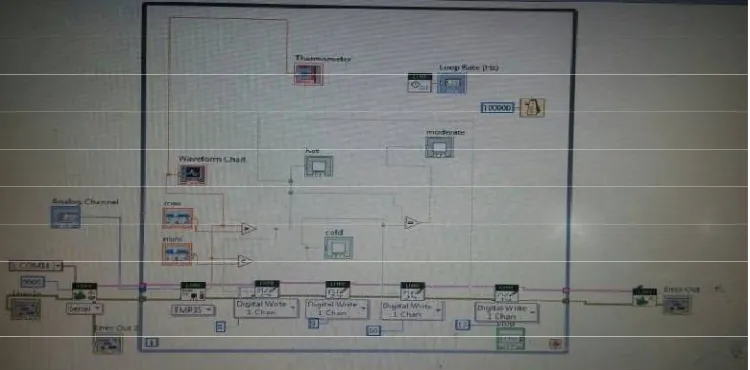
The programs has been developed for sensing the voltage from sensor, process data and display the room temperature, level and gas. The software language LabVIEW is used to develop the program. LabVIEW (Laboratory Virtual Instrument Engineering Workbench) uses dataflow programming where the flow of data through the nodes on the block diagram determines the execution order of the VIs and functions. The block diagram contains this graphical source code, also known as G code or block diagram code. Front panel objects appear as terminals on the block diagram.
The output of LM35 is connected to pin A0 of the Arduino. Using LINX , the Arduinouno board is interfaced to the LabVIEW . The output of ultrasonic sensor echo and trigger is connected to pin 8 and pin 9 respectively of the Arduino. In the very first step Arduino was initialized the temperature sensor reads the temperature of particular Environment which we want to measure and converts the temperature into corresponding electrical signals. From the Arduino resource using analog read.vi we can read the values of temperature and ultrasonic sensor in terms of voltage to end the process we had to place the Arduino close for the process the temperature is measure in degree Celsius , ultrasonic measure in centimeters and inches and gas is measured in ppm .
ISSN(Online): 2320-9801 ISSN (Print) : 2320-9798
I
nternational
J
ournal of
I
nnovative
R
esearch in
C
omputer
and
C
ommunication
E
ngineering
(An ISO 3297: 2007 Certified Organization)
Vol. 4, Issue 10, October 2016
IV.SIMULATION RESULTS
The front panel allows us to control and monitor the process. It consists of software controls and indicators that resemble the physical controls of the hardware construction such as LEDs, sliders, buttons and graphic charts. Figure3. shows the screenshot of the front panel.
Fig.3. Simulation in LabVIEW
After successful implementation and test run, the above figure shows the temperature variable range and controller output plotted with respect to each time chart.We have obtained the observations of temperature and tank level from the Arduino blocks in LabVIEW. This inexpensivesystem is designed for Industries having analog I/Os to measure and record the processes in industries. This work has considered two important parameters to measure temperature and tank level as being mostly measured parameters in industries. Graph of time versus parameters is plotted in front panel of LabVIEW. If any of the parameter goes beyond threshold limit, there is indication on front panel of LabVIEW.
V. CONCLUSION AND FUTURE WORK
The field of parameters monitoring and control is very wide. In this system, an attempt is made to minimize the problem of cost, to monitor and control various parameters which will help in reducing industrial hazardous effect. The regularinspections can be done using this system. There may be other softwares used for designing control system but LabVIEW is the simplest of them all. Is because it uses the drag and drop principle, it doesn’t need any code to run the software since it follows graphical coding E.g. for a while loop we simply make a box inside which the contents of the statement are taken from. The user can observe the parameters readings taken from the workplace and control them.
REFERENCES
1. K P J Pradeep, K Sai Prasad Reddy, C. Nagaraja, D. Hanumesh Kumar, K NagabhushanRaju, “ Monitoring of Temperature and Humidity Using LIFA”, International Journal of IT, Engineering and Applied Sciences Research (IJIEASR) Volume 3, No. 6, June 2014 .
2. Ambrayya, Shridhar. S. Bilagi, K. PaneendraReddy,“Implementation of Monitoring Industrial Parameters and Providing Security by using Labview and NI MyRIO”, International Journal of IT, Engineering and Applied Sciences Research (IJIEASR) Volume 3, No. 6, June 2014 . 3. Book by Ronald W. Larsen “LabVIEW for Engineers”.
4. Isha Gupta, RashpinderKaur,“ Design and Development of Industrial Pollution Control System using LabVIEW”, International Journal of Advanced Research in Computer Engineering & Technology (IJARCET) Volume 2 Issue 11, November 2013 .
ISSN(Online): 2320-9801 ISSN (Print) : 2320-9798
I
nternational
J
ournal of
I
nnovative
R
esearch in
C
omputer
and
C
ommunication
E
ngineering
(An ISO 3297: 2007 Certified Organization)
Vol. 4, Issue 10, October 2016
6. AN-460 LM34/LM35 Precision Monolithic Temperature Sensors, Application Report SNOA748C–October 1986–Revised May 2013 7. Shyam, R., Nair, V., and Venkatesh, T. (2012) “Design of a LabVIEW Based Real Time Simulator for ABS Tester”, International Journal of
Scientific and Research Publications, Volume 2, Issue 5, May 2012.
8. Rick Bitter, TaqiMohiuddin, Matt Nawrocki “LabVIEW Advanced Programming Techniques” second edition ISBN-13: 978-0-8493-3325-5 (Hardcover) p22, 1.
9. Data Acquisition Handbook, A Reference for DAQ and Analog & Digital Signal Conditioning Third edition, Published 2004-2012 in the United States of America by Measurement Computing Corporation p 1-2.
10. S.HemaChandra,Dr.R.V. S.Satyanarayana. Temperature Control of Transformers Using Soft Computing Techniques. International Journal of Computer Engineering and Technology, 3(2), pp. 133-137,2012.
11. Joshi M.P, More V.A.. Real Time Cost Effective Temperature Controller. International Journal of Electronics and communication Engineering and Technology, 3(2), pp. 271 – 277, 2012.
12. How to Interface Arduino with LabVIEW, [online]. Available from: http://myclassbook.org/labview-interfae-for-arduino [Accessed 18th May, 2015].
BIOGRAPHY
Ms. A. H .Utgikar M.Tech (Electronics Design Technology) currently working asst.prof.in Electronics and Telecommunication Engineering Department at G.S.Mandal’sMaharashrra Institute of Technology. Has a Experience as a visiting faculty for DESD CDAC and 1.4 years in industry. Has publish a paper on ‘Drying of Grapes Using Infrared Heating Mechanism’ in International Journal of Innovations in Engineering and Technology in August 2013. Also presented a paper on ‘Performance Analysis of Batteries and InverterrsWith Polymer as an Electrolyte’ at National Level Technical Paper Presentation held at SNJCOE, Nashik. M.Tech project –‘Design and Development of IR Based Grapes Drying System ‘ was Exhibited in International Electronics Expo 2011 by Electronics For You held at PragatiMaidan. New Delhi.Areas of Interest: Speech Processing, Agri-instrumentation and Control Signal Processing.
Mr.Ajay G. Gardi is currently B. Tech student in Maharashtra Institute of Technology, Dept. of E&TC, Aurangabad. He is interested in Mechatronics, Automation. He is Also participated in district level project competition for this project.
Mr.Pratik S. Khule is currently B. Tech student in Maharashtra Institute of Technology, Dept. of E&TC, Aurangabad. His field of interest is Embedded, Networking and Automation. Also participated in district level project competition.