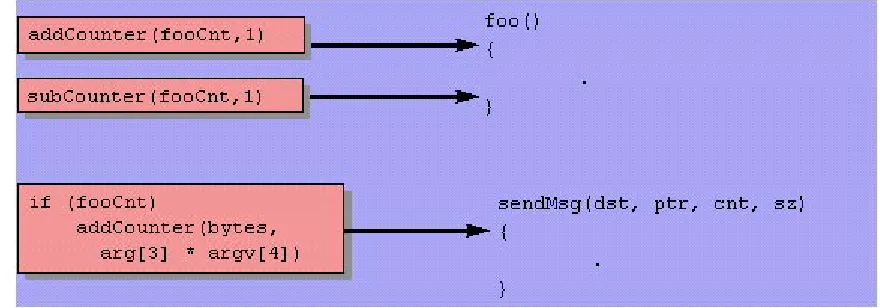
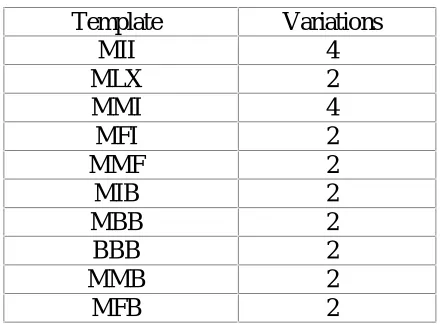
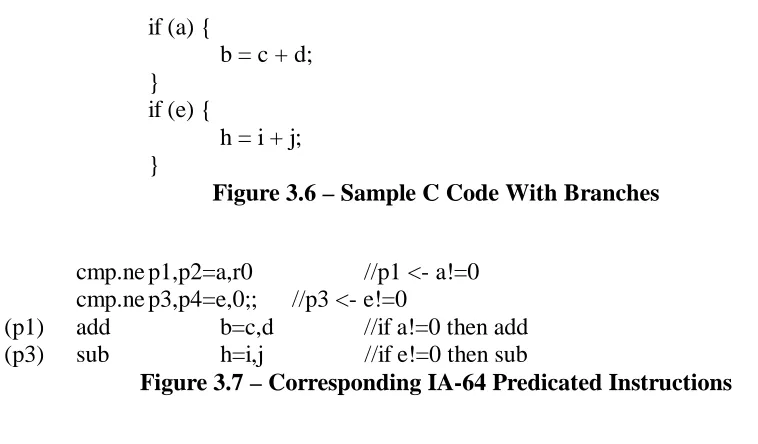
ABSTRACT
HAZELWOOD, KIM MICHELLE
Dynamic Optimization Infrastructure and Algorithms for IA-64
(Under the direction of Dr. Thomas M. Conte)
Dynamic Optimization refers to any program optimization performed after the initial static compile time. While typically not designed as a replacement for static optimization, dynamic optimization is a complementary optimization opportunity that leverages a vast amount of information that is not available until runtime. Dynamic optimization opens the doors for machine and user-specific optimizations without the need for original source code.
This thesis includes three contributions to the field of dynamic optimization. The first main goal is the survey of several current approaches to dynamic optimization, as well as its related topics of dynamic compilation, the postponement of some or all of compilation until runtime, and dynamic translation, the translation of an executable from one instruction-set architecture (ISA) to another.
The second major goal of this thesis is the proposal of a new infrastructure for dynamic optimization in EPIC architectures. Several salient features of the EPIC ISA prove it to be not only a good candidate for dynamic optimization, but such optimizations are essential for scalability that is up to par with superscalar processors. By extending many of the existing approaches to dynamic optimization to allow for offline optimization, a new dynamic optimization system is proposed for EPIC architectures. For compatibility reasons, this new system is almost entirely a software-based solution, yet it utilizes the hardware-based profiling counters planned for future EPIC processors.
DYNAMIC OPTIMIZATION
INFRASTRUCTURE AND ALGORITHMS FOR IA-64
by
KIM MICHELLE HAZELWOOD
A thesis submitted to the Graduate Faculty of North Carolina State University
in partial fulfillment of the requirements for the Degree of
Master of Science
COMPUTER ENGINEERING Raleigh
2000
APPROVED BY:
________________________________
Dr. Thomas M. Conte, Chair of Advisory Committee _________________________________
Dr. Eric Rotenberg
BIOGRAPHY
Kim Hazelwood was born on July 23, 1976 in Richmond, Virginia and grew up in
Melbourne, Florida. She graduated first in her class with a Bachelor of Science degree in
Computer Engineering from Clemson University in August 1998. During her years as an
undergraduate, she participated in the cooperative education program working with
Kemet Electronics Corporation in Greenville, South Carolina. She also participated in
the Calhoun College Honors Program at Clemson University, as well as the Summer
Undergraduate Research Program sponsored by the National Science Foundation where
she worked in the Parallel Architecture Research Laboratory.
She then went on to the master’s program at North Carolina State University
working under the direction of Professor Thomas M. Conte. While working toward her
master’s degree, Kim spent a summer interning with the CarbonFIRE Dynamic
Optimization group at Hewlett-Packard Company in Cupertino, California, and a summer
with the Dynamo group at Hewlett-Packard Laboratories in Cambridge, Massachusetts.
She plans to continue her graduate education working toward her Ph.D. in
TABLE OF CONTENTS
LIST OF TABLES ...v
LIST OF FIGURES...vi
Chapter 1 Introduction ...1
1.1 Motivation for Dynamic Optimization ...2
1.2 Current Approaches ...6
1.3 Dynamic Compilation vs. Optimization ...7
1.4 Dynamic Translation vs. Optimization ...8
1.5 Layout of the Thesis...9
Chapter 2 Background ...11
2.1 Dynamic Optimization Efforts ...11
2.1.1 Dynamo – HP Labs ...11
2.1.2 Morph ...15
2.1.3 Evolutionary Compilation ...18
2.2 Dynamic Compilation Efforts ...20
2.2.1 DyC ...21
2.2.2 DCG...23
2.2.3 Dynamo – Indiana University...24
2.2.4 Runtime Optimization ...26
2.2.5 Tempo...29
2.2.6 Summary...30
2.3 Translation and Emulation Efforts...31
2.3.1 DAISY ...31
2.3.2 Crusoe...32
2.3.3 FX!32...34
2.4 Profiling Monitors For Feedback-Directed Optimization...35
2.4.1 ProfileMe ...36
2.4.2 Profiling for Hot Spots ...38
2.4.3 The Profile Buffer ...39
2.4.4 Itanium Monitors...40
2.4.5 Summary...42
2.5 Useful Tools for Dynamic Optimization...42
2.5.1 DynInstAPI ...42
2.5.2 EEL...43
2.5.3 OM ...44
Chapter 3 Salient Features of EPIC Architectures ...45
3.2 Summary ...53
Chapter 4 DO: A Dynamic Optimization Infrastructure...54
4.1 An Extension of Dynamo ...56
4.2 Performance Improvements Achieved by HPL’s Dynamo...57
4.3 A High-Level Description...60
Chapter 5 Dynamic Optimization Opportunities and Algorithms...65
5.1 Sampling Study: Branch Mispredictions ...65
5.1.1 Misprediction Sampling Based on First N Occurrences...66
5.1.2 Adaptive Warmup Exclusion...68
5.2 New Dynamic Optimization Algorithms ...71
5.2.1 Dynamic If-Conversion ...74
5.2.2 Dynamic Reverse If-Conversion...82
5.2.3 Dynamic Rescheduling for Scalability...85
5.2.4 Predicate Promotion with Double Predication...86
5.2.5 False Predicate Path Collapse ...88
5.2.6 Predicate Profiling and Prediction ...89
5.2.7 Dynamic Instruction Hint Adjustment ...90
Chapter 6 Conclusions & Future Work...92
LIST OF TABLES
Table 2.1 – Summary of Past Approaches...31
Table 3.1 – The Six IA-64 Instruction Types ...47
Table 3.2 – Possible Instruction Combinations ...47
LIST OF FIGURES
Figure 2.1 – How HPL’s Dynamo Works [6]...12
Figure 2.2 – The Harvard University Morph Project [46]...16
Figure 2.3 – Sathaye’s Evolutionary Compilation System [40] ...19
Figure 2.4 – UW’s DyC Dynamic Compilation System [18] ...22
Figure 2.5 – Kistler’s Dynamic Runtime Optimization System [27]...27
Figure 2.6 – Illinois' Monitor Table Hardware for Hot-Spot Detection [37] ...38
Figure 2.7 – The Profile Buffer Hardware [9] ...40
Figure 2.8 – Runtime Code Insertion via DynInstAPI ...43
Figure 3.1 – An IA-64 Instruction Bundle...47
Figure 3.2 – An IA-64 Instruction Sequence Without Control Speculative Loads ...49
Figure 3.3 – An IA-64 Instruction Sequence With Control Speculative Loads ...49
Figure 3.4 – An IA-64 Instruction Sequence Without Data Speculative Loads ...50
Figure 3.5 – An IA-64 Instruction Sequence Utilizing Data Speculative Loads ...50
Figure 3.6 – Sample C Code With Branches ...51
Figure 3.7 – Corresponding IA-64 Predicated Instructions ...51
Figure 4.1 – Dynamo Overhead as a Percentage of Execution Time...57
Figure 4.2 – The Smallest Number of Fragments that Account for 90% of the Total Execution Time...58
Figure 4.3 – Wall Clock Time Comparison of Dynamo Performance to Native Execution ...59
Figure 4.4 – The DO Dynamic Optimization Infrastructure...62
Figure 5.1 – The Average Difference Between Sample (First N Branch Occurrences) and Actual Misprediction Rates for all Branches in the SPECint95 Benchmarks...66
Figure 5.3 – Misprediction Rate Over Time for Certain Hard-to-Predict Branches in
SPECint95 ...69
Figure 5.4 – Determining the End-of-Warmup Condition ...70
Figure 5.5 – Mean Difference Between Sample (First N Branch Occurrences Ignoring Warm-up Period) and Actual Misprediction Rates ...70
Figure 5.6 – Effect of Varying the Warm-up Completion Threshold Value ...70
Figure 5.7 – If-Conversion Example ...75
Figure 5.8 – A Predication Algorithm ...77
Figure 5.9 – A General Predication Algorithm...77
Figure 5.10 – Dynamic If-Conversion Algorithm...78
Figure 5.11 – Maximum Allowable Branch Distance...79
Figure 5.12 – Speedup from Applying the Dynamic If-Conversion Algorithm...80
Figure 5.13 – Number of Branches Converted to Predicates...80
Figure 5.14 – Percent of Branch Mispredictions Eliminated using Dynamic If-Conversion ...81
Figure 5.15 – The Dynamic Reverse If-Conversion Algorithm ...82
Figure 5.16 – Speedup Resulting from Dynamic Reverse-If-Conversion...83
Figure 5.17 – Actual Number of Predicate Traces Converted to Branches...84
Figure 5.18 – Dynamic Rescheduling ...86
Figure 5.19 – IA-64 Instructions With an Instruction Group Boundary ...87
Figure 5.20 – Breaking the IA-64 Instruction Group Boundary...87
Figure 5.21 – An Example of False Predicate Path Collapse ...88
Chapter 1
Introduction
When inspecting the basic run-time performance equation, runtime = instruction
count * cycles per instruction * cycle time [22], it becomes clear that a reduction in the
overall runtime of a program can be accomplished by reducing any of the three variables
– instruction count, cycles per instruction, or cycle time. The ideas discussed in this
thesis attempt to reduce the run time of a given program by reducing both its instruction
count and its cycles per instruction. This run-time reduction is not the result of new
compiler techniques, as is typically the case. A dynamic optimization system is
presented, which supplements the optimization performed by the static compiler and
allows for a uniform level of optimization for all executables.
Dynamic Optimization refers to any optimization of software that is performed
after the initial compile. Dynamic optimizations can be performed as the program is
running or anytime thereafter, such as during the exit procedure of a program of even
after the program has exited – during the idle time of the computer. Dynamic
optimization can be used to leverage a large set of run-time information that is not
available to the static compiler. This information can range from run-time constants to
operator usage patterns. Such information can provide the foundation for an entirely new
set of optimization algorithms.
Dynamic optimization is especially challenging due to the strict performance
requirements for runtime optimization. Typically, our industry is not willing to accept a
new idea unless performance improvements are seen immediately. Therefore, the
overall system that performs at least as well as a system that does not employ dynamic
optimization. While it is possible that users will permit some program slowdown if it is a
one-time occurrence, this is only true in the case that performance of the program is
improved to the extent that the average runtime over time is notably improved.
1.1
Motivation for Dynamic Optimization
Several factors may lead to the decision to implement a dynamic optimization
system. Often, decisions made by a static compiler are not well suited for the runtime
behavior of the program. This may be due a variance in the usage patterns of the client, a
change or upgrade of hardware (such as the pipeline structure) since the initial compile
time, or simply an overly aggressive static compilation decision. The current software
development cycle does not provide an opportunity for correcting or changing decisions
made by the static compiler. Dynamic optimization can provide this flexibility in the
software development cycle.
The limitations of a static-only optimization scheme make dynamic optimization
an appealing option. Runtime values and branch behavior are known and can be
leveraged in an effective manner. Some of the most prominent observations that led up
to the need for dynamic optimization are described in the next subsections.
Software Vendor Optimization Levels. One justification for a dynamic
optimization system concerns the large amounts of off-the-shelf software packages that
are purchased every year. Ideally, all software vendors would employ the highest level of
optimization during their compilation process. Yet this is often not the case. Vendors
the difficulty of debugging an executable with a high level of optimization. The varying
level of compile technology available in the compilers used by software vendors has
resulted in an unknown level of optimization in off-the-shelf software products and
consumers have no way of ensuring that high levels of optimization were employed in the
products they purchase. Dynamic optimization allows even the latest advances in
optimization technology to be introduced to existing software, therefore ensuring optimal
performance. For instance, Hewlett-Packard Laboratories has shown that programs
originally compiled with level-2 optimization (-O2) running under their Dynamo
dynamic optimization system performs as well as the same program compiled with
level-4 optimization (-0level-4) without dynamic optimization [6].
Processor Changes Within an ISA. Yet another reason for choosing to
implement dynamic optimization concerns processor upgrades within a processor family
and cross-generation compatibility between processor families [10], [14], [40]. A
program compiled for a given instruction-set architecture (ISA) can be run on any
processor implementing that ISA. The program is only optimized, however, for
execution on a processor with an identical execution pipeline, identical function units,
and identical instruction availability. Variances in any of these attributes result in a
program that is not employing the available functionality of the processor. Even worse,
incorrect execution is possible for processors that do not check instruction dependencies
at runtime, such as traditional VLIW processors or RISC processors that have load-use
delay slots.
Allowing a user to recompile for his/her own system could easily provide for
requires original source code. Clearly, software vendors would not want to release their
source code due to the proprietary information available within. Releasing versions of
the executable for every single processor would furthermore be quite tedious. Dynamic
optimization enables custom optimization for any processor within an ISA from a single
executable, without the need for original source code.
Changes in Usage Patterns. Ideally, a program should be optimized based on
how it is used. Unfortunately, usage patterns vary from person to person, and even one
person’s usage may vary over time [40] as they discover new features of the software.
Since conventional compilation optimizes the program only once and before the user runs
the program, optimization will either (1) not take into account actual user behavior, or (2)
base optimization on an average profile. There is no guarantee that the average profile
information is at all representative of typical user behavior. Representative profile
information is difficult to produce because of the large variance among users, and over
time for the same user. This sheds doubt on the effectiveness of a unified set of profile
data.
Dynamic optimization allows for software that is optimized for the particular user.
Code can be optimized to better represent actual runtime behavior for each and every run
of a program. It allows for continued optimization as the client’s usage patterns change.
This level of customization is simply not possible with conventional static optimization
methods.
Trend Toward Static Scheduling. While most of the processors of the past rely
on dynamic scheduling of instructions, an upcoming generation of processors contains a
even before the program executes, increases the importance of accurate profile data.
Inaccurate profiles result in poor scheduling decisions that will affect every run of a
program [40]. Because static scheduling involves a great deal of speculation, poor
scheduling choices can greatly harm runtime performance. At this time, unfortunately,
there is no widely accepted and used means for correcting poor scheduling choices by the
static scheduler. Dynamic optimization, on the other hand, may be effectively used to
leverage runtime information in order to recognize poor static scheduling choices and
correct them.
Power Reduction. A well-designed dynamic optimization system has great
potential for venturing into other domains, such as power reduction. There are many
opportunities for noting the runtime power consumption and making changes that focus
on consuming less power. For example, code transformations can be performed that
result in less bit flips between sequences of instructions [43]. Reduced bit flips result in
reduced power consumption. Rather than having a NOP instruction equate to adding two
zeros together, it could add the inputs of the previous instruction while storing the result
in a free register. As processors become more and more power hungry, dynamic
optimization could become an essential tool for balancing power and performance in a
case-by-case basis.
Complementary Optimization Opportunity. There is an abundance of
information unavailable at static compile time that can be leveraged by dynamic
optimizations. Optimizations can be based on run-time constants and may span library
and function calls. Branch behavior for the particular run is known, so more aggressive
can be completely compatible with the array of static optimizations already implemented
in conventional compilers.
1.2 Current
Approaches
There are various approaches to dynamic optimization. One approach is direct
optimization of the binary executable using an executable editing mechanism. This
method is typically system dependent, yet it results in a dynamic optimization
infrastructure that does not have any front-end compiler requirements – any existing
executable can be optimized requiring no special compilers or programming languages.
Another approach involves performing optimizations on intermediate representations of
the program, which are generated at the same time as the executable itself. This approach
simplifies the optimization procedure and provides for system independency, yet it
requires all software vendors to produce intermediate representations of their software.
Intermediate representations, which can typically be reverse engineered to produce
original source code, are not popular among software vendors. A variation of that
approach, however, is the generation of an intermediate representation from the final
executable, upon which optimizations are performed. This approach, while not as fast as
the direct optimization of the original executable, provides for system-independent
optimizations.
Dynamically optimized code can either be immediately consumed, it may be
cached for use during the current or subsequent executions, or it may be permanently
applied to the executable. It is evident that any optimizations that are based on the
they would not be correct in subsequent runs. Yet there are several optimizations that can
be permanently applied, such as rescheduling based on a hardware change.
The time at which optimizations are performed is another design decision. Most
of the current research efforts focus on one of the following optimization opportunities: • compile time, i.e. static optimization [36]
• run time, i.e. on-line dynamic optimization [6], [8], [10], [14], [27], [28]
• idle time, i.e. off-line dynamic optimization [27], [46]
All dynamic optimizations can be classified as either heavyweight or lightweight
optimizations. Heavyweight optimizations make the largest amount of impact on
program performance. Not surprisingly, heavyweight optimizations take the largest
amount of time to perform, and therefore may not always be feasible to perform at
runtime. They can, however, be performed offline, during the idle time of the computer.
Lightweight optimizations, on the other hand, can typically be performed at runtime.
Again, not surprisingly, most lightweight optimizations do not result in the same level of
performance improvement as that of heavyweight optimizations.
The advantages and disadvantages of each of the current approaches for
performing dynamic optimization will be explored in detail in Chapter 2, the background
section.
1.3
Dynamic Compilation vs. Optimization
Some researchers make a sharp distinction between dynamic optimization, the
of static compilation until runtime and therefore invoking compilation on a code format
that would not otherwise execute [6], [27].
Dynamic compilation differs from dynamic optimization in their means for
optimization. Dynamic compilation is performed on code that was specially designed for
the task. Special compilers and programming languages are required in order to generate
an executable containing holes (portions of uncompiled code) that will be filled in at
runtime. No special compiler or programming language is required for dynamic
optimization, however, because all optimizations are performed on a working executable.
Projects involving both dynamic optimization and dynamic compilation are
described in the background section, however all of the original ideas presented in this
thesis focus exclusively on dynamic optimization.
1.4
Dynamic Translation vs. Optimization
Another distinction must be made between dynamic optimization and dynamic
translation or emulation projects. Translation or emulation systems allow an executable
compiled for one ISA to execute on a processor featuring another ISA. While translation
systems may optimize the code that is translated, the primary goal is compatibility.
Several systems falling into the translation/emulation category are discussed in
the related-work chapter in order to clarify the difference between these systems and the
1.5
Layout of the Thesis
The purpose of this thesis is to explore many old and new approaches for
dynamically optimizing executables. This includes the analysis of the goals associated
with dynamic optimization and the means for accomplishing the goals. Also presented is
an infrastructure for the dynamic optimization of EPIC computers. In addition, several
new dynamic optimization algorithms are presented which leverage features of an EPIC
architecture.
Chapter 2 of this thesis contains background information. Several research
projects involving dynamic optimization are discussed including the potential advantages
and disadvantages of each approach. Three projects involving dynamic optimization
(Section 2.1), five projects involving dynamic compilation (Section 2.2), and three
projects involving dynamic translation (Section 2.3) are included in the discussion. Next,
Section 2.4 discusses the current research on profiling monitors for feedback-directed
optimizations. Several useful tools are available that can be leveraged in any dynamic
optimization project. These tools are discussed in Section 2.5.
Chapter 3 describes the salient features of EPIC architectures and describes why
EPIC is a good target for dynamic optimization.
Shortcomings discovered in many of the current research approaches led to the
proposal of a new dynamic optimization system. Chapter 4 motivates and presents a
high-level view of the DO dynamic optimization system. DO is a combination
online/offline dynamic optimizer that is built on the solid foundation already available in
One line of study that few researchers have ventured into is the development of
specialized runtime optimization algorithms. Chapter 5 introduces a set of new dynamic
optimization algorithms designed for implementation in EPIC architectures. After laying
the groundwork for dynamic optimizations by studying the optimal time at which the
optimizations should be performed, Section 5.2 goes on to introduce several new
dynamic optimization algorithms that are specially designed for runtime implementation
on EPIC architectures. Finally, Chapter 6 concludes that dynamic optimization is a
Chapter 2
Background
Many research groups are currently working on Dynamic Optimization efforts in
one of its many forms. Some groups work exclusively within a given instruction set
architecture (ISA), gearing their optimizations toward reoptimizing for differing features
of processors within a processor family or user behavior. Others work between ISAs. In
this case, the final product does the job of emulating one instruction set on a different
instruction-set architecture.
The purpose of the following sections is to provide an overview of some of the
similar research efforts that are currently underway. A brief description of each of the
approaches is mentioned, along with any notable advantages or disadvantages of the
model.
2.1
Dynamic Optimization Efforts
About a dozen research groups are currently exploring dynamic optimization,
compilation, or emulation techniques. Each group has a different set of approaches for
accomplishing the overall goals. The approaches differ in when, how, and what is
optimized. Some of the concepts contained within the approaches can be reorganized and
balanced to form a new, more universal approach to dynamic optimization.
2.1.1 Dynamo – HP Labs
mechanism that works to optimize native executables and DLLs (dynamically-linked
libraries) at run time [6].
interpret until branch
lookup branch target in cache
start-of-trace condition?
jump to top of fragment in
cache
increment counter associated with branch target addr
counter value exceeds hot
threshold?
interpret + codegen until branch end-of-trace condition? create new fragment and optimize it emit into cache, link with
other fragments & recycle associated counter fragment cache s ignal handl er Yes hit m iss Yes Yes No No No start
Figure 2.1 – How HPL’s Dynamo Works [6]
Figure 2.1 [6] shows how Dynamo selects, optimizes and stores program
fragments. As indicated in the figure, Dynamo interprets a native binary until it detects a
hot trace. This is determined by observing the branches in the program. If that branch
target meets certain conditions, such as being the target of a backward-taken branch, a
counter associated with the target address is incremented. Only when the counter
exceeds a certain threshold value is the trace deemed a hot trace (in the case of Dynamo,
the threshold is 50.) The corresponding program fragment (an executable unit of trace
instructions) is inserted into the software-based code cache, using a very speculative but
entry point is likely to be taken in the future. Link stubs are inserted to catch any
off-trace branches, in order to direct execution to the correct location, which may also be in
the code cache. From that point forward, anytime the particular branch target address is
encountered, Dynamo takes control and executes the optimized instructions from the
fragment cache.
Dynamo ensures that time is not wasted optimizing infrequently executed
fragments; only hot fragments are selected for optimization. This method of determining
hot traces ensures that Dynamo doesn’t waste time dealing with infrequently executed
code. If effort were spent optimizing every program fragment, the interpretation
overhead of Dynamo would be unacceptable.
HP Labs’ Dynamo group points out an important distinction between their work
and the solutions that are currently being developed by other research groups. First, they
assume that the starting point for optimization is a native program binary. For this
reason, no translation step is involved. This significantly reduces the complexity of the
Dynamo solution, while allowing it to be effectively used with any existing executable.
Second, the Dynamo group points out the difference in their solution and the solutions
that involve dynamic compilation. Dynamo does not postpone any part of the
compilation process until runtime. This design decision was made because the group felt
that the solution should be transparent. Dynamic compilation solutions require a set of
program annotations that must be inserted by the programmer, or they require the use of a
new programming language that has been designed for the task of dynamic compilation.
Solutions of this sort are less transparent, and are therefore excluded from the Dynamo
optimizer to bail out at any point without any adverse effects within the program itself.
Bailout occurs when the amount of time spent in the fragment cache falls below a certain
threshold. Dynamo suspends execution and allows the program to run directly on the
underlying processor.
Another distinctive feature of Dynamo is that it is completely online, that is, all
optimizations are performed at runtime. All data that is generated to aid in optimization
is used within the same execution; no data is written out for later optimizations.
Yet the most notable feature of Dynamo is the performance. Even without
employing any optimizations, Dynamo’s methods produce speedup by storing fragments
in the fragment cache. These fragments are executable traces through the code with
many of the branches and procedure calls removed. Even many off-trace branches within
a particular trace result in hits in the fragment cache. Taken branches normally limit
fetch bandwidth, therefore the removal of procedure call and branch overheads for
frequently executed paths results in an overall speedup of the code. Optimizations
performed on the traces result in even higher levels of speedup.
The major advantage of Dynamo is that it is a binary-to-binary solution. No
special compilation methods are needed; therefore the solution is applicable to all future
applications, as well as legacy executables. Dynamo is rare in that it is a completely
transparent solution. Yet the interpretation feature also requires that custom versions of
some of the Dynamo code be written for each processor and operating system.
There is an entire domain of optimization, namely off-line optimization, which
Dynamo does not leverage, however. The fact that Dynamo occasionally bails out of
conclusion that a similar attempt and failure will ensue during each of the subsequent
executions. Furthermore, the optimization that was attempted will never be completed,
resulting in a suboptimal execution. If information regarding the failed attempt to
optimize was maintained in an external file, the dynamic optimizer could avoid the cost
of future failed attempts. This external data could also be used in order to complete
optimizations off line, such as during any idle time of the operating system.
2.1.2 Morph
Zhang et al, of Harvard University developed a framework for offline dynamic
optimization, known as Morph [46]. Unlike Dynamo, which performs all optimizations
online (during execution), Morph collects profile information at runtime and uses that
information to perform optimizations offline (after the program has exited.)
The main components of Morph are the Morph Back-end, the Morph Monitor, the
Morph Editor, and the Morph Manager. The Morph Back-end is a portion of the
compiler that produces the executable along with shared libraries containing all of the
annotations necessary to support dynamic re-optimization. The Morph Monitor is a
low-overhead profiling system that is built into the Digital UNIX operating system and serves
the purpose of program monitoring. The Morph Editor is a component built into the
SUIF research compiler [20] that performs optimizations on the intermediate
representation produced by SUIF and outputs an executable. Finally, the Morph
Manager, an off-line system component, makes decisions concerning the time at which to
invoke re-optimization of programs based on the data reported by the monitor.
software is actually being executed and should emphasize the usage patterns of the end
user. This requirement ensures the effectiveness of profile data. Second, no source code
should be required for optimization. This requirement is clearly due to the proprietary
nature of industry source code. A dynamic optimization solution that required software
vendors to release their source code would not be welcomed by industry. The final
requirement is that any optimization performed should be entirely transparent to an end
user. A user should be able to benefit from dynamic optimization without any necessary
interaction or knowledge of the optimization system. This requirement also encompasses
correctness, in that optimization itself must not break any working code.
file.c SUIF Morph Back-End
Compiler
Your Computer Morph
Executable
Morph
Monitor MorphPost
Morph Manager
legacy executable
Profile Morph
Editor
Machine Description
The three requirements listed above show that Morph is geared toward
mainstream, industrial use, rather than selective research use. Morph hides complexity
and insures that an end user is unaware of the reoptimization being performed, save the
performance increase that will be encountered after reoptimization.
A drawback of Morph is that all optimizations are performed after the program
has exited. A system such as Morph cannot leverage much of the runtime information
that varies from run to run. For example, an optimization such as constant propagation,
based on runtime constants, cannot be employed in the optimization process.
Furthermore, the profile data collected throughout the course of an execution will be
compiled into a single set of averages, and no indication of profile shifting [40] or phased
behavior [41] will be evident.
Another concern is the assumption of a single user workstation environment.
While Morph may be quite effective at learning the usage patterns of a single user, it
could potentially hurt the performance of a multi-user program. It is not designed to be
useful in an environment where a centralized binary is shared over a network, as is
becoming a more and more common case.
The next drawback of Morph concerns the shared libraries containing program
annotation. It is unfortunate that these annotations require compilation with the SUIF
research compiler in order to be produced and cannot be generated on the fly. Morph
requires a recompilation of all existing software in order to be employed, and cannot be
effectively implemented on the large quantities of legacy binaries that are available in
industry. While a component of Morph known as Post Morph, which should infer
Finally, Morph’s program annotation is simply an intermediate representation of
the entire program. Maintaining an intermediate representation of an entire program
could result in severe code expansion. In addition, software vendors may not be willing
to allow an intermediate representation of their software to be maintained on every users
system for fear of reverse engineering.
2.1.3 Evolutionary Compilation
Sumedh Sathaye of North Carolina State University suggested many ideas for an
Evolutionary Compilation system in his Ph.D. thesis [40]. His contributions include two
schemes for dynamic rescheduling code for VLIW architectures: an evolutionary
compiler and a dynamic rescheduler. Sathaye also contributed a technique for reducing
dynamic scheduling overhead, known as the Persistent Reschedule-Page Cache (PRC).
Sathaye’s evolutionary compilation ideas were based on the notion that the usage
patterns of a user evolve over time and that the code must be optimized accordingly. His
dynamic rescheduling ideas focused on the different optimization opportunities available
between certain processors within a single ISA.
The evolutionary compilation framework is designed to be resident in the
operating system and contains a hardware-based program monitor, a loader, and an
evolutionary compiler. While the application is executing, the monitoring hardware keeps
track of the usage pattern of the application. If it becomes apparent that the usage pattern
has changed from that for which the application was optimized, the evolutionary
compiler steps in and reschedules the application to better suit the needs of the user.
The OS loader loads an application and determines if there is a generation
mismatch exists, the Dynamic Rescheduler steps in at page-fault time and performs
object-code transformation with page-sized granularity. This process employs an
external file, known as the object-file annotation, which was produced during the initial
compile of the application.
Profile Info
Evolutionary Compiler
OS Loader Object-file
Annotations
Application
OS
Need to Reschedule?
Generation Mismatch?
Programmable monitoring
hardware
Figure 2.3 – Sathaye’s Evolutionary Compilation System [40]
Because the process of rescheduling an executable can be time consuming,
Sayathe suggested caching the rescheduled versions of the executable in a special PRC,
Persistent Rescheduled-Page Cache. This technique reduces scheduling time by storing
previously translated code portions and not requiring such portions to be rescheduled and
optimized every time they are encountered.
The notable feature of Sayathe’s Evolutionary Compilation system is its focus on
other solutions focused exclusively on optimizing for generation mismatches, Sayathe
suggests an alternate optimization stimulus.
A weakness of the system is that all retargeting is performed right at runtime, yet
the rescheduled code is not maintained for subsequent executions. While a one-time
slowdown for rescheduling might be acceptable, rescheduling during each execution for
retargeting to the same processor is unnecessary.
In addition, like the Morph solution, the static compiler generates the program
annotations required for rescheduling. This means that only programs compiled using a
specialized compiler that generates such annotations can be rescheduled. Evolutionary
compilation is not applicable to the volumes of legacy binaries in existence.
Finally, it should be noted that terminology has progressed since Sayathe’s use of
the phrase evolutionary compilation. As stated in the introduction, compilation is a term
reserved for the process of generating a native executable from non-native instructions.
Today, evolutionary compilation as described by Sayathe is simply referred to as
rescheduling.
2.2
Dynamic Compilation Efforts
Dynamic compilation refers to the postponement of some or all of the static
compilation process until runtime. In many cases the static compiler performs some
initial compilation activities, but the creation of executable code is not performed until
runtime. Dynamic compilation differs from basic dynamic optimization in this respect –
the static distributed program is not executable without the dynamic compilation system
is not the case with dynamic compilation. For this reason, there is a strong association
between the dynamic compiler and its programs. It would not be easy to switch dynamic
compilers if a program was partially compiled with a different dynamic compiler.
Several groups are currently working on projects related to dynamic compilers
and dynamic compilation methodologies. Some of the research efforts are discussed in
the following subsections.
2.2.1 DyC
A research group at the University of Washington has developed a rather
thorough system to support dynamic compilation called DyC. DyC consists of a
declarative annotation language and corresponding compiler [18], [19].
The annotated language resembles C, while including the necessary instructions
for providing compiler directives used in dynamic compilation. Differences in the model
and a standard programming model are that DyC requires all data to be declared as static
or dynamic initially, and requires dynamic compilation possibilities to be explicitly
declared by the programmer.
DyC’s static compiler produces an executable that contains a combination of
statically compiled code and a run-time specializer for the portions of code where
dynamic compilation will occur. The run-time specializer allows code to be optimized
for various instances of run-time variables. Two control-flow subgraphs, called setup
code and template code, replace each dynamic code region. The setup code contains
static computations, while the template code contains dynamic computations. The
time, once the runtime values are known. Scheduling and register allocation is performed
on the two subgraphs independently, with no interference between the two.
Finally, custom dynamic compilers are implemented within the code itself, which
trigger the dynamic compilation and throw away the corresponding template.
A notable advantage of the DyC model is its speed. The performance can be
attributed to its lack of an intermediate format. In addition, no general analysis is
performed at run time, as all decisions are made in advance and dynamic compilation is
actually coded into the final executable. These two design decisions have led to notable
performance gains over other research models.
Traditional Optimizations Binding-Time Analysis Dynamic-Compiler Generator Static Compile Time Statically Generated Code Dynamic Compiler Dynamically Generated Code Run Time Program Input Annotated Program Source
Figure 2.4 – UW’s DyC Dynamic Compilation System [18]
A limitation of DyC that the group plans to improve upon is inadequate support
for global variables and partially static data structures [19]. These limitations arise from
the fact that each variable and data structure must be initially declared as static or
A weakness of the DyC model, however, is that it requires the use of an entirely
new language. While the system is a rather complete and adequate environment for
dynamic compilation, it cannot be used with existing code. In order for mainstream use
to be possible, software developers must switch to the annotated C language.
Should the group decide to automate the annotation process and provide the
functionality for DyC to work with standard programming languages, DyC may become
a viable option for dynamic optimization in industry.
2.2.2 DCG
DCG, or dynamic code generation, is a system developed by Engler et al. of the
Massachusetts Institute of Technology [15]. Dynamic code generation entails the idea of
an executable process that creates additional executable code that is tailored to the
environment on which the program is run. It is similar to the concept of self-modifying
code, but rather than altering existing code, the existing code is augmented with
additional code.
Within the DCG model, the task of code generation is postponed until run time.
Instead, the intermediate representation of the lcc compiler is released, which will be
converted to machine code just before execution. Because the intermediate
representation is machine-independent, the system is completely retargetable. A single
intermediate representation of a program can be used to generate code for any of a
number of systems. Furthermore, the resulting executable will be optimized for the
A single procedure is the basic unit of code generation within the DCG model. A
procedure is compiled by DCG and a pointer to the code is then passed to the client. The
code is invoked as an indirect call to a C procedure.
The DCG model takes care of code generation tasks including tree construction
and labeling, register allocation, instruction selection, jump resolution, and binary code
emission. Not included in the list of tasks is code optimization. While executable code is
dynamically generated, DCG makes no efforts to support automatic global optimization
or pipeline scheduling. This matter is instead “the responsibility of the client, which has
access to the low-level IR specification” [15]. Despite this fact, DCG reserves eight
registers for its personal use. The user can utilize these registers for a limited amount of
register re-allocation, if desired.
DCG has been shown to be an efficient means for emitting code locally, however
it makes no claims, nor any attempts to optimize the code it produces. The limiting factor
is the fact that it produces code procedure-by-procedure, and therefore has no global
awareness of optimization opportunities. This fact, combined with the fact that
optimization issues are left to the client, is a clear weakness of the DCG model in the
dynamic optimization domain.
2.2.3 Dynamo – Indiana University
Leone et al. of Indiana University have proposed a staged-compiler architecture
for dynamic optimization which they also call Dynamo1 [33].
Within the scheme of Dynamo, the programmer annotates a particular program
occur for a certain portion of code and the actions that should be performed in order to
optimize the code.
The key feature of Indiana’s Dynamo project is the staged compiler concept.
During static compilation, only portions of the code that will not benefit from dynamic
optimization are compiled into native code. The other portions of code are segmented
into lightweight optimization candidates and heavyweight optimization candidates.
Lightweight optimizations require little time to perform and only provide minor
improvements to code. Heavyweight optimizations, on the other hand, are rather time
consuming but typically provide substantial benefits to performance. During static
compile time, heavyweight candidates are partially compiled into a high-level
intermediate format. This high-level IR is suitable for more aggressive optimizations.
Conversely, lightweight candidates are compiled into a mid-to-low-level IR, which is
more suitable for simple optimization techniques.
A minimal amount of optimization is performed at static compile time. Selective
dynamic optimization is then performed at runtime. The dynamic optimizer begins by
performing candidate selection and cost- benefit analysis. Candidate selection allows the
system to identify code portions that may benefit from dynamic optimization using a
profiler. Cost-benefit analysis then assesses the feasibility of run-time optimization.
The most evident flaw concerns the cost-benefit analyzer. For Dynamo, this step
is performed at run time. This form of analysis will most likely be extremely
time-consuming and inaccurate. Not only must it accurately predict the benefit of and time
required to perform a particular optimization, it must do so quickly enough not to impact
this form actually reduces the amount of dynamic optimization that can be performed at
runtime.
Another drawback of IU’s Dynamo is many static optimizations are forgone if it
appears that they will impact the amount of runtime optimization that will be available.
While many other approaches look at dynamic optimization as a complementary
optimization opportunity, Dynamo sees it as a replacement for many of the static
optimization opportunities.
The Dynamo approach is extremely limited in that it does not perform automatic
optimization selection and instead relies on the programmer to recognize optimization
opportunities and annotate the code accordingly. Furthermore, in order for existing code
to benefit from the Dynamo strategy, the code must be explicitly altered. This attribute
alone is such a severe limitation that it can be seen as an indication of why Dynamo may
not be viewed as a universal dynamic optimization solution.
2.2.4 Runtime Optimization
In an effort labeled Dynamic Runtime Optimization, Kistler, et al. of the
University of California at Irvine suggests moving all program optimization to runtime
[27]. At compile time, he suggests that the role of the compiler should be to produce an
object file that contains a generic tree-based intermediate representation of the program,
rather than native machine instructions. No optimizations are performed on the
intermediate format, as that would jeopardize its portability. This would allow the
intermediate format to be issued to any of a number of processors, which would then
This optimization would all be done at runtime, however, utilizing the idle time of the
program.
Kistler suggests a new system architecture that consists of four key elements: a
compiler, a dynamic code-generating loader, an adaptive profiler, and a dynamic
optimizer.
Source Text
Object File Compiler
Code Generating
Loader
Executable Code
Profiler Optimizer
Compile Time Run Time
Figure 2.5 – Kistler’s Dynamic Runtime Optimization System [27]
The role of the compiler is to generate an intermediate representation object file
from the original source code. It is not the role of the compiler, however, to perform any
static optimizations, as that may obstruct the opportunity for dynamic runtime
optimizations.
The dynamic code-generating loader then transforms the intermediate
During the execution period, the adaptive profiler observes the runtime behavior
and gathers all of the necessary information required for future dynamic optimization
decisions.
Finally, the dynamic optimizer periodically optimizes code portions that are
executed most frequently. The intermediate code representation is optimized in the
background during the idle time of the operating system.
One of the major advantages of this runtime optimization model is that it allows
the dynamic optimizer to be aware of the time-consuming portions of the code (via the
profiler) and to focus optimization efforts on such portions. This is clearly superior to the
static optimization model, which applies optimizations uniformly to all code portions,
regardless of usage patterns.
The major disadvantage of this system architecture is that a great deal of strain is
put on the runtime system. In typical systems, the only task performed at runtime is the
execution of native code on the processor. In this system, however, the runtime system
takes on the added responsibility of code generation, profiling, and dynamic optimization.
Moving this much functionality to the runtime system may not result in the desired
performance gains.
In addition, this model increases code size significantly due to the intermediate
representation of the code that must be kept around for use in the dynamic optimizer.
This form of runtime optimization is not applicable to the existing code base. It
would require software vendors to either release their source code (not an option), or
compile their software into the proprietary intermediate format. Furthermore, software
around. If there is any possibility of decompilation of the IR, vendors will not be willing
to implement the optimizer for fear of code piracy. Unfortunately, this model requires
100% compliance by software vendors in order to be effective.
2.2.5 Tempo
In 1995, Charles Consel of the University of Rennes / Irisa, France introduced an
infrastructure, which he called Tempo, upon which much of the DyC project of the
University of Washington was based [11].
Consel was the first to automate the process of run-time specialization, where a
template is produced containing holes that correspond to each of the values that are
constant at run time. Using formal methods, Consel proved the correctness of his
proposed techniques for a variety of languages and developed Tempo, a prototype
version of his run-time specializer based in the C programming language.
At compile time, a tree grammar is produced, which is an approximation of the
possible program specializations. This tree grammar is produced using programmer
annotations in the code that specify the program invariants. The tree grammar is then
converted into a set of templates. At run time, a run-time specializer selects the
appropriate templates, computes invariants and fills them into the template holes, and
relocates jump targets.
This method for dealing with constants known at runtime was revolutionary for its
time. When compared to other pre-1995 run-time specializers, Tempo possessed the
following notable traits. It was the first automated specializer of its time. While other
the Tempo compiler produced the templates automatically, the risk of error was greatly
reduced. Second, Tempo’s correctness was formally proven and published [11]. Third,
although a prototype was developed in C, the details of Tempo were applicable to any of
a number of programming languages. Fourth, this model was the first of its kind to be
portable. And finally, Tempo was shown to be an efficient means of run-time
specialization. The code produced required as little as three runs to amortize the cost of
specialization, resulting in code that ran five times faster.
On the negative side, Tempo addressed only one of the numerous goals of
dynamic optimization. Tempo makes no attempt to deal with issues such as rescheduling
code for differing architectures, or register reallocation.
Furthermore, the one goal that Tempo did address, it did so in a manner that
required a great deal of programmer effort. While the task of template creation was in
fact automated, the task of determining potential templatized portions was still the duty of
the programmer. This not only required effort and knowledge on behalf of the
programmer, but it introduced the potential for error and/or suboptimal specialization.
2.2.6 Summary
The dynamic compilation and optimization methods presented in this section can
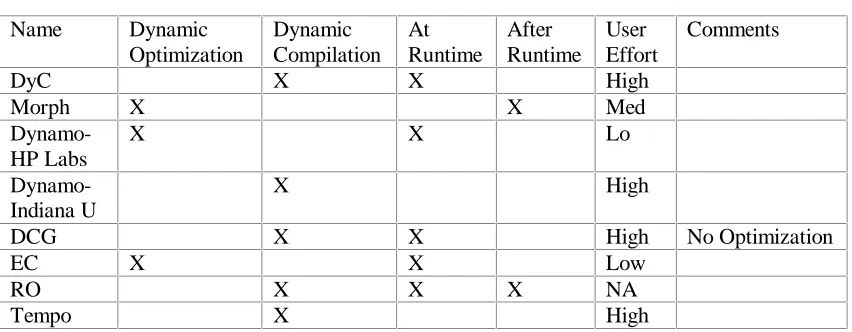
be summarized in Table 2.1. Several of the research groups employed dynamic
compilation, which is an interesting approach but it requires a great deal of software
development effort. New compilers and programming languages are required in order to
employ such an approach. Other groups chose the dynamic optimization route, however
approaches varied widely. The approaches ranged from a high amount of user effort
approaches perform optimizations at runtime and very few perform any optimizations
offline.
Table 2.1 – Summary of Past Approaches Name Dynamic
Optimization
Dynamic Compilation
At Runtime
After Runtime
User Effort
Comments
DyC X X High
Morph X X Med
Dynamo-HP Labs
X X Lo
Dynamo-Indiana U
X High
DCG X X High No Optimization
EC X X Low
RO X X X NA
Tempo X High
2.3
Translation and Emulation Efforts
Several research groups have undertaken the task of emulating a program
compiled for one ISA in an environment that uses a different ISA. While IBM developed
an emulator for executing x86 instructions in a VLIW environment, Transmeta developed
a general approach to program translation. Future efforts that provide for compatibility
with IA-64 will soon be underway.
2.3.1 DAISY
A group at IBM’s T.J. Watson Research Center has developed a system that they
call DAISY: Dynamically Architected Instruction Set from Yorktown. DAISY focuses
While most DAISY documentation focuses on VLIW as the target architecture,
with modifications DAISY could be used to translate code to execute on processors using
the new EPIC instruction set architecture.
As each code fragment is executed for the first time, DAISY translates the
fragment into a simple RISC-like intermediate representation. This translation occurs at
instruction cache miss time. The translated version of the code is then stored in a caching
emulator, which is simply a portion of main memory that is not visible to the old
architecture and resembles a cache. Because the translation is cached, the process of
translating each fragment must only occur once.
Within DAISY, precise exceptions are handled by scheduling VLIW instructions
in the same order as they occurred in the original binary. Unfortunately, this scheduling
mechanism will result in code that is far from optimized.
DAISY provides 100% architectural compatibility between ILP architectures and
other existing architectures. It also provides fast emulation using clever caching
techniques. Such caching techniques would not be necessary, however if the new
translated version of the code fragments would actually replace the old code.
2.3.2 Crusoe
In January 2000, Transmeta announced the Crusoe package [28]. Comprised as a
combination of a low-power VLIW chip and specialized Code Morphing software,
Crusoe entered the mobile computing market offering a microprocessor that achieved
While the core Crusoe processor is a 4-wide VLIW, it is able to run all legacy x86
code using the Code Morphing software, which translates x86 instructions into the
native instruction set on the fly. The savings in power came from the fact that not all
attributes of the x86 architecture needed to be supported in hardware. An entirely new,
simple processor could be used.
The Crusoe technology essentially eliminates the ties between the x86 ISA and
the underlying hardware. Furthermore, as upgrades to the Crusoe processor are released,
the user need only replace the Code Morphing software, which is specialized to the
new processor. Even dramatic changes in the processor will not require any of the
software (aside from the code-morphing software) to be recompiled.
The more advanced of the two Crusoe processors introduced in January 2000, can
also perform LongRun power management. Unlike many mobile processors which
have two clock frequency settings for power savings, full speed or off, the Crusoe
processor can dynamically analyze the program(s) being run and adjust the clock
frequency to any frequency between maximum and off. Crusoe can also vary the voltage
used by the processor as the clock frequency is varied. These adjustments of clock speed
and voltage result in cubic reductions in power since power varies linearly with clock
speed and quadratically with voltage.
The most ingenious feature of the Crusoe system, is that the Code Morphing
software could be upgraded to not only translate x86 code, but Sparc, Alpha, HP-UX, and
IA-64 code as well. This would result in a single system that could transparently execute
any legacy code compiled for any architecture without the user knowing or caring about
The drawback of the Crusoe system is that the translation step is not free; some
amount of time must be spent executing the code-morphing software. The translated
groups of instructions are maintained in a translation cache, however, amortizing the cost
of the translation step. Because the translated code stored in the translation cache is
optimized, it can potentially execute faster than the original code.
While the power saving features of the Crusoe processor makes it an competitive
option for mobile computing, the translation and optimization features could be employed
in the general-purpose (desktop) computing market. The potential for compatibility
among all instruction-set architectures is a goal that the entire computing community
could certainly benefit from.
2.3.3 FX!32
Compaq (Digital) Corporation introduced a combined emulator and translator that
allows x86 applications to run on an Alpha using the Windows NT 4.0 operating system
[23]. This system, called FX!32, combines run-time emulation with an off-line
optimization system in order to truly distinguish itself from other emulation systems,
such as DAISY or Crusoe.
While all of the emulation systems described in this section perform the task of
executing non-native instructions on a particular processor, FX!32 employs advanced
background dynamic optimization to optimize the Alpha code that is produced during the
emulation stage using profiling information gathered at runtime.
The design goals of the background optimization system were user transparency
and high performance. To ensure transparency, FX!32 had to be certain that no user
complete and correct. These restrictions resulted in an optimization algorithm that relied
on no assumptions or manual interaction of any kind. To ensure the best possible
performance, FX!32 leverages many modern advances in compiler optimizations.
A major optimization leveraged by FX!32 is the concept of global optimization.
While many other dynamic optimizations are limited to discrete elements such as basic
blocks, FX!32 breaks this limitation and is able to perform global optimizations that were
currently implemented only during static compile time. This method produces an Alpha
executable that performs at least 70% as well as the ideal performance value, which is
determined by directly compiling the original source code into an Alpha executable.
2.4
Profiling Monitors For Feedback-Directed Optimization
An important feature of any dynamic optimization system is its ability leverage
profile information about a user to guide runtime optimizations. This allows the software
to perform well for the way it is typically used. This concept is known as
feedback-directed optimization. The feedback from the usage patterns guides the optimization
process.
The question of how to monitor usage statistics for a particular piece of software
without hurting software performance is an open research area. The monitoring could be
performed in the operating system, such as a daemon that frequently polls the software
and gathers statistics much like the monitoring scheme suggested in Thomas Kistler’s
dynamic run-time optimization system in Section 2.2.4. The problem with a
software-monitoring scheme such as this is that it carries a lot of overhead. The scheme requires a
overhead associated with software monitoring may outweigh the benefits gained from
dynamic optimization.
Another alternative is to provide dedicated profiling hardware. Since all profiling
tasks are performed by the dedicated hardware, there is no performance impact on the
running program. The drawback of hardware-based profiling is the expense incurred in
adding specialized hardware. Convincing processor manufacturers to dedicate silicon to
a task such as profiling may not initially be a welcomed concept. This silicon could be
used for a more universal application, such as speeding up the clock or adding a function
unit. Furthermore, upgrading the monitoring hardware would require a new processor.
Hardware monitoring is much less flexible or upgradeable than its software counterpart.
Several research groups have looked into the problem of program monitoring and
profiling. While most groups agree that hardware profiling is the most feasible form of
program profiling, their approach and scope differs greatly.
2.4.1 ProfileMe
In order to overcome many of the limitations of profiling in the out-of-order
processor domain, Digital Equipment Corporation introduced a novel profiling
mechanism, called ProfileMe [13]. Rather than employing event counters that monitor
specific events such as the number of branch predictions and causing an exception when
the counters overflow, the group chose to randomly choose instructions and gather all
pertinent information regarding the specific instruction.
The move to instruction sampling arose from problems noted in previous
monitors. In order to optimize a program, it is necessary to discern the particular
models, accurate event counts can be maintained, but the method for indicating the
instruction causing each event is rarely correct. Out-of-order instruction execution
complicated this process, resulting in a nearly random distribution of causing
instructions. Speculative execution further complicates the process, as speculative
instructions were ignored in previous models. ProfileMe permits the analysis of which
instructions are aborting and why, while other sampling methods ignore aborted
instructions.
ProfileMe is a hardware/software approach to accurately track events and their
causes. This is done in two ways. The first method is the instruction sampling
technique. This technique selects a random instruction and tracks all information about
the instruction, such as cache miss rates. Another sampling technique can also be
employed. This technique, known as the paired sampling technique, collects data about
the interaction of other instructions with the random selected instruction.
The major advantages of ProfileMe over techniques such as hardware event
counters are:
(1) It collects complete information about each instruction, rather than sampling a small number of events at a time; (2) it accurately attributes events to
instructions; (3) it collects information about all instructions, including instructions in uninterruptible sections of code; and (4) it collects information about useful concurrency, thus helping to pinpoint real bottlenecks [13].
The ProfileMe group chose sampling as a means of profiling rather than some of
the other methods, such as simulation or instrumentation, for three reasons. First,
sampling works on unmodified programs. No additional instructions need to be inserted
into the program in order for sampling to proceed. Second, sampling can be used to
be directly correlated to the sampling rate. Reducing the sampling interval can therefore
directly reduce the overhead caused by sampling.
2.4.2 Profiling for Hot Spots
Wen-mei Hwu’s group at the University of Illinois extends the typical profiling
scheme by also recording the relative importance of the basic blocks encountered [37].
They define a hot spot of code to be a small section of code that is executed very
frequently.
Branch Addr
=
&
+1
-D
0
1
Branch Addr
Valid Bits
T/F
Saturating Adder
At Zero: Stop Profiling
At Max: Start Profiling
Figure 2.6 – Illinois' Monitor Table Hardware for Hot-Spot Detection [37]
The importance of hot spot determination lies in the realm of dynamic
optimization. A frequently executed portion of code that contains a small static footprint,
as in the case of hot spots, is a prime candidate for runtime optimization. Due to time
restrictions, not all optimizations can be performed at runtime. Therefore potential
![Figure 2.1 – How HPL’s Dynamo Works [6]](https://thumb-us.123doks.com/thumbv2/123dok_us/1370833.1169799/20.612.111.522.156.410/figure-hpl-s-dynamo-works.webp)
![Figure 2.2 – The Harvard University Morph Project [46]](https://thumb-us.123doks.com/thumbv2/123dok_us/1370833.1169799/24.612.121.529.342.648/figure-harvard-university-morph-project.webp)
![Figure 2.3 – Sathaye’s Evolutionary Compilation System [40]](https://thumb-us.123doks.com/thumbv2/123dok_us/1370833.1169799/27.612.109.517.210.454/figure-sathaye-s-evolutionary-compilation.webp)
![Figure 2.4 – UW’s DyC Dynamic Compilation System [18]](https://thumb-us.123doks.com/thumbv2/123dok_us/1370833.1169799/30.612.107.535.356.561/figure-uw-s-dyc-dynamic-compilation-system.webp)
![Figure 2.5 – Kistler’s Dynamic Runtime Optimization System [27]](https://thumb-us.123doks.com/thumbv2/123dok_us/1370833.1169799/35.612.144.462.237.466/figure-kistler-s-dynamic-runtime-optimization.webp)
![Figure 2.6 – Illinois' Monitor Table Hardware for Hot-Spot Detection [37]](https://thumb-us.123doks.com/thumbv2/123dok_us/1370833.1169799/46.612.142.507.294.532/figure-illinois-monitor-table-hardware-hot-spot-detection.webp)