An Analysis of Transformation in Teaching
and Learning Methods
Shabana Parveen Ansari, Prof. Mona Deshmukh
Dept. of IT. VESIT Chembur, Mumbai University, Mumbai, India
Assistant Professor, Dept. of MCA, VESIT Chembur Mumbai University, Mumbai, India
ABSTRACT: With the fast development of science and technology, innovative knowledge and high-tech development have become the world's economic development and nationally competitive high ground. With technological advancement learning methods has also been transformed from traditional learning into smart learning environment. Large data availability, information processing tools and techniques further created a new approach and exploration into teaching and learning. Expansion of educational technology framework, diversified content characteristics and huge volume of information availability further made the e-learning to spearhead the learning platform irrespective of technology constraints. This paper explores the stages of learning method from traditional learning to smart learning. How the Learning methods are transformed, to help students to be highly qualified specialists and innovative students.
KEYWORDS: Web based learning, M-learning, cloud base learning, adaptive and big data.
I. INTRODUCTION
Learning is the act of acquiring new, or modifying and reinforcing existing knowledge, behaviors, skills, values, or preferences and may also involve synthesizing different types of information. It is a continuous process that starts since our birth and continue till death. Throughout our lives our learning approach continually evolves as our experiences in learning mould and shape our future experiences [1]. There are different sources from whom we learn like family, friends, teachers, colleagues, gadgets etc. The proposed paper divided learning from class room, web based learning and now on mobile phone or on other Portable device in different sections, section vii has a comparison table sowing different learning methods. Section viii has methodology and procedure of research and the last section has conclusion.
Initially there was only class room learning but from last two decades there is a major transformation in learning methods and trends. Learning methods has been shifted from Traditional Learning (class room) to E-learning, and now from E- Learning to Smart Learning.
Guiding Principal of learning:
Learning should be relevant to existing Knowledge and any Future Task.
Learning should comprise of appropriate sequencing of instruction.
Learning should have attractive student’s involvement.
Learning is incomplete without feedback on performance
Learning Styles:
Learning style refers to the preferential way in which the student absorbs processes, comprehends and retains information. Every learner has different preference of learning, by using the best suitable learning style, user can learn better. Every Learner prefers one of the following Learning styles .
3) Auditory: User uses sound, Music files for learning.
4) Kinesthetic: User uses hands body, sense of touch to help learning.
5) Logical/Mathematical: Learner uses logic, reasoning, sequences, and system.
6) Social: Learner prefers group learning for better understanding and mostly used for learning new things. 7) Solitary: Learner prefers doing self study.
8) Combination: when learner uses more than one learning style.
II. TRADITIONAL LEARNING METHOD
Traditional Learning method is also known as conventional education or customary education. Traditional learning is a Teacher Centred learning environment and classroom learning is the most common traditional learning method, where teacher and students meet face to face. Classroom learning has different types of learning, such as, lectures, debates, labs, tutorials, and question/response discussions.
A classroom learning environment is more interactive, competitive and structured; students learn to work in groups. In this methods teacher keeps students busy by questioning, disciplining, guiding, validating, monitoring, motivating, encouraging, suggesting and clarifying.
Advantages of class room learning
1) Exchange of Ideas: Traditional learning is an interactive learning method where student can exchange ideas without any communication barrier.
2) Development of skills: It helps students to develop their technical and presentation skills. 3) Socialization: This helps in developing level of socializing between the students.
Disadvantages of classroom learning
1) Classroom size: Due to large number of students some student’s pay attention and some are inattentive.
2) Student teacher ratio: there is one teacher and many students hence teacher cannot solve all the problems or cannot payee attention on individual.
3) Accessibility: available at fixed timing. Some time institute or college is very far therefore difficult to access.
III. ELEARNING OR WEB BASED LEARNING
From the last decade the focus of the learning has been shifted from teacher centred approach to learner centred approach. E- Learning technique came into existence in the year 1999 where more and more focus is given to the learner. E learning has become very powerful learning method because it uses technology to enable people to learn anytime and anywhere. It can include training, the delivery of Just in time information and guidance from experts. E-learning systems provide primarily the following interactive functions: (1) distance E-learning, (2) Communication support, (3) learning-contents sharing, (4) self-learning, and (5) collaborative learning. E-learning offers the ability to share material in all kinds of formats such as videos, slideshows, word documents and PDFs. Conducting webinars and communicating with professors via chat and message forums is also an option available to users [2].
Advantages of E-learning
1) E- Learning provides flexibility of time and place for the learner.
2) E-learning enhances the efficacy of knowledge and qualifications via ease of access to a huge amount of information.
3) E-learning is cost effective; there is no need for the students or learners to travel. It also offers opportunities for learning for maximum number of learners with no need for many buildings.
Similarly e-learning has certain limitation or Disadvantages [3]. 1) The learning method might be less effective than traditional method.
2) E-learning may also probably be misled to piracy and plagiarism, predisposed by inadequate selection skills, as well as the ease of copy and paste.
3) Not all fields or discipline can employ the e-learning technique in education.
4) Since tests for assessments in e-learning are possibly done with the use of proxy, it will be difficult, if not impossible to control or regulate bad activities like cheating.
The core of web based learning is integration of content, technology, pedagogy into a system that supports learning. The most important element of e-learning is a web site. Developers must make careful decision while considering the visual design of website.
According to Meyer, developers must create a design that is open and inviting. The color balance must not be too bright or too dull. There needs to be an appropriate amount of white space and keeping color and text consistent. The navigation elements need to be thought through also. Navigation elements are the buttons, text links, or other on-screen indicators which will move the reader around within the text. The reader's interest in the web-based learning experience will be retained if the required information is presented in the proper manner. Too much could overwhelm the learner and not enough could cause boredom and lack of interest.
Some of the disadvantages of e-learning are as follows
1)
Some people found e-learning as inferior in quality in comparison with the traditional classroom setting.2)
There is lack of personal contact which causes low motivation among the students.3)
Lack of control because of which students do not do their tasks properly.4)
Students often search for the answers to the questions posed on the Internet and often use the unreliable sources.5)
Lack of resources, technologies and infrastructure for the communication [4].To overcome these limitations adaptive learning system was designed.
IV. ADAPTIVE LEARNING
The success of web technologies has led to a growing attention on e-learning activities. However, most E-Learning systems provide static web-based learning so that learners access the same learning content through the internet, irrespective of individual learner’s profile. These learners may have very different learning backgrounds, knowledge levels, learning styles, and abilities. The ‘one size fit all’ in an eLearning systems is clearly a typical problem. To overcome this limitation and increase effective learning, adaptive and personalized learning came into existence [5]. This method of learning uses background details like personal and technical knowhow of the learner and displays the pages accordingly. It uses different algorithms and data mining techniques to display personalized pages. It gives a tailor made solution to user’s requirement.
architecture has some limitations such as lack of scalability, elasticity and security. Since the e-learning applications are not getting delivered with high end network, the learning services cannot be shared and delivered efficiently to the learners [5] Cloud Computing offers a dynamic provision of virtualization for different resources, on demand elasticity, scalability and metered service. Use of Cloud computing for e-learning provides the solution for scalability and large storage.
V. M-LEARNING
Mobile learning is an advance feature of e-learning where users can view the web pages on their mobile, other PDA or tablet devices; it is more convenient than learning on desktop or laptop. The first definition of M-Learning is “e-learning through mobile computational devices: Palms, Windows CE Machines, even your digital cell phone.” [7]. M-Learning focuses on the mobility of the learner, interacting with portable technologies, and learning that reflects a focus on how society and its institutions can accommodate and support an increasingly mobile population. This is because mobile devices have features and functionality for supporting learners.
Mobile technologies are an attractive and easy means to maintain literacy skills and gain constant access to information. They are affordable; can be easily distributed and thus hold great potential for reaching marginalized groups and providing them with access to further learning and development. Mobile technologies facilitate distance learning in situations where access to education is difficult or interrupted because of geographical location or due to post conflict or post disaster situations [8].
Some of the objectives of M-learning are
Encourage ‘anywhere, anytime’ learning
Mobile devices allow students to gather, access, and process information without geographical boundaries. They can encourage learning in a real world context, and help bridge school, and home environments.
Improve twenty first century social interactions
Mobile technologies have the power to promote and foster collaboration and communication, which are deemed essential for twenty - first century success.
Fit with learning environments
Mobile devices can help overcome many of the challenges associated with larger technologies, as they fit more naturally within various learning environments.
Enable a personalized learning experience
Not all children are alike; instruction should be adaptable to individual and diverse learners. There are significant opportunities for genuinely supporting differentiated, autonomous, and individualized learning through mobile devices. This learning method has some technical challenges.
Connectivity and battery life.
Number of file/asset formats supported by a specific device. Content security or copyright issue from authoring group.
Multiple standards, multiple screen sizes, multiple operating systems. Limited memory.
Risk of sudden obsolescene.
But M-learning is more popular and has more Benefits over e-learning. Some of the benefits are as follows.
Relatively inexpensive opportunities, as the cost of mobile devices are significantly less than PCs and laptops. Multimedia content delivery and creation options.
Potentially a more rewarding learning experience, using the communication features of a mobile phone as part of a larger learning activity, e.g. sending media or texts into a central portfolio, or exporting audio files from a learning platform to your phone.
VI. CLOUD COMPUTING
In the current scenario, cloud computing as a new type of advanced technology accelerates innovation for the computer industry [9]. Cloud computing is a model for deploying IT resources and capabilities that seeks to minimize the implementation and management load for the organization. Cloud computing provides anytime, anywhere services that can be accessed from any device in such a way that user is not responsible for where the services or applications are located or how it is maintained or updated. Cloud computing not only saves the money needed for upgrading many labs’ hardware or purchase many software licenses but also it relieves the user from periodic maintenance operations. It also provides a high level of security and privacy to user data [10]
Cloud learning has certain benefits like
Cloud provides anytime anywhere service. Users can access resources using different technologies including mobile devices.
Scalability to the number of learners. It can handle the growing population of learners.
Compatibility with the social and collaborative tool. It helps the students learning in collaborative manner where they can share their knowledge with others.
Improve the rate of use of IT resources, reduce the maintenance costs of the infrastructure, and provide everyone with access to optimized resources.
Provides an adaptive and virtual environment of learning.
Cloud offers different services based on the requirement, particular kind of cloud service is enabled by the organization. Services like Iaas, Paas, Saas.
In cloud technology data centers are located somewhere in the world, or even multiple data centers scattered around the world, and cloud computing providers deliver common applications online that are accessed from web browsers, also can provide a storage unit to store all learners documents. Cloud uses necessary security method to protect user data.
VII. LEARNING USING BIG DATA
Cloud gave many benefits to the learners but due to growing popularity of internet and expansion of mobile network which has increased the number of learners and the data they upload onto the cloud. Cloud computing and a rise of unintelligibly of big amounts of data, are described as “Big Data”.
The term “big data” does not only apply to the volume of data itself, but the individual pieces of data that are being collected. These pieces of data can be analysed to offer organizations or e-Learning professionals the opportunity to determine how the learner is acquiring information, at what pace, and to pinpoint any problems that may exist within the E-Learning strategy itself.
There are a number of reasons why big data may, very well, revolutionize the E-Learning industry. First and foremost, it allows E-Learning Professionals to customize the E-Learning experience to provide learners with more effective, engaging, and informative E-Learning courses and modules
Allowing eLearning professionals to design more personalized eLearning courses.
Big data gives us the chance to gain an in-depth understanding of the eLearning process and how the learners are responding to the eLearning courses we are delivering to them.
majority of the learners struggle with a particular module or assignment, he can make proper adjustments to improve learners’ performance.
VIII. COMPARISION SHOWING DIFFERENT LEARNING METHODS
Traditional Learning E- Learning M-Learning Cloud Based Learning Learning
Environment
Class room Learning or learning in a closed environment.
Learning using internet on web pages.
By using specialized Applications or tool
By using specialized learning tool
Interaction Pattern Classroom learning has face to face interaction between teacher and student.
No direct interaction with the developer or other user.
No direct interaction between learners and developer.
More Interactive. Facilities are provided to connect with experts and other user.
Number of Learners
In this method whole class learn together.
Learning is possible in small group or individual
Individual learn on mobile or PDA
Learning is in group or individual.
Upgraded content Teachers update data when there is change in syllabus from university.
Once the web site is built there is rarely any change made in data.
Frequents updates are provided.
Data can be easily added or updated.
security No need for security. Less secured data. More Security is provided as users can access from different type of device.
High security is provided. Data is accessible by large number of users from different devices.
Cost involved Cost includes Infrastructure cost, teacher’s salary. Cost includes development, hosting and maintenance. Cost includes development, hosting, maintenance and frequent updates.
Comparatively cost in infrastructure and maintenance. .
customization It is possible in a classroom learning environment.
Customization as per the user is possible with specialized software
Customization is possible with specialized software
Limited control for customization to the needs of the organization;
Engaging Students are Less engage Keeps students engaged in learning.
Keeps students engaged in learning
Keeps students Very much engaged.
Resources Limited number of resources like text or images.
Large number of resources available.
Large number of resources available
Large number of resources available
Sharing of knowledge.
Knowledge is shared with limited number of students or within the class.
Information can be shared with friends or colleagues.
Information can be shared with friends or colleagues
IX. METHODOLOGY AND PROCEDURE
This section describes the research design used in the study, population and sample, data collection, treatment of the experiment and statistical analytical techniques applied in the study. The research design for this investigation was an experimental study. The independent variables were different learning methods traditional learning, E-learning, M-learning and cloud based learning; and the dependent variable was student’s test scores.
Population and Sample
The population for the study is 100 students learning computer science (CS) and Information Technology (IT) as specialization at undergraduate level in Mumbai University. A survey was conducted by giving one topic, which was taught by the instructor in class and the same topic was to learn from E-learning web site on computer, mobile phone and on cloud based environment. Result of the research is as follows.
Table I: Comparison of different learning methods by ANOVA technique α=0.05 Groups Count Sum Average Variance
Class Room Learning 6 405 67.5 337.5
E-Learning 6 324 54 58.8
M Learning 6 330 55 97.2
Cloud Based Learning 6 409 68.16666667 58.56666667
ANOVA
Source of Variation SS df MS F P-value F crit Between Groups 1071 3 357 2.586644125 0.081617 3.098391
Within Groups 2760.333333 20 138.0166667
Total 3831.333333 23
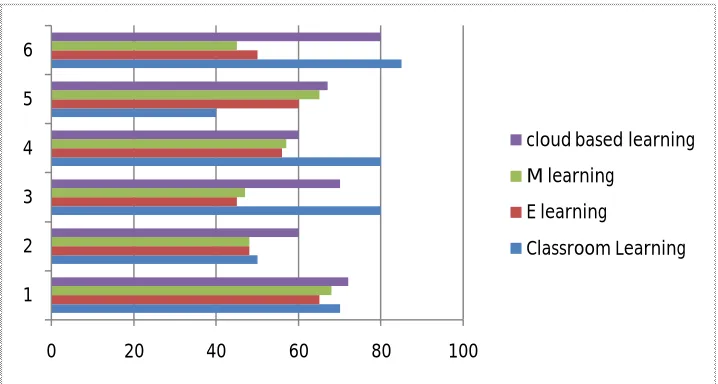
Table shows the comparison of different learning methods. A particular learning method is considered good by the user in one aspect than the other method is preferred on other aspect. By looking at the table we can say that technology based learning is more popular compared to the traditional learning method.
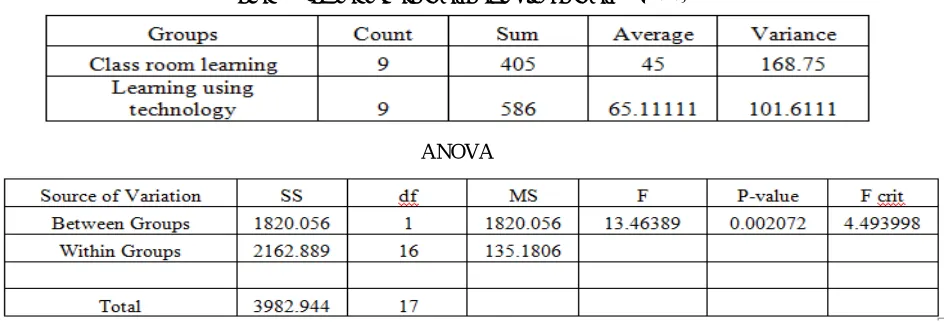
Table II: Sample pre learning and post Learning α=0.05
The table shows that the technology based learning methods are helpful for learning their topic. There is significant increase in the knowledge of learner after using technology based learning.
Figure 1: Comparison of learning methods
X. CONCLUSION
From the above analysis it has been observed that the new learning methods like adaptive learning, social learning, mobile learning and cloud based learning provides better learning. Despite availability of other learning methods the class room learning is still the preferred learning method. Technology based learning methods cannot completely replace classroom learning. As said by Nafukho [12]“ Technology is only a facilitator it cannot replace the teacher”. A learner may personally think that technology based learning is better because of the flexibility in schedule, convenience of place and 24/7 accessibility. Students prefer base learning in classroom learning Environment and to get more knowledge and information they go for technology based learning. In current learning environment even the educational institutes are using technology in classroom to teach their lessons. Blended learning is the best learning method where classroom and the modern learning together make learning easier, comfortable and effective.
REFRENCES
1) R. Costello and D.P. Mundy “The Adaptive Intelligent Personalised Learning Environment” 2009 Ninth IEEE International Conference on Advanced Learning Technologies.
2) https://www.talentlms.com/elearning/elearning-101-jan2014-v1.1.pd “E –learning concepts trends, application”.
3) Valentina Arkorfu “The role of e-learning, the advantages and disadvantages of its adoption in Higher Education” International Journal of education and research vol2 December 2014
4) Zuzana Melicheríková, Alena Bušíková” Adaptive E-learning – a Tool to Overcome Disadvantages of E-learning” ICETA 2012 • 10th IEEE International Conference on Emerging eLearning Technologies and Applications • November 8-9, 2012, Stará Lesná, The High Tatras, Slovakia 5) Maryam Yarandi, Hossein Jahankhani” An Adaptive E-Learning Decision Support System” School of Computing Information Technology and Engineering University of East London London, UK 2012 IEEE
6) Sucheta Kolekar, Radhika M. Pai, Manohara Pai M. M. “Adaptive User Interface for E- Iearning Applications based on Learning Styles using Web Logs Analysis: A Hybrid Cloud Architecture” 978-1-4799-8641-5/15/$31.00 2015 IEEE
7) Quinn, C., mLearning: mobile, wireless, in-your-pocket learning. LiNE Zine, 2000.
8) Yousef Mehdipour “Mobile Learning for Education Benefits and Challenges” nternational Journal of Computational Engineering Research||Vol, 0 3||Issue, 6 ||
9) Gazhal Riahi “E-Learning System based on Cloud Computing: A Rivew” The 2015 International Conference on Soft Computing and software Engineering.
10) N. S. Abu El-Ala “Cloud Computing for Solving E-Learning Problems” (IJACSA) International Journal of Advanced Computer Science and Applications, Vol. 3, No. 12, 2012
0 20 40 60 80 100
1 2 3 4 5 6
cloud based learning
M learning
E learning
10) Athanasios S. Drigas “The Use of Big Data in Education” Institute of Informatics & Telecommunications, Telecoms Lab - Net Media Lab, N.C.S.R. “Demokritos” Agia Paraskevi, Athens, 15310, Greece IJCSI International Journal of Computer Science Issues, Vol. 11, Issue 5, No 1, September 2014.
11) D. Bollier and C. M. Firestone, “The promise and peril of big data”. Aspen Institute, communications and Society Program, 2010