Differential Power Analysis of a McEliece Cryptosystem
Cong Chen1, Thomas Eisenbarth1, Ingo von Maurich2, and Rainer Steinwandt3 1
Worcester Polytechnic Institute, Worcester, MA, USA
{cchen3,teisenbarth}@wpi.edu
2
Ruhr-Universit¨at Bochum, Germany [email protected]
3
Florida Atlantic University, USA [email protected]
Abstract. This work presents the first differential power analysis of an implementation of the McEliece cryptosystem. Target of this side-channel attack is a state-of-the-art FPGA implementation of the ef-ficient QC-MDPC McEliece decryption operation as presented at DATE 2014. The presented crypt-analysis succeeds to recover the complete secret key after a few observed decryptions. It consists of a combination of a differential leakage analysis during the syndrome computation followed by an algebraic step that exploits the relation between the public and private key.
Keywords: Differential Power Analysis, McEliece Cryptosystem, QC-MDPC Codes, Hardware Implemen-tation
1
Introduction and Motivation
The basic idea of the McEliece public-key encryption scheme can be traced back more than 35 years [McEliece, 1978]. Having passed the test of time, today it is considered one of the most promising alternatives to public-key encryption schemes whose underling hardness assumptions are invalidated by known quantum algorithms [Shor, 1997]. A critical point of McEliece-based constructions is the large key size, and to tackle this problem it is tempting to impose additional structure on the code involved. For some proposals in this line of work, including constructions building on Goppa codes, cryptanalytic strategies to exploit the additional structure have been put forward [Faug`ere et al., 2010, 2014a,b].
Lacking obvious algebraic code structure that can be exploited by an adversary, quasi-cyclic moderate-density parity-check (QC-MDPC)codes currently receive considerable attention as an implementation choice, and in this paper we take a closer look at a state-of-the-art implementation of such a scheme, presented in [von Maurich and G¨uneysu, 2014].
Our contribution In this paper we are not concerned with the security of the specific parameters in [von Maurich and G¨uneysu, 2014] against the underlying theoretical problem, and instead focus onside-channel attacks. Even in a post-quantum world, i. e., when scalable quantum computers are available, implementation-specific information leakage will remain a serious issue, but so far no differential power analysis (DPA) has been documented on implementations of McEliece. In fact, [Heyse et al., 2010] concluded that a classical DPA attack is not possible for their target implementations. In this paper we demonstrate that DPA can be a realistic threat for a state-of-the-art FPGA implementation of McEliece. Besides showing that significant parts of the private key can be recovered by DPA, we show that knowledge of the public key can be utilized to recover missing key information or to correct remaining errors in hypothesized key bits.
Related work Using QC-MDPC codes in the McEliece cryptosystem was first proposed by [Misoczki et al., 2012] and later published with small changes in the parameter set in [Misoczki et al., 2013]. These codes have no obvious algebraic code structure and still allow small key sizes, which gained high interest in the research community.
First implementations of this scheme for AVR microcontrollers and Xilinx FPGAs were proposed by [Heyse et al., 2013]. Their FPGA implementation aimed for a high throughput at the cost of a high resource con-sumption while their microcontroller implementation for the first time showed that it is possible to implement McEliece without external memory to store the keys. A lightweight FPGA implementation by [von Mau-rich and G¨uneysu, 2014] showed the full potential of this promising scheme. Occupying less than 230 slices and 4 block RAMs on Xilinx’s smallest Spartan-6 FPGA (XC6SLX4) for a combined encryption/decryption unit, their implementation still provides a reasonable performance of 3.4 ms and 23 ms for en-/decryption, respectively.
Side-channel leakages of McEliece have first been studied in [Strenzke et al., 2008]. This work, as well as two follow-up studies have focused on analyzing timing behavior of different parts of contemporary PC implementations of McEliece [Strenzke, 2010, Shoufan et al., 2010]. Subsequently, [Avanzi et al., 2011] im-proved over prior results, presented countermeasures and pointed out leakages in the preprocessing steps of McEliece encryption.
[Heyse et al., 2010] performed power analysis on software implementations of classic McEliece implemen-tations. Their work relies on simple power analysis (SPA)-based approaches, which usually do not translate well to hardware implementations, due to the increased parallel processing of data and the much smaller side-channel leakage. They also show that side-channel analysis is impeded by the large key sizes of McEliece.
2
Background
McEliece based on (QC-)MDPC codes is fully described in [Misoczki et al., 2013]. To provide the necessary context for our attack, the remainder of this section gives a brief summary of (QC-)MDPC codes and their proposed use to instantiate the McEliece cryptosystem.
2.1 Quasi-cyclic Moderate-Density Parity-Check Codes
Abinary linear[n, k]error-correcting codeC of lengthnis ak-dimensional vector subspace ofFn2. We write
r=n−kfor the co-dimension ofC. The codeCcan be specified by providing agenerator matrix G∈Fk×n2 , i. e., a matrix whose rows form a basis ofC. Alternatively, one can provide aparity-check matrix H∈Fr×n2 which characterizes the linear code as C ={c∈Fn2|cHT = 0r}. Given a parity-check matrix and a vector
x∈Fn2, we refer tos=Hx
T ∈
Fr2assyndrome ofx. In particular, a vector fromF
n
2 is contained inC if and only if its syndrome is 0r.
If a codeCis closed under cyclic shifts of its codewords byn0positions for some integern0≥1, we refer to C as quasi-cyclic (QC). Ifn=n0·pfor some integerp, both generator and parity-check matrix can be chosen to be composed ofp×pcirculant blocks. This has the advantage, that only one row (usually the first) of each circulant block needs to be stored to completely describe the matrices. For amoderate-density parity-check (MDPC) code, we choose the weight of each row to have the same density w = O(pnlog(n)). For short, we refer to a binary linear [n, k] error-correcting code defined by a parity-check matrix with constant row weightwand co-dimensionras an (n, r, w)-MDPC code. If such a code is in addition quasi-cyclic with
n=n0r, we speak of an (n, r, w)-QC-MDPC code.
2.2 The QC-MDPC McEliece Public-Key Encryption Scheme
Key-Generation The secret key is comprised of the first rows h0, . . . , hn0−1 ∈ F r
2 of the n0 parity-check matrix blocksH0, . . . , Hn0−1. These rows are chosen at random and it must be ensured that their weights—
the number of non-zero entries—sum up tow:
n0−1
X
i=0
wt(hi) =w.
Iterated cyclic rotation of thehiyields the parity-check matrix blocksH0, . . . , Hn0−1∈F r×r
2 and thereby the secret parity-check matrixH= (H0|. . .|Hn0−1) of an (n, r, w)-QC-MDPC code withn=n0r. Assuming the
last blockHn0−1 to be non-singular, the public key is obtained as generator matrixG= [Ik|Q] in standard
form, simply concatenating the identity matrixIk∈Fk×k2 with
Q=
(Hn−1 0−1·H0)
T
(Hn−01−1·H1)T · · · (Hn−1
0−1·Hn0−2) T
.
Similarly as for the secret key, the public matrixGis fully determined through its first row. For a textbook version of McEliece the systematic form ofGis problematic, but in combination with a conversion to protect against chosen-ciphertext attacks (cf. [Kobara and Imai, 2001, Nojima et al., 2008]) having the generator matrixGin systematic form is accepted practice.
Encryption To encrypt a messagem∈Fk2, an error vectore∈Fn2 of weight wt(e)≤tis chosen at random. With this, the ciphertext evaluates tox= (m·G⊕e)∈Fn2.
Decryption To decrypt a ciphertext x∈Fn2, a t-error correcting (QC-)MDPC decoder ΨH is applied tox, recoveringmG←ΨH(x). SinceGis in systematic form, the messagemcan simply be read off from the first
kpositions ofmG.
Parameters For the implementation investigated in this paper, we used parameters, which in [Misoczki et al., 2013] have been considered for an 80-bit security level:
n0= 2, n= 9602, r= 4801, w= 90, t= 84.
With these parameters a 4801-bit plaintext block results in a 9602-bit codeword to which t= 84 errors are added. The parity-check matrixH has constant row weightw= 90 and is obtained as juxtaposition of
n0= 2 circulant blocks. TheQ-part of the public generator matrixGconsists of a single circulant block.
2.3 Decoding (QC-)MDPC Codes
Several decoders have been proposed to actually decode (QC-)MDPC codes [Berlekamp et al., 1978, Gallager, 1962, Heyse et al., 2013, Huffman and Pless, 2010, Misoczki et al., 2013]. The implementation investigated in this paper employs the decoder from [Heyse et al., 2013], an optimized version of thebit-flipping decoder
by [Gallager, 1962]. To decode a received ciphertextx∈Fn2, four main steps are involved: 1. Compute the syndrome s=HxT.
2. Count the number of unsatisfied parity checks for every ciphertext bit.
3. If the number of unsatisfied parity checks for a ciphertext bit exceeds a precomputed threshold, flip the ciphertext bit and update the syndrome.
4. If s = 0r, the codeword was decoded successfully. If s 6= 0r, go to Step (2) or abort after a defined
maximum of iterations with a decoding error.
2.4 Target Implementation
The target under investigation is a lightweight implementation of QC-MDPC McEliece for reconfigurable de-vices by [von Maurich and G¨uneysu, 2014]. The resource requirements are 64 slices and 1 block RAM (BRAM) to implement encryption and 159 slices and 3 BRAMs to implement decryption on a Xilinx XC6SLX4 which is the smallest device available in Xilinx’s Spartan-6 family. Encrypting a plaintext takes 3.4 ms and decrypting a ciphertext takes 23 ms.
This lightweight implementation is possible mainly for two reasons. First, QC-MDPC codes allow smaller keys compared to (optimized) Goppa codes. Second, the implementation stores inputs, outputs and most intermediate values during encryption and decryption in block memories. Since our attack focuses on secret key recovery, we limit the description of the details of the implementation to the decryption, especially to the part in which the syndrome is computed.
Decryption uses three BRAMs, one BRAM stores the 2·4801-bit secret key, one BRAM stores the 2 ·4801-bit ciphertext, and one BRAM stores the 4801-·4801-bit syndrome. Each BRAM is dual-ported, offers 18/36 kBit, and allows to read/write two 32-bit values at different addresses in one clock cycle.
To compute the syndrome, set bits in the ciphertext select rows of the parity-check matrix that are accumulated. Since only one row of the parity-check matrix is stored in the BRAM, it needs to be rotated by one bit to generate the next row. To generate all rows ofH this rotation is repeated 4801 times.
Rotating the two parts of the secret key is implemented in parallel, which means that the 4801-bit rows of the first and the second part of the parity-check matrix are rotated at the same time. Efficient rotation is realized using the Read First mode of Xilinx’s BRAMs which allows to read the content of a 32-bit memory cell and then to overwrite it with a new value, all within one clock cycle.
Rotation is implemented as follows: in the first clock cycle, the least significant bit is loaded from the last memory cell. The first 32-bit of the row to be rotated are loaded next. In all following clock cycles, the succeeding 32-bit blocks of the row are read and overwritten by the rotated preceding 32-bit block. The least significant bit of each 32-bit block is delayed by a flip-flop and becomes the most significant bit of the following block. An abstraction of this implementation is depicted in Figure 1. In addition to a rotation of the row, this introduces a rotation of the memory cells, so after one 4801-bit rotation, the most significant 32 bits of the parity-check matrix row do not reside in memory cell 0 but in memory cell 1.
The syndrome computation is done in parallel to the key rotation. Ciphertext xis split into two parts that are processed bit-by-bit in parallel. If a bit in one or both parts is set, then the current row(s)h0/h1of the secret key are added to the syndrome, as shown in Figure 1.
3
Attack Description
Usually DPA attacks exploit an intermediate statey=f(x, k) that is a function of both a known data item
xand a subkey k. The subkey space K should be small enough so that a hypothesis y can be checked for all candidates k ∈ K. Some works that elaborate on this model are [Mangard et al., 2007, Kocher et al., 2011, Whitnall et al., 2014]. McEliece does not offer itself for this approach, as also noted in [Heyse et al., 2010]. One would expect the syndrome sto serve as a potential predictable intermediate statey. However, the bits in the ciphertextxonly determine which rows of the parity check matrixH are added tos, where
H is the secret key to be recovered. Predicting (parts of) the syndrome s requires an additional key bit hypothesis for each variation of each bit of s, i. e., each bit of s depends on l key bits after l variations, supporting the infeasibility claim of [Heyse et al., 2010]. One of the strengths of QC-MDPC, its small private key size, comes from the fact that secret information is highly redundant: each row ofH contains the same information—namely hh0≪i||h1≪ii—only rotated by one bit per row. This redundancy allows for an efficient recovery of key information. More importantly, it enables a differential analysis approach which greatly enhances the visibility of even faint leakages.
dout h0
dout h1
din h0
din h1
SecKey BRAM
[31:0] [31:0]
[31:1] [0]
[31:0] [31:0]
[0] [31:1]
Carry h0
Carry h1
Syndrome BRAM
dout syn
din syn
0
[31:0]
[31:0]
Fig. 1.Abstract block diagram of the syndrome computation circuit including key rotation.
the independence ofxwe claim both analysis methods to be differential leakage analyses, since in both cases differential leakage traces can be computed—similar to the approach originally proposed by [Kocher et al., 1999].
3.1 Leakage Behavior of the Target Implementation
The described attacks recover the key during the syndrome computation step of the decryption algorithm. The key for QC-MDPC consists of a single line of the parity check matrixH, namely h0||h1. As described in Section 2.4, only this line ofH, or one of its rotated versionshh0≪i||h1≪ii, is stored in BRAM. The key has some noteworthy features that influence the derived DPA attacks. First, the private key is of low weight: both parts of the secret keyh0andh1are of low Hamming weight such that, wt(h0||h1) =w. For the target implementation, w= 90 and wt(hi) = 45, i. e. bothh0 and h1 have exactly 45 bits set. This means, each key bithi,j ∈ {0,1}is set with probability
Pr(hi,j= 1) = w
n0r = 45
4801 ≈.94%.
This implies low-weight leakages: Syndrome and key parts hi are stored in BRAMs and processed as 151
32-bit words. The chance of a 32-bit key word to be all-zero is still 74%, about 22% contain a single one bit, leaving the chance of having more than one bit set in a word below 5%. The critical parts of the target implementation that feature exploitable key leakage are depicted in Figure 1.
leakage λj,carry. In the following clock cycle, that bit is overwritten with hi,j+32. Assuming a Hamming distance leakage function, this register leaks first
λj,carry=w1·wt(hi,j−32⊕hi,j), (1)
then, in the subsequent clock cycle, leaksλj+32,carry=w1·wt(hi,j⊕hi,j+32), wherew1∈Ris an appropriate
weight. Assuming thathi,j= 1 and further hi,j±32= 0,λj,carry gives a clearly distinguishable leakage from the case wherehi,j= 0.
Besides the key rotation, the computation of the syndromescontributes significantly to the leakage. The target implementation processes the ciphertextxin a bitwise fashion. If thei-th bit is set, i. e.,xi= 1, then thei-th row ofH is added to the syndrome s. The implementation adds two 32-bit words in parallel: one word of the rotatedh0 and one word ofh1 are processed each clock cycle. This means that the addition of one row ofH takes 151 clock cycles (plus two additional clock cycles for preprocessing and data read-write delay, resulting again in 153 clock cycles). The syndromes is only updated if at least one of the currently processed ciphertext bitsxi is set.
Note that we know for each key bit hi,j at which clock cycle it is processed (if not, several hypotheses
can be checked in parallel by analyzing neighboring clock cycles). In fact, knowing the implementation and
x, it is predictable which 32-bit word ofhi is added to the syndrome at which point in time. Similarly, it is
predictable which key bithi enters the carry register in which clock cycle for the key rotation. We use this
information to build the differential power analysis attacks.
As in the classical DPA by Kocher et al., we can now hypothesize each key bithi,j separately to be one,
knowing that this hypothesis will be wrong 99% of the time. We further know at which clock cycle the leakage of the carry register (for the key rotation)or the currently written syndrome word (for the computation of the syndrome) depends onhi,j. Based on this knowledge, one can build two different attacks:
3.2 DPA of Syndrome Computation
The first analysis targets the leakage of the syndrome during its computation. This analysis assumes the adversary to send chosen ciphertexts of weight one, i. e., all possible xsuch that wt(x) = 1. Ciphertexts of weight 1 ensure that a rotated version of eitherh0 or ofh1 is written into a zeroed syndromes. To recover
h0, we chose only the first 4801 bits of xto be one, yielding a total of 4801 different ciphertexts for the analysis.4
For eachxwe know when a line of the key is added to the syndrome. We also know at which clock cycle during that addition the word containinghi,jis added. Our algorithm recovers the clock cycle where thehi,j
is added tosfor eachxand the corresponding leakage in the leakage traceL. Next, we simply sum all the leakage instances of the targethi,j for the different xi into a bin, as typically done by DPA. Unlike DPA,
we have only one bin per key bit. However, assuming that each bit leaks similarly, we have 4756 bins that correspond to ahi,j = 0, and only 45 bins corresponding to a bithi,j= 1.
The leakage model for the registers containing the syndrome is described next. Since the ciphertexts are of weight one, the syndrome is initially zero, and then overwritten with (a shifted version of)h0 orh1. The key bithi,jis processed as part of one 32-bit wordhhi,j−l. . . hi,j. . . hi,j−l+31i, wherel∈ {0, . . . ,31}depends on j and the position of the set bit inx. As mentioned before, this leakage occurs during a specific cycle that we can reconstruct. Assuming a Hamming distance leakage, the Hamming weight of the word will leak, since it overwrites a zeroed register, i. e., the leakage of the corresponding syndrome word can be modeled as
λj,syn=w0·wt (hhi,j−l. . . hi,j. . . hi,j−l+31i)
with an appropriate weightw0∈R.
This approach has two disadvantages, one being the inaccuracy of the model; the other disadvantage is that bits of hi located close to each other have highly correlated leakage functions. In fact, since 32-bit
registers are leaking, all bits in the same register will enter the leakage function in the same way. However, 4
whether a given neighboring bit is in the same register depends on the row index that is currently processed, since the key bits are rotated by one bit for each row. This means that the neighboring bits will leak in a different clock cycle eventually, as the position of the set bit in xchanges for different ciphertexts. The closer the bit is to the correct bit, the higher their correlation is (since they are more likely to be in the same register). We will later show that, while key bits equal to 1 can be detected, their exact position is harder to detect, since neighboring bits “look like” ones as well.
The other problem are correlated leakages from the key rotation. Bothh0 andh1are rotated during the above computation, with the same key words being processed in the studied clock cycle. We detail on this leakage in Section 3.3. Since those leakages are dependent on the predicted bit, they are not independent noise that decreases by averaging, as usually happening in DPA. However, they occur independently of whether the syndrome is updated or not. It is possible to remove these leakages, which we refer to asλj,const by subtracting the average leakage during the corresponding clock cycles, i. e., the leakage of the same clock cycles when the key word is not added to the syndrome word (and the set bit inxis zero), given as
Lj,syn=λj,syn+λj,const+N,
whereN is the noise, which is assumed to be Gaussian and can be minimized by increasing the number of observations used for computing Lj,syn. We can approximateλj,const by simply averaging over all observed traces and compute it asLj,const= avg(Lj). This average is then subtracted from the leakage trace forLj,syn, which is computed as
∆syn(j) = 4800 X
l=0
(Lj,syn(l)− Lj,const(l)). (2)
0 500 1000 1500 2000 2500 3000 3500 4000 4500
0 0.2 0.4 0.6 0.8 1 1.2
key bit h0, j
Differential Trace
∆syn
Real Differential trace Simulated Differential trace
Fig. 2.Differential leakage for syndrome computation with key parth0 only. The plot shows the normalized leakage
(vertical axis) for each key bit ofh0 (horizontal axis) for simulated leakage according toλj,syn(blue/black line) and
real measurement, i. e., empirical∆syn(j) (red/gray line).
bits up to 64 bits lower than the predicted one still exhibit a correlation. We assume this to be due to the ReadFirst mode of the BRAM. In fact, when a specific syndrome word is written to BRAM, the next one is simultaneously read, as is the corresponding part of the key. Hence, the next clock cycle’s word could already be computed. While we expect this leakage to be constant, i. e., to occur independently of whether the syndrome will be updated or not, the observed leakage suggests otherwise.
As a summary, the described method lets us detect leakages ofh0andh1separately. It allows us to reliably distinguish set bits from zero bits. We get a single leakage observation per traceLfor chosen ciphertexts of weight 1. However, closely co-located bits are highly correlated, making the exact position of a bit difficult to detect.
3.3 DPA of Key Rotation
The next analysis targets the key rotation itself. Our algorithm identifies all clock cycles where hi,j is written to or overwritten in the carry register in each traceL. Per processed ciphertext bit, only 150 words are rotated. The additional bit is stored in the carry register. Hence all rotations together result in a total of 4801·150 carry register overwrites for eachhi. Since there are 4801 bits inhi, each bit is written to the carry register 150 times. By identifying the corresponding clock cycles and adding them together, one can generate a differential power trace∆carry, as typically done by DPA. As for the DPA of the syndrome computation, we have only one bin per key bit. Since the key is sparse, we have only very few bins that correspond to a
hi,j = 1, while most bins correspond to a bit hi,j = 0. The target implementation processes h0 andh1 in parallel. This means that there are two carry registers (cf. Figure 1), one stores h0,j when the other stores h1,j. While these leakages slightly differ, we do not attempt to distinguish them. Instead we recover the
combined leakages. That is, we predict the combined leakageh=h0+h1. Note that the addition here isnot in F2, i. e., we can distinguish the case whereh0,j =h1,j = 1 from the case h0,j =h1,j = 0, although this
case is very rare.
The assumption of all bits leaking the same way is perfectly justified: each bit hi,j takes each column position exactly once, in a specific row. That means due to the rotation, each key bit leaks in every position exactly once, averaging out any position-specific leakages.
In addition to the leakage of the carry registerλj,carrydescribed in Equation (1), there are related leakages happening in the same clock cycles. In fact, when hi,j is written to the carry register, the implementation also reads the word hhi,j+1. . . hi,j+32i from the block memory at one address and then stores the word hhi,j−32. . . hi,j−1i into the block memory at the same address. Both reading and storing operations will cause leakages at different levels. Assuming a Hamming weight leakage function here, reading data and storing data leaks as
λj,read=w2·wt(hhi,j+1. . . hi,j+32i) and
λj,store=w3·wt(hhi,j−32. . . hi,j−1i),
respectively. Here, w2 ∈ R and w3 ∈ Rare appropriate weights for the different types of operations. The
overall observed leakage is approximated by the following model:
Lj =λj,carry+λj,read+λj,store+N
where Lj is the overall leakage at the clock cycle wherehi,j is written into the carry register andN is the
noise, which is assumed to be Gaussian. While the model is not perfect, it describes the observed leakages well enough to base a decent key recovery on it.
In order to detect whether a key bit is set, i. e., hi,j = 1, we average over all clock cycles where hi,j is
written to the carry register.
∆carry(j) = 1 150
150 X
l=1
Note that, since hi,j−32 = 0 with very high probability, ∆carry(j) depends directly on the key bit. Further note thathi,j= 1 has an even stronger influence on∆carry(j±32), since it leaks throughλj,carry and either
λj,readorλj,store. The dependence of∆carry(j) on neighboring key bitshi,j±l, withl≤32, implies that each
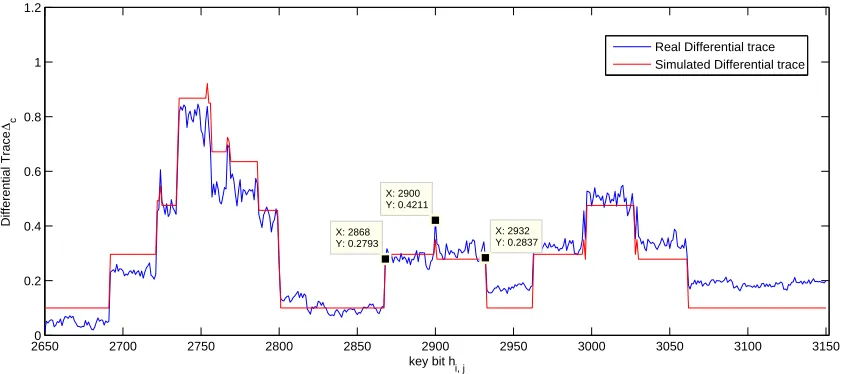
set key bit not only results in an increased differential signal for its own position (i. e., indexj), but also in the neighboring positions. Note that due to the differing weights, each set key bit imprints a characteristic shape onto the differential trace. These shapes can (and actually will) overlap if several key bits in the same region are set.
Fig. 3.Differential trace for key rotation. The plot shows the normalized leakage (vertical axis) of both key parts h=h0+h1. The red/gray line is the simulated leakage while the blue/black line is the observed leakage from the
target implementation.
26500 2700 2750 2800 2850 2900 2950 3000 3050 3100 3150
0.2 0.4 0.6 0.8 1 1.2
X: 2868 Y: 0.2793
key bit hi, j
Differential Trace
∆c
X: 2900 Y: 0.4211
X: 2932 Y: 0.2837
Real Differential trace Simulated Differential trace
Figure 3 shows the comparison of the simulated differential trace (red/gray line) using the power model and the real differential trace (blue/black line). The characteristic shape is highlighted in Figure 4, which is a magnification of a single set bit of the key, surrounded by zeroes.
In summary, the key rotation analysis allows us to detect joint leakages of h0 and h1. This is due to the target implementation that processes both in parallel. Unlike the leakage of the syndrome computation, the key rotation leakage does not feature a slowly decreasing correlating leakage, but rather a characteristic shape with easily detectable bounds. This allows for a more precise location of set key bits. Furthermore, the analysis of the key rotation is mostly input-independent, as will be discussed in Section 4. More importantly, each bit features 150 leakage observations per traceL, resulting in a very strong leakage.
3.4 Key Bit Recovery
The computation of syndrome and key rotation both cause leakages which can be analyzed in the presented differential traces. In both of the differential traces, characteristic shapes caused by set key bits can be detected and used to recover the set key bits. In the same way, the traces can be used to detect key bits that are not set.
For the computation of the syndrome, the differential trace can recover the key bits ofh0orh1separately, depending on the ciphertext we use. For the key rotation, since the analyzed implementation processes h0 andh1 in parallel, resulting in an overlap of the leakages, the differential trace actually recovers the key bits ofh=h0+h1.
In order to recover key bits, the characteristic shapes need to be detected. We propose a generic shape detection algorithm that works as follows:
1. Shape Definition From the differential trace, one singular characteristic shape can be identified and used as a template for set bits. The template is used to generate a shape threshold as shown in Figure 4. The threshold is defined by the value of features in this shape such as edges, slopes and pulses.
2. Shape Detection For each key bit in the differential trace, we check if this key bit together with the neighboring key bits can form a characteristic shape. This is done by checking if there are features that are beyond the threshold. If more than two features exist, it is highly probable that this key bit is set. If no feature exists, then it is highly probable that this key bit is 0. Otherwise, we mark this key bit as an undetermined bit.
Note that the shapes will overlap if two set key bits are close to each other. Furthermore, the differential traces are noisy, hence we can only recover parts of the key bits, leaving the other key bits as undetermined. By choosing the thresholds for shape detection carefully, the number of detected bits can be maximized while keeping the number of false positive errors as low as needed.
4
Measurement Setup and Results
We ported the implementation of [von Maurich and G¨uneysu, 2014] to a Xilinx Virtex-5 LX50 FPGA which is mounted on a Sasebo-GII side-channel attack evaluation board5. The implementation is clocked at 3 MHz. Measurements were performed using a Tektronix DPO 5104 oscilloscope at a sampling rate of 100 MS/s. Since all of our attacks focus on the syndrome computation, only the syndrome computation was recorded. The syndrome computation takes 245 ms, resulting in long traces. For the ease of analysis, a peak extraction was performed. In each clock cycle only the point of maximum power consumption is retained. The peak extraction prevents potential alignment issues and makes data handling much faster.
As mentioned in Section 3, key rotation and syndrome computation run in parallel which leads to a mixed leakage. To fully exploit the leakages, measurements were obtained in three different scenarios:
5 The VHDL code of the QC-MDPC McEliece implementation of [von Maurich and G¨uneysu, 2014] is available at
Known Ciphertext In this scenario we assume the adversary to only observe ciphertext-leakage pairs. Hence, the ciphertexts xare chosen uniformly at random. While this can result in invalid ciphertexts, the attacker could also just generate valid ciphertexts by choosing plaintexts at will. In this scenario, a mixed leakage of key rotation and syndrome computation is obtained.
All-Zero Ciphertext In order to minimize the impact of the syndrome computation and storage on the leakage, we recorded the power consumption for an all-0 ciphertext. The syndrome is never updated when the ciphertext is 0, while key rotation is always executed. Note that the all-zero word is a valid codeword without any errors. This corresponds to a chosen ciphertext side-channel attack, without the need to observe the corresponding plaintext.
Single-One Ciphertext As mentioned in Section 3.2, the ciphertext weight is chosen to be one in this scenario, i. e., only a single bit of the ciphertext is set. This is done by adding a one bit error in each position of the all-0 ciphertext. There are 9602 such ciphertexts since both message and the redundant part have 4801 bit positions.
4.1 DPA Results of the Syndrome Computation
To extract key leakage from the syndrome computation, the single-1 ciphertexts give the main contribution. In fact, they provide the leakages of theLj,syn(l) term in Equation (2). The syndrome-storage independent leakageLj,const(l) can either be derived by an average of several all-0 leakage traces or the average of all used single-1 measurements. The latter approach has the advantage of not requiring additional measurements. We chose the former approach, as it is slightly less noisy. By subtraction of the two leakage terms, we derive the leakage of the syndrome computation only. Figure 5 shows the differential trace of the syndrome computation with respect toh0.
Fig. 5.Differential trace for syndrome computation ∆syn(j) forh0 only. Peak shapes correspond to set bits in the
key parth0. Due to correlation in the leakage of closely located bits, the shapes overlap on several positions.
The magnification of the differential trace in Figure 6 highlights the observed characteristic shapes im-printed by set key bitsh0,j = 1. The shape on the left is caused by a single set key bith0,118with neighboring key bits set as 0. The shape on the right is the result of two overlapping shapes of set bits in position 267 and 306, i. e.,h0,267=h0,306= 1.
0 100 200 300 400 500 600 700 0
0.2 0.4 0.6 0.8 1
X: 54 Y: 0.1097 X: 86 Y: 0.4344
X: 118 Y: 0.5068
X: 150 Y: 0.2137
key bit h
0, j
Differential Trace
∆syn
Fig. 6.Magnification of the characteristic shape of a single set key bit (left,h0,118 = 1) and two adjacent set key
bits (center left,h0,267=h0,306 = 1). The two shapes on the right are due to two other set key bits (h0,501= 1 and
h0,616= 1).This plot is a magnification of the gray shaded area of Figure 5.
As shown in Figure 6, the set key bith0,j = 1 forj= 118 caused a characteristic shape where there are two
strong features. One is a rising slope fromh0,j−64toh0,j−32and the other one is a falling slope fromh0,j to h0,j+32.
An easy way to detect slopes is by computing the backward difference of∆syn(j) as∆0syn(j) =∆syn(j)−
∆syn(j−1), which is strictly positive for rising slopes and strictly negative for falling slopes. The number of values for which∆0syn(j−64) to∆0syn(j−32) is positive and for which∆0syn(j) to ∆0syn(j+ 32) is negative are counted separately. If both of the features exist, h0,j is taken as 1. If none of the features exist,h0,j is
taken as 0. Otherwise, it is taken as undetermined. As discussed in Section 3.4, due to the overlapping and noise in the differential trace, there are false positive errors in the recovered key bits. The detection works very well for set key bits that are surrounded by zeros, and less well for set bits that are located close to each other. A partial improvement can be achieved by removing (subtracting) the leakage of detected bits from the leakage trace and thereby decomposing an area of overlapping shapes into its components. However, this process turned out to be quite error-prone in itself, so that we did not further explore that direction. As we show in Section 5, such improvements to the detection algorithms are not necessary, as the recovered information is already plenty to recover the correct key.
Table 1.Key bit recovery rates (#rec) and bit error rates (#error) for h0 based on the leakage of the syndrome
computation for various thresholds and number of traces.
Key bit Total # of Threshold: 16 Threshold: 20 Threshold: 24 Threshold: 28 value traces #rec #error #rec #error #rec #error #rec #error
0
1·4801 2636 0 3281 4 4089 12 4702 34
2·4801 2672 0 3143 2 3749 6 4463 17
5·4801 2681 1 3063 3 3573 6 4133 10
10·4801 2703 0 3035 3 3439 6 3931 8
1
1·4801 14 12 (0) 10 7 (0) 3 2 (0) 0 0(0)
Table 1 shows the results using this recovery algorithm. For each experiment, a multiple of 4801 single-1 ciphertexts are used for computing∆syn(j). As expected, a lower threshold reduces the number of detected zeros, while it increases the number of detected ones. However, with a higher number of detections, the number of false positives usually goes up as well. Finally, a higher number of observed traces reduces noise and helps a cleaner shape detection. This is directly obvious from the zero recovery results, where the number of errors goes down for an increased number of used measurements. For the 1 recovery, the obvious improvement for more observations is the higher number of recovered bits. However, the number of false positives also tends to go up quickly with more measurements. This is due to the correlation effect for closely located bits described in Section 3.2. The described detection based on thresholds favors the detection of correlated bits close to true one bits as well. This means that the detected errors are bits located close to a true 1. In fact, for lower thresholds, the method returns sequences of ones, of which only one (of the center ones) is a true poitive. This means that for each set key bit there will be a few false positives in the neighboring bits as well. One could say that the ones are correctly detected, but that there is remaining uncertainty of the exact location. The number in the parentheses shows the number of false positives that cannot be explained by this, i. e., false positives that are not due to the choice of the threshold. We will later see that the remaining errors in the leakage can be fixed in the final full key recovery phase in Section 5.
4.2 DPA Results of the Key Rotation
Next, the results for the DPA of the key rotation are discussed. Since the key rotation is independent of the ciphertext, the choice of the ciphertext could be arbitrary. However, key rotation and syndrome computation run in parallel, leading to a mixed leakage. To determine the influence of the syndrome computation, two different ciphertext scenarios are studied. One is the all-zero ciphertext of which all bits are set as 0 to minimize the influence of the syndrome computation. In this scenario the syndrome remains all-0 throughout the entire computation. The other scenario assumes random ciphertexts, where each bit in xis set with a 50% probability. For each scenario we took 256 measurements for various different keys. Note that, in the second case, a new random ciphertext is generated for each measurement.
0 500 1000 1500 2000 2500 3000 3500 4000 4500
0 0.2 0.4 0.6 0.8 1
Key Bit hij
Differential Leakage
∆c
Differential trace for random ciphertext Differential trace for all zero ciphertext
Fig. 7.Normalized differential leakage trace∆cfor the key rotation for the bits ofh=h0+h1. Whether the ciphertext
is known (green/gray line) or all-0 (blue/black line) has only marginal influence on the observed leakage.
Section 3.3. Note that averaging explicitly before the computation of∆cor implicitly during the computation of∆c does not influence the result. Figure 7 shows the differential traces for the key rotation, showing the key bit position (horizontal axis) vs. the differential power (vertical axis) for all key bits. The blue (black) line indicates the result for the all-0 ciphertext scenario while the green (gray) line indicates the results for the random ciphertext. The latter one is slightly noisier, but nevertheless provides a well-exploitable leakage for a low number of observations. Figure 4 shows magnifications of the differential trace to highlight the characteristic shapes, particularly the one generated by setting the key bithi,2901as 1 and the neighboring key bits as 0. The other shapes in Figure 4 result from the overlapping of characteristic shapes that occur when set key bits ofhare close to each other. We noticed that set key bits forh0result in a slightly different shape than those of h1. Since this difference cannot as easily be distinguished, we did not further try to exploit this information.
Key Extraction To extract keys from ∆c, we used the algorithm described in Sec. 3.4. The first step is to define the characteristic shape. Distinguishable features such as the rising edge, the pulse in the center and the falling edge are clearly visible in Figure 7 and are used to detect the shape. These features are quantified using a threshold vector. Then, for each key bithi,j in ∆c, we check if there is a pulse athi,j, a rising edge
athi,j−32and a falling edge athi,j+32. If more than one feature exists forhi,j, we takehi,j as 1. If no feature
exists, hi,j is taken as 0. If only one feature exists, hi,j is left as undetermined key bit. Depending on the
number of traces used for generating ∆c, it can be noisy and there will be false positive errors in recovered key bits. Errors can also be introduced by unfavorable overlapping of shapes.
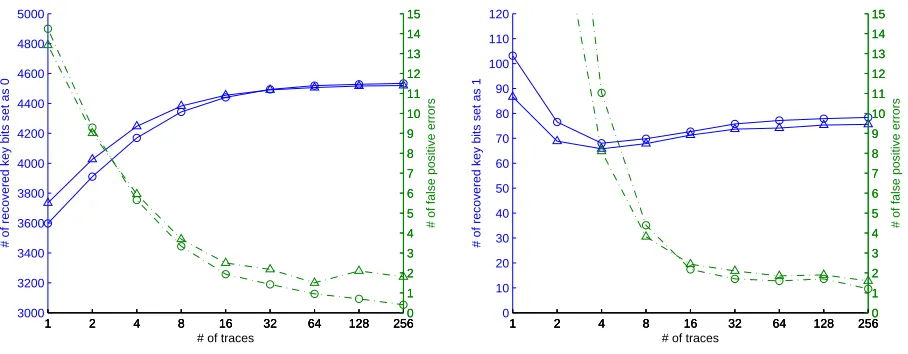
Figure 8 shows the comparison of number of recovered key bits and false positive errors between the all-zero ciphertext and random ciphertext. In Figure 8.1, as the number of traces used to generate the differential trace increases, the number of recovered key bits of 0 increases and the number of false positive errors decreases for both cases. However, with the all-zero ciphertext, there are less positive errors. Figure 8.2 shows the comparison of the number of recovered key bits of 1 and the false positive errors. It can be seen that using the all-zero ciphertext recovers more key bits of 1 with fewer false positive errors as the number of traces increases. In conclusion, the all-zero ciphertext is more advantageous to the DPA of key rotation. Hence, we use the traces with the all-zeros ciphertext in the following experiment. Note that we used five different keys to validate the conclusion and thus the figure actually shows the average result of five keys.
1 2 4 8 16 32 64 128 256
3000 3200 3400 3600 3800 4000 4200 4400 4600 4800 5000
# of recovered key bits set as 0
# of traces
1 2 4 8 16 32 64 128 2560
1 2 3 4 5 6 7 8 9 10 11 12 13 14 15
1 2 4 8 16 32 64 128 2560
1 2 3 4 5 6 7 8 9 10 11 12 13 14 15
# of false positive errors
8.1: Recovered 0 key bits vs. false positives.
1 2 4 8 16 32 64 128 256
0 10 20 30 40 50 60 70 80 90 100 110 120
# of recovered key bits set as 1
# of traces
1 2 4 8 16 32 64 128 2560
1 2 3 4 5 6 7 8 9 10 11 12 13 14 15
1 2 4 8 16 32 64 128 2560
1 2 3 4 5 6 7 8 9 10 11 12 13 14 15
# of false positive errors
8.2: Recovered 1 key bits vs. false positives.
Figure 9 shows how the chosen threshold affects the key recovery. Three different thresholds are used. The first one (◦) is exactly the value extracted from the characteristic shape in ∆c. The other two (4 and then ∗) are increased based on the first one. In Figure 9.1, as the number of traces used to generate the differential trace increases, the number of recovered 0 key bits increases and the number of false positive errors decreases for all three thresholds. However, the less aggressive the threshold is, the lower is the number of false positive errors. In contrast, Figure 9.2 shows that with the least aggressive threshold (◦), more key bits of 1 can be recovered with a few more false positive errors. Hence, to recover more key bits of 0 with least false positive errors, the less aggressive threshold should be used. In contrast, to recover key bits of 1 with least false positive errors, the more aggressive threshold should be used.
1 2 4 8 16 32 64 128 256
3000 3200 3400 3600 3800 4000 4200 4400 4600 4800 5000
# of recovered key bits set as 0
# of traces
1 2 4 8 16 32 64 128 2560
1 2 3 4 5 6 7 8 9 10 11 12 13 14 15
1 2 4 8 16 32 64 128 2560
1 2 3 4 5 6 7 8 9 10 11 12 13 14 15
1 2 4 8 16 32 64 128 2560
1 2 3 4 5 6 7 8 9 10 11 12 13 14 15
# of false positive errors
9.1: Recovered 0 key bits vs. false positives.
1 2 4 8 16 32 64 128 256
0 10 20 30 40 50 60 70 80 90 100 110 120
# of recovered key bits set as 1
# of traces
1 2 4 8 16 32 64 128 2560
1 2 3 4 5 6 7 8 9 10 11 12 13 14 15
1 2 4 8 16 32 64 128 2560
1 2 3 4 5 6 7 8 9 10 11 12 13 14 15
1 2 4 8 16 32 64 128 2560
1 2 3 4 5 6 7 8 9 10 11 12 13 14 15
# of false positive errors
9.2: Recovered 1 key bits vs. false positives.
Fig. 9.Key bit recovery rates for a range of detection thresholds for recovering 0 key bits (left) and 1 key bits (right). Solid line indicates the number of recovered bits (out of 90 ones and 4711 zeroes, scale on right), the dashed line indicates the number of false positives (scale on left). Markers◦, then4, and then∗indicate the increasing values for the threshold.
Overall, it can be seen that with as little as 10 measurements, more than half the key bits can be recovered with a remaining number of errors that is small enough to allow for efficient error correction. With 100 measurements and a careful choice of thresholds, the determined bits are already error-free with high probability. This strong leakage is partially due to the fact that 150 leakages are extracted from each measurement, strongly amplifying the amount of leakage gained from each individual trace. Furthermore, unlike the leakage of the syndrome computation, the characteristic shape of the key rotation favors precise localization and straightforward error-minimizing detection.
5
Full Key Recovery
5.1 Exploiting a Connection between Secret Key and Public Key
As described in Section 2.2, the secret key consists of two related parts, h0 and h1. Due to the relation between the secreth0, h1 and the public matrixQ, we can expressh0 as:
h0=h1·QT (3)
Likewise, given h0, one can compute h1, since Q is invertible. This means that once the first half of the secret key is recovered, the second half can be computed using the public key. More interestingly, this relationship can be used for error detection for each hi independently: since Q is of high weight (each bit has approximately a 50% chance of being 1), even a single bit error in h∗i will result in a high weight of a consequently derivedh¯∗i, i. e., wt(h
∗
¯i)≈r/2. A correct hi, however, will result in an h¯i of low weight, in
our case wt(h¯i) = 45. Unfortunately, we are currently not aware how slightly faulty or noisy information of h0 and h1 can be combined more efficiently without a trial and error approach using the abovementioned relationship.
In one of the attacks described above the adversary observes a combined leakage ofh0andh1. This is not a problem, since knowledge ofh0⊕h1 can also enable key recovery. Addingh1on both sides of Equation (3) we obtain
h0⊕h1=h1·(QT ⊕I4801). (4)
If side-channel leakage allows us to obtain the combined leakageh0⊕h1 and the rank ofQT⊕I4801 is high, we can solve this linear system of equations for h1 with a computer algebra system like Magma [Bosma et al., 1997]—and then deriveh0 from Equation (3). In our experiments, the rank observed for QT ⊕I4801 was 4800, resulting in two candidate solutions with only one of them having the correct Hamming weight. So in cases where all ones can be correctly identified, Equations (3) and (4) enable a practical key recovery. The syndrome computation leakage provides information on the positions of ones inh0 orh1, but error correction would be essential to correct positions that are slightly off. Guessing error positions becomes infeasible quickly, even with small improvements over an exhaustive search of 4801l possibilities forlerrors. We did not try to devise elaborate error-correction strategies, as a different attack strategy which relies on exploiting detected zeroes turned out to be quite effective. We explain this strategy next.
5.2 Efficient Key Recovery From Partial Information
After having identified several 1 bits as well as several 0 bits of the secret key correctly, we aim at an efficient way to recover remaining unknown or uncertain key bits. For this, we define B0, B1 and Bu as index sets
indicating the locations of definite zeroes, definite ones and positions of undetermined bits in h0⊕h1 such that
B0∪˙B1∪˙Bu={0,1, . . . ,4800}. (5)
positions inB0indicate that bothh0andh1 are zero in that position, while positions inB1will mean a one in eitherh0 or h1.6 Hence, the uncertain positions forh1 are Bu1=B1∪˙ Bu, and with Iverson’s convention
[Knuth, 1992] we can summarize our knowledge ofh0⊕h1andh1 as
h0⊕h1=h1·[i∈B1] +u·[i∈Bu]i0≤i≤4800 and
h1=u·[i∈Bu1]
0≤i≤4800,
whereuindicates unknown bits (“erasures”). So Equation (4) yields
h1·[i∈B1] +u·[i∈Bu]i0≤i≤4800=
u·[i∈B1u]
0≤i≤4800·(Q
T⊕I
4801) 6 The (rare) case ofh
0 andh1 having a one in the same position is not considered here, as this situation is quite
As the indices in B0 indicate definite zeroes in h0⊕h1 and h1, the corresponding rows in the matrix
QT⊕I4801will always be multiplied with a zero coefficient. We remove these|B0|rows and the corresponding known 0-entries inh1, obtaining an updated equation system
h1·[i∈B1] +u·[i∈Bu]i0≤i≤4800=
u·[i∈B1u]
i6∈B0·Q
0. (6)
with a (smaller) matrix Q0 ∈F2(4801−|B0|)×4801. There are 4801− |B0| − |B1| unknown bits on the left- and 4801− |B0| unknown bits on the right-hand side of Equation (6). As we are only interested in finding h1, we can try to eliminate unknown values inh0⊕h1 by droppingcolumns fromQ0. One may hope that |Bu| columns can be eliminated withoutQ0 dropping in rank, so that we end up with a linear system of equations
h1·[i∈B1]ii6∈Bu =
u·[i∈B1u]
i6∈B0·Q
00 (7)
in 4801− |B0|unknowns and a matrix Q00∈F2(4801−|B0|)×(4801−|Bu|). If |Bu| ≤ |B0|one may hope that this linear system of equations can be solved and yields a unique candidate forh1.
To check the practical applicability and feasibility of this approach, we ran several experiments in Magma [Bosma et al., 1997], solving the equation system given in (7) for several different vectorsB0andB1. We were particularly interested in the situation where knowledge of 1-positions inh0⊕h1 is ignored (i. e.,
B1=∅), because in our measurements the 0-detection was more reliable. WithB1=∅, the resulting system of equations is homogeneous and thus in addition toh1 also has the trivial solution. From Equation (5) we see that the condition|Bu| ≤ |B0| now implies that|B0| ≥ d4801/2e. Staying above this threshold, in our experiments we obtained no more than 8 candidates forh1, and the weight condition identified the correct secret key uniquely.
For|B0|<2400, the kernel of the matrixQ00in Equation (7) gets larger quickly and we obtain additional candidates forh1, but finding the correct h1may still be feasible by looking at the Hamming weight of the candidates as long as the number of candidates is not overwhelming.
The results in Section 4 show that for the target implementation the attacker can expect to recover more information from the side-channel than necessary for recovering the secret key. Having |B0| comfortably above the threshold of 2400, a few false positives inB0 can be dealt with efficiently: Instead of using all of these bit positions, one can select subsets of size 2401 at random. Assuming a hypergeometric distribution, withf false positives among the|B0|indices, the probability of guessing 2401 error-free positions is
|B0|−f
2401
|B0|
2401 .
For instance, with|B0|= 3281 andf = 4, this probability is still about 2−7.6.
In summary, as long as more than half the bits of the key can be recovered with a low error rate, the remaining key bits can be determined using the above-described algebraic methods. Knowledge of additional bits ofh0⊕h1facilitates the handling of possibly remaining errors. Not being able to recover more than half the number of key bits can make the search infeasible, although—due to the highly biased key—guessing a few additional zeroes may still be an option.
Remark 1. If the target platform allows the separation of leakages forh0andh1, the above strategy naturally carries over when Equation (3) (instead of Equation (4)) is used as starting point.
6
Preventing the Attacks
The described attacks are somewhat specific to the implementation choices of the target, but can be adjusted to other implementation parameters as well. For example, an implementation that does not process h0 and
influence the described attack as well. The smaller the word size, the more leakages per target bit, most likely facilitating the attacks further. However, a massively parallelized implementation such as the one described in [Heyse et al., 2013] could impede the described attacks, since all bits would always be leaking in parallel. One might however still be able to exploit resource-specific leakages, e. g., leakage from a carry register. Furthermore, such an implementation is very resource-consuming and might not find widespread use.
A more reliable way to prevent these attacks are side-channel countermeasures. A good overview of standard DPA countermeasures is available in [Mangard et al., 2007]. Countermeasures are typically classified asmasking orhidingcountermeasures. Both classes can be applied to an implementation of MDPC McEliece and, if done correctly, should prevent the above-mentioned attacks. Note that masking would need to be applied to the syndromeand the key, since the presented attacks target both leakage sources separately. The disadvantage of SCA countermeasures is usually the large performance overhead they introduce. Masking, for example, typically doubles the amount of storage needed for internal states. So far, SCA countermeasures for (QC-)MDPC McEliece have not been studied in detail in the literature, making it an interesting subject for future work.
To spur the discussion, we point out a plausible solution strategy that should prevent the introduced attacks while maintaining a comparably low footprint. All of the described attacks take advantage of the knowledge of when a specific key bit is processed. This advantage only holds for deterministic execution orders. A countermeasure that randomizes the execution order is known asshuffling and has been discussed in detail, e. g., in [Tillich and Herbst, 2008]. Shuffling the syndrome computation is fairly simple. Ciphertext bits and key bits could be processed in a random order. This would require the implementation to be able to rotate the private key and possibly the syndrome by various offsets while ensuring that these offsets are not detectable by the adversary. Implementing shuffling in such a way that no additional leakages are introduced is not a trivial task, as discussed in [Veyrat-Charvillon et al., 2012], for instance. However, such an imple-mentation can be realized with comparably low area overhead, since no new arithmetic units nor additional storage, e. g., for masks, would be required. Furthermore, common counterattacks such ascombing (cf. again to [Tillich and Herbst, 2008]) would not be helpful in this scenario, since it would require a summation over all clock cycles, making all key bits leak in parallel and thereby making them indistinguishable.
7
Conclusion
This work presents the first successful differential power analysis of a state-of-the-art McEliece implementa-tion based on quasi-cyclic MDPC codes. The analysis is not affected by a potentially present padding that is commonly used to achieve CCA security. Two different leakages are exploited. Both exploited leakages occur during the syndrome computation step of the decryption. The leakage of the syndrome register gives information on the two secret key halvesh0andh1 separately, but is slightly vague in the exact position of set key bits. Thousands of chosen ciphertext traces are necessary for successful key recovery. The attack on the key rotation recovers a combined leakage ofh0 andh1. The leakage model provides precise and strong leakage. The resulting attack is independent of the ciphertext and succeeds with tens of traces. A significant part of the key recovery stems from the relation between the private key and the known public key, which can be exploited to ease the key recovery process. In fact, recovering only half the bits of the (highly biased) secret key with a low error rate is sufficient for full key recovery.
Bibliography
Roberto Avanzi, Simon Hoerder, Dan Page, and Michael Tunstall. Side-channel attacks on the McEliece and Niederreiter public-key cryptosystems. Journal of Cryptographic Engineering, 1(4):271–281, 2011. Elwyn R. Berlekamp, Robert J. McEliece, and Henk C.A. van Tilborg. On the Inherent Intractability of
Certain Coding Problems (Corresp.). IEEE Transactions on Information Theory, 24(3):384–386, May 1978.
Wieb Bosma, John Cannon, and Catherine Playoust. The Magma algebra system. I. The user language.
Journal of Symbolic Computation, 24:235–265, 1997.
Jean-Charles Faug`ere, Ayoub Otmani, Ludovic Perret, and Jean-Pierre Tillich. Algebraic Cryptanalysis of McEliece Variants with Compact Keys. In Henri Gilbert, editor, Advances in Cryptology – EURO-CRYPT 2010, volume 6110 ofLeture Notes in Computer Science, pages 279–298, Berlin Heidelberg, 2010. International Association for Cryptologic Research, Springer.
Jean-Charles Faug`ere, Ayoub Otmani, Ludovic Perret, Fr´ed´eric de Portzamparc, and Jean-Pierre Tillich. Structural Cryptanalysis of McEliece Schemes with Compact Keys. Cryptology ePrint Archive: Report 2014/210, March 2014a. Available athttp://eprint.iacr.org/2014/210.
Jean-Charles Faug`ere, Ayoub Otmani, Ludovic Perret, Fr´ed´eric de Portzamparc, and Jean-Pierre Tillich. Folding Alternant and Goppa Codes with Non-Trivial Automorphism Groups. Cryptology ePrint Archive: Report 2014/353, May 2014b. Available athttp://eprint.iacr.org/2014/353.
Robert Gallager. Low-density Parity-check Codes. Information Theory, IRE Transactions on, 8(1):21–28, 1962.
Stefan Heyse, Amir Moradi, and Christof Paar. Practical Power Analysis Attacks on Software Implemen-tations of McEliece. In Nicolas Sendrier, editor,Post-Quantum Cryptography – PQCrypto 2010, volume 6061 ofLecture Notes in Computer Science, pages 108–125, Berlin Heidelberg, 2010. Springer.
Stefan Heyse, Ingo von Maurich, and Tim G¨uneysu. Smaller Keys for Code-Based Cryptography: QC-MDPC McEliece Implementations on Embedded Devices. In Guido Bertoni and Jean-S´ebastien Coron, editors,
Cryptographic Hardware and Embedded Systems – CHES 2013, volume 8086 ofLecture Notes in Computer Science, pages 273–292, Berlin Heidelberg, 2013. Springer.
W. Cary Huffman and Vera Pless. Fundamentals of Error-Correcting Codes. Cambridge University Press, United Kingdom, 2010.
Donald E. Knuth. Two Notes on Notation.The American Mathematical Monthly, 99(5):403–422, May 1992. Kazukuni Kobara and Hideki Imai. Semantically Secure McEliece Public-Key Cryptosystems –Conversions for McEliece PKC–. In Kwangjo Kim, editor, Practice and Theory in Public Key Cryptosystems – PKC ’01, volume 1992 ofLecture Notes in Computer Science, pages 19–35, Berlin Heidelberg, 2001. Springer. Paul Kocher, Joshua Jaffe, Benjamin Jun, and Pankaj Rohatgi. Introduction to differential power analysis.
Journal of Cryptographic Engineering, 1(1):5–27, 2011.
Paul C. Kocher, Joshua Jaffe, and Benjamin Jun. Differential Power Analysis. In Michael Wiener, editor,
Advances in Cryptology – CRYPTO’99, volume 1666 ofLecture Notes in Computer Science, pages 388–397, Berlin Heidelberg, 1999. Springer.
Stefan Mangard, Elisabeth Oswald, and Thomas Popp. Power Analysis Attacks: Revealing the Secrets of Smartcards. Springer, US, 2007.
Robert J. McEliece. A Public-Key Cryptosystem Based On Algebraic Coding Theory. Deep Space Network Progress Report, 44:114–116, January 1978.
Rafael Misoczki, Jean-Pierre Tillich, Nicolas Sendrier, and Paulo S. L. M. Barreto. MDPC-McEliece: New McEliece Variants from Moderate Density Parity-Check Codes. Cryptology ePrint Archive, Report 2012/409, 2012. http://eprint.iacr.org/2012/409.
Ryo Nojima, Hideki Imai, Kazukuni Kobara, and Kirill Morozov. Semantic security for the McEliece cryp-tosystem without random oracles. Designs, Codes and Cryptography, 49(1–3):289–305, December 2008. Peter W. Shor. Polynomial-Time Algorithms for Prime Factorization and Discrete Logarithms On a Quantum
Computer. SIAM J. Comput., 26(5):1484–1509, 1997. ISSN 0097-5397.
Abdulhadi Shoufan, Falko Strenzke, H.Gregor Molter, and Marc St¨ottinger. A Timing Attack against Patter-son Algorithm in the McEliece PKC. In Donghoon Lee and Seokhie Hong, editors,Information, Security and Cryptology – ICISC 2009, volume 5984 ofLecture Notes in Computer Science, pages 161–175. Springer, Berlin Heidelberg, 2010.
Falko Strenzke. A Timing Attack against the Secret Permutation in the McEliece PKC. In Nicolas Sendrier, editor,Post-Quantum Cryptography – PQCrypto 2010, volume 6061 ofLecture Notes in Computer Science, pages 95–107, Berlin Heidelberg, 2010. Springer.
Falko Strenzke, Erik Tews, H. Gregor Molter, Raphael Overbeck, and Abdulhadi Shoufan. Side Channels in the McEliece PKC. In Johannes Buchmann and Jintai Ding, editors, Post-Quantum Cryptography – PQCrypto 2008, volume 5299 of Lecture Notes in Computer Science, pages 216–229, Berlin Heidelberg, 2008. Springer.
Stefan Tillich and Christoph Herbst. Attacking State-of-the-Art Software Countermeasures – A Case Study for AES. In Elisabeth Oswald and Pankaj Rohatgi, editors,Cryptographic Hardware and Embedded Sys-tems – CHES 2008, volume 5154 of Lecture Notes in Computer Science, pages 228–243. Springer, Berlin Heidelberg, 2008.
Nicolas Veyrat-Charvillon, Marcel Medwed, St´ephanie Kerckhof, and Fran¸cois-Xavier Standaert. Shuffling against Side-Channel Attacks: A Comprehensive Study with Cautionary Note. In Xiaoyun Wang and Kazue Sako, editors, Advances in Cryptology – ASIACRYPT 2012, volume 7658 of Lecture Notes in Computer Science, pages 740–757. Springer, Berlin Heidelberg, 2012.
Ingo von Maurich and Tim G¨uneysu. Lightweight code-based cryptography: QC-MDPC McEliece encryption on reconfigurable devices. In Design, Automation and Test in Europe – DATE 2014, pages 1–6. IEEE, 2014.