Protocol Misidentification Made Easy
with Format-Transforming Encryption
Kevin P. Dyer
Portland State UniversityScott E. Coull
RedJack, LLC.Thomas Ristenpart
University of WisconsinThomas Shrimpton
Portland State UniversityABSTRACT
Deep packet inspection (DPI) technologies provide much-needed visibility and control of network traffic using port-independent protocol identification, where a network flow is labeled with its application-layer protocol based on packet contents. In this paper, we provide the first comprehensive evaluation of a large set of DPI systems from the point of view of protocol misidentification attacks, in which adver-saries on the network attempt to force the DPI to mislabel connections. Our approach uses a new cryptographic prim-itive called format-transforming encryption (FTE), which extends conventional symmetric encryption with the ability to transform the ciphertext into a format of our choosing. We design an FTE-based record layer that can encrypt arbi-trary application-layer traffic, and we experimentally show that this forces misidentification for all of the evaluated DPI systems. This set includes a proprietary, enterprise-class DPI system used by large corporations and nation-states. We also show that using FTE as a proxy system incurs no latency overhead and as little as 16% bandwidth overhead compared to standard SSH tunnels. Finally, we integrate our FTE proxy into the Tor anonymity network and demon-strate that it evades real-world censorship by the Great Fire-wall of China.
Categories and Subject Descriptors
D.4.6 [Security and Protection]: Invasive software; C.2.0 [Computer-Communication Networks]: Security and protection
Keywords
deep packet inspection; protocol classification; regular ex-pressions; censorship circumvention; applied cryptography
A preliminary version of this work appeared in the proceedings of the 20th ACM Conference on Computer and Communications Security (CCS), 2013. This is the full version.
1.
INTRODUCTION
Network operators increasingly deploy deep packet inspec-tion (DPI) to improve visibility into network activities and control those activities based on identified application-layer protocols and content. The most advanced in-use DPI sys-tems use regular expressions to encode fingerprints for, in particular, the protocols of interest, and whether packet con-tents match against these expressions informs what is often called port-independent protocol identification [3, 10, 12, 24, 35]. This may be followed by other, potentially more sophis-ticated, traffic and content analysis methods, or may lead to filtering or other discriminatory behavior. For example, cor-porations use DPI to block file-sharing protocols that often cause accidental data leakage, while ISPs often use DPI to throttle bandwidth-heavy BitTorrent traffic [22, 53]. More controversially, nation-states use DPI to censor their citi-zens’ use of the Internet, in part by blocking privacy tools like Tor [14].
Despite their growing roles in many security-critical set-tings, we are unaware of any work that specifically studies the robustness of state-of-the-art DPI protocol-identification tools in the face of dedicated attacks. Thus, we address the following question: are there practical attacks that will force any regular-expression-based DPI into misclassifying connections as protocols of the attacker’s choosing? And, if such attacks do exist, can these misclassified connections carry practically useful amounts of information?
The results of our work conclude that, indeed, misclassifi-cation attacks exist against enterprise-grade DPI, and that these attacks can be mounted while carrying sufficient infor-mation to surf the web, transfer files, and use Tor. Rather than building an array of ad-hoc schemes to trick specific DPI systems, we instead target the implicit premise under-lying modern DPI: that regular expressions (regexes) are sufficient for identifying network protocols. To that end, we develop a generic approach for controlling the format of en-crypted data, so that it will match whatever regex we desire to specify. With this ability, we can force protocol misiden-tification across a broad range of DPI systems.
The development of a generic approach to evasion of regex-based DPI implies that, for settings with adversarial net-work users, future protocol-identification systems will have to move to more expensive techniques based on machine learning [26, 33, 34, 55], active probing [28], or something else entirely. At the same time, the approach also suggests a promising way forward for tools aiming to circumvent net-work censors.
our approach is a new cryptographic primitive called format-transforming encryption (FTE). It allows the user to input a regex of their choosing and output ciphertexts that are guar-anteed to match it. This gives FTE a built-in mechanism for forcing misidentification by regex-based DPI. It will ad-ditionally achieve more traditional privacy and authenticity goals.
We consider a variety of methods to specify the regular expressions that are input to the FTE scheme. In those sce-narios where we know which DPI systems are being used, the simplest method is lifting them directly from systems themselves, or manually creating them using knowledge of RFCs and the DPI code. When we do not have informa-tion about the DPI system, we provide a simple procedure for learning regexes from network traces of the application-protocols that we wish our traffic to match.
Under the hood, our FTE scheme relies heavily on well-known algorithms for ranking strings in a given regular lan-guage [17]. The algorithms were previously suggested for use in the related context of format-preserving encryption [5], however, as far as we are aware, our work gives the first im-plementation and performance analysis of the algorithms. To realize a working FTE proxy system capable of tunnel-ing arbitrary network traffic, we specify and implement a full, FTE-powered record layer. By this we mean that we build, around the FTE core, logic to manage buffering and fragmentation of incoming plaintext streams on the sender’s side, and ciphertext stream buffering, parsing and fragment reassembly on the receiver’s side.
We use this FTE proxy system to explore the resistance of six state-of-the-art DPI systems to protocol misclassifi-cation attacks. We show that even expensive, proprietary systems can be forced to mistakenly identify FTE-protected traffic as any of a number of target protocols chosen by the user, including HTTP, SMB, and SSH. We stress that our approach works no matter what the underlying FTE-encapsulated application-layer protocol actually is. To the best of our knowledge, this is the first comprehensive anal-ysis exposing how ineffectual modern DPI systems can be rendered.
One immediate implication is that our proxy system pro-vides a ready-made mechanism for circumventing actual, de-ployed DPI tools. When used to surf the web, FTE imposes as little as 16% bandwidth overhead and no latency overhead compared to conventional encryption of traffic. By compar-ison, FTE is both more flexible and efficient than existing circumvention tools that also attempt to prevent proper pro-tocol identification [20, 30, 52] As a practical matter, our FTE system works as a drop-in pluggable transport [42] for Tor, and we are working to include FTE in the official Tor Browser Bundle. Furthermore, the FTE library source code has been released under the GNU General Public License, and is available on GitHub1. Initial tests from servers within the Great Firewall of China (GFC) using an FTE-powered Tor Browser Bundle have been successful, and enabled us to browse a variety of censored websites.
2.
MODERN DPI SYSTEMS
In our evaluation, we focus on port-independent protocol identification as used by six modern DPI systems. These systems span a wide range of complexity, cost, and expected
1
https://github.com/redjack/FTE
DPI Multi-stage Classifier Complexity System Type Pipeline HTTP SSH SMB
DFA States
appid regex-only 7 15 8 104
l7-filter regex-only 7 55 8 6
YAF regex-only 3 29 10 5
Lines of C/C++ Code
bro hybrid 3 1593 30 1188
nProbe hybrid 3 807 89 24
DPI-X ? ? ? ? ?
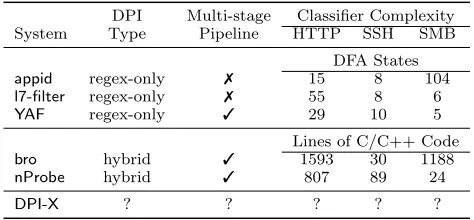
Figure 1: Summary of evaluated DPI systems. Type
indicates the kind of DPI engine used. Multi-stage pipelines chain together several passes over packet contents. Classifier complexityis the number of DFA states used for regular expressions or total lines non-whitespace/non-comment C/C++ code.
deployment environments. Here, we discuss details of the systems we evaluate, and present a summary in Figure 1. Unless otherwise mentioned, our discussion and later evalu-ations will use default configurevalu-ations.
appid. Theappid [3] library uses port-based pre-filtering to determine a set of protocol-identifying regexes, against which each TCP stream should be evaluated. It applies each regular expression in the set against the stream, and returns the first match as the protocol label. A match is attempted for bi-directional (i.e., client-server and server-client) streams. In our evaluation we used the latest avail-able version of appid(as of April 2013), and instantiated it via its included Python module.
L7-filter. The l7-filter [10] software also performs regex-only matching. However, it differs fromappidin that it does not pre-filter based on port numbers. Moreover,l7-filter spec-ifies only regexes to identify uni-directional server-to-client streams. In our evaluation we used version 2009-05-28 of the l7-filteruserspace classification engine, and invoked it with its included test suite.
Yet Another Flowmeter. YAF[24] is a network moni-tor that performs application labeling. The YAF protocol-classification engine is predominantly regex-only, although in a few cases (e.g., the classification of TLS) it employs C-based logic. We classify YAF as regex-only because the majority of protocols are classified using a regex-only strat-egy. Additionally, for some protocols,YAFperforms its regex analysis in two stages; HTTP is one example. A first-pass match for HTTP (caused, say, by matching the stringHTTP/) triggers a second-pass to extract message contents, such as the User-Agent field of the HTTP request. In our evalua-tion we used the latest stable version ofYAF(2.3.3, January 2013) compiled with application identification support.
as the URI of an HTTP request, or the version number of the SSH protocol being used. In our evaluation, we used the latest, stable version (2.1, Aug. 2012) ofbro, and ex-tracted the assigned stream label from theservicefield of theconn.logfile.
For classification of SMB streams, which is not supported in version 2.1, we used an alpha-release SMB parser available in thebrogit repository. We bootstrapped this parser into an SMB-classifier by labeling a flow as SMB only if the parser did not encounter parse errors, which is consistent with the strategy of other classifiers present inbro.
nProbe Pro. nProbe[12] is an open-source network moni-toring utility that costse299.95 for commercial use.nProbe includes the ability to identify the encapsulated data within a protocol. As an example, it can identify a web request to YouTube or FaceBook. This means that nProbecan re-assemble TCP streams, identify the contents of a flow, and then parse individual message within a flow. nProbe uses hard-coded C-based logic, for the sake of efficiency, to iden-tify attributes that could be captured by a regular expres-sion. As an example, for HTTP it searches for a finite list of values (i.e. GET, POST, HTTP, etc.), in order to identify an HTTP stream. When such a match occurs, a C-based second-pass parser is triggered. In our evaluation we used version 6.9.5 ofnProbe Pro, and the NetFlow output value %L7_PROTO_NAMEto determinenProbe’s stream label.
DPI-X. We obtained access to an enterprise-grade secu-rity gateway device sold by a well-known network equip-ment manufacturer. The DPI capabilities of this device, as advertised, enable classifying over 900 applications and protocols, including nested and tunneled applications (e.g., Facebook over HTTP). We disclosed our results to the equip-ment manufacturer, but did not receive approval to release details about the device. Hence, we refer to this system as DPI-X. This device belongs to a class of commercial systems, ranging from lower-end systems capable of handling a max-imum throughput of 90 Mbps ($600), up to carrier-grade products capable of 100 Gbps (over $25,000). The system used in our testing has a maximum throughput of 1.5 Gbps and a cost of $8,000. We believeDPI-Xis representative of the DPI products employed in many enterprise and carrier networks. In fact, the maker of this product has been iden-tified as one of the suppliers of censorship equipment for Iran [36].
Threat model. A primary goal in this work is to experi-mentally ascertain the extent to which these representative DPI systems are vulnerable toprotocol-misidentification at-tacks. (We will use misidentification and misclassification interchangeably.) To define this term, consider a setting in which a DPI system monitors all connections travers-ing a network. Two parties want to communicate via an application-layer protocol that uses connection(s) travers-ing the DPI-protected network. We will refer to these two parties as the “attacker” to emphasize that the DPI faces adversarially generated traffic. In awhite-box DPI attack, the attacker knows the DPI classification algorithms that are used, while in ablack-box DPIsetting the attacker does not. The latter may be because the particular DPI being used is not known (even if the set of possible DPIs is known), or simply because the algorithms are proprietary.
We call the application-layer protocol used for communi-cating data the source protocol. In a misidentification
at-tack, the attacker’s goal is to have its connections, which use the source protocol, be (mis)identified by the DPI as a target protocol of the attacker’s choosing. An example would be to have SSH as the source protocol, and HTTP as the target protocol. In a successful attack, the DPI will incorrectly label the actual (encrypted) SSH connections as (unencrypted) HTTP connections. To declare a practical success, we also require that the attack does not significantly degrade performance of the source protocol.
Despite the clear importance of protocol misidentification attacks, we are unaware of any prior work that evaluate the DPI systems in our test set (or other similar systems). See Section 7 for discussion of related settings and other potential approaches for forcing protocol misidentification that are different from ours.
3.
FORMAT-TRANSFORMING
ENCRYPTION
All of the open-source DPI systems in our evaluation set use membership in a regular language — either explicitly with regexes or implicitly by logic coded in languages such as C/C++ — to inform application-layer protocol classifi-cation. We therefore target mechanisms which enable an attacker to force protocol misidentification against any DPI that relies on regex checks. Note that this goal is more ag-gressive than merely defeating the systems in our corpus (but we will do that as well!), and we expect our approach will work against any currently deployed regex-based DPI system.
Our main idea is to build DPI resistance into encryption schemes. The key technological enabler, which we explain in the remainder of this section, is augmenting the normal encryption interface to take a regex as an input. The pur-pose of this regex is to specify the format of ciphertexts: this means that ciphertexts, when taken as a string over the appropriate alphabet, are guaranteed to match against the specified regex. We call the resulting primitive format-transforming encryption (FTE). In turn, we show how to use FTE as a component within a record layer that han-dles streams of messages from an arbitrary source proto-col. Through proper choice of regex, ciphertexts produced by this record layer –which are actually carrying the source protocol– will be classified as messages from another proto-col (of our choosing) by the DPI.
Our FTE record layer will be used for two purposes. First, we will build an FTE (single-hop) proxy system by combin-ing the FTE record layer with SOCKS in a straightforward way. We will then use it to support our hypothesis that the regex-based DPI used in practice is fundamentally vulnera-ble to misclassifcation attacks. We do this by showing how to use the FTE proxy to force protocol misidentification by the entire set of DPI systems and with respect to a variety of target protocols. We also show that doing so has essentially negligible overhead for most relevant regular languages. We believe these results suggest that DPI systems must move to more advanced mechanisms (discussed in Section 7) in settings with adversarial users.
CTRK1( |M||| M )
HMACK2(.)
T
split unrank
FTE Ciphertext
Encrypted Record
C
|| X X C'
1
C'
2 C'2
format (R,k,m)
FTE Ciphertexts
M or ctxt bits
C' 1 X
AE decryption logic
rank
recvr buffer logic |M|
format (R,k,m)
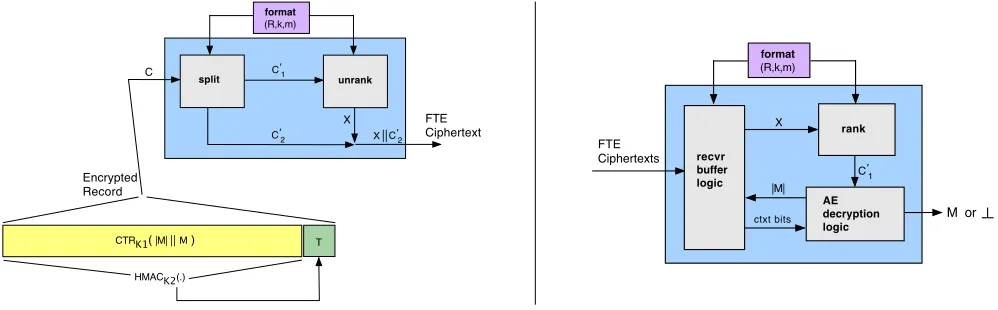
Figure 2: Sender-side (left) and receiver-side (right) record-layer flow. We discuss the various modules in the text.
3.1
FTE via Encrypt-then-Unrank
An FTE scheme is a triple of algorithms: key genera-tion, encryption and decryption. Key generation works as in conventional encryption, outputting a randomly chosen symmetric keyK. EncryptionEnctakes inputs of a keyK, a formatF, and a messageM. It can be randomized, state-ful, or deterministic, and always outputs a ciphertextCor a distinguished error symbol⊥. DecryptionDectakes inputs of a keyK, a formatF, and a ciphertext C. It outputs a message or⊥. The formatF specifies a setL(F) called the language ofF. The requirement is that any C output by Encmust be a member ofL(F).
FTE is a related to format-preserving encryption (FPE), first formalized by Bellare, Ristenpart, Rogaway, and Ste-gers (BRRS) [5]. FPE is used in the context of in-place encryption of credit-card numbers (or other records) within databases. It likewise uses formats, but requires that both plaintext messages and ciphertexts be members of the same format-specified language.
We desire FTE schemes that support formats described by regexes. This will allow easy “programming” of formats and endows FTE with the same expressive power as regex-based DPI. To do so, we start by following an approach similar to one used by BRRS. Loosely speaking, to imple-mentEnc(K,F, M) for a regular expressionF we: (1) en-cryptM using a standard authenticated encryption scheme to obtain an intermediate ciphertextY; (2) treatY as an in-teger inZ|L(F)|(the set of integers from 0 to the size of the
language minus one); and (3) apply an encoding function unrank: Z|L(F)|→L(F). To be able to decrypt, we require
thatunrankis in fact a bijection with efficiently computable inverserank:L(F)→Z|L(F)|.
The key algorithmic challenge is implementing rank and unrankefficiently. These associate to each string in the lan-guage its rank, i.e., its position in a total ordering of the language. The notion of ranking was first explored by Gold-berg and Sipser [17] in the context of language compres-sion. Goldberg and Sipser also gave an efficient way to rank a regular language when that language is represented by a deterministic finite automaton (DFA). BRRS used this for an (unimplemented) FPE scheme for arbitrary regular languages encoded as DFAs, but they also emphasize that, asymptotically speaking, there is provably no way to give ef-ficientrankandunrankfunctions starting just from a regex.
Standard tools exist for converting from a regex to an non-deterministic finite automaton (NFA) and from there to a DFA (see Section 5), but the second step potentially incurs an exponential blow-up in state size. We observe that this worst-case behavior is not an issue for FTE, in part because the kinds of regexes used by DPIs are themselves designed explicitly to avoid the worst-case blowup.
Our implementation uses the time-space tradeoff of Gold-berg and Sipser to support more efficient runtime perfor-mance by precomputing tables that allow (un)ranking of all strings x ∈ L with |x| ≤ n. (Appendix A details the al-gorithms.) The complexity of this precomputation isO(n· |Σ| · |Q|), where Σ is the underlying alphabet and Qis the state set for the DFA implementing the FTE regular ex-pression. Given these tables, the complexity ofrankL and
unrankLare Ω(n) andO(n·|Σ|), wherenis the length of the
output of rankL or input ofunrankL, respectively. We can
also formalize all of the above and prove that the Encrypt-then-Unrank approach preserves the message confidentiality and authenticity security of the underlying authenticated encryption scheme. Due to space constraints, we omit de-tails of the optimizations and formal treatment, and instead move on to discuss how we build a full FTE record layer.
3.2
FTE Record Layer
In order to transform arbitrary TCP streams, we need ad-ditional “record layer” machinery to buffer, encode, unam-biguously parse, and decode streams of FTE messages. In Figure 2 we give an overview of the processes by which plain-texts are transformed into FTE cipherplain-texts, and vice versa. We assume that sender and receiver share a pre-established set of keys, possibly derived from a single shared master key. Our record layer also assumes an underlying, reliable network transport protocol, e.g. TCP.
cases where the desired language is, in fact, any string with a prefix inL(R). All told, forF = (R, k, m) the language becomesL(F) = (L(R)∩Σk)kΣ≤mwhere Σ is the alphabet underlyingR. For simplicity we assume Σ ={0,1}in what follows, but in implementations one will typically use larger alphabets. In our implementation we use values m = 218 andk= 210, unless otherwise specified.
FTE Sender. See the left diagram in Figure 2 and consider a format F = (R, k, M). LetLk(R) = L(R)∩ {0,1}k be
thek-bit slice ofL(R) we will use andt=blog2(|Lk(R)|)c
be that slice’s capacity (the number of bits one can encode using the slice). The first action on the sender’s side is to prepare an encrypted record using a secret keyK. From a plaintext message buffer, grab a plaintext messageM of length at most |M| < m. Then form a plaintext record, containing an encoding of|M|followed byM. The record is then encrypted using a standard, stateful authenticated-encryption (AE) scheme withKto produce a ciphertextC. We assume that|C|is defined solely by|M|, which is true for AE schemes used in practice. We also padM, if required, to ensure that|C| ≥t. Our implementation uses CTR mode over AES and then authenticates the resulting ciphertext with HMAC-SHA256.
The encrypted recordCis passed to thesplitmodule, and appended to an internal buffer maintained by split. The job of split is to produce two strings: one to be passed to unrank for formatting, and one that will be passed along as-is. In particular, split takes up to t+m bits (and at leasttbits) from the front of the buffer, which we refer to as C0. Note thatC0 may be a full AE ciphertext, part of one, or include bits from multiple ciphertexts. Thensplit partitionsC0 intoC10 andC
0
2 with|C
0
1|=tand |C
0
2| ≤m. The first portionC10 is forwarded tounrank, which produces a formatted stringX ∈Lk(R). Finally, the concatenation
XkC20 becomes the sender’s FTE ciphertext which can then be transmitted.
FTE Receiver. Referring to the right-hand diagram in Figure 2, the receiver buffer logic is responsible for man-aging the stream of incoming FTE ciphertexts. One issue here, is that there are no explicit markers to demarcate FTE-encoded ciphertext boundaries. We therefore must take care to ensure that the receiver can correctly decrypt given that its buffer may contain multiple contiguous ciphertexts. To do so, the receiver takes advantage of the fact that the sender used a fixed2 slice Lk(R). As soon as it has the first k
FTE ciphertext bits in its buffer, it treats these as a string X ∈ Lk(R) and applies rank(X) to recover C01. (Should X /∈Lk(R) decryption should abort.) It then feedsC10 to the AE decryption algorithm in order to retrieve `= |M| and possibly some initial bits of a messageM. (Those latter message bits should not yet be released to higher layers.) Note that this means that the AE scheme must be able to perform incremental decryption and that it should not be vulnerable to attacks (c.f., [1]) that abuse use of the length field before ensuring integrity. CTR mode plus HMAC pro-vides these properties.
Given`the receiver now knows how many more bits of AE ciphertext are expected. From here it can remove the next up tombits of ciphertext from the input buffer, and then go back into a state where it treats the subsequent k bits
2One could instead rely on L(R) being prefix-free, but we found using fixed slices simpler and sufficient.
in the buffer as a string inLk(R), applyingrank as above,
and so on. When it retrieves a full AE ciphertext, it finishes decryption, verifies integrity of the ciphertext, and only now releases the buffered message bits up to the application.
Regex negotiation. One unique feature of FTE is the ability to quickly change regexes on the fly. We would like to be able to provide in-band negotiation of formats, but since all data sent on the wire must be formatted to pass DPI checks, it is not possible to negotiate regexes in the clear. We address this limitation by allowing the client/server to agree upon regexes for the duration of a TCP connection assuming they support some initial large set of possible regexes.
In more detail, we assume the client and server have a shared, ordered list of FTE formats (F1, . . . ,Fn), and still
assume the client and server have negotiated cryptographic keys out-of-band. For each TCP connection, the client de-termines the FTE format Fi it wishes to use for
client-to-server messages, and the Fj it wishes to use for
server-to-client message. Then, the client constructs the message M ← hii k hji, encryptsM as a distinguished negotiate message-type, designated by the value of a first (reserved) byte of the plaintext, encodes it with Fi, then sends it to
the server.
When the server receives an initial message from the client it iterates through its list of formats, attempting to decode the message with each of the FTE formats. Once it encoun-ters a successful decryption, it evaluates the message and then uses for the sessionFi for client-server messages and Fj for server-client messages. The server finalizes the
ne-gotiation by responding to the client with a distinguished negotiate_acknowledgemessage.
We can improve on the na¨ıve receiver-side implementa-tion of this procedure by having an implementaimplementa-tion of rank that contains special checks that short-circuit evaluation to terminate early in cases when the string being ranked is not accepted by the DFA. This enables the server to quickly ex-clude certain formats, thereby making it possible to support dozens of formats.
4.
PROTOCOL MISCLASSIFICATION
In this section, we experiment with three strategies for providing regexes used with our FTE record layer: regexes extracted from open-source DPI systems (4.1); regexes pro-grammed manually (4.2); and regexes automatically learned from samples of target protocol traffic (4.3). We will always use a pair of formats: one for upstream (client-to-server) and one for downstream (server-to-client) communications. We will then use our FTE record layer to assess the vul-nerability of the DPI systems in our evaluation to protocol-misidentification attacks.
Recall that a source protocol is the application-layer pro-tocol whose connections the attacker wants to have misclas-sified. We explored HTTP [16], HTTPS [13], secure copy (SCP) [54], and Tor [14] as source protocols, and found that the choice of source protocol does not influence our results. We therefore focus our discussion primarily on HTTP(S).
three as the results for the others were the same. Indeed, we suspect FTE can be successfully used for almost any target protocol.
Experimental testbed. We implemented our FTE record layer as a library that can be used to relay arbitrary data streams. More implementation details appear in Section 5. In our evaluation we use it in the following configuration. The FTE client listens for incoming TCP connections on a local client-side port. Upon receipt of an incoming connec-tion the FTE record layer encrypts the messages using the upstream format and relays them to a remote FTE server. The FTE server receives these FTE ciphertexts, decrypts them, and then relays the recovered plaintexts to a pre-configured destination TCP port. Downstream, the process is reversed, with the FTE server encrypting returned mes-sages using the downstream format.
We use Mozilla Firefox version 17.0.3, controlled by ver-sion 2.28.0 of the Selenium browser automation framework to request the Alexa Top 50 (US) websites over the FTE record layer; this is repeated five times for each upstream-downstream format pair tested. The testing framework gen-erates a mixture of HTTP, HTTPS and DNS source traffic and a total of roughly 12,000 TCP connections. On the server-side we relayed all HTTP(S) messages via a SOCKS proxy. We used the default Firefox configuration, with the following exceptions: we tunneled all DNS requests through the SOCKS connection, specified our start page as blank, and disabled caching to disk.
4.1
DPI-Extracted Regular Expressions
As our first method of programming the FTE record layer, we build FTE formats by extracting them directly from the source code of open-source regex-based DPI systems. This models a white-box DPI attack setting for the DPI systems from which we extract regexes, and a black-box DPI attack for others (e.g.,DPI-X).Extracting regular expressions. Using regexes from DPI systems within our FTE record layer is straightforward. Given a regular expressionRfrom the DPI, we specify a for-matF = (R0, k, m) where R0 is exactly R except without a “.∗” (match any) prefix, should there be one. This makes L(R0) ⊆ L(R), while ensuring that FTE ciphertexts will include the formatting information found inRafter the pre-fix. We setk= 128 andm= 215for good performance (the misclassification results do not change with other reasonable settings).
We use the naming convention of hDPI systemi-htarget protocolito reference a pair of upstream-downstream regexes extracted from the given DPI system. (Some systems only have a regex for a single direction, in which case we use “.∗” for the other direction.) YAFcontains at least two regexes for each target protocol, and we indicate that using a 1 or 2 in the format name. The result is 12 different formats.
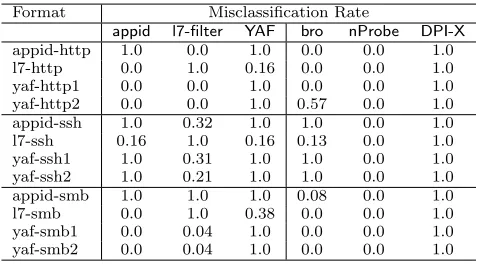
Misclassification evaluation. The misclassification rates for all 12 formats against the 6 classifiers appears in Figure 3. Here (and throughout this section) the rate is calculated as the number of TCP connections labeled as the target pro-tocol by the classifier, divided by the total number of TCP connections generated when using that FTE format. Thus a rate of 1.0 means complete misclassification success, and 0.0 is complete failure. Throughout our evaluations, a connec-tion that failed to be misclassified as the target protocol by
Format Misclassification Rate
appid l7-filter YAF bro nProbe DPI-X appid-http 1.0 0.0 1.0 0.0 0.0 1.0 l7-http 0.0 1.0 0.16 0.0 0.0 1.0 yaf-http1 0.0 0.0 1.0 0.0 0.0 1.0 yaf-http2 0.0 0.0 1.0 0.57 0.0 1.0 appid-ssh 1.0 0.32 1.0 1.0 0.0 1.0 l7-ssh 0.16 1.0 0.16 0.13 0.0 1.0 yaf-ssh1 1.0 0.31 1.0 1.0 0.0 1.0 yaf-ssh2 1.0 0.21 1.0 1.0 0.0 1.0 appid-smb 1.0 1.0 1.0 0.08 0.0 1.0 l7-smb 0.0 1.0 0.38 0.0 0.0 1.0 yaf-smb1 0.0 0.04 1.0 0.0 0.0 1.0 yaf-smb2 0.0 0.04 1.0 0.0 0.0 1.0
Figure 3: Misclassification rates for the twelve DPI-Extracted FTE formats against the six classifiers in our evaluation testbed.
a DPI system was always marked as an unknown protocol, regardless of the DPI system.
What Figure 3 reveals is that DPI-extracted regexes al-ways succeed against the DPI system from which they were extracted, and can even force misclassification by different DPI systems. As an example of the latter, we need only look atDPI-X, which is by far the easiest system to force misclas-sification against despite having no information about its operation. We confirmed the proper operation of the device by running a variety of control traffic, such as Facebook, Gmail, and SSH, through the device, and found that our results were indeed correct. While we still do not know the exact DPI strategy used, our best guess is that DPI-X per-forms minimalistic analyses, favoring performance and opti-mistic labeling of protocols. These regexes were not effective againstnProbe, and had varied success againstbro. This can be attributed to the latter DPI systems requiring slightly more stringent protocol conformance.
Intersection formats. We also consider formats whose regexRis the explicit intersection of multiple DPI regexes. FTE based on such an intersection format will produce ci-phertexts matching all of the individual regexes used to form R. Using the intersection of the four DPI-extracted formats for each target protocol resulted in formats with perfect 1.0 misclassification rates forappid,l7-filter,YAF, and DPI-X. The rates againstbroandnProbeare comparable to those for the individual regexes.
4.2
Manually-Generated Regular Expressions
As our next strategy for producing regexes, we will code them manually. Our FTE record layer makes this easy since most developers are already familiar with regexes due to their use in other programming contexts. Moreover, it turns out to be very simple to build fast, simple regexes that achieve perfect misclassification forallclassifier/target pro-tocol combinations in our evaluation set.re-quires that responses have a string of length greater than zero following the status code, and that the status line is ter-minated with\r\n.YAFrequires that we have a valid HTTP method verb for requests (i.e. GET, POST, etc.). nProbe re-quires that we terminate HTTP messages with \r\n\r\n. Finally,brorequire that we have no payload for HTTP re-quests, or a payload and a valid Content-Length field — we accommodate this requirement by not allowing a payload for requests and specifying an FTE format parameter ofm= 0. (Section 3.1)
For SSH all classifiers require that the first downstream, and in some cases upstream, messages start withSSH-. Next, l7-filterdemands that the first two messages in a stream start withSSH-1.xorSSH-1.y. nProberequires the first messages in an SSH stream to be less than or equal to 99 bytes long, and we achieve this by setting our FTE format parameter to k = 99 for both directions of traffic, which constricts message lengths.
All classifiers in our evaluation require that SMB messages have a valid SMB fingerprint, which is the byte\xFF, fol-lowed bySMBencoded in ASCII. In addition,nProberequires that message have a valid length that matches the length of the message payload, that the length field is located as the first 32-bit word in the message, and thatSMB is encoded as ASCII in the second 32-bit word. Here we encounter a check that is not easily encoded as a regular language (or avoided as above for nProbe’s checking of HTTP Content-Length fields), at least if one wants to support all 232 possi-ble lengths. However, we can simply use a specific value for the length field and provide an equivalently sized payload. For the regexes in our experiments, we set the FTE format parameterm to zero, meaning that we do not append any raw AE ciphertext bytes.
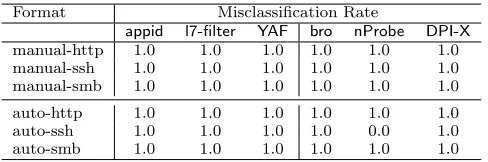
Misclassification evaluation. We specified regexes that met the above requirements for each of the target proto-cols. It took less than 30 minutes for one of the authors to specify each regex and debug it by testing it against known DPI engines. The resulting regexes achieved perfect mis-classification for all classifier/target protocol combinations, as shown in Figure 4. Every TCP connection was tagged as the target protocol of our choosing.
4.3
Automatically-Generated
Regular Expressions
When we know the DPI systems and their classification methods, the DPI-extracted and manually-generated regexes provide guaranteed evasion and optimal capacity. Unfortu-nately, there are many cases where it is not possible to know this information, like when the DPI classification strategy abruptly changes or when proprietary systems are used. In these situations, we can use a simple but effective process to automatically generate regexes from network traffic sam-ples using widely-available protocol parsers. This allows us to implicitly learn FTE formats from data that is assumed (or known) to pass DPI scrutiny without raising alerts. Al-though other, more complex, methods of format discovery are available [7, 8, 41, 50], we focus on well-known network message formats to avoid unnecessary complexity while still providing robust regex generation capabilities. The regex generation process proceeds as follows.
1. Collect packet trace data for target protocol message. 2. Apply a parser to label message fields.
Format Misclassification Rate
appid l7-filter YAF bro nProbe DPI-X manual-http 1.0 1.0 1.0 1.0 1.0 1.0 manual-ssh 1.0 1.0 1.0 1.0 1.0 1.0 manual-smb 1.0 1.0 1.0 1.0 1.0 1.0
auto-http 1.0 1.0 1.0 1.0 1.0 1.0 auto-ssh 1.0 1.0 1.0 1.0 0.0 1.0 auto-smb 1.0 1.0 1.0 1.0 1.0 1.0
Figure 4: Misclassification rates for the manually-generated and automatically-manually-generated FTE for-mats against all six classifiers.
3. Create a set containing observed values for each field, called adictionary.
4. Create atemplatefor each message type by replacing the values with placeholders for the associated dictionaries. 5. Convert each dictionary into a regex by concatenating
the values with an “or” operator between them.
6. For each template, replace the placeholders with the as-sociated dictionary regexes.
7. Choose one or more of the resultant template regexes as the language(s) used by the FTE system.
There are a number of ways this method can be tuned to adjust the quality and capacity of the resultant language(s). First, we can control the properties of the messages that are collected in the packet trace data, such as their mes-sage types or payload lengths. Data containing a single, consistent message type will produce more coherent regexes at the cost of smaller dictionaries, while a mix of message types will produce much larger dictionaries with more ca-pacity but with potentially inconsistent, low-quality regexes. We can also control the regexes through the granularity of the parsers used to break the data into fields. Fine-grained parsing produces a greater number of dictionaries within each template and, consequently, an increase in the number of possible combinations among their values. Conversely, coarse parsers will create templates that are more likely to produce valid outputs, but with less overall capacity.
Regex generation. The packet trace data used to eval-uate the security of the generated regexes was produced by agents that randomly logged into and crawled HTTP, SMB, and SSH servers. For HTTP, we used the wget utility to download the front page of a random selection of web sites on the Alexa Top 1000. SMB and SSH data was generated by scripts that logged into local Linux and Windows servers, randomly crawled the directory structure, accessed files, and logged out several times over the course of a one-hour period. We partitioned the captured data into groups based on their message types and payload lengths. From these partitions, we extracted client headers for HTTP POST requests, SMB transaction requests, and SSH handshake banner messages. The server messages that we use include HTTP 200 OK responses, SMB transaction responses, and SSH handshake banner messages. Each of these message types was parsed using their respective Wireshark dissectors, and the highest-capacity template regular expression was chosen for the FTE format. Any remaining payload bytes not included in the parsed message header were automatically replaced with a regular expression that produced the appropriate number of random bytes.
re-avg. avg.
FTE DFA unrank rank
format states (ms) (ms)
intersection-http-downstream 70 0.52 0.48 intersection-smb-downstream 104 0.55 0.54 intersection-ssh-downstream 11 0.55 0.52
manual-http-downstream 38 0.43 0.43 manual-smb-downstream 130 0.53 0.5 manual-ssh-downstream 9 0.42 0.42
auto-http-downstream 13,815 1.6 1.5 auto-smb-downstream 222 0.82 0.79 auto-ssh-downstream 237 0.52 0.49
Figure 5: Average rank and unrank performance for our downstream FTE formats.
sults of our evaluation, and illustrates that the generated regexes achieved perfect misclassification rates except for thenProbeSSH classifier, which had a misclassification rate of zero. ThenProbeSSH classifier requires that the first mes-sage in each direction be an appropriately formatted banner message with an arbitrary length limitation of 100 bytes. Since our regex generation method is limited to only us-ing what it observes (in this case a sus-ingle client banner and less than five server banners), the generated regex would have only two bits of capacity. To enhance the capacity, we artificially generated RFC-compliant banner messages with the optional comment field used to carry random bytes up to the specified maximum length of 255 bytes, which pro-vided sufficient capacity and the ability to evade all classi-fiers butnProbe. This highlights a natural limitation of the simple generation process, though avenues for improvement are possible through more advanced generalization proce-dures or the use of multiple FTE formats within a single connection (e.g., zero-capacity banner messages followed by high-capacity key exchange messages).
5.
PERFORMANCE
Our FTE prototype was developed in C/C++ and Python. Performance-critical algorithms such as rank, unrank, and BuildTableare implemented in C/C++. We use a customized version of the re2 library for regular expression to DFA conversion, and OpenFST for DFA minimization. Crypto-graphic algorithms are implemented using PyCrypto. Mul-tiple precision arithmetic is performed using GMP. Logic for the record layer and networking is multi-threaded and implemented in Python.
For performance benchmarks our client machine was an AMD Opteron 8220 SE @ 2.80GHz running CentOS 6.4 and server was an Intel Core i5-2400 @ 3.4GHz running Ubuntu 12.04. Each machine was connected to the Internet at an academic institution.
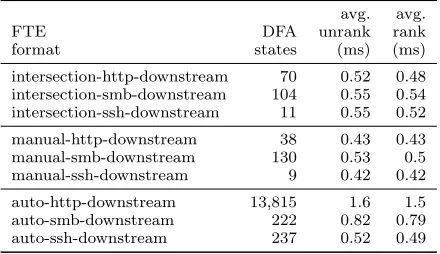
Rank/Unrank. Recall that for FTE we must perform unranking starting from regexes, which can require expo-nential time in the worst case (see Section 3.1). In practice, however, the regexes we require for misidentification attacks admit fast (un)ranking. In Figure 5, we present the DFA size and average time to perform ranking and unranking for our intersection, manual, and automated formats over 100k trials using random integers as input. We present per-formance results for downstream formats only. In all cases the upstream formats perform better than their downstream
counterpart in (un)ranking benchmarks and have smaller DFA state-spaces. The FTE format parameters used in these benchmarks are described in Section 3.2. The DPI-extracted intersection formats and manual formats resulted in very compact DFAs, with no more than 130 states. We note that the automatically generated regexes resulted in the largest DFAs, but were still very fast even for>10,000 state DFAs. This all evidences that the worst-case blow-up in state sizes when converting from an NFA to DFA does not greatly impede performance.
Web-browsing performance. We setup our FTE record layer to proxy HTTP(S) traffic as described in Section 4. As a baseline for comparison, we use a conventional encrypted tunnel. Using OpenSSH’s integrated functionality we estab-lished a SOCKS proxy which listened client-side, such that all connections were routed through the SSH connection to the remote server, and then ultimately on to the destination IP address. We call this oursocks-over-ssh configuration.
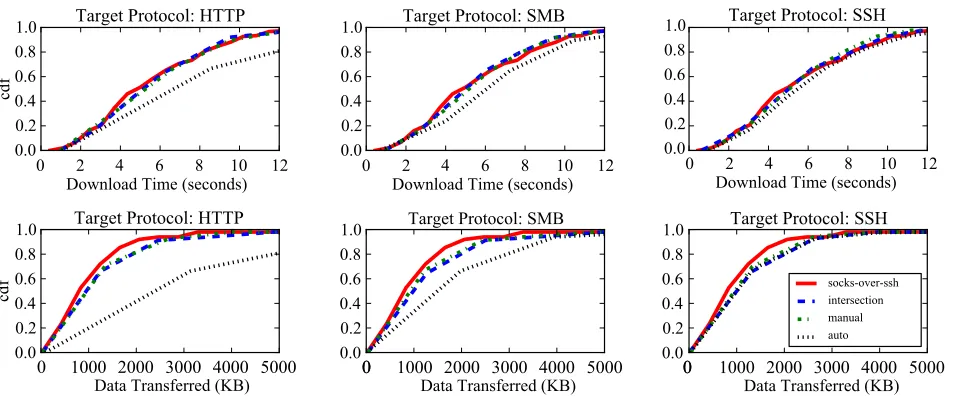
We download the Alexa Top 50 websites five times each using the socks-over-ssh setup. We do the same with the FTE proxy for each of the intersection, manual, and auto-matically generated regexes. Each of the four separate runs (inclusive of socks-over-ssh) therefore resulted in 250 data points. In our socks-over-ssh configuration, websites in the Alexa Top 50 took an average of 5.5 seconds to render the webpage and all dependencies, and required an average of 1,164KB of data transfer including all TCP/IP overhead. In Figure 6, we show the cumulative distribution of the la-tency and bandwidth data points for the four different runs. The lowest average download time of the FTE formats was the intersection-ssh format, which incurred no increase (5.5s avg.) in latency compared to socks-over-ssh, and 1,348KB (16%) increase in data transfer overhead. The highest aver-age download time of all the formats was the automatic-http format, with an average page-render time of 7.1s (29%) and an average of 3,279KB (181%) transferred per website. The increase in data transferred is due to (1) ciphertext expan-sion and (2) Firefox generating persistent TCP connections that cause FTE/SOCKS negotiation, but do not result in data transfer. These latter empty connections do not use much bandwidth in the socks-over-ssh case.
In our testing we note that engineering issues often over-shadow the overheads of FTE. For example, the socks-over-ssh system performed better on sites with low bandwidth requirements and a small number of TCP connections, while our FTE prototype actually performsbetterthan socks-over-ssh for websites that use a large number of TCP connec-tions. This is because our FTE implementation uses multi-threading more aggressively than OpenSSH, and this is bet-ter aligned with the Firefox’s use of multiple TCP connec-tions in parallel.
0 2 4 6 8 10 12 Download Time (seconds) 0.0
0.2 0.4 0.6 0.8 1.0
cdf
Target Protocol: HTTP
0 2 4 6 8 10 12
Download Time (seconds) 0.0
0.2 0.4 0.6 0.8
1.0 Target Protocol: SMB
0 2 4 6 8 10 12
Download Time (seconds) 0.0
0.2 0.4 0.6 0.8
1.0 Target Protocol: SSH
0 1000 2000 3000 4000 5000
Data Transferred (KB) 0.0
0.2 0.4 0.6 0.8 1.0
cdf
Target Protocol: HTTP Target Protocol: SMB
00 1000 2000 3000 4000 5000
Data Transferred (KB) 0.0
0.2 0.4 0.6 0.8
1.0 Target Protocol: SSH
socks-over-ssh intersection manual auto
00 1000 2000 3000 4000 5000
Data Transferred (KB) 0.0
0.2 0.4 0.6 0.8 1.0
Figure 6: Distribution of webpage (Alexa top fifty) download times (top row) and data transferred (bottom row) for our intersection, manually-generated and automatically-generated FTE formats, compared to using our socks-over-ssh configuration.
to follow unrank output.
In our goodput tests, the FTE implementation was never CPU bound. Hence, the performance of our (un)ranking algorithms was not the bottleneck. Profiling of our FTE prototype indicates that future performance gains could be had by optimizing the buffer management and networking logic.
Memory utilization. To determine the memory utiliza-tion of our FTE prototype, we first measured the mem-ory requirements of theBuildTablealgorithm, which is the largest consumer of memory in our prototype. For all for-mats, except auto-http, theBuildTablealgorithm required at most 2 MB of memory. The auto-http upstream format re-quires 15 MB and the auto-http downstream format rere-quires 184 MB. As expected, memory utilization increases linearly with respect to DFA state space.
As an additional test we profiled the maximum heap us-age, inclusive of the Python interpreter and all dependent libraries, when browsing the web with our FTE prototype. For all formats, except auto-http, peak heap usage never exceed 13 MB, while auto-http used roughly 383 MB at its peak. We can attribute this nearly two-fold increase in mem-ory usage, compared to itsBuildTablerequirement, to an in-efficient copy ofBuildTable’s output — this will be resolved in the next release of our prototype.
6.
CENSORSHIP CIRCUMVENTION
In the previous sections, we focused on using FTE to eval-uate the efficacy of modern enterprise-grade DPI. We showed that not only can our FTE record layer easily force DPI mis-classification, but it can do so while incurring negligible per-formance impact. This suggests that FTE can be a useful tool for settings where one wants to circumvent DPI-enabled censorship. Here, we experimentally investigate integrating our FTE record layer into the Tor anonymity network as a as a pluggable transport [2].
Integration. A pluggable transport is a record-layer
mech-anism that processes Tor messages before being transmitted on the wire. The only currently deployed transport is obf-sproxy [42], which applies a stream cipher to every bit out-put by Tor using a shared key. Originally, this shared key was a hard-coded, but a newer version (not yet deployed) re-places this with an in-band, anonymous Diffie-Hellman key exchange [43]. The result of this latter approach is a cryp-tographic guarantee that all the bitstrings seen by a (pas-sive) DPI are indistinguishable from random strings, so that the obfuscated Tor messages will not have fixed fingerprints. This does not, however, force protocol misclassification, and therefore would fail to bypass DPI that use a whitelist of allowed protocols.
We can do better using our FTE record layer as the plug-gable transport. Integrating it into Tor with a hard-coded key is immediate, and it is straightforward to add key ex-change to our record layer. Specifically, one could just initi-ate sessions using the existing obfs3 [43] Diffie-Hellman key exchange, but running the key-exchange messages through our unranking mechanisms before being sent on the wire, since the messages in this exchange are indistinguishable from uniformly random bit strings, they behave like the AE ciphertext bits in our record layer. Together with our ex-isting library of regex formats, we arrive at a version of Tor that can easily force misclassification for the DPI systems currently used in practice. Indeed we verified that misclassi-fication rates for all the six systems in our corpus are as seen in Section 4, but now using Tor with FTE as the pluggable transport. We believe that FTE is an attractive pluggable transport option for several reasons:
• Flexibility: The FTE record layer already supports a variety of target protocols, and adding new ones re-quires only specifying new regexes. Extending prior steganographic systems to support many targets (see Section 7), on the other hand, would be very labor in-tensive.
pro-prietary classification strategy is unknown to us and is similar to systems used in censorship settings [36].
• Speed: The FTE record layer has essentially negligible overhead and, when used with Tor, its overhead is lost in the noise of the Tor network’s performance variabil-ity.
FTE through the GFC. We set up an FTE client on a Virtual Private Server (VPS) located within China and an FTE server in the United States. The server was con-figured to accept incoming connections on port 80. To set a censorship baseline, we first attempted to browse several websites that are known to be censored, including YouTube and Facebook,without using FTE to tunnel the traffic, and found that these sites were blocked. We then attempted to browse the same websites through the FTE tunnel, using our intersection, manual, and automatic HTTP formats. In every case, the FTE tunneled traffic successfully traversed the GFC, and we were able to browse the censored websites. Next, we considered using FTE to tunnel Tor traffic. Again, to set a baseline, we attempted to connect to a private Tor bridge listening on port 443 of our server, using the default Tor distribution. We observed behavior consistent with the recent analysis of the Great Firewall of China (GFC) by Winter et al. [49]: initial Tor connections to our private bridge were successful, and they were followed by an active probe from a Chinese IP address after roughly 15 minutes. The probe performed a handshake with the bridge, then blacklisted the (IP,port)-combination used by the bridge. We validated the blacklisting by observing that subsequent attempts to connect to our Tor bridge (IP,port)-combinations resulted in a successful SYN packet from the VPS to our bridge, followed by spoofed TCP RSTs transmitted to the client and bridge to terminate the TCP connection.
Having established that Tor was indeed being censored, we then attempted the same tasks through our FTE tunnel, again using each of our intersection, manual, and automatic HTTP formats. Despite port 443 being blacklisted from our previous Tor tests, using FTE on port 80 was successful, and we were able to circumvent the GFC with this FTE-tunneled Tor circuit. After these initial tests we established a persis-tent FTE tunnel between our FTE client and server. Every five minutes we selected a censored URL and downloaded it through our FTE-powered tunnel. This tunnel remained active for one month, and successfully subverted the GFC until the termination of our VPS account.
On detecting FTE. Censors have been aggressive at rolling out new DPI-based mechanisms for detecting and blocking circumvention tools. How will FTE fare in this kind of arms race? The first idea would be for DPI systems to obtain the FTE regex formats and then use them to mark any traffic exactly matching the regex as FTE. For most of the regexes we consider, this would lead to prohibitively high false posi-tive rates (e.g., 100% of HTTP traffic). The one exception is the automatically generated regexes, which may not match against other traffic, because of (for example) time stamps or unique hash values that were learned from collected traffic traces.
A second approach might be for DPI to perform more non-regular checks, such as verifying correctness of length fields for protocols that include them, e.g., the Content-Length field of HTTP responses. Note that actually this
exam-ple would not work for DPI in practice, as one-third of the response messages generated when downloading the Alexa Top 50 did not include a valid Content-Length field despite it being strongly recommended in the HTTP RFC. Else-where this kind of check can be addressed by, for example, developing formats that encode a large number of lengths that are frequently observed in legitimate traffic, and for each length ensuring appropriate length of ciphertexts. In theory, one could also use FTE for more powerful language classes (i.e., an algorithm for ranking unambiguous CFGs appears in [17]).
More generally, DPI is faced with finding checks for pro-tocol semantics or formatting with fidelity beyond what is captured by the FTE record layer. Since the latter takes a minimalist approach, there are innumerable ways in which FTE communications differ from real target protocol runs. The recent work of Houmansadr et al. [19], for example, shows how to exploit discrepancies in other circumvention systems that do much more than FTE in terms of attempt-ing to mimic a target protocol [30, 45, 46]. However, findattempt-ing such discrepancies is easy, and the hard open question (not addressed in [19]) is how to make such checks effective—fast, scalable, and with negligible errors—in the messy deploy-ment environdeploy-ments faced by DPI and for all of the essentially arbitrary target protocols FTE supports.
The GFC, as discussed above, also engages in active prob-ing. For example, attempting to connect to destination sys-tems suspected of undesirable behavior. Determining how to resist such active attacks in practice is an ongoing research topic (c.f., [39]). Use of FTE, however, can hope to force ac-tive probing for all legitimate connections using the target protocol, vastly increasing the complexity of such censorship techniques.
7.
RELATED WORK
Steganography/censorship circumvention. Stegano-graphic systems seek to hide the existence of messages from all observers by way of embedding the message in real cover traffic such as TCP/IP connections [32], HTTP [15], email [45], VoIP [21], or social media [9, 25]. FTE does not embed data in real cover traffic, but instead ensures that cipher-texts are formatted to include the telltale protocol finger-prints that DPI systems look for.
Other recent work targets censorship circumvention via so-called protocol mimicking [20, 30, 31, 45, 46, 52]. In these systems, data is embedded within specific application-layer headers and content so that it appears to be a specific un-blocked target protocol. These systems target DPI misclas-sification, but (to the best of our knowledge) their efficacy against production DPI systems has not been systematically measured. FTE, when used as a circumvention mechanism, can be thought of as new lightweight protocol mimicking tool that targets a certain class of adversary, those being the regex-based (or similarly powerful) DPI used in prac-tice. We note that FTE is more efficient than prior pro-tocol mimicing systems, yet already forces misclassification against enterprise-grade DPI.
using an FTE record layer. For instance, tunneling can have high overheads for certain source protocol/tunnel protocol pairs (e.g., HTTP over DNS [27]) and FTE can easily switch between target protocols in a fine-grained manner.
The Dust [48] protocol and Tor’s recent obfsproxy [42] systems strive to ensure that no application-layer bits are left unencrypted in order to remove any identifiable fingerprint. FTE also encrypt all bits sent, but additionally allows one to selectively add back into ciphertexts the formatting needed to force protocol misclassification.
DPI. Performance and scalability of regex-based traffic classification has been extensively studied [4, 18, 44]. Al-ternative protocol identification strategies that have been explored include using packet sizes and timings [6, 51], the types and number connections initiated by a host (its “so-cial behavior”) [23, 26], and various machine learning tech-niques [33,34,55]. However, the feasibility of deploying more sophisticated classification strategies for DPI at scale re-mains unclear [11, 33, 40].
Recent work uses fast small-sample hypothesis tests to identify and discard compressed or encrypted packets [47]. Such tests might flag FTE packets from our simpler formats as compressed/encrypted due to their use of unformatted AE ciphertext bits, thereby preventing protocol misclassifi-cation. However, these tests are easy to defeat by simply changing the format so that the hypothesis test fails on the first few packets in a flow.
Acknowledgements
We thank the anonymous reviewers and Juniper Networks for their constructive feedback on earlier versions of this pa-per. Kevin Dyer and Thomas Shrimpton were supported by NSF CAREER grant CNS-0845610. Thomas Ristenpart was supported in part by generous gifts from Microsoft, as well as NSF grant CNS-1065134.
8.
REFERENCES
[1] M. R. Albrecht, K. G. Paterson, and G. J. Watson. Plaintext recovery attacks against ssh. InSecurity and Privacy, 2009 30th IEEE Symposium on, pages 16–26. IEEE, 2009.
[2] J. Appelbaum and N. Mathewson. Pluggable transports for circumvention. Available at: https://gitweb.torproject.org/torspec.git/HEAD:
/proposals/180-pluggable-transport.txt, 2010.
[3] Arbor Networks, Inc. appid. Available at:
https://code.google.com/p/appid/.
[4] M. Becchi, M. Franklin, and P. Crowley. A workload for evaluating deep packet inspection architectures. In IEEE International Symposium on Workload
Characterization, 2008., pages 79–89, 2008.
[5] M. Bellare, T. Ristenpart, P. Rogaway, and T. Stegers. Format-preserving encryption. In M. Jacobson, V. Rijmen, and R. Safavi-Naini, editors,Selected Areas in Cryptography, volume 5867 ofLecture Notes in Computer Science. 2009.
[6] L. Bernaille and R. Teixeira. Early recognition of encrypted applications. In S. Uhlig, K. Papagiannaki, and O. Bonaventure, editors,Passive and Active Network Measurement, volume 4427 ofLecture Notes in Computer Science. 2007.
[7] D. Brumley, J. Newsome, D. Song, H. Wang, and S. Jha. Towards automatic generation of
vulnerability-based signatures. InSecurity and Privacy, 2006 IEEE Symposium on, pages 15–pp. IEEE, 2006.
[8] D. Brumley, J. Newsome, D. Song, H. Wang, and S. Jha. Theory and techniques for automatic generation of vulnerability-based signatures. Dependable and Secure Computing, IEEE Transactions on, 5(4):224–241, 2008.
[9] S. Burnett, N. Feamster, and S. Vempala. Chipping away at censorship firewalls with user-generated content. InProceedings of the 19th USENIX conference on Security, USENIX Security’10, 2010.
[10] Clear Foundation. l7-filter. Available at:
http://l7-filter.clearfoundation.com/.
[11] A. Dainotti, A. Pescap`e, and K. C. Claffy. Issues and future directions in traffic classification.Network, IEEE, 26(1):35–40, 2012.
[12] L. Deri. nprobe: an open source netflow probe for gigabit networks. InIn Proc. of Terena TNC 2003, 2003.
[13] T. Dierks and E. Rescorla. The Transport Layer Security (TLS) Protocol Version 1.2. RFC 5246 (Proposed Standard), Aug. 2008.
[14] R. Dingledine, N. Mathewson, and P. Syverson. Tor: The second-generation onion router. InIn Proceedings of the 13thUSENIX Security Symposium, 2004.
[15] N. Feamster, M. Balazinska, G. Harfst, H. Balakrishnan, and D. Karger. Infranet:
Circumventing Web Censorship and Surveillance. In Proceedings of the 11th USENIX Security Symposium, 2002.
[16] R. Fielding, J. Gettys, J. Mogul, H. Frystyk,
L. Masinter, P. Leach, and T. Berners-Lee. Hypertext Transfer Protocol – HTTP/1.1. RFC 2616 (Draft Standard), June.
[17] A. Goldberg and M. Sipser. Compression and ranking. InProceedings of the 17thAnnual ACM symposium on Theory of computing, STOC ’85, 1985.
[18] D. Guo, G. Liao, L. N. Bhuyan, B. Liu, and J. J. Ding. A scalable multithreaded l7-filter design for multi-core servers. InProceedings of the 4th ACM/IEEE
Symposium on Architectures for Networking and Communications Systems, ANCS ’08, 2008.
[19] A. Houmansadr, C. Brubaker, and V. Shmatikov. The Parrot is Dead: Observing Unobservable Network Communications. InThe34th IEEE Symposium on Security and Privacy (Oakland), 2013.
[20] A. Houmansadr, G. T. Nguyen, M. Caesar, and N. Borisov. Cirripede: circumvention infrastructure using router redirection with plausible deniability. In Proceedings of the 18th ACM conference on Computer and communications security, CCS ’11, 2011.
[21] A. Houmansadr, T. Riedl, N. Borisov, and A. Singer. I Want my Voice to be Heard: IP over Voice-over-IP for Unobservable Censorship Circumvention. InThe 20th Annual Network and Distributed System Security Symposium (NDSS), 2013.
[22] M. Iliofotou, H.-c. Kim, M. Faloutsos,
backbone. InINFOCOM Workshops 2009, IEEE, pages 1–6. IEEE, 2009.
[23] M. Iliofotou, P. Pappu, M. Faloutsos,
M. Mitzenmacher, S. Singh, and G. Varghese. Network monitoring using traffic dispersion graphs (tdgs). In Proceedings of the 7thACM SIGCOMM conference on
Internet measurement, IMC ’07, 2007.
[24] C. M. Inacio and B. Trammell. Yaf: yet another flowmeter. InProceedings of the 24th international conference on Large installation system
administration, LISA’10, 2010.
[25] L. Invernizzi, C. Kruegel, and G. Vigna. Message In A Bottle: Sailing Past Censorship. InHot Topics in Privacy Enhancing Technologies – PETS, 2012. [26] T. Karagiannis, K. Papagiannaki, and M. Faloutsos.
Blinc: Multilevel traffic classification in the dark. In In Proceedings of ACM SIGCOMM, 2005.
[27] Kryo. iodine DNS Tunnel. Available at:
http://code.kryo.se/iodine/, 2010.
[28] E. Menahem, G. Nakibly, and Y. Elovici.
Network-based intrusion detection systems go active! InProceedings of the 2012 ACM conference on Computer and communications security, pages 1004–1006. ACM, 2012.
[29] Microsoft. [MS-SMB2]: Server Message Block (SMB) Protocol Versions 2 and 3. Available at: http:
//msdn.microsoft.com/en-us/library/cc246482.aspx,
2013.
[30] H. Mohajeri Moghaddam, B. Li, M. Derakhshani, and I. Goldberg. Skypemorph: protocol obfuscation for tor bridges. InProceedings of the 2012 ACM conference on Computer and communications security, CCS ’12, 2012.
[31] S. J. Murdoch. Proof of concept transport plugin: http headers. Available at: https:
//trac.torproject.org/projects/tor/ticket/2759,
2011.
[32] S. J. Murdoch and S. Lewis. Embedding covert channels into TCP/IP. InProceedings of the 7th International Workshop on Information Hiding, 2005. [33] T. T. Nguyen and G. Armitage. A survey of
techniques for internet traffic classification using machine learning.Communications Surveys & Tutorials, IEEE, 10(4):56–76, 2008.
[34] T. T. T. Nguyen, G. Armitage, P. Branch, and S. Zander. Timely and continuous
machine-learning-based classification for interactive IP traffic.IEEE/ACM Trans. Netw., 20(6), Dec. 2012. [35] V. Paxson. Bro: a system for detecting network
intruders in real-time. InProceedings of the 7th conference on USENIX Security Symposium - Volume 7, SSYM’98, 1998.
[36] C. Rhoads and F. Fassihi. Iran vows to unplug internet. Available at: http://online.wsj.com/article/
SB10001424052748704889404576277391449002016.html,
December 2011.
[37] J. Rosenberg, H. Schulzrinne, G. Camarillo,
A. Johnston, J. Peterson, R. Sparks, M. Handley, and E. Schooler. SIP: Session Initiation Protocol. RFC 3261 (Proposed Standard), June 2002.
[38] H. Schulzrinne, A. Rao, and R. Lanphier. Real Time
Streaming Protocol (RTSP). RFC 2326 (Proposed Standard), Apr. 1998.
[39] R. Smits, D. Jain, S. Pidcock, I. Goldberg, and U. Hengartner. Bridgespa: improving tor bridges with single packet authorization. InProceedings of the 10th annual ACM workshop on Privacy in the electronic society. ACM, 2011.
[40] R. Sommer and V. Paxson. Outside the closed world: On using machine learning for network intrusion detection. InSecurity and Privacy (SP), 2010 IEEE Symposium on, 2010.
[41] G. Szab´o, Z. Tur´anyi, L. Toka, S. Moln´ar, and A. Santos. Automatic protocol signature generation framework for deep packet inspection. InProceedings of the 5th International ICST Conference on
Performance Evaluation Methodologies and Tools, pages 291–299. ICST (Institute for Computer Sciences, Social-Informatics and Telecommunications Engineering), 2011.
[42] Tor Project. Obfsproxy. Available at: https:
//www.torproject.org/projects/obfsproxy.html.en,
2013.
[43] Tor Project. Obfsproxy3. Available at:
https://gitweb.torproject.org/pluggable-transports/ obfsproxy.git/blob/HEAD:
/doc/obfs3/obfs3-protocol-spec.txt, 2013.
[44] M. Vallentin, R. Sommer, J. Lee, C. Leres, V. Paxson, and B. Tierney. The nids cluster: Scalable, stateful network intrusion detection on commodity hardware. In C. Kruegel, R. Lippmann, and A. Clark, editors, Recent Advances in Intrusion Detection, volume 4637 ofLecture Notes in Computer Science. 2007.
[45] Q. Wang, X. Gong, G. Nguyen, A. Houmansadr, and N. Borisov. CensorSpoofer: Asymmetric
Communication using IP Spoofing for
Censorship-Resistant Web Browsing. InThe 19th ACM Conference on Computer and Communications Security (CCS), 2012.
[46] Z. Weinberg, J. Wang, V. Yegneswaran,
L. Briesemeister, S. Cheung, F. Wang, and D. Boneh. Stegotorus: a camouflage proxy for the tor anonymity system. InACM Conference on Computer and Communications Security, 2012.
[47] A. M. White, S. Krishnan, M. Bailey, F. Monrose, and P. Porras.Clear and Present Data: Opaque Traffic and its Security Implications for the Future. NDSS, 2013. [48] B. Wiley. Dust: A blocking-resistant internet
transport protocol. Technical report, School of Information, University of Texas at Austin, 2011. [49] P. Winter and S. Lindskog. How the Great Firewall of
China is Blocking Tor. InFree and Open Communications on the Internet, 2012. [50] G. Wondracek, P. M. Comparetti, C. Kruegel,
E. Kirda, and S. S. S. Anna. Automatic network protocol analysis. In15th Symposium on Network and Distributed System Security (NDSS), 2008.
[51] C. V. Wright, F. Monrose, and G. M. Masson. On inferring application protocol behaviors in encrypted network traffic.Journal on Machine Learning Research, 7, Dec. 2006.
infrastructure. InProceedings of the 20th USENIX
Security Symposium, Aug. 2011.
[53] A.-m. Yang, S.-y. Jiang, and H. Deng. A p2p network traffic classification method using svm. InYoung Computer Scientists, 2008. ICYCS 2008. The 9th International Conference for, pages 398–403. IEEE, 2008.
[54] T. Ylonen and C. Lonvick. The Secure Shell (SSH) Transport Layer Protocol. RFC 4253 (Proposed Standard), Jan. 2006.
[55] S. Zander, T. Nguyen, and G. Armitage. Automated traffic classification and application identification using machine learning. InLocal Computer Networks, 2005. 30th Anniversary. The IEEE Conference on, pages 250–257. IEEE, 2005.
APPENDIX
A.
ALGORITHMS FOR RANKING AND
UN-RANKING A REGULAR LANGUAGE
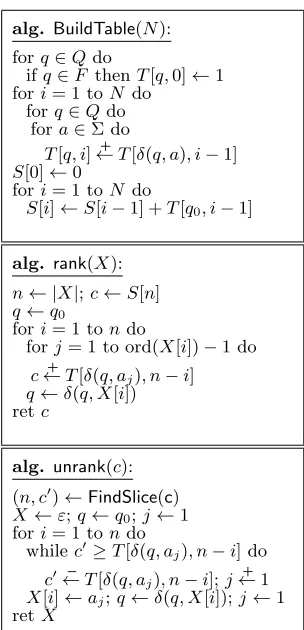
In Figure 7 we have the core algorithmsBuildTable,rank, andunrank, used in our FTE record layer. The ordinality of symbolα∈Σ, written ord(α), is its position (starting from 1) in the lexicographical ordering of the elements of Σ. T[q, i] is the number of strings of lengthithat end in an accepting state when starting from stateq; thusT[q0, i] is the number of X ∈ L such that|X|=i. S[i] is the number of strings inLof length at mosti−1. Unspecified algorithmFindSlice finds the largest`such thatS[`]< c, and returnsn=`+ 1 andc0=c−S[`]. This can be done inO(log2(|S|)) time via binary search.alg. BuildTable(N): forq∈Qdo
ifq∈F thenT[q,0]←1 fori= 1 toN do
forq∈Qdo fora∈Σ do
T[q, i]←+T[δ(q, a), i−1] S[0]←0
fori= 1 toN do
S[i]←S[i−1] +T[q0, i−1]
alg. rank(X): n← |X|;c←S[n] q←q0
fori= 1 tondo
forj= 1 to ord(X[i])−1 do
c←+T[δ(q, aj), n−i]
q←δ(q, X[i]) retc
alg. unrank(c): (n, c0)←FindSlice(c) X←ε;q←q0;j←1 fori= 1 tondo
while c0≥T[δ(q, aj), n−i] do
c0←−T[δ(q, aj), n−i];j +
←1
X[i]←aj;q←δ(q, X[i]);j←1
retX