VladislavKovtun1, Andrew Okhrimenko2
Approaches for the Parallelization of Software Implementation
of Integer Multiplication
In this paper there are considered several approaches for the increasing performance of software implementation of integer multiplication algorithm for the 32-bit & 64-bit platforms via parallelization. The main idea of algorithm parallelization consists in delayed carry mechanism using which authors have proposed earlier [11]. The delayed carry allows to get rid of connectivity in loop iterations for sums accumulation of products, which allows parallel execution of loops iterations in separate threads. Upon completion of sum accumulation threads, it is necessary to make corrections in final result via assimilation of carries. First approach consists in optimization of parallelization for the two execution threads and second approach is an evolution of the first approach and is oriented on three and more execution threads. Proposed approaches for parallelization allow increasing the total algorithm computational complexity, as for one execution thread, but decrease total execution time on multi-core CPU.
Keywords: multiplication, integers, parallelization, OpenMP, OpenCL, software implementation, cryptographic transformations, public key cryptosystem.
Introduction. The IT penetration of society life leads to increasing of information security role, which are unthinkable without cryptographic cryptosystems. Public key cryptosystems hold a special place among the cryptographic transformations.
Public key cryptosystems have a long history from first publication of Diffie & Hellman [1], which initiates basis to modern cryptosystems, for example algebraic curve cryptosystems. The increasing of software and hardware implementation of public key cryptosystems is the most important among topical tasks of public key cryptosystems developing.
Arithmetic operations in rings and fields of integers form the basis of public key cryptosystems the whole of germination time.
Integer multiplication operation is the main operation in ring or field arithmetic.
Thus, the increasing of performance of public key cryptosystems may be achieved via increasing performance of integer multiplication operation in ring or field.
It is well known, that software implementation of any algorithm depends on the architecture of hardware platform. Such microprocessors evolution goes to increasing a clock frequency. But upon reaching of physical limitation accent moves to increasing number of execution threads. Now, following CPU are available:
AMD proposes CPU (Opteron 6200 Series) with 16 physical cores and 16 execution threads;
Intel proposes CPU (Xeon 7000 Series) with 10 physical cores with Hyper-Threading and 20 execution threads.
There are two computational accelerators based on GP GPU available:
NVIDIA proposes GP GPU (Tesla FermiM2090) with CUDA technology with 512 physical cores;
AMD proposes GP GPU (FireStream 9370) with AMD APP technology with 20 SIMD PU and 1600 Streamed cores.
The task of efficiency using all these cores lies on software engineer which designs and programs algorithms.
In accordance with this, it is no doubt that adaptation of existing algorithms for execution on multi-core CPU (CPU with several execution threads) is an urgent task.
1
The task of algorithm parallelization of arithmetic operations for integers is not new [2, 3], in these papers there are considered Montgomery multiplication and integers arithmetic for implementation on NVIDIA GP GPU [2, 3]. Further evolution of this direction for other arithmetic algorithms allows to find more effective parallelization technique for different hardware platforms.
There are several well known parallelization techniques:
OpenMP [4, 5] for general purpose CPU.
OpenCL [6] for general purpose CPU and for GP GPU NVIDIA & AMD.
Intel Threading Building Block [7] for the general purpose CPU.
NVIDIA CUDA [8] for GP GPU NVIDIA.
AMD Accelerated Parallel Processing (APP) [9] for GP GPU AMD.
Further we consider algorithms for integer multiplication and approaches for their parallelization with OpenMP technology. The OpenMP technology was chosen because it is supported by most modern C++ compilers for variety hardware platforms (like Intel C++ Compiler, GCC C++ Compiler & Microsoft C++ Compiler). OpenMP makes it easy to implement parallelism in existing C++ programs. Other mentioned technologies are more cumbersome and less obvious, but the main idea of proposed parallelization approach remains unchangeable.
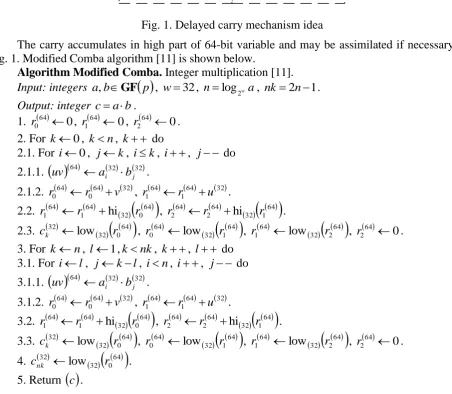
Modified Comba. Earlier, in paper [11], authors proposed a modified algorithm Comba [10] – Modified Comba, with delayed carry technique. Usage of 64-bit variables for storing 32-bit variables allows to get rid of carry assimilation from high part of 32-bit variable after each arithmetic operation.
Hi(a0*b0) Lo(a0*b0)
r0 r1
Fig. 1. Delayed carry mechanism idea
The carry accumulates in high part of 64-bit variable and may be assimilated if necessary, see Fig. 1. Modified Comba algorithm [11] is shown below.
Algorithm Modified Comba. Integer multiplication [11].
Input:integers a,bGF
p , w32, nlog2wa, nk2n1. Output:integer cab.1. r0 64 0, r1 64 0, r2 64 0. 2. For k0, k n, k do
2.1. For i0, jk, ik, i, j do 2.1.1.
uv 64 ai 32 b j32 .2.1.2. 0 64 32 64
0 r v
r , 1 64 32 64
1 r u
r .
2.2. r1 64 r1 64 hi 32
r0 64 , r2 64 r2 64 hi 32
r1 64 .2.3. c k32 low 32
r0 64 , r0 64 low 32
r1 64 , r1 64 low 32
r2 64 , r2 64 0. 3. For k n, l 1,knk, k, l do3.1. For il, jkl, in, i, j do 3.1.1.
uv 64 ai 32 b j32 .3.1.2. r0 64 r0 64 v 32 , 64 32 1
64
1 r u
r .
3.2. r1 64 r1 64 hi 32
r0 64 , r2 64 r2 64 hi 32
r1 64 . 3.3. 32
0 6432
low r
ck ,
32
1 64 640 low r
r , 32
2 6464
1 low r
r , r2 64 0.
4. 32
0 64 32low r
cnk .
Let’s conduct a brief analysis of Modified Comba algorithm [11], and show main difference with prototype – Comba algorithm [10] as well as work out in details Modified Comba potentialities.
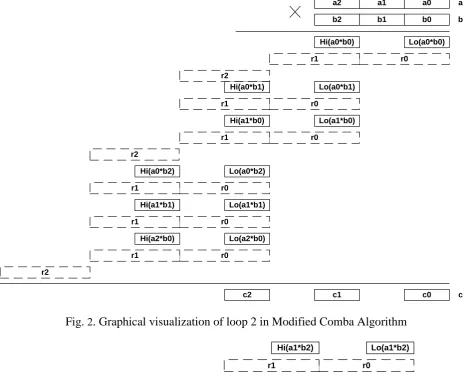
On fig. 2 and 3 graphical visualization of Modified Comba Algorithm for n3 is shown, where the addition of corresponding products is clearly traced in columns.
a2 a1 a0
b2 b1 b0
Hi(a0*b0) Lo(a0*b0)
Hi(a2*b0) Lo(a2*b0)
c2 c1 c0
a
b
c
Hi(a1*b0) Lo(a1*b0)
Hi(a0*b1) Lo(a0*b1)
Hi(a0*b2) Lo(a0*b2)
Hi(a1*b1) Lo(a1*b1)
r0 r1
r2
r0 r1
r0 r1
r2
r0 r1
r0 r1
r0 r1
r2
Fig. 2. Graphical visualization of loop 2 in Modified Comba Algorithm
c3 c4
c5
Hi(a2*b1) Lo(a2*b1)
Hi(a1*b2) Lo(a1*b2)
Hi(a2*b2) Lo(a2*b2)
r0 r1
r2
r0 r1
r0 r1
r2
c
Fig. 3. Graphical visualization of loop 3 in Modified Comba Algorithm
The idea of delayed carry, previously described in Modified Comba Algorithm [11], has prompted authors on possibility of parallel addition values in columns
a b
k i j i j nr n
k i j
21Lo | ,0 ,0
0 and r
a b
k i j i j nn
k i j
21Hi | ,0 ,0
1 . In the
The fact of carry absence in additions integers in column (sum accumulation) for Modified Comba Algorithm allowing to say about isolatedness of sum accumulation operation, which allows to execute accumulation loop on step 2 and 3 in parallel independent threads.
Notice, after the completion of sum accumulation in all independent threads, still it is required to make an adjustment (to assimilate a carry) r1r1Hi
r0 , r2 r2Hi
r1 and compute result
0Lor
ci .
The delayed carry mechanism allows formulating several approaches to the Modified Comba Algorithm parallelization:
Parallel execution (in two parallel threads) of loops in the step 2 and 3 with further final result correction. We will call it Modified Comba 2x.
Parallel execution (number of parallel threads) of iterations in loops on steps 2 and 3 with further intermediate results (from parallel threads) merging. We will call it Modified Comba Mx.
Modified Comba 2x algorithm. The algorithm contains two loops on step 2 and 3, which read elements ai 32 and b j32 of corresponding arrays with further writing results of multiplication ai 32
and b j32 to elements ck 32 . Note, indexes k in loops on step 2 and 3 are not repeated while writing to elements ck 32 . This allows to say about data independence in these loops and possibility of parallel loops execution by the parallel technique. It is worth underlining that, both loops on step 2 and 3 use common temporary variables r0, r1 and r2. Moreover, variables r0 and r1 keep values which use in
loop in step 3 after the loop on step 2 is complete.
Thus, after the finishing loop on step 3 it will require making a correction of results of loop execution in step 3 – to take into account results of execution loop in step 2 (results keep in temporary variables r0, r1 and r2). See, while loops on steps 3 and parallelization, each thread should work with
its own private temporary variables rl0, rl1 and rl2.
Global variables r0 and r1 will be used only for the possible carry from rl0, rl1 loop on step 2
to further correction of results accumulation in loop on step 3.
Let’s consider Modified Comba algorithm with parallelization via OpenMP into two threads.
Algorithm Modified Comba 2x. Integer multiplication with OpenMP supports two threads.
Input: integers a,bGF
p , w32, nlog2wa, nk2n1. Output: integer cab.1. #pragma omp parallel sections private(r0 64 ,r1 64 ) begin 1.1. #pragma omp section begin
1.1.1. rl0 64 0, rl1 64 0, rl2 64 0. 1.1.2. For k0, kn, k do
1.1.2.1. For i0, jk, ik, i, j do 1.1.2.1.1.
uv 64 ai 32 b32j .1.1.2.1.2. rl0 64 rl0 64 v 32 , rl1 64 rl1 64 u 32. 1.1.2.2. 32
0 6464 1 64
1 rl hi rl
rl , 32
1 6464 2 64
2 rl hi rl
rl .
1.1.2.3. 32
0 64 32low rl
ck ,
32
1 64 640 low rl
rl , 32
2 6464
1 low rl
rl , rl2 64 0.
1.1.3. 1 64 64
0 rl
r .
1.1.4. r1 64 rl2 64 . #pragma omp section end 1.2. #pragma omp section begin
1.2.2. For kn, l 1,knk, k, l do 1.2.2.1. For il, jkl, in, i, j do 1.2.2.1.1.
uv 64 ai 32 b32j .1.2.2.1.2. rl0 64 rl0 64 v 32 , rl1 64 rl1 64 u 32. 1.2.2.2. 32
0 6464 1 64
1 rl hi rl
rl , 32
1 6464 2 64
2 rl hi rl
rl .
1.2.2.3. 32
0 64 32low rl
ck ,
32
1 64 640 low rl
rl , 32
2 6464
1 low rl
rl , rl2 64 0.
#pragma omp section end
#pragma omp parallel sections end 2. r0 64 r0 64 cn 32.
3.
321 640 32 64
1 64
1 r hi rl cn
r .
4. 32
1 64 64hi rl
t .
5. For k n2, k nk, k do 5.1. t 64 t 64 ck 32 .
5.2. c k32 low 32
t 64 . 5.3. low 32
t 64 hi 32
t 64 . 5.4. hi 32
t 64 0.6. cnk 32 low 32
r0 64 . 7. Return
c .a2 a1 a0
b2 b1 b0
Hi(a0*b0) Lo(a0*b0)
Hi(a2*b0) Lo(a2*b0)
c3 c2 c1 c0
c4 c5
a b
c Hi(a1*b0) Lo(a1*b0)
Hi(a0*b1) Lo(a0*b1)
Hi(a0*b2) Lo(a0*b2)
Hi(a1*b1) Lo(a1*b1)
Hi(a2*b1) Lo(a2*b1) Hi(a1*b2) Lo(a1*b2)
Hi(a2*b2) Lo(a2*b2)
r0 r1
r2
r0 r1
r0 r1
r2
r0 r1
r0 r1
r0 r1
r2
r0 r1
r2
r0 r1
r0 r1
r2 Thread 1 (Section 1)
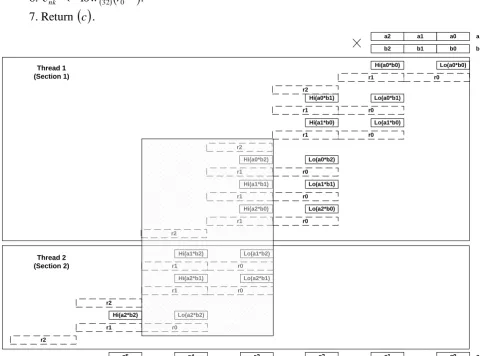
After the finishing execution of the parallel threads in step 1.1 and 1.2, it is required to correct in steps 2-6 the result of thread in step 1.2 via carry transfer from result in other thread in step 1.1.
The algorithm Modified Comba 2x for 2 threads and n3 shown on fig. 4.
An algorithm with parallelization on multiply threads deserves special attention. It is described below.
Modified Comba Mx algorithm. In detailed consideration of Modified Comba algorithm, it is easy to note, that iterations in loops in steps 2 and 3 do not depend on one another.
The exclusions are addition accumulation results and carry from current iteration to only that addition and carry results after the current iteration to further iteration processing in steps 2.2 and 2.3. By entering individual local variables for the sum accumulation parallel sum accumulation in iteration on steps 2 and 3 may be correctly performed.
For these purposes in algorithm Modified Comba Mx two arrays r0 i64 и r1i 64 , i0,2n1. Are declared. Easy to see, that this approach allows to variate number of parallel threads without algorithm modification in whole.
Algorithm Modified Comba Mx. Integer multiplication with OpenMP supports multiply threads
Input: integersa,bGF
p , w32, nlog2wa, nk2n1. Output: integers cab.0. l 1.
1. #pragma omp parallel private (r0 64 ,r1 64 ) reduction (+ : l) begin 2. #pragma omp for nowait begin
2.1. For k 0, kn, k do 2.1.1. rl0 64 0,
0
64
1
rl .
2.1.2. For i0, jk, ik, i, j do 2.1.2.1.
uv 64 ai 32 b32j .2.1.2.2. rl0 64 rl0 64 v 32 , rl1 64 rl1 64 u 32 . 2.1.3. 0 64
64
0 rl
r k , 1 64
64
1 rl
r k .
#pragma omp for end
3. #pragma omp for nowait begin 3.1. For k n, knk, k do 3.1.1. rl0 64 0, rl1 64 0, rl2 64 0.
3.1.2. For il, jkl, in, i, j do 3.1.2.1.
uv 64 ai 32 b32j .3.1.2.2. 0 64 32 64
0 rl v
rl , 1 64 32
64
1 rl u
rl .
3.1.3. r0 64k rl0 64 , r1 64k rl1 64 . 3.1.4. l.
#pragma omp for end #pragma omp parallel end 4. 064
64
0 r0
rl .
5. rl1 64 r1 064 . 6. 32
0 6432
0 low rl
c .
7. 32
0 64 641 64
1 rl low rl
rl .
8. 32
1 64 642 hi rl
9. rl0 64 rl1 64 . 10. 2 64
64
1 rl
rl .
11. rl2 64 0.
12. For k 1, k nk, k do 12.1. rll0 64 r0 k64 .
12.2. rll1 64 r1 k64 .
12.3. 32
0 64
640 64
0 rl low rll
rl .
12.4. rl1 64 rl0 64 hi 32
rl0 64 hi 32
rll0 64
low 32
rll1 64
. 12.5. rl2 64 rl2 64 hi 32
rl1 64 hi 32
rll1 64
.12.6. 32
0 64 32low rl
ck .
12.7. 1 64 64
0 rl
rl .
12.8. 64 2 64
1 rl
rl .
12.9. rl2 64 0.
13. cnk 32 low 32
rl0 64 . 14. Return
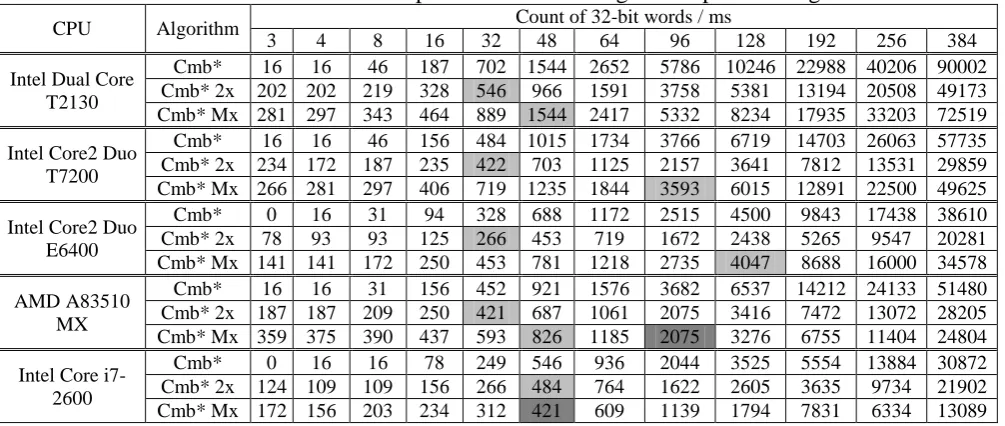
c .Comparison with other algorithms. Parallelization efficiency may be evaluated by the comparison of average time execution of software implementations for proposed parallel algorithms with single thread Modfied Comba algorithm [11], for one million iterations for different integers bit-length.
Performance measurement of software implementation is performed for the arrays with 32-bit machine words, which allows to estimate performance of implementations as a whole.
The Modified Comba 2x, Mx and single thread Modified Comba are implemented in C++ and compiled with Intel C++ Compiler XE 2011 in Microsoft Visual Studio 2005 in Release Win32 target with Maximize Speed option and SSE2 supports.
While testing several hardware platforms are used:
Entry-level old mobile CPU – Intel Dual Core T2130 on Microsoft Windows 7 x86.
Middle-level old mobile CPU – Intel Core2 Duo T7200 on Microsoft Windows XP x86.
High-level modern mobile CPU – AMD A8-3510 MX on Microsoft Windows 7 x86-64.
Middle-level old desktop CPU – Intel Core2 Duo E6400 on Microsoft Windows 7 x86.
High-level modern desktop CPU – Intel Core i7 2600 on Microsoft Windows 7 x86. All CPU have two cores with two execution threads without Hyper-Threading only that:
AMD A8-3510 MX has 4 cores and 4 execution threads (without Hyper-Threading).
Intel Core i7 2600 has 4 cores and 8 execution threads (with Hyper-Threading).
Table 1. Performance of different implementations of integer multiplication algorithms in ms
CPU Algorithm Count of 32-bit words / ms
3 4 8 16 32 48 64 96 128 192 256 384
Intel Dual Core T2130
Cmb* 16 16 46 187 702 1544 2652 5786 10246 22988 40206 90002
Cmb* 2x 202 202 219 328 546 966 1591 3758 5381 13194 20508 49173
Cmb* Mx 281 297 343 464 889 1544 2417 5332 8234 17935 33203 72519
Intel Core2 Duo T7200
Cmb* 16 16 46 156 484 1015 1734 3766 6719 14703 26063 57735
Cmb* 2x 234 172 187 235 422 703 1125 2157 3641 7812 13531 29859
Cmb* Mx 266 281 297 406 719 1235 1844 3593 6015 12891 22500 49625
Intel Core2 Duo E6400
Cmb* 0 16 31 94 328 688 1172 2515 4500 9843 17438 38610
Cmb* 2x 78 93 93 125 266 453 719 1672 2438 5265 9547 20281
Cmb* Mx 141 141 172 250 453 781 1218 2735 4047 8688 16000 34578
AMD A83510 MX
Cmb* 16 16 31 156 452 921 1576 3682 6537 14212 24133 51480
Cmb* 2x 187 187 209 250 421 687 1061 2075 3416 7472 13072 28205
Cmb* Mx 359 375 390 437 593 826 1185 2075 3276 6755 11404 24804
Intel Core i7-2600
Cmb* 0 16 16 78 249 546 936 2044 3525 5554 13884 30872
Cmb* 2x 124 109 109 156 266 484 764 1622 2605 3635 9734 21902
Cmb* Mx 172 156 203 234 312 421 609 1139 1794 7831 6334 13089
Let’s try to analyze the results of experiments shown in table 1. The low-end CPU Dual Core T2130 showed superiority two thread implementation Cmb* 2x over single thread implementation Cmb* on 32 word long integers and Cmb* Mx over single thread implementation Cmb* on 48 word Long integers. Note, Cmb* Mx showed much worse performance than Cmb* 2x.
CPU Core2 Duo T7200 has better performance then CPU Dual Core T2130, in accordance with this Cmb* 2x leaded Cmb* on integers with length of 32 words and Cmb* Mx leaded Cmb* on 48 word long integers. Note, as in previous case, Cmb* Mx showed worst performance then Cmb* 2x. This behavior may be clearly explained via higher core performance of Core2 Duo T7200 in comparison with Dual Core T2130.
Special attention should be paid to the mobile CPU AMD A83510 MX, which shows the superiority Cmb* 2x on 32 word long integers and Cmb* Mx on 48 word long integers. In addition, the implementation of Cmb* Mx excels the Cmb* 2x on 96 words long integers. These results allow us to safely say, what Cmb* Mx may be efficiently used in computers with multiprocessors and multi-core CPUs.
Let us now consider the results of experiments in desktops. The desktop with Core2 Duo E6400 shows the comparatively results with Core2 Duo T7200: Cmb* 2x shows the superiority over single thread implementation of Cmb* on integers with length in 32 words and Cmb* Mx shows the superiority over single thread implementation of Cmb* on integers with length in 128 words. This behavior may be explained by the higher core performance of Core2 Duo E6400 in comparison with Core2 Duo T7200.
The desktop with Core i7-2600 CPU shows the best results in comparison with other: so due to high performance of cores the superiority of Cmb* 2x and Cmb* Mx over single thread Cmb* shows on integers with length in 48 words.
The effect of execution Cmb* Mx on CPU with 4 cores and 8 execution threads appears in explicit superiority not only on Cmb* but also on Cmb* 2x. A further increasing the integers length showed a significant superiority Cmb* Mx over Cmb* 2x.
Table 1 clearly shows that the effect of parallelism begins to appear during multiplication of integers with length more than 32 words. This is connected with significant expenses in new work thread creation in one multiplication operation. These expenses are commensurable with expenses) on multiplication by itself. This undesirable effect may be avoided via preliminary working thread creation, before it carries out all arithmetic operations on library initialization stage.
Conclusion. Results of experiments and theoretical investigations, which made in this paper, allow saying about next conclusions:
1. Modified Comba algorithm proposed by authors may be efficiently parallelized. Modified Comba 2x algorithm in 1.5 times and Modified Comba Mx algorithm in 2 times is in excess of single thread algorithm.
2. The parallelization benefits appear on 1024 bit (on 32 word with 32-bit), this allow to say about large expenses on new parallel thread creation. These expenses may be compensated in the arithmetic library on initialization stage.
3. The OpenMP implementation (support) in GNU gcc C++ Compiler on Debian Linux 6.0 x86-64 and Microsoft C++ Compiler in Visual Studio 2005, 2008 and 2010 on Windows XP x86 and Windows 7 x86-64 appear to be much worse than Intel C++ Compiler XE 2011 on Windows 7 because C++ programs have much worse performance (they are not described in this work).
In software implementation, large time on new thread creation and large time on delay before thread destruction are mainly responsible for the worse performance (GNU gcc C++ Compiler on Debian Linux 6.0 x86-64 and Microsoft C++ Compiler in Visual Studio 2005, 2008 and 2010).
Further, authors see application of parallelization technique to other arithmetic operation algorithms in rings and fields such as reduction and inversion for the enhancing performance of public key cryptosystems, like cryptosystems on algebraic curves.
The necessity of these researches speaks results obtained by the authors of [12] via using CUDA technology in the implementation of elliptic curve cryptosystem.
Bibliography
1. Diffie W., Hellman M. E., “New directions in cryptography,” IEEE Transactions on Information Theory, vol. IT-22, pp. 644–654, 1976.
2. Selçuk Baktir and Erkay Sava. Highly-Parallel Montgomery Multiplication for Multi-core General-Purpose Microprocessors. // Cryptology ePrint Archive. –Report 2012/140. –2012. –16 p. Available at: http://eprint.iacr.org
3. Pascal Giorgi, Thomas Izard, Arnaud Tisserand. Comparison of Modular Arithmetic Algorithms on GPUs // In Proc. International Conference on Parallel Computing (ParCo 2009). -Vol19. –Lyon, France. -2009. –pp. 315-322.
4. The OpenMP API Specification for Parallel Programming. Available at: http://openmp.org
5. OpenMP in Visual C++. Available at: http://msdn.microsoft.com/en-us/library/tt15eb9t.aspx
6. Khronos OpenCL API Registry. URL: http://www.khronos.org/registry/cl/
7. Intel Threading building blocks for open source. URL: http://threadingbuildingblocks.org/
8. NVIDIA CUDA. URL: http://www.nvidia.ru/object/cuda_home_new_ru.html
9. AMD Accelerated Parallel Processing (APP). URL: http://developer.amd.com/sdks/
AMDAPPSDK/samples/showcase/Pages/default.aspx
10. Comba P. G. Exponentiation cryptosystems on the IBM PC // IBM Systems Journal. –Vol. 29(4). -1990. -pp. 526– 538.
11. Kovtun V., Okhrimenko A. Approaches for the performance increasing of software implementation of integer multiplication in prime fields // Cryptology ePrint Archive. –Report 2012/170. –2012. –9 p. Available at:
http://eprint.iacr.org.