4-point Attacks with Standard Deviation
Analysis on A-Feistel Schemes
Val´erie Nachef1, Jacques Patarin2, Emmanuel Volte1
1
Department of Mathematics, University of Cergy-Pontoise, CNRS UMR 8088 2 avenue Adolphe Chauvin, 95011 Cergy-Pontoise Cedex, France
2 PRISM, University of Versailles
45 avenue des Etats-Unis, 78035 Versailles Cedex, France
[email protected], [email protected] [email protected]
Abstract. A usual way to construct block ciphers is to apply several rounds of a given structure. Many kinds of attacks are mounted against block ciphers. Among them, differential and linear attacks are widely used. In [18, 19], it is shown that ciphers that achieve perfect pairwise decorrelation are secure against linear and differential attacks. It is pos-sible to obtain such schemes by introducing at least one random affine permutation as a round function in the design of the scheme. In this pa-per, we study attacks on schemes based on classical Feistel schemes where we introduce one or two affine permutations. Since these schemes resist against linear and differential attacks, we will study stronger attacks based on specific equations on 4-tuples of cleartext/ciphertext messages. We give the number of messages needed to distinguish a permutation produced by such schemes from a random permutation, depending on the number of rounds used in the schemes, the number and the position of the random affine permutations introduced in the schemes.
1
Introduction
Differential cryptanalysis on encryption schemes was invented in the early 90s by Biham and Shamir who applied it against DES [1, 2].Then Matsui developped linear cryptanalysis against DES [9, 10]. Differential cryptanalysis exploits the high probability of certain occurrences of plaintext differences and differences into the last round of the cipher. Consider two inputs M0 and M00 with cor-responding outputs Y0 and Y00. The input difference is ∆M and the output difference is ∆Y. In an ideally randomizing cipher the probability that a par-ticular output difference ∆Y occurs given a particular difference input∆M is
1
2n where n is the number of bits ofM. Differential cryptanalysis seeks to
ex-ploit a scenario where a particular∆Y occurs given a particular input difference
∆M with a very high probability. Linear cryptanalysis tries to take advantage of high probability occurrences of linear expressions involving plaintext bits, ci-phertext bits and subkey bits. Both methods use pairs of plaintext/cici-phertexts. They allowed to produce attacks on classical Feistel schemes with random func-tions [7, 8, 14] or random permutafunc-tions [6, 17], unbalanced Feistel schemes with expanding [5, 16, 20] or contracting functions [13, 15], Misty schemes [3, 11], gen-eralized Feistel schemes of type 1, 2 and 3 [12]. In [18, 19], Vaudenay showed that if a block cipher has perfect pairwise decorrelation, then it is secure against linear and differential attacks. We recall that a function F has perfect pair-wise decorrelation if for any x1 6= x2, the random variables F(x1) and F(x2) are uniformly distributed and independent. Affine permutations are examples of functions achieving perfect pairwise decorrelation. Now suppose that we have
r independent ciphers C1, . . . , Cr. If one of these cipher has perfect pairwise
decorrelation, thenC=Cr◦. . .◦C1has also perfect pairwise decorrelation ([18, 19]). Thus if one of the ciphers is an affine permutation, thenChas perfect pair-wise decorrelation and is secure against linear and differential cryptanalysis. This gives a method to construct ciphers that are secure against linear and differential attacks. COCONUT and PEANUT ([18]) are examples of such schemes: they are of the formC3◦C2◦C1whereC1 andC3are any ciphers andC2 performs per-fect pairwise decorrelation. In [13], the authors studied the security of schemes of the form C2◦ψ◦C1 or ψ◦C1 where C1 and C2 are pairwise independent permutation (they achieve perfect pairwise decorrelation) and ψ is a balanced Feistel scheme or an unbalanced Feistel scheme with contracting functions. By Vaudenay’s result, we know that again these schemes are secure against linear and differential cryptanalysis. But we can consider different types of attacks. For example, we may have specific relations on tuples of cleartext/ciphertext mes-sages. In this paper, we will study these kind of attacks on a family of schemes that are secure against linear and differential cryptanalysis. We will see that we can use 4-tuples of cleartext/ciphertext messages. We consider schemes of the form Ψd◦ϕ,ϕ0◦Ψd◦ϕ,Ψd2◦ϕ◦Ψd1 where ϕ, ϕ0 are affine permutations and
ψd, ψd1, Ψd2 are classical Feistel schemes with respectively d, d
We introduce an affine permutation at the beginning, at the end, inside the Feis-tel scheme, or both at the beginning and at the end. Thus, by symmetry, we will obtain results for Known Ciphertext Attacks (KCA) and non adaptive Chosen Ciphertext Attacks (CCA-1). The affine permutations and the functions used in the Feistel schemes are keyed dependent. With our attacks we want to distin-guish a random permutation from a random permutation produced by a scheme. For some of our attacks, we will make a precise analysis of standard deviation. The paper is organized as follows. In section 2, we define our schemes that we name A-Feistel schemes. In section 3, we describe our best KPA and CPA-1 on schemes with one affine permutation. We show that it is possible to attack up to 3 rounds after the affine permutation with a number of messages less than 22n and then we describe attacks against generators of permutations. We did some simulations of our attacks. The results of these simulations are given in sec-tion 3.4. In Secsec-tion 4, we present attacks on schemes for which we apply first an affine permutation, then a Feistel scheme with several rounds and again an affine permutation. Appendices A and B are devoted to the computation of standard deviations. In appendix C, it is shown that A-Feistel permutations have even signature. This allows attacks by the signature when all the cleartext/ciphertext pairs are known.
2
Preliminaries
2.1 Notation
We use the following standard notations. The number of messages is denoted by m. The set of the 2n binary strings of length n is denoted by {0,1}n. For a, b ∈ {0,1}n, [a, b] will be the string of length 2n of {0,1}2n which is the
concatenation ofaandb. Fora, b∈ {0,1}n,a⊕bstands for bit by bit exclusive or
ofaandb. The composition of functions is denoted by◦. The set of all functions from {0,1}n to{0,1}n is Fn. Let f be a function of Fn. LetL, R, S andT be
elements of{0,1}n. We defineΨ(f)[L, R] = [S, T] def
⇔ S =RandT =L⊕f(R). More generally, let d be an integer andf1, f2, . . . , fd be d functions of Fn. We set:Ψd(f1, . . . , fd) =Ψ(fd)◦ · · · ◦Ψ(f2)◦Ψ(f1). The permutationΨd(f1, . . . , fd) is called a “Feistel scheme withdrounds” and is denoted byΨd.
2.2 A-Feistel schemes
We now define A-Feistel Schemes. We consider an affine permutation from{0,1}2n
to {0,1}2n. It is written under the form: M →A.M⊕cwhere A∈GL(2n, K)
andc∈ {0,1}2n. In order to construct an A-Feistel scheme with “drounds”, we
use one or two affine permutations and a classical Feistel scheme withdrounds. Here dis related with the Feistel scheme. Letϕandϕ0 be affine permutations, an A-Feistel scheme withdrounds is one of the following permutations: Ψd◦ϕ, ϕ◦Ψd,Ψd2◦ϕ◦Ψd1 withd
We will write Aunder the form:
A1A2
A3A4
where each Ai∈ M(n×n,F2). We also setc= [c1, c2] whereci∈ {0,1}n.
We introduce the internal variables that appear in the different rounds of A-Feistel schemes.
1. Ψd◦ϕ
[L, R]−→ϕ [P, Q]Ψ−→(f1)[Q, X1]Ψ−→(f2)[X1, X2]. . .
Ψ(fd−1)
−→ [Xd−2, Xd−1]Ψ−→(fd)[S, T]
Thus we have introduce internal variables: P = A1.L⊕A2.R⊕c1, Q =
A3.L⊕A4.R⊕c2, X1 = P ⊕f1(Q), X2 = Q⊕f2(X1) and for j ≥ 3,
Xj =Xj−2⊕fj(Xj−1). 2. ϕ◦Ψd
[L, R]Ψ−→(f1)[R, X1]Ψ−→(f2)[X1, X2]. . .
Ψ(fd−1)
−→ [Xd−2, Xd−1]Ψ−→(fd)[Xd−1, Xd]−→ϕ [S, T]
Here we have the internal variables:X1=L⊕f
1(R),X2=R⊕f2(X1) and forj ≥3,Xj =Xj−2⊕f
j(Xj−1). Since we apply ϕ at the end, we have: S=A1.Xd−1⊕A2.Xd⊕c1,T =A3.Xd−1⊕A4.Xd⊕c2.
3. Ψd2◦ϕ◦Ψd1 withd
1+d2=d
[L, R]Ψ−→(f1)[R, X1]Ψ−→(f2)[X1, X2]. . .Ψ(fd1)
−→ [Xd1−1, Xd1]
ϕ
−→[P, Q]Ψ(fd1 +1)
−→ [Q, Xd1+1]Ψ(fd1 +2)
−→ [Xd1+1, Xd1+2]. . .Ψ(fd1 +d2)
−→ [S, T]
The internal variables are: X1 = L⊕f
1(R), X2 = R ⊕f2(X1) and for 3 ≤ j ≤ d1, Xj = Xj−2⊕fj(Xj−1), P = A1.Xd−1⊕A2.Xd⊕c1, Q =
A3.Xd−1⊕A4.Xd⊕c2,Xd1+1=P⊕fd1+1(Q),X
d1+2=Q⊕fd 1+2(X
d1+1).
We also haveS=Xd1+d2−1 andT =Xd1+d2−2⊕fd 1+d2(X
d1+d2−1).
4. ϕ0◦Ψd◦ϕ
[L, R]−→ϕ [P, Q]Ψ−→(f1)[Q, X1]Ψ−→(f2)[X1, X2]. . .
Ψ(fd−1)
−→ [Xd−2, Xd−1]Ψ−→(fd)[Xd−1, Xd] ϕ
0
−→[S, T]
The internal variables are:P =A1.L⊕A2.R⊕c1,Q=A3.L⊕A4.R⊕c2,
X1=P⊕f
1(Q),X2=Q⊕f2(X1) and forj≥3,Xj =Xj−2⊕fj(Xj−1).
FinallyS =A01.Xd−1⊕A0
2.3 Overview of the attacks.
We present attacks that allow us to distinguish a permutation computed by the scheme from a random permutation. Depending on the number of rounds, it is possible to find some relations between the input and output variables. These relations hold conditionally to equalities of some internal variables due to the structure of the scheme. Our attacks consist in using 4-tuples of plain-text/ciphertexts and in counting the numberN of these 4-tuples that satisfy the relations between the input and output variables. We then compare Nscheme,
the number of such 4-uples we obtain with an A-Feistel scheme, with Nperm,
the corresponding number for a random permutation. The attack is successful, i.e. we are able to distinguish a permutation generated by an A-Feistel scheme from a random permutation if, by the Chebyshev’s inequality, the difference |E(Nscheme)−E(Nperm)|is larger than both standard deviationsσ(Nperm) and σ(Nscheme), whereEdenotes the expectancy function. This gives the number of
messages needed for the attack. In order to computeE andσfor a scheme and a random permutation, we need to take into account the fact that the structures obtained from the plaintext/ciphertext 4-tuples are not independent. However, their mutual dependence is very small. To computeσ(Nperm) andσ(Nscheme), we
will use this well-known formula (see [4], p.97), that we will call the “Covariance Formula”: if x1, . . . xn, are random variables, then ifV represents the variance, we have V(Pn
i=1xi) = Pn
i=1V(xi) + 2 Pn−1
i=1 Pn
j=i+1
E(xixj)−E(xi)E(xj). Examples of computations are given in Appendices A and B.
3
A-Feistel schemes with one affine permutation
3.1 One affine permutation and a Feistel scheme with one round
Ψ(f1)◦ϕ. Let [L, R] denote the input. The output is denoted by [S, T]. Then we
have [L, R]→[P, Q]→[S, T], whereP =A1.L⊕A2.R⊕c1,Q=A3.L⊕A4.R⊕c2,
S=QandT =X1=P⊕f
1(Q) andf1∈RFn. ThusS=A3.L⊕A4.R⊕c2. CPA-1 with 4 messages. We chooseL1, L2, R1, R2such thatL16=L2andR16=
R2. Then we construct the four following messages: [L1, R1],[L1, R2],[L2, R1] and [L2, R2]. Let us write [S1, T1] = Ψ(f1)◦ϕ[L1, R1],[S10, T10] = Ψ(f1)◦ϕ[L1, R2], [S2, T2] =Ψ(f1)◦ϕ[L2, R2] and [S20, T20] =Ψ(f1)◦ϕ[L2, R1]. With an A-Feistel scheme, the probability to obtainS1⊕S10 ⊕S2⊕S02= 0 is equal to one. For a random permutation, the same probability is about21n. Thus we need 4 messages
to distinguish a random permutation from a permutation of the formΨ(f1)◦ϕ.
KPA with2nmessages. We can transform the previous CPA-1 into a KPA. With
2n messages, by the birthday paradox, we can obtain with a good probability L1, L2, R1, R2 such that L16=L2 andR16=R2. As previously we construct the outputs [S1, T1],[S10, T10],[S2, T2] and [S20, T20]. Then we check ifS1⊕S10⊕S2⊕S20 = 0. The probability to obtain this value is one with an A-Feistel and 21n for a
ϕ◦Ψ(f1). Let [L, R] denote the input and [S, T] denote the output. We have
[L, R] →[R, L⊕f1(R)],→ [S, T], whereS = A1.R⊕A2(L⊕f1(R))⊕c1 and
T =A3.R⊕A4(L⊕f1(R))⊕c2.
CPA-1 with 4 messages . We choose againL1, L2, R1, R2such thatL16=L2and
R1 6= R2 and we construct the 4 messages [L1, R1],[L1, R2],[L2, R1],[L2, R2]. Then with a permutation of the formϕ◦Ψ(f1) we obtainS1⊕S01⊕S2⊕S20 = 0 and T1⊕T10⊕T2⊕T20 = 0 with probability one. With a random permutation the probability to obtain theses equalities is about 212n.
KPA with2n messages. We transform the previous CPA-1 into a KPA as
previ-ously and we need again 2n messages to distinguish a random permutation from
a permutation of the formϕ◦Ψ(f1).
3.2 One affine permutation and a Feistel scheme with two rounds
Ψ(f2)◦Ψ(f1)◦ϕ. Here, the output is given by [S, T] withS=X1=P⊕f1(Q) and T = X2 = Q⊕f2(P ⊕f1(Q)) where f1, f2 ∈R Fn. Remind that P = A1.L⊕A2.R⊕c1, andQ=A3.L⊕A4.R⊕c2.
CPA-1 with 2n2 messages. We choose only 2 values forL:L1 andL2. Then, we
choose approximately 12.2n2 distinct values for Ri. Therefore we can construct
aboutm '2n2 messages. We count the numberN of (Ri, Rj) values,Ri 6=Rj
such that with the 4 following messages:
i: [L1, Ri], i0: [L2, Ri] j: [L1, Rj], j0 : [L2, Rj] we have Si⊕Sj⊕Si0⊕Sj0 = 0.
We are going to show that for an A-Feistel scheme, this number N is at least twice the number we get for a random permutation. Since for a random permutation, we have Nperm ' m
2
2.2n, we will be able to distinguish when the
probability to haveNperm ≥1 is not negligible, i.e. whenm≥2
n
2 (we can also
try another [L1, L2]; for each [L1, L2] the probability of success of this attack is not negligible). For A-Feistel schemes, the condition on the outputs may appear at random as well. They also may happen due to condition on the internal variables. First we notice that the conditions on the inputs imply:
Pi⊕Pj⊕Pi0 ⊕Pj0 = 0 andQi⊕Qj⊕Qi0⊕Qj0 = 0 (1)
Thus we get Si ⊕Sj⊕Si0 ⊕Sj0 = f1(Qi)⊕f1(Qj)⊕f1(Qi0)⊕f1(Qj0). The
equality (1) implies the following equivalences:
Thus if we have Qi =Qj or Qi = Qi0, or Qi =Qj0, we will obtain Si⊕Sj⊕ Si0⊕Sj0 = 0.
We will use the following proposition whose proof is straightforward.
Proposition 1 Suppose that Li=Lj,Lk =L`6=Li,Ri =Rk andRj =R`6=
Ri. Then we have the following properties:
1. Qi =Qj ⇔A4(Ri⊕Rj) = 0. Thus ifA4 is a bijection, this condition will never be satisfied sinceRi6=Rj. IfA4 is not a bijection, then the probability to have(2)is greater then 1
2n. Indeed, it is easy to check that ifdim ker(A4) =
tthen the probability that Ri⊕Rj∈ker(A4) = 2
t
2n =
1 2n−t ≥
1 2n.
2. Qi = Qi0 ⇔ A3(L1⊕L2) = 0. Thus if A3 is a bijection, this condition
will never be satisfied since L1 6= L2. Again, if A3 is not a bijection the probability to have (3) is greater than 21n since it is equal to
1
2n−t0 where
t0= dim(ker(A3)).
3. The condition Qi=Q` is not related to conditions on the dimension of the kernels of eitherA3 or A4. Thus this condition is satisfied with probability about 21n.
IfA3andA4are bijective, we can only haveQi=Q`. We obtainNscheme' m
2
2n.
ThusNschemeis at least twiceNpermand we get a CPA-1 withm'2
n
2 messages
when bothA3andA4are bijective. WhenA3is not bijective andA4is bijective, then we have Nscheme ' m
2
2n +
m2
2.2n−t0 and m ' 2
n−t0
2 (it is also possible to
have A3 bijective and A4 not bijective). If A3 and A4 are not bijective, then Nscheme' m
2
2n +
m2
2.2n−t0 +
m2
2.2n−t0 andm'min(2 n−t0
2 ,2
n−t
2 ).
Remark 1: In [13], it is proved that for d = 2, there is security against all adaptive chosen plaintext attacks (CPA-2) when the number of queries ism≤ 2n2. Since for d = 2, we have a CPA-1 with 2n2 messages, the bound is tight.
In their scheme, the authors use first a pairwise independent permutation and then a Feistel Scheme with 2 rounds. As said before, an affine permutation is an example of a pairwise independent permutation.
KPA with 254n messages. The previous attack can be transformed into a KPA
with complexityO(254n): we count the numberN of (i, j, i0, j0) such that
Li=Lj
Li0 =Lj0 6=Li and
Ri=Ri0
Rj=Rj0 6=Ri andSi⊕Sj⊕Si
0⊕Sj0 = 0
We haveNperm ' m
4
4.25n andNscheme' m
4
2.25n for a A-Feistel permutation when
A3 andA4are bijective. Therefore this KPA succeeds whenm'2
5n
4 . As in the
previous CPA-1, if we want to take into account the properties of the kernels of
A3 andA4, we obtainm'min(2
5n
4 ,2 5n−t
4 ,2 5n−t0
4 ).
ϕ◦Ψ(f2)◦Ψ(f1) Here, after one round the output is [R, L⊕f1(R)]. Let
X1 = R⊕f
[X1, X2] whereX2=R⊕f
2(X1). Then after the affine permutation, we obtain
S=A1.X1⊕A2.X2+c1andT =A3.X1⊕A4.X2+c2.
We first describe a CPA-1 with 2n2 messages. We proceed as in the caseΨ(f2)◦
Ψ(f1)◦ϕ. We choose only 2 values forL: L1 andL2. Then, we choose approx-imately 12.2n2 distinct values for Ri. Therefore we can construct aboutm'2n2
messages. We count the numberN of (Ri, Rj) values, Ri 6=Rj such that with the 4 following message:i: [L1, Ri], i0: [L2, Ri] j: [L1, Rj], j0 : [L2, Rj], we haveSi⊕Sj⊕Si0⊕Sj0 = 0 andTi⊕Tj⊕Ti0⊕Tj0 = 0. When we have an
A-Feistel scheme, the conditions on the inputs imply thatXi1⊕Xi10⊕Xj1⊕Xj10= 0.
If we impose Xi1 = Xj10 (or Xi1 = Xk2, or Xi1 = X`1), then we will obtain X2
i ⊕Xi20⊕Xj2⊕Xj20 = 0 and the conditions on the outputs will be satisfied .
The probability to haveXi1=Xj10 is about 21n. Notice that the conditions on the
outputs may also happen at random and in that case the probability is about 1
22n. ThusNscheme' m
2
2.2n+
3 2×
m2
22n. For a random permutation, the probability
to getSi⊕Sj⊕Si0⊕Sj0 = 0 and Ti⊕Tj⊕Ti0⊕Tj0 = 0 is about 1
22n and we
haveNperm' m
2
22n. Thus withm'2 n
2 messages, the attack succeed and we can
distinguish an A-Feistel scheme from a random permutation. This CPA-1 can be transformed into a KPA with 254n messages.
Remark 2:Here we do not need to take into account the properties of the kernels ofA3 andA4.
Ψ(f2)◦ϕ◦Ψ(f1). Let as usual [L, R] denote the input. Then we have: S =
Q=A3.R⊕A4(L⊕f1(R)) andT =P⊕f2(Q) withP =A1.R⊕A2(L⊕f1(R)). We give a CPA-1 with 4 messages. We choose 4 messages [L1, R1],[L1, R2], [L2, R1],[L2, R2] such that L1 6= L2 and R1 6= R2. Then again we check if
S1⊕S10 ⊕S2⊕S20 = 0. The probability to obtain this equality is equal to one with a scheme and to 21n with a random permutation.
We can transform this attack into a KPA with 2n messages.
Remark 3: In the next attacks, and in order to simplify the presentation, we will assume thatA3andA4are bijective. It is not difficult to study the other possibilities. The properties of the kernels of A3 and A4 are not involved when the scheme ends with the affine permutation.
3.3 One affine permutation and a Feistel scheme with three rounds
Ψ(f3)◦Ψ(f2)◦Ψ(f1)◦ϕ. We have the following values: [L, R]−→[P, Q]−→
[Q, X1] −→ [X1, X2] −→ [S, T]. Here,the output is given by [S, T] with S =
X2=Q⊕f
1(X1) and T =X3 =X1⊕f3(X2) wheref1, f2, f3∈RFn. Remind
that P=A1.L⊕A2.R⊕c1,Q=A3.L⊕A4.R⊕c2 andX1=P⊕f1(Q).
KPA with274n messages. We want to count the numberN of (i, j, k, `) such that
Li=Lj
Lk =L`6=Li and
Ri=Rk
When we have a random permutation, E(Nperm) ' m
4
4·25n (Appendix A), and
whenm'274n, we obtain from the computations of Appendix A, thatσ(Nperm) =
O(m2
252n
). With an A-Feistel scheme, these equalities may happen at random or because there are some conditions which can be satisfied by internal variables. For example, we may have the following conditions:
Li=Lj Lk=L`6=Li
and
Ri=Rk Rj =R`6=Ri
and
Qi=Q` X1
i =Xj1orXi1=Xk1
It is also possible to have no condition on the Qi values and 2 conditions on the Xi1 values (for example Xi1 = Xj1 and Xk1 = X`1). Thus, using the com-putations performed in Appendix B, we get E(Nscheme)' m
4
4.25n +O(
m4
26n), and
σ(Nscheme) =O(m
2
252n
). We can distinguish an soon as the difference of the mean values is greater than both standard deviations, i.e. 2m64n ≤
m2
252n
. This means we must havem'274n.
CPA-1 with232n messages. The previous KPA can be transformed into a CPA-1.
We choose all the possible [L, R] such that the first n2 bits ofLare equal to 0. Therefore we have 2n2 ·2n = 2
3n
2 possible inputs. We keep the same input and
output conditions. HereE(Nperm)' m
4
4.24n and σ(Nperm) = O(m
2
22n) since each
collision on L has probability about 2n/12. The computation of the variance is
similar to the computation done for the KPA. For an A-Feistel scheme, we get
E(Nscheme)' m
4
4.24n+O(
m4
25n) =
m4
24n) andσ(Nscheme) =O(m
2
22n). This shows that
we can distinguish a random permutation from an A-Feistel permutation as soon as 2m5n4 ≥
m2
22n. This gives a CPA-1 with 2
3n
2 messages.
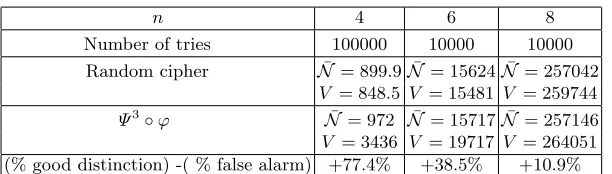
Computer simulations We made computer simulations for this attack in the following way: for all values (or almost all values) ofL, and all values ofR, we computeS, T. Then for alli, j such thatLi=Lj andRi< Rj, we add to a list the 3-tuple (Si⊕Sj, Ri, Rj). Finally we count how many collisions we have in this list. These simulations confirm our theoretical results (see Table 1).
Table 1.Simulation results
n 4 6 8
Number of tries 100000 10000 10000
Random cipher N¯ = 899.9 ¯N = 15624 ¯N = 257042
V = 848.5 V = 15481 V = 259744
Ψ3◦ϕ N¯ = 972 N¯ = 15717 ¯N = 257146
ϕ◦Ψ(f3)◦Ψ(f2)◦Ψ(f1) We have the following values: [L, R]−→[R, X1]−→
[X1, X2]−→[X2, X3]−→[S, T] withX1=L⊕f
1(R), X2=R⊕f2(X1), X3=
X1⊕f 3(X2),
S=A1.X2⊕A2.X3⊕c1andT =A3.X2⊕A4.X3⊕c2
CPA-1 with 2n messages. We choose only 2 values forL:L
1 andL2. Then, we choose approximately 2n values for R
i (i.e. almost all the possible values for Ri). Therefore we havem'2.2n messages. We count the numberN of (Ri, Rj)
values, Ri 6= Rj such that with the 4 following message: i : [L1, Ri], i0 : [L2, Ri] j : [L1, Rj], j0 : [L2, Rj], we haveSi⊕Sj⊕Si0 ⊕Sj0 = 0 andTi⊕ Tj⊕Ti0⊕Tj0 = 0. When we have an A-Feistel scheme, these two equalities may
happen at random with probability about 221n. But we may also have equalities
on the internal variables that imply the equalities on the outputs. The conditions on the inputs imply thatXi1⊕Xi10⊕Xj1⊕Xj10 = 0. Then we may haveXi1=Xj1⇔ Xi10 =Xj10 orXi1=Xj10 ⇔Xi10 =Xj1but we cannot haveXi1=Xi10 ⇔Xj1=Xj10
because this will implyL1=L2. Suppose that we haveXi1=Xj10 ⇔Xi10 =Xj1,
which happens with probability about 21n. Then we getX
2
i⊕X
2
i0⊕Xj2⊕Xj20= 0.
Now we can impose either X2
i =Xj2 ⇔Xi20 =Xj20 or Xi2 =Xj20 ⇔ Xi20 =Xj2,
but we cannot imposeX2
i =Xj20 since this will implyRi =Rj. Then we obtain X3
i⊕Xi30⊕Xj3⊕Xj30 = 0 and then the properties of the affine permutation will give
the required conditions on the outputs. If we impose X1
i = Xj1 ⇔Xi10 =Xj10,
then there are again two possibilities for equalities between Xi2, Xj2, Xi20, Xj20.
With a random permutation, the conditions on the outputs will only appear at random. Thus we getNperm' m
2
2.22n andNscheme'2.m
2
22n. This shows that when
m'2nwe can distinguish a random permutation from a permutation produced
by an A-Feistel scheme.
KPA with 232n messages. As usual, we can transform this CPA-1 into a KPA.
We count the numberN of (i, j, k, `) such that
Li =Lj
Lk =L`6=Li and
Ri=Rk
Rj=R`6=Ri and
Si⊕Sj⊕Sk⊕S`= 0
Ti⊕Tj⊕Tk⊕T`= 0
When we have a random permutation, E(Nperm) ' m
4
4·26n. With an A-Feistel
scheme, these equalities may happen at random or, as previously, because there are some conditions which can be satisfied by internal variables.
ThusE(Nscheme)' m
4
26n
We can distinguish a random permutation from a permutation produced by an A-Feistel scheme whenm'232n
Ψ(f3)◦Ψ(f2)◦ϕ◦Ψ(f1) or Ψ(f3)◦ϕ◦Ψ(f2)◦Ψ(f1). We explain the
attacks forΨ(f3)◦Ψ(f2)◦ϕ◦Ψ(f1). The other case is quite similar. The values are given by: [L, R] −→ [R, X1]−→ [P, Q] −→ [Q, X2] −→ [S, T], with X1 =
L⊕f1(R), P =A1.R⊕A2.X1⊕c1, Q=A3.R⊕A4.X1⊕c2, S=X2=P⊕f2(Q) andT =X3=Q⊕f
CPA-1 with2n2 messages Here, we choose only 2 values forL:L1andL2. Then,
we choose approximately 12.2n2 distinct values forRi. Therefore we can construct
aboutm '2n2 messages. We count the numberN of (Ri, Rj) values,Ri 6=Rj
such that with the 4 following messages:
i: [L1, Ri], i0: [L2, Ri] j: [L1, Rj], j0 : [L2, Rj] we haveSi⊕Sj⊕Si0⊕Sj0= 0. We obtainE(Nperm)' m
2
2·2n andE(Nscheme)' m2
2n. Thus when m ' 2 n
2, we can distinguish a random permutation from a
permutation generated by an A-Feistel scheme.
KPA1 with254n messages. The previous attack can be transformed into a KPA
with complexityO(254n): we count the numberN of (i, j, i0, j0) such that
Li=Lj
Li0 =Lj0 6=Li and
Ri=Ri0
Rj=Rj0 6=Ri andSi⊕Sj⊕Si
0⊕Sj0 = 0
We haveNperm ' m
4
25n andNscheme'2.m
4
25n for a A-Feistel permutation.
There-fore this KPA succeeds when m'254n.
3.4 One affine permutation and a Feistel scheme with four rounds
Ψ(f4)◦Ψ(f3)◦Ψ(f2)◦Ψ(f1)◦ϕ. Here we are going to attack generators of
permutations and not only a single permutation. Thus we want to distinguish a generator of random permutations from a generator of A-Feistel permutations. We suppose that we haveµ permutations. The values are given by: [L, R] −→ [P, Q] −→ [Q, X1] −→ [X1, X2] −→ [X2, X3] −→ [S, T]. After round 4, the output is given by [S, T] whereS =X3andT =X4=X2⊕f4(X3). Remind that
P =A1.L⊕A2.R⊕c1,Q=A3.L⊕A4.R⊕c2,X1=P⊕f1(P), X2=Q⊕f2(X1) and X3 = X1⊕f
3(X2). Again, we want to count the number N of (i, j, k, `) such that
Li=Lj
Lk =L`6=Li and
Ri=Rk
Rj =R`6=Ri andSi⊕Sj⊕Sk⊕S`= 0
When we have a random permutation, E(Nperm) ' µ m
4
4.25n and σ(Nperm) = O(√µm2
252n
). The computation of the standard deviation can be done as pre-viously. With an A-Feistel scheme, these equalities may happen at random or because there are some conditions that can be satisfied by internal variables. For example, we may have (other conditions are possible like (Qi =Q`, Xi1 = X1
j, Xi2=Xj2) or (Qi6=Q`, Xi1=Xj1, Xk1=X`1, Xi2=Xk2)):
Li=Lj
Lk=L`6=Li and
Ri=Rk
Rj =R`6=Ri and
Qi=Q` Xi1=Xj1 X2
Remark 4: It is not possible to have the same kind of conditions on suc-cessive variables. For example, it is not possible to have Qi = Q` and and X1
i = X`1, since this will imply Pi = P` and we obtain a contradiction since
we have permutations and [Li, Ri]6= [L`, R`]. This is why we set the conditions
Qi = Q`, X1
i = Xj1, Xi2 = Xk2. For a permutation produced be an A-Feistel
scheme, we obtainE(Nscheme)'µm
4
25n+O(µ
m4
27n) andσ(Nscheme) =O(
√
µm2
252n
). We can distinguish when µm4
27n ≥
√
µm2
252n
. If we take the maximum number of messages (i.e. 22n), we obtain µ= 2n and the number of needed computations
is given byλ=µ·2n= 23n.
ϕ◦Ψ(f4)◦Ψ(f3)◦Ψ(f2)◦Ψ(f1) We have the following values:
[L, R]−→[R, X1]−→[X1, X2]−→[X2, X3]−→[X3, X4]−→[S, T] withX1=L⊕f
1(R), X2=R⊕f2(X1), X3=X1⊕f3(X2), X4=X2⊕f4(X3),
S=A1.X3⊕A2.X4⊕c1andS=A3.X3⊕A4.X4⊕c2. We give here an attack which needs the maximal number of messages, i.e. 22n. We count the numberN
of (i, j, k, `) such that
Li =Lj
Lk =L`6=Li and
Ri=Rk
Rj=R`6=Ri and
Si⊕Sj⊕Sk⊕S`= 0 Ti⊕Tj⊕Tk⊕T`= 0
Here we haveE(Nperm)' m
4
4.26n,σ(Nperm) =O(m
2
23n) andE(Nscheme)' m
4
4.26n+
O(2m74n) and σ(Nscheme) =O(m
2
23n). We can distinguish when
m4
27n ≥
m2
23n. Thus
the attack succeeds when m'22n.
Ψ(f4)◦Ψ(f3)◦Ψ(f2)◦ϕ◦Ψ(f1) or Ψ(f4)◦Ψ(f3)◦ϕ◦Ψ(f2)◦Ψ(f1)
orΨ(f4)◦ϕ◦Ψ(f3)◦Ψ(f2)◦Ψ(f1). We only give the sketch of the attacks
forΨ(f4)◦Ψ(f3)◦Ψ(f2)◦ϕ◦Ψ(f1). The other cases are quite similar.
KPA with 274n messages. The values are given by: [L, R] −→ [R, X1] −→
[P, Q]−→[Q, X2]−→[X2, X3]−→[S, T], with X1 =L⊕f1(R), P =A1.R⊕
A2.X1⊕c1, Q=A3.R⊕A4.X1⊕c2, X2 =P⊕f2(Q),S =X3=Q⊕f3(X2) and T =X4 =X2⊕f4(X3). We want count the number N of (i, j, k, `) such that
Li=Lj
Lk =L`6=Li and
Ri=Rk
Rj =R`6=Ri andSi⊕Sj⊕Sk⊕S`= 0
When we have a random permutation, E(Nperm)' m
4
4.25n and we obtain from
computations similar to those permform in section A, thatσ(Nperm) =O(m
2
252n
). With an A-Feistel scheme, these equalitites may happen at random or because there are some conditions which can be satisfied by internal variables. For ex-ample, we may have the following conditions:
Li=Lj
Lk=L`6=Li and
Ri=Rk
Rj =R`6=Ri and
Thus, using the computations similar to those performed in Section B, we get we getE(Nscheme)' m
4
4.25n+O(
m4
26n) andσ(Nscheme) =O(m
2
252n
). We can distinguish an soon as the difference of the mean values is greater than both standard deviations, i.e. m4
26n ≤
m2
252n
. This means we must havem'274n.
CPA-1 with232n messages. The previous KPA can be transformed into a CPA-1.
We choose all the possible [L, R] such that the first n2 bits ofLare equal to 0. Therefore we have 2n2.2n = 232n possible inputs. We keep the same input and
output conditions. HereE(Nperm)' m
4
4·24n and σ(Nperm) = O(m
2
22n) since each
collision on L has probability about 1
2n/2. The computation of the variance is
similar to the computation done for the KPA. For an A-Feistel scheme, we get
E(Nscheme)' m
4
4·24n +O(
m4
4·25n) and σ(Nscheme) =O(m
2
22n). This shows that we
can distinguish a random permutation from an A-Feistel permutation as soon as m4
25n ≥
m2
22n. This gives a CPA-1 with
3n
2 messages.
3.5 Complexities of attacks on A-Feistel with one affine permutation
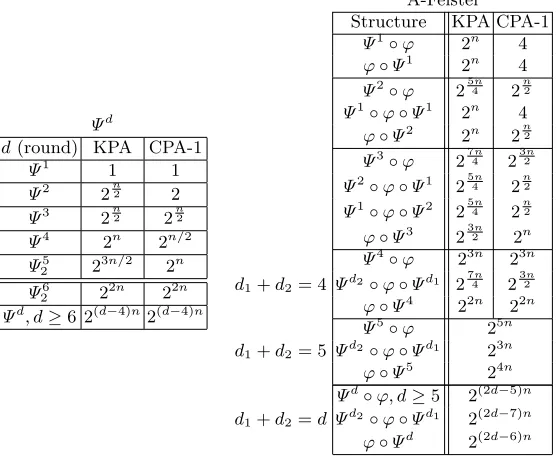
For the following rounds, we always have to add one more condition on the in-ternal variables and we perform the same computations. We need to alternate the conditions on the indices. The complexities of our attacks are summarized in Table 2 (A-Feistel). We also mention the results for classical Feistel schemes (Ψd, see [15]). As said before we only give the results for KPA and CPA-1. By symmetry, we obtain the corresponding complexities of a KCA and CCA-1: for example the complexity of KPA onΨ3◦ϕis the complexity of a KCA onϕ◦Ψ3
and so on. Ford≥5, we attack generators of permutations and not only a single permutation.
Remark 5:The attacks performed on classical Feistel schemes are 2-points at-tacks. These kind of attacks cannot be mounted in the case of A-Feistel schemes. There exist 4-points attacks on classical Feistel schemes for that achieve the same complexity as the attacks on Ψd2◦ϕ◦Ψd1 withd
1+d2= 4 (see [14]).
4
A-Feistel schemes with two affine permutations
This section is devoted to attacks on schemes for which we have first an affine permutation, then a Feistel schemes with several rounds, and finally an affine permutation. The attacks are very similar to the ones in section 3. We will give an overview of these attacks and provide the results. We give here a CPA-1 and a KPA when we apply first an affine function ϕ, then a Feistel scheme with 2 rounds and we finish with an affine permutationϕ0. We still suppose thatA3and
A4 are bijective. We have the following values: [L, R]−→[P, Q]−→[Q, X1]−→ [X1, X2] −→ [S, T], with P = A
1.L⊕A2.R⊕c1, Q = A3.L⊕A4.R ⊕c2,
X1=P⊕f
Table 2. Complexities of attacks on A-Feistel with one affine permutation and on classical Feistel schemesΨd.
Ψd
d(round) KPA CPA-1
Ψ1 1 1
Ψ2 2n2 2
Ψ3 2n2 2n2
Ψ4 2n 2n/2
Ψ25 23n/2 2n
Ψ26 22n 22n
Ψd, d≥6 2(d−4)n2(d−4)n
A-Feistel
Structure KPA CPA-1
Ψ1◦ϕ 2n 4
ϕ◦Ψ1 2n 4 Ψ2◦ϕ 254n 2n2
Ψ1◦ϕ◦Ψ1 2n 4
ϕ◦Ψ2 2n 2n2 Ψ3◦ϕ 274n 232n
Ψ2◦ϕ◦Ψ1 254n 2n2
Ψ1◦ϕ◦Ψ2 254n 2n2
ϕ◦Ψ3 232n 2n Ψ4◦ϕ 23n 23n
d1+d2= 4 Ψd2◦ϕ◦Ψd1 2 7n
4 232n
ϕ◦Ψ4 22n 22n
Ψ5◦ϕ 25n d1+d2= 5 Ψd2◦ϕ◦Ψd1 23n
ϕ◦Ψ5 24n
Ψd◦ϕ, d≥5 2(2d−5)n d1+d2=d Ψd2◦ϕ◦Ψd1 2(2d−7)n
ϕ◦Ψd 2(2d−6)n
For the CPA-1, we choose only 2 values forL:L1 andL2. Then, we choose ap-proximately 2n values forRi (i.e. almost all the possible values forRi).
There-fore we have m ' 2.2n messages. We count the numberN of (Ri, Rj) values, Ri 6=Rj such that with the 4 following message: i: [L1, Ri], i0 : [L2, Ri] j: [L1, Rj], j0 : [L2, Rj], we haveSi⊕Sj⊕Si0⊕Sj0= 0 andTi⊕Tj⊕Ti0⊕Tj0= 0.
Then, we obtain:E(Nperm)' m
2
2.22n andE(Nscheme)' m
2
22n. This shows that it
is possible to distinguish a random permutation from a permutation produced by an A-Feistel scheme with 2 affine permutations whenm'2n. As usual, this CPA-1 can be transform into a KPA with m'232n. The results of our attacks
(CPA-1 and KPA) are given in table 3. By symmetry, we also get the results for KCA and CCA-1. Ford≥4, we give the complexity of the attacks on generators of permutations and on a single permutation.
Table 3.Complexities of attacks on A-Feistel with two affine permutations
Structure KPA CPA-1
ϕ0◦Ψ1◦ϕ 254n 2n2
ϕ0◦Ψ2◦ϕ 232n 2n
ϕ0◦Ψ3◦ϕ 22n 22n
Remark.Another possibility would be to alternate affine permutation and Feis-tel scheme with one round. This does not secure the scheme. Indeed the diffu-sion is too slow. For example, we get the same complexities for Ψ3 ◦ϕ and
Ψ1◦ϕ◦Ψ1◦ϕ◦Ψ1◦ϕ. We have the same complexities for ϕ0 ◦Ψ2◦ϕ and
ϕ◦Ψ1◦ϕ◦Ψ1◦ϕas well.
5
Conclusion
By [18, 19] we know that A-Feistel schemes are secure against linear and dif-ferential attacks In this paper, we provided attacks on A-Feistel schemes using 4-tuples of cleartext/ciphertext messages. Our results on A-Feistel schemes are given in Tables 2 and 3. The simulations of our attacks given in Table 1 (sec-tion 3.4) confirm our theoretical analysis for the complexity of these attacks. The analysis of the attacks requires to study the standard deviations of random variables.
References
1. Eli Biham and Adi Shamir. Differential Cryptanalysis od DES-like Cryptosystems. In Alfred Menezes and Paulo Scott A. Vanstone, editors,Advances in Cryptology – CRYPTO 1990, volume 537 ofLecture Notes in Computer Science, pages 2–21. Springer-Verlag, 1991.
2. Eli Biham and Adi Shamir. Differential Cryptanalysis od DES-like Cryptosystems.
J. Cryptology, 4(1):3–72, 1991.
3. Henri Gilbert and Marine Minier. New Results on the Pseudorandomness of Some Blockcipher Constructions. In Mitsuru Matsui, editor, Fast Software Encrytion – FSE ’01, volume 2355 of Lecture Notes in Computer Science, pages 248–266. Springer-Verlag, 2001.
4. Paul G. Hoel, Sidney C. Port, and Charles J. Stone. Introduction to Probability Theory. Houghton Mifflin Company, 1971.
5. Charanjit S. Jutla. Generalized Birthday Attacks on Unbalanced Feistel Networks. In Hugo Krawczyk, editor,Advances in Cryptology – CRYPTO ’98, volume 1462 ofLecture Notes in Computer Science, pages 186–199. Springer-Verlag, 1998. 6. Lars R. Knudsen. DEAL - A 128-bit Block Cipher. Technical Report 151,
Univer-sity of Bergen, Department of Informatics, Norway, february 1998.
7. Michael Luby and Charles Rackoff. How to Construct Pseudorandom Permutations from Pseudorandom Functions. SIAM J. Comput., 17(2):373–386, 1988.
8. Stefan Lucks. Faster Luby-Rackoff Ciphers. In Dieter Gollman, editor,Fast Soft-ware Encryption – FSE ’96, volume 1039 of Lecture Notes in Computer Science, pages 189–203. Springer-Verlag, 1996.
9. Mitsuru Matsui. Linear Cryptanalysis Methods for DES Cipher. In Gerahard Goos and Juris Hartmanis, editors,Advances in Cryptology – EUROCRYPT 1993, volume 765 ofLecture Notes in Computer Science, pages 386–397. Springer-Verlag, 1994.
11. Val´erie Nachef, Jacques Patarin, and Joana Treger. Generic Attacks on Misty Schemes. In Michel Abdalla and Paulo S.L.M. Barretol, editors,Progress in Cryp-tology – LATINCRYPT 2010, volume 6212 ofLecture Notes in Computer Science, pages 222–240. Springer-Verlag, 2010.
12. Val´erie Nachef, Emmanuel Volte, and Jacques Patarin. Differential Attacks on Generalized Feistel schemes. In Michel Abdalla, Cristina Nita-Rotaru, and Ricardo Dahab, editors,CANS 2013, volume 8257 ofLecture Notes in Computer Science, pages 1–19. Springer-Verlag, 2013.
13. Moni Naor and Omer Reingold. On the Construction of Pseudorandom Permuta-tions: Luby-Rackoff Revisited. J. Cryptology, 12(1):29–66, 1999.
14. Jacques Patarin. Generic Attacks on Feistel Schemes. In Colin Boyd, editor,
Advances in Cryptology – ASIACRYPT 2001, volume 2248 of Lecture Notes in Computer Science, pages 222–238. Springer-Verlag, 2001.
15. Jacques Patarin, Val´erie Nachef, and Cˆome Berbain. Generic Attacks on Unbal-anced Feistel Schemes with Contracting Functions. In Xuejia Lai and Kefei Chen, editors,Advances in Cryptology – ASIACRYPT 2006, volume 4284 ofLecture Notes in Computer Science, pages 396–411. Springer-Verlag, 2006.
16. Bruce Schneier and John Kelsey. Unbalanced Feistel Networks and Block Cipher Design. In Dieter Gollmann, editor,Fast Software Encrytion – FSE ’96, volume 1039 ofLecture Notes in Computer Science, pages 121–144. Springer-Verlag, 1996. 17. Joana Treger and Jacques Patarin. Generic Attacks on Feistel Networks with Internal Permutations. In Bart Preneel, editor, Progresses in Cryptology – AFRICACRYPT ’09, Lecture Notes in Computer Science. Springer-Verlag, 2009. 18. Serge Vaudenay. Provable Security for Block Ciphers by Decorralation. In Michel
Movan, Chritoph Meinel, and Daniel Krob, editors,STACS 1998, volume 1373 of
Lecture Notes in Computer Science, pages 249–265. Springer-Verlag, 1998. 19. Serge Vaudenay. Decorrelation: A theory for block cipher security. J. Cryptology,
16(4):249–286, 2003.
20. Emmanuel Volte, Val´erie Nachef, and Jacques Patarin. Improved Generic Attacks on Unbalanced Feistel Schemes with Expanding Functions. In Masayuki Abe, editor,Advances in Cryptology – ASIACRYPT 2010, 2010.
A
Computation of the mean value and the variance for a
random permutation (attack on
Ψ
3◦
ϕ
)
In this section, we compute the mean value and the standard deviation for a random permutation. For 1≤i≤m, we choose randomly in{0,1}n, and with
a uniform distribution, variablesLi,Ri andSi. Then we want to compute then number Nperm of (i, j, k, `) such thati≤j, i≤kandi≤`and
Li=Lj
Lk=L`6=Li and
Ri=Rk 6=Ri
Rj =R` andSi⊕Sj⊕Sk⊕S`= 0
We introduce the following random variables:
δijk`= 1 ⇔
Li=Lj Lk=L`6=Li Ri=Rk Rj =R`6=Ri
andSi⊕Sj⊕Sk⊕S`= 0
Let D = {(i, j, k, `) pairwise distinct, i < j, i < k, i < `}. Then we have: Nperm =
X
(i,j,k,`)∈D δijk`.
A.1 Computation of the mean value
Since we have permutations, we assume that the inputs and the outputs are pairwise distinct. We computeE(δijk`). For [Li, Ri], there are 22n possibilities.
For [Lj, Rj], there are (2n−1) possibilities sinceLj is fixed andRj6=Ri. Now we
have Lk 6=Li andRk is fixed. Thus there are (2n−1) possibilities for [Lk, Rk]
and then [L`, T`] is fixed. The numbers of inputs satisfying the conditions is 22n.(2n−1)2. We count the number of distinct outputs [Si, Ti],[Sj, Tj],[Sk, Tk] and [S`, T`] such that Si⊕Sj⊕Sk⊕S`= 0. There are different cases:
Case 1:Si =Sj=Sk=S`. Then Ti, Tj, Tk, T` are pairwise distinct. There are 22n.(2n−1).(2n−2).(2n−3) possibilities for the outputs.
Case 2: Equalities of the form Si =Sj and Sk =S` 6=Si. We can also have Si = Sk and Sj = S` 6= Si or Si = S` and Sj = Sk 6= Si. The number of
possible pairwise distinct outputs is given by 3×22n(2n−1)(2n−1)2n.(2n−1) =
3×23n(2n−1)3.
Case 3:Si, Sj, Sk andS` are pairwise distinct. Here the numbers of outputs is
equal to 22n(2n−1)2n(2n−2)2n2n= 25n(2n−1)(2n−2).
The total numbers of possible distinct inputs and outputs is given by [22n(22n−
1)(22n−2)(22n−3)]2. Thus we obtain:
E(δijk`) =
24n(2n−3)3(24n+ 23n−5×22n−2×2n+ 6)
[22n(22n−1)(22n−2)(22n−3)]2 = 1
25n(1−
2 2n +
7 22n −
9 23n +
22 24n +O(
1 25n))
This gives:E(Nperm)'m(m−1)(4·m−25n2)(m−3)(1−
2 2n+
7 22n−
9 23n+
22 24n+O(
1 25n)).
A.2 Computation of the variance
We now compute the variance ofNperm. LetD={(i, j, k, `) pairwise distinct, i < j, i < k, i < `}. We apply the covariance formula:
V(Nperm) =
X
(i,j,k,`)∈D
V(δijk`) + X
(i,j,k,`)∈D
(p,q,r,s)∈D
(i,j,k,`)6=(p,q,r,s)
[E(δijk`δpqrs)−E(δijk`)E(δpqrs)]
We haveV(δijk`) =E(δijk`)−(E(δijk`))2. We have to study the term second part of the formula. FirstE(δijk`)E(δpqrs) =2101n(1−
4 2n+
18 22n−
46 23n+
129 24n+O(
1 25n)).
Then we computeE(δijk`δpqrs). There are several cases.
Case 1. In {i, j, k, `, p, q, r, s}, there are 8 pairwise distinct values. First, we study the different possibilities for the inputs. We have the following conditions:
Li =Lj, Ri =Rk, Lp=Lq, Rp=Rr
There are several sub-cases. 1. Equalities of the form:
Li=Lj =Lp=Lq, Ri =Rk, Rp=Rr6=Ri, Rj
Lk =L`=Lr=Ls6=Li, Rj =R`6=Ri, Rq=Rs6=Ri, Rj, Rp
There are 4 possibilities for this kind of equalities. The number of inputs satisfying these conditions is: 22n(2n−1)2(2n−2)(2n−3).
2. Equalities of the form:
Li =Lj=Lp=Lq, Ri=Rk, Rp =Rr6=Ri, Rj Lk =L`6=Li, Rj =R`6=Ri, Rq =Rs6=Ri, Rj, Rp Lr=Ls6=Li, Lk
There are 8 possibilities for this kind of equalities. The number of inputs satisfying these conditions is: 22n(2n−1)2(2n−2)2(2n−3).
3. There is no relations between the inputs indexed by i, j, k, `and the inputs indexed byp, q, r, s. In that case, the number of inputs is 22n(2n−1)2(2n−
2)2(2n−3)2.
Finally, the total number of inputs in given by: 22n(2n−1)2(2n−2)(2n−3)(22n+
3×2n−6).
We now study the conditions on the outputs:
Si⊕Sj⊕Sk⊕S`= 0, Sp⊕Sq⊕Sr⊕Ss= 0
We have to consider several possibilities:
1. Relations of the form Si⊕Sj =Sk⊕S`=Sp⊕Sq =Sr⊕Ss. There are 9 ways to obtain such relations.
When we have these conditions, several sub-cases appear. We represent in Figure 1 the indicesi, j, k, `, p, q, r, s in order to explain the relations that may appear between the outputs.
Fig. 1.Representation of the indices
i k p r
j ` q s
(a) Si =Sj =Sk =S` =Sp =Sq =Sr =Ss. There are 22n(2n−1)(2n− 2)(2n−3)(2n−4)(2n−5)(2n−6)(2n−7) outputs satisfying these
con-ditions.
(b) As represented in Figure 2, we may have 4 vertical equalities and one horizontal equality which implies another horizontal equality (dotted line):
Fig. 2.4 vertical equalities and one horizontal equality
i k p r
j ` q s
(c) We only have vertical equalities. The number of outputs is: 25n(2n− 1)5(2n−2)(2n−3).
(d) As shown in Figure 3, we may have 4 vertical equalities and 4 horizontal equalities. There are 4 ways to get this kind of relations. The number of
Fig. 3.4 vertical equalities and 4 horizontal equalities
i k p r
j ` q s
outputs is: 4×23n(2n−1)3(2n−2)(2n−3)(2n−4)(2n−5).
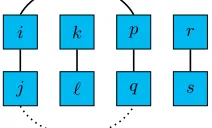
(e) Another possibility is to have two distinct groups with two vertical and horizontal equalities as shown in Figure 4. There are 6 such combinations. The number of outputs is 6×23n(2n−2)3(2n−2)2(2n−3)2.
Fig. 4.Two distinct groups with two vertical and horizontal equalities
i k p r
j ` q s
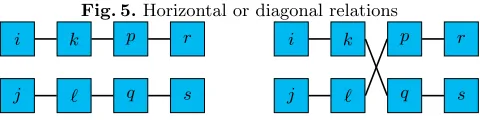
(f) Here we only have horizontal or diagonal relations as shown below (Fig-ure 5). There are 8 possibilities. Then the number of outputs is given by: 8×23n(2n−2)3(2n−2)2(2n−3)2.
(g) We have two horizontal or diagonal equalities. There are 16 possibilities and the number of out puts is 16×25n(2n−5)3(2n−2)3.
(h) We only have one horizontal or diagonal relation. There are 12 possibil-ities and the number of outputs is 12×27n(2n−1)3(2n−2)(2n−4).
(i) We do not have any relation. The number of outputs is given by 29n(2n−
Fig. 5.Horizontal or diagonal relations
i k p r
j ` q s
i k p r
j ` q s
2. No relations of the formSi⊕Sj =Sp⊕Sq. Again we need to consider several
sub-cases.
(a) We haveSi=Sj =Sk =S` andSp, Sq, Sr, Ssare pairwise distinct. We
may also exchange the roles of the indices. First there is a link between the blocks of indices (i, j, k, `) and (p, q, r, s). For example, we haveSi= Sj = Sk = S` = Sp. There are 4 possible links. Or there is no link between the blocks. The number of outputs is given by 8×25n(2n−
1)2(2n−2)2(2n−3)(2n−4) + 2×26n(2n−1)2(2n−2)2(2n−3)(2n−4).
(b) We have for example Si = Sj and Sk =S` 6=Si and Sp, Sq, Sr, Ss are
pairwise distinct. Again we may have a link between the two blocks of indices or we may have no link. There are three ways to choose the relations between Si, Sj, Sk and Sl and we can also exchange the roles
of the indices. The number of outputs is given by 48×26n(2n−1)3(2n−
2)2(2n−4) + 6×27n(2n−1)3(2n−2)(2n−3)(2n−4)(2n−8).
(c) Si, Sj, Sk, S` andSp, Sq, Sr, Ssare pairwise distinct and we may have or not a link between the blocks of indices. We obtain here 16×28n(2n−
1)2(2n−2)(2n−4)(2n−8) + 29n(2n−1)(2n−2)(2n−4)(2n−8)(2n−16).
We now multiply the number of inputs and outputs we have obtained and we divide by the total number of pairwise distinct inputs and outputs and finally we get:
E(δijk`δpqrs) =
1 210n(1−
4 2n +
48 22n −
346 23n +
1265 24n +O(
1 25n))
Thus in E(δijk`δpqrs)−E(δijk`)E(δpqrs), the dominant term is inO(2121n) and
whenm'274n, we will have m 4
25n '
m8
212n.
Case 2. In {i, j, k, `, p, q, r, s}, there are 7 pairwise distinct values. We may assume for example that i=p(there are 16 possibilities of equalities between the indices). We have the following relations:
Li=Lj=Lq, Ri=Rk=Rr, Si⊕Sj⊕Sk⊕S`= 0 Lk=L`6=Li, Rj=R`6=Ri, Si⊕Sq⊕Sr⊕Ss= 0 Lr=Ls6=Li, Rq=Rs6=Ri,
The number of inputs is given by 23n(2n−1)2(2n−2). There are several cases for the outputs.
1. We have relations of the typeSi⊕Sj=Sk⊕S`=Si⊕Sq =Sr⊕Ss. Thus is
(a) We have Si=Si =Sk =S`=Sq =Sr=Ss. The number of outputs is
22n(2n−1)(2n−2)(2n−3)(2n−4)(2n−5)(2n−5).
(b) We suppose we have vertical equalities. This will imply the dotted equal-ities (see Figure 6). Here we consider that we have 3 different blocks and
Fig. 6.Vertical equalities
r i k
s q j `
we study the possible links between the blocks. We can either one link or no link. We notice that if we have two links, then the values are equal. There are 2 cases where we have the link between a vertical line and a triangle and on case where we have a link between two vertical lines. The number of outputs is given by 2×23n(2n−1)3(2n−2)(2n−3)(2n−
4) + 23n(2n−1)3(2n−2)2(3n−3). We may also have no link between the
blocks and in that case the number of outputs is 24n(2n−1)4(2n−2)2. (c) We now suppose that we do not have vertical equalities and we study the possibility to horizontal or diagonal links. First we can have two horizon-tal or diagonal equalities as shown in Figure 7. There are 4 possibilities
Fig. 7.Two horizontal or diagonal equalities
r i k
s q j `
r i k
s q j `
of equalities and the number of outputs is given by 4×23n(2n−1)3(2n−
2)2(2n−4).
(d) We may also have one horizontal or diagonal equality. There are 2× 25n(2n−1)3(2n−2)2+ 25n(2n−1)4(2n−2) possible outputs.
(e) There are no equalities. This gives 27n(2n−1)2(2n−2)(2n−4) outputs.
2. We do not have any relations of the typeSi⊕Sj=Sk⊕S`=Si⊕Sq =Sr⊕Ss. Again, we consider the 2 blocks of indices (i, j, k, `) and (i, q, r, s) and we proceed as in the case where we had 8 different indices. The number of outputs is given by 2×25n(2n−1)2(2n−2)2(2n−3) + 6×26n(2n−1)3(2n− 2)(2n−4) + 28n(2n−1)(2n−2)(2n−4)(2n−8).
we get:
E(δijk`δpqrs) = 1 210n(1−
4 2n +
36 22n −
62 23n −
128 24n +O(
1 25n))
Thus inE(δijk`δpqrs)−E(δijk`)E(δpqrs), the dominant term is in O(2121n). We
have 2m127n
m4
25n.
Case 3. In {i, j, k, `, p, q, r, s}, there are 6 pairwise distinct values. Due to the conditions on the inputs, there are relations between the indices that are not allowed. For example, it is not possible to havei=qandj=rsince this implies that Li =Ls and Ri =Rs. This is not possible since the inputs are pairwise distinct and i6=s. We examined all the possible combinations and it turns out that there is 16 possibilities to choose the relation between the two 4-tuples of indices (i, j, k, `) and (p, q, r, s). We have to link either vertical relations or horizontal relations but no diagonal relations. For example, we suppose that
i=pandj=q. Then we have the conditions:
Li=Lj, Ri=Rk =Rr,
Lk =L`6=Li, Rj=R`=Rs6=Ri,
Lr=Ls, Si⊕Sj =Sk⊕S`=Sr⊕Ss,
The number of inputs is given by 22n(2n−1)2(2n−2). In order to compute the number of outputs, we proceed as in the cases with 8 or 7 indices. We consider the different kind of equalities that may occur between Si, Sj, Sk, S`, Sr, Ss. We obtain that the number of outputs is given by
22n(2n−1)(2n−2)(2n−3)(2n−4) + 3×23n(2n−1)2(2n−2)2(2n−3)+
24n(2n−1)4(2n−2) + 4×23n(2n−1)3(2n−2)2+ 6×25n(2n−1)2(2n−2)2+ 27n(2n−2)(2n−2)(2n−4)
We now multiply the number of inputs and outputs we have obtained and we divide by the total number of pairwise distinct inputs and outputs and finally we get:
E(δijk`δpqrs) = 1 29n(1−
4 2n +
14 22n −
1 23n −
162 24n +O(
1 25n))
Thus in E(δijk`δpqrs)−E(δijk`)E(δpqrs), the dominant term is in O(219n). We
have 2m9n6
m4
25n sincem2
2n in this attack.
The conditions on the inputs do not allow to have 5 pairwise distinct indices in {i, j, k, `, p, q, r, s}.
The previous computations show that V(Nperm) =O(m
4
25n) +O(
m6
29n) It is easy
to check that the dominant term is m4
25n as soon as m≤2
2n and then we obtain
that σ(Nperm)' m
2
252n
.
behave like the mean value. In the previous computation, if we do not include the condition onS, but we only keep the conditions onLandR, we obtain
E(Nperm)'
m(m−1)(m−2)(m−3)
4·24n andV(Nperm) =O( m6 27n) +O(
m4 24n)
Here whenm≥232n, the dominant term inV(Nperm) is m 6
27n and not
m4
24n.
B
Computation of the mean value and the variance for a
Ψ
3◦
ϕ
permutation
Here we compute the mean value and the standard deviation for an A-Feistel permutation. With an A-Feistel scheme, the equalities that we want to be sat-isfied may happen at random or because there are some conditions which are verified by the internal variables. We still want to have:
Li=Lj
Lk =L`6=Li and
Ri=Rk
Rj =R`6=Ri andSi⊕Sj⊕Sk⊕S`= 0
B.1 Computation of the mean value
Here we haveSi⊕Sj⊕Sk⊕S`=Qi⊕Qj⊕Qk⊕Q`⊕f2(Xi1)⊕f2(Xj1)⊕f2(Xk1)⊕ f2(X`1). SinceQi⊕Qj⊕Qk⊕Q`= 0 (by the conditions on the input variables),
we getSi⊕Sj⊕Sk⊕S`= 0⇔f2(Xi1)⊕f2(Xj1)⊕f2(Xk1)⊕f2(X`1) (∗). Thus
this may happen at random, or due to conditions satisfied by internal variables.
A3 and A4 are bijective As stated in Proposition 1, the conditions that
may appear on the internal variables depend on the properties of the kernels ofA3and A4. Here we suppose thatA3 andA4 are bijective. We want to have
f2(Xj1)⊕f2(Xk1)⊕f2(X`1) = 0. In our attacks, we use the difference between the
mean value obtained when we have a random permutation and the one obtained with a scheme. Thus we will compute the first terms of the mean value. We now look at the conditions on the internal variables that will imply (∗):
1. Equalities on the Qvariables. Since A3 andA4 are bijective, the only pos-sibility is Qi = Q` ⇔ Qj = Qk. This happens with probability 21n. This
impliesX1
i ⊕Xj1⊕Xk1⊕X`1= 0. The we may haveXi1=Xk1⇔Xk1=X`1.
The probability is 21n. it is also possible to have Xi1 =Xk1 ⇔Xj1=X`1but
it is not possible to have Xi1 =X`1 since this implies Pi =P`. Remember thatQi=Q` and we have an affine permutation. Then we multiply by the probability ofQi=Q`. The probability in this case is 222n.
2. We now suppose that Qi 6= Q` ⇔ Qj 6= Qk. We want to have f2(Xi1)⊕ f2(Xj1)⊕f2(Xk1)⊕f2(X`1). Then we can get (∗) if we have X
1
i =Xj1 and X1
k = X`1 or Xi1 = Xk1 and Xj1 = X`1 or Xi1 = X`1 and Xj1 = Xk1. The
probability in that case is given by 3×(1− 1 2n)×
3. We are not in the previous case and we have the (∗). Here the probability is (1− 2
22n−3(1−
1 2n)
1 22n)
1 2n =
1 2n −
5 23n−
3 24n.
Thus the probability to get (∗) is 1 2n +
5 22n −
8 23n −
3
24n. In order to compute
the mean value, we have consider the conditions on the inputs. The probabil-ity that the inputs satisfy the conditions is 214n(1−
2 2n +
13 22n −
24 23n +
98 24n +
O(215n). Thus we getE(δijk`) =
1 25n(1 +
3 2n −
5 22n+O(
1
23n)) andE(Nscheme)' m(m−1)(m−2)(m−3)
4·25n (1 +
3 2n −
5 22n+O(
1 23n)).
A3 is bijective and A4 is not bijective. The case whereA3 in not bijective and A4 is bijective is similar. If A4 is not bijective, we can have Qi = Qj, since this is equivalent to have Ri⊕Rj ∈ ker(A4) whose probability is about
1
2n−t where t = dim(ker(A4)). Moreover, when we have Qi =Qj then we get
X1
i⊕Xj1⊕Xk1⊕X
1
` = 0 and we obtain (∗) by settingX
1
i =Xk1orX
1
i =X`1. The
conditions on the inputs do not change. Here, we obtainE(δijk`) = 215n(1+
2 2n−t+
3 2n+O(
1
22n−t)) andE(Nscheme)'
m(m−1)(m−2)(m−3) 4·25n (1 +
2 2n−t+
3 2n+O(
1 22n−t)).
In that case, the difference of the mean values (for a random permutation and for a scheme) is 2n2−t. Thus ift >0 then the attack will be better that the attack
in the case whereA3 andA4 are bijective.
A3and A4are not bijective. SinceA3is not bijective, we can haveQi=Qk.
This is equivalent toLi⊕Lk ∈ker(A3) and the probability is about 2n1−t0 where
t0= dim(ker(A3)). We proceed as previously and we obtainE(δijk`) = 251n(1 +
2 2n−t +
2
2n−t0 +23n +O(
1
22n−max(t0,t))) and E(Nscheme)'
m(m−1)(m−2)(m−3) 4·25n (1 +
2 2n−t +
2 2n−t0 +
3 2n +O(
1
22n−max(t,t0))). The difference of the mean values (for a
random permutation and for a scheme) is min(2n2−t,
2 2n−t0).
B.2 Computation of the variance
A3 and A4 are bijective Here E(δijk`)E(δpqrs) = 2101n(1 +
6 2n −
1 22n +
O(213n)). Now, in order to compute the variance, the main issue is to know
the value of E(δijk`δpqrs). Again, we have to consider several cases. Our aim is to show that the variance behaves like the mean value. For example, when in {i, j, k, `, p, q, r, s} we have 8 pairwise distinct values, we want the dominant term inE(δijk`δpqrs)−E(δijk`)E(δpqrs) to be smaller than 2m54n. This shows that
we must not have terms in 2m108n and in
m8
211n. We have to look carefully on the
first two terms ofE(δijk`δpqrs)−E(δijk`)E(δpqrs).
Case 1.In{i, j, k, `, p, q, r, s}, there are 8 pairwise distinct values. We are look-ing for the terms in m8
210n and in
m8
211n when computingE(δijk`δpqrs). We still have
the following conditions on the inputs:
Li =Lj, Ri =Rk, Lp=Lq, Rp=Rr
Then we add
f2(Xi1)⊕f2(Xj1)⊕f2(Xk1)⊕f2(X`1) = 0 (5) f2(Xp1)⊕f2(Xq1)⊕f2(Xr1)⊕f2(Xs1) = 0 (6)
In order to get the first two terms of E(δijk`δpqrs), we have to consider the following cases:
1. (Qi=Q` andX1
i =Xj1) or (Qi =Q` andXi1=Xk1) and there is no
condi-tion on the internal variablesQp, Qq, Qr, Qs, Xp1, Xq1, Xr1, Xs1 except (6). In
that case, the probability is given by 2 22n(1−
5 22n −
3 23n)
1
2n. Since there is
also a symmetry ini, j, k, `andp, q, r, s, we obtain 4 23n(1−
5 22n−
3 23n).
2. Here we have Qi 6=Q`, ( X1
i =Xj1 and Xk1 =X`1) or (Xi1=Xk1 andXj1= X`1) or (Xi1 =X`1 andXj1=Xk1) and there is no condition on the internal variables Qp, Qq, Qr, Qs, Xp1, Xq1, Xr1, Xs1 except (6). Again there is also a
symmetry ini, j, k, `andp, q, r, s. The probability is 236n(1−
1 2n)(1−
5 22n−
3 23n).
3. We do not have any conditions on Qi, Qj, Qk, Q`, X1
i, Xj1, Xk1, X`1 and Qp, Qq, Qr, Qs, Xp1, Xq1, Xr1, Xs1 but we have (5) and (6). In that case, the
probability is (1− 10 23n −
50 25n+
18 27n)
2 1 22n.
Thus the probability to get (5) and (6) is 212n(1 +
10 2n−
60 23n +O(
1
24n)). In order
to compute the mean value, we have consider the conditions on the inputs. The probability on the inputs is given by
22n(2n−1)2(2n−2)(2n−3)(22n+ 3×2n−6)
22n(22n−1)(22n−2)(22n−3)(22n−4)(22n−5)(22n−6)(22n−7)
The computation gives: 212n(1−
4 2n+
18 22n−
36 23n+0(
1
24n)) Thus we getE(δijk`δpqrs) =
1 210n(1 +
6 2n−
22 22n+O(
1
23n)). In that case, the dominant term inE(δijk`δpqrs)−
E(δijk`)E(δpqrs), is inO(2121n) and when m'2
7n
4 , we will have m 4
25n '
m8
212n. In
that case, we haveV(δijk`) =O(251n).
Remark 1: There are other possibilities on the internal variables in order to get (5) and (6), but they involve too many equations and this is not useful since we are interested in finding the two first terms. For example, it is possible to have no conditions on Qi, Qj, Qk, Q`, Qp, Qq, Qr, Qs, but Xi = Xj, Xk = X`
and (X1
i, Xj1, Xk1, X
1
`) = (X
1
p, Xq1, Xr1, Xs1).
Case 2.In{i, j, k, `, p, q, r, s}, there are 7 pairwise distinct values. We may as-sume for example thati=p(there are 16 possibilities of equalities between the indices). We have the following relations:
Li=Lj=Lq, Ri=Rk=Rr, f2(Xi1)⊕f2(Xj1)⊕f2(Xk1)⊕f2(X`1) = 0 Lk=L`6=Li, Rj=R`6=Ri, f2(Xi1)⊕f2(Xq1)⊕f2(Xr1)⊕f2(Xs1) = 0 Lr=Ls6=Li, Rq=Rs6=Ri,
The number of inputs is given by 23n(2n−1)2(2n−2).
In that case, we just have to check that there is no term in2101n inE(δijk`δpqrs)−
1
210n appears when there is no relations between the internal variables. Thus the
dominant term inE(δijk`δpqrs)−E(δijk`)E(δpqrs), is inO(2111n) andV(δijk`) = O(215n).
Case 3.In{i, j, k, `, p, q, r, s}, there are 6 pairwise distinct values. The dominant term inE(δijk`δpqrs)−E(δijk`)E(δpqrs) is inO(261n).
Finally, from Cases 1,2 and 3, we haveV(Nscheme) =O(m
4
25n) +O(
m6
29n) and when
m≤274n, we haveV(Nscheme) =O(m 4
25n). Then the difference of the mean values
will be greater than the standard deviations and again the attack succeeds.
A3 is bijective andA4is not bijective. Here we are interested in obtaining
the first three terms ofE(δijk`δpqrs), i.e the terms in 2101n+
1 211n−t+
1
211n. We will
show that the dominant term inE(δijk`δpqrs)−E(δijk`)E(δpqrs) is inO(212n1−2t).
Thus if m '27n−42t, we will get that the variance behave like the mean value
and the attack will succeed if the difference of the mean value is greater than both standard deviation. This will be the case ifm=O(27n−42t). In order to get
this result, we proceed as in the case where A3 and A4 are bijective. When in {i, j, k, `, p, q, r, s}, there are 8 pairwise distinct values, we study the conditions in the internal variables in order to get (5) and (6). Again we take into account the cases that do not involve too many equations. We consider the same possibilities as in the previous case. The probability to get (5) and (6) is 212n(1 +
4 2n−t+
10 2n+
O(22n1−2t)). In order to compute the mean value, we have consider the conditions
on the inputs. We obtainE(δijk`δpqrs) = 2101n(1 +
4 2n−t+
6 2n+O(
1
22n−2t)). In that
case, the dominant term inE(δijk`δpqrs)−E(δijk`)E(δpqrs), is inO(212n1−2t) and
whenm'27n−42t, we will have m 4
25n '
m8
212n−2t. When in{i, j, k, `, p, q, r, s}, there
are 7 or 6 pairwise distinct values, the computations are similar. Finally, when
m ' 27n4−2t, we obtain and V(Nscheme = O(m 4
25n). Then the difference of the
mean values will be greater than the standard deviations and again the attack succeeds.
A3 and A4 are not bijective. The computations are very similar to those
performed previously. We just have to add the possibility to get the equal-ity Qk = Q`. Then we obtain E(δijk`δpqrs) = 2101n(1 +
4 2n−t +
4
2n−t0 + 26n +
O(min(22n1−2t,
1
22n−2t0))). Whenm 'min(2 7n−2t
4 2 7n−2t0
4 ), the dominant term in
the variance will be in 2m5n4. Then the difference of the mean values will be greater
than the standard deviations and again the attack succeeds.