Securely Sharing Of Data with Others in Cloud
Storage Using Public–Key Cryptosystem
R.S.Bhalerao 1, S.M.Rokade 2,
1
M.E. Student Of Computer,pune 2Associat Professor SVIT, Nashik
Abstract
—
Cloud storage could be a storage of information on-line in cloud that is accessible from multiple and connected resources. Cloud storage will offer smart accessibility and reliability, sturdy protection, disaster recovery, and lowest price. Cloud storage having vital practicality i.e. securely, with efficiency, flexibly sharing information with others. New public–key cryptography that is named as Key-aggregate cryptosystem (KAC) is introduced. Key-aggregate cryptosystem turn out constant size ciphertexts specified economical delegation of decoding rights for any set of ciphertext area unit attainable. Any set of secret keys are often mass and create them as single key, that encompasses power of all the keys being mass. This combination key are often sent to the others for decoding of ciphertext set and remaining encrypted files outside the set area unit remains confidential..Keywords— Cloud storage, data sharing, key-aggregate
encryption, Public Key Encryption.
I. INTRODUCTION
New computing paradigms keep rising. One notable example is that the cloud computing paradigm, a replacement economic computing model created attainable by the advances in networking technology, wherever a consumer will leverage a service provider’s computing, storage or networking infrastructure. With the unprecedented exponential rate of information, there's Associate in nursing increasing demand for outsourcing information storage to cloud services like Microsoft’s Azure and Amazon’s S3 they assist within the strategic management of company information. storing information remotely to the cloud in an exceedingly versatile on-demand manner brings appealing benefits: relief of the burden for storage management, universal information access with freelance geographical locations, and avoidance of value on hardware, software, and personnel maintenances etc .although the infrastructures at a lower place the cloud unit of measurement far more powerful and reliable than personal computing devices, they're still facing the broad vary of every internal and external threats for information integrity. Samples of outages and security breaches of noteworthy cloud services appear from time to time. Secondly, there do exist various motivations for CSP (cloud service provider) to behave unfaithfully towards the cloud users regarding the standing of their outsourced information. As examples, CSP may reclaim storage for monetary reasons by discarding information that has not been or isn't accessed, or even hide information.
Considering information privacy, by the traditional means that it completely depends upon the server to produce the access management alone once
can expose all information. As a result of its shared atmosphere, things become worst. As information is access from any virtual machines (VMS) but it resides on one physical machine. Information in an exceedingly target VM is also taken by instantiating another VM co-resident with the target one. Commonly in study schemes, TPA will check the supply of information on behalf of owner but cloud server doesn't trust TPA. So we've an inclination to follow vary hypothetical approach for good security .users is required to cipher their own information by using their own key before uploading. Information sharing is Associate in nursing crucial usefulness in cloud storage. Sharing encrypted information effectively is form of tough task. Clearly user will transfer encrypted information and decode them, and share with others; however approach violates worth of cloud storage. Finding Associate in Nursing economical and secure thanks to share partial information in cloud storage isn't trivial.
Consider Associate in nursing example of 2 military camps. Assume that military camp A is willing to share space maps with military camp B. however because of varied information run chance they can't expose maps to everybody. that the camp A encrypts all the map victimisation her own keys before uploading. And send key firmly to the camp B however this might cause drawback that they share all the photos.
• camp A encrypts all files with one cryptography key and provides camp B the corresponding secret key directly. • Camp A encrypts files with distinct keys and sends camp B the corresponding secret keys
So, if we have a tendency to look at the start methodology, it s not acceptable since all various maps would possibly data put together belies conjointly} also leaked to camp B. For the second methodology, there are unit smart concerns on efficiency. For having distinct key cryptography sends should send multiple keys. Transferring is completed through secure channel and storing of keys desires secure storage. Succeeding worth and quality can increase.
be camp A encrypts the map with distinct key but sends alone single cryptography key that's of Constant size. Since the cryptography key need to be sent via a secure channel and unbroken secret, little key size is typically fascinating. For example, we have a tendency to tend to cannot expect large storage for cryptography keys among the resource-constraint devices like sensible cards. Especially, these secret keys a typically hold on among the tamper-proof memory, that's relatively valuable. The present analysis efforts manly target minimizing communication refulgent like aggregate sign.
II. REVIEW OF LITERATURE
In [3] V. Goyal, O. Pandey, A. Sahai, and B. Waters develop a brand new cryptosystem for fine-grained sharing of encrypted information that we tend to decision Key-Policy Attribute-Based secret writing (KP-ABE). In our cryptosystem, ciphertexts area unit labelled with sets of attributes and personal keys area unit related to access structures that management that ciphertexts a user is ready to decode. In AN ABE system, a user s keys and ciphertexts area unit labelled with sets of descriptive attributes and a selected key will decode a selected ciphertext providing there s a match between the attributes of the ciphertext and therefore the user s key. The cryptosystem allowed for cryptography once a minimum of k attributes overlapped between a ciphertext and a non-public key. Whereas this primitive was shown to be helpful for error-tolerant encryption with biometrics.
In this system every ciphertext is labelled by the encryptor with a group of descriptive attributes. Every nonpublic secret is related to AN access structure that species which sort of ciphertexts the key will decode. We tend to decision such a theme a Key-Policy Attribute-Based secret writing (KP-ABE), since the access structure is per the non-publickey, whereas the ciphertexts area unit merely labelled with a group of descriptive attributes.
In [4] M. J. Atallah, M. Blanton addresses the matter of access management and, a lot of specifically, the key management drawback in AN access hierarchy. Informally, the overall model is that there s a group of access categories ordered mistreatment partial order. A user UN agency obtains access (i.e., a key) to an explicit category also can acquire access to any or all descendant categories of her category through key derivation. Our answer to the higher than drawback has the subsequent properties:
I) solely hash functions area unit used for a node to derive a descendant’s key from its own key.
II) The house complexness of the general public info is that the same as that of storing the hierarchy.
III) The private information at a class consists of a single key associated with that class.
IV) Updates (revocations, additions, etc.) are handled locally in the hierarchy
V) The scheme is provably secure against collusion; and VI) Key derivation by a node of its descendant’s key is bounded by the number of bit operations linear in the length of the path between the nodes. This is the first that satisfies all of them.
In [5] attempt to alleviate the issue of constructing a safe and protected system of cloud storage which supports active and even capricious users and data province The abovementioned advantageous and sought-after attributes & properties is not offered by the prior system as it is based on certain constructions. Significance is of the fact that, dynamic user is unsupported. The use of public cloud infrastructure introduces significant security and privacy risks. Techniques for data encryption can be used when there is a case of sensitive or susceptible data. It is needless for the cloud client attempting to implement data control to let the cloud server know the identity or information of the users. Actually, anonymity is a desirable feature for many web or collaborative applications. In some measure, the manner and extent to which there is such interactive exchanges on the web is due to the somewhat false perception of a sense of anonymity.
The drawback can be that ideal and flawless privileges of secrecy and anonymity might be abused by users with the wrong intentions. This illustrates the equal necessity to hold up data attribution, particularly, to keep stringent and accurate records of the personnel performing any operation on the data stored in a cloud. The given four aspects inspect the restrained problems involved in the relations and dealings of these two cryptographic primitives as well as add to the research of safe cloud storage systems:
1. Survey of Cryptographic Toolkits and a Generic System Design
2. Revocation in Group Signatures 3. Dynamic Broadcast Encryption
4. Linkage between Group Signatures and Broadcast Encryption.
In [6] D. Boneh constructs an efficient aggregate signature from a recent short signature scheme. Aggregate signatures are useful for reducing the size of corticated chains (by aggregating all signatures in the chain) and for reducing message size in secure routing protocols such as SBGP. We also show that aggregate signatures give rise to variably encrypted signatures. Such signatures enable the viewer to test that a given cipher text C is the encryption of a signature on a given message M.
There should be no extra and unnecessary demands from the third party auditor, for instance the demand for the data’s local copy, and thus in turn, it shouldn’t unnecessarily hinder the user. The third party auditing process should bring in no new vulnerabilities towards user’s data privacy. As previously stated, our unique grouping and integration of the public key based HLA along with random masking, results in the secure and privacy-protecting data auditing system in cloud
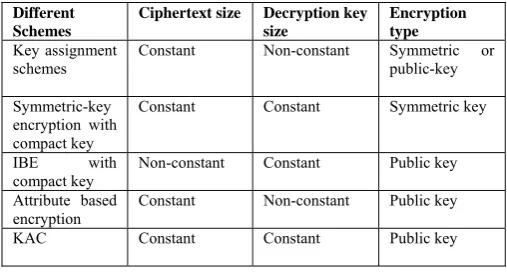
Different Schemes
Ciphertext size Decryption key size
Encryption type
Key assignment schemes
Constant Non-constant Symmetric or public-key
Symmetric-key encryption with compact key
Constant Constant Symmetric key
IBE with compact key
Non-constant Constant Public key
Attribute based encryption
Constant Non-constant Public key
KAC Constant Constant Public key
Table. 1. Comparison between KAC scheme and other related scheme
III.PROPOSED METHOD
A. Framework
n key-aggregate cryptosystem (KAC), users inscribe a message not solely below a public-key, however conjointly below associate degree symbol of ciphertext referred to as category. Which means the ciphertexts square measure more classified into completely different categories. The key owner holds a master-secret referred to as master-secret key, which may be wont to extract secret keys for various categories. Additional significantly, the extracted key have may be associate degree mixture key that is as compact as a secret key for one category, however aggregates the facility of the many such keys, i.e., the decipherment power for any set of ciphertext categories.With our example, Alice will send Bob one mixture key through a secure e-mail. Bob will transfer the encrypted photos from Alice’s Box.com area and so use this mixture key to rewrite this encrypted knowledge. The sizes of ciphertext, public-key, master-secret key and mixture key in KAC schemes square measure all of constant size. the general public system parameter has size linear within the range of ciphertext categories, however solely atiny low a part of it's required when and it may be fetched on demand from massive (but non-confidential) cloud storage.
B. Algorithm
1. Setup (1λ, n): The data owner establishes public system parameter via Setup. On input of a security level parameter 1λand number of ciphertext class’s n, it outputs the public
system parameter param
2. KeyGen: it is for generation of public or master key secret pair.
3. Encrypt (pk, i, m):It is executed by data owner and for message m and index i, it computes the ciphertext as C.
4. Extract (msk, S): It is executed by data owner for delegating the decrypting power for a certain set of ciphertext classes and it outputs the aggregate key for set S denoted by Ks.
5. Decrypt (Ks,S,i,C): When an appointee receives an aggregate key Ks as exhibited by the previous step, it can execute Decrypt. The decrypted original message m is displayed on entering Ks, S, i, and C, if and only if I belongs to the set S.
Fig 1.Proposed KAC for data sharing in cloud storage system
IV.RESULT AND DISCUSSION
then be imperviable, or at the foremost proof against outpouring at the aspect of economical key appointing, will confirm that one can transport same keys on mobile devices without fear of outpouring.
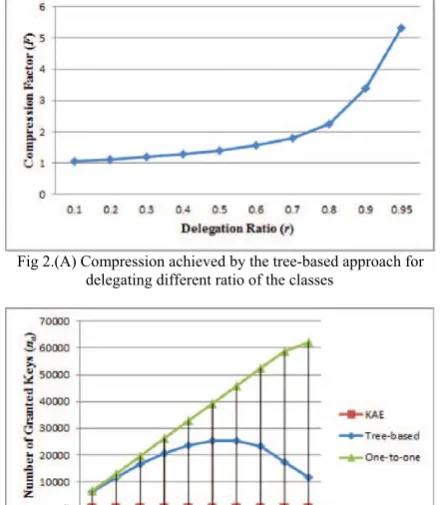
Fig 2.(A) Compression achieved by the tree-based approach for delegating different ratio of the classes
Fig 2.(B) Number of granted keys (na) required for different approachesin the case of 65536 classes of data
r 0.1 0.2 0.3 0.4 0.5 0.6 0.7 0.8 0.9 0.95
Setup 8.4 Extract 2 4 5 7 8 9 10 10 11 11 Decrypt 4 6 9 12 14 15 16 18 20 20
Table. 2. Performance of our basic construction for h = 16 with respect to different delegation ratio r (in milliseconds)
As shown in Table two. The execution times of Setup, KeyGen, inscribe area unit freelance of the delegation quantitative relation r. In our project, KeyGen takes 3:3 milliseconds and inscribe takes 6:8 milliseconds. As expected, the period of time complexities of Extract and rewrite increase linearly with the delegation quantitative relation r (which determines the dimensions of the delegated set S). Our timing results additionally adjust to what is seen from the equation in Extract and rewrite — 2 pairing operations take negligible time, the period of time of rewrite is roughly a double of Extract. Note that our experiments dealt with up to 65536 range of class (which is additionally the compression factor), and will be massive enough for fine-grained information sharing in most things. Finally, we have a tendency to remark that for applications wherever the number of ciphertext categories is massive however the no confidential storage is restricted, one ought to deploy our schemes exploitation the Type-D pairing bundled with the PBC, that solely needs 170-bit to represent a part in G. For n = 216, the system parameter needs or so 2:6 megabytes, that is as massive as a lower quality MP3
file or a higher-resolution JPEG file that a typical wireless telephone will store over a dozen of them. But we have a tendency to saved dear secure storage while not the effort of managing a hierarchy of delegation class.
V.CONCLUSIONS
User’s information privacy could be a central question of cloud storage. Compress secret keys in public-key cryptosystems that support delegation of secret keys for various cipher text classes in cloud storage. Regardless of that one in every of the facility set of classes, the delegate will continuously get aggregate key key of constant size. In cloud storage, the amount of cipher texts typically grows chop-chop with none restrictions. So we have to reserve enough cipher text categories for the longer term extension. Otherwise, we'd like to expand the public-key. Though the parameters are often downloaded with cipher texts, it'd be higher if its size is freelance of the utmost variety of cipher text classes.
REFERENCES
[1] key –Aggregate Cryptosystem for Scalable Data Sharing in Cloud Storage Cheng-Kang Chu, Sherman S. M. Chow, Wen-Guey Tzeng, Jianying Zhou, and Robert H. Deng, Senior Member, IEEE
[2] C Wang, S. S. M. Chow, Q. Wang, K. Ren, and W. Lou, “Privacy-Preserving Public Auditing for Secure Cloud Storage,” IEEE Trans.Computers, vol. 62, no. 2, pp. 362–375, 2013
[3] V. Goyal, O. Pandey, A. Sahai, and B. Waters, “Attribute-Based Encryption for Fine-Grained Access Control of Encrypted data,”in
Proceedings of the 13th ACM Conference on Computer and Communications Security (CCS ’06). ACM, 2006, pp. 89–98.
[4] M. J. Atallah, M. Blanton, N. Fazio, and K. B. Frikken, “Dynamic and Efficient Key Management for Access Hierarchies,”
ACMTransactions on Information and System Security (TISSEC), vol.
12,no. 3, 2009.
[5] S. S. M. Chow, C.-K. Chu, X. Huang, J. Zhou, and R. H. Deng,“Dynamic Secure Cloud Storage with Provenance,” in
Cryptography and Security: From Theory to Applications - Essays Dedicatedto Jean-Jacques Quisquater on the Occasion of His 65th Birthday, ser. LNCS, vol. 6805. Springer, 2012, pp. 442–464.
[6] D. Boneh, C. Gentry, B. Lynn, and H. Shacham, “Aggregate and Verifiably Encrypted Signatures from Bilinear Maps,” in Proceedings of Advances in Cryptology - EUROCRYPT ’03, ser. LNCS,vol. 2656.
Springer, 2003, pp. 416–432.
[7] S. S. M. Chow, Y. J. He, L. C. K. Hui, and S.-M. Yiu, “SPICE - Simple Privacy-Preserving Identity-Management for Cloud Environment,” in Applied Cryptography and Network Security – ACNS2012, ser. LNCS, vol. 7341. Springer, 2012, pp. 526–543.
[8] L. Hardesty, “Secure computers aren’t so secure,” MIT press, 2009,http://www.physorg.com/news176107396.html
[9] B. Wang, S. S. M. Chow, M. Li, and H. Li, “Storing Shared Data on the Cloud via Security-Mediator,” in International Conference on Distributed Computing Systems - ICDCS 2013. IEEE, 2013.
[10] J. Benaloh, M. Chase, E. Horvitz, and K. Lauter, “Patient Controlled Encryption: Ensuring Privacy of Electronic Medical Records,” in
Proceedings of ACM Workshop on Cloud ComputingSecurity (CCSW ’09). ACM, 2009, pp. 103–114.
[11] F. Guo, Y. Mu, Z. Chen, and L. Xu, “Multi-Identity Single-Key Decryption without Random Oracles,” in Proceedings of Information Security and Cryptology (Inscrypt ’07), ser. LNCS, vol. 4990.
Springer, 2007, pp. 384–398.
[12] G. C. Chick and S. E. Tavares, “Flexible Access Control with Master Keys,” in Proceedings of Advances in Cryptology - CRYPTO’89, ser. LNCS, vol. 435. Springer, 1989, pp. 316–322
[14] G. Ateniese, A. D. Santis, A. L. Ferrara, and B. Masucci, “Provably-Secure Time-Bound Hierarchical Key Assignment Schemes,” J. Cryptology, vol. 25, no. 2, pp. 243–270, 2012Cho,
[15] J., Garcia-Molina, H., Page, L., Efficient Crawling: Through URL Ordering, Computer Science Department, Stanford University, Stanford, CA, USA, 1997.