arXiv:cond-mat/0308226v1 [cond-mat.mtrl-sci] 12 Aug 2003
First principles simulations of direct coexistence of solid and liquid aluminium
Dario Alf`e
Department of Earth Sciences, and Department of Physics and Astronomy, University College London, Gower Street, London, WC1E 6BT, U.K
First principles calculations based on density functional theory, with generalised gradient corrections and ultrasoft pseudopotentials, have been used to simulate solid and liquid aluminium in direct coexistence at zero pressure. Simulations have been carried out on systems containing up to 1000 atoms for 15 ps. The points on the melting curve extracted from these simulations are in very good agreement with previous calculations, which employed the same electronic structure method but used an approach based on the explicit calculation of free energies [1].
PACS numbers: 64.10.+h 64.70.Dv 71.15.-m 71.15.Pd
The calculation of melting properties of materials us-ing computer simulations has a long history. Two main approaches have traditionally been used. The first is based on the direct simulation of solid and liquid in co-existence [2–5,17]. The second on the calculation of the free energy of solid and liquid [7–10,18], with the melting point (p, T) determined by the condition of equality of the Gibbs free energies of liquid and solid, Gliq(p, T) =
Gsol(p, T). The two approaches must clearly give the
same answer once all the sources of errors have been brought under control. These works were originally car-ried out using classical model potentials, with parameters usually adjusted to reproduce some known experimental properties of the material, or fitted to ab-initio
calcula-tions. The advantage of using these classical potentials is that they are relatively simple, so that computer simula-tions could easily be carried out on large systems and for long time. The main disadvantage, however, is that the transferability of these potentials is not always guaran-teed, so that the accuracy of the predictions is sometimes questionable. In 1995 Sugino and Car [11] showed that it was actually possible to use density functional theory (DFT) [12] techniques to calculate the melting temper-ature of materials truly from first principles, i.e without relying on any adjustable parameters. They chose the melting of silicon as a test case, and using the local den-sity approximation (LDA) they calculated the Gibbs free energy of solid and liquid using thermodynamic integra-tion. This is a well known statistical mechanics tech-nique to compute free energy differences between two sys-tems [13]. The idea is to use a simple system for which the free energy is known as a reference system, and then compute the free energy difference between theab-initio
and the reference system, which is equal to the reversible work done in adiabatically switching the potential energy from one system to the other. An attractive feature of this method is that the final result is totally independent on the choice of the reference system. In practice, how-ever, this method can only work if one is able to find a reference system which is as close as possible to the ab
initio system, so that the computational effort needed
to calculate the free energy difference between the two
systems is reduced to the minimum. Using this method, Sugino and Car found a zero pressure melting tempera-ture about 20% lower than the experimental datum. This may seem not particularly good, but it has to be remem-bered that no adjustable parameters were inputed in the calculations, nor any experimental data other than the Plank’s constant and the mass and charge of the elec-tron. Recently, we have argued [14] that this non-perfect agreement between LDA results and experiments is prob-ably due to non-cancelling LDA errors between the solid and liquid. The reason is that the two phases have very different properties: the liquid is six-fold coordinated and the solid four-fold coordinated, the liquid is a metal and the solid an insulator, so it is not surprising that the LDA errors in the two phases may be different. We have repeated the LDA calculations of Sugino and Car using similar techniques and found the same melting tempera-ture. However, we have also shown that if the generalised gradient corrections (GGA) are used, then the melting temperature of silicon comes out in much closer agree-ment with the experiagree-ments [14].
Since the work of Sugino and Car [11] a number of first principles based calculations of melting points and melting curves have followed. In some cases the free en-ergy approach has been used [15,16,19,20,1], while other methods relied on fitting a model potential to first princi-ples simulations and calculating melting properties with the model potential [3–5]. The advantage of the free en-ergy approach is that it is unbiased, provided all sources of technical errors are brought under control. A disad-vantage of the method is that it is intrinsically complex. On the other hand, the coexistence approach is relatively simple to apply, but has the main disadvantage of rely-ing on good quality fittrely-ing and, more importantly, trans-ferability of the model for at least a simultaneous good description of solid and liquid. Recently, we have shown that provided that the model potential is reasonably close to theab-initio system [21], it is possible to correct for
the (small) differences between the model and the full
ab-initiosystem using a perturbational approach to
free energy approach [22].
The coexistence approach has been used extensively in the past to calculate the melting properties of various ma-terials. In the constant volume constant internal energy (N V E ensemble) approach to the method it has been shown that liquid and solid can coexist for long time, providedV andE are appropriately chosen [2,22]. The average value of the pressurepand temperatureT over the coexisting period then give a point on the melting curve. Size effects have also been studied quite exten-sively, and it was shown that correct results can be ob-tained in systems containing more than 500 atoms [5,6]. Here I have exploited recent advances in computer power and algorithms developments to use direct DFT calculations for simulating solid and liquid aluminium in coexistence near zero pressure. This work combines the simplicity of the coexistence approach with the accuracy provided by DFT, and in some respect represents a shift of paradigm, whereby the main effort is transferred from the human to the computer. The temperature at which solid and liquid coexist are found to be in good agreement with our previous results obtained with the free energy approach [1], so that these results also provide additional evidence that our techniques to calculate free energies are sound.
The calculations have been performed with the VASP code [23], with the implementation of an efficient extrap-olation of the charge density [24], ultrasoft pseudopo-tentials [25] with a plane wave cutoff of 130 eV, and generalised gradient corrections. The simulations have been performed in the N V E ensemble on systems con-taining 1000 atoms (5×5 ×10 cubic supercell), with a time step of 3 fs and a convergency threshold on the total energy of 2×10⁻⁷ eV/atom. With these
prescrip-tions the drift in the microcanonical total energy was less than 0.3 K/ps. The total length of the simulations were typically 15 ps. The volume per atom was cho-sen to be V = 18.5 ˚A3, which is close to the average
of the volumes of solid and liquid at the zero pressure melting point calculated in our previous work [1]. Elec-tronic excitations have been included within the frame-work of finite temperature DFT. The simulations have been performed using the Γ point only, and spot checked with Monkhorst-Pack [26] (2×2×1) and (4×4×2)
k-point grids. Calculations with the Γ point predict a small non-hydrostatic stress tensor with a difference of about pz−(px+py)/2 = −2 kB between the compo-nents of the stress parallel to the solid-liquid interface, px and py, and that perpendicular to the interface, pz. The pressurep= (px+py+pz)/3 is essentially exact and the three off-diagonal components of the stress tensor fluctuate around zero average, so that there is no shear stress on the cell. With Γ the total energy is wrong by ≈5 meV/atom, and it is likely that the error is almost equally shared by the liquid and the solid parts, so that the resulting error on the melting temperature is most
probably negligible [27]. A correction term of 2.7 kB due to the lack of convergency with respect to the plane wave cutoff has been added to the calculated pressures. The systems have been monitored by inspecting the average number density in slices of the cell taken parallel to the boundary between solid and liquid. In the solid region this number is a periodic function of the slice number, and in the liquid part it fluctuates randomly around its average value.
The zero pressure crystal structure of aluminium is face-centred-cube (fcc), so I have assumed that melting occurs from this structure. To prepare the system I have used the inverse power classical potential employed in Ref. [1]. This model has been tuned to the sameab-initio
It has been pointed out that non-hydrostaic conditions artificially raise the free energy of the solid, and there-fore lower the melting temperature [6]. To investigate the effect on the melting temperature due to the present non-hydrostatic conditions I have used the model po-tential used in Ref. [1]. The model showed a difference pz−(px+py)/2 = 0.5 kB when simulated with the same cell as theab-initiosystem with 1000 atoms. To estimate
the systematic error on the melting temperature I have performed an additional simulation using a slightly elon-gated cell at the same volume, so that non-hydrostaticity was reduced to less than 0.1 kB. The decrease of melting temperature in this second simulation was less than 10 K. A similar effect is expected for theab-initiosystem, so
that I estimate a systematic error due to non-hydrostatic conditions to be at worse of the order of 20 K.
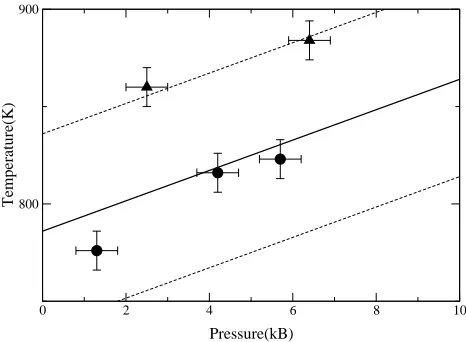
In Fig. 4 I report the values ofpandT calculated here in comparison with the low end of the melting curve cal-culated in Ref. [1] The agreement between the present finding with 1000 atoms and the free energy approach results is extremely good. The results obtained from the simulations with 512 atoms display melting temperatures higher by about 50 K, although they are still compatible with the results obtained with the free energy approach within the combined error bars. In order to test if the cause of this size effect was due to inadequate k-point sampling, I have performed a simulation using a (2×2×1)
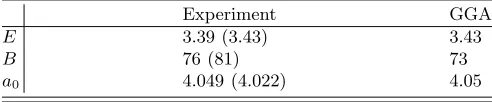
k-point grid on a system with 512 atoms for ≈ 6 ps. The length of this simulation is too short to draw defi-nite conclusions, but it indicates that the pressure may be underestimated by ≈ 1−2 kB and the temperature over-predicted by ≈20 K. This would bring the results in somewhat better agreement with those obtained with the larger system, and also with the calculations based on the free energy approach (which were fully converged with respect to size and k-point sampling) [1]. Notice that these results do not agree perfectly with the experi-mental zero pressure melting temperature of aluminium (933 K) [30]. We have argued in our previous work [1] that this disagreement is due to inadequacy of the GGA to predict the vibrational properties of the solid. We have also suggested that this inaccuracy can be rationalised in terms of the errors in the equation of state, and de-vised a simple way to correct for it. In Table 1 I report the calculated GGA lattice constant, the bulk modulus and the cohesive energy compared with the experimental data. Following Gaudoin et al. [32], I also report the ex-perimental values adjusted for the absence of zero point motion effects, which is missing in the present calculated values. It is evident that the GGA predicts a zero pres-sure lattice constant for Al which is too large, or, which means that at the correct lattice constant GGA predicts a positive pressure of about 16 kB. It follows that the GGA zero pressure melting point is actually the melting point at a negative pressure of about -16 kB, which is about 120-130 K lower.
In summary, I have shown here that it has become pos-sible to directly simulate solid and liquid in coexistence using density functional theory techniques. This method combines the advantages of being relative easy to use and provide DFT accuracy. It is inevitably computationally very intensive, and these calculations have only been pos-sible thanks to an access onto the 3.5 Teraflop/s machine (IBM p690 Regatta with 1280 processors). The cost of each molecular dynamics step for the 1000 atoms system was between 3 and 4 minutes on 128 processors of the machine. However, as large computer resources become routinely available this method should find widespread applicability in the future. The present results are in very good agreement with our previous findings based on the direct calculations of free energies, and therefore also support the reliability of those techniques.
This work has been supported by the Royal Soci-ety and by the Leverhulme Trust. The author wishes to acknowledge the computational facilities of the UCL HiPerSPACE Centre (JREI grant JR98UCGI), and the early access to the HPCx computer facilities in
Dares-bury, granted by NERC through support of the Mineral Physics Consortium. The author is grateful to C. Wright for computational technical support and to M. J. Gillan and G. D. Price for discussions. The author also wishes to thank M. Pozzo for useful suggestions on the manuscript.
[1] L. Voˇcadlo and D. Alf`e, Phys. Rev. B,65, 214105 (2002).
[2] J. R. Morris, C. Z. Wang, K. M. Ho, and C. T. Chan, Phys. Rev. B49, 3109 (1994).
[3] A. Laio, S. Bernard, G. L. Chiarotti, S. Scandolo and E. Tosatti, Science287, 1027 (2000).
[4] A. B. Belonoshko, R. Ahuja, and B. Johansson, Phys. Rev. Lett.84, 3638 (2000).
[5] A. B. Belonoshko, R. Ahuja, O. Eriksson, and B. Johans-son, Phys. Rev. B61, 3838 (2000).
[6] J. R. Morris, X. Song, J. Chem. Phys.,116, 9352 (2002).
[7] J. A. Moriarty, D. A. Young, and M. Ross, Phys. Rev. B
30, 578 (1984).
[8] J. Q. Broughton, X. P. Li, Phys. Rev. B,35, 9120 (1987).
[9] J. Mei, J. W. Davenport, Phys. Rev. B46, 21 (1992).
[10] G. K. Straub, J. B. Aidun, J. M. Willis, C. R. Sanchez-Castro, and D. C. Wallace, Phys. Rev. B50, 5055 (1994).
[11] O. Sugino and R. Car, Phys. Rev. Lett.74, 1823 (1995).
[12] R. Car and M. Parrinello, Phys. Rev. Lett. 55, 2471
(1985).
[13] For a discussion of thermodynamic integration see e.g. D. Frenkel and B. Smit,Understanding Molecular Simu-lation, Academic Press, San Diego (1996).
[14] D. Alf`e and M. J. Gillan, Phys. Rev. B., (in press). [15] G. A. de Wijs, G. Kresse and M. J. Gillan, Phys. Rev. B
57, 8223 (1998).
(1999).
[17] B. J. Jesson and P. A. Madden, J. of Chem. Phy. 113
5935 (2000).
[18] B. J. Jesson and P. A. Madden, J. of Chem. Phy. 113
5924 (2000).
[19] D. Alf`e, G. D. Price, M. J. Gillan, Phys. Rev. B, 64,
045123 (2001).
[20] D. Alf`e, G. D. Price, M. J. Gillan, Phys. Rev. B, 65,
165118 (2002).
[21] The distance between the model potential and the ab-initio system at a chosen thermodynamic state can be defined as the magnitude of the fluctuations in the dif-ference of the respective internal energies. See Ref. [22] for more details.
[22] D. Alf`e, G. D. Price, M. J. Gillan, J. Chem. Phys,116,
7127 (2002).
[23] G. Kresse and J. Furthm¨uller, Phys. Rev. B, 54, 11169
(1996); G. Kresse and J. Furthm¨uller, Comput. Mater. Sci.,6, 15 (1996); a discussion of the ultra-soft
pseudopo-tentials used in the VASP code is given in G. Kresse and J. Hafner, J. Phys. Condens. Matter, 6, 8245 (1994). [24] D. Alf`e, Computer Phys. Commun.,118, 31 (1999).
[25] D. Vanderbilt, Phys. Rev. B,41, 7892 (1990).
[26] H. J. Monkhorst and J. D. Pack, Phys. Rev. B13, 5188
(1976).
[27] Even in the unlikely worse case scenario in which this error was borne entirely by the solid (or entirely by the liquid), this would result in a wrong prediction of the melting temperature by only about 30 K.
[28] The temperature of 800 K has been chosen because it is close to the DFT-GGA melting temperature previously calculated [1].
[29] In fact, the simulation reported in Fig. 2 has been spawn from a previously well equilibrated simulation with a dif-ferent value of total energy. The time needed to equili-brate the system the first timeab-initiowas switched on from the classical regime was about 1 ps.
[30] CRC Handbook of Chemistry and Physics, Editor D. R. Lide, New York, 77th edition (1996-1997).
[31] C. Kittel, Introduction to solid state physics, 7th edn (New York: Wiley), 1996.
[32] R. Gaudoin, W. M. C. Foulkes and G. Rajagopal, J. Phys: Condens. Matter148787 (2002).
[33] F. Birch, Phys. Rev.71809 (1947).
Experiment GGA
E 3.39 (3.43) 3.43
B 76 (81) 73
a0 4.049 (4.022) 4.05
TABLE I. Experimental values for the cohesive energy
Ec
(eV/atom) [31], the bulk modulus B (GPa) [30] and the lattice constant a0 (˚A) [30]. In parenthesis are the
ad-justed values for the effect of zero point motion [32]. The calculated GGA values have been obtained from a fit to a Birch-Murnaghan equation of state [33], and they do not in-clude zero point motion effects.
0 20 40 60 80 100
Slice number 0
10 20 30 40
Number of atoms
FIG. 1. Density profile in a simulation of solid and liquid Al coexisting at zero pressure. The system is divided in slices of equal thickness (0.42 ˚A) parallel to the solid-liquid interface, and the graph shows number of atoms in each slice. Simula-tions were performed on a system of 1000 atoms using density functional theory.
0 5 10 15
780 820 860
Temperature(K)
0 5 10 15
Time (ps)
3 5 7
Pressure (kB)
0 10 20 30 40 800
850 900 950
Temperature(K)
0 10 20 30 40
Time(ps)
0 5 10
Pressure(kB)
FIG. 3. Time variation of temperature (upper panel) and pressure (lower panel) during a simulation of solid and liquid Al in coexistence for a system containing 512 atoms. Gray lines: actual data; black lines: running averages over a 0.75 ps period.
0 2 4 6 8 10
Pressure(kB) 800
900
Temperature(K)