A Question of Regulation
A study of the regulation of qualifications in England
William David Blacklock
Institute of Education, University of London
Thesis submitted in part fulfilment of the degree of Doctor in
Abstract
This thesis considers whether there is a case for the regulation of qualifications in
England. It draws on regulatory theory to develop an original conceptual model for
regulation incorporating five important public interest objectives: control of systemic risk;
quality; information asymmetry; value for money; and planning deficit. The model is used
to evaluate the case for regulation. Interviews with officials responsible for regulatory
policy, and representatives of those organisations subject to regulation, provide evidence
that allows an assessment of whether they understand and support the regulatory functions
appropriate to qualifications, the value of such regulation and possible alternatives. The
study reviews how other regulatory arrangements in education and training inform the
evaluation of the case for regulation. The thesis also surveys the basis for the regulation of
financial services to see if lessons can be learnt for the regulation of qualifications from a
non-educational context. The thesis concludes that a case can be made for the regulation
of qualifications but that such a case needs to go back to first principles rather than
depend on the current inadequate legislative basis. There is a clear case for regulation to
address the issues of systemic risk and quality and standards and these were identified in
my empirical findings as the two most important objectives. As far as the issues of
information asymmetry and value for money are concerned there is justification for
regulation in principle although in practice the case does not appear to be very strong.
However, the case for central planning of the qualifications system is not clear and further
justification would need to be made for before regulation could be justified to achieve this
objective. Finally, the key issues of regulatory balance and the impact of economic
Contents
CHAPTER 1 – INTRODUCTION ... 5
THE REGULATORY LANDSCAPE IN EDUCATION AND TRAINING ... 8
DEFINITION AND PURPOSES OF A QUALIFICATION ... 11
STRUCTURE AND METHODOLOGY ... 13
CHAPTER 2 – LITERATURE REVIEW ... 16
INTRODUCTION ... 16
THEORIES OF REGULATION ... 17
GOVERNMENT AND REGULATION ... 21
REGULATION AND QUALIFICATIONS ... 23
CONCLUSION... 26
CHAPTER 3 – A MODEL FOR REGULATION ... 27
THE REGULATORY MODEL ... 29
Objective 1 – to avoid systemic risk... 29
The control of systemic risk in order to reduce moral hazard is an important issue for economic regulation but is also relevant in an evaluation of the case for the regulation of a qualifications system in which is invested significant amounts of public money. ... 30
Objective 2 – to ensure quality and standards ... 30
Objective 3 – to ensure provision of information ... 31
Objective 4 – to ensure efficiency and value for money ... 33
Objective 5 – to plan and organise ... 34
CONCLUSION... 35
CHAPTER 4 – QCA AND THE CASE FOR REGULATION ... 36
THE ESTABLISHMENT OF THE NEW REGULATOR ... 36
THE MODEL FOR THE REGULATION OF QUALIFICATIONS ... 44
Objective 1 – to avoid systemic risk... 45
Objective 2 – to ensure quality and standards ... 48
Objective 3 – to ensure the provision of information ... 50
Objective 4 – to secure efficiency and value for money... 52
Objective 5 – to plan and organise ... 53
CONCLUSION... 55
CHAPTER 5 – INTERVIEWS ... 56
DEFINITION OF A QUALIFICATION ... 62
Objective 1 – to avoid systemic risk... 63
Objective 2 – to ensure quality and standards ... 64
Objective 3 – to ensure the provision of information ... 66
Objective 4 – to secure efficiency and value for money... 67
Objective 5 – to plan and organise ... 69
ALTERNATIVES TO REGULATION ... 70
CONCLUSION... 73
CHAPTER 6 – OTHER REGULATORY ARRANGEMENTS ... 75
BACKGROUND ... 75
RATIONALES FOR REGULATION ... 76
REGULATORY OBJECTIVES ... 78
Quality and standards ... 80
Efficiency ... 82
SUMMARY ... 85
CHAPTER 7 – THE FINANCIAL SERVICES AUTHORITY... 87
THE ESTABLISHMENT OF THE FINANCIAL SERVICES AUTHORITY ... 87
THE OBJECTIVES OF THE FINANCIAL SERVICES AUTHORITY ... 89
Systemic risk ... 91
Asymmetric information... 91
CONCERNS ABOUT THE FSA ... 93
APPROACH OF THE FSA TO REGULATION ... 94
THE PROGRESS OF THE FSA ... 96
SUMMARY ... 97
CHAPTER 8 - CONCLUSIONS ... 99
THE CASE FOR REGULATION ... 99
IMPLICATIONS FOR REGULATION ... 103
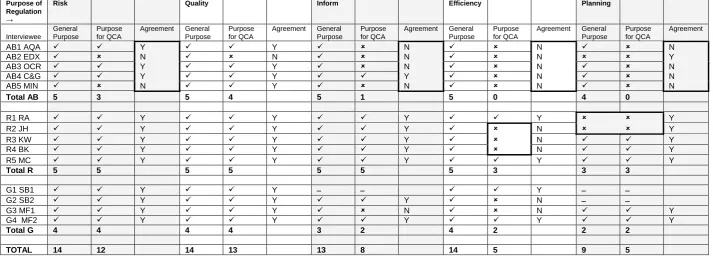
ANNEX 1 - PURPOSE OF REGULATION ... 106
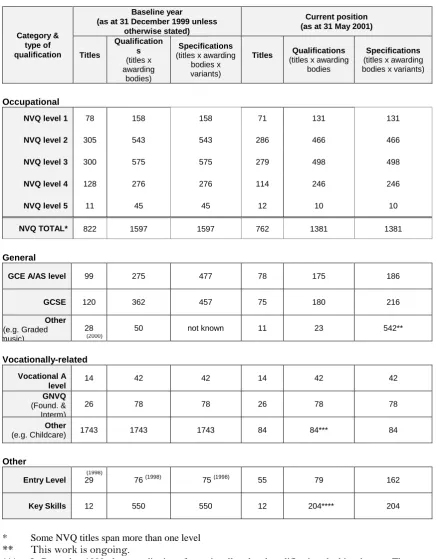
ANNEX 2 – RATIONALISATION OF QUALIFICATIONS ... 107
ANNEX 3 – THE NATIONAL QUALIFICATIONS FRAMEWORK ... 108
BIBLIOGRAPHY ... 109
LEGISLATION ... 109
REFERENCES ... 110
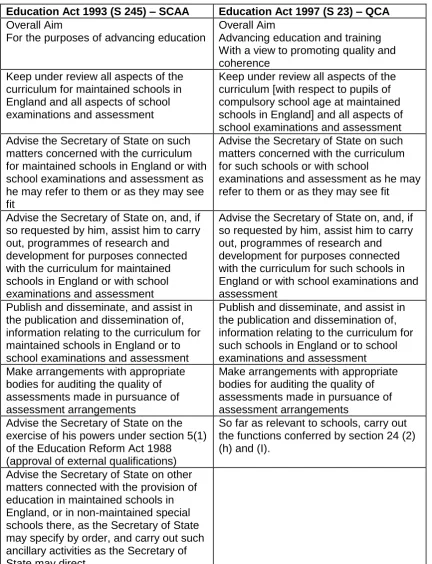
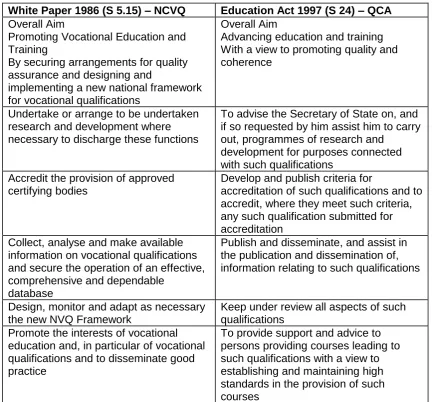
Table of Figures Figure 1 - Comparison of the Education Act 1993 (SCAA) and the Education Act 1997 (QCA) 40 Figure 2 - Comparison of the White Paper 1986 (NCVQ) and the Education Act 1997 (QCA) .. 41
Chapter 1 – Introduction
In 1911, the Consultative Committee on Examinations in Secondary Schools argued that
‘examinations should be subjected to most stringent regulations as to their number, the age at which they are taken, and their general character’ (Board of Education, 1911,
p.103). When describing the variety of examinations that had grown up by the beginning
of the 20th century, the Committee observed that:
the system is the result of practically independent action. It is the outcome of a varied succession of unconnected accidents, in which owing to the disinclination or inability of the State to superintend the work at its beginning, there has been no single co-ordinating force at work.
The report of the committee recommended that:
The existing multiplicity of external examinations (including those of Universities, and professional and other bodies), the claims of which at present so frequently interfere with the best work of schools should be reduced by concerted action (Board of Education, 1911, p.104).
Almost a century later, and five years after the Qualifications and Curriculum Authority
was established to ‘superintend’ the qualifications system, over 100 awarding bodies
continue to offer almost 3,500 awards.
This thesis considers whether a coherent and sustained case can be made for the
regulation of public qualifications. Qualifications signal in a public way acquisition of
certain knowledge and skills and are crucial achievements in the lives of many people.
Individuals can use qualifications to differentiate themselves in the labour market and can
thereby increase their status in society. Academic qualifications function as passports to
higher education, to the limited number of places available in medical or law schools or to
potentially high-earning jobs in business. Studies such as those carried out by the Centre
for the Economics of Education (Dearden et al, 2000) suggest that those who gain such
qualifications enjoy greater potential earnings over their lifetime. Even some vocational
qualifications, which are often seen as the poor relations of academic awards, deliver
some gain to the individual in terms of financial return.
Given the kind of advantages that qualifications can offer, the need to ensure the quality
and status of those qualifications becomes a major issue. The quality of the procedures
used to achieve the independent validation of these qualifications needs to command
particularly as it underwrites it financially. Even so, there has been little discussion as to
whether a case can be made for regulation as the most appropriate mechanism for
addressing issues of public interest raised by the ways in which the qualifications system
in England currently operates. The annual appeal in both the general and educational press
to protect ‘standards’, when the results of public examinations are published, is a
symptom of public concern that confidence in the value of qualifications is maintained.
Some observers argue that guarding the quality and standards of qualifications, and the
assessment arrangements on which they are based, attract naturally the attention of
governments and regulatory agencies:
Assessment is characterised by elaborate processes to safeguard the reliability of the scores obtained. Furthermore, it is dominated (at least in the UK) by external agencies, again designed to safeguard the ‘gold standard’ of the public examination (Lambert and Lines, 2000, p.192).
In addition to such social concerns over quality and standards, there are economic
concerns over competition between the providers of qualifications and the cost of the
qualifications system. The continuing existence of so many different qualifications
offered by such a wide range of awarding bodies may be an indication of healthy
competition. One may argue that such competition encourages higher standards and better
customer service. One may also argue that it promotes cost-effectiveness and value for
money. Alternatively, one may see the many competing awards as evidence of
oversupply, confusing duplication and a threat to quality especially if awarding bodies cut
costs and allow quality to suffer as a result. The significant expense incurred by the
taxpayer - in terms of the payment of qualification fees from the public purse - is a matter
of concern.
Qualifications, whether academic, vocational or professional, are developed and marketed
by awarding bodies. The costs of qualifications - whether it be registration and
certification fees for individuals or moderation and verification fees for the providers of
education and training programmes – are significant and the state underwrites the cost of
the majority of such qualifications through the mechanisms of its new central funding
agency - the Learning and Skills Council. The costs of the services of the awarding bodies
have been criticised by some commentators:
In view of the rising costs of qualifications, the provision of qualifications has been one
service that has become subject to ever-tighter regulation:
Further central interventions in certification and assessment have involved the stipulation of courses and qualifications that may receive funding in colleges and government initiatives to reform the traditionally independent examination and certification bodies (Green, Wolf & Leney, 1999, p.101).
In examining whether a case can be made for the regulation of qualifications this thesis
draws on research which distinguishes between economic and social regulation. For the
purpose of this study such a sharp distinction may not be helpful and it may be more
useful to see economic and social regulation within an overall spectrum of activity with
efficiency goals on one side and equity goals on the other. Economic regulation deals
primarily with issues such as the management of competition in the private sector, the
privatisation of monopoly suppliers - in the utilities sector, for example - and the
introduction of ‘internal markets’. The aim of such regulation is to secure a high level of
efficiency through the use of specific incentives, a more responsive service to consumers
and better value for money. Social regulation deals primarily with public interest issues
such as quality and safety. The aim of such regulation is to secure a degree of protection
for the individual. Hughes compares the purposes of economic and social regulation:
with the former aimed at encouraging business and other economic actors to undertake certain activities and to avoid other activities. Social regulation is usually seen as attempting to protect the interests of citizens and consumers, especially concerning quality standards, safety levels, and pollution controls (Hughes, 1994, p.89).
In terms of the justification for the regulation of qualifications the arguments for
regulation are evenly balanced. The economic regulation of competition to encourage
greater efficiency and value for money in the supply of qualifications may need to assume
as important a profile as the more familiar calls for social regulation of quality and
standards.
It is vital to remember also that a powerful argument exists that regulation should be used
to safeguard the public interest only in cases where other non-regulatory mechanisms are
not sufficient to correct deficiency or failure. Howard Davies set out this argument just
prior to the establishment of the Financial Services Authority:
If we share this view we need to identify what might constitute ‘substantial market
imperfection’ in the qualifications system in order to consider whether a case can be made
for regulation. Essentially, therefore, we need to find a way of determining whether there
are possible justifications for regulation on social grounds and whether there are possible
justifications for regulation on economic grounds. If we find that there are justifications
for regulation there will be a need to evaluate whether these are strong enough to
overcome the argument that ‘the cure is worse than the disease’ and that overall the
benefits of regulation are likely to outweigh the possible costs.
The regulatory landscape in education and training
The Education Act 1997 set up the Qualifications and Curriculum Authority in order to
pursue certain goals in relation to the curriculum, assessment, and qualifications. The Act
created QCA as a major part of the overall regulatory framework for education and
training in England. The establishment of this new body is set against the background of
the significant growth, particularly in the last decade, in the powers assumed by central
government to regulate education and training. The establishment of QCA is typical of the
push towards more high profile regulation across the public sector. The structural reform
underlying these changes marks a major extension of the influence of central government
in its search to give a greater guarantee of standards of product and delivery in public
services.
In addition to the Qualifications and Curriculum Authority, other key organisations are
involved in the direction and control of education and training for those aged 16 and
above:
1. Department for Education and Skills (DfES);
2. Learning and Skills Council (LSC);
3. Office for Standards in Education (OFSTED); and
4. Adult Learning Inspectorate (ALI).
Other regulatory mechanisms at a local level are applied by bodies such as local education
authorities with their responsibilities for managing schools; local Learning and Skills
private training providers; and Government Offices and Regional Development Agencies
with their planning and reporting functions.
Two important parameters govern the research. The study focuses on public qualifications
designed for those aged 16 and over and not national curriculum assessment. Also,
following devolution, key legislation applies to education and training in England only
and the thesis cannot offer any comment on Scotland, Northern Ireland or Wales. In the
field of academic qualifications such as GCSEs and ‘A’ Levels, competition exists
between the three so-called ‘unitary bodies’. Following the government’s public
consultation on ‘Guaranteeing Standards’ (DfEE, 1996a) these bodies were created by the
rationalisation of a number of vocational awarding bodies and academic examinations
boards. The origins of the latter can be traced back to the university matriculation boards.
They are large organisations, two of which employ over 500 staff. However, there is a
much larger group of smaller organisations which function in the vocational qualifications
market, where competition has been exacerbated recently by new entrants eager for a
share of public funding. Some enjoy charitable status and others have a Royal Charter that
allows them to promulgate their educational responsibilities.
The greatest proportion of the income for most of these awarding bodies comes from the
charges they make to individuals who take their qualifications. In turn, the charges the
awarding bodies make for their services including:
the devising, administering, verifying or certifying the qualification; setting or moderating examinations for the purposes of the qualification; registering, assessing and examining candidates (Learning and Skills Act, 2000)
are subsidised by the state through the provisions of the relevant legislation. The
‘qualifications industry’ for those aged 16 and above is big business:
In spring 2001, 6,373,000 or 17% of all people of working age were studying toward a qualification in the UK (Office of National Statistics, 2002).
In 1999/2000 there were 5,683,000 entries for the General Certificate of Secondary
Education (GCSE) examinations and 890,700 entries for the General Certificate of
Education (GCE). In the same year, achievements in vocational qualifications included
454,000 National Vocational Qualifications (NVQs), 117,000 General National
Vocational Qualifications (GNVQs) and 502,000 other vocational qualifications (Office
In order to deliver this large and increasing number of examinations and to award the
resulting qualifications, there are a number of categories of organisations that share the
common description of ‘awarding body’. We have mentioned the three ‘unitary’ awarding
bodies for academic qualifications:
1. Oxford, Cambridge and Royal Society of Arts Examinations Board (OCR);
2. Assessment and Qualifications Alliance (AQA);
3. Edexcel.
The City and Guilds of London Institute (C&G) set up in 1878, is the largest vocational
awarding body. These four bodies together are estimated to have a combined annual
turnover of over £300 million.
The other types of awarding body that serve the market for occupational or vocational
qualifications are remarkably diverse and include those:
a) set up to serve a particular market such as business and commercial services – for
example, the London Chambers of Commerce and Industry Examinations Board
(LCCI EB);
b) specific to a particular activity such as dance, music or drama – for example,
Trinity College of Music (TCM);
c) specific to a particular industrial sector such as engineering – for example,
Engineering and Marine Training Authority Awards Limited (EAL);
d) Former regional bodies serving mainly the further education sector, some of them
derived from the 19th century tradition of mechanics institutes – such as the
Awarding Body Consortium (ABC) that can trace its beginning back to the 1876
Union of Lancashire and Cheshire Institutes (ULCI);
e) Professional bodies such as the Royal Society of Chemistry, the Institution of
Civil Engineers, the Chartered Institute of Library and Information Professionals,
and the Royal College of Nursing. These latter bodies, however, offer higher level
or professional qualifications very few of which are likely to be considered for
Definition and purposes of a qualification
QCA has been established with specific powers to regulate qualifications. However,
despite this significant development there is little discussion or research to help us
understand more easily why regulation by QCA is needed or to suggest measures against
which we can judge whether such regulation will achieve its goals, or not. The lack of
discussion of the purposes of the regulation of qualifications is perhaps surprising given
the importance attached to the achievement of qualifications, particularly those that are
seen as ‘high stake’ such as the major academic public examinations.
In the case of the introduction of the new inspection regime for schools and the
establishment of the Office for Standards in Education (OFSTED), there has been
informed discussion, indeed controversy, over the aims of regulation and whether such
intervention works in practice. However, in education increasing regulation has been
accepted with less consideration and debate, because government has mobilised public
opinion in support of regulation as the preferred solution and because regulation has
become such an integral and unquestioned part of every day life in education. However,
even if regulation has become such a natural part of education and training, its aims are
not often understood.
The absence of any sustained intellectual justification for the theory and practice of
regulation of qualifications is notable when one compares the open debates that took
place prior to the establishment of the Financial Services and Markets Act 2000. This
kind of intellectual debate is important if we are to go back to first principles and ask the
question ‘Why regulate?’ A consideration of first principles needs a number of definitions
beginning with a definition of regulation itself. The definition I use in the thesis is drawn
from the work of Baldwin & Cave but adapted for my own purposes. It is that regulation
can be defined as:
the application of a set of rules or regulations, which have a basis in law, by a public body established to monitor and promote compliance with those rules in the public interest (Baldwin & Cave, 1999).
We need also to suggest a definition of a qualification as the object of regulation, together
with the principal purposes of a qualification, so we can consider more clearly the case for
regulation. For the purpose of this study, my definition of a ‘public qualification’ is a
qualification that can be taken by any individual and is not subject to pre-requisites such
in all cases, such a qualification will be attempted after a course of learning offered within
the public education and training system. The costs of the qualification – those charged by
the organisation that provides the course of education or training and those charged by the
organisation that awards the qualification – would normally be covered by the state for
those under the age of nineteen. Some costs are covered for those over the age of nineteen
– although individuals and employers are expected to make a contribution - and awarding
body costs are covered if the qualification has accredited status. The definition of such a
qualification in the relevant legislation is given as:
any academic or vocational qualification authenticated or awarded by an outside person except an academic qualification at first degree level or any comparable or higher level (Education Act 1997 S 24 (6) (a)).
In order to help develop the definition the thesis draws on several commentators including
Broadfoot (1979) and Dore (1997). One particularly helpful source is the work of
Goldstein & Lewis (1996) with its focus on assessment:
It is useful to distinguish three principal purposes or functions of assessment. The first is to certify or qualify individuals by discriminating among them; for example on the basis of a test, examination or teacher grading. The second is to assist in the learning process by providing an understanding of what someone has learnt so that remediation and further learning may take place. The third use is for making inferences about the functioning of institutions, enterprises or systems (Goldstein & Lewis, 1996, p.2).
Lord Mackay, in the recent ‘Review of the Regulation of School and Vocational
Examinations’, focuses on what he sees as the main purpose of a qualification:
The system of external qualifications in England is one that has a variety of uses. For example: it is used as a means of university entrance, it is used to compare schools, it is used as a criterion for gaining employment, although many employees would have additional tests or requirements before engaging a particular employee. But surely the main use of external qualifications is to provide the individual holder of the qualification with an independent validation of his/her standard of skill, competence and knowledge of the subject matter concerned (Edexcel, 2001, p.3).
Drawing from these and other sources a detailed definition of a qualification can be
developed as follows:
1. A mark of formal recognition of achievement;
2. Based on a demonstration of attainment of specified outcomes;
3. Dependent on defined assessment requirements;
Moreover, where the achievement of such formal recognition is supported by public funds
the certificate must be:
5. Issued by a body authorised for that purpose;
6. Subject to monitoring and public reporting.
In addition, three principal purposes for a qualification have been identified, as follows:
1. Supporting Learning
Support learning by setting goals and measuring outcomes in a reliable and
valid manner for the individual to confirm acquisition of knowledge and skills
within either an educational framework or within a training environment to
support individual and/or workforce development
2. Providing Information
Provide an indicator of individual achievement in a public and formal way
Support selection procedures either for higher education or employment by
providing standardised information on the success of candidates
Inform state policy with regard to economic performance by setting and
monitoring targets for qualifications as a proxy for educational or skills
achievement
3. Ensuring Accountability
Provide indicators of success by the individual or provide institutions and state
agencies with data against which value for money can be measured.
Structure and methodology
Chapter 1 serves as an introduction to the thesis. I examine briefly the regulatory
landscape within which QCA sits and describe some of the pertinent features of the
‘qualifications market’. A definition of a qualification is established to allow us to
understand the object of regulation. I identify the principal purposes of qualifications. An
overview of the structure of the thesis is provided. The methodology for the research
includes first a discussion of the general theory and purpose of regulation before asking
In Chapter 2, I set out a wide theoretical base for regulation both within and outside
education and training, with reference to a number of leading commentators in the field.
Several of these sources are studies of economic regulation, particularly where
government has intervened to control private suppliers. A spectrum of regulation is
identified taking into account efficiency goals on the one hand and equity goals on the
other. There is an exploration of the historical perspective of the regulation of
qualifications in order to help set this study in context.
In Chapter 3, drawing on a study of general regulatory literature, the thesis sets out a new
conceptualisation of a theoretical model for regulation. Five key objectives covering
social and economic regulation are identified. This model is then used during the
remainder of the thesis as a benchmark to interrogate the case for regulation, examine the
current regulatory arrangements and gauge the views of key stakeholders in the
qualifications system. The model is used as a general framework to evaluate whether
overall a case can be made for the regulation of qualifications.
In Chapter 4, I examine the details of the legislation which established QCA. A study of
sources such as the 1997 legislation, debates in parliament and expressions of views in the
public domain or by interest groups forms a primary basis for the research. Official
publications such as Command Papers and Acts of Parliament are examined and
discussed. The secondary rules, administrative criteria, and codes of practice developed to
underpin the regulatory regime are also examined. Announcements and policy statements,
speeches and publications from the bodies involved in the regulation of education, but
particularly the Qualifications and Curriculum Authority, are evaluated in order to
identify key issues and underlying concerns. I reiterate the theoretical model for
regulation and match where similar objectives for the regulation of qualifications exist for
QCA and where they do not. A detailed exegesis of QCA’s published material allows me
to assess whether a clear and coherent view of its regulatory functions can be articulated.
A preliminary assessment is made of the progress of QCA in relation to the model’s
objectives.
In Chapter 5, the views of stakeholders in the current qualifications system are examined
to assess whether they share a clear view of the purposes of regulation generally and, in
particular, in respect of qualifications. Interviews are carried out with those policy makers
and operation of regulation of qualifications. The interviews focus on the general theories
of regulation to ascertain whether there is a degree of consensus on what regulation might
achieve in principle and in practice. Respondents were then asked to consider the
purposes of qualifications and agree whether they view regulation as the most appropriate
way of reinforcing those purposes in support of the public interest. The empirical data
captures the perspectives of government officials, officers of the regulator and awarding
body staff and allows me to determine the degree of support for the regulatory objectives
set out in the model of regulation. Questions are asked as to whether alternative
approaches are viewed as being more appropriate and desirable. Textual analysis of the
interviews is carried out to determine the degree of consensus and whether there are
significantly differing views and, if so, the reasons for this.
In Chapter 6, a study of official documents, policy statements, and national debates is
undertaken. Policy considerations that led to the establishment of the Learning and Skills
Council will be reviewed including the detail of the debate in the House of Lords,
government policy consultations and the views of a range of commentators. Regulatory
arrangements for education and training post - 16, including the Learning and Skills
Council (LSC), the Office for Standards in Education (OFSTED) and the Adult Learning
Inspectorate are examined. Through a review of the debates that preceded the Learning
and Skills Act 2000 and through an analysis of other key documents I evaluate the aims of
the new arrangements, benchmark regulatory activity against the theoretical model.
The regulation of financial services is undergoing major change with the recent
establishment of the FSA. Chapter 7 offers a detailed examination of the aims of financial
services regulation in order to provide material on which to base possible comparisons.
The aim of this chapter is to develop an appreciation of the work of another regulator in
order to gain a fresh perspective on the regulation of qualifications. Like QCA and LSC,
the FSA is a new organisation formed from a merger of previously existing regulators and
a study of the FSA throws light on differing approaches to regulation matched against the
theoretical model, providing a useful comparison between the ways in which FSA and
QCA carry out their roles.
Chapter 2 – Literature Review
Introduction
There are many studies that focus on the theory and practice of both economic and social
regulation. A large number of articles and books were published on the subject of
economic regulation following the often controversial privatisation of public utilities and
the deregulation policies applied by government in the 1980s. More recently, interest has
grown in the area of social regulation particularly regulation in the public sector.
However, very little of the literature dealing with the issue of regulation examines the
theories of regulation of education or the practical effects of regulation on education.
Within the field of educational research one has to search for studies of, or even
references to, regulation and the way regulation impinges on education.
In one sense, regulation happens all the time in education whether it is based on the
outcomes of the rolling programme of education legislation – almost one education bill
was put through parliament each year in the late 1980s and early 1990s – or whether it is
characterised as bureaucracy and administrative arrangements of the system. The
Education Reform Act 1988 regulated the curriculum on the grounds that children were
owed what was described as an entitlement to cover all the main subjects. Statutory
assessment has been in place since then and the importance of the outcomes of the
national programme of tests is significant. Following the Education Reform Act
commentators examined the effects of the introduction of the National Curriculum on the
work of teachers and the achievements of children, although this is not my primary
concern here. From 1992 onwards, the new pressures brought about by the establishment
of OFSTED and its more radical policies on the inspection of schools instigated much
public debate. However, commentary on OFSTED tends to concentrate rather less on the
theoretical justification of regulation than on the practical effects of the inspection regime
on schools and teachers. Little of this work is set within regulation theory or draws from
comparative studies of models of regulation. Within the constraints of this review of the
literature therefore, I propose to look at the theory of regulation as set out by leading
commentators in the field, develop a brief historical perspective of the regulation of
education and training and examine the literature that deals directly with the regulation of
Theories of regulation
Generally speaking, the theories on regulation pertinent to this study reflect the
rational-legal model of regulation exemplified by Max Weber in his Essays in Sociology (Gerth &
Mills, 1970). Hughes identifies the six principles set out in Weber’s model of bureaucracy
(Hughes, 1994, p.22):
official areas of activity or interest, ordered by administrative regulations;
hierarchical authority;
written documentation;
expert training;
full time officials;
general rules of management.
These principles underpin perhaps the most recognisable approach to the establishment of
regulatory regimes. Although the arrangements for regulation are important - and a
number of studies to which I refer here in Chapter 2 focus on such arrangements - a more
interesting question is why the decision to regulate in taken in the first place.
Understanding Regulation: Theory, Strategy and Practice (Baldwin & Cave, 1999) introduces ‘the major practical and theoretical issues central to a study of regulation’
(Baldwin & Cave, 1999, p.1) and covers the main approaches to regulation from both
legal and economic points of view. As they introduce their work, the authors comment on
the importance of regulation for a whole range of disciplines. However, despite the major
impact of regulation on education there is no mention of this field in their work. In Part 1
of the study, Baldwin and Cave discuss the different kinds of regulatory strategies in use
across a range of activity, the types of organisation that take on responsibility for
regulation and the purposes of regulation. The text outlines the administrative,
functionalist and institutionalist models of regulation and deals with public interest and
public choice theories. In Part 2 there are more detailed discussions on a series of issues in
relation to the utilities and other regulatory sectors including monopolies, competition,
efficiency and quality. In an early section of the study, the authors deal with the key
Many of the rationales for regulating can be described as instances of ‘market failure’. Regulation in such cases is argued to be justified because the uncontrolled market place will, for some reason, fail to produce behaviour or results in accordance with the public interest (Baldwin & Cave, 1999, p.10).
This will be a primary focus for the thesis in that we will examine possible justifications
for regulatory intervention, from both social and economic viewpoints, in relation to
specific objectives in order to decide whether there is a strong enough case for the
regulation of qualifications.
A significant number of studies of regulation are linked to programmes of privatisation of
state industries. Regulatory agencies were established by government to oversee the
privatised utilities including OFTEL in 1984 (Telecommunications), OFGAS in 1986
(Gas), OFFER in 1989 (Electricity), OFWAT in 1990 (Water) and ORR in 1993 (Rail).
Many works focus on the regulation of banking and financial services. The area of
financial services offers some interesting parallels to the regulation of education when one
considers the purpose of regulation in relation to products such as insurance, savings
schemes or pensions. Later in the thesis I will examine the achievements of the Financial
Services Authority (FSA) to throw light on how one might move from the theoretical
question of whether and how regulation might be justified to the practical question of
whether and how regulation actually is justified, and in what respects. Other relevant
works include The Politics of Regulation (Francis, 1993) and Regulation: Legal Form and
Economic Theory (Ogus, 1994) both of which cover the spectrum of social and economic
regulation. The work of Francis, Ogus and others is drawn on in the discussions of
regulation that underpin the creation of a model in Chapter 3 for evaluating whether a
case for regulation can be justified in relation to particular objectives. Francis explores a
range of theories of regulation including public interest, interest group and public choice
theories. Like Hughes (Hughes, 1994), Francis draws a useful distinction between
economic and social regulation:
Traditional definitions of regulation concentrated on what is described as economic regulation – that is, a response to market failure defined as the absence of competition and characterised by higher prices and fewer goods that would occur in a competitive market. In the last several decades, a distinction has developed between more traditional economic regulation and what is described as social regulation – the protection of the consumer-citizen from the unwanted and unexpected, be it air pollution, airline crashes or contaminated food (Francis, 1993, p. 6).
In his study, Francis looks at a number of case studies in the domain of social regulation,
health. He underlines the importance in the analysis of any regulatory regime of making a
clear justification for regulation, referring to the study on politics and regulation carried
out by Wilson who argues that:
The politics of regulation cannot be understood in the absence of the justifications advanced for a specific regulatory endeavour. Justification is remarkably important in understanding both regulation and regulatory change in a variety of areas (Wilson, 1980, p. 354).
However, as I argue in Chapter 4 and throughout the thesis, such justification is not
commonly found in the case of the regulation of qualifications.
One of the key justifications for regulation that Francis identifies is risk:
Much regulation today is advanced as reducing risk. Risk intertwines objective and subjective dimensions. There is wide agreement that certain activities and products are correlated with dangerous consequences. In other areas there is much less agreement about the magnitude and severity of the risk. It is this mixture of the objective and subjective that makes risk regulation so politically controversial but ensures it is always demanded (Francis, 1993, p. 17).
One of the underpinning themes of the general model of regulation used to evaluate the
case for the regulation of qualifications is risk either to the system, to the individual or to
the state either in social and economic terms. The empirical data set out in Chapter 5
shows that there are differing views about the possible risks of not regulating
qualifications. The key to managing risk is determined by the way that the level or
seriousness of any particular risk is perceived and, based on that perception, the regulatory
approach chosen to address the risk. One might address the risk prescriptively and tightly
if it was felt to be serious but one might regulate less tightly if the risk assessment were
less negative. The proportionality of regulation can be designed on the basis of an
effective risk assessment and this is discussed both in relation to the general model of
regulation and, in practice, the regulatory regimes such as the one established by the
Financial Services Authority examined in Chapter 7.
Ogus sets out his arguments on regulation in his work on Regulation: Legal Form and
Economic Theory (Ogus, 1994):
The aim of this book is, then, to classify and explain regulatory forms and to evaluate their capacity and record of achievement in meeting public goals. Regulation is fundamentally a politico-economic concept and, as such, can best be understood by reference to different systems of economic organisation and the legal forms which maintain them (Ogus, 1994, p.1).
Ogus distinguishes between public and private interest theories of regulation as he looks
the European Union on regulatory policy. Essentially, he sees two forms of economic
organisation – the market system and the collectivist or public system. He argues that in
the market system regulation is normally facilitative, private and decentralised. By
contrast, he proposes that regulation in the collectivist or public system is directive, in the
public domain and centralised. This is a pertinent distinction in that the evaluation of the
case for the regulation of qualifications shows that the current regulatory regime draws
heavily from the latter paradigm.
In The Regulatory Challenge (Bishop et al, 1995) a number of fields of regulation are
examined including higher education, financial services and broadcasting. In particular,
McEldowney’s chapter on key issues for the future for law and regulation traces the
development of twentieth century regulation and, in doing so, helps throw light on the
development of regulation of education relevant for this study:
Historically the regulation and scrutiny of industry in Britain had developed from nineteenth century. Legal powers were first granted through Private Acts of Parliament in return for statutory responsibilities assumed by the industries. A wide range of powers were enjoyed by [such] regulators, invariably a statutory framework would set the general shape and scope of the individual Board or inspectorate. Additionally, codes of practice, circulars, directions, rules, regulations were all included as part of that legal framework (McEldowney in Bishop et al, 1995, p.410).
Political, constitutional and legal issues play a significant part in how regulation is
established and applied. In Regulation and Public Law Baldwin & McCrudden, whilst
noting that ‘agencies have a porcupine-like quality within government’ set out the general
expectations placed on a regulator. These expectations were that the regulator would base
its actions on clear legislative authority; be accountable within the law for its actions;
apply due process to its decisions; develop and apply expertise in its chosen field; and
operate efficiently (Baldwin & McCrudden, 1987, pp35 - 40) much in line with the
legal-rational approach set out by Weber earlier in this chapter. They also note
the increasing practice of regulation by administrative rather than statutory rules instead of relying on primary legislation enforced by officials, an increasing number of regulatory regimes now rely heavily on codes of practice, guidance and circulars, often of indeterminate legal status (Baldwin & McCrudden, p.27).
As public bodies in England can have their regulatory decisions appealed through the
courts it seemed sensible to examine the principles on which such a review might depend.
A number of legal issues surrounding the topic of regulation were considered and there
are two useful books on judicial review: The Judge over your Shoulder (Treasury
Tomlinson 1993). It became clear that there were three possible grounds for review
including illegality (acting outside the law), irrationality (taking unreasonable decisions)
and procedural impropriety (whether a person has been given a fair hearing). The basic
question for public bodies would be: ‘What power or discretion has been conferred and
has it been exceeded?’ (Treasury Solicitor’s Department, 1987). There is also a key text
that describes the legal background to the work of a public body in Constitutional &
Administrative Law (Stevens, 1996). Specifically relating to education but mainly to
schools there is Law and Education: regulation, consumerism and the education system
(Harris, 1993).
Government and regulation
Hood and others focus on regulation inside government and the increasing number of
public bodies involved in such activity:
a typical public organisation faces a collection of waste-watchers, quality police, sleaze-busters, and other ‘regulators’. Some of those oversight organisations, in the UK at least, are common to the public and private sectors (for instance data-protection and safety-at-work regulators). But many are specific to public bodies, in the form of distinctive systems of audit, grievance-handling, standard-setting, inspection and evaluation (Hood et al, 1999, p.4).
One of the key arguments made by Hood and his colleagues is that far from new
approaches to public management resulting in ‘bonfires of regulation’, or in any cutting
back of the regulatory state, what has resulted is an increasing dependence on
administrative rules. This ‘administrative approach’ to regulation usually involves
detailed rules and procedures, centralised inspection regimes and public reporting of the
outcomes of such inspection in order that comparisons can be made and conclusions
drawn by the users of public services.
However, one key concern for Hood and his colleagues is a general trend they identify in
regulation, and particularly in the regulation of education and training:
More generally, the regulatory regime of the 1990s differed in style from that operating in the middle years of the century, in that the perception by politicians of a ‘secret garden’ of education experts shielding schools from public accountability and scrutiny was replaced by a more open and adversarial kind of oversight (Hood et al, 1999, p.146).
Certainly, the rhetoric of regulation is an issue we will come across several times in this
study where we find that regulation can be a fiercely contested domain. The establishment
of the inspection regime applied by the Office for Standards in Education (OFSTED) is
and compliance regime; (ii) there was a sharp increase in resources for the application of
the regime; (iii) ‘relational distance’ was introduced between the regulator and those
regulated to reduce the possibility of professional capture; (iv) inspection procedures were
standardised and set down in great detail; and (v) the issue of school standards was given
prominence in the mind of the public.
Other significant literature of relevance deals with the structures of government and
power, and how the various agencies within the modern bureaucratic state interrelate.
These works include The Political Economy of Public Administration (Horn, 1995) and
the collection of studies in Modern Systems of Government – Exploring the role of
bureaucrats and politicians (Farazmand, 1997). Other texts relating to the role of
government in regulation or to the policy process include Public Management &
Administration: an introduction (Hughes, 1994), and The Policy Process in the Modern
State (Hill, 1997). These offer the opportunity to see the establishment of regulatory
bodies within an overall social and political context where administrative and legal
relationships between governments and agencies, between agencies themselves and,
finally, between agencies and their stakeholders form the basis for agreement and action.
In view of this social and political context, government itself took an increasing interest in
the practice of regulation and in September 1997 established the Better Regulation Task
Force. The Principles of Good Regulation (Better Regulation Task Force, 2000) sets out
to establish a common approach to regulatory policies across government departments
and seeks to establish a common set of principles for the business of regulating:
Regulation may be widely defined as any government measure or intervention that seeks to change the behaviour of individuals or groups. Government regulations can promote both the rights and liberties of citizens and impose restrictions on their behaviour. Whilst recognising that there are differences about the levels of intervention, all governments should seek to ensure that regulations are necessary, fair, effective, affordable and enjoy a broad degree of public confidence. To achieve all of this, good regulations and their enforcement should meet the following five principles:
Transparency
Accountability
Proportionality
Consistency
Targeting
(Better Regulation Task Force, 2000, p.2)
It is important to note, however, that the Task Force is less concerned here about the
justification for regulation than the importance of issues such as the clarity,
Regulation’ are about how best to regulate not about the arguments which actually justify regulation in the first instance. The ‘Principles’ concern themselves with how one might
regulate and how much it might cost and do not offer any general conceptual framework
for looking at underlying general justifications for regulation.
Regulation and qualifications
Ainley and Corney argue that:
the first effort to create a unified system of education and training goes back to Elizabethan times. The 1563 Statute of Artificiers (repealed in 1814) was the only legislation to deal exclusively with training for work until the Industrial Training Act became law in 1964 (Ainley & Corney, 1990, p.8).
Perry also notes that concern about the lack of skills available to underpin the economic
competitiveness of the country goes back to the introduction of the first statutory
apprenticeship (Perry, 1976). In his detailed history of the evolution of British manpower
policy, he traces the development of vocational and industrial training through from the
Statute of Artificers in 1563 to the Industrial Training Act in 1964. He identifies how
voluntary societies played their part in the formalisation of the recognition of vocational
training and provides two examples of this voluntary movement both of which are
pertinent to the discussions in this thesis. On the one hand he describes how the RSA (the
Royal Society for the encouragement of Arts, Manufactures and Commerce founded in
1755) affiliated with 220 Regional Unions of Mechanics Institutes to take under their
wing their 90,000 members and turned itself into an examining body in the process (Perry,
1976). He also describes how comparisons between the quality of technical education
amongst Britain’s chief competitors caused great concern among the City of London
Livery Companies and led them to establish a new institute:
In 1878 [five of the livery companies] – the Clothworkers, Mercers, Drapers, Fishmongers and Goldsmiths - endowed a new foundation, the City and Guilds of London Institute for the Advancement of Technical Education. In the following year the Institute took over the technical examinations from the Royal Society of Arts, which henceforth confined itself to examinations in commercial and clerical subjects (Perry, 1976, p.23).
Studies that are specifically focused on the regulation of qualifications are rare, despite
the fact that the 'issue' of qualifications goes back to the beginning of the twentieth
century. The Report of the Consultative Committee of the Board of Education on
Examinations in Secondary Schools balanced the positive effects of examinations on both
As Sutherland notes:
By the early twentieth century the structures of formal education in English society were punctuated at every stage by examinations. There were examinations for entry to secondary schools; examinations during and at the end of secondary schooling; examinations at university. So many bodies jostled to provide secondary schools in England and Wales with examinations that in 1911 the Board of Education’s Consultative Committee launched an investigation into them and recommended substantial rationalisation and reduction (Sutherland, 2001, p.53).
The Report of the Board of Education recommended the establishment of the Secondary
Schools Examinations Council which eventually came into being in 1917. In respect of
the external examining bodies, the new Council was asked to assume responsibility for
controlling the proliferation and ensuring the quality of qualifications. One of the first
primary references to the regulation of qualifications is in From Voluntarism to
Regulation - Awarding Bodies in English Education and Training: A case study of City
and Guilds (Bush, 1993) - a monograph written by a member of staff of the City and
Guilds of London Institute. In the last decade of the twentieth century, the qualifications
of the vocational awarding bodies were being brought under regulation for the first time
and Bush cites what she perceives as the growing trend of government intervention as
‘unprecedented’. She traces the origins of vocational education and training through to the
establishment of the City and Guilds of London Institute in 1878 and its award of a Royal
Charter in 1900. She observes that government’s awareness of vocational education and
training was extremely limited until the Industrial Training Act of 1964. This legislation
led to the creation of Industrial Training Boards, bodies which were given greater
responsibility for defining the education and training needs of employers within industry
sectors. From that time she traces the development of what she terms the ‘new
vocationalism’, the growing influence of both the Employment Department and the
Manpower Services Commission and eventually the creation of the National Council for
Vocational Qualifications in 1986. She argues that these interventions have led to tensions
which it will be difficult to resolve:
EVBs [Examining and Validating Bodies] are now increasingly required to operate on a competitive basis within a common, centrally determined framework rather than provide their own alternative provision. There is a tension between the aims to rationalise and standardise awarding bodies while relying on market principles where differences between what is on offer is fundamental to ‘consumer’ choice (Bush, 1993, p.5).
More recently, the Centre for the Study of Regulated Industries, commissioned by
Edexcel – one of the largest unitary awarding bodies - has published a study on the
Study of Regulated Industries, 1998). The study sets out to recommend key principles for
QCA’s regulatory work and to evaluate the relevance of approaches to regulation in the
utility, financial and accountancy sectors in order to establish the optimal characteristics
of the regulatory framework for qualifications. The study argues both that regulation
should be efficient and effective and that ‘systems of regulation should be designed to
ensure the greatest possible reliance on self-regulation’ (CRI, 1998, p.vii). The Edexcel
Foundation commissioned the report in order to apply pressure on the developing policies
of the newly established regulator. The report is relevant to this study in that it outlines
the background for the regulation of qualifications, makes useful comparison of different
approaches to regulation and identifies some similar purposes for regulation. However, it
was too soon for the authors of the report to study QCA’s emerging thinking on regulation
and the report’s primary focus therefore is more directed to the principles of regulation
and what might be termed ‘good practice’ than to an examination of possible
justifications for regulation. However, the report does posit four possible objectives for
regulation in attempting its analytical framework for regulation. The four objectives
include rectification; standards; value for money; and the need for innovation,
responsiveness and choice. Notably, however, the report argues for a minimalist approach
to how to regulate rather than setting out arguments in principle for and against
regulation.
As a mark of its continuing concern, Edexcel commissioned a further report on the
regulation of qualifications in 2001. The report was written by Lord Mackay and its
primary emphasis was
the extent to which the regulatory system can assist a particular awarding body, to provide a service in which the public have confidence and in which the needs of our country: in manufacturing, in the service industries, in education, in Government and of the candidates sitting the examinations as well as the general public, can be met (Edexcel, 2001, p.1).
In the report, Lord Mackay noted that the objectives of regulation were not clearly set out
in the legislation that had established QCA and his examination of the regulatory system
suggests a number of possible objectives. Some fall into the area of social regulation
-including ensuring public confidence in the system and the maintenance of quality and
standards. Other objectives fall into the area of economic regulation – including a review
of charging structures and cost efficiencies and the adequate resourcing of awarding
All of these are matters of economic regulation which would certainly be important in other fields and it seems to me would be important in this field also (Edexcel, 2001, p.22).
Finally, there is a brief account of the ‘examinations industry’ in Understanding
Assessment: purposes, perception, practice:
This industry is crucial, given governments that have increasingly engaged in centralising both the academic and vocational curricula, because summative, high-stakes assessment has been seen as a way of measuring overall teaching standards as well as student achievement (Lambert & Lines, 2000, p.22).
The authors provide a historical overview from early examples of assessment in China,
through the nineteenth century to the present day. They reflect on the view that the
ideology of merit replaced patronage as a key to progression in society. They discuss
arguments both for and against a single awarding body, touch on vocational qualifications
and comment on the increasing reliance on external assessment to raise standards.
Conclusion
This chapter has provided a broad review of literature on the theory and practice of
regulation. Key texts have offered theoretical perspectives drawn from both regulatory
traditions, that of economic regulation and that of social regulation. Other sources have
provided information on the history and background of the development of the
qualifications system. Very little of the literature offers a broad conceptual framework for
addressing why one should regulate. Some of the sources do describe broad justifications
for regulation – either social or economic - and some offer principles to encourage
proportionality in regulation. However, there is little insight into possible justifications for
the regulation of qualifications and one report suggests that the establishment of clearer
objectives for the regulation of qualifications is necessary. This means that a new
approach is needed and a fresh contribution to our understanding of this subject. As my
principal interest is in whether a case can be made for the regulation of qualifications, we
need to derive a model of regulation that we can use as a tool to examine this case. The
model will be used to determine whether there are possible justifications for regulation on
social grounds and possible justifications for regulation on economic grounds and will be
Chapter 3 – A model for regulation
The paucity of literature on either the theory or practice of the regulation of qualifications
is perhaps surprising given that a regulatory body has existed in one form or another for
the purpose of controlling qualifications since 1917. This vacuum makes the development
of an original model of regulation important. The advantages of such a model are that it
allows us to establish both a language and the parameters for intellectual debate and
provides a basis for evaluating the case for the regulation of qualifications, taking related
theoretical and practical issues into consideration. As we have seen, a limited number of
studies on the regulation of qualifications has been produced recently, notably the
monograph by Bush (1993) and the report for Edexcel on regulation by the Centre for
Regulated Industries (1998). These recent studies focus more closely on the practice of
regulation not on the theoretical underpinning of regulation – on the how and not the why.
However, the report commissioned from Lord Mackay of Clashfern by Edexcel (Edexcel,
2001) goes some way to answering why one might wish to regulate qualifications and to
suggesting possible objectives for regulation. The report notes that the purposes of
regulation are not clearly set out in the legislation that established QCA and one of Lord
Mackay’s key recommendations is that this is necessary:
there is no express provision in the Education Act 1997 which sets out the objectives of the examination system in respect of which the QCA has regulatory functions. I consider that it would be of prime importance to set out in greater detail in statute than does the Act of 1997 which precisely the objectives to be attained by the regulator are (Edexcel, 2001, p.9).
The development of a theoretical model for regulation, which we can apply to evaluate
the case for the regulation of qualifications, is useful and timely therefore. Drawing in part
from the Edexcel report, the model sets out a number of key objectives that could justify
regulatory activity. These objectives include social objectives intended primarily to ensure
the protection and rights of the user or consumer; and economic objectives relevant to the
efficient provision and delivery of services in publicly funded contexts. Each of the key
objectives in the model is discussed with reference to relevant regulatory theory.
In line with Francis (1993), cited earlier in Chapter 2, each objective is designed to
address a potential risk which the market may not be interested in correcting and which
Regulation can be seen to be centrally concerned with the control of risks – be these of illnesses caused by exposure to carcinogens or of inadequate utility services, or of losses caused by incompetent financial advice. To see regulation in terms of risk control adds moreover, to our understanding of regulatory decisions, methods, and priorities. It does so by exposing a number of difficulties attending the management of uncertainties and the construction of regulatory questions and answers (Baldwin & Cave, 1999, p. 138).
The model tests the case for regulation against relevant legislation and public debate,
studied in detail in relation to QCA, the LSC and the FSA; against current examples of
administrative arrangements developed for regulation; and against the expectations of
those involved in the regulation of qualifications, particularly those who work for the
awarding bodies that comprise the regulated industry.
In summary therefore the model draws from the Mackay report (Edexcel 2001) and deals
with possible justifications for regulation in the form of objectives that can be tested
through research and the analysis of empirical data. The model takes forward the
distinction drawn by Baldwin & Cave (1999) and others between social and economic
regulation. Finally, the model of regulation is developed to address five key objectives
based on the risk theory outlined by Francis (1993). The first of these objectives can be
construed as cutting across the fields of social and economic regulation, the second and
third fall within the sphere of social regulation, the fourth within economic regulation and
the fifth mainly but not exclusively in the field of social regulation. I noted, for example,
in Chapter 1 that public confidence and quality and standards (Lambert & Lines, 2000)
are important issues for the qualifications system; the availability of a range of
information on qualifications is important in relation to the purposes of a qualification we
also described in Chapter 1; value for money is a matter of concern (Gravatt, 1996) given
the increasing costs to the state of examination fees; and the Board of Education in 1911
pointed up the dangers of a lack of a ‘single coordinating force’ particularly relevant to
concerns over the uncontrolled development of qualifications by competing awarding
bodies (Sutherland, 2001).
Objective 1 is designed to address systemic risk.
The objective would be to ensure the least risk to the probity, financial stability, and
capability of the organisations that function within the system.
Objective 2 is designed to address any potential quality deficit.
The objective would be to ensure the least risk to quality and standards and to ensure that
in place for achieving such quality and standards.
Objective 3 is designed to address information asymmetry.
The objective would be to ensure the risk that the necessary information on the individual
products available and on the system as a whole is not available to the public.
Objective 4 is designed to address the question of value for money.
The objective would be to avoid that risk that the objectives of economy and efficiency in
the operation of the system and the effective use of public money are not pursued.
Objective 5 is designed to address a planning deficit.
The objective would be to reduce the risk of confusing provision and duplication by
encouraging rational planning and coordination of the system.
In this chapter I shall take each of these objectives in turn and discuss them in more detail.
The regulatory model
Objective 1 – to avoid systemic risk
Although the issue of systemic risk has been most evident in the financial services sector
it is in fact a much more generally applicable one. Here I characterise the control of
systemic risk as involving both social and economic regulatory considerations whether it
is to do with the maintenance of public confidence in the system or the reduction of
financial loss caused by moral hazard. Systemic risk relates to situations where the failure
of one provider could lead to a collapse of others to such an extent that the entire system
is at risk and a corresponding collapse in confidence is the result. As Mayer notes in his
essay on the lessons learnt from the regulation of financial services:
A prima-facie case for regulation exists where the functioning of one part of the financial system is essential to the system or to the economy as a whole, and where interlinkages exist between the performance of different financial institutions (Mayer in Bishop et al,1995, p. 145).
The definition of systemic risk is based on a situation where an initially localised
development initiates a chain of events that have the potential to undermine the entire
system. In this situation, a default by a major player can cause significant problems for a
number of counterparts thereby risking major damage to and loss of confidence in the
system as a whole. In the banking sector a number of steps can be taken by the regulatory