An Efficient Image Steganography for
Message Security
Dr.G.Karuna
Associate Professor, Computer Science and Engineering, Gokaraju Rangaraju Institute of Engineering and Technology,
Hyderabad, Telangana, India
ABSTRACT - The major goal of Steganography is to hide messages inside other harmless messages in a way that does not allow any enemy to even detect that there is a second message present. For reducing transmission bandwidth and storing space, the JPEG image is very common on the Internet. There are many ways to send the data in JPEGs. One popular technique is, by hiding data into the digital images. In this method the data is hidden into images that can’t be seen by others, in fact others couldn’t find that if any data is present in images. Reversible or invertible image data hiding can imperceptibly hide data into digital images and can reconstruct the original image without any distortion after the hidden data have been extracted out. It is easy for the data hider to reversibly embed data in the encrypted image. The proposed embedding method gains promising performance in terms of secure embedding capacity against steganalysis, easy to hide the data and can attain real reversibility.
KEY WORDS:Steganography, distortion, embedding image, encryption, reversibility.
I. INTRODUCTION
Steganography is the art and science of communicating in a way which hides the existence of the communication. Steganography, as an important branch of information hiding techniques, is mainly applied to covert communication. Image Steganography allows you to embed text and files into images, with optional encryption. Therefore, a lot of researchers have paid attention to investigate the steganography in the JPEG format over the past decade, and a number of steganographic methods for hiding messages in JPEG images have been proposed.
this explore the redundancy in digital images to achieve very high embedding capacity, and keep the distortion low. W. Zhang, et al [4] presented the novelty of reversing the order of the steps, i.e., first encrypting and then compressing, without compromising either the compression efficiency or the information-theoretic security. The histogram-shifting technique to remedy the two major drawbacks of Tian’s algorithm presented which is an Expansion Embedding Technique for Reversible Watermarking [5]. A reversible data hiding scheme based on histogram is proposed by J. Fridrich and M. Goljan [6]. J. Tian focused [7] on the design and analysis of a practical lossless image codec, where the image data undergoes stream-cipher based encryption before compression and proposed resolution progressive compression which has been shown better coding efficiency and less computational complexity. A novel scheme for separable reversible data hiding in encrypted images proposed by D.M. Thodi, et al [8].J. Kodovský and J. Fridrich [9] proposed Steganalysis of JPEG images using rich models and classifiers for steganalysis of digital media[13].In this paper, they derived a rich model of DCT coefficients in a JPEG file for the purpose of detecting steganographic embedding changes.T. Filler, J. Judas, and J. Fridrich [10] proposed trellis-coded quantization for minimizing embedding impact. Many mainstream universal feature sets for JPEG steganalysis, like MP-486D [11] and CC-PEV-548D [14]are employed to evaluate the security performances of the image steganographic schemes. N. Provos[12], discussed about the defending against statistical steganalysis.
In literature more attention is paid to reversible data hiding (RDH) in encrypted images, since it maintains the excellent property that the original cover can be lossless Recovered after embedded data is extracted while protecting the image content’s confidentiality. These methods embed data by reversibly vacating room from the encrypted images, which may be subject to some errors on data extraction and/or image. Previous methods implement RDH in encrypted images by vacating room after encryption, as opposed to which we proposed by reserving room before encryption. Thus the data hider can benefits from the extra space emptied out in previous stage to make data hiding process effortless.
There are many methods for steganography, to hide the secret message into the image. LSB is the well-known method for data hiding. The PVD Method i.e pixel-value differencing method divides the cover image into blocks and modifies the pixel difference in each block for data embedding. Gray-level modification Steganography is a technique to map data by modifying the gray level values of the image pixels. It uses the odd and even numbers to map data within an image.
III. PROPOSED METHOD
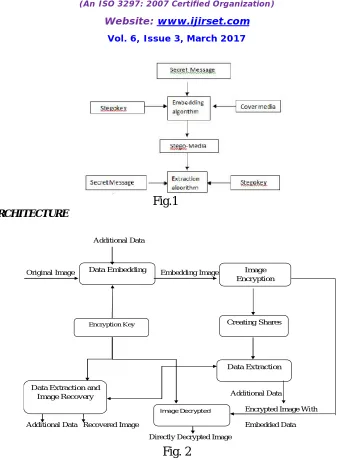
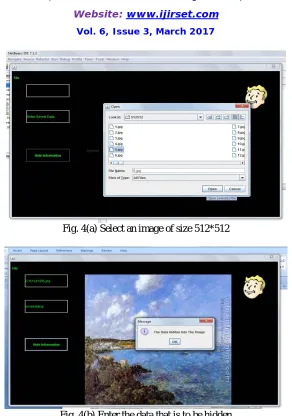
The proposed method can take advantage of all traditional RDH techniques for plain images and achieve excellent performance without loss of perfect secrecy. This method reserving room before encryption with a traditional RDH algorithm, and thus it is easy for the data hider to reversibly embed data in the encrypted image and great improvement on the quality of marked decrypted images. A receiver can successfully extract the embedded secret data and recover the original content in the subsets with an inverse order.
Fig.1
A. SYSTEM ARCHITECTURE
Fig. 2
B. PROPOSED ALGORITHM
The proposed Novel Embedding Image Encryption Method (NEIEM) has two major steps. In this algorithm, firstly, to get the place where the message is to be embedded and second, implement the embedding algorithm given below.
Step 1: Find Location to embed a message 1. Divide the cover image into blocks. 2. Calculate the median for each block M.
Additional Data
Original Image Embedding Image
Additional Data
Encrypted Image With
Additional Data Recovered Image Embedded Data
Directly Decrypted Image
Data Extraction
Image Decrypted Data Extraction and
Image Recovery
Data Embedding Image
Encryption
(Go to step 2)
Step 2: Embedding Algorithm
1. Split each pixel Pi into two equal parts.
2. Make the least significant four bits of the pixel to zeros. 3. Split the Message into two equal parts.
4. Make the most significant four bits to the zeros. 5. Apply bitxor operation on the two results.
The recipient uses the extraction algorithm i.e. reverse order of embedding algorithm to extract the secret message from the stego-image.
B.1REVERSIBLE DATA HIDING
Reversible Data hiding Image is a technique, by which the original cover can be loss lessly recovered after the embedded message has beenextracted.Reversible data hiding is very useful for some extremely image such like medical images and military images. In reversible data hiding schemes, some schemes are good performance at hiding capacity but have a bad stego image quality, some schemes are good stego image quality but have a low hiding capacity. It is difficult to find the balance between the hiding capacity and stego image quality. In this paper, a novel reversible data hiding scheme is proposed. The proposed scheme uses a new embedding method, which is called Even-Odd embedding method, to keep the stego image quality in an acceptable level, and uses the multi-layer embedding to increase the hiding capacity.
B.2 IMAGE ENCRYPTION
This describes the encryption of image to be transmitted. Here visual cryptography algorithm used for encrypt the image. So first the image is converting into streams of data array and each data will be encrypted. The shares will be created based on the number of users. For example if 5 users are there i.e creating five shares. For each share the user can reveal the image but only after five shares he can view the full image. This algorithm not uses the encryption key because if the key is obtained by some unauthorized person then he will reveal the image very easily.
Fig.3
B.3 DATA EMBEDDING
Step 1: Assume that the size of the host image is 512×512. Host image is divided into small M×M blocks Z, block Z is divided into small M ×M blocks Y. If M=8 is used, the size of block Y is 8×8.
Z
Z
Z
Z
Block Z (64*64) Block Y (8*8)
Step 2: A number of pairs of coefficients (A, B) in block Y are chosen as A = a1, . . . , an,
B = b1. . . bn based on a pseudo-random numbers, and mapping key that contains index of original chosen coefficients are kept.
Step 3: For embedding, two coefficient values (ai, bi) are modified by add parameterwhich is a parameter for watermark strength. i=1,…, n.
Step 4: Continue the above process according to n. Each block Y is embedded 1 bit watermark and watermark length decides how many blocks Y is embedded.
B.4 DATA PROTECTION
Image retrieval is computationally intensive and can benefit from offloading to save energy. To handle the protected data, the image retrieval program may be modified; the modified program must provide acceptable retrieval performance compared with the original program and unprotected data. Different retrieval algorithms may need different protection schemes. Consider two retrieval algorithms: Img Seek and Gabor filtering, and two protection schemes: Steganography and homomorphism encryption. Steganography uses a cover image to disguise the secret image so that it is difficult to detect. A simple and commonly used image Steganography technique is hiding images by replacing bits from the cover image with bits from the secret image. Encryption transforms plain data to make them unreadable. Steganography is different from encryption: the former hides the existence of data. In contrast, encryption makes the data meaningless without the key. ImgSeek can be performed on Steganography data as based on the linear property of feature extraction. However, ImgSeek assumes the images are with the same scales and orientations. Gabor filtering has better accuracy than ImgSeek for searching similar images with rotated objects. When using Gabor filtering, Steganography is not suitable to protect data anymore, because the feature extraction in Gabor does not show linear properties. Homomorphism encryption can be used in Gabor retrieval, because Gabor filtering mostly performs additions and multiplications on encrypted data.
B.5 EXTRACTING DATA FROM ENCRYPTED IMAGES
To manage and update personal information of images which are encrypted for protecting clients’ privacy, an inferior database manager may only get access to the data hiding key and have to manipulate data in encrypted domain. The order of data extraction before image decryption guarantees the feasibility of our work in this case. When the
1
3
0
-1
0
28 5
0
-3 23 34
64
1
9
54
92
Y Y
Y
Y Y
Y
Y Y
Y
B.6EXTRACTING DATA FROM DECRYPTED IMAGES
In Case, both embedding and extraction of the data are manipulated in encrypted domain. On the other hand, there is a different situation that the user wants to decrypt the image first and extracts the data from the decrypted image when it is needed. The following example is an application for such scenario. Assume Alice outsourced her images to a cloud server, and the images are encrypted to protect their contents. Into the encrypted images, the cloud server marks the images by embedding some notation, including the identity of the images’ owner, the identity of the cloud server and time stamps, to manage the encrypted images. Note that the cloud server has no right to do any permanent damage to the images. Now an authorized user, Bob who has been shared the encryption key and the data hiding key, downloaded and decrypted the images. Bob hoped to get marked decrypted images, i.e., decrypted images still including the notation, which can be used to trace the source and history of the data.
B.7 DATA HIDING IN ENCRYPTED IMAGE
Once the data hider acquires the encrypted image, he can embed some data into it, although he does not get access to the original image. The embedding process starts with locating the encrypted version of image. After knowing how many bit-planes and rows of pixels one can modify, the data hider simply adopts LSB replacement to substitute the available bit-planes with additional data. Finally, the data hider sets a label following to point out the end position of embedding process and further encrypts according to the data hiding key to formulate marked encrypted image denoted by. Anyone who does not possess the data hiding key could not extract the additional data.
IV. EXPERIMENTAL RESULTS
A. ENCRYPTION PROCESS
In the proposed method the data which is to be sent is encrypted using Advanced Encryption Standard algorithm with a secret key. The secret key should be known to the receiver so that he can decrypt the hidden data.Then proposed method uses the reversible encrypted data concealment in digital images using visual cryptography algorithm and then least significant bit replacement technique.
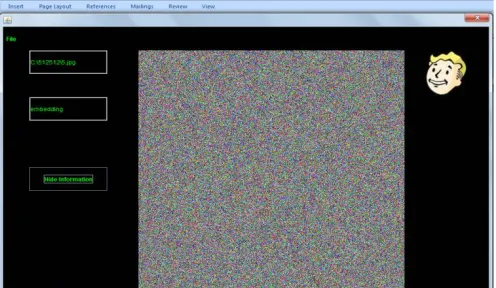
Fig. 4(a) Select an image of size 512*512
Fig. 4(b) Enter the data that is to be hidden
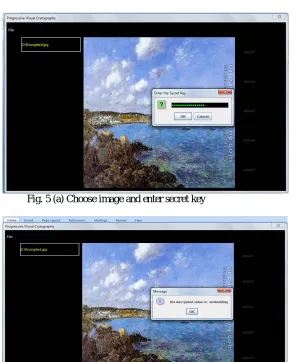
Fig.4(c) Shares are created (Two shares are shown)
Fig. 4(d) Encrypted image (After 5th share the encrypted image is formed)
B. DECRYPTION PROCESS
Fig. 5 (a) Choose image and enter secret key
Fig. 5 (b) Decrypted Image
V. CONCLUSION
However, the lossy compression method compatible with encrypted images generated by pixel permutation is not suitable here since the encryption is performed by bit-XOR operation. In the future, a comprehensive combination of image encryption and data hiding compatible with lossy compression deserves further investigation.
REFERENCES
[1]J. Fridrich, T. Pevný, and J. Kodovský, “Statistically undetectable JPEG steganography: Dead ends challenges, andopportunities”, in Proc. 9th ACM Workshop Multimedia Security, Dallas, TX, USA, pp. 3–14, Sep. 2007.
[2] A. Westfeld, “F5-A Stenographic algorithm”, in Proc. 4th Inf. Hiding Conf., vol. 2137, pp. 289–302, 2001.
[3] T. Kalker and F.M.Willems, “Capacity bounds and code constructions for reversible data-hiding”, in Proc. 14thInt. Conf. Digital Signal
Processing
(DSP2002), pp. 71–76, 2002.
[4] W. Zhang, B. Chen, and N. Yu, “Capacity-approaching codes for reversible data hiding”, in Proc 13th InformationHiding (IH’2011),LNCS 6958, pp. 255–269, Springer-Verlag, 2011.
[5]W. Zhang, B. Chen, and N. Yu, “Improving various reversible data hiding schemes via optimal codes for binarycovers”, IEEE Trans.Image Process, vol. 21, no. 6, pp. 2991–3003, Jun. 2012.
[6] J. Fridrich and M. Goljan, “Lossless data embedding for all image formats”, in Proc. SPIE Proc. Photonics West, Electronic Imaging, Securityand Watermarking of Multimedia Contents, San Jose, CA, USA, vol. 4675, pp. 572–583, Jan. 2002.
[7] J. Tian, “Reversible data embedding using a difference expansion”,IEEE Trans. Circuits Syst. Video Technol., vol. 13, no. 8, pp. 890–896, Aug.2003.
[8] D.M. Thodi and J. J. Rodriguez, “Expansion embedding techniques for reversible watermarking”,IEEE Trans. Image Process., vol. 16, no. 3,pp. 721–730, Mar. 2007.
[9] J. Kodovský and J. Fridrich, “Steganalysis of JPEG images using rich models”, Proc. SPIE, vol. 8303, p. 83030A,Jan. 2012.
[10]T. Filler, J. Judas, and J. Fridrich, “Minimizing embedding impact in steganography usingtrellis-coded quantization”, in Proc. SPIE, Electron.Imag., Security, Forensics Multimedia XII, N. D. Memon, E. J. Delp, P. W. Wong, and J. Dittmann, Eds., San Jose, CA, Jan. 17–21, vol. 7541, pp. 05-01–05-14, 2010.
[11]C. Chen and Y. Q. Shi, “JPEG image steganalysis utilizing both intrablock and interblock correlations,” in Proc. IEEE Int. Symp. Circuits Syst.
pp. 3029–3032, Mar. 2008.
[12]N. Provos, “Defending against statistical steganalysis”, in Proc. 10th USENIX Security Symp., Washington, DC, USA, pp. 323–335, 2001.
[13]J. Kodovský, J. Fridrich, and V. Holub, “Ensemble classifiers for steganalysis of digital media”, IEEE Trans. Inf. Forensics Security, vol.7,no.2, pp. 432–444, Apr. 2012.
[14]J. Kodovský and J. Fridrich, “Calibration revisited”, in Proc. 11th ACM Workshop Multimedia Security, New York, NY, USA, pp. 63–74. Sep.
2009.
BIOGRAPHY