DOI: 10.1534/genetics.105.044560
High Functional Overlap Between MluI Cell-Cycle Box Binding Factor and
Swi4/6 Cell-Cycle Box Binding Factor in the G1/S Transcriptional
Program in
Saccharomyces cerevisiae
James M. Bean, Eric D. Siggia and Frederick R. Cross
1Rockefeller University, New York, New York 10021 Manuscript received April 18, 2005 Accepted for publication June 7, 2005
ABSTRACT
In budding yeast, many genes are induced early in the cell cycle. Induction of these genes has been predominantly attributed to two transcription factors, Swi4-Swi6 (SBF) and Mbp1-Swi6 (MBF). Swi4 and Mbp1 are related DNA-binding proteins with dissimilar target sequences. For most G1/S-regulated genes that we tested in acdc20block-release protocol for cell-cycle synchronization, removal of both Swi4 and Mbp1 was necessary and sufficient to essentially eliminate cell-cycle-regulated expression. Detectable SBF or MBF binding sites (SCBs or MCBs) in the promoters or available genome-wide promoter occupancy data do not consistently explain this functional overlap. The overlapping ability of these transcription factors to regulate many promoters with very similar cell-cycle kinetics may provide robustness to the G1/S transcriptional response, but poses a puzzle with respect to promoter-transcription factor specificity. In addition, for some genes, deletion of Mbp1 or Swi4 enhances transcription, suggesting that these factors can also function as transcriptional repressors. Finally, we observe residual G1/S transcriptional regu-lation in the absence of Swi4 and Mbp1.
C
OMMITMENT to the cell cycle in eukaryotic cells occurs late in G1 at a point termed Start (Pringle and Hartwell 1981). Start coincides with a peak in transcription of.200 genes including the G1 cyclinsCLN1andCLN2, the B-type cyclinsCLB5andCLB6, and the mating-type switch endonuclease HO, along with many other genes involved in DNA synthesis, budding, and spindle pole body duplication (Cho et al. 1998; Spellmanet al. 1998). Timely G1-specific transcription requires the G1 cyclin Cln3 (Tyerset al. 1993; Dirick
et al. 1995; Stuart and Wittenberg 1995) and the cyclin-dependent kinase, Cdc28 (Koch et al. 1996). Cln3-Cdc28 promotes transcriptional activation by for-mation of the RNA polymerase II holoenzyme at the TATA boxes of the G1 cyclinsCLN1andCLN2, among others (Cosma et al. 2001). Cln3 activates cell-cycle initiation in a dosage-dependent manner (Cross1988; Tyerset al. 1993). Regulation of cell size, pheromone sensitivity, and budding by Cln3 are dependent on the transcription factors MluI cell-cycle box binding factor (MBF) and Swi4/6 cell-cycle box binding factor (SBF) (Wijnen et al. 2002). Cln1 and Cln2 activation may represent the key event of Start. Cln1,2-Cdc28 com-plexes are involved in activating a number of pathways, including activation of B-type cyclins, bud emergence, and microtubule organizing center duplication (re-viewed in Cross1995).
Much of the Start transcriptional program depends on two related transcription factors, MBF and SBF (reviewed by Kochand Nasmyth 1994). MBF is com-posed of two proteins: Swi6, thetrans-activating compo-nent, and Mbp1, the DNA-binding component. Mbp1 recognizes the MluI cell-cycle box (MCB), ACGCG (Koch et al. 1993). One study has found that Stb1, a Swi6-binding protein involved in Start transcription (Hoet al. 1999), is a specific regulator of MBF-dependent transcription (Costanzoet al. 2003). In addition to its role as a G1/S transcriptional activator, a role for MBF as a repressor during other stages of the cell cycle has been proposed (Kochet al. 1993).
SBF is composed of two proteins: Swi6 and Swi4, a homolog of Mbp1 that acts as the DNA-binding com-ponent of SBF. SBF recognizes the Swi4/6 cell-cycle box (SCB) CRCGAAA (Breeden and Nasmyth 1987; Andrews and Herskowitz 1989b; Tabaet al. 1991). Consistent with the roles of SBF and MBF as DNA-binding factors that coordinately regulate the broad G1/S transcriptional regulatory program, three genome-wide location analyses show binding of MBF and SBF to a broad range of targets, in which SCB and MCB sites are enriched (Iyeret al. 2001; Simonet al. 2001; Harbison
et al. 2004).
Whi5, a negative regulator of cell-cycle Start, was identified by small cell size in whi5 deletion strains ( Jorgensenet al. 2002; Zhanget al. 2002). Whi5 binds to SBF and acts as a repressor of G1-specific transcription. Dissociation of Whi5 from SBF is dependent on Cln3,
1Corresponding author:Rockefeller University, 1230 York Ave., Box 237,
New York, NY 10021. E-mail: [email protected]
and in the absence of Whi5 the requirement for Cln3 in transcriptional activation is much reduced (Costanzo
et al. 2004; DeBruinet al. 2004). A similar role for Whi5 as a repressor of MBF-dependent transcription has also been proposed (Costanzoet al. 2004).
The single deletion mutantsswi4andmbp1are viable in
Saccharomyces cerevisiae. However, the double deletion mu-tantmbp1 swi4is inviable with arrest occurring in G1. The
mbp1 swi4lethality can be rescued by constitutive expres-sion ofCLN2, suggesting that the lethality stems primarily from failure to express G1 cyclins (Kochet al. 1993). A role for Cln3p as an activator of MBF and SBF has been proposed (Wijnen et al. 2002). However, cln3 deletion mutants are viable with delayed expression of MBF- and SBF-regulated genes whereas mbp1 swi4 strains are in-viable, suggesting additional activators of MBF and SBF.
BCK2andCTR9encode candidate SBF and MBF activa-tors that are essential in the absence of Cln3 (Epsteinand Cross 1994; Di Como et al. 1995; Koch et al. 1999). Furthermore, incln3deletion strainsCLN1andCLN2are sufficient for transcriptional activation via a model of positive feedback (Cross and Tinkelenberg 1991; Dirick and Nasmyth 1991; Nasmyth and Dirick 1991; Tyers et al. 1993; Dirick et al. 1995; Stuart and Wittenberg1995; Costanzoet al. 2004; DeBruin
et al. 2004), in which Cln1,2 can inactivate Whi5 and/ or directly activate SBF/MBF, thus driving their own transcription.
Despite the substantial amount of information that has been accumulated about SBF and MBF and the control of G1/S-regulated transcription, some mysteries remain. In some cases, it has been noted that removal of either Swi4 or Mbp1 has at best minor effects on the transcriptional activation of putative SBF or MBF target genes, respectively (Kochet al. 1993; Crosset al. 1994). In some circumstances Swi4 and Mbp1 may be func-tionally redundant, either because of the presence of both SCBs and MCBs in the promoters of some genes (e.g.,CLN2; Stuartand Wittenberg1994) or because of cross-binding of SBF and MBF to MCBs and SCBs, respectively (Koch et al. 1993; Partridge et al. 1997; Tayloret al.2000). Functional redundancy of Swi4 and Mbp1 has never been tested directly, primarily because the lethality of swi4 mbp1 double mutants precludes simple analysis.
Here we directly analyze overlap of Swi4 and Mbp1 in the G1/S transcriptional regulation of multiple genes. We wished to distinguish between (i) Swi4- or Mbp1-specific regulation, so that the appropriate single deletion would abolish regulation; (ii) overlapping function of Swi4 and Mbp1, so that only the double deletion would abolish reg-ulation; or (iii) Swi4- and Mbp1-independent regulation.
MATERIALS AND METHODS
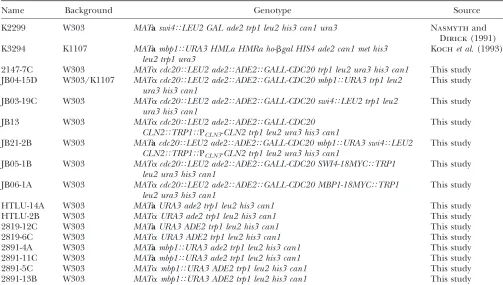
Strains and plasmids:All yeast strains used are described in Table 1. JB04-15D is a segregant of a cross between 2147-7C
and K3294. JB03-19C is a segregant of a cross between 2147-7C and K2299. Plasmid pI411 was created by inserting900 bp of theCLN3 promoter fused to 1.6 kbCLN2coding sequence with three HA tags at the 39end between theSalI andSacII sites in the multiple cloning site (MCS) of pRS304. ASpeI digest of pI411 was used to transform 2147-7C by integration at the CLN2locus to create JB13. Plasmid pKL035 was created by inserting 700 bp of theGAL-inducible promoter fused to 1.6 kbCLN2coding sequence with three HA tags at the 39end between theSalI andSacII sites in the MCS of pRS404. ASpeI digest of pKL035 was used to transform 2147-7C by integration at the CLN2locus to create JB14. JB21-2C was created in a similar way to JB13 by first transforming strain K2299 with SpeI-digested pI411 and then crossing the resulting transformed strain to JB04-15D and selecting segregants. All integrations were confirmed by anSspI Southern blot.
Growth and synchronization procedures:YEP medium was used for all experiments, supplemented with the appropriate carbon source as indicated below. Yeast cultures were shaken at 250 rpm, in a volume no more than 20% of the container maximum at 30°. Cell-cycle synchronization was achieved by thecdc20 GALL-CDC20block release in 2147-7C, JB13, JB03-19C, JB04-15D, and JB21-2C by growing cells to early log phase in YEP1galactose (3%) and then filtering them and growing them in YEP 1 glucose (2%) for 3 hr to arrest cells in metaphase.GALLis a truncated version of theGAL1promoter that shows inducible but significantly lower expression than the full-lengthGAL1promoter (Mumberget al.1994). Cells
were released from the block by filtering back into YEP 1
galactose (3%).
Northern blot analysis: Procedures for Northern blot analysis of mRNA were as described previously (McKinney
et al. 1993). RNA was harvested from synchronized cultures every 15 min for 2–3 hr. Probes were generated by polymerase chain reaction using Research Genetics (Birmingham, AL) primer pairs for each gene tested. DNA fragments were radiolabeled by random-prime labeling using a Prime-It II kit (Stratagene, La Jolla, CA), and transcript levels were visualized and quantitated using a Molecular Dynamics (Sunnyvale, CA) STORM PhosphorImager system. Each blot contained a mutant time course and the relevant wild-type control time course run below it (2147-7C for JB03-19C and JB04-15D; JB13 for JB21-2C). All blots were probed withTCM1 as a loading control. TCM1expression has been previously shown to be non-cell-cycle regulated and useful as a loading control for Northern blots (McKinneyet al. 1993; Oehlen
et al.1996); lack of cell-cycle regulation ofTCM1was also ob-served in the genome-wide study of Spellmanet al.(1998).
denominator should not be allowed to get smaller than the measurement error. A precise formula can be derived for the average of the logarithm of two variables, each distributed with a mean and standard deviation. In the context of actual measurements this implies that intensities (after background subtraction) are positive, and that the standard deviation should be added to small quantities before taking the ratio and the logarithm. For the ratios of expression of 2147-7C the average of two replicate Northern blots for each gene was used. The ratios of expression found by microarray hybridization (Spellmanet al., 1998; Figure 2A) were calculated by
averag-ing expression ratios from four different methods of cell synchronization. To calculate ratios of expression in mutant strains relative to that in control strains (Figure 2B), the following was done: Mutant expression was defined as the normalized peak value of the mutant minus the average normalized trough value of the mutant. Control expression was defined as the normalized peak value of the control minus the average normalized trough value of the control. The ratio of expression was defined as mutant expression divided by con-trol expression. We recognize that this metric, while conve-nient, does ignore some kinetic details of precise peak timing and peak width (seeresults). In all G1/S-regulated genes
tested for which any regulated expression was detected in the various mutant strains, the peaks of expression remained at approximately the same point in the cell cycle as those in the wild-type strain. In none of the genes tested was there significant unregulated expression or peak expression at any point in the cell cycle other than G1/S. The raw quantitation of all the Northern blot data used is available upon request.
Analysis of published genome-wide binding data sets: To compare the binding of MBF and SBF found in previous pub-lished genome-wide location analyses (Figure 2D; Figure 3) we used the supplementary data available from three data sets (Iyer et al. 2001, http://genome-www.stanford.edu/
chromatinip/; Simon et al. 2001, http://web.wi.mit.edu/
young/cellcycle; Harbison et al. 2004, http://web.wi.mit.
edu/young/regulatory_code). For the first data set (Iyeret al.
2001), the figure3_data.xls file was used to identify MBF-bound, SBF-MBF-bound, and MBF1SBF-bound ORFs, including divergently transcribed ORFs, which satisfied the authors’ criteria. For the second data set (Simon et al. 2001), the
all_genes.xls file was used to sort out all ORFs withP-values
,0.001 for binding of Mbp1 (or Mbp11Swi6) and Swi4. For the third data set (Harbison et al. 2004), the pvalbygene_
forpaper_abbr.xls file was used to sort out all ORFs with P-values,0.001 for binding of Mbp1 (or Mbp11Swi6) and Swi4. For all lists any duplicate ORFs were removed and care was taken to correct any alternate ORF names. For all com-parisons the systematic yeast gene names were used. A UNIX shell script was used to compare the MBF-only-, SBF-only-, and MBF1 SBF-bound gene lists from the three data sets. To determine the conservation of MBF and SBF binding sites acrosssensu strictuSaccharomyces species, we used the yeast regulatory map available from the third data set (Harbison
et al. 2004) at http://jura.wi.mit.edu/fraenkel/regcode/.
MCB and SCB consensus site counts:To count the number of MCBs and/or SCBs in the promoters of the genes tested, a regular expression search of the upstream intergenic sequence of each gene was performed. For this analysis, we defined MCB as ACGCG and SCB as CRCGAAA (where R represents A or G).
Chromatin immunoprecipitations: ChIP was performed as described (Wilmeset al. 2004), with some modifications. Cells
from an untagged strain (2147-7C), a Swi4-Myc-tagged strain ( JB05-1B), and a Mbp1-Myc-tagged strain ( JB06-1A) were synchronized by the cdc20 GALL-CDC20 block release at midlog phase. Cells were formaldehyde fixed 40 min after
release, which is at approximately the peak of G1/S-regulated gene expression in this protocol. One-tenth of the whole-cell extract was set aside for input DNA. Mbp1-Myc and Swi4-Myc were immunoprecipitated overnight with a 1:250 dilution of 9E11 monoclonal antibody (Genetex). For amplification by PCR, fiftieth of the immunoprecipitated DNA and one-fiftieth of the input DNA were used as template. Multiplex PCR was performed using oligos for the non-G1/S-regulatedURA3 as a control along with G1/S-regulated promoter-specific oligos. PCR was performed using PuReTaq Ready-To-Go PCR Beads (Amersham Biosciences, Arlington Heights, IL) in a RoboCycler 96 temperature cycler (Stratagene), separated on 1.5% agarose gels, and stained with 13Sybr Green (Molecular Probes, Eugene, OR). Primer sequences are available upon request.
Coulter counting: Mode cell volume measurements were made using a Beckman Coulter Z Series Z2 Coulter particle count and size analyzer. All cultures were grown to midlog phase in YPD and sonicated before analysis. For each strain, triplicate counts were obtained from the same culture and averaged. Mode cell volume for each strain was then obtained from those averaged size profiles.
RESULTS
Construction of a set of strains allowing cell-cycle synchronization in the absence of Swi4, Mbp1, or both: To examine the roles of MBF and SBF as transcriptional regulators we have made use of single deletion strains of
mbp1 and swi4. In addition, we have created double deletion strains ofmbp1 swi4. To construct the normally inviable double mutant strain, we made use of the ob-servation of Kochet al.(1993) thatmbp1 swi4mutants were viable when CLN2was placed under control of a constitutive promoter. We observed reasonably efficient rescue of viablembp1 swi4mutant strains by inclusion of an integrated construct containingCLN2under the control of theCLN3promoter, PCLN3-CLN2(Valdivieso
et al. 1993; Levineet al. 1996).
temporally from the G1/S transition where most Swi4-and Mbp1-dependent expression is thought to occur.
To assess the synchrony of thembp1 swi4PCLN3-CLN2
cdc20 GALL-CDC20strain uponcdc20 block release, we examined expression of two cell-cycle-regulated genes expressed at different parts of the cell cycle, neither of which is thought to be under control of SBF/MBF. Expression of the cyclin-dependent kinase inhibitor
SIC1is induced in M/G1 by Swi5p (Toynet al. 1996).
SIC1expression was regulated in a cell-cycle-dependent manner in thembp1 swi4double mutant similar to that in the respective control strain, indicating that the double mutant strain exits mitosis and activates Swi5 on schedule upon release of thecdc20block. In addition, accumula-tion of SIC1 transcript in a second weaker peak after release in both wild type and the mbp1swi4 mutant indicates successful completion of a second mitosis following release of the block (Figure 1). Likewise, the
SWI5transcription factor itself, which is transcribed in S, G2, and M (Nasmyth et al. 1987) under control of Ndd1/Mcm1p/Fkh1,2 (Lydallet al. 1991; Althoefer
et al. 1995; Koranda et al. 2000; Zhu et al. 2000), was regulated in a normal cell-cycle-dependent manner in thembp1 swi4double mutant (Figure 1). These controls indicate that the cell cycle proceeds with relatively normal kinetics in thembp1 swi4mutant following release of the mitoticcdc20 block through the next mitosis, as indicated by probing expression of genes controlled by transcription factors other than SBF/MBF, thus validat-ing this assay for examination of genes thought to be under direct control of SBF/MBF.
Examination of a subset of genes in the G1/S
program for Swi4/Mbp1 requirements: To dissect the
specificity and/or redundancy of SBF and MBF for transcriptional regulation of G1/S targets, we looked at expression profiles ofcdc20 GALL-CDC20synchronized cultures ofmbp1,swi4, andmbp1 swi4PCLN3-CLN2strains (Table 1) by Northern blot analysis. We analyzed expression levels in thecdc20block-release protocol of 23 G1/S transcripts in all these strains (Figure 2), as well as four additional transcripts analyzed only in WT and the singlembp1andswi4mutants (CLN1,CLN2,PCL1,
TABLE 1
Yeast strains used in this study
Name Background Genotype Source
K2299 W303 MATaswi4TLEU2 GAL ade2 trp1 leu2 his3 can1 ura3 Nasmythand
Dirick(1991)
K3294 K1107 MATambp1TURA3 HMLa HMRa ho-bgal HIS4 ade2 can1 met his3 leu2 trp1 ura3
Kochet al. (1993)
2147-7C W303 MATacdc20TLEU2 ade2TADE2TGALL-CDC20 trp1 leu2 ura3 his3 can1 This study JB04-15D W303/K1107 MATacdc20TLEU2 ade2TADE2TGALL-CDC20 mbp1TURA3 trp1 leu2
ura3 his3 can1
This study
JB03-19C W303 MATacdc20TLEU2 ade2TADE2TGALL-CDC20 swi4TLEU2 trp1 leu2 ura3 his3 can1
This study
JB13 W303 MATacdc20TLEU2 ade2TADE2TGALL-CDC20 CLN2TTRP1TPCLN3-CLN2 trp1 leu2 ura3 his3 can1
This study
JB21-2B W303 MATacdc20TLEU2 ade2TADE2TGALL-CDC20 mbp1TURA3 swi4TLEU2 CLN2TTRP1TPCLN3-CLN2 trp1 leu2 ura3 his3 can1
This study
JB05-1B W303 MATacdc20TLEU2 ade2TADE2TGALL-CDC20 SWI4-18MYCTTRP1 leu2 ura3 his3 can1
This study
JB06-1A W303 MATacdc20TLEU2 ade2TADE2TGALL-CDC20 MBP1-18MYCTTRP1 leu2 ura3 his3 can1
This study
HTLU-14A W303 MATaURA3 ade2 trp1 leu2 his3 can1 This study
HTLU-2B W303 MATaURA3 ade2 trp1 leu2 his3 can1 This study
2819-12C W303 MATaURA3 ADE2 trp1 leu2 his3 can1 This study
2819-6C W303 MATaURA3 ADE2 trp1 leu2 his3 can1 This study
2891-4A W303 MATambp1TURA3 ade2 trp1 leu2 his3 can1 This study 2891-11C W303 MATambp1TURA3 ade2 trp1 leu2 his3 can1 This study 2891-5C W303 MATambp1TURA3 ADE2 trp1 leu2 his3 can1 This study 2891-13B W303 MATambp1TURA3 ADE2 trp1 leu2 his3 can1 This study
Figure1.—Northern blot analysis of control genes and representative G1/S-regulated genes. Northern blots of total RNA from
cdc20 GALL-CDC20-synchronized cultures for each selected gene and the correspondingTCM1loading control are shown formbp1 ( JB04-15D, blue),swi4( JB03-19C, red),mbp1 swi4( JB21-2B, green), and WT (2147-7C or JB13, black) strains over time. Total RNA from unsynchronized cultures is also shown (cyc). Quantitation of expression from each blot is also shown as expression level relative to the peak of expression of the WT control as a function of time from block release. For quantitation, all probes in each strain were normalized usingTCM1probed on the same blot. For theCLB2andCLB5genes, no 165- or 180-min time point was collected for any strain and no 135- or 150-min time point was collected formbp1orswi4single deletion strains.
Figure2.—Comparison of expression data in mutants, consensus binding sites, and genome-wide binding data. (A) Log 2of the
ratio of expression of genes in WT (2147-7C, blue), PCLN3-CLN2( JB13, purple), and by microarray hybridization (Spellmanet al.
1998, orange). Ratios of expression for WT are the averages of two experiments. For each gene, the ratio of expression for WT and PCLN3-CLN2is defined as Log2(Peak/(s1Trough)), where the trough value is normalized to the peak value, which is set to one.s
is the error in measurement of the trough value. The ratio of expression for microarray hybridization is the average of the log2of
the expression ratios from four different methods of cell synchronization (Spellmanet al. 1998). The ratios of expression of the
and CLB6; data not shown). These transcripts were selected on the basis of the following criteria: A number of previously identified canonical SBF and MBF targets were selected to test along with a random sampling of transcripts found to be at least moderately cell-cycle regulated (Spellmanet al. 1998) and weighted in favor of those with a consensus with respect to Mbp1 and/or Swi4 binding in the genome-wide binding data (Iyer
et al. 2001; Simon et al. 2001; Harbison et al. 2004). Sample data for some of these transcripts are presented in Figure 1, and a compilation of the data for 23 G1/S transcripts and the two controls discussed above (SIC1
andSWI5) is shown in Figure 2B.
Because of the history of strain construction in this project, we used different controls for the singlembp1
andswi4mutants than for the doublembp1 swi4mutant. For the single mutants, the control strain was a simple
MBP1 SWI4wild type, while for the doubleswi4 mbp1
mutant, which was rescued by PCLN3-CLN2, the control strain wasMBP1 SWI4PCLN3-CLN2. To compare among all the experiments, it is important to establish that in the wild-type context, PCLN3-CLN2did not significantly affect G1/S-regulated gene expression. Figure 2A dem-onstrates that this is the case: The peak/trough ratios for the 25 genes tested are generally quite comparable with or without PCLN3-CLN2 (CWP1 displays a significant effect of PCLN3-CLN2 on its peak/trough ratio relative to that of wild type and the effect of this on the ratios of expression in mutants is discussed below; a less dramatic effect of PCLN3-CLN2is also seen inSWI5). These peak/ trough ratios are also generally comparable to the genome-wide data of Spellmanet al. (1998) (shown in Figure 2A), obtained using several different methods of cell-cycle synchronization.
In Figure 2B, the data are condensed for each transcript as the relative cell-cycle-regulated induction (peak/trough) for each gene in thembp1 swi4double mutant compared to that in wild type (Figure 2B, top, green bars) or in thembp1orswi4single mutants com-pared to that in wild type (Figure 2B, bottom, blue and red bars, respectively). Fifteen of the G1/S targets showed evidence of being under redundant positive control of MBF and SBF since their peak/trough ex-pression ratios were not significantly reduced by single deletion ofMBP1orSWI4but were significantly reduced by concurrent removal of bothMBP1andSWI4. Seven
genes, including the G1 cyclinsCLN1,CLN2,PCL1, and the B-type cyclinCLB6(not shown) andYHP1andYOX1
(Figure 1; Figure 2B) had significantly reduced peaks of expression after removal ofSWI4but were unaffected by removal of MBP1. Only one gene tested, CDC45, was found to have peak expression reduced significantly by a single deletion ofMBP1but to be unaffected by deletion ofSWI4.
Interestingly, the genes tested exhibited varying degrees of residual control in the swi4 mbp1 double mutant. In Figure 2B, we indicate semi-arbitrary ‘‘normal,’’ ‘‘reduced,’’ and ‘‘off’’ cutoffs of .50%,,50%, and,25% of wild type as visual aids; 10 genes are in the off class, 8 are in the reduced class, and 5 are in the normal class. The G1/S-regulated genes in the normal class,PLM2,EXG1,DUN1, and ERP3, clearly demonstrate the existence of func-tional G1/S cell-cycle control by other factors beyond Mbp1 and Swi4, and a similar conclusion can be reached from the broad class of genes showing reduced but still clearly detectable regulation in the swi4 mbp1 double mutant (CLB2, though within the normal class, is a unique case; seeresultshereafter anddiscussion).
While the quantitative measure we chose to charac-terize expression was peak/trough ratio, for many genes there was an apparent delay in peak expression due to removal ofSWI4orMBP1(see Figure 1 for examples). Since these differences are almost all single 15-min time-point differences in these time courses, we cannot accurately quantitate the actual peak displacement, but we note that these differences suggest a degree of independent function of Swi4 and Mbp1 at many promoters, at least at early times during the induction. Mbp1 and Swi4 can act as transcriptional repressors
at some promoters: Three genes showed increases in
peak expression following removal of Mbp1: CLB2,
SPT21, (each about threefold elevated) and CWP1, showing a remarkable eightfold increase in peak ex-pression. As shown in Figure 2A, the peak:trough ratio ofCWP1measured in the wild-type control is reproduc-ibly and significantly lower than that of all other genes tested and this fact contributes to the eightfold increase in peak expression of CWP1 in the mbp1strain. In all cases, an essentially normal pattern of cell-cycle regula-tion of these genes was observed; the main difference was the sharply increased peak value. This result suggests that Mbp1 is acting as a negative regulator of expression
expression of the two control genes (SIC1 andSWI5) are shown on the left. (C) The number of MCBs (ACGCG) and SCBs (CRCGAAA) in the intergenic region upstream from each gene is shown. For divergently transcribed genes sharing the same upstream intergenic region, any sites are listed for both genes. The numbers of sites in the promoter regions of the two controls (SIC1andSWI5) are shown on the left. (D) For each gene, the binding status of MBF and SBF is shown for three genome-wide binding data sets: study A (Iyeret al. 2001), study B (Simonet al. 2001), and study C (Harbisonet al. 2004). M (blue) indicates only
MBF binding, S (red) indicates only SBF binding, B (green) indicates both MBF and SBF binding, and N (black) indicates neither MBF nor SBF binding. Also shown (bottom row) for each gene is the presence of MBF binding sites and/or SBF binding sites that are conserved acrosssensu strictuSaccharomyces species according to one data set (Harbisonet al. 2004). For this row, M (blue)
of these genes specifically at the normal peak expression time. Previously, Mbp1 was proposed to inhibit expres-sion of its target genes during times when the genes were turned off (Koch et al. 1993). Our observations here suggest in addition that Mbp1 can also be an inhibitor during the G1/S interval, when it is thought to be activated for expression of its canonical targets (Koch and Nasmyth 1994). The three genes exhibiting ele-vated expression in response toMBP1deletion differ in their response to removal of Swi4, withCLB2 showing very strong Swi4 dependence compared to SPT21 and
CWP1. Perhaps related to this, Clb2 but not the other two shows a paradoxical increase in expression in theswi4 mbp1double mutant compared to that in theswi4single mutant (seediscussion).
PLM2peak/trough ratio was increased in the absence of either Swi4 or Mbp1 and was more strongly increased in the absence of both factors, suggesting that Swi4 and Mbp1 are jointly decreasing peak PLM2 expression.
ERP3,ELO1, TOS4, andMSB2 all exhibit increases in expression in the absence of Swi4 and/or Mbp1 (Figure 2B), suggesting varying patterns of repressive or activat-ing effects of the two factors at these promoters.
Previous work showed derepression of some G1/ S-regulated gene expression (TMP1,POL1, andCLB5)
in mbp1 G1 cells (Koch et al. 1993). Under the syn-chronization conditions of this study, we do not see derepression ofTMPorCLB5in G1 cells (Figure 1 and data not shown).
Site locations in promoters and published promoter occupancy data do not explain the pattern of Swi4/
Mbp1 requirements: Three genome-wide location
ana-lyses reported the binding of MBF and SBF across all yeast promoters (Iyer et al. 2001; Simon et al. 2001; Harbisonet al. 2004, respectively). We attempted to use these genome-wide binding data sets to explain the results of our Northern blot analyses, with limited success. Out of the 23 G1/S-regulated genes and two control genes we assayed, 18 were assigned the same binding patterns in all three data sets (Figure 2D). Since the list of genes we assayed by Northern blot was heavily weighted in favor of genes that shared Mbp1 and Swi4 binding by the genome-wide binding data sets, the extent of shared binding in this list cannot be used to assess the overall similarity of these data sets (see Figure 3). Even among those genes with the same binding pattern in the three genome-wide binding data sets, there is little predictive power for the effect of deletion of either Mbp1 or Swi4 or for the presence or absence of a consensus binding site.
Figure 3.—Venn diagrams of the
overlap of MBF and SBF binding in three genome-wide binding data sets. Venn diagrams depicting the overlap of MBF-only bound, SBF-only bound, or MBF- and SBF-bound genes in study A (Iyeret al. 2001), study B (Simonet al.
2001), and study C (Harbison et al.
2004) are shown. All the circles repre-senting the size of each of the nine sets (three data sets3three binding states) are drawn to scale; however, due to spa-tial constraints the overlaps between sets may not be to scale. The number given in parentheses next to each data set name for each binding state is the total number of genes with that binding state found in that data set. The numbers listed in red indicate the number of genes in that particular space. For exam-ple, in the MBF-only binding state, 35 (of 46) genes were found by study B (Simonet al. 2001) that were not found
by either of the other two data sets and 2 genes were found by study A (Iyer
et al. 2001) and study C (Harbisonet al.
2004) but not by study B (Simon et al.
CLB5is an example of the failure of the consensus motifs and binding data to predict function. Two genome-wide location analyses (Simon et al. 2001; Harbisonet al. 2004) found that the intergenic region upstream of CLB5 is bound by MBF but not by SBF whereas a third study (Iyer et al. 2001) found neither MBF nor SBF binding to theCLB5promoter. Northern blot analysis of yeast strains deleted formbp1,swi4, or
mbp1 swi4 shows that expression ofCLB5 transcript is not affected by deletion of mbp1 or swi4 alone but is completely abrogated by a double deletion ofmbp1 swi4
(Figure 1; Figure 2B). This suggests that in the absence of MBF, SBF is able to regulate CLB5 transcription normally despite the absence of any canonical SCB. The
CLB5promoter contains multiple MCBs but no canon-ical SCBs (Figure 2C). The regulatory element that SBF is binding in theCLB5promoter could be the MCBs or an unknown site (for example, a highly degenerate SCB) or SBF could be acting through indirect regula-tion (Horaket al.2002).
As an additional example, evidence from all three genome-wide location analyses (Iyeret al. 2001; Simon
et al. 2001; Harbisonet al. 2004) suggests thatRAD27, a gene that encodes a protein involved in DNA replication or repair, is bound by MBF and not by SBF. Its promoter contains several MCBs and one SCB. Northern blot analysis ofmbp1,swi4, andmbp1 swi4strains shows that
RAD27expression is not perturbed by eithermbp1orswi4
single deletions but is strongly affected by thembp1 swi4
double deletion (Figure 2B). This result suggests that
RAD27, likeCLB5, can be regulated by either MBF or SBF. This difference in Mbp1 and Swi4 binding among the G1/S-regulated genes we assayed underestimates the extent of the difference between the data sets across the entire yeast genome, as we used overlap among the binding data sets in initial selection of the set of G1/ S-regulated genes used in our Northern blot analysis. Across the genome, the three data sets shared 11–20% of MBF-only targets, 21–25% of SBF-only targets, and 5–7% of MBF 1 SBF targets (Figure 3). The evident high variability among the data sets may provide the simplest explanation for why these data sets were not highly predictive of which genes would be specificallyvs.
redundantly controlled by Swi4 or Mbp1.
We note further that simple inspection of the pro-moter sequences for canonical SCB or MCB sites was similarly only poorly predictive of the factor(s) required for appropriate gene regulation (Figure 2; some specific examples discussed above). In this site-counting mea-surement, we used only a single conventional definition of the SCB or MCB consensus; while other site defini-tions will naturally give different numbers of sites, no alternative definitions that we have tried (in anad hoc, nonexhaustive search) have given a clearly better fit to the data.
Chromatin immunoprecipitation of Mbp1 and Swi4
shows dual binding of promoters:Our data suggest that
Mbp1 and Swi4 overlap functionally in the control of many genes, with little correlation to the presence or absence of recognizable SCB/MCB sites in the pro-moters of these genes. This could be explained by the idea of cross-binding of Swi4 and Mbp1 to MCBs or SCBs, respectively. Consistent with this idea, it was proposed that Swi4 regulatesCLN1by binding to MCB elements in the CLN1 promoter (Partridge et al. 1997). Alternatively, the effects of Swi4 or Mbp1 on reg-ulation of some of these genes could be indirect, since other transcription factors are potential Swi4 targets (Horak et al.2002). To begin to distinguish between these possibilities, we used ChIP analysis to examine the binding of Swi4 or Mbp1 to several promoters (Figure 4). We tested the specificity of binding by three criteria. First, we compared the amount of promoter-specific PCR product from anti-Myc immunoprecipitated en-riched pools of DNA (IPs) from tagged vs. untagged strains and observed significantly higher amounts of product from the tagged strains (Figure 4, A and B). Second, we carried out the PCR reactions with inclusion of both promoter-specific oligonucleotides and oligonu-cleotides for amplifying a fragment ofURA3, as a negative control (Figure 4B). No specific enrichment of URA3
amplification in the IPs from the Swi4-tagged strain could be observed. Slight enrichment ofURA3 amplification was detected in the IPs from the Mbp1-tagged strain in a few reactions (Figure 4B). Third, we tested the IPs for enrichment of a fragment overlapping the CLN3 pro-moter and coding sequence (Figure 4A). TheCLN3 pro-moter possesses no canonical MCBs or SCBs and is not a G1/S-regulated gene (Spellmanet al. 1998; Mackayet al. 2001). No specific binding of Swi4 to the CLN3 frag-ment was detected; however, there was variable enrich-ment ofCLN3in IPs from the Mbp1-tagged strain. Thus, it appears that while Swi4 binding to all three G1/S promoters tested is specific, background apparently derived from nonspecific Mbp1-DNA interactions means that the data are suggestive but not conclusive of specific Mbp1 binding to the G1/S promoters. (We speculate that some ‘‘stickiness’’ of Mbp1 for nonspecific DNA could account for some of the variation in results in the genome-wide ChIP-chip experiments discussed above). The CLN2promoter shows specific binding of Swi4 and probably of Mbp1 (Figure 4).CLN2transcription is at least partially Swi4 dependent (see Introduction; our data not shown). This promoter contains several MCBs and SCBs (Stuartand Wittenberg1994), so Swi4 and Mbp1 could be binding to their cognate SCB/MCB sites or could occur through cross-binding. The finding that both Mbp1 and Swi4 are bound to theCLN2promoter is in keeping with a study that showed a decreased level of dimethylsulfate protection of theCLN2promoter in a strain lacking both Mbp1 and Swi4 compared to one lacking Swi4 alone (Kochet al. 1996).
MCBs nor SCBs on the basis of simple counting of consensus sites; despite this, we find specific binding of Swi4, and evidence suggestive of specific binding of Mbp1, to this promoter (Figure 4). YOX1 is Swi4 dependent (Figure 2) despite the absence of canonical SCBs from its promoter. We find specific binding of both Swi4 and probably Mbp1 to this promoter (Figure 4). It is possible that Swi4 is binding to the MCBs present in theYOX1 promoter and regulating expression in a manner analogous to Swi4 regulatingCLN1expression through MCBs in its promoter (Partridgeet al. 1997). TheYOX1homologYHP1is similar toYOX1in that it contains only canonical MCBs in its promoter but is controlled by Swi4 (Figure 2), and this promoter may show Swi4 and Mbp1 binding similar to YOX1 (pre-liminary data not shown).
In all three cases,CLN2,TOS4, andYOX1, the binding of Swi4 is not strikingly affected by the removal of Mbp1 and vice versa (data not shown). However, we note that the ChIP assay as we have carried it out is not a quan-titative assay. Therefore, the question of quanquan-titative regulation of the degree of Swi4 or Mbp1 binding to these promoters by the presence or absence of the other factor remains for future work.
Despite the caveats from the nonquantitative nature of these ChIP studies and the background binding problem for Mbp1, these results confirm the ability of Swi4 and probably Mbp1 to bind to promoters where simple sequence inspection makes it difficult to explain their binding. These findings could explain the func-tional overlap of Swi4 and Mbp1 in transcripfunc-tional regulation of these genes.
Figure 4.—Chromatin
immunoprecipi-tations using tagged Swi4 and Mbp1. The results from duplicate experiments are shown. For each promoter tested, the amount of signal from an untagged control (2147-7C), a Swi4-Myc-tagged strain ( JB05-1B), and a Mbp1-Myc-tagged strain ( JB06-1A) is shown. All strains were cdc20::LEU2 GALL-CDC20 and were blocked and re-leased for 40 min before harvesting, to en-rich cells at the peak time of expression of G1/S-regulated genes. ‘‘IP’’ indicates the signal from the anti-Myc immunoprecipi-tated enriched pool of DNA. ‘‘INPUT’’ indicates the signal from the whole-cell extracted DNA. For all ChIPs the bands shown are unsaturated and within the lin-ear range of pixel intensities. (A) ChIPs of three G1/S-regulated genes as well as CLN3used as a control are shown. Also in-dicated is the presence or absence of MCBs or SCBs in the promoters of the genes tested. Here MCB is defined as ACGCG and SCB as CRCGAAA. Also shown is each gene’s dependence on either Mbp1 or Swi4 for normal regulation as determined by Northern blot analysis (see Figure 2). ‘‘Swi4/Mbp1’’ means that removal of both is required to ablate regulation; ‘‘Swi4’’ means that removal of Swi4 is sufficient to ablate control. (B) ChIPs using multiplex PCR with oligos for three G1/S-regulated genes along with oligos for URA3 used as a nonspecific control are shown. Regula-tion of CLN2was not fully determined in this study, since we used ectopic CLN2 expression to rescue the mbp1 swi4strain, precluding analysis of the endogenous gene by Northern blot. Previous data sug-gest that CLN2is under partial control of Swi4, consistent with a 70% reduction in peak:trough ratio upon SWI4 deletion in CDC20-synchronized cells in our protocol (data not shown), and also may be under partial control of Mbp1 (Kochet al.1993;
Koch and Nasmyth 1994; Stuart and
Evidence for function of Mbp1 in aSWI4background: The absence ofSWI4 causes a notable phenotype, in-cluding slow growth, problems with morphogenesis, and large cell size (e.g., Ogaset al.1991; Jorgensenet al. 2002; Igualet al. 1996). In contrast, little or no pheno-typic consequence to deletion ofMBP1 has ever been described to our knowledge. Perhaps consistent with this, of all the genes we tested, onlyCDC45was found to be specifically Mbp1 dependent for its normal tran-scription. This could suggest the hypothesis that Mbp1 essentially functions solely in a backup pathway for Swi4. Since cell size is a sensitive indicator of cell-cycle pro-gression overall ( Jorgensen et al. 2002) we tested whether removal of Mbp1 altered cell size. We found a significant cell size phenotype formbp1 strains (other-wise wild type) during exponential growth (Table 2). Loss of Mbp1 leads to a 20% increase in modal cell volume compared to that in controls. This volume in-crease is associated with a 5% inin-crease in the proportion of budded cells, suggesting a possible delay in the replicative (budded) part of the cell cycle.
As noted above, many of the dually Swi4/Mbp1-regulated genes showed evidence for slight delays in peak expression in both the mbp1 and swi4 single mutants. The transcriptional delay in thembp1 single mutants could be consistent with the moderate overall cell-cycle delay suggested by increased cell size and proportion of unbudded cells in the mutant (Table 2).
DISCUSSION
Do Mbp1 and Swi4 overlap in function? This study
was motivated by the clear importance of SBF and MBF for G1/S transcriptional regulation, combined with a number of observations showing puzzlingly small effects of deletion of the DNA-binding components of these factors on regulation of their putative targets (see Introduction). The standard view of SBF and MBF as direct and exclusive regulators of SCB-containing pro-moters and MCB-containing propro-moters, respectively, was clearly inadequate. The simple prediction that these
factors might overlap in function at some promoters has been made (first by Koch et al. 1993), but was never tested directly by simultaneous deletion of the factors, due to inviability of theswi4 mbp1double mutant. We exploited the observation that the swi4 mbp1 double mutant was viable upon ectopic expression of the G1 cyclinCLN2(Kochet al.1993) to directly test overlap of transcriptional regulation by SBF and MBF through the cell cycle.
Our results simplify understanding of G1/S-regulated expression in yeast: Swi4 and Mbp1 are substantially redundant with each other for control of the majority (19/23) of the G1/S-regulated genes that we tested (Figure 2). Only four genes [YOX1, YHP1, CDC45
(Figure 2B), andPCL1(data not shown)] show specific Swi4 or Mbp1 dependence and lack of dependence on the other factor.
Swi4- and Mbp1-independent G1/S regulation: Our
data show clearly that G1/S activators of transcription that are independent of Swi4 and Mbp1 must exist.
PLM2,DUN1,EXG1, andERP3are cell-cycle regulated at least as well in the absence as in the presence of Mbp1 and Swi4 (Figure 2B). We note in addition that many of the genes that we tested show reproducible (although significantly reduced) regulation of expres-sion in the absence of Mbp1 and Swi4 (Figure 2B), suggesting Swi4- and Mbp1-independent regulation of G1/S accumulation of many transcripts, by an unknown mechanism.
Mbp1 and Swi4 as repressors: A number of genes
(SPT21, CWP1, CLB2, PLM2, ERP3, ELO1, TOS4, and
MSB2) show increased peak expression in the absence of Swi4 and/or Mbp1 in various patterns, suggesting that Swi4 and/or Mbp1 may act as repressors for many genes. As noted above, this phenomenon is distinct from the previously characterized repressive effect of Mbp1 on some of its targets during G1, when the targets are normally not expressed (Kochet al.1993).
CLB2is a unique case in that its peak expression level is higher in a doublembp1 swi4mutant than in the single
swi4 mutant, in which expression is greatly reduced (Figure 2B). The Swi4 dependence ofCLB2expression, combined with the ability of Clb2 to antagonize Swi4-dependent gene expression (Amonet al. 1993), suggests the possibility of a negative feedback loop, whereby Swi4 would activate CLB2, and Clb2 would subsequently inactivate Swi4. This would prevent CLB2 expression from activating prematurely and then preventing Swi4-dependent expression from occurring at all. Swi4 dependence of CLB2 expression may be due to the repressive effects of Mbp1 onCLB2transcription. Swi4 does bind to theCLB2promoter by ChIP (in both the published genome-wide studies and in our unpublished data); we lack clear data as to whether Mbp1 binds the
CLB2promoter (data not shown). The near-normal cell-cycle regulation ofCLB2 in thembp1 swi4double mu-tant (Figure 1) is presumably due to the previously
TABLE 2
Mode cell volume and percentage unbudded inmbp1and control yeast strains
Genotype Mode cell volume (fl) % unbudded
MBP1 46.761.85 27.461.65 mbp1 55.760.71 22.260.87
characterized Ndd1/Mcm1/Fkh1,2 regulators (Lydall
et al. 1991; Althoeferet al.1995; Korandaet al. 2000; Zhuet al. 2000; Reynoldset al.2003).
A remaining puzzle for specific site recognition:For
the large class of genes for which Swi4 and Mbp1 overlap in function, the mechanistic basis for the overlap is still unclear. The simplest explanation, which doubtless applies in some cases, is independent binding of Swi4 and Mbp1 to canonical binding sequences in some promoters (as may be the case forCLN2; Stuartand Wittenberg1994). Another possibility is cross-binding of Swi4 and Mpb1 to canonical sequences for the other factor. There is biochemically detectable cross-binding of Swi4 to MCBs and of Mbp1 to SCBs (Dirick et al. 1992; Primiget al. 1992; Partridgeet al.1997; Taylor
et al. 2000). Expression from simple SCB-element reporter plasmids is specifically dependent on Swi4 (Andrewsand Herskowitz1989a); thus, cross-binding of Mbp1 to SCBs may not be an adequate explanation in general. (The reciprocal measurement of the degree of exclusive dependence on Mbp1 for expression of MCB element reporter expression has not been reported to our knowledge.)
It is also possible that many promoters contain non-canonical binding sequences for Swi4 and/or Mbp1. The canonical sequences for binding Mbp1 or Swi4, ACGCG and CRCGAAA, respectively, are not very similar by inspection beyond the CRCG core (although the proteins use a different method of inspection than the human eye does!) In addition, both of these are rather short sequences, which occur many times in the genome presumably without effectively regulating tran-scription; it seems likely that any proposed hybrid sequence that could be recognized by both factors would have even less information content. This leaves us with little understanding of how these sequence-specific binding factors bind effectively to the ‘‘right’’ sites and not the ‘‘wrong’’ sites. Binding of other factors to SBF/MBF-regulated promoters may provide an environment that might encourage Swi4 or Mbp1 binding even to apparently nonconsensus sites.
The technique of measuring genome-wide promoter occupancy mapping by ‘‘Chip-ChIP’’ methods is a pow-erful and very useful method, and initially we expected that it would help to resolve many of these mysteries. Unfortunately, in the present specific experimental context we have not found the available public data sets to be useful in helping us to predict what genes will be regulated by Swi4 or Mbp1. It is also notable that multiple carefully performed studies using very similar reagents and procedures give binding occupancy data that are substantially nonoverlapping (Figure 3). We do not have any concrete suggestions to make here, but wish only to provide a caveat for the use of these very valuable data sets.
Conclusions: Gene duplication followed by partial
divergence of function is a well-known theme in
evolu-tion and is frequently observed in transcripevolu-tion factors. This process provides fascinating challenges with re-spect to coevolution of binding specificities and binding sites and either divergence or conservation of functions of the related factors. Swi4 and Mbp1 present an excel-lent case study for working out some of these issues. Here we have shown that these factors have substantially conserved the ability to regulate the majority of their target genes. We document an apparent reversal of specificity in the case of several targets, including the main mitotic cyclin CLB2, for which Swi4 appears to be an activator and Mbp1 a repressor. Last, we pose a paradox with respect to specificity of DNA binding and promoter occupancy.
We thank Michael Mwangi, Rahul Siddharthan, and Jonathan Widom for helpful discussions and Kim Nasmyth and Richard Young for providing strains. We also thank Vincent Archambault for helpful advice regarding ChIP. This work was supported by a Howard Hughes Medical Institute Predoctoral Fellowship ( J.M.B.), National Institutes of Health grant PHS GM047238 (F.R.C), and the Burroughs Wellcome Fund (F.R.C, E.D.S.).
LITERATURE CITED
Althoefer, H., A. Schleiffer, K. Wassmann, A. Nordheim and G. Ammerer, 1995 Mcm1 is required to coordinate G2-specific transcription in Saccharomyces cerevisiae. Mol. Cell. Biol.15: 5917–5928.
Amon, A., M. Tyers, B. Futcherand K. Nasmyth, 1993 Mechanisms that help the yeast cell cycle clock tick: G2 cyclins transcriptionally activate G2 cyclins and repress G1 cyclins. Cell74:993–1007. Andrews, B. J., and I. Herskowitz, 1989a Identification of a DNA
binding factor involved in cell-cycle control of the yeastHOgene. Cell57:21–29.
Andrews, B. J., and I. Herskowitz, 1989b The yeast SWI4 protein contains a motif present in developmental regulators and is part of a complex involved in cell-cycle-dependent transcription. Nature342:830–833.
Breeden, L., and K. Nasmyth, 1987 Cell cycle control of the yeast
HOgene: cis- and trans-acting regulators. Cell48:389–397. Cho, R. J., M. J. Campbell, E. A. Winzeler, L. Steinmetz, A. Conway
et al., 1998 A genome-wide transcriptional analysis of the mitotic cell cycle. Mol. Cell2:65–73.
Cosma, M. P., S. Panizzaand K. Nasmyth, 2001 Cdk1 triggers as-sociation of RNA polymerase to cell cycle promoters only after recruitment of the mediator by SBF. Mol. Cell7:1213–1220. Costanzo, M., O. Schuband B. Andrews, 2003 G1transcription
factors are differentially regulated inSaccharomyces cerevisiaeby the Swi6-binding protein Stb1. Mol. Cell. Biol.23:5064–5077. Costanzo, M., J. L. Nishikawa, X. Tang, J. S. Millman, O. Schub
et al., 2004 CDK activity antagonizes Whi5, an inhibitor of G1/S transcription in yeast. Cell117:899–913.
Cross, F. R., 1988 DAF1, a mutant gene affecting size control, pher-omone arrest, and cell cycle kinetics ofSaccharomyces cerevisiae.
Mol. Cell. Biol.8:4675–4684.
Cross, F. R., 1995 Starting the cell cycle: What’s the point? Curr. Biol.7:790–797.
Cross, F. R., and A. H. Tinkelenberg, 1991 A potential positive feedback loop controllingCLN1andCLN2gene expression at the start of the yeast cell cycle. Cell65:875–883.
Cross, F. R., M. Hoek, J. D. McKinneyand A. H. Tinkelenberg, 1994 Role of Swi4 in cell cycle regulation ofCLN2expression. Mol. Cell. Biol.14:4779–4787.
DiComo, C. J., H. Changand K. T. Arndt, 1995 Activation ofCLN1 andCLN2G1cyclin gene expression byBCK2.Mol. Cell. Biol.15:
1835–1846.
Dirick, L., and K. Nasmyth, 1991 Positive feedback in the activa-tion of G1 cyclins in yeast. Nature351:754–757.
Dirick, L., T. Moll, H. Auerand K. Nasmyth, 1992 A central role forSWI6in modulating cell cycle Start-specific transcription in yeast. Nature357:508–513.
Dirick, L., T. Bohmand K. Nasmyth, 1995 Roles and regulation of Cln-Cdc28 kinases at the start of the cell cycle ofSaccharomyces cerevisiae.EMBO J.14:4803–4813.
Epstein, C. B., and F. R. Cross, 1994 Genes that can bypass the
CLN1requirement forSaccharomyces cerevisiaecell cycle START. Mol. Cell. Biol.14:2041–2047.
Harbison, C. T., D. B. Gordon, T. I. Lee, N. J. Rinaldi, K. D. Macisaac et al., 2004 Transcriptional regulatory code of a eukaryotic genome. Nature431:99–104.
Ho, Y., M. Costanzo, L. Moore, R. Kobayashiand B. J. Andrews, 1999 Regulation of transcription at theSaccharomyces cerevisiae
Start transition by Stb1, a Swi6-binding protein. Mol. Cell. Biol. 19:5267–5278.
Horak, C. E., N. M. Luscombe, J. Qian, P. Bertone, S. Piccirrillo
et al., 2002 Complex transcriptional circuitry at the G1/S tran-sition inSaccharomyces cerevisiae.Genes Dev.16:3017–3033. Igual, J. C., A. L. Johnsonand L. H. Johnston, 1996 Coordinated
regulation of gene expression by the cell cycle transcription fac-tor Swi4 and the protein kinase C MAP kinase pathway for yeast cell integrity. EMBO J.15:5001–5013.
Iyer, V. R., C. E. Horak, C. S. Scafe, D. Botstein, M. Snyderet al., 2001 Genomic binding sites of the yeast cell-cycle transcription factors SBF and MBF. Nature409:533–538.
Jorgensen, P., J. L. Nishikawak, B. Breitkreutz and M. Tyers, 2002 Systematic identification of pathways that couple cell growth and division in yeast. Science297:395–400.
Koch, C., and K. Nasmyth, 1994 Cell cycle regulated transcription in yeast. Curr. Opin. Cell Biol.6:451–459.
Koch, C., T. Moll, M. Neuberg, H. Ahorn and K. Nasmyth, 1993 A role for the transcription factors Mbp1 and Swi4 I pro-gression from G1 to S phase. Science261:1551–1557. Koch, C., A. Schleiffer, G. Ammerer and K. Nasmyth,
1996 Switching transcription on and off during the yeast cell cycle: Cln/Cdc28 kinases activate bound transcription factor SBF (Swi4/Swi6) at start, whereas Clb/Cdc28 kinases displace it from the promoter in G2. Genes Dev.10:129–141.
Koch, C., P. Wollmann, M. Dahland F. Lottspeich, 1999 A role for Ctr9p and Paf1p in the regulation of G1 cyclin expression in yeast. Nucleic Acids Res.27:2126–2134.
Koranda, M., A. Schleiffer, L. Endler and G. Ammerer, 2000 Forkhead-like transcription factors recruit Ndd1 to the chromatin of G2/M-specific promoters. Nature406:94–98. Levine, K., K. Huangand F. R. Cross, 1996 Saccharomyces cerevisiae
G1 cyclins differ in their intrinsic functional specificities. Mol. Cell. Biol.16:6794–6803.
Lydall, D., G. Ammerer and K. Nasmyth, 1991 A new role for
MCM1in yeast: cell cycle regulation ofSWI5transcription. Genes Dev.5:2405–2419.
Mackay, V. L., B. Mai, L. Watersand L. L. Breeden, 2001 Early cell cycle box-mediated transcription ofCLN3andSWI4contributes to the proper timing of the G(1)-to-S transition in budding yeast. Mol. Cell. Biol.21:4140–4148.
McKinney, J. D., F. Chang, N. Heintz and F. R. Cross, 1993 Negative regulation ofFAR1at the Start of the yeast cell cycle. Genes Dev.7:833–843.
Mumberg, D., R. Muller and M. Funk, 1994 Regulatable pro-moters ofSaccharomyces cerevisiae: comparison of transcriptional activity and their use for heterologous expression. Nucleic Acids Res.22:5767–5768.
Nasmyth, K., A. Seddonand G. Ammerer, 1987 Cell cycle regula-tion ofSW15is required for mother-cell-specificHOtranscription in yeast. Cell49:549–558.
Ogas, J., B. J. Andrewsand I. Herskowitz, 1991 Transcriptional activation of CLN1, CLN2, and a putative new G1 cyclin (HCS26) bySWI4, a positive regulator of G1-specific transcrip-tion. Cell66:1015–1026.
Oehlen, L. J., J. D. McKinneyand F. R. Cross, 1996 Ste12 and Mcm1 regulate cell cycle-dependent transcription of FAR1.
Mol. Cell. Biol.16:2830–2837.
Partridge, J. F., G. E. Mikeselland L. L. Breeden, 1997 Cell cycle-dependent transcription ofCLN1involves swi4 binding to MCB-like elements. J. Biol. Chem.272:9071–9077.
Primig, M., S. Sockanathan, H. Auer and K. Nasmyth, 1992 Anatomy of a transcription factor important for the start of the cell cycle in Saccharomyces cerevisiae. Nature 358: 593–597.
Pringle, J. R., and L. H. Hartwell, 1981 TheSaccharomyces cerevisiaecell cycle, pp. 97–142 inThe Molecular Biology of the Yeast Saccharomyces, edited by J. Strathern, E. Jonesand J. Broach. Cold Spring Harbor Laboratory Press, Cold Spring Harbor, NY.
Reynolds, D., B. J. Shi, C. Mclean, F. Katsis, B. Kemp et al., 2003 Recruitment of Thr 319-phosphorylated Ndd1p to the FHA domain of Fkh2p requires Clb kinase activity: a mechanism for CLB cluster gene activation. Genes Dev.17:1789–1802. Shirayama, M., A. Toth, M. Galova and K. Nasmyth,
1999 APCCdc20promotes exit from mitosis by destroying the
anaphase inhibitor Pds1 and cyclin Clb5. Nature402:203–207. Simon, I., J. Barnett, N. Hannett, C. T. Harbison, N. J. Rinaldi
et al., 2001 Serial regulation of transcriptional regulators in the yeast cell cycle. Cell106:697–708.
Spellman, P. T., G. Sherlock, M. Q. Zhang, V. R. Iyer, K. Anders
et al., 1998 Comprehensive identification of cell cycle-regulated genes of the yeastSaccharomyces cerevisiaeby microarray hybridiza-tion. Mol. Biol. Cell9:3273–3297.
Stuart, D., and C. Wittenberg, 1994 Cell cycle-dependent tran-scription of CLN2 is conferred by multiple distinct cis-acting regulatory elements. Mol. Cell. Biol.14:4788–4801.
Stuart, D., and C. Wittenberg, 1995 CLN3, not positive feedback, determines the timing ofCLN2gene expression in cycling cells. Genes Dev.9:2780–2794.
Taba, M. R. M., I. Muroff, D. Lydall, G. Tebband K. Nasmyth, 1991 Changes in a SWI4,6-DNA-binding complex occur at the time ofHOgene activation in yeast. Genes Dev.5:2000–2013. Taylor, I. A., P. B. Mcintosh, P. Pala, M. K. Treiber, S. Howell
et al., 2000 Characterization of the DNA-binding domains from the yeast cell-cycle transcription factors Mbp1 and Swi4. Biochemistry39:3943–3954.
Tyers, M., G. Tokiwaand B. Futcher, 1993 Comparison of the
Saccharomyces cerevisisae G1 cyclins: Cln3 may be an upstream activator of Cln1, Cln2 and other cyclins. EMBO J.12:1955–1968. Toyn, J. H., A. L. Johnson, J. D. Donovan, W. M. Tooneand L. H. Johnston, 1996 The Swi5 transcription factor ofSaccharomyces
cerevisiaehas a role in exit from mitosis through induction of the cdk-inhibitor Sic1 in telophase. Genetics145:85–96.
Valdivieso, M. H., K. Sugimoto, K. Y. Jahng, P. M. Fernandesand C. Wittenberg, 1993 FAR1is required for posttranscriptional regulation ofCLN2gene expression in response to mating pher-omone. Mol. Cell. Biol.13:1013–1022.
Wasch, R., and F. R. Cross, 2002 APC-dependent proteolysis of the mitotic cyclin Clb2 is essential for mitotic exit. Nature418: 556–562.
Wijnen, H., A. Landmanand B. Futcher, 2002 The G1 cyclin Cln3 promotes cell cycle entry via the transcription factor Swi6. Mol. Cell. Biol.22:4402–4418.
Wilmes, G. M., V. Archambault, R. J. Austin, M. D. Jacobson, S. P. Bellet al., 2004 Interaction of the S-phase cyclin Clb5 with an ‘RXL’ docking sequence in the initiator protein Orc6 pro-vides an origin-localized replication control switch. Genes Dev. 18:981–991.
Zachariae, W., and K. Nasmyth, 1999 Whose end is destruction: cell division and the anaphase-promoting complex. Genes Dev. 13:2039–2058.
Zhang, J., C. Schneider, L. Ottmers, R. Rodriguez, A. Dayet al., 2002 Genomic scale mutant hunt identifies cell size homeosta-sis genes inS. cerevisiae.Curr. Biol.12:1992–2001.
Zhu, G., P. T. Spellman, T. Volpe, P. O. Brown, D. Botsteinet al., 2000 Two forkhead genes regulate the cell cycle and pseudo-hyphal growth. Nature406:90–94.