ISSN(Online): 2319-8753 ISSN (Print): 2347-6710
I
nternational
J
ournal of
I
nnovative
R
esearch in
S
cience,
E
ngineering and
T
echnology
(An ISO 3297: 2007 Certified Organization) Vol. 5, Issue 6, June 2016
Effect of Substrate Topography on Print
Quality in Gravure Press
Pratik Borude1, Shrikant Tora2, Sanjay Sharma3
B.E. Student, Department of Printing Engineering & Graphics Communication, P.V.G’s COET, Pune, India1 B.E. Student, Department of Printing Engineering & Graphics Communication, P.V.G’s COET, Pune, India2
Lecturer, Department of Printing Technology, Kalaniketan Polytechnic College, Jabalpur, M.P., India3
ABSTRACT: Gravure printing is regarded as the prominent printing process amongst the conventional which delivers high print quality. Moreover, gravure print quality is subjective and greatly dependent on substrate surface i.e. topography. Topography of the paper substrate plays a significant role in the dot reproduction on substrate. The surface undulation creates often problems such as missing dots and denigrates the print quality. Also, the print attributes such as density, dot gain are more influenced by the topography. Thus, this paper studies the effect of topography on dot reproduction fidelity. For investigation three paper substrates were chosen viz. two coated stock and one uncoated stock; denoted as grade A, B and C respectively. The topography of the substrate was evaluated using Verity IA print target software. The substrate surface was scanned at 1200 ppi using Epson V700 scanner. The printability on these substrates was gauged by density, dot area, missing dot and print mottle. The results revealed that, paper grade A surface with lower topographical index showed less missing dots, lower print mottle, dot area and higher density. Higher topographical index was seen in paper grade C which showed distorted dot reproduction thereby reduced the print quality.
KEYWORDS: Topography, Density, Missing dots, Dot area and Print Mottle.
I. INTRODUCTION
Roto-gravure is best known for its high quality and long run jobs amongst the conventional printing processes. Amongst all the printing process gravure printing delivers more consistent throughput. However, gravure print quality is mostly affected by the surface properties of substrate surface [1]. Therefore the gravure press needs to be adapted to each substrate for consistent print quality. The transfer of ink on substrate surface depends predominantly on the surface properties of the paper. Topography of the substrate is the most significant factor which affects ink transfer from cells due to undulations, pits and pores. These irregularities denigrate the print quality. Hence, quantification and characterization of the paper substrate’s surface is important for predicting the ink lay down on the paper surface [2, 3]. Thus the main goal of thispaper was to do quantitative analysis of topography and its effect on print quality in gravure printing process.
II. RELATED WORKS
ISSN(Online): 2319-8753 ISSN (Print): 2347-6710
I
nternational
J
ournal of
I
nnovative
R
esearch in
S
cience,
E
ngineering and
T
echnology
(An ISO 3297: 2007 Certified Organization) Vol. 5, Issue 6, June 2016
From the study researchers concluded that Verity IA Print Target software could emulate the human in visual print mottle evaluation, the research predicted that the quality of print was based upon surface topography measurement.
Velho.J and Santos.N conducted the experiments to study the effect of surface topography of coated paper and print quality. For the experiment, researchers considered commercial printing papers (100 GSM) coated with two different calcium carbonate composition one with calcinitic natured scalenohedral particle shape (CC-S) andthe other argonoitic natured acicular particles (CC-A) with a coat weight varying in the range of 2.5 g/m2 to 3.5 g/m2. Coating color was prepared by using carboxylated styrene-butadine latex as a binding agent. Two different carboxymethyl cellulose were used i.e. C35 (MW=35,000 g/mol) and C250 (MW=250,000 g/mol) as rheological modifiers. Surface topography was measured using laser and mechanical profilometry whereas the substrate was scanned by electron microscope. Surface energy of substrate was determined by Owens Wendt RabelKaelble (OWRK) method by using contact angle measurement. Surface tension of ink was measured by Pendent Drop method. Print quality was determined by analyzing print mottle, dot gain, and optical density. Inkjet printing method was used for printing the samples. Specific masking was done for each color (black, cyan, magenta, yellow, green, blue and red) to determine the inkjet print quality. The black area was analyzed for mottle analysis; images were scanned by using microtek-scan-maker 8700 scanner. It was observed that in CC-A substrate macro roughness was higher while micro roughness was lower when compared to CS substrate. Higher rheo-thickening was observed on CS with 35 than C-250.According to the results CC-A substrate had lower optical density due to high surface roughness and lower surface energy as compared to CC-S. Lower surface energy was observed because CC-A had more polar components. Print mottle was found to be lower with C-250 because it exhibited high optical density than C-35. CC-A substrate showed less dot gain compared to CC-S because it had more valleys and it lead to ink penetration than ink spreading. The research concluded that optical density and print mottle improved with the use of rheo-thinning suspension.
III. METHODOLOGY Topography Analysis
Three different substrates two coated and one uncoated stock were chosen for topographical analysis of the experiments. The substrates were denominated as A, B and C respectively. The topography of the substrates was evaluated with Verity IA Print Target software [4].
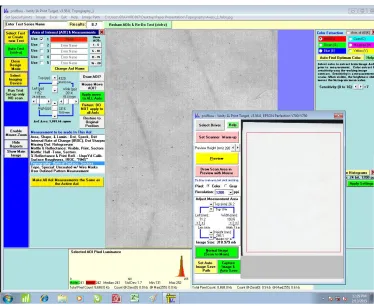
Verity IA Print Target software allows us to view area of interest (AOI), under magnification which facilitates us to visually identify the problem causing elements on the substrate surface [5]. The software also selects the background color using a color extraction algorithm to make the aberrant elements easily distinguishable using a false color view mode.
ISSN(Online): 2319-8753 ISSN (Print): 2347-6710
I
nternational
J
ournal of
I
nnovative
R
esearch in
S
cience,
E
ngineering and
T
echnology
(An ISO 3297: 2007 Certified Organization) Vol. 5, Issue 6, June 2016
Fig. No. I Topography measurement using Verity IA Imaging Software
ISSN(Online): 2319-8753 ISSN (Print): 2347-6710
I
nternational
J
ournal of
I
nnovative
R
esearch in
S
cience,
E
ngineering and
T
echnology
(An ISO 3297: 2007 Certified Organization) Vol. 5, Issue 6, June 2016
Table No. I Topography of Unprinted Stock
Sample No. Substrate A Substrate B Substrate C
1 7.74 91.94 442.8
2 8.68 85.40 480.5
3 12.04 86.96 470.8
4 12.80 94.58 481.3
5 12.36 87.86 490.2
Mean 10.72 89.35 473.1
Standard Deviation 2.335 3.795 18.288
The topography of coated substrate A showed a lower topographical index followed by grade B and C. The paper grade C resulted higher topography due to more undulations.
Printing:
The samples were printed on roto-gravure machine with black ink. The machine presetting are as followed. Presetting Parameters:
Acrylic based ink
Viscosity of ink – 19 sec on B4-ford cup
Speed of machine – 120 m/min
Hardness of Impression roller – 80 Shore A
Impression Pressure – 3.5 kg/cm2
Web Tension – 5 unit
Dryer Temperature –600C
IV. RESULTS
The printed stock were cut into sheets and forwarded for printability analysis; the parameters considered are as stated below:
Density
Dot Area
Print Mottle
Missing dots
Density analysis:
Density is defined as log of opacity. It is the light blocking ability of a substrate. The density of the printed sample was measured at solid patch using eye-one pro spectrophotometer.
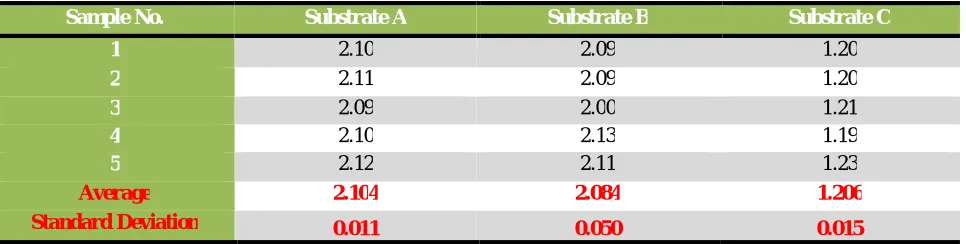
Table No. IIDensity of Solid Patch on Printed Stock
Sample No. Substrate A Substrate B Substrate C
1 2.10 2.09 1.20
2 2.11 2.09 1.20
3 2.09 2.00 1.21
4 2.10 2.13 1.19
5 2.12 2.11 1.23
ISSN(Online): 2319-8753 ISSN (Print): 2347-6710
I
nternational
J
ournal of
I
nnovative
R
esearch in
S
cience,
E
ngineering and
T
echnology
(An ISO 3297: 2007 Certified Organization) Vol. 5, Issue 6, June 2016
The higher the print density better is the print contrast. By analyzing the above results the best print density of a solid patch is obtained in coated grade A followed by B and then by grade C. The absorption and spreading of the ink on the uncoated stock ‘C’ has resulted in lower density value.
Dot Area analysis:
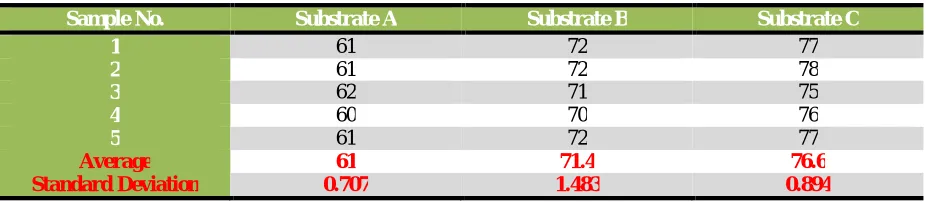
The dot area was analyzed at 50% step wedge. The area covered by dot depends upon substrate’s surface characteristics and press parameters.
Table No. III Dot area at 50% dot
Sample No. Substrate A Substrate B Substrate C
1 61 72 77
2 61 72 78
3 62 71 75
4 60 70 76
5 61 72 77
Average 61 71.4 76.6
Standard Deviation 0.707 1.483 0.894
The dot area covered by 50% dot is highest in case of grade C, followed by B and A. The fibers of the uncoated stock being unorganized and unsized absorb ink and spread it on the surface of the substrate. With this it is evident that the substrate is also responsible for the dot gain in the press. The substrate with higher topographic index showed higher dot area.
Missing Dots:
The dots that are not reproduced on the substrate are called as missing dots. Their frequencies were analyzed by missing dot analyzer. It has been a common observation that as dot size reduces the number of missing dots increases.
Table No. IV Missing Dots at 30% dot
Sample No. Substrate A Substrate B Substrate C
1 0 268
Cannot be determined
2 0 246
3 0 213
4 0 236
5 0 279
Average 0 248.4
Standard Deviation 0 26.140
The number of missing dots were observed more in grade B followed by grade A. In grade C, it is very difficult to identify dot due uneven spreading of ink on the substrate.
Print Mottle Analysis:
ISSN(Online): 2319-8753 ISSN (Print): 2347-6710
I
nternational
J
ournal of
I
nnovative
R
esearch in
S
cience,
E
ngineering and
T
echnology
(An ISO 3297: 2007 Certified Organization) Vol. 5, Issue 6, June 2016
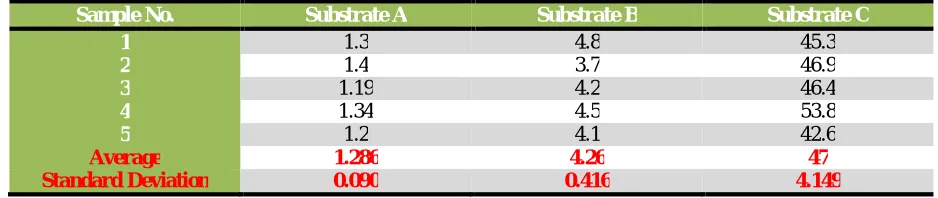
Table No. VPrint Mottle Measurement on a Solid Patch
Sample No. Substrate A Substrate B Substrate C
1 1.3 4.8 45.3
2 1.4 3.7 46.9
3 1.19 4.2 46.4
4 1.34 4.5 53.8
5 1.2 4.1 42.6
Average 1.286 4.26 47
Standard Deviation 0.090 0.416 4.149
The print mottle is higher in the grade C due to the presence of loose fibers on the surface of the uncoated paper absorbs ink and spread it in an uneven manner. Thus the higher topographic index results in higher mottle.
V. CONCLUSION
The experimental investigation on three substrates showed varying topographical index. The printability on these substrates was analyzed by density, dot area, missing dots and print mottle.
Thus the result highlighted that as topographic index decreased the density increased and the dot area decreased due to lower spreading of the ink.
The trends also concluded that lower the topographical index i.e. lower undulations in the substrates resulted in lower print mottle and lower missing dots.
REFERENCES
1. Gandhi. V, Kumar. R,“Effect of Nip Pressure Parameters on Substrate’s Surface Characteristic and Printability in Roto-Gravure Printing”, Article published in Imprint(2014).
2. Cruz M. A. Joyace M., Fleming, P. D. and Rosenberger, R. “Comparative study: Verity IA Topography”, Emveco, and Parker Print Surf. 3. Johansson P.A,“Optical Homogeneity of Prints”, (1999).
4. Rosenberger. R and Clark. D “A new topography measurement using modified scanner & results correlation to print mottle”. Verity IA, Appleton WI 54914.