A Robust Age Estimation Technique Using
Artificial Intelligence
Gurpreet Kaur1, Mandeep Kaur2
M.Tech Student, Department of CSE, Sri Guru Granth Sahib World University, Punjab, India1
Associate Professor, Department of CSE, Sri Guru Granth Sahib World University, Punjab, India2
ABSTRACT: Human age is a fundamental individual trademark, can be finishing up by means of alternate patterns rising from the facial appearance. Machine based age estimation through faces have emerge as exceptionally frequent field seeing that of their explosively rising real-styles functions such as safety manipulate and surveillance tracking, cosmetology, entertainment, forensic art, biometrics, electronic customer relation-ship management. Age estimation is the essential obligation of facial pictures class. It could be depicted as determination of somebody’s age or age bunch from facial pictures. This paper offers a top level perspective of recent research in facial age estimation along with an outline of earlier research in this field matter. The age estimation trouble is challenging. The key trouble is that particular individual’s age truly distinctive. The aging technique will not only depend on the simplest characteristic gene but in addition many other factors are included such as health, environment, climate conditions and way of life. We constructed a real-time age perdition system that predict age of real face images and also design a new age estimation system using the DCT technique for extraction on large dataset. This novel approach reduces the age estimation errors enormously over all previous methods. An experiment on three dataset such as FACES dataset, Images of Groups dataset and FG-NET aging dataset shows the success of proposed system for human aging estimation.
KEYWORDS: Age estimation, feature extraction, facial aging, DCT (discrete cosine transformation), feature selection, Viola-Jones algorithm.
I. INTRODUCTION
A human face comprises plentiful data regarding personal characteristics together with the identification, gender, age, expressions and so no[1]. In the most recent years, with the expanding utilization of face recognition and video observation frameworks, research on the numerical examination of human faces including face recognition, facial expressions, gender classification, face detection has pulled concentration in the grouping of pattern recognition and computer vision[2]. Age estimation by means of numerical analysis of the face photograph has numerous expertise functions such as the improvement in smart human machine interfaces, enhancing the security and assurance of minors in different and various areas . The age characteristics could also be utilized in the face verification and enhancing the tools utilized in police investigations. Most commonly, automatic age estimation via computer or machine is valuable in purposes where the target is to investigate an age of a person without identifying him[3].
Fig 1. Alterations due to change in craniofacial growth
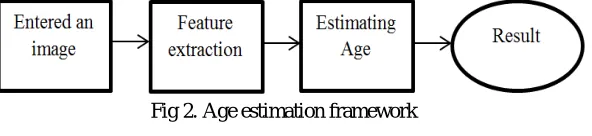
Assessing age from facial pictures utilizes the system of image processing and machine learning. More often that, all automatic image supported age estimation framework are made out of two modules. First, a set of attributes extracted from face image and the second module presents an estimate of the age settled on this set of attributes. It is clear that the general execution of the framework relies upon these two modules shown in fig 2.
Fig 2. Age estimation framework
II. RELATEDWORK
Age estimation is an urgent errand in facial picture class. The point of age estimation is to routinely mark a facial picture with genuine age (year) or age bunch (12 month range).A facial age estimation machine incorporate two key modules:
1) The way in which facial photo is represented and
2) Learn how to estimate its age notably based on the representation[5].
III.THEPROPOSEDROBUSTAGEESTIMATIONALGORITHM
The determination of this work is to evaluating the human age exactly on big datasets and performing the age estimation project on single picture. The most essential strides in age estimation are distinguishing the face in a picture, removing the components or extracted the features and estimating the age of the face. The local elements and global components are joined together to accomplish a more exact model. The global components included are AAM, face edge,distance and proportion. The local features included are wrinkles and composition.
Fig 3. Major steps involved in age estimation technique.
Determination of Tool for Feature Extraction
The various approaches utilized for facial feature extraction are Principle Component Analysis (PCA), Local binary patterns (LBP), Histograms of Oriented Gradients (HOG) and Discrete Cosine Transform (DCT). Here, we are investigating the execution of the two techniques specifically, PCA and DCT.Examine the framework by first training the set for particular no. of pictures and after that examining the execution for the two techniques by computing the error in these two strategies. This work indicated and tested the PCA and DCT transformation methods. In our proposed work we utilize DCT procedure for feature extraction.
PCA is a procedure which includes a technique which numerically transforms number of presumably related parameters into littler number of parameters whose qualities don't change called principal components.DCT is an invertible linear become which states a finite sequence of information facets as a sum of cosine features. Transformation of common signal to frequency area and vice versa is possible via DCT and inverse DCT. 2d-DCT defeats the difficulties such as brightening points, face occlusions, hues and pose.DCT is broadly utilized as a feature extraction and compression technique in different applications because of its properties, for example, decorrelation, vitality compaction, detachability and orthogonality. DCT strategy represents regional areas of a picture.It retrieves facial facets from more than a few frequency bands i.e minimal, medium and highest frequency bands. It is data independent model and practice of consultant set of training information set is just not required. DCT gives frequency information which can be used in taking charges in facial appearance[15]. In comparison with different input unbiased transforms, DCT has the advantages of packing probably the most valuable information into the fewest coefficients, introducing simplest a small error within the reconstructed picture. Moreover, DCT algorithms are typically more efficient than different transforms. In specified, the DCT turn into presents countless advantages over PCA, including producing great quality pictures at compatible compression ratios and the ability to participate in in real time situations as a result of its computational efficiency. Also, unlike the PCA turn into, which determines the most consultant eigenvectors dependently on the set of photographs, the DCT foundation is independent of the set of images.
General framework of proposed work
Broad investigations are led on the FACES dataset, Images of Groups dataset, and the FG-NET dataset to demonstrate the force of proposed calculation, in the examination of existing age estimation calculations. Firstly, pick one dataset out of these three datasets. At that point, load dataset and assess PLO and DCT classification.
Algorithm level design: The steps for calculating accuracy in age estimation are explained below and shown in fig 4.3.
Step 1: Start the process of age estimation system.
Step 2: Load matfile. and Choose one dataset out of three datasets (FACES dataset, FG-NET dataset, images of group).
Step 3: Get the information of total number of images and Load the dataset.
Step 4: Read all the images that are positioned in the selecting dataset.
Step 6: Split the data into train and test dataset. A training set is a set of data used to determine hypothetically predictive relationships. A test set is a set of data used to assess the strength and utility of a predictive relationship.
Step 7: Train with PLO classifier.
Step 8: Test with PLO classifier. Firstly, investigate the system by first training the set for specific no. of images then, investigate the test data and calculating the error in both data.
Process of estimating age on single image
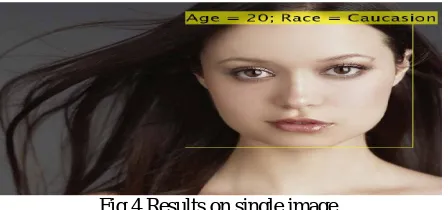
This work is an age model variant of visual facial model of a specific age or race. Creating age models has been utilized to characterize salient features of a specific age. Firstly, every picture is gone to the framework to pre-process the picture with the goal that they can the database. After that the frontal face landmarks are distinguished of each picture like face, mouth, nose by utilizing viola-jones algorithm and afterward, extracted the features point such as Haar-like elements, geometric elements and wrinkle features. After extracting the features, training dataset is made by utilizing them, which is then gone to the classifier to train it. After that, test dataset is gone to classifier which then predict the human age.
1. Input Image: To identify the age and race preferone face image.
2. Converting of RGB image into the Grayscale: Grayscale transformation is the main task of image pre-processing that includes the transformation of color or RGB image to grayscale image .Fuzzy Histogram Equalization is applied, fuzzy statistics used in digital images for their representation and processing in the fuzzy area which allows the system to handle the approximation of gray level values in a better way for better presentation.
3. Face Detection and Face Normalization: The following stride in the age estimation framework is to recognize thefrontal face in an input image. Identify the face within an image is considered as face detection system in our method based on the concept of Viola-Jones algorithm. After face detection face normalization process is applied on facial image
4. Feature Extraction:Subsequently, Geometric features and wrinkles features (detected by the canny edge detection algorithm) have been for the extraction of features. The method based on features uses all the information contained in an image and uses that data as a set of features for detecting the image.
5. Classify the age and race: After, the feature extraction the age and race can be predicted.
Fig 4 Results on single image
IV.EXPERIMENTAL RESULTS
Experiment on the FACES dataset
This dataset suggested both the age and facial expressions with ground truth labels, which is first acquainted in [5] for reviewing the human age estimation under different facial expression. The proposed method applied on 714 face images. For feature extraction DCT technique is used instead of PCA. Table 1 shows the greatest experimental outcomes of PLO method and proposed method, as well as the corresponding optimum numbers of the selected features that are listed in the brackets of the first column. Table 1 show that the proposed method achieves the best performance.
Table1 MAE comparison of PLO and Proposed method
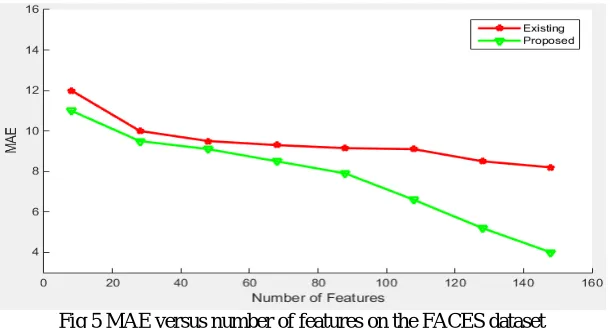
In directive to observe how the performance is influenced by the number of the selected features, we plot the curves of
MAE against the number of the selected features shown in Fig. 5
Fig 5 MAE versus number of features on the FACES dataset
We also compare proposed method with some other existing method as shown in table 2. Our proposed method attains the best performance among all the feature selection methods
Table 2 MAE comparison of various feature selection algorithms on FACES dataset
Method MAE
Adaboost (150 dims) 12.85
Laplacian Score (150 dims) 10.73
FS-ED (150 dims) 10.61
PLO (150 dims) 8.16
Proposed (150 dims) 3.04
Experiment on the Images of Groups dataset
Images of Groups dataset comprises of 28231 faces from 5080 Flickr images, which has been generally used for age range estimation [5]. Seven age groups are measured: 1) 0–2, 2) 3–7, 3) 8–12, 4) 13–19, 5) 20–36, 6) 37–65 and 7) 66+,
Method MAE
PLO (150 dims) 8.16
roughly equivalent to different life stages, which are separately labelled as 1,2,...,7. Each face image is normalized to 61 × 49 pixels based on eye centre. The facial images are downloaded from internet; the quality of many of them is tremendously low. We thus pick out 1910 high quality images used for the experiments. For feature extraction DCT technique is used as a replacement for of PCA. Table 3 shows the greatest experimental consequences of PLO method and proposed method, as well as the equivalent ideal numbers of the selected features that are recorded in the brackets of the first column.
Table 3 MAE comparison of PLO and Proposed method
Method MAE
PLO (150 dims) 0.864
Proposed(150 dims) 0.333
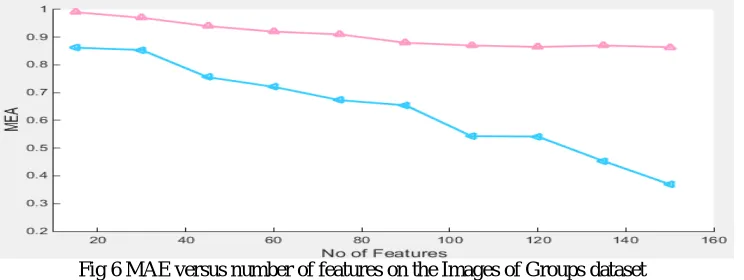
Fig 6 shows how the performance is influenced by the number of the selected features; we plot the curves of MAE against the number of the selected features.
Fig 6 MAE versus number of features on the Images of Groups dataset
We also relate proposed method with some other present method as shown in table 4. Our proposed method achieves the best presentation amongst all the feature selection methods.
Table 4 MAE comparison of various feature selection algorithms on Images of Groups dataset
Method MAE
Laplacian Score (150 dims) 0.926
Rankboost (150 dims) 0.911
PLO (150 dims) 0.864
Proposed (150 dims) 0.333
Experiment on the FG-NET dataset
Table 5 MAE comparison of PLO and Proposed method
Method MAE
PLO (150 dims) 1.306
Proposed(150 dims) 0.945
In order to inspect how the performance is influenced by the number of the selected features, we plot the curves of
MAE against the number of the selected features shown in Fig.7 the proposed method outperforms then the existing method.
Fig 7 MAE versus number of features on the FG-NET dataset
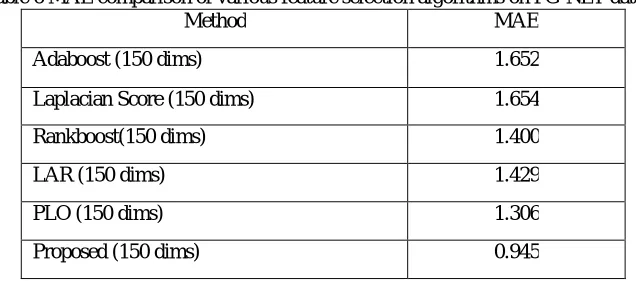
We also relate proposed method with some other existent method as shown in table 6. Our proposed method accomplishes the best performance amongst all the feature selection methods.
Table 6 MAE comparison of various feature selection algorithms on FG-NET dataset
Method MAE
Adaboost (150 dims) 1.652
Laplacian Score (150 dims) 1.654
Rankboost(150 dims) 1.400
LAR (150 dims) 1.429
PLO (150 dims) 1.306
Proposed (150 dims) 0.945
V. CONCLUSION
the case of human age estimation we required to preserve minute features because of large data should be processed very fast and having low complexity. Therefore, DCT is great decision for the calculation on the grounds that DCT is extremely effective for square information pictures and don’t loss any pertinent information. The power of proposed algorithm is compared to the state-of-arts. It produces results almost 70% efficient then existing technique. We also work on single image. We may effectively build a real time age estimation system that predict the age and race for any real image directly downloaded from web. From the experiments and summons encountered in this research, it has been able to observe some of the certain aspects that could not be accomplished within the extent of this work and therefore these can be suggested for the future work. our proposed work not deal with real time application .so in future make it dynamic age estimation system and for single image in future we can deal with more parameters such as gender, group prediction etc. and achieves higher accuracy.
REFERENCES
[1] Y. Xu , J. Yang, Z. Lai, D. Zhang, and X. Li, “Integrating conventional and inverse representation for face recognition,” IEEE Trans. Cybern., vol. 44 no.10, pp. 1738-1746, 2014.
[2] G. Guo. and. G. Mu, “Simultaneous dimensionality reduction and human age estimation via kernel partial least squares regression,” IEEE, pp. 657-664, 2011.
[3] Yun Fu, Thomas S. Huang, Charles R. Dyer, G. Guo, “Locally Adjusted Robust Regression for Human Age Estimation,” IEEE, 2008. [4] P. Grd, “Introduction To Human Age Estimation Using Face Images,” Research Papers Faculty Of Materials Sci. And Technology Slovak University of Tech., Bratislava, vol. 21, pp. 24-30, 2013.
[5] changsheng Li, Weishan Dong, Xiaobin Zhu, Jing Liu, Hanqing Lu, Qingshan Liu, “Human Age Estimation Based on Locality and Ordinal Information,” IEEE transactions on cybernetic, pp. 1-13, 2015.
[6] Y. Kwon. a. N. Lobo, “Age classification from facial images,” in IEEE Int. Conf. Comput. Vis. Pattern Recognit, Seattle, WA, USA, 1994. [7] C. J. Taylor, T. F. Cootes, A. Lanitis, “Toward automatic simulation of aging effects on face images,” IEEE Trans. Pattern Anal. Mach. Intell., Vols. 24, no. 4, pp. 442-455, 2002.
[8] Z. H. Zhou, Y. Zhang, G.Li and H.Dai, X. Geng, “Learning from facial aging patterns for automatic age estimation,” in Proc. ACM Int. Conf. Multimedia, Santa Barbara, CA.
[9] Y. Fu. and T. S. Huang, “Human age estimation with regression on discriminative aging manifold,” IEEE Trans. Multimedia, vol. 10, no. 4, pp. 578-584, 2008.
[10] K. Ricanek, Y. Wang, C. Chen, S. Simmons, “Generalized multi-ethnic face ageestimation,” in IEEE Int. Conf. Biometrics Theory Appl. Syst., Washington, DC, USA, 2009.
[11] B. Efron, T. Hastie, I. johnstone, and R. Tibshirani, “Least angle regression,” Ann. Statist, vol. 32, no. 2, pp. 407-451, 2004.
[12] G. Mu, Y. Fu, and T. S. Huang,G Guo, “Human age estimation using bioinspired features,” in IEEE Int. Conf. Comput. Vis. Pattern Recognit, Miami, FL, US, 2009.
[13] C. Shan, “Learning Local Features for Age Estimation on Real-life Faces,” in Proc. ACM Workshops Multimodal Pervasive Video Anal., pp. 23-28, 2010.