Fuzzy Logic based Short-Term
Load
Forecasting
Khushbu Dhiraj Chawda1, Tarak Paul, Jeelan Waris1, Dr. Altaf Badar2
Student, Dept. of EE, Anjuman College of Engineering and Technology, Sadar, Nagpur, Maharashtra, India1 Assistant Professor, Dept. of EE, Anjuman College of Engineering and Technology, Sadar, Nagpur,
Maharashtra, India2
ABSTRACT: In today’s scenario the efficient generation, transmission and distribution of power is more crucial.
Hence, the developing & developed countries do not want to waste electricity. Therefore, the wise use of electricity is the need of the hour. This leads to the concept of Load Forecasting [1]. Forecasting of demand load is the precondition to guarantee power system security and its safe supply, according to the non-linearity and complexity of load demand. In the paper, a fuzzy logic approach for short-term load Forecasting (STLF) is attempted in power system operations [2]. Short-term Load forecasting has become an essential part of modern control centere. The paper is written on the convenient analysis of previous year’s load of a substation in India using the idea of fuzzy logic. The study has been done on Mamdani type membership functions. MATLAB SIMULINK software is used in this work for system designing and Simulation. Using Mean square error (MSE) and average error the results show that, the fuzzy model with centre of area (COA) defuzzification method gave an improved performance compared to other defuzzification methods. The error has been abridged to a significant level in the range of 5-6%.
KEYWORDS: Load forecasting, Fuzzy logic, Short-term load forecasting, Fuzzy set theory, Load Demand.
I.INTRODUCTION
The estimation of future active loads at various load buses is known as load forecasting. The capacities of the transmission, generation, and distribution strictly depend on accurate load forecasting of the system. The Energy Management System (EMS) demands precise forecasting and Short Term Load Forecasting gives improved and accurate Results [3]. Accurate forecasts of the system load in advance can help the system operator to accomplish a variety of tasks like scheduling of fuel purchases, economic scheduling of generating capacity and system security assessment. Load forecasting techniques are of three types such as short-term forecasting, mid- range forecasting, and long-term forecasting. All these types of forecasting methods are valuable for different types of systems.
II.THE WORK
In the work, short-term load forecasting technique using fuzzy logic has been considered. The system input parameters are the season, day’s minimum temperature, day capacity, day’s maximum temperature, daylight intensity (Cloudy), rain. Day’s minimum temperature is a temperature when working hours start [4]. All these parameters are set as input to the fuzzy system and the inputs are first scaled in the required value limits and fuzzified. Previous load data, which has already been stored in the database, is used for inference [5]. The rule base is designed to follow the heuristic knowledge according to the membership functions of various inputs. As shown in Fig-1, Degree of Membership for each input parameters is found out in the range [0-1] and then de- fuzzified to get the crisp output, further it is descaled, to the required units and range.
Fig. 1. Flow and Processing of data through Fuzzy Inference System. III. HISTORICAL DATA AND KEY FACTORS
For input parameters, historical data of the last few years has been stored in the database management system (DBMS) [6]. STLF mainly depends on the following conditions:
1. Day capacity 2. Weather conditions 3. Day temperature 4. Light Intensity 5. Season
However, the working day or non-working day (weekend or holiday) defines the capacity of the day. Nevertheless, as per this study, weekend and holiday are put in the same category. One more category as the special day has considered. This is the category when work is done after regular 8 working hours of the day (means if work is done for 9 Hrs. in a day shows one complete regular day and 1 Hr. of the special day) or 9 Hrs. of the special day depending on the type of work. The day capacity is very much dependent on two factors:
1. The type of work 2. Day elongation
IV. LOAD FORECASTING
A FUZZIFICATION
The inputs, as well as output parameters as the member of fuzzy sets, represent Fuzzy linguistic variables in the paper. In order to state the fuzziness of information, the paper makes an arrangement of fuzzy subsets for different inputs and outputs in the complete universe of discourse as membership functions. The relationship between some inputs and output may be non-linear but for the simplicity purpose, linear membership functions are considered [8]. The membership function for seasons is ridge-shaped membership function such as gauss mf, gbell mf, and gauss2mf etc. The Day's Maximum Temperature and Minimum Temperature are represented as the fuzzy subset [Low (L), Very Low (VL), Very High (VH)], Medium (M), High (H)].
The linguistic variables of Day Capacity as [Very Low (VL), Minimum (min), Maximum (max), Low (L), High (H), Very High (VH)].
The fuzzy subset for day capacity is [Low (L), Very Low (VL), High (H), Normal (N), and Very High (VH)]. The Season’s fuzzy subset is given with the names of the season as [summer, spring, winter, and autumn]. The rain forecast has been given by fuzzy subset [Drizzling, No Rain, Heavy Rain, and Normal Rain].
The above figure represents triangular membership function. The simplest membership functions are formed using straight lines [9]. The simplest membership function is the triangular membership function, and it has the function name trimf. It is nothing more than a collection of three points forming a triangle.
Gaussian membership functions, it can approach a non-fuzzy set if the free parameter is tuned. Because of their smoothness and concise notation, Gaussian and bell membership functions are popular methods for specifying fuzzy sets. The curves have the advantage of being smooth and nonzero at all points. Season do not change frequently hence Gaussian membership function has been taken for the analysis [10].
B. FUZZY RULE BASE
It is the part of the fuzzy system where heuristic knowledge is stored in terms of “IF-THEN Type” Rules [11]. The rule base is used to transmit information to fuzzy inference system (FIS) to process through inference mechanism to numerically evaluate the information embedded in the fuzzy rule base to get the output.
The rules are like:
IF (MinTemp is M) and (MaxTemp is L) and (Day Light- Intensity (Clouds) is VH) and (Season (Day Number) is SUMMER) and (Rain is NORMAL) THEN (Output Load is H).
IF (Min Temp is H) and (Max Temp is H) and (Day Light- Intensity (Clouds) is L) and (Season (Day Number) is AUTUMN) and (Rain is DRIZZLING) THEN (Output Load is H).
V. RESULTS
Table 1 shows the Forecasted load, Actual load and the Percentage error in the forecasted load and calculated in the month of September 2016. The Percentage error (% Error) of the study is calculated as
AL−FL % Error = ───────×100
AL
Where AL is Actual load and FL is Forecasted load.
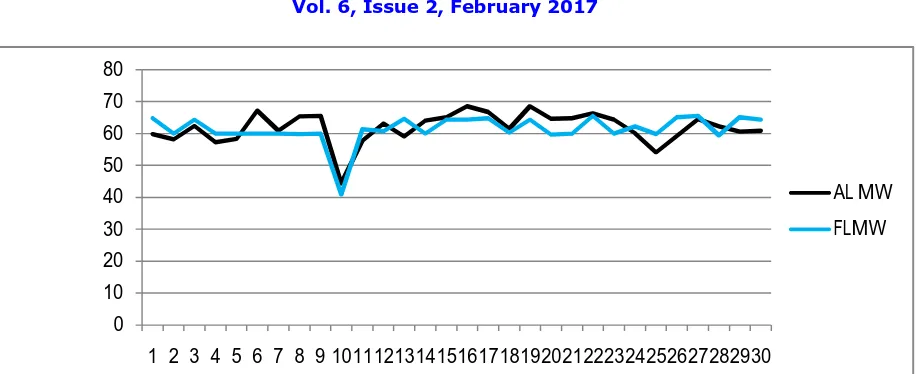
The actual load compared with the forecasted load gives the maximum percentage error 4.41618% and minimum percentage error obtained is -0.28007%. The load curve is plotted as in Fig. 3, showing the minute variations in the actual and forecasted loads for the same session given in Table I. which is the comparison between the actual load (black colour) and the fuzzy forecasted load (blue colour). From the curve, it is observed that fuzzy forecasted load curve is very close to the actual load curve. Thus, we can conclude that for Short-term load forecasting using fuzzy logic provides better and improved solutions.
Table I -Error (%) in Load Forecasting for September, 2016
VI. CONCLUSIONS
In the paper fuzzy for short-term load forecasting is discussed. It is concluded that using temperature, time, light intensity and previous day load as the inputs and by formulating rule base of fuzzy logic using available data, the maximum percentage error 4.41618% and minimum percentage error obtained is -0.28007%. In addition, it is also concluded that fuzzy logic approach is very easy for the forecaster to understand as it works on simple “IF-THEN” statements [12]. It also helps in; reduce spinning reserve capacity, schedule device maintenance, unit commitment decisions.
Sr.no AL (MW) FL (MW) % Error
1 59.98 64.8193 -8.06819 2 58.28 65.84711 -12.9841 3 62.47 64.4 -3.08948 4 57.43 53.74518 4.416185 5 58.39 53.74518 3.954813 6 67.29 65.84711 2.14428 7 61.04 65.84711 -7.87535 8 65.48 65.66339 -0.28007 9 65.64 65.84711 -0.31553 10 44.44 40.9787 2.788705 11 57.84 61.35723 -6.08097 12 63.23 60.7902 3.858615 13 59.26 64.66059 -9.11338 14 64.1 65.84711 -2.72561 15 65.25 64.4 1.302682
Sr.no AL (MW) FL (MW) % Error
Fig. 3. Comparison of Actual Load (Black) and Forecasted Load (Blue) for September 2016.
REFERENCES
[1] Bart Kosko, “Neural Networks and Fuzzy Systems”, New Delhi: Prentice Hall of India Private Limited, 2006. [2] D Driankov, H Hellendoorn, M Reinfrank, “An Introduction to Fuzzy Control”, Narosa Publishing House, 2001. [3] M.Amirthavalli, “Fuzzy Logic and Neural Networks”, SCITECH Publications, 2004.
[4] SandeepSachdeva and Chander Mohan Verma, “Load forecasting using fuzzy methods”, In Power System Technology and IEEE Power India
Conference 2008. POWERCON 2008. Joint International Conference, pp: 1-4, IEEE- 2008.
[5] Jagbi Kaur, Yadwinder Singh Brar,“Short Term Load Forecasting using Fuzzy Logic of 220kV Transmission Line”, International Journal of Engineering Research and Technology, Vol. 3, Issue 9, pp: 2278-0181, September-2014.
[6]Sunil Kumar J, Arun Kumar.P, Sultan.F.Meko, Dawitleykuen, Milkias Berhanu, “Load Forecasting of Adama University by Implementing Logic Controller”, IJAREEIE, Vol. 2, Issue 12, pp: 2278-8875, December-2013.
[7] Patel Parth Manoj, Ashish Pravinchandra Shah, “Fuzzy logic methodology for short term load forecasting”, International Journal of Research in Engineering and Technology, Vol. 3, Issue 4, pp: 2321-7308, April 2014.
[8] Saleh Ahmadi, Hassan Bevrani, and Hannah Jannaty, “A fuzzy inference model for short-term load forecasting”, Second Iranian Conference on Renewable Energy and Distributed Generation, pp: 39-44, IEEE, 2012.
[9] Priti Gohil, Monika Gupta, “Short term load forecasting using fuzzy logic”, IJEDR, ISSN: 2321-9939, January-2014.
[10]Swaroop R, I.Hussein Ali and Al Abdulgader, “Load forecasting for Power System Planning using Fuzzy-Neural Networks”, Proceeding of the
World Congress on Engineering and Computer Science, Vol. 1, pp: 187-191, October- 2012.
[11] Zuhaimy Ismail, Member, IEEE and Rosnalini Mansor, “Fuzzy Logic Approach Half-hour Malaysia Electricity Load Demand”.
[12] ]Sunil Kumar J, Arun Kumar.P, Sultan.F.Meko, Dawitleykuen, Milkias Berhanu, “Load Forecasting of Adama University by Implementing Logic Controller”, IJAREEIE, Vol. 2, Issue 12, pp: 2278-8875, December-2013.
0 10 20 30 40 50 60 70 80
1 2 3 4 5 6 7 8 9 101112131415161718192021222324252627282930
AL MW