Abstract
AL-OTOOM, MUAWYA MOHAMED. Preliminary Study of Trace-Cache-Based Control Independence Architecture. (Under the direction of Dr. Eric Rotenberg.)
Conventional superscalar processors recover from a mispredicted branch by squashing all
instructions after the branch. While simple, this approach needlessly re-executes many future
control-independent (CI) instructions after the branch's reconvergent point. Selective
recovery is possible, but is complicated by the fact that some control-independent
instructions must be singled out for re-execution, namely those that depend on data
influenced by the mispredicted branch. That is, control-independent data-dependent (CIDD)
instructions must be singled out for re-execution, thus avoiding needless re-execution of
control-independent data-independent (CIDI) instructions.
To contrast different recovery models, we abstract the recovery process as constructing a
“recovery sub-program” for repairing partially incorrect future state. In this conceptual
framework, selective recovery constructs a shorter recovery sub-program than full recovery.
In current selective recovery microarchitectures, the recovery sub-program is constructed
on-the-fly after detecting a mispredicted branch, by sequencing through all CI instructions and
singling out only the CIDD instructions among them. Not only is this discriminating
approach complex, but the same recovery sub-program is repeatedly constructed every time
this branch is mispredicted.
We propose constructing the recovery sub-program for each branch once and caching it for
recovery trace cache. When a misprediction is detected, first, the branch's correct
control-dependent instructions are fetched from the conventional instruction cache as usual. Then, at
the reconvergent point, fetching simply switches from the instruction cache to the recovery
trace cache. The appropriate recovery trace is fetched from the recovery trace cache at this
time. In this way, fetching only the CIDD instructions is as simple as fetching all CI
instructions from a conventional instruction cache. No explicit singling-out process is needed
as this was done a priori, on the fill-side of the trace cache. Therefore, the recovery trace
cache is efficient on multiple levels, combining the simplicity of full recovery with the
performance of selective recovery.
This thesis explains the proposed trace-cache-based control independence architecture, at a
high level. Preliminary studies are also presented, to project the potential of exploiting
control independence as well as the effectiveness of a trace-cache-based approach in
particular. The results include (i) breakdowns of retired dynamic instructions into different
categories, based on their control and data dependences with respect to prior mispredicted
branches, (ii) contributions of individual recovery traces to total CIDI instruction savings,
PRELIMINARY STUDY OF TRACE-CACHE-BASED CONTROL
INDEPENDENCE ARCHITECTURE
by
MUAWYA MOHAMED AL-OTOOM
A thesis submitted to the Graduate Faculty of North Carolina State University
in partial fulfillment of the requirements for the degree of
Master of Science
COMPUTER ENGINEERING
Raleigh, NC
2006
Approved by:
______________________ Dr. Eric Rotenberg Chair of Advisory Committee
Dedication
To my loving parents …
To my love Zeinab …
Biography
Muawya Al-Otoom was born in Amman, Jordan, on November 1981, the second son of
Mohamed and Raisa Al-Otoom. Muawya spent the first seven years of his childhood in the
capital Amman where he attended the first year of his high school at Dar El-Elem School. In
1988, Muawya moved with his family to Souf, his hometown, to join the rest of Al-Otoom
family. In 1999, Muawya finished his high school education and joined Jordan University of
Science and Technology (JUST) to pursue his undergraduate education in computer
engineering. He received his Bachelor’s degree in computer engineering from JUST in 2003
and worked there for one year as a teaching assistant. Motivated by an undergraduate project
on Tomasulo’s algorithm, Muawya decided to pursue his graduate studies in computer
microarchitecture at North Carolina State University (NCSU) in 2004. He joined the research
group of Dr. Eric Rotenberg in 2005 as a Master Student. Now he is continuing his graduate
studies at NCSU toward the PhD degree under the direction of Dr. Eric Rotenberg. In 2006,
Muawya was invited to be a member of the Phi Kappa Phi honor society in recognition of his
Acknowledgments
First, I would like to thank God for everything, for giving me health, family, friends,
education and good life.
I want to thank my parents, Mohamed and Raisa Al-Otoom. I don’t know what I would have
done without their continuous support. Despite, the long distance, I have never felt that I am
far from them. Thanks to my father for being a great model I wanted to be like always.
Thanks to my brothers, Muaz and Awni, and my sisters, Doa’a, Demah, and Amomah.
Thanks to all of my uncles and aunts for their calls, and for making sure that I am doing fine.
Thanks to my love Zeinab, her continuous calls and support were great help while we were
apart. Her trust in me helped me face all fears here and made me proud of her. I am waiting
for the day when we will be together.
Special thanks to my advisor, mentor, and teacher Dr. Eric Rotenberg. Thank you for
believing in me when nobody did. Thanks for being a good teacher through this year, and
showing me how to be a good researcher. Thanks for always reminding me how to write
good code by using the “Japanese Car Bumper” model. Thanks for tolerating my nagging
during the submission period.
I would like to thank my friends and roommates here in Raleigh: Tareq Ghaith, my previous
and current roommate, has always been a good brother; Mazen Kharbutli, my first friend in
Raleigh and unofficial mentor during my first experience in research, Ali El-Haj-Mahmoud,
thanks for the 24-hour services upon coming to Raleigh; Khalid Gharaibeh and Hazim
Al-Dwari, my Cup-O-Joes dudes.
I would like to thank all of my current and previous research group members: Ali
El-Haj-Mahmoud, Aravindh Anantaraman, Ahmed Al-Zawawi, Vimal Reddy, Hashem Hashemi,
Ravi Venkatesan, and Sailashri Parthasarathy. Special thanks to Ali and Aravindh for the
24-hour technical and non-technical support. Thanks to Ahmed for being our enthusiastic
member responsible for the brainstorming us at our meetings and being the second criminal
in the crime of control independence after Eric.
I would like to thank my committee members, Dr. W. Rhett Davis and Dr. Suleyman Sair,
for their help in finishing up this work.
Thanks to Sandy Bronson, CESR administrative assistant, for making my life easier through
taking care of all administrative and logistic issues.
I would like to thank all of my professors at JUST, especially Dr. Omer Al-Jarah, Dr.
Abdullah Bataineh, and Dr. Sameer Bataineh.
Thanks to my friends during my undergrad studies and who are now here in the US, thanks
for keeping in touch: Ghaith Matalkah, Rawad Haddad, Abdullah Khresha, Bashar
Gharaibeh, Samer Al-Kiswani, Mohamed Kharashkah, Mwafag Al-Otoom, Mohamed
Zbeidee, and Hakim Hussein.
Thanks to all my fellows in Souf: Sadeq, Omar, Hassan, Hamzeh, Zaid, and Tawfeeg.
Souf, especially “experiencing our survival skills at 3:00 AM driving with no windshield
while it’s raining cats and dogs”. Thanks to my cousin and friend, Ahmed, who I can always
Table of Contents
List of Figures...viii
List of Tables ... x
Chapter 1 Introduction ...1
1.1 Motivation: Trend of Large Instruction Windows ...1
1.2 Revisiting Control Independence ...2
1.2.1 Managing Instructions Insertion and Removal ...5
1.2.2 Handling Selective Re-Issue ...6
1.3 The “Big Picture” ...7
1.4 Contributions... 10
Chapter 2 Target Future Microarchitecture ... 12
2.1 Reconvergent Point and Influenced Register Set (IRS) Predictor ... 13
2.2 Pre-constructing CIDD Recovery Traces ... 14
2.3 Preparing for Recovery... 16
2.4 Recovery ... 17
2.4.1 Repairing the CD Region... 17
2.4.2 Fetching and Executing the CIDD Recovery Traces... 18
Chapter 3 Related Work... 23
3.1 Predication ... 23
3.2 Multipath Execution ... 24
3.3 Control Independence Techniques ... 25
3.4 Exploiting Caches for Faster Misprediction Recovery... 29
Chapter 4 Evaluation Methodology ... 31
4.1 Simulation Environment ... 31
4.2 Description of Results Generated by the Simulator ... 32
4.2.1 Breakdown of Retired Instructions... 32
4.2.2 Studying Locality: Contributions of Individual Recovery Traces ... 35
4.2.3 Trace Cache Hit Ratio... 36
4.3 Benchmarks... 36
Chapter 5 Results and Analysis ... 38
5.1 Breakdown of Retired Dynamic Instructions ... 38
5.2 Contribution of Traces to CIDI Savings... 41
5.3 Trace Cache Hit Ratio ... 44
5.4 Measuring Memory Violations ... 49
5.5 Control Independence Example: Top Trace in Twolf... 50
Chapter 6 Summary and Future Work... 53
List of Figures
Figure 1-1: Control independence terminology...3
Figure 1-2: The “big picture”. ...8
Figure 2-1: High-level view of possible trace-cache-based control independence microarchitecture. ...12
Figure 2-2: Pre-constructing CIDD recovery traces. ...14
Figure 2-3: Preparing for recovery...17
Figure 2-4: Repairing the CI region using the CIDD recovery trace from the trace cache...19
Figure 2-5: Three types of data dependences among CIDD instructions in the recovery trace. ...20
Figure 4-1: Breakdown of retired instructions...34
Figure 5-1: Unbounded trace cache, logical trace length = 32 instructions. ...40
Figure 5-2: Unbounded trace cache, logical trace length = 64 instructions. ...40
Figure 5-3: Unbounded trace cache, logical trace length = 128 instructions. ...40
Figure 5-4: Contributions of unique traces (bzip2)...42
Figure 5-5: Contributions of unique traces (gap)...42
Figure 5-6: Contributions of unique traces (gcc)...42
Figure 5-7: Contributions of unique traces (gzip)...42
Figure 5-8: Contributions of unique traces (mcf). ...42
Figure 5-9: Contributions of unique traces (parser)...42
Figure 5-10: Contributions of unique traces (perlbmk). ...43
Figure 5-11: Contributions of unique traces (twolf). ...43
Figure 5-12: Contributions of unique traces (vortex). ...43
Figure 5-13: Contributions of unique traces (vpr). ...43
Figure 5-14: Recovery trace cache results for bzip2: instruction breakdown (left), hit ratios (right)...45
Figure 5-15: Recovery trace cache results for gap: instruction breakdown (left), hit ratios (right)...45
Figure 5-16: Recovery trace cache results for gcc: instruction breakdown (left), hit ratios (right)...45
Figure 5-17: Recovery trace cache results for gzip: instruction breakdown (left), hit ratios (right)...46
Figure 5-18: Recovery trace cache results for mcf: instruction breakdown (left), hit ratios (right)...46
Figure 5-19: Recovery trace cache results for parser: instruction breakdown (left), hit ratios (right)...46
Figure 5-20: Recovery trace cache results for perlbmk: instruction breakdown (left), hit ratios (right)...47
Figure 5-21: Recovery trace cache results for twolf: instruction breakdown (left), hit ratios (right)...47
Figure 5-22: Recovery trace cache results for vortex: instruction breakdown (left), hit ratios (right)...47
Figure 5-23: Recovery trace cache results for vpr: instruction breakdown (left), hit ratios (right)...48
List of Tables
Chapter 1
Introduction
Researchers have proposed exploiting control independence to reduce the branch
misprediction penalty in high-performance processors. Control independence architectures
avoid needlessly re-executing future misprediction-independent instructions. This thesis
presents a preliminary study for a Trace-Cache-Based Control Independence Architecture.
My preliminary study discusses a possible microarchitecture at a high level and projects the
potential of the microarchitecture in terms of the amount of misprediction-independent
instruction savings and other results.
1.1 Motivation: Trend of Large Instruction Windows
Recent studies have suggested increasing the instruction window size
[3] [10] [11] [20] [24] [38] as one solution to hide the latency of cache-missed loads. By
allowing future independent instructions after cache-missed loads to be fetched and executed,
much of the long latency of cache misses can be hidden effectively. However, with the
presence of branch mispredictions, forming large instruction windows will be extremely
difficult. All of the instructions after the misprediction have to be squashed, and this will
leave the instruction window with fewer instructions to execute in parallel with pending
Many solutions have been proposed [5] [15] [16] [21] [31] [35] [40] (discussed in the related
work section) to deal with the problem of branch mispredictions. Some of these solutions try
improve the accuracy of the branch predictor. Other solutions try to reduce the penalty of a
branch misprediction. Control independence [2] [7] [8] [12] [19] [31] [32] [35] [36] [41] is one
solution that aims at reducing the penalty of a branch misprediction by not squashing all
instructions after the branch, saving some of the good work that is independent of the branch
itself.
1.2 Revisiting Control Independence
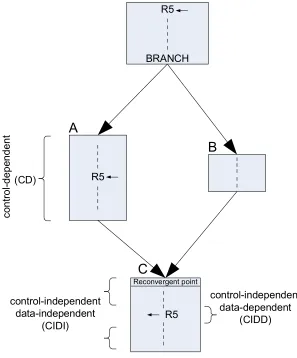
Dynamic instructions, in general, depend on prior branches through two types of
dependences, control dependences and data dependences. As shown in Figure 1-1
instructions in both basic blocks A and B are considered to be control-dependent (CD) on the
branch since fetching them is dependent on the direction taken by the branch. Basic block C
is considered to be control-independent of the branch since it will be fetched regardless of the
decision taken by the branch. The first instruction in basic block C is called the reconvergent
point of the branch since it reconverges the control-flow of both paths of the branch.
Although all instructions in basic block C are control-independent (CI) of the branch, some
of them depend on values produced on either control-dependent path of the branch. For
example, the consumption of R5 in basic block C, depends on the direction taken by the
branch since it may use the production of R5 in basic block A or the production of R5 before
the branch, as shown in Figure 1-1 these instructions are considered to be
control-independent data-dependent (CIDD) on the branch. On the other hand, the rest of the
(CIDI). The benefit of exploiting control independence is not discarding CIDI instructions in
the shadow of branch mispredictions.
R5
BRANCH
R5 R5
A
B
C
co
nt
ro
l-d
ep
en
de
nt
(CD)
control-independent data-independent
(CIDI)
control-independent data-dependent
(CIDD) Reconvergent point
Figure 1-1: Control independence terminology.
A conventional superscalar processor [33] recovers from a branch misprediction by
squashing all instructions after the misprediction and rolling back the architectural state. The
state is rolled back either by walking backward from the last fetched instruction until the
point of the branch misprediction, fixing the state and freeing resources incrementally, or by
restoring the state instantaneously from a checkpoint at the mispredicted branch or at an
the processor to re-execute many correct CIDI instructions unnecessarily, full squash
recovery is simple to implement. That is, it is simplest to squash CD, CIDD, and CIDI
instructions indiscriminately.
Processors that exploit control independence do not squash all instructions after the
mispredicted branch and roll back the architectural state the same way a conventional
superscalar processor does. Only the incorrect CD instructions are squashed or drained from
pipeline, freeing their allocated resources accordingly. Then the correct CD instructions are
fetched, thereby replacing the incorrect CD instructions that were removed. After repairing
the branch’s CD region, all CIDD instructions must be identified and re-issued again with
new correct values. Note that the architectural state is not rolled back when the branch
misprediction is detected. Therefore, when the misprediction is detected, the future state is
partially incorrect. Holes in the state caused by the incorrect CD and CIDD instructions are
fixed after fetching and executing the correct CD instructions and re-executing the CIDD
instructions.
In general, any control independence architecture should be able to support two main
requirements:
(i) Removing incorrect CD instructions from the middle of the instruction window
and inserting correct CD instructions into the middle of the instruction window.
1.2.1 Managing Instructions Insertion and Removal
Contemporary superscalar processors use a Reorder Buffer (ROB) [34] to maintain precise
register state for recovery from exceptions and branch mispredictions. The ROB is a circular
FIFO buffer containing all in-flight instructions in the window in program order. The FIFO
ensures that instructions commit their results to the precise architectural state in program
order, despite executing of instructions out-of-order. Unfortunately, the ROB is not
compatible with control independence, because control independence requires inserting and
removing instructions from the middle of the window, violating simple FIFO management of
the ROB.
Checkpoint-based architectures [3] [10] [11] [14] [24] [38] have been proposed as an alternative
to ROB-based architectures. A checkpoint-based architecture does not use a ROB to maintain
precise state for recovery. Instead, it maintains precise state by checkpointing the register
state at coarse intervals. The fact that there is no FIFO of instructions in between checkpoints
means there is no structural obstruction to prevent inserting/removing instructions between
checkpoints. In other words, a checkpoint-based architecture provides a flexible instruction
window, i.e., an expandable and collapsible window.
In addition to not presenting any structural obstruction for inserting/removing instructions
from the middle of the window, other aspects associated with instruction insertion/removal
are transparently handled by the checkpoint-based substrate:
· Incorrect CD instructions must be removed from the window, and their allocated
allocation and deallocation through usage counters [3]. There is no custom
requirement to squash incorrect CD instructions and free their resources since it is
performed naturally by the substrate. Once an instruction executes, whether correct or
not, it will drain out of the pipeline and decrement usage counters of its source
registers. Once the usage counter of a physical register reaches zero and it is not
mapped to any logical register (in the rename map), it is freed autonomously.
Summing up, incorrect CD instructions need not be explicitly identified and
squashed, as all instructions eventually drain and physical registers are freed
autonomously.
· Correct CD instructions must link to their producers correctly. The correct CD
instructions are fetched out-of-order. The checkpoint taken at the mispredicted branch
can be used to rename these instructions, ensuring that they link to the right producers
in the middle of the window.
1.2.2 Handling Selective Re-Issue
Proposed control independence architectures handle the selective re-issue problem either by
saving all CI instructions in a separate buffer or fetching them one more time from the
instruction cache. These approaches are inefficient since the CI instructions include both
CIDI and CIDD instructions. Using either approach requires re-sequencing through all CI
instructions and singling out only the CIDD instructions for selective re-issuing. Having to
re-sequence through all CI instructions just to identify CIDD instructions reduces the benefit
Another problem with these previous approaches is that they require repeatedly constructing
the same set of CIDD instructions, every time the same branch misprediction occurs.
We propose a novel approach, in which “compressed” recovery traces of CIDD instructions
are pre-constructed before resolving mispredictions and stored in a recovery trace cache. So,
when a branch misprediction occurs, a compressed trace of pre-identified CIDD instructions
will be fetched for recovery. This approach performs better because it avoids fetching all the
CI instructions just to single out CIDD instructions. Moreover, it is simple and more efficient
because it only constructs traces of CIDD instructions once, and then repeatedly reuses the
traces for many recurrences of the same misprediction.
As discussed previously, although full squashing after a mispredicted branch discards many
correctly executed instructions, it is very simple and appealing for designers since it requires
only rolling back the architectural state to the point of the misprediction and re-directing the
fetch engine to start fetching instructions from the correct path. In this thesis, I will suggest a
trace-cache-based control independence architecture that provides the illusion of full
squashing (hence preserving the simplicity of conventional recovery) without actually
discarding correctly executed instructions. This will be achieved by fetching correct CD
instructions from the instruction cache, as usual, and then simply switching the fetch unit to
fetch compressed CIDD traces from the recovery trace cache.
1.3 The “Big Picture”
This thesis proposes a misprediction recovery approach that combines the simplicity of full
BRANCH
Predicted
Path Actual
Path construct recovery sub-program
BRANCH
Predicted
Path Actual
Path construct recovery sub-program
sequence through all CI instructions to identify CIDD instructions
BRANCH
Predicted
Path Actual
Path construct recovery sub-program
Recovery Trace Cache
Conventional
Recovery
Control
Independence
Recovery
Trace-Cache-Based
Recovery
A
B
C
Incorrect instructions
Correct instructions
duplicate good work
level. The process of recovering from a branch misprediction is abstracted as constructing a
“recovery sub-program”. The recovery sub-program is a set of instructions that, when
executed, repairs the future architectural state of the processor. This abstraction provides a
conceptual framework for contrasting different recovery models.
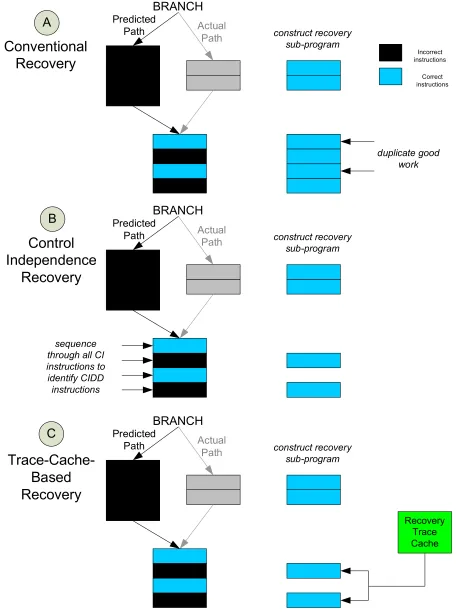
Figure 1-2 shows how different paradigms construct a recovery sub-program for a single
mispredicted branch, to repair the future architectural state corresponding to the end of the
control flow graph (CFG) shown in the figure. Instructions colored in black are incorrect
instructions that need to be replaced or re-executed, specifically incorrect CD instructions
and CIDD instructions, respectively. Instructions colored in blue are correct instructions,
comprised of (i) CIDI instructions and (ii) instructions in the recovery sub-program.
Part A of the figure shows how a conventional superscalar processor recovers from the
mispredicted branch. Conceptually, it constructs a recovery sub-program that includes all
correct CD instructions and all CI instructions (CIDD and CIDI) after the mispredicted
branch. The recovery sub-program is easy to construct since it does not require
discriminating CIDD and CIDI instructions. However, the recovery sub-program duplicates
the work done by correct CIDI instructions as shown.
Part B of the figure shows how a conventional control independence architecture recovers
from the same misprediction, in terms of constructing a recovery sub-program. A shorter
recovery sub-program is constructed that includes the correct CD instructions and only CIDD
(shorter) by virtue of not duplicating correct CIDI instructions, constructing it is more
complex and somewhat inefficient. Constructing the recovery sub-program requires
sequencing through all CI instructions to identify CIDD instructions as shown in the figure.
Moreover, the same recovery sub-program must be reconstructed every time the branch is
mispredicted.
Part C illustrates the paradigm proposed in this thesis, a trace-cache-based approach for
exploiting control independence. It constructs the same compressed recovery sub-program as
a conventional control independence architecture. But, rather than repeatedly constructing the
same recovery sub-program every time the branch is mispredicted, CIDD instructions are
efficiently supplied by the recovery trace cache. The new approach is similar to approach A,
in that it fetches the recovery sub-program from the instruction cache (CD region) and the
recovery trace cache (compressed CI region consisting of only CIDD instructions), similar to
fetching the whole program from the instruction cache. Yet the new approach is similar to
approach B, in that it does not duplicate good work performed by CIDI instructions.
Summing up, the new approach combines the simplicity of full recovery and the performance
of selective recovery.
1.4 Contributions
The main contributions of this thesis are:
· Preliminary analysis of CIDD traces in a recovery trace cache. Although a detailed
cycle-level timing simulator was not implemented for measuring performance
improvement of the target microarchitecture directly, we measure the potential
recovery trace cache. CIDI instruction savings are measured using both unbounded
trace caches and multiple finite-sized trace cache configurations. Moreover, we
characterize the contributions of individual recovery traces to the total amount of
CIDI savings. The hit ratios of different trace cache configurations are also provided.
The combined studies give a preliminary indication of performance improvement.
· Trace-Cache-Based Control Independence Architecture. This thesis proposes the idea
of a trace-cache-based control independence architecture and discusses it at a high
level. However, a full microarchitecture design is left for future work. What
distinguishes this architecture from other proposed control independence architectures
is that it provides the illusion of simple full-squash recovery while still reducing the
Chapter 2
Target Future Microarchitecture
This chapter explains a possible microarchitecture for Trace-Cache-Based Control
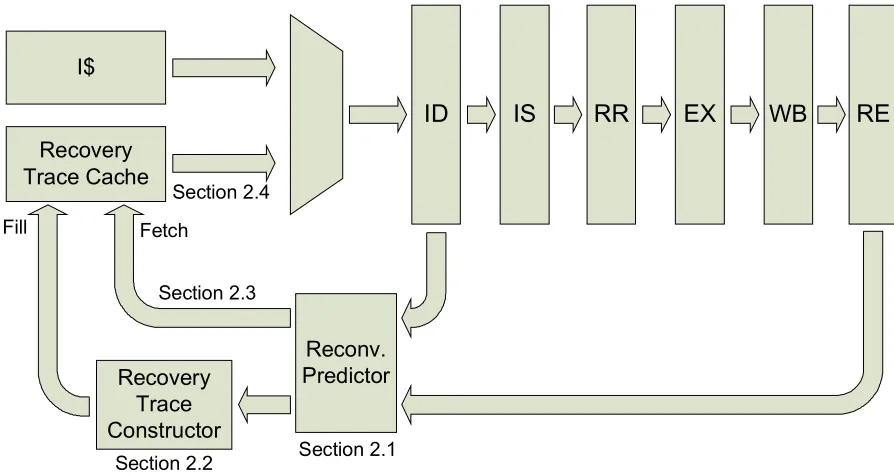
Independence, at a high level. Figure 2-1 shows a high-level view of a superscalar pipeline
[33] modified for trace-cache-based control independence. In the figure, pathways and
components are labeled with corresponding sections of this chapter that describe them.
Section 2.1 describes the reconvergence predictor, Section 2.2 describes the recovery trace,
pre-construction, and Section 2.3 and 2.4 describes preparing for recovery and recovery
respectively.
I$
ID
Reconv. Predictor Recovery
Trace Cache
IS RR EX WB RE
Recovery Trace Constructor
Section 2.1 Section 2.2
Fill Fetch
Section 2.3 Section 2.4
2.1 Reconvergent Point and Influenced Register Set (IRS) Predictor
To exploit control independence with respect to a branch misprediction, two pieces of
information are needed about the CD region of the mispredicted branch. (i) The program
counter (PC) of the reconvergent point, which identifies the first instruction in the CI region.
(ii) The Influenced Register Set (IRS), which is the set of logical registers that are written to
along one or more CD paths of the branch. These two pieces of information are used to
identify CIDD instructions when pre-constructing traces. All CI instructions, starting from
the reconvergent point, that directly or indirectly depend on logical registers specified in the
IRS will be singled out as CIDD instructions. This is explained in section 2.2.
The reconvergent points and IRSs of branches can be determined statically using a compiler
or dynamically using a hardware predictor. We borrow the Dynamic Reconvergence
Predictor proposed by Collins, Tullsen, and Wang [9] augmented with IRS predictions as
done by Al-Zawawi, Reddy, and Rotenberg [4]. The predictor is accessed at two different
points in the pipeline, (i) when beginning construction of the CIDD recovery trace for a
branch at the retirement stage (Section 2.2), and (ii) when preparing for possible recovery of
a branch at the dispatch stage (Section 2.3). In either case, the predictor is indexed using the
PC of the branch. The predictor supplies the predicted reconvergent PC and a predicted IRS
for the branch. (The predictor may also supply other information for guiding selective
application of control independence, such as the confidence of the reconvergent PC and IRS
2.2 Pre-constructing CIDD Recovery Traces
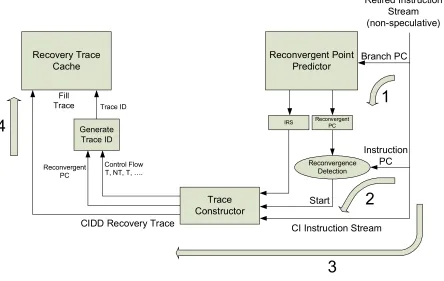
Recovery traces of CIDD instructions are pre-constructed by monitoring the retired dynamic
instruction stream at the retirement stage of the pipeline. Figure 2-2 shows the overall
process divided into a sequence of four steps (labeled with block arrows 1 through 4).
The first step is performed when a branch is retired. The branch’s PC is used to index the
reconvergent point predictor. The predictor supplies the predicted reconvergent PC and IRS
for the branch. The predicted reconvergent PC is then held, as shown in Figure 2-2, for
detecting reconvergence of the CD region among instructions that follow. The IRS is also
held, for later use by the trace constructor to identify CIDD instructions among future CI
instructions, as shown in Figure 2-2.
Retired Instruction Stream (non-speculative)
Reconvergent Point
Predictor Branch PC
Reconvergence Detection
Instruction PC
Trace
Constructor Start
CI Instruction Stream CIDD Recovery Trace
Reconvergent PC
Control Flow T, NT, T, ….
Generate Trace ID
Recovery Trace Cache
Fill
Trace Trace ID
Reconvergent PC IRS
1
2
3
4
In the second step, retired instructions’ PCs are checked against the reconvergent point that
was set aside. Reconvergence of the CD region is detected when the next retired instruction
PC matches the reconvergent PC. All instructions including and after the reconvergent point
are considered to be CI with respect to the branch.
In the third step, after reconvergence is detected, CI instructions are examined. The trace
constructor uses the IRS that was set aside previously to single out CIDD instructions among
CI instructions. A CI instruction is CIDD if it depends directly or indirectly on registers
potentially written to within the branch’s CD region, as specified by the IRS. Direct and
indirect CIDD instructions are easily identified using a logical register table of “poison” bits
where logical registers specified in the IRS are initially poisoned [4]. An instruction is CIDD
if any of its sources is poisoned. An instruction marks its poison status in the table entry
corresponding to its logical destination register, propagating poison status to its dependents.
The identified CIDD instructions are grouped together to form the recovery trace. The trace
constructor decides when to end the CIDD trace, based on the trace selection policy [28] [29].
For the purpose of this study, we use two trace selection policies. In the first policy, a trace is
ended when the CI region (encompassing both CIDI and CIDD instructions) reaches a
maximum bound. The second policy also uses a maximum bound, but may prematurely end
the trace at the first indirect branch. Notice that the bound is with respect to “logical trace
length” which reflects the uncompressed CI region, as opposed to using a bound on the
“physical trace length” which reflects the number of CIDD instructions only (compressed
During step 3, in addition to collecting the CIDD instructions, the trace constructor collects
the branch outcomes (e.g., T, NT, T …) that characterize the control-flow of the CI region.
The reconvergent PC and the sequence of branch outcomes through the CI region uniquely
identify the recovery trace. We call this a trace ID [28] [29]. The trace ID is used to index into
the recovery trace cache for storing the constructed trace (assuming it is not already in the
trace cache).
Finally, in step 4, when construction of the CIDD recovery trace has finished and the trace ID
is now available, the trace cache is indexed using the trace ID and the new trace is stored into
the corresponding location in the trace cache.
2.3 Preparing for Recovery
To recover from a branch misprediction, the recovery trace cache must be accessed to obtain
the CIDD recovery trace corresponding to the current CI region fetched after the branch’s
reconvergent point. To do the access, some preparation is needed before the branch executes,
i.e., before recovery. In particular, the trace ID needs to be generated so that the trace cache
can be accessed later. Figure 2-3 shows the process of preparing for recovery, i.e., generating
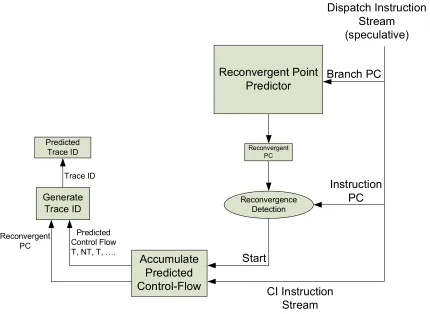
the trace ID corresponding to the CI region in the window. When the branch is dispatched,
the reconvergent point predictor is accessed using the branch’s PC. The predictor supplies the
predicted reconvergent PC that terminates the CD region of the branch. After this, fetching
proceeds as usual, until the reconvergent point is fetched. After reconvergence is detected,
the branch predictions in the CI region are accumulated as control independent instructions
are fetched. By combining the reconvergent PC and the cumulative branch predictions, a
If the branch was in fact mispredicted, then the misprediction is detected when the branch
executes. At this time, the predicted trace ID is used to access the trace cache, and the
recovery trace is supplied if the trace cache hits. Selective recovery, in the case of a trace
cache hit, is described in Section 2.4. In the case of a trace cache miss the processor falls
back to conventional full-squash recovery.
Dispatch Instruction Stream
(speculative)
Reconvergent Point
Predictor Branch PC
Reconvergence Detection
Instruction PC
Accumulate Predicted Control-Flow
Start
CI Instruction Stream
Reconvergent PC
Predicted Control Flow T, NT, T, ….
Generate Trace ID
Trace ID
Reconvergent PC
Predicted Trace ID
Figure 2-3: Preparing for recovery.
2.4 Recovery
2.4.1 Repairing the CD Region
As discussed previously, a checkpoint-based architecture provides a flexible substrate for
branch misprediction is detected, corresponding incorrect CD instructions finish as usual and
their physical registers are freed autonomously, except those registers tied to any checkpoint
or still mapped in the rename map table.
When the misprediction is detected, the fetch unit begins fetching correct CD instructions. A
second rename map, called the repair rename map, is initialized from the branch’s
checkpoint, and is used to rename correct CD instructions. Fetching correct CD instructions
stops when the reconvergent point is reached. The reconvergent PC was retrieved during the
recovery preparation step, as explained in Section 2.3.
2.4.2 Fetching and Executing the CIDD Recovery Traces
Similar to incorrect CD instructions, incorrect CIDD instructions finish as usual and any
non-checkpointed and unmapped physical registers free autonomously. After repairing the CD
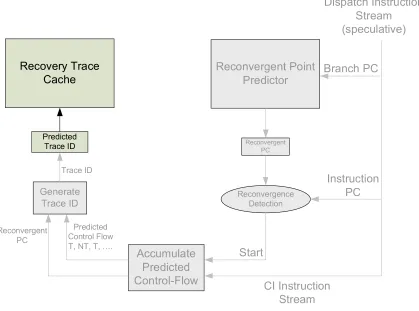
region, the predicted trace ID generated during earlier preparations (Section 2.3) is used to
access the trace cache for fetching the CIDD recovery trace, as shown in Figure 2-4. As
CIDD instructions are fetched, they are renamed using the repair rename map which now
Dispatch Instruction Stream
(speculative)
Reconvergent Point
Predictor Branch PC
Reconvergence Detection
Instruction PC
Accumulate Predicted Control-Flow
Start
CI Instruction Stream
Reconvergent PC
Predicted Control Flow T, NT, T, …. Generate
Trace ID Trace ID
Reconvergent PC
Predicted Trace ID
Recovery Trace Cache
Figure 2-4: Repairing the CI region using the CIDD recovery trace from the trace cache.
To execute correctly, the trace’s CIDD instructions must be linked to their correct producers.
With respect to the re-dispatched CIDD instructions, there are three types of values, must be
made available: (i) values produced by instructions before the branch or within the branch’s
CD region, (ii) values produced by other CIDD instructions in the trace, and (iii) values
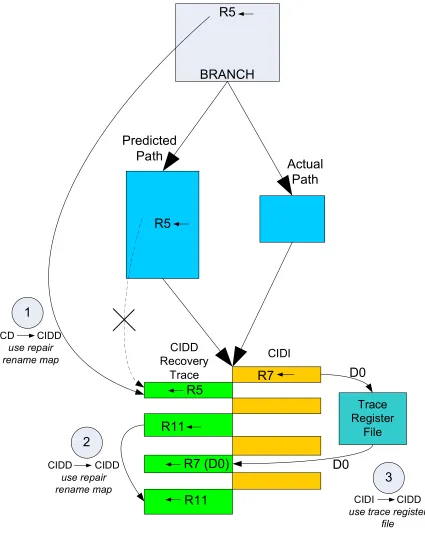
produced by CIDI instructions. Figure 2-5 shows the three types of data dependences
explained through an example.
For register values produced before or within the CD region and consumed by a CIDD
instruction in the recovery trace (dependence 1 in the figure), the recovery trace uses the
R5
BRANCH
R5 Predicted
Path
Actual Path
R7 R5
R7 (D0) R11
R11
CIDD Recovery
Trace
CIDI
Trace Register
File
1
CD CIDD
use repair rename map
2
CIDD CIDD
use repair rename map
D0
D0
3 CIDI CIDD
use trace register file
Figure 2-5: Three types of data dependences among CIDD instructions in the recovery trace.
In the example, the repair rename map (which was initialized from the branch’s checkpoint)
Register values produced by CIDD instructions in the recovery trace and consumed by other
CIDD instructions in the recovery trace (dependence 2 in the figure) are handled as usual by
the repair rename map. Producers in the recovery trace update the repair rename map and
consumers use these mappings. In the figure, the production and consumption of R11,
localized within the recovery trace, is an example of the second type of dependence.
Register values produced by CIDI instructions and consumed by CIDD instructions in the
recovery trace (dependence 3 in the figure) pose a more difficult problem. The problem with
this type of dependence is that CIDI instructions may have already executed and their
physical registers may have been freed via the aggressive register reclamation policy [3].
Therefore, these values must be saved in some alternative storage area and the CIDD
instructions in the recovery trace must know how to link to them correctly in the event of a
branch misprediction.
One solution is to write these values to a separate register file, one register file dedicated to
each potential recovery trace in the window. We call these trace register file. CIDD
instructions in a recovery trace are pre-renamed [30] [37] [39] such that source registers
dependent on CIDI instructions (external to the trace) are linked to specific physical registers
in the trace register file. During preparation for recovery (Section 2.3), once reconvergence is
detected, all CI instructions not only write their values to the conventional physical register
file, as usual, but also to a larger trace register file. The particular destination physical
register in the trace register file is based on the distance of the producer CI instruction from
value for R7 into the conventional physical register file (using its conventional physical
register name), but it also writes this value to D0 in trace register file. D0 is selected based on
the distance of the CI producer instruction from the reconvergent point, which is zero in the
example. CIDD instructions in the recovery trace that consume this version of R7 link to the
D0 value via pre-renaming, done during trace pre-construction. All CIDD instructions in the
recovery trace that consume this version of R7 are pre-renamed to access D0 int trace register
Chapter 3
Related Work
3.1 Predication
Predication [17] [21] [22] [27] attempts to reduce the misprediction penalty of
difficult-to-predict forward branches. A difficult-to-difficult-to-predict branch is typically identified via profiling.
Mispredictions are avoided altogether for this branch, by removing the branch and combining
its control-dependent paths into one straight-line block. The branch is replaced with just the
predicate calculation part of the original branch. To achieve selection of instructions from
only one of the original paths, instructions from various paths are qualified by exclusive
predicates.
At run-time, all paths of the original branch are fetched since the compiler merged them into
a single straight-line block. After predicates are resolved, instructions from the correct path
execute and instructions from other paths are discarded. In some predication schemes,
instructions from all paths start executing before predicates are known. Only instructions
with true predicates commit their values to the architectural state, whereas instructions with
false predicates nullify their results.
Scheduling all paths and nullifying results of incorrect paths solves the problem of
inserting/removing instructions from the middle of the window. In other words, predication
The performance advantage of predication is that correct CD instructions are fetched and
maybe executed before resolving the branch condition and without predicting the branch
condition. However, this performance advantage must be weighed against two performance
disadvantages. The first disadvantage is that predication wastes fetch bandwidth and maybe
execution bandwidth with respect to conventional speculation, since both selected and
non-selected instructions are scheduled. The second disadvantage is that CIDD instructions after
the predicated region are delayed with respect to conventional speculation. CIDD instructions
cannot execute speculatively since their source values are not forwarded from the predicated
region until predicates resolve. This squanders performance with respect to conventional
speculation, when speculation is correct.
In contrast to predication, microarchitectures that exploit control independence fully
capitalize on correct branch predictions by speculatively forwarding data to CIDD
instructions. Thus the benefits of conventional speculation are preserved. The advantage with
respect to conventional speculation is not re-executing CIDI instructions after a branch
misprediction.
3.2 Multipath Execution
Multipath execution [1] [13] [18] [40] speculatively executes both paths of branches. To prune
the total number of simultaneous paths, multipath execution is typically only applied to
hard-to-predict branches as identified by a confidence estimator [15]. When an unconfidently
predicted branch is encountered, a speculative thread is spawned to fetch and execute the
incorrect thread is squashed. Different policies have been proposed for controlling the
number and quality of spawned threads. For example, TME [40] spawns alternate threads
only from the predicted path and SDPE [13] limits the number of simultaneous threads to
only two.
Multipath execution reduces the penalty of a mispredicted branch because the prediction is
hedged by also fetching and executing the non-predicted path. However, multipath execution
degrades performance with respect to conventional speculation when the branch prediction is
correct, since the correct path competes for fetch and execution bandwidth with the incorrect
path.
3.3 Control Independence Techniques
Multiscalar Processors [36] and other speculative multithreading architectures [2] [23] [26]
divide a sequential program into multiple speculatively-parallel tasks. The multiple tasks are
fetched and executed in parallel. In Multiscalar, a branch misprediction in one task does not
squash future tasks if the future tasks are control independent of the mispredicted branch.
However, if the register forwarding policy is to speculatively forward branch-influenced
values among tasks, then a branch misprediction in one task may squash future
control-independent tasks. The reason is that Multiscalar does not implement selective recovery with
respect to data-flow speculation. Thus the original register forwarding policy is to forward
inter-task register values only when branches influencing these values are resolved. This has
the downside of delaying CIDD instructions in future tasks until branches in previous tasks
Dynamic Multithreading [2] introduces selective recovery capabilities in the context of
speculative multithreading. DMT creates speculative threads at the return points of functions
and exit points of loops. Thus, DMT implicitly exploits control independence at these
coarse-grain reconvergent points. To facilitate selective re-execution of only CIDD instructions after
these reconvergent points, all instructions executed by a thread must be kept in a trace buffer
(there is one trace buffer per speculative thread). Selective re-execution of CIDD instructions
is performed by re-sequencing through all the speculative instructions in the trace buffer and
only instructions that depend on a misprediction get re-dispatched into the pipeline. In
contrast, our trace-cache-based approach does not need to re-sequence through all the CI
instructions just to single out the CIDD instructions. Moreover, constructing the “recovery
sub-program” is done only once, on the fill-side of the recovery trace cache.
Rotenberg and Smith advocate using trace processors for efficiently exploiting control
independence [32]. Fine-grain control independence (FGCI) is defined for exploiting control
independence with respect to arbitrary nested if-else constructs. FGCI targets relatively
short CD regions that fit within a single trace, thus, exploiting FGCI only requires replacing
the trace in the affected PE. They also define coarse-grain control independence (CGCI) for
other branches that cannot be covered with FGCI. CGCI uses global reconvergent points to
cover many branches. Global reconvergent points include the backward edges of loops, loop
exit points, and function return points. In the case of CGCI, multiple CD traces may need to
be inserted/removed from the middle of the window. To achieve this, the trace processor’s
processing elements (PEs) are managed as a linked list for arbitrary trace insertion/removal.
identify and re-issue direct CIDD instructions. Then, indirect CIDD instructions re-issue
automatically via the existing issue logic. This is possible because all traces remain in the
PEs until retirement, ready to re-issue instructions as needed. The fact that all CI traces must
be redispatched, places trace processors among the class of control independence
architectures that must resequence through all CI instructions to identify CIDD instructions.
The instruction reuse buffer [35] records the result values of instructions along with the
source values that produced the results. The reuse buffer is consulted when an instruction is
dispatched. If the instruction hits in the reuse buffer and its current source values match the
previous source values in the reuse buffer, the result value in the reuse buffer can be reused.
In this case, the instruction bypasses the execution core and writes its reusable value to the
register file. Instruction reuse implicitly exploits control independence in the form of squash
reuse. All instructions after a mispredicted branch are squashed. Nonetheless, if a squashed
CIDI instruction executed and wrote its result value to the reuse buffer before the
mispredicted branch resolved, then the CIDI instruction is not executed when it is
re-fetched. However, all CI instructions still need to be re-fetched even if not all of them need to
be re-executed. This places squash reuse among control independence architectures that must
resequence through all CI instructions to single out CIDD instructions. The dual-ROB
approach proposed by Chou, Fung, and Shen features a secondary ROB that serves as a FIFO
squash reuse buffer [8].
In the Skipper microarchitecture [7], if a candidate branch is unconfidently predicted, the
processor skips fetching of the branch’s CD region. In this case, the fetch unit is redirected to
the ROB and the load/store queues to allow skipped CD instructions to be filled in after
resolving the branch. The size of the gap is the maximum length among all paths (similar to
how trace processors pad traces for FGCI branches). As mentioned, the CI region is fetched
early, before the skipped CD region. Among the CI instructions, only CIDI instructions can
execute before the branch resolves. Similar to predication, CIDD instructions are delayed
because they depend on values that are influenced by the deferred CD region.
Gandhi, Akkary, and Srinivasan target only mispredicted branches that exhibit exact
convergence [12]. In exact convergence, the correct target of the mispredicted branch is the
reconvergent point itself. Thus, repairing the mispredicted branch does not require inserting
any instructions in the middle of the window, greatly simplifying exploiting of control
independence. However, the effects of incorrect CD instructions must be reversed. They
propose converting each incorrect CD instruction into a move instruction, that copies the
value from the physical register that was unmapped by the instruction to the instruction’s
own physical register. When the CD instructions re-execute, this time as move instructions,
CIDD instructions re-execute. This requires buffering all CI instructions, either in the issue
queue or in separate replay buffers. They suggest implementing selective re-issuing by one of
three means: (1) all instructions remain in the issue queue until they are non-speculative, or
(2) all CI instructions are placed in a replay buffer and are scanned to single out CIDD
instructions for re-injection into the pipeline, or (3) all CI instructions are placed in a replay
buffer and dependence bit vectors are used to identify CIDD instructions directly without
Zilles, Emer, and Sohi propose exploiting control independence in the context of exception
handling [41]. They propose executing the exception handler in a separate hardware context
and not squashing instructions after the excepting instruction. All instructions after the
excepting instruction are CI instructions, and many of these are CIDI instructions.
This thesis is heavily influenced by a precursor project [4] that leverages the Continual Flow
Pipeline (CFP) [38] as a convenient substrate for tolerating branch mispredictions.
The CFP-CI microarchitecture [4] essentially constructs CIDD traces on-the-fly within CFP’s
slice data buffer (SDB). When a mispredicted branch is detected, the correct CD instructions
are fetched from the instruction cache followed by the branch’s CIDD instructions from the
SDB. The SDB and recovery trace cache play the same role of supplying compressed
recovery traces. The key distinction is that my approach does not repeatedly construct
recovery traces. Rather, each unique recovery trace is pre-constructed once and cached. A
trace-cache-based approach potentially simplifies exploiting control independence compared
to an SDB-based approach.
3.4 Exploiting Caches for Faster Misprediction Recovery
Bondi, Nanda, and Dutta proposed the Misprediction Recovery Cache (MRC) [5] to reduce
the pipeline refill penalty following a mispredicted branch. The technique is particularly
beneficial in the context of CISC ISAs (e.g., x86), which often require many fetch and
decode pipeline stages. When a mispredicted branch is detected and the fetch unit is
redirected to the branch’s correct target, a trace of decoded correct-path instructions is
accumulated in the MRC. If the same misprediction recurs in the future, the MRC is
the already decoded instructions, significantly reducing or eliminating the deep pipeline refill
penalty. The MRC does not exploit control independence because all instructions after the
mispredicted branch are still fetched and executed. Nonetheless, the time required to
Chapter 4
Evaluation Methodology
4.1 Simulation Environment
I developed a custom trace-driven simulator, using the Simplescalar toolset [6]. The
simulator generates three types of results:
(i) The breakdown of all retired instructions, that shows the percentages of CIDI
instructions, CIDD instructions, CD instructions, and remaining instructions that
are not in the shadow of mispredictions.
(ii) The contribution of each unique recovery trace to the total number of saved CIDI
instructions.
(iii) The hit ratios of recovery trace caches.
Timing and hardware resources are not modeled, except for the recovery trace cache. The
recovery trace cache is modeled in order to measure its hit ratio and how hit ratio affects
actual CIDI instruction savings.
Although a trace-driven simulator is used, the simulator still fetches instructions on the
wrong paths of mispredicted branches, specifically within the CI regions of branches. A
predicted recovery trace, which is based on branch predictions in the CI region, may itself
mispredictions within the CI region of the branch being serviced, are not counted among the
branch’s CIDI and CIDD instructions. Modeling wrong control-flow within predicted
recovery traces will more accurately reflect the number of retired CIDI and CIDD
instructions with respect to the mispredicted branch being serviced.
4.2 Description of Results Generated by the Simulator
4.2.1 Breakdown of Retired Instructions
The first set of results, that will be presented in the results chapter, is a breakdown of retired
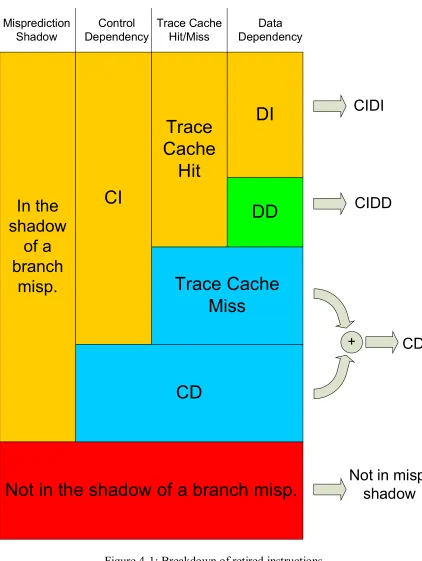
dynamic instructions into different categories. As shown in Figure 4-1, dynamic instructions
are first divided into two categories. Dynamic instructions that were fetched after one or
more unresolved mispredicted branches in the window, are considered to be in the shadow of
a branch misprediction. These instructions are targeted for savings by any control
independence architecture. Instructions that were fetched when there were no prior
unresolved mispredicted branches are not considered to be in the shadow of a branch
misprediction. As such, these instructions do not represent opportunity for applying control
independence, as there are no prior mispredictions.
Dynamic instructions in the shadows of branch mispredictions are further divided into CD
instructions and CI instructions. CI instructions are further broken down into those that are
logically part of traces that either hit or miss in the trace cache. CI instructions that hit in the
trace cache are then classified as either data independent (DI) or data dependent (DD) with
On the right-hand side of Figure 4-1 are shown the labels used in the results section to
convey each category: “not in misp. shadow”, “CD”, “CIDD”, and “CIDI”. The CIDI
category represents the savings, in terms of not needlessly re-executing CIDI instructions.
Only CIDD instructions are re-executed efficiently using the recovery trace cache.
Note that the “CD” label refers to both truly CD instructions as well as CI instructions that
are not covered by the trace cache due to a trace miss. In the case of a miss, the proposed
architecture cannot discriminate between CI and CD instructions, that is, all instructions in
the shadow of the misprediction are deemed CD (even the CI instructions). In other words,
on a trace cache miss, conventional full-squash recovery is used thereby handling CI
instructions as CD instructions.
A subtle point is that an instruction may be in the shadows of multiple branch mispredictions.
Note that all measures are with respect to the last misprediction prior to an instruction. Thus,
for example, CIDI consists of instructions that were CIDI at least with respect to the last
DI
DD
Control Dependency
Data Dependency
In the
shadow
of a
branch
misp.
Not in the shadow of a branch misp.
Misprediction Shadow
Trace
Cache
Hit
Trace Cache
Miss
Trace Cache Hit/Miss
CIDD
+
CD
Not in misp.
shadow
CI
CD
CIDI
Figure 4-1: Breakdown of retired instructions.
The above breakdown is misleading in the context of a mispredicted branch that has a very
even reaches the reconvergent point along the long incorrect path. In this case, the CI
instructions are not truly in the shadow of a misprediction (not fetched yet) and as such it is
misleading to classify them as either CIDI or CIDD.
To more closely represent a mispredicted branch with a long incorrect CD path, its CI
instructions are not marked as CIDD or CIDI with respect to this branch, rather they are
marked as “not in misp. shadow” since they will most likely be fetched after the mispredicted
branch is resolved. We define a long incorrect CD path to be 128 or more instructions. The
128-instruction threshold approximates the number of incorrect CD instructions that can be
fetched in a 4-issue processor assuming a fetch-to-resolve branch misprediction penalty of 32
cycles.
4.2.2 Studying Locality: Contributions of Individual Recovery Traces
In the previous section, the CIDI category represents the total number of instruction savings
due to exploiting control independence. A moderately sized trace cache will only be effective
if relatively few unique recovery traces (e.g., 10%) contribute most of the CIDI instruction
savings (e.g., 90%). Accordingly, the second set of results characterizes the contributions of
individual recovery traces to the total number of CIDI instructions. The contribution of a
unique recovery trace is the number of CIDI instructions after the reconvergent point that are
not re-executed when the recovery trace is used, multiplied by the number of times the trace
is used for recovery. After determining individual contributions, traces are sorted in
4.2.3 Trace Cache Hit Ratio
The actual achievable CIDI instruction savings depends on the trace cache hit ratio. The last
set of results presents hit ratios, for different trace cache configurations.
4.3 Benchmarks
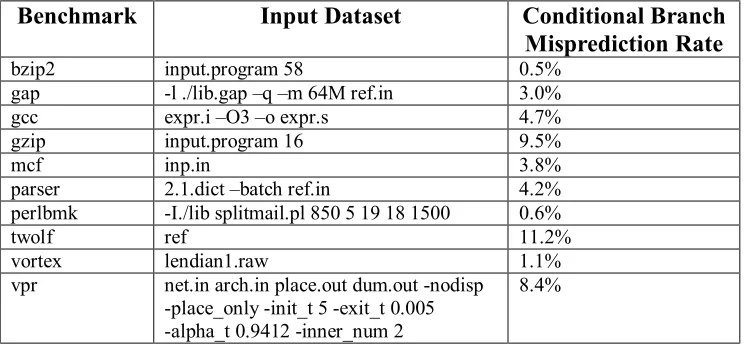
Table 4-1 shows the benchmarks used for this study. Ten of the SPEC2K integer benchmarks
are simulated. The remaining two SPEC2K integer benchmarks (eon and crafty) did not
compile using the Simplescalar gcc compiler because of compatibility issues. None of the
SPEC2K floating-point benchmarks are included since they have low misprediction rates,
hence there is little need for exploiting control independence. The ref inputs are used for all
benchmarks, with specific parameters shown in Table 4-1.
For each benchmark, the first one billion instructions are skipped without warming the
recovery trace cache or the branch predictor. The next 100 million instructions are simulated.
Table 4-1 also shows the branch misprediction rates for the benchmarks using a gshare
branch predictor [25], with a 64K-entry pattern history table and a 4K-entry branch target
Table 4-1: SPEC2K benchmarks.
Benchmark Input Dataset Conditional Branch
Misprediction Rate
bzip2 input.program 58 0.5%
gap -l ./lib.gap –q –m 64M ref.in 3.0%
gcc expr.i –O3 –o expr.s 4.7%
gzip input.program 16 9.5%
mcf inp.in 3.8%
parser 2.1.dict –batch ref.in 4.2%
perlbmk -I./lib splitmail.pl 850 5 19 18 1500 0.6%
twolf ref 11.2%
vortex lendian1.raw 1.1%
vpr net.in arch.in place.out dum.out -nodisp
-place_only -init_t 5 -exit_t 0.005 -alpha_t 0.9412 -inner_num 2
Chapter 5
Results and Analysis
In this chapter, I will present the results of my study. Four types of results are presented.
First, retired dynamic instructions are broken down into the four categories that were
discussed in Section 4.2.1, for an unbounded recovery trace cache. Second, contributions of
individual recovery traces to total CIDI instruction savings are presented. Third, recovery
trace cache hit ratios and retired dynamic instruction breakdowns are shown for different
finite-size trace cache configurations. Finally, an example of control independence from the
twolf benchmark is studied in depth.
5.1 Breakdown of Retired Dynamic Instructions
As explained in Chapter 4, all retired dynamic instructions are classified into one of four
categories, according to their control and data dependences with respect to prior branch
mispredictions. For this set of results, an unbounded trace cache is used to study the intrinsic
behavior of benchmarks. The logical trace length and the trace selection policy are varied.
The logical trace length is the total number of CI instructions after the reconvergent point,
from which CIDI savings will be exploited. For example, if the logical trace length is 64
instructions, this means that the physical trace length (CIDD instructions only) will vary from
zero to 64. When the physical trace length is zero, there are no CIDD instructions in the trace
the other hand, if the physical trace length is 64 instructions, then all CI instructions after the
reconvergent point are CIDD instructions and there are no CIDI instructions (0% savings).
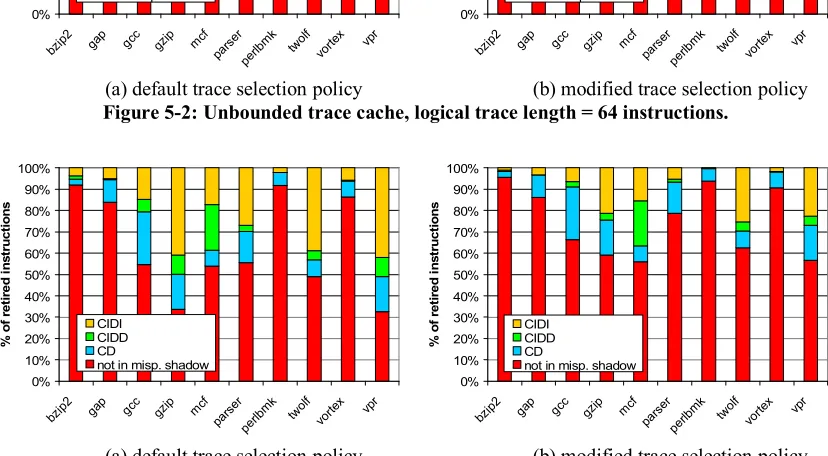
Figure 5-1, Figure 5-2, and Figure 5-3 show the breakdown of retired dynamic instructions
for an unbounded trace cache, with logical trace lengths of 32, 64, and 128 instructions,
respectively. For each figure, two trace selection policies are shown. The default policy ends
traces at the maximum logical trace length (32, 64, or 128 instructions). The modified policy
ends traces at either the maximum logical trace length or the first indirect branch.
First, I will discuss CIDI savings for a specific logical trace length and trace selection policy.
Then I will explain how CIDI savings change with different logical trace lengths and
selection policies. For the case of a logical trace length of 64 instructions and default trace
selection policy, CIDI savings vary among benchmarks from 1% (perlbmk) to 31% (twolf).
Referring to Table 4-1, notice that twolf has the highest branch misprediction rate of 11.2%
while perlbmk has the very low misprediction rate of 0.6%. Based on misprediction rate,
there is more opportunity to exploit control independence in twolf than perlbmk. Twolf
shows a large percentage of instructions in the shadow of mispredictions (43%) whereas
perlbmk has a much smaller percentage (7%). Twolf achieves 31% CIDI savings among 43%
of instructions in the shadows of mispredictions, indicating a large amount of control