THE E F F E C T OF X-RAYS UPON MUTATION O F T H E G E N E A I N MAIZE*
L. J. STADLER AND HERSCHEL ROMAN
University of Missouri and U . S. Department oj Agriculture, Columbia, Missouri,’ and U n i v m i t y of Washington, Seattle, Washinylon
Received February 18, 1948
H E experimental evidence indicating tha t gene mutation is induced by
T
X-rays comes almost wholly from experiments on the general mutation rate; t h at is, from experiments in which the total frequency of detectable mutations a t all loci is compared in treated and untreated cultures. “Gene mutations” as experimentally identified in such studies, include all variations inherited as if due to a change in a single gene. If it may be assumed th at such variations can arise only from the transformation of a gene to a n alternative form, these experiments,prove the effect of the treatment upon some process of genic evolution.It has long been evident that this assumption is not valid. Various extra- genic alterations may produce effects which are distinguishable only with great difficulty, if a t all, from the effects expected from qualitative change in the hereditary unit. These include alterations involving loss, reduplication, a q d rearrangement of unaltered genes. T o avoid ambiguity, the con-commi, tal term “point mutation” will therefore be used to designate a?parent gene mutations as experimentally identified, and the term “gene mutation” will be used only to designate the hypothetical conversion of a gene to an allelic form. The inference t hat gene mutation is induced by X-rays is founded upon the assumption tha t some among the induced point mutations are in fact due to intragenic change, although others may be shown to be due to extra-genic alterations simulating gene mutation. But there are no general criteria b y which the observed mutations occurring a t miscellaneous loci may be individ- ually identified as intra-genic or extra-genic. Consequently it is not possible to determine the effect of X-ray treatment upon gene mutation by experi- mental modification of the general mutation rate.
The alternative is to study the mutational behavior of selected genes espe- cially suited to the purpose, both in spontaneous mutation and in mutation induced by various treatments, in the hope of developing for these genes a sounder basis for interpretation. For this purpose the loci A and R in maize provide favorable material, for reasons which have been stated in an earlier paper (STADLER 1941).
* The cost of the accompanying illustrations is paid by the GALTON AND MENDEL MEMORIAL FUND.
Cooperative investigations of the Division of Cereal Crops and Diseases, Bureau of Plant Industry, U. S. DEPARTMENT OF AGRICULTURE, and DEPARTMENT OF FIELD CROPS, UNIVERSITY
OF MISSOURI. Missouri Agricultural Experiment Station Journal Series No. 1083. Genetics33: 273 May 1948
274 L. J. STADLER AND HERSCHEL ROMAN
The present study is concerned with the nature of X-ray-induced mutations a t the A locus. A parallel study of ultraviolet-induced mutations a t the A locus will be published shortly. These studies were made several years ago and the summarized results have been published in abstract form (STADLER and ROMAN 1943), but various delays incidental to the war have prevented the completion and fuller publication of the work. Meanwhile, certain other studies concerned with the general problem have been reported (STADLER and FOGEL
1943, 1945; STADLER 1944, 1946, FOGEL 1946a, b ; LAUGHNAN 1946).
EXPERIMENTAL MATERIALS AND METHODS
The gene A , in the presence of appropriate complementary genes, affects the pigmentation of various tissues of the maize plant. I n the presence of Az, B , PI, C, R , Pr, and P , the phenotypic effect of A may be represented as follows:
GENOTYPE ALEURONECOLOR PLANT COLOR PERICARP COLOR
A A , A a Purple Purple Red
a a Colorless Brown Brown
The purple color of the aleurone and plant tissues is due to an anthocyanin pigment, while the red color of the pericarp is due to an unknown pigment, not a n anthocyanin. Various additional alleles of A have been reported, including some with effects apparently intermediate between those of A and a (EMERSON and ANDERSON 1932; RHO~ZDES 1941).
The populations from which the mutants here described were selected were FI progenies produced by the cross a a X A A , the pollen of the male parent being X-rayed just before pollination. Plants showing loss of the A effect, whether by mutation, deficiency, or other types of genetic alteration, will be referred to as “ A losses.” These are readily identified in F1, A loss in the endo- sperm resulting in a seed with colorless aleurone, A loss in the embryo in a seedling devoid of anthocyanin. Endosperm and embryo effects are produced independently in maize pollen irradiated a t maturity, since the second micro- spore division occurs several days before the pollen is mature. Spontaneous mutations of A to a , occurring previous to gene reduplication for this division, would result in A loss in both endosperm and embryo. As determined from the frequency of mutation affecting endosperm and embryo together, the fre- quency of spontaneous mutation of A is low (STADLER 1941 and unpubl.), and no spontaneous mutations would be expected in a population equal to the total number of plants examined in this study.
With X-ray treatment of mature pollen, loss of the A effect is not uncommon, its frequency varying with the X-ray dose. A losses in the endosperm cannot be tested to discriminate between mutation and deficiency. The anthocyanin- free seedlings of the F1, which include all A losses in the embryo, may include also maternal haploids or diploids resulting from development of the embryo without fertilization. The plants may be grown for further study, to distinguish these classes, and such alterations as are not lethal to the gametophyte may be carried on to subsequent generations for more critical analysis.
MUTATION OF GENE A I N MAIZE 275
tion, as well as by their wholly maternal phenotype. Maternal diploids would be recognizable only by their maternal phenotype. They would presumably be normal in development, and would be distinguishable from self-contamina- tions only b y their failure to show the maternal phenotype in the endosperm of the seed from which the affected plant was grown. I n cultures so marked as to permit identification of both maternal haploids and maternal diploids, more than 30 maternal haploids, but no maternal diploids, were found. T he frequency of maternal haploids varies rather widely in different stocks used
as female parent, and is not materially affected by X-ray treatment of the pol- len parent, except for the slight increase in relative frequency expected from the elimination of a portion of the diploid progeny through lethal effects of the treatment.
The great majority of the A losses found were distinctly defective plants. among which those which survived to flowering had a t least 50 percent of the pollen aborted. Among the remainder, with approximately normal plant de- velopment, similar segregation of aborted pollen is found in almost all cases. I n a few of these plants the segregating defective pollen was not aborted, but was distinctly subnormal in size and in starch content a t maturity. Many of these plants show segregation for two or more factors producing defective pol- len, and in some of these there is segregation for both aborted and subnormal pollen. Various grades of defective pollen development are recognizable in iodine-stained pollen specimens, and specific grades are associated with specific deficiencies. These range form aborted pollen containing little or no starch, characteristic of most known deficiencies, to types only slightly subnormal in size and starch content. I n a few cases the pollen is wholly normal in appear- ance but fails to accomplish fertilization in competition with normal pollen. MCCLINTOCK (1944) has described minute terminal deficiencies in chromosome 9 with pollen visibly normal and capable of normal functioning in competition with non-deficient pollen. The occurence of segregating defective pollen serves as a rather sensitive detector of segmental deficiency, but deficiencies without detectable effect upon the pollen may occur.
276 L. J. STADLER AND HERSCHEL ROMAN
portion of A losses free from gametophytic effect was obviously extremely low, various progenies produced for other purposes were used as a supplementary source of A losses. These were mostly from doses of 1000 r, though some with higher doses were included. They included progenies not so marked as to per- mit regular identification of haploids, and in some cases the genotype was such as t o give anthocyanin-free seedlings by R loss as well as A loss. Among the anthocyanin-free plants which did not survive the seedling stage the R losses and in some cases the haploids could not be distinguished from the A losses. The inclusion of this supplementary material made it impossible to determine accurately the total number of A losses observed, but it did result in the finding of two A losses with no visible effect upon the pollen. A total of 543 anthocyanin-free seedlings was observed in the course of the experiment. On the basis of the relative frequency of haploids and R losses in cultures properly marked for their identification, it is estimated that about 415 of these plants were A losses.
THE MUTANTS
The genetic alterations responsible for the two A loss plants with normal pollen were designated respectively a - X I and a-XZ, and were extracted for further study. I n addition there was included for comparison the genetic al- teration extracted from one of the A losses with segregating subnormal pollen. This was designated a-X3.
Alteration a - X I occurred in a plant of normal vigor in a n F1 progeny of the cross a A2 R g C b pl-y fir wx p X A A2 y e h C b pl-y Pr
Wx
p ,
in which the pollen was irradiated (dose 1000 r) just before pollination. The genotype was such as to give green plants by either A loss or y c h loss. T he ear, pollinated b y u p Dt Dt, yielded a full seed set, showing that the alteration was haplo-viable and transmissible through female germ cells. All of the seeds were pale, showing t hat the case was due ,o A loss rather than y c h loss. Somewhat less than halfof these seeds showed one or more dots, and the remainder were dotless. Th e plants grown from these seeds were crossed on and by a n a-tester (a A2 C
R).
I n crosses on the U tester stock all of the plants from dotted seeds gave ap- proximately equal transmission of pale and colorless, while all but one of the plants from dotless seeds showed lowered transmission of the colorless seed type. Subsequent tests confirmed this indication, showing tha t the a “allele” derived from the treated parent was distinguished from the standard a allele by failure to respond to Dt (in any dosage) and by consistently lowered trans- mission through male germ cells.
MUTAl'ION OF GENE A I N MAIZE 277 and an indication in some ears of possible reduced transmission through fe- male germ cells.
Alteration a-X3 occurred in the F1 of the cross a A2
C-Wx
rr j l g X A A2 c-wxRU p r su y, in which both the parental ear and the parental tassel were X-rayed just before pollination. This treatment also was applied in the field. The dose applied to the tassel was approximately 1200 r. The original F1 plant was nor-
mal in development, but about 50 percent of its pollen was clearly subnormal in size and starch content. A similar subnormal pollen type, associated with an R deficiency ( D f X - I ) has been illustrated and described in some detail in an earlier paper (STADLER 1933). The ear of this plant did not produce a full seed set, but in parts of the ear ther:: seemed to be definitely more than 50 percent seed set. Cultures grown from the seed in these sections yielded a few plants with pollen segregation similar to that observed in the F1 plant, and these were crossed with various testers to provide material for further study. Pollinations similar to those described for a-XI showed that the sub- normal pollen segregation is regularly associated with a-X3, and that there is no transmission of the alteration through niale germ cells. The subnormal pol- len is slightly less deiective than in Of X - l , but is always clearly detectable. Transmission through female germ cells also is distinctly reduced. I t s frequency is readily shown in pollinations of the type A / a - X 3 X a p , in which the seeds heterozygous for a-X3 are pale, while their normal sibs are fully colored. The pale seeds in this pollination are usually less than one fourth as numerous as the colorless seeds, and in general are slightly smaller. The difference in seed size is slight, and would not be detectable in the shelled seed, because of differ- ence in seed size due to position of the seed on the ear. The reality of the dif- ference may be demonstrated objectively in ears of the type A / a - X 3 X A , in which the two classes are indistinguishable in color-phenotype. Small seeds, carefully selected by comparison of seed size in neighboring seeds, give with few exceptions plants showing subnormal pollen segregation. The plants grown from the small seeds are not visibly inferior to their sibs, either in seedling growth or in development a t later stages.
All three alterations occurred in cultures lacking the complementary factors,
B , PI, and P. I n subsequent extractions it was found, for all three alterations, that plants of genotype a/a-X B PI are brown, like a l a B
P1,
and plants of genotype ala-X P have brown pericarp like a l aP.
Several objective tests were made in an attempt to distinguish a/a-X3 from a l a sibs on the basis of plant color phenotype a t various stages of development, b u t these attempts were wholly unsuccessful.GAMETOPHYTE VIABILITY
In crosses of the type A / a - X X a p , the production of pale seeds demonstrably
278 L. J. STADLER AND HERSCHEL ROM.4N
female gametophytes. The failure of male transmission of a-X3 does not neces- sarily mean that pollen bearing this alteration is inviable, since it could result from the slower pollen tube growth of this type in competition with pollen bearing the standard allele a , as well as from failure of the pollen to germinate. The pollinations made to determine haplo-viability show also the relative frequency of fertilization accomplished by a-X gametophytes versus gameto- phytes bearing a standard A or U P allele. Differences in female transmission between two contrasted types presumably result only from differences in the proportion effectively fertilized or differences in survival of the heterozygotes produced. Differences in male transmission may result from these causes also, but in addition the factor of competition in pollen-tube growth may cause large inequalities in the number of ovules which may be fertilized by the two types of sperms. Trials of male transmission frequency are complicated by the fact that there are many unidentified pollen tube growth factors in maize, so that 1:1 transmission through male germ cells is not necessarily to be expected in the case of two alleles which are themselves without effect upon gameto- phyte functioning. A significant deviation from equality may be the result of other factors linked to those under study. For more critical evidence of the effect, it is desirable to make comparisons of male transmission between sibs secured from a cross of the type A X a - X / a , the transmission tests being crosses of a number of the progeny plants, including A / a - X and A / a individuals, upon an adl-tester (ad[ A2 C R Dt Dt). The symbol a d L represents an allele similar to
a except for failure to respond to Dt. Colorless seeds in the crosses by A l a are dotted; those in crosses by A / a - X are dotless. The relative frequency of colored and colorless seeds in the crosses by A j a plants establishes a norm of trans- mission of the A chromosome for comparison with that shown in crosses b y the A / a - X plants.
Trials of this type were made in v u i o u s extracted stocks of both a-XI and
a-Xi’, and trials of female transmission in several extracted stocks of each of the three alterations. Alteration a-XI regularly shows reduced male tians- mission, but the extent of reduction varies in different cultures. For example, in tests of a - X l / a ~ plants, in comparison with ala. sibs, seven a - X l / a ~ plants of one culture yielded a total of 803 colorless and 1390 pale seeds (58 percent of normal transmission), while in a closely related culture tested a t the same time five plants tested yielded 317 colorless and 742 pale (43 percent of normal transmission). The individual plants did not differ significantly from the aver- ages stated, and the a / @ sibs in both cultures gave normal transmission. Oc- casional plants heterozygous for a-XI have been found to give less than 25 percent normal transmission, b u t ordinarily male transmission of this alter- ation is not far from 50 percent of normal. Female transmission is usually equal to normal, with occasional exceptions showing slightly lowered transmission.
MUTATION OF GENE A I N MAIZE 279 931 A and 661 a-XZ in female transmission (71 percent normal). Differences between individual plants were slight and transmission was normal in the
A l a sibs. I n other cultures male transmission has frequently been as low as 15 percent and occasionally as low as 5 percent. For example, in one culture in which three aP/a-XZ plants were tested rather extensively for male trans- mission, the total frequency was 1588 up and 72 a-XZ (4.5 percent normal).
With a-X3, male transmission has never been found, and female transmis- sion is always low, ordinarily about 15-35 percent. Individual ears with no transmission of the alteration are not rare? but usually a t least a few a - X 3 seeds are produced, and occasionally female transmission approaches 50 percent.
VIABILITY OF HOMOZYGOTES AND COMPOUNDS
When A / a - X I or aP/a-Xl plants are selfed or intercrossed, the homozygote
a - X l / a - X l should be recognizable by absence oi anthocyanin in the aleurone and plant tissues, and should occur with an average irequency of about 17 per- cent (assuming normal female transmission and 50 percent male transmission of a - X l ) . Selfed or intercrossed ears of these genotypes yield no colorless seeds a t all. The absence of colorless seeds cannot be accounted for by the assump- tion that the phenotype of A - X l / a - X I is other than as expected, for all of the seeds from A / a - X I selfs are full-colored, and all of the seeds from aP/a-Xl
selfs are pale. The plants grown from these seeds show the corresponding plant color phenotvpe, and a t least half of these plants are found to be heterozygous for a - X I . I n many of these pollinations, the same pollen sample used in selfing was used also in outcrosses on an a tester, to establish the level of male trans- mission of a-X1, and sibs of the plants selfed were pollinated by an a tester to establish female transmission of a - X 1 in the cultures used. Male and female transmission tests of a - X I in the outcrosses gave results in agreement with the tests described in the preceding section. Assuming random fertilisation, the ab- sense of colorless seeds thus shows that the homozygote is inviable. There was no class of aborted or defective seeds, or of empty pericarps, which could be considered to represent the ovules in which the combiflation occurred.
With a-XZ the proportion of homozygotes expected in selfs and intercrosses is lower, due to the lower male and female transmission of this alteration. With female transmission at 65 percent and male transmission at 25 percent of nor- mal, the expected average frequency of homozygotes would be about 8 percent. A large number of selfs and intercrosses of a-XZ heterozygotes, including sev- eral with simultaneous tests of male and female transmission, failed to yield a single colorless seed, and it is clear that in this case also the absence of color- less seeds is due to the inviability of the homozygote.
The viability of a-X3 homozygotes cannot be tested in this manner, because of the lack of male transmission.
2 80 L. J. STADLER AND HERSCHEL ROMAN
to be heterozygous for a dottable a. The seed thus does not represent the com- pound, and presumable was the result of pollen contamination.
Viability of the compounds a - X l / a - X 3 and a - X Z / a - X 3 may be tested simi- larly, b ut because of the low and variable female transmission of a-X3 the tests must be made on a fairly large number of ears of the a - X 3 heterozygote. Crosses of the type aP/a-XS X aP/a-X1 were made on 11 ears, which produced B total of 985 seeds, all pal:. With average transmission of the a-X alterations concerned, and with normal viability of the compound, the expected frequency of colorless seeds would be 55 (5.6 percent). Similarly, 13 ears of the cross
a ~ / a - X 3 X a ~ l a - X Z yielded a total of 1130 seeds, all of which were pale except two colorless seeds which proved to be due to pollen contamination. With average transmission rates the expected frequency of colorless seeds would be 37 (3.3 percent). These crosses indicate beyond reasonable doubt tha t the com- pounds in all combinations, like the homozygotes, are zygotically lethal.’
EFFECT O N CROSSING OVER
Short intercalary deficiencies in maize sometimes reduce crossing over much more than would be expected from the length of the deficient segment. For example (STADLER 1935)
Dj
5-1, a deficiency of a short intercalary segment of the longer arm of chromosome 5, includes the locus V 3 , and not the neigh- boring loci Bt, to the left, and Bv, to the right. I t s genetic length is therefore less than 3.8 crossover units, the map distance from Bt toBv,
The deficiency is haplo-viable in the female gemetophyte, and in heterozygous plants it is cy- tologically detectable a t pachytene by the occurrence of a short “buckle” in chromosome 5, usually located on the longer arm near the centromere. I n plants heterozygous for D j 5-1, crossing over in the region betweenB m
a nd Bv (the region including the deficiency) is almost completely inhibited, and crossing over in the adjacent region between Bo and Pr is greatly reduced. T he total reduction in crossing over is considerably greater than the map length of the deficiency.Presumably, the reason for the reduction in crossing over outside of the de- ficient region is the strong tendency toward non-homologous pairing in the chromosomes of maize. MCCLINTOCK (1933) has shown, in plants heterozygous for various chromosomal derangements, the frequent occurrence of close pach- ytene pairing of non-homologous regions. In plants heterozygous for Dj 5-1, the buckle observed in the chromosorre 5 pair a t Fachytene is formed by a seg- ment of the non-deficient hoyolog equal in length to the segment missing from the deficient homolog. If pairing were always between homologous regions, the position of the buckle would be constant and would mark the location of the deficiency. I n fact, however (STADLER 1935), the position of the buckle varies widely, and in extreme instances it may occur on the distal half of the longer arm, or in the proximal region of the shorter arm. When the position of the buckle is not identical with the locus of the deficiency, the chromosome re-
MUTATION OF GENE A I N MAIZE 281 gions paired between these two points must be non-homologous. I n cases in which the buckle is found on the shorter arm, the non-homology of the paired region is cytologically evident, for the centromeres of the two chromosomes are separated by a distance approximately equal to the length of the buckled segment.
If non-homologous pairing is a major cause of the reduction in crossing over, it may be expected that pronounced reduction in crossing over may usually be found with short intercalary deficiencies in maize. The cytological observa- tions described above are typical of the observed behavior of short intercalary deficiencies. Deficiencies too short to cause the formation of a visible buckle, though they would not permit its cytological demonstration, could result in non-homologous pairing which might extend over a considerable length of chromosome and thus might lead to distinct reduction in crossing over.
The effect of the a-X alterations upon crossing over can be determined only with rather distant or otherwise unfavorable marker genes. The only known marker distal to A is et, a n X-ray-induced mutant located about 1 2 units from
A (STADLER 1940). The phenotypic effect of et is shown by both endosperm and seedling, the endosperm surface being characteristically scarred (etched)
,
and the seedling being virescent. The endosperm effect is usually distinct enough for positive separation, though it may sometimes be confused with scarred endosperm resulting from the action of other genes or occurring spo- radically with no simple genetic basis. I n some matings the endosperm effect is very extreme, and many of the etched seeds are small and inviable. The vi- rescent character of the seedling is always clear and readily separable, except a t unusually high temperatures. Cultures which give a clear etched endosperm sepsration always give virescent seedlings from all etched seeds, and in ears with endosperm separation doubtful, the seedling separation is useful as a check. The alteration is readily transmitted through both male and female germ cells, though sometimes in less than normal ratio.The nearest useful locus proximal to A is lgz, about 34 crossover units distant. The gene nu is probably a few units closer to A but is not well suited to seed- ling detection. The effect of Zgz is clear in the seedling stage, permitting posi- tive classification in the rather large numbers needed for the comparison.
The effect of the a-X alterations upon crossing over in the regions Et-A and
A-LgZ was determined from sib plants produced in crosses of the type Et a-X Lg2/Et a LgzXet A lgz. This cross yields plants of two types, Et a-X Lgz/et A
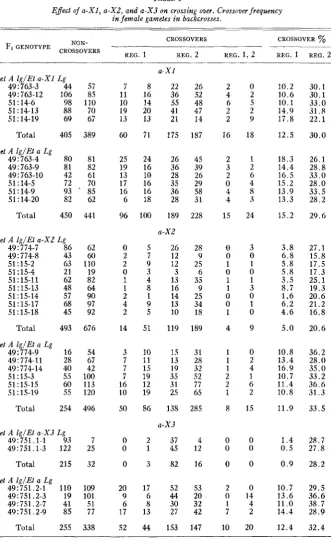
lg2 and Et a Lgz/et A lgz. Crossover frequency was determined in plants of both types, by pollinating them by et a Zgz. The results are shown in table 1. The relationship of the plants tested is indicated by the culture numbers. For ex- ample, the effect of a - X I was tested in two cultures, 49:763 (including two
a - X I / A plants and three a / A plants tested) and 51:14 (including three a - X l / - 4
and three a / A plants tested). The cultures 49:763 and 51:14 were progenies of two different crosses of the type Et a-X LB/Et a lgzXet A Lgz.
With a - X I there is no consistent indication of crossover modification, al- though the average frequency of crossing over in the Et-A interval is slightly lower than in the normal sibs tested.
282 L. J. STADLER AND HERSCHEL ROMAN TABLE 1
Effect o j a - X I , a-XZ, and a - X 3 on crossing over. Crossover frequency in female gametes in backcrosses.
CROSSOVERS CROSSOVER %
__________ _______
F1 GENOTYPE ---
REG. 2 REG. 1. 2 REG. 1 REG. 2
CROSSOVERS REG.
--____
a - X I
8 22
16 36
__
--et A l g / B a - X 1 Lg 49: 763-3 44 49:763-12 106 51: 14-6 98 51 : 14-13 88 51 : 14-19 69
Total 405
et A lg/Et a Lg 49: 763-4 80 49: 763-9 81 49:763-10 42 51 : 14-5 72
57
85 11 7 26 52
48 47 14 187 2 0 4 2 6 5
10.2 30.1 10.6 30.1 110
70 67
10 14 55
20 41
13 21
10.1 33.0 14.9 31.8 17.8 2 2 . 1 ~~
19 13
2 2
2 9
389 60 71 175 16 18 12.5 30.0
81 82 61 25 19 13
24 26
16 36
10 28
16 35
16 36
18 28
100 189 a-XZ
5 26
7 12 45 39 26 29 58 31 228 2 1 3 2
18.3 26.1 14.4 28.8 16.5 33.0
2 6
0 4
4 8
4 3
1.5 24 70 85 62 17 16 6
15.2 28.0 13.9 33.5 13.3 28.2 ~~ ~~ ~
51 : 14-9 93
.
51 : 14-20 82Total 450 441 96 15.2 29.6
et A lg/EI a-XZ Lg
49: 774-7 86 62 60 0 2 28 9 0 3 0 0 1 1 0 0 1 1 1 3 0 0 0 1 1 0 4 9
3.8 27.1 6.8 15.8 49: 774-8 43
51:15-2 63 110
19 82
2 0 1
9 12
3 3
4 13
8 16
25 6 35
5.8 17.5 5.8 17.3 3.5 25.1 ._ ~~ ~
51 : 15-4 21 51: 15-11 62 51 : 15-13 48 64
90 97 92 676 1 2 4 2 14 9 25
8.7 19.3 1.6 20.6 6.2 21.2 4.6 16.8 5.0 20.6 51: 15-14 57
51:15-17 68 51: 15-18 45
Total 493
1 14
9 13
5 10 51 119
34 18 189 et A lg/Et a Lg
49 : 774-9 16 49:774-11 28 49:774-14 40
54 67 3 7 7 7
10 15
11 13
15 19
31 28 32 52 77 65 1 0 1 2 1 4 2 1 2 6 1 2
8 15
10.8 36.2 13.4 28.0 16.9 35.0 42
100 113 120 496 51 : 15-3 55 51 : 15-15 60 51 : 15-19 55
Total 254
19 35
12 31
19 25
86 138 a - X 3
10.7 33.2 11.4 36.6 10.8 31.3 11.9 33.5 16
10
50 285
et A lg/Et a - X 3 Lg 49:751.1-1 93 49:751.1-3 122
7 25 32 0 0 0
2 37
1 45 4 12 16 0 0 0 0 0 0
1.4 28.7 0.5 27.8 0.9 28.2
Total 215
49:751.2-1 110 49:751.2-3 19 49: 751.2-7 41 49:751.2-9 85
Total 255
et A lg/El a Lg
3 82
109 101 51 77 20 9 6 17
17 52
6 4 4
53 2 0
0 14
1 4
7 2
10 20
10.7 29.5 20
32 42
13.6 36.6 11.0 38.7 14.4 28.9 _ _
8 30
13 27
MUTATION OF GENE A IN MAIZE 283 quency, both in the Et-A interval, to the left of the alteration, and in the
A-Lg? interval, to the right. There is considerable variation in the extent of reduction of crossing over in different plants, but in each of the nine a - X Z / A
plants tested, for both of the segments covered, the crossover frequency is lower than in any of the six a / A plants tested.
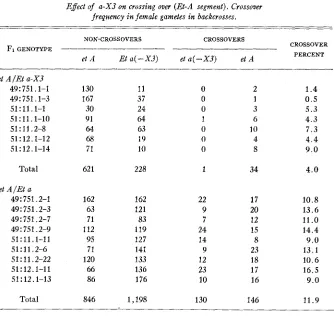
With a-X3, only two plants heterozygous for the alteration are available in the test for crossover effects in the entire Et-Lgz region, since in the tests made in the later series it was necessary to use cultures not marked a t the Lgz locus.
TABLE 2
Effect of a-X3 on crossing over (Et-A segment). Crossover freqzlency in female gametes in backcrosses.
NON-CROSSOVERS CROSSOVERS
CROSSOVER PERCENT
____
__FI GENOTYPE --
et A Et a( -X3) et a( -X3) et A
et AIEt a-X3
49t751.1-1 130 11 0 2 1.4
49: 751.1-3 167 37 0 1 0.5
51 : 11.1-1 30 24 0 3 5.3
51 : 11.1-10 91 64 1 6 4.3
51:11.2-8 64 63 0 10 7.3
51Z12.1-12 68 19 0 4 4.4
51: 12.1-14 71 10 0 8 9.0
Total 621 228 1 34 4.0
et A / E t a 49Z751.2-1 49: 751.2-3 49:751.2-7 4917.51.2-9 51:11.1-11 51 : 1 1 .2-6
51:12.1-11 51: 12.1-13
sr:
11.2-22162 63 71 112 95 71 120 66 86 162 121 83 119 127 141 133 136 176 22 9 7 24 14 9 12 23 10 17 20 12 15 8 23 18 17 16 10.8 13.6 11.0 14.4 9.0 13.1 10.6 16.5 9.0
Total 846 1,198 130 146 11.9
The data on crossing over in the Et-A region in these tests will be given pres- ently. The data for the two plants marked a t all three loci show pronounced reduction of crossing over in the Et-A region, but only slight and insignificant reduction in the A-LgZ region.
Additional data €or a-X3, on crossing over in the Et-A region, are given in table 2. The endosperm classification was checked by seedling classification in all cases, and seeds which failed to germinate are omitted. The data are therefore comparable with those for the Et-A region in table 1. Data on the a-X3 effect from table 1 are included in table 2 for comparison.
284 L. J. STADLER AND HERSCHEL ROMAN
zygous for a-X3, similar to that observed with a - X Z , and like the latter vary- ng rather widely in different F1 plants tested.
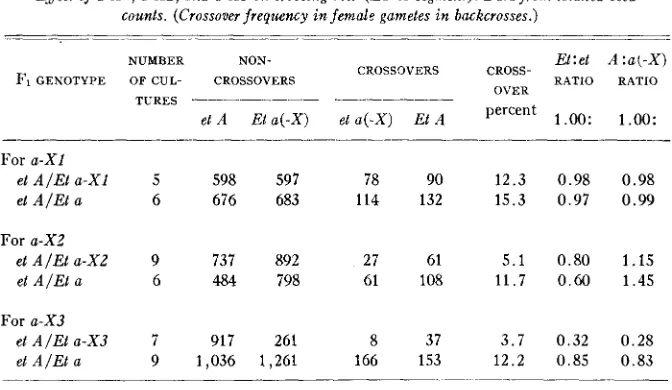
It should be noted that there are large inequalities in the frequency of cor- responding classes in these backcross progenies. This is evident not only in the progenies of A l a X plants, in which inequality is expected from the lowered female transmission of the various a - X alterations, but also in the progenies of A / . plants, in which this factor would not enter. The marker gene et shows distinctly reduced visbility in the families used in testing the crossover effect of a-XZ and a-X3, in which the progenies of A / a plants used as controls show
Et:et ratios of 1.OO:O.Sl and 1.00:0.73 respectively. The reduced frequency of
TABLE 3
Effect o j a - X I , a-XZ, and a-X3 on crossing over ( E T - A segment). Data from totalled seed counts. (Crossover frequency in female gametes in backcrosses.)
- ~-
NUMBER NON-
CROSSOVERS Fi GENOTYPE OF CUL- CROSSOVERS
For a-XI
et AIEL a-X1 5 598 597 78 90
et AIEL a 6 676 683 114 132
For a-X2
et A / E t a-XZ 9 737 892 27 61
et A / E t a 6 484 798 61 108
For a-X3
et AIEL a-X3 7 917 261 8 37
et A / E t a 9 1,036 1,261 166 153
Et: et A : a ( - X ) CROSS-
OVER RATIO RATIO percent
1
.oo:
1.oo:
1 2 . 3 0 . 9 8 0 . 9 8 1 5 . 3 0 . 9 7 0 . 9 9
5 . 1 0 . 8 0 1 . 1 5 1 1 . 7 0.60 1 . 4 5
3 . 7 0 . 3 2 0 . 2 8 1 2 . 2 0 . 8 5 0 . 8 3
et is due in part to lowered female transmission and in part to lowered germi- nation of et seeds in some of the cultures. Both tendencies vary widely in dif- ferent families; note for example that the Et:et ratio in progenies of A l a plants used as controls for a - X I effects is 1.00:0.95.
Since Et and A w e both identified b y seed as well as seedling effects, in- equalities due to differences in germination may be excluded from data on the
Et-A region by using the seed counts rather than the seedling counts. All of the data relating to Et-A crossing over in tables 1 and 2 were recalculated in terms of the total population of seeds produced. Since the seedling results cor- rected certain errors of seed classification for et, the corrected figures were used, and in the classes affected the same proportionate correction was applied to the seeds which failed to germinate. This recalculation lnade slight changes in the crossover frequencies observed in individual cultures, b u t made no ma- terial change in the indications of effects on crossing over. I n the case of both
MUTATION OF GENE A I N MAIZE 285 It is evident that marked inequalities of the Et and et classes remain in the families used for the a-XZ and a-X3 comparisons, with a reduction of female transmission of et to about 60 percent and 85 percent respectively in the cul- tures from the et A / E t a control plants. I n the control cultures this does not distort the crossover frequency, since it affects the crossover and non-crossover classes equally. But in the cultures segregating also for an a-X allele of re duced viability, the effect upon these two classes is necessarily unequal. Is this factor, rather than an actual decrease in crossing over, the cause of the reduced frequency of crossover gametes observed in the Ala-X plants?
Assume, for example, a crossover frequency of 12 percent in the et A / E t a-XZ
plants, as in their control sibs. I n an ear with a potential yield of 200 seeds, we expect 88 gametes of each of the non-crossover types and 12 of each of the crossover types. Assuming 60 percent survival for et, the frequency of the et -4
class is reduced from 88 to 53. The frequency of the Et a-XZ class will be simi- larly reduced by lower female transmission of a-XZ, but the extent of this re- duction varies in different cultures. We may estimate the reduction in these plants directly by comparing the a-X frequency observed with that expected if a-X had no effect on viability. With 12 percent crossing over and with full survival of a-XZ, these cultures would be expected to have a ratio for A:a-X
of 1.00:1.47, the reduced frequency of A being due to the disproportionate elimination of A individuals by the action of et. Actually the ears had a ratio for A : a of 1.00:1.15, indicating survival of a-X2 a t about 78 percent of normal. The expected frequencies of the four classes (with no interaction of viability effects) would thus be
% OF et A Et a-X et a-X E t A TOTAL CROSSOVERS
CROSSOVERS
Gamete ratio 88 88 12 12 200 24 12.0
Survival rate .60 .78 .47 1.00
Expected fre-
(. 6 0 X . 78)
quency 53 69 6 12 140 18 12.9
The effect is thus to increase slightly the apparent frequency of crossing over. With lower survival of gametes, such as might occur with a-X3, the error would be increased materially, as shown below:
% OF et A Eta-X eta-X Et A TOTAL CROSSOVERS
CROSSOVERS
Gametes 88 88 12 12 200 24 12.0
Survival rate .60 .25 .15 1.00
Expected 53 22 2 12 89 14 15.7
It is clear that this error in estimating crossover frequency, when the viabil- i t y factors are in repulsion-phase, must always be in the plus direction. The apparent increase in crossover frequency is due to an unbalanced reduction in survival of the various classes of gametes, and while both non-crossover classes are reduced in survival, only one of the two crossover classes is so af-
f ected.
286 L. J. STADLER AND HERSCHEL ROMAN
type et a-XZ expected, 40 percent would be eliminated by the action of et. and of the remainder, 22 percent would be eliminated b y the action of A - X 2 ,
It would not be surprising if the survival of et a-XZ gametes were less tha n t h e expected 47 percent, since the effect of both viability factors in the same in- dividual might be greater than would be anticipated from their effects in different individuals. But even if the cumulative effect were much increased, it could not result in any large decrease in apparent crossovers compared with the control, for it could only affect individuals in the single class which pro- vides only a minority of the observed crossovers. At its extreme, in the ex- ample given, with complete elimination of this class, it would give a n apparent reduction of crossing over from 12 percent to 8.6 percent. I n the second il- lustration, with lower survival, the maximum decrease possible would not b e sufficient to balance the spurious increase in observed crossovers, an d the results with complete elimination of the et a-X class would still indicate an increase in crossovers over the control. Obviously, the reduction of crossovers to less than half the control frequency, as found with both a-XZ and a - X 3 ,
could not be due to these sources o€ error.
Th e experimental results (table 3) show further tha t the et a-X class was not eliminated; it provides 27 of the 88 crossovers observed with a - X 2 a n d 8 of the
45 with a-X3. Is this inequality of the crossover classes, and the observed in- equality of the non-crossover classes, reasonably accounted for on the basis of viability differences involved?
Consider first the experimental data for a-XZ (table 3). T he survival ratio for et in the families used is 0.60, as indicated b y the control cultures. With
60 percent survival of et in the et A / E t a - X 2 cultures, a nd with full survival of
a-XZ, these ears should have produced 1228 E t a-XZ seeds (737/0.60) a n d
37 et a-XZ seeds (61X0.60). Actually they produced 892 E t a-XZ and 27 et a-XZ seeds, indicating survival of about 73 percent in both classes. I n other words. on the assumption of 60 percent survival for et, 73 percent survival for
a-XZ, and no interaction of viability effects, a gametic population of 2456
non-crossovers a nd 122 crossovers would have given the results observed. This represents a n actual crossover percentage of 4.7, though among the surviving individuals crossovers would constitute 5.1 percent.
A similar cslculation for the el A / E t a - X 3 cultures is shown below:
et A E t a - X 3 e t a - X 3 E t A
Observed (table 3) 917 261 8 37
Expected with full survival of a-X3 917 1079 31 37
Indicated survival of a-X3 24% 26%
Indicated gametic ratio 1079 1079 37 37
Here also the inequality of the crossover classes is well accounted for by the relative viability of the genotypes concerned, and the crossover frequency in- dicated, 3.3 percent, is a little lower than tha t shown by the percentage of crossovers among survivors.
MUTATION OF GENE A I N MAIZE 287 of about 20 crossover units in the Et-Lgz segment. I n a - X 3 heterozygotes, which were adequately tested only in the Et-A segment, the reduction in frequency of crossing over in this region was even greater than t h a t shown by
a-XZ.
CYTOLOGICAL OBSERVATIONS
The pronounced effect of a-XZ and a - X 3 upon crossing over suggests a n effect of these alterations on chromosome pairing in the region of the A locus. The additional effect of a-X3 upon pollen development, and its sharply re- duced female transmission, suggests further deficiency a t this locus. Cytologi- cal examinations were made therefore of plants heterozygous for a-X3, in the pachytene stage of the microsporocyte.
The A locus is in the terminal one-fifth of the long arm of chromosome 3 (MCCLINTOCK 1931). This region was carefully examined in two types of material. I n the first of these, the normal chromosome 3 carried a distinctive knob, near the midpoint of the long arm, which facilitated identification of the chromosome. Repeated observations failed to show any consistent abnormality in the region concerned. However, the material was not well suited for the de- tection of small alterations since the knob itself, in heterozygous condition, was responsible for some looseness and the frequent occurrence of buckles, usually in the vicinity of the knob b u t sometimes also in adjatent regions. More critical material was obtained from plants heterozygous for a-X3 but lacking the knob. Several pachytene configurations were examined in which chromosome 3 was positively identified. I n these there was no suggestion of a deficiency buckle or an inversion loop in the region of the A locus; the strands were as closely paired in this region as in other regions of the chromosomes.
The examinations made show that no reciprocal translocation is present, and no deficiency, insertion, or inversion long enough to interfere with visually normal pairing of the affected chromosome with its normal homolog. However, they do not exclude the possibility of a minute alteration t h a t might be de- tectable only if located in a region most favorable for cytological study. All three a-X alterations, if due to deficiency, must be intercalary since the gene
Et, located distal to A and present in the stocks originally treated, was not lost in any of the alterations. It is doubtful that losses as small as the minute terminal deficieqces of chromosome 9, recently described by MCCLINTOCK (1944), would be cytologically detectable if they occupied an intercalary posi- tion.
EVIDENCE FROM THE USE O F A N UNSTABLE DUPLICATION
The unstable duplication used in the experiments now to be described was secured indirectly from a chromosomal aberration found in a progeny from ultraviolet-treated pollen. A stock carrying A b was irradiated and crossed on a n a tester stock, in order to secure A losses from ultraviolet treatment for study in comparison with tliose from X-ray treatment. One of the plants of this progeny was a sectorial chimera, in which most of the plant showed the a
288 L. J. STADLER AND HERSCHEL ROMAN
ears showed some transmission of A b (39 colored seeds+ 7 colored-colorless mosaicsf260 colorless).
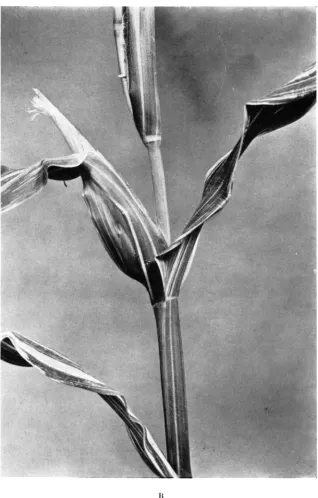
The colored seeds yielded colored plants, typical of Ab. A few of these were found to show small sectors of a tissue. The colored-colorless mosaic seeds regularly gave plants variegated for A b and a tissue, suggestive of the ring- chromosome variegation types described by MCCLINTOCK (1938). A typical plant of this sort is shown in fig. 1, A. Cytological examination of these plants showed a t pachytene a short supernumerary fragment in addition to the normal complement of ten pairs of chromosomes. This is designated D p 3a,
and will be referred to in this paper simply as Dp. The fragment was never seen as an open ring though it may have been a collapsed ring. Cytological study of the aberration was undertaken by DR. HELEN V. CROUSE, and will be reported separately.
This unstable duplication covering the A locus provides an opportunity for further study of the a-X alterations. With the addition of this duplication, the homozygotes and compounds of the a-X alterations may be shielded from the zygotic lethal effect, and, if these genotypes are viable in any tissue, the sub- sequent loss or diminution of the duplication fragment might make it pas- sible to observe their effects.
Crosses were made with all three a-X alterations, according to the scheme illustrated below in the case of a-XZ:
(1) a - X l / a p X a a , Dp.
Most of the seeds produced by this pollination are pale or colorless. There are in addition a considerable number of seeds showing full color due to Ab,
b u t all of these are endosperm mosaics. I n about half of these mosaics the sector lacking full color is pale; in the remainder it is colorless. The latter class repre- sents the genotype a - X Z l a , Dp. The plants grown from these seeds show a sectorial phenotype similar to a a , D p (fig. 1, A). A seed showing a typical endosperm mosaic of this class is shown in fig. 3, A.
( 2 ) a-Xl/aP
x
a - X l / a , Dp.This cross similarly yields pale and colorless seeds together with colored seeds showing endosperm mosiacs. Among the latter a new type appears, in which the region lacking color, instead of being healthy endosperm tissue dis- tinguished only by pigmentation of the aleurone layer, is shriveled, degenerate tissue. An example is shewn in fig. 3, B.
Seeds of this type are a - X l / a - X I , D p . Plants grown from these seeds are variegated, but are of a type very different from their a X l l a (or u p ) , D p sibs which resemble the plant pictured in fig. 1, A. A typical plant of a - X l / a - X l , D p is pictured in fig. 1, B. The sectors are all relatively small, and in general they are marked by absence of chlorophyll rather than absence of anthocyanin. The plants are distinctly defective in development, but they usually survive to maturity, and produce both tassels and ears. Flowering is delayed, and seed yield is small.
MUTATION OF GENE A I N MAIZE 289 Crosses of this type are used to produce the a - X / a - X , D p types in quantity, since all of the seeds produced are colored seed mosaics. Th e mosaics not show- ing degenerate sectors are mosaic for pale, not colorless.
Compounds are produced by appropriate substitution of the various a-X
alterations in crosses (2) and (3). The chief difficulty in extracting the types desired comes from the low transmission of a-X3, and to a lesser extent of
a-XZ, in the heterozygotes lacking the duplication. Both alterations are readily transmitted through pollen from plants carrying the duplication. Successful extraction of a-XZ 01 a-X3 in cross (2) thus makes the production of their compounds with a-X1 a simple matter, but the extraction of the homozygotes requires further use in cross (3) of the non-duplication stocks of low transmis- sion. It was ultimately possible to extract all three homozygotes a nd all three compounds. The types a - X 3 / a - X 3 , Dp and a-XZ/a-X3, Dp were first secured in crosses using Dp stocks as both male and female parents, a procedure which is undesirable for some purposes because of the possible inclusion in the progeny of individuals inheriting a duplication from both parents. The two types were later obtained also from crosses analogous to those of the scheme outlined above.
Dp-bearing plants homozygous for a-X1, and those representing the
a - X l / a - X Z and a - X l / a - X 3 compounds, were produced by crossing the ap- propriate types on a - X l / a ” (cross-type (3) above). Thus in each of the three crosses, the a - X / a - X types desired were produced in a progeny which included sib p l m t s of a-X/ap for comparison. I n each case, the a - X / a - X plants were distinctly smaller and in general later than their a-X/aP sibs, and were charac- terized invariably b y the occurrence of the characteristic chlorophyll-lacking sectors described above and pictured in fig. 1, B. T he variegation type ob- served showed no consistent differences in the three a - X / a - X genotypes in- cluded.
These sectors, marked by absence of chlorophyll, in general gave no indica- tion of loss of A , for the anthocyanin pigmentation within the sector was in almost all cases unaffected. Examination for anthocyanin effects cannot be made effectively in leaf blade tissue, since little anthocyanin is produced in this tissue. Many of the sectors identified in the blade extend into the leaf sheath, in which, with the proper complementary factors, anthocyanin pig- mentation is strong. For pigmentation of the sheaths above the base, the com- plementary factor B is essential, and unless the complementary factor PI is also present, pigmentation is absent in the portion of the sheath shielded from light by overlying tissue. Critical examination for adthocyanin effects in the sectors can therefore be made only in B
PZ
plants, and in some of the sectors of B $1 plants. Most of the sectorial plants carried B and a substantial pro- portion had PI also.MITT.\TION OF GENE A I N MAIZE 291
- -
I
-.
---I
13
FIGURE 1. Characteristic variegatecl plant types. A. ( I / ~ J , Dp. Note I)roacl to narrow sectors
292 L. J. STADLER AND HERSCHEL ROMAN
A R
FIGURE 2.-Leaves of plants showvn in Fig. 1 . A. a/a, Dp. No chlorophyll sectors.
MUTATION OF GENE A IN MAIZE 293
A 13
FIGURE 3. Characteristic endosperm mosaics. A. a/a, Dp. The mosaic sector is characterized only by the absence of anthocyanin pigmentation. P. a - X l / a - X I , Dp. The mosaic sector is chrr- rcterized by degenerate endosperm tissue.
t o the sheath, where even in the presence of strong anthocyanin the sector is recognizable by its lighter color resulting from the absence of chlorophyll. Such sectors are reasonably numerous, a single leaf sometimes providing a dozen or more. The counts were always made from only one leaf of any plant, to avoid including sectors of common origin in different counts.
It was found that in a large majority of the sectors lacking chlorophyll, anthocyanin pigmentation was present and apparently wholly normal, in comparison with adjoining tissue outside the sector. Much less frequently
A R
294 L. J. STADLE'R AND HERSCHEL ROMAN
I
A B
FIGURE 5. Leaf blades of plants shown in Fig. 4. A. a-Xl/a-X3, Dp. R. a-X3/a-X3, Dp.
sectors lacking anthocyanin as well as chlorophyll were found. Usually such sectors were adjoined on one or on both sides by sectors lacking chlorophyll only, as if the sector characterized by loss of both anthocyanin and chlorophyll occurred within a larger sector initiated by loss of chlorophyll only. There were, however, other cases in which sectors showing loss of both anthocyanin and chlorophyll occurred without adjoining sectors showing loss of chlorophyll only.
MUTATION OF GENE A I N MAIZE 295 cyanin pigmentation, with a sharp line of demarcation between the pigmented and non-pigmented tissues. On the other side it was adjoined by a sector about six mm wide, in which chlorophyll was lacking. Within the latter sector there were several streaks of anthocyanin-bearing tissue, but otherwise antho- cyanin was lacking in this sector also. Among sectors lacking anthocyanin; both in cases with and without chlorophyll, there is sometimes clear brown pigmentation similar to that found in a a B
PI
plants.These observations suggest that the sectors observed in the a - X / a - X plants result not from the loss of the duplication as a whole, but from losses of a por- tion only. If the a-X alterations represent deficiencies which are effectively cell- lethal, this is the result to be expected. Losses of the duplication as a whole, occurring in the course of development, would only eliminate the cell progeny of occasional cells of growing meristems. This might result in the reduced growth and distortion observed in the a-X/a-X plants as compared to their
a-X/aP sibs, but could not produce sectors of phenotypically distinguishable tissue. But if the duplication is capable of partial loss in mitosis, such as the diminution in ring chromosomes demonstrated by MCCLINTOCK (1938), and if the cell-lethal effect of the a-X alterations is due to a locus different from the
A locus or the chlorophyll-essential locus (here designated W ) , then partial losses could occur which would given viable sectors lacking chlorophyll or anthocyanin or both. The relative frequency of such sectors would depend up- on the sequence of the genes concerned, relative to the centromere of the duplication fragment. The relatively low frequency of sectors lacking both chlorophyll and anthocyanin, and the fact that there are usually found ad- joining sectors lacking chlorophyll only, suggests that a factor essential for cell- viability may be so located that losses of a segment including both A and W
would ordinarily include the cell-viability factor, but a loss involving one of the two loci might be followed by a loss involving the other, without including the viability factor.
It should be possible, by detailed study of the cytological behavior of the fragment and of the relations of the various genetic effects in the sectors, to locate these factors more definitely, and to distinguish between the various viability effects involved. For our present purpose, the essential point is the demonstration that all three of the a-X alterations are characterized by the absence of distinct and separable genetic effects. This is evident from the vary- ing types of sectors observed.
The phenotypic similarity of a - X l / a - X l , D p plants to the compounds
a - X l / a - X Z , D p and a - X l / a - X 3 , Dp is best tested in the progeny of crosses of the type a - X l / a P X a - X l / a - X Z (or a - X 3 ) , Dp. Here the seeds with degenerate sectors include two types, a - X l / a - X l , D p and a - X l / a - X Z (or a - X ? ) , Dp.
296 L. J. STADLER AND HERSCHEL ROMAN
Dp-bearing a - X / a - X genotypes including a-XI thus appear to be pheno- typically indistinguishable.
Of the three remaining Dp-bearing genotypes, a-XZ/a-XZ, a - X Z / a - X 3 , and
a - X 3 / a - X 3 , the first two also are similar to the a-XI homozygote and com- pounds. These types, obtained in various progenies, were always recognizable as defective plants with chlorophyll-lacking sectors, similar to those pre- viously described. The third, a-X3/a-X3, Dp, is distinctly different. This may be illustrated in the progeny of the cross a - X 3 / a p X a - X I (or a - X Z ) / a - X S , Dp. Because of low transmission of a-X3 by the female parent, this cross yields only a few seeds of the desired types per ear, b u t by pollinating several ears of
a - X 3 / a ~ by pollen from a single plant, small b u t adequate populations were secured. The results are as follows:
The seeds produced are mostly colored-pale mosaics. The remainder include some with clear degenerate sectors and some with no clear sectors, b u t usually with a slight pitting of the surface. I n some cases no pitting is detectable, and the seed appears fully colored.
Plants grown from the seeds with degenerate sectors are typical a - X / a - X
sectorial plants of the type previously described, and are indistinguishable from those previously found with a - X I or a-XZ. These plants show the segrega- tion of subnormal pollen associated with a - X 3 , b u t in proportions below 50 percent, as in the a-X3 heterozygotes previously reported. They are thus identified as the a-XI (or a-XZ)/a-X3, Dp class expected.
Plants grown from the pitted seeds or from the wholly colored seeds are of a new type, regularly defective in comparison with their a-X/ap, Dp sibs and usually more defective than their a-XI (or a - X Z ) / a X 3 , Dp sibs. These plants usually show no sectors except for numerous minute streaks of chloro- phyll-lacking tissue. Occasionally a small sector similar to those found in the other a - X / a - X types occurs, but ordinarily the plant is distinguishable only by its fine-streaked leaf blades and its generally defective development. A considerable proportion of these plants fail to survive t o the flowering stage, but the majority survive to maturity and usually produce a few seeds. These plants show subnormal pollen in proportions approximating 80-85 percent, or subnormal and defective pollen approximating this total. They are thus identified as the a-X3/a-X3, Dp class expected. The contrasted types of a - X / a - X , Dp plants are illustrated in figs. 4 and 5 .
Thus a-X3 must differ from a-XI and a-XZ in some viability factor or fac- tors concerned in the development of the sectors produced as a result of loss or diminution of the duplication fragment. If it be assumed t h a t a - X 3 involves deficiency of a viability factor or factors not involved in the other a-X altera- tions, it does not necessarily follow that sector survival would be appreciably affected, for the evidence indicates that the sectors observed with a-X1 and
MUTATION OF GENE A I N MAIZE 297 The interpretation applied may best be illustrated b y considering the vari- ous classes of progeny in a cross of the type a - X 3 / a P X a - X l / a - X 3 , Dp. The progeny includes four genotypes, which we may designate for convenience a s classes I, 11, I11 and IV as follows:
GENOTYPE
I a-Xl/ap, Dp
I1 a-X3/ap, Dp I11 a-Xl/a-X3, Dp IV a-X3/a-X3, Dp
I All classes of the progeny include the same Dp fragment (or, assuming that the fragment is constantly changing, equivalent samples from the mixture of Dp types present in the pollen grains of the plant used as male parent). T h e fragments present in the progeny plants therefore must undergo elimination and partial loss of the same kinds in plants of the four classes. The total effects of such losses are best indicated by classes I and 11, for these carry a chromo- some 3 free from viability defects (the @-bearing chromosome). Any loss of the duplication, in whole or in part, therefore will be without effect upon sub- sequent development of the affected tissue. I n these classes, visible sectors result only from losses which include the A locus.
The frequent occurrence of large sectors lacking A b in classes I and I1 shows that the Dp-fragment is undergoing frequent loss in development, including losses a t early stages of development. These losses may be entire or partial, so long as they include the A locus. Presumably they include chiefly cases of loss of the entire fragment.
The nature of the sectors observed in class I11 plants shows that few, if any, such losses, when they occur in plants of this genotype, result in the production of visible sectors. Sectors lacking A b are extremely rare. Since there is no reason to assume that these losses do not occur, we must postulate a genotype for the a-X alterations involved which prevents the development of these sectors. A factor (or factors) essential for viability, present in the normal chromosome 3
in the region covered by Dp 3a, must therefore be lacking in both a - X I and a-X3. Since a-XZ compounds show the same behavior, it must be lacking also in aAXZ. The location of this factor is such as to make possible its preservation when W and A are eliminated in successive losses, though it is commonly lost when W and A are lost simultaneously. The sectors involving loss of W and not of A , which make up the great majority of the sectors observed in plants of class 111, result from a type of loss not detectable in classes I and 11, since these classes are not genetically marked a t the W locus.
298 L. J. STADLER AND HERSCHEL ROMAN
enough this might result in apparently uniform anthocyanin pigmentation throughout the sector. On this basis the sectors found in class 111 plants could be considered the result of the same losses as those found in classes I and 11, and the loss responsible in both cases could be loss of the entire fragment. The reduction in size of sector might be considered to be the result of reduced growth in the a - X l a - X tissue, and the difference in phenotype the result of an effect upon chlorophyll development involved in the a-X alterations. It would still be necessary to postulate effects of the a-X alterations upon anthocyanin, chlorophyll, and growth, but no separation of these effects would be demon- strated by the variegation patterns observed.
This possibility is not supported by histological examination of the tissues within and adjoining the sectors. It requires the assumption that a very broad margin must be subject to pigmentation by diffusion, for some of the chloro- phyll deficient sectors are eight to ten mm wide, and are uniformly colored by anthocyanin throughout. It is contradicted by the sharpness of the margins of the exceptional types of sector in which anthocyanin, or both anthocyanin and chlorophyll, are deficient, and especially by the fact that this margin is sharp on a side adjoining normal tissue as well as on a side adjoining a chlorophyll- deficient’sector. We are forced to conclude that the sectors involving loss of chlorophyll alone represent a second type of loss, distinct from that involving loss‘of anthocyanin in classes I and 11, and occurriqg frequently enough to produce a large number of sectors on each leaf.
$he disappearance, or extreme reduction in size, of these sectors in plants of class IV, similarly shows an additional viability effect in plants of genotype
a-X3/a-X3. Alterations in the Dp fragment of the “second type” mentioned in the preceding paragraph, when they occur in plants of a - X 3 / a - X 3 , Dp geno- type, fail to iesult in sectors comparable to those found in other a - X / a - X , Dp plants. The chlbrophyll-essential factor W must be deficient in a - X 3 as well as .in a-X1 and a-XZ; otherwise the a-X3 compounds a - X l l a - X 3 and a - X Z / a - X 3
could not show the chlorophyll-deficient sectors. The absence of these sectors in the a-X3/a-X3, Dp plants must therefore be due to their failure to de- velop, throughrfhe action of some viability-affecting factor, or factors, dis- tinguishing a-X3 from a-X1 and a-XZ. The factor must be so located that its normal homolog tends to be lost from the duplication when W is lost.