©
DOI: 10.1534/genetics.104.039735
RacGap50C
Negatively Regulates Wingless Pathway Activity
During Drosophila Embryonic Development
Whitney M. Jones and Amy Bejsovec
1Department of Biology, Duke University, Durham, North Carolina 27708-1000
Manuscript received December 14, 2004 Accepted for publication January 3, 2005
ABSTRACT
The Wingless (Wg)/Wnt signal transduction pathway directs a variety of cell fate decisions in developing animal embryos. Despite the identification of many Wg pathway components to date, it is still not clear how these elements work together to generate cellular identities. In the ventral epidermis of Drosophila embryos, Wg specifies cells to secrete a characteristic pattern of denticles and naked cuticle that decorate the larval cuticle at the end of embryonic development. We have used the Drosophila ventral epidermis as our assay system in a series of genetic screens to identify new components involved in Wg signaling. Two mutant lines that modifywg-mediated epidermal patterning represent the first loss-of-function mutations in theRacGap50Cgene. These mutations on their own cause increased stabilization of Armadillo and cuticle pattern disruptions that include replacement of ventral denticles with naked cuticle, which suggests that the mutant embryos suffer from ectopic Wg pathway activation. In addition,RacGap50Cmutations interact genetically withnaked cuticleandAxin, known negative regulators of the Wg pathway. These phenotypes suggest that theRacGap50Cgene product participates in the negative regulation of Wg pathway activity.
T
HE Wnt signaling pathway plays a critical role in requires input from Wg signaling in the epidermal cells prior to stage 10 orⵑ6 hr after egg laying (Bejsovec many developmental processes. Of the 19 mouseWntgenes, 10 have been characterized mutationally and and Martinez-Arias 1991; Moline et al. 1999). Wg signaling at later stages specifies the expanses of naked each directs patterning and cell fate decisions in a different
tissue, such as brain, somites, kidneys, and limbs (reviewed cuticle that separate the denticle belts (Bejsovecand Martinez-Arias 1991). Loss-of-function wg mutations inWodarz and Nusse 1998;Logan andNusse 2004).
In Drosophila, a single Wnt molecule, encoded by the alter the cuticle pattern profoundly: mutant embryos se-crete no naked cuticle and instead produce a continuous wingless(wg) gene, alone directs a similar range of cell
lawn of denticles, all with a similar morphology (Nu¨ sslein-fate and patterning decisions, specifying cell sslein-fate in the
Volhard et al. 1984; Bejsovec and Wieschaus 1993). central nervous system, larval muscle, Malpighian
tu-Conversely, ectopic overexpression of wgredirects all of bules, and appendages (reviewed inDierickand
Bejso-the epidermal cells into Bejso-the naked cuticle cell fate, re-vec 1999). Although other Wnt genes are present in
sulting in a uniform expanse of smooth cuticle (Noorder-the fly genome, (Noorder-they do not appear to have major roles
meeret al.1992). in development (reviewed inLoganandNusse2004).
Wg protein specifies cell fates by activating an intracel-Wg signaling is most easily assayed in the embryonic
lular signaling cascade, the components of which are epidermis. Epidermal cells are exquisitely sensitive to
highly conserved among animal species (reviewed in Wg signaling levels and so this tissue provides a useful
Cadigan andNusse 1997; Wodarz and Nusse 1998; model to investigate the proteins involved in the
path-Dierick andBejsovec1999). The activity of the path-way and to explore how they work together to generate
way hinges on regulation of Armadillo (Arm), the fly pattern. Ventral epidermal cells secrete a segmentally
homolog of-catenin. In the absence of Wg signal, Arm repeating pattern of small hooks, called denticles,
sepa-is present at adherens junctions, but sepa-is kept at low levels rated by expanses of naked cuticle (Lohs-Schardin
in the cytoplasm. This downregulation is accomplished et al.1979;WieschausandNu¨ sslein-Volhard1986).
by a set of proteins collectively known as the destruction These belts of denticles provide traction for the crawling
complex, which includes Axin, Apc2, and the kinase larva after it hatches from the egg. In abdominal
seg-Zeste-white 3 (Zw3). The complex phosphorylates Arm, ments 2–7, each belt contains six rows of denticles. Each
targeting it for destruction by the proteasome (reviewed row of denticles shows a characteristic morphology that
inPeiferandPolakis2000;JonesandBejsovec2003). When Wg binds to its receptor, Dfz2, and coreceptor, Arrow, the clustering of the cell surface molecules
some-1Corresponding author: Department of Biology, Duke University,
how activates Dishevelled (Dsh) and leads to the degra-DCMB Group/Box 91000, B336 LSRC, Research Dr., Durham, NC
27708-1000. E-mail: [email protected] dation of Axin (Tolwinskiet al.2003). Degradation of
embryonic cuticles, eggs were allowed to develop fully (24 hr Axin and disruption of the destruction complex allows
at 25⬚), dechorionated in bleach, and transferred to a drop Arm to accumulate in the cytoplasm and in the nucleus.
of Hoyer’s medium, mixed 1:1 with lactic acid (Wieschaus In the nucleus, Arm binds to the DNA-binding protein and Nu¨ sslein-Volhard 1986), on a microscope slide. Me-Tcf (also known as Pangolin or LEF) and activates down- chanical devitellinization was performed by exerting gentle pressure on the coverslip to burst the vitelline membrane. stream gene transcription (Brunneret al.1997;van de
Cuticle preparations were baked at 65⬚overnight before view-Weteringet al.1997). Depending on the tissue and the
ing on a Zeiss Axioplan microscope with phase optics. time of development, different downstream genes are
acti-Isolation and characterization of mutant alleles:TheAR2
vated. andDH15mutant lines were isolated independently in a
ge-The Wg pathway components characterized to date netic screen for modifiers of thewgmutant phenotype. The temperature-sensitivewgallele,wgIL114, used in this screen is
were identified primarily through their mutant
pheno-also known as wgts orwgl-12. MalewgIL114/CyO flies were fed
types in Drosophila. Loss of a pathway activator mimics
overnight on ethyl methanesulfonate (EMS) at a concentra-the phenotype ofwgnull mutants, resulting in embryos
tion of 25 mmin 1% sucrose. They were allowed to recover that secrete a uniform lawn of denticles. Loss of a nega- and mated with virginDominant temperature sensitive (DTS)/CyO tive regulatory component mimics the effect of ectopic females (Nu¨ sslein-Volhard et al. 1984). At 29⬚, only flies bearing the mutagenizedwgIL114chromosome overCyOsurvive,
wgoverexpression, producing a uniform naked cuticle
and these were mated singly withDTS/CyOflies and raised phenotype. Despite the many components implicated
at 29⬚ to establish isogenic lines. A total of 1768 lines were in pathway modulation, their interactions and precise
established, and their F3progeny were examined for alteration
mechanisms of action are still somewhat mysterious. For of thewgIL114cuticle pattern at 25⬚.
example, it is not clear how Dsh, the most upstream TheAR2andDH15mutations were tested for complementa-tion because they yielded similar modificacomplementa-tions of thewgIL114
cytosolic component in the Wg pathway, interacts with
pattern. They failed to complement each other in this modifi-the receptor complex to mediate inactivation of modifi-the
cation, and when recombined away from the linkedwgIL114
destruction complex. Our laboratory has sought to fill
mutation, their homozygous-recessive embryonic-lethal pheno-the gaps by isolating mutations that modify Wg pathway types also failed to complement. The mutations were mapped activity. Here we describe loss-of-function mutations in using meiotic recombination against a second chromosome one such component, encoded by theRacGap50Clocus, marked with the adult visible mutationsblack, purple, cinnabar, curved, plexus, andspeck. The mutations mapped betweencinnabar which were isolated through their suppression of a
hypo-andcurvedatⵑ70 MU, and deficiencies in this region were tested morphicwgmutant allele.
for their failure to complement. Both alleles failed to complement
Df(2R)CX1, which removes cytological position 49C1-4;50C23-D2, and to complementDf(2R)vgB, which removes 49D3-4;49F15-MATERIALS AND METHODS
50A3. We mapped AR2and DH15 more precisely using site-specificP-element-mediated recombination in males (Chenet al. Drosophila stocks and culture conditions:All deficiencies
1998). ThePelements used for mapping the two alleles include andP-element insertions were obtained from the
Blooming-P{lacW}drkk02401,P{PZ}drk10626,P{EP}EP2007,P{PZ}fas05488,P{lacW}
ton Stock Center.P{UAS-DRacGap⫹}andP{UAS-DRacGap⌬EIE},
v(2)k16105k16105,P{EP}EP2423,P{lacW}shotk03010,P{lacW}AGO1k08121,
a dominant-negative form of RacGap50Cwith GAP domain
P{lacW}AGO1k00208,P{PZ}AGO104845, andP{lacW}Cp1k15606.
amino acids 405–407 deleted, were kindly provided by S.
Cam-The mutations mapped betweenP{EP}EP2423andP{lacW}
puzano (SotillosandCampuzano 2000). TheP{UAS-nkd}
shotk03010, narrowing down the interval to 13 annotated open
transgenes (Zeng et al. 2000) were a gift from K. Wharton
reading frames, 6 of which were predicted to encode “housekeep-and M. Scott.P{UAS-Rac1.V12}andP{UAS-Rac1.N17}, the
con-ing” enzymes. The complete sequences of all exons from the stitutively active and dominant-negative forms ofRac1,
respec-7 other candidate genes in theAR2andDH15mutant lines tively (Luoet al. 1994), and P{UAS-AxinGFP}(Cliffe et al.
were compared to the consensus sequence to locate the EMS-2003) were obtained from the Bloomington Stock Center.
induced mutations. PCR primers were designed using MacVec-Ubiquitous embryonic expression of UAS transgenes was
tor software and tested using Amplify (W. R. Engels). PCR was achieved with either the E22C-Gal4 or the arm-Gal4 driver
performed with both homozygous and heterozygous genomic lines. Both were tested in each assay and produced similar
DNA. The products were purified using the QIAquick PCR results unless otherwise noted. More restricted embryonic
ex-purification kit (QIAGEN, Chatsworth, CA) and sequenced pression was achieved using theprd-Gal4 andwg-Gal4driver
using ABI PRISM dye terminator cycle sequencing ready reac-lines. All driver lines are available from the Bloomington Stock
tion kit with Amplitaq DNA polymerase according to manufac-Center.
turer’s protocols. Both alleles were found to encode nonsense The naked cuticle (nkd) allele used in this study, nkd7E89,
mutations in theRacGAP50Cgene, CG13345. The PCR primers is a strong hypomorph (Ju¨ rgens et al. 1984; Zeng et al.
used to identify the single nucleotide changes in theRacGAP50C
2000). TheAR2andDH15mutations were induced on awgIL114
gene include 5⬘-CGAGTGAAAACCGATTCGTAG-3⬘, 5⬘-AGGT chromosome, as described below, and were subsequently
GTGGTTCCTCATCAG-3⬘, 5⬘
-GGTAAATGCTATGGCACCTC-recombined away from wgfor further analysis. The mutant
3⬘, and 5⬘-CGTCAAATGCTTTCCAACAAGG-3⬘. Additional pri-chromosomes were extensively recombined with wild type
mers used for sequencingDRacGAP50Cwere 5⬘-ATCTGAACA (Oregon-R) to remove unrelated lethal mutations and were
ACGAGACCC-3⬘, 5⬘-GGTATCTGCTCACCGTTAGC-3⬘, and 5⬘ -rebalanced over a CyO chromosome carrying Kruppel-Gal4
TCCTGGGAGTTTTGGTGTC-3⬘.
UAS-GFPinserts (obtained from Bloomington) to allow
identi-Antibody staining andin situhybridization:RNAin situ hy-fication of homozygous-mutant embryos by their failure to
bridization was performed with antisense digoxigenin-labeled fluoresce.
probes following standard protocols (Ashburner 1989; Flies were reared on cornmeal-agar-molasses unless
other-TautzandPfeifle1989). Antibody staining was as described wise noted. For analysis of embryonic stages, eggs were
Figure 1.—Epidermal patterning is altered in AR2 and DH15 homozygous-mutant embryos. (A) The wgIL114 allele at the
restrictive temperature produces the “lawn of denticles” phenotype characteristic ofwgloss-of-function mutations. (B) This severe patterning defect is altered inwgIL114AR2doubly mutant embryos, which are larger than thewgsingle-mutant embryo. (C) The
wgPE2hypomorphic allele produces a weaker pattern defect, with normal segmental patterning of the denticle rows but loss of
the intervening naked cuticle expanse. (D) Some naked cuticle is restored inwgPE2AR2double-mutant embryos, indicating that
the weak Wg signaling promoted bywgPE2mutant protein is enhanced. (E) Wild-type embryos secrete a stereotyped pattern of
six rows of denticles interspersed with naked cuticle in each abdominal segment. Abdominal segments 2–4 are shown. (F) In each abdominal segment, some denticle rows are replaced by naked cuticle in embryos homozygous for theAR2mutation. In this and all subsequent figures, anterior of the embryo is to the left. Bar, 100m.
at 1:1000 and anti-Arm was used at 1:50 (both from the Devel- Bank) at 1:100 and with antitubulin at 1:5000 (Labvision). Cross-reacting proteins were detected and quantified using opmental Studies Hybridoma Bank). Anti-Coracle antibody
(kindly provided by R. Fehon) was used at 1:10,000. DAPI stain the Odyssey infrared imaging system and reagents (Li-Cor Technologies).
was used at 1:20,000. Cy3 and Cy5 IgG secondary antibodies ( Jackson ImmunoResearch, West Grove, PA) were used to detect fluorescence staining. Embryos were mounted in
Aqua-polymount (Polysciences, Niles, IL) and viewed with a Zeiss RESULTS
410 confocal microscope.
AR2 and DH15modify wg phenotypes:In a genetic
Hatching efficiencies and cuticle pattern analysis:Fly crosses
were performed at 25⬚, and eggs were collected in 2- to 4-hr screen to identify mutations that suppress or enhance time windows. Eggs were arrayed on apple juice agar plates the mutant phenotype of thewgtemperature-sensitive and counted before being allowed to age for 24 hr at 25⬚. allele wgIL114, we isolated two EMS-induced mutations
Unhatched eggs were then dechorionated with bleach and
that subtly modify the wgIL114 mutant cuticle pattern.
mounted in Hoyer’s medium for scoring; in some cases
These modifier mutations,AR2andDH15, fail to com-hatched larvae were mounted as well. The number of
unfertil-ized eggs was subtracted from the total egg count, prior to plement each other and thus identify a single comple-calculating proportions for different phenotypic classes. Den- mentation group, linked towgon the second chromo-ticle rows in abdominal segments 3–6 were examined in at some. These two alleles produce identical phenotypes in least 20 embryos for each genotype, concentrating on the
our assays: all figures shown use theAR2line; however, middle one-third of the belt centered over the ventral midline.
similar results were obtained usingDH15. Both muta-Immunoblot analysis: Five- to 7-hr-old embryos were
col-lected, dechorionated, and examined for the presence or ab- tions show no increase in severity when placed intrans sence of GFP from theKr-GFP CyObalancer. Fifteen homozy- to a deficiency for the region and so are likely to repre-gous-mutant embryos (identified by lack of fluorescence) as sent loss-of-function alleles.
well as 15 wild-type siblings (identified by twofold brightness
wgIL114 embryos at the restrictive temperature are
of fluorescence) were collected and immunoblots were
per-much smaller than wild-type embryos and secrete the formed as described inChaoet al.(2003). Filters were stained
Figure 2.—RacGap50C is mu-tated inAR2andDH15.(A) Struc-ture ofRacGap50Cpredicted pro-tein, with position of premature termination codons noted and po-sitions of the PKC and GTPase-acti-vating domain homologies high-lighted. Overall, the predicted RacGap50C protein is 32% identi-cal to the human RacGap1, and in the GAP region, the identity is 51% (using Clustal alignment). In the Drosophila genome, Rac-Gap50C is most closely related to RacGap84C (24% identical, 56% in the GAP region) but shares homology in the GAP region with other members of the Rho family GTPase-activating proteins. (B) RacGap50CmRNA appears to be loaded into the egg maternally since early stage wild-type embryos, such as the stage 4 embryo shown here, stain heavily in RNAin situhybridizations. (C) Stage 10 embryo shows the uniform low level ofRacGap50C
mRNA detected at later stages of wild-type embryonic development. Bar, 100m.
activity (Figure 1A). The modifier linesAR2andDH15 theAR2andDH15mutations might disrupt a negative regulator of the pathway.
were found to alter thewgIL114phenotype in a similar
AR2and DH15carry nonsense mutations disrupting
way, increasing the spacing between denticles and the
the RacGap50C locus: The AR2 and DH15 mutations overall body size of the doubly mutant embryos (Figure
were mapped on the second chromosome, using stan-1B). This phenotype indicates that the modifier
muta-dard meiotic recombination and deficiency analysis. tions considerably reduce the severity of the wg
loss-Male site-specific recombination further refined the in-of-function phenotype, resulting in a larger, healthier
terval to cytological region 50C06-09. Seven candidate embryo even though the cuticle pattern is only subtly
genes within this interval were sequenced and lesions altered. Both AR2and DH15 also modify other wg
al-in only theRacGap50Clocus were detected for both the leles, including wgCX4, an RNA null allele of wg (not
AR2 and DH15 lines. RacGap50C encodes one of two shown). The cuticle pattern defects of weak wgalleles
RacGaps annotated in the Drosophila genome (Adams are more dramatically suppressed by theAR2andDH15
et al.2000; FlyBase at http://flybase.bio.indiana.edu/). mutations. The wgPE2 hypomorphic allele produces a
While the genome contains 21 predicted Rho family protein with a lower affinity for the receptor complex
GTPase-activating proteins (Bernards2003), only Rac-(BejsovecandWieschaus1995; Molineet al. 2000).
Gap50CandRacGap84Care strongly conserved with the wgPE2homozygous mutants show segmental denticle
di-human RacGap1. The predicted RacGap50C polypep-versity, but little or no naked cuticle separating the belts
tide contains a protein kinase C (PKC) conserved re-(Figure 1C). ThewgPE2
AR2doubly homozygous mutants
gion, which is predicted to bind diacylglycerol, as well show an increase in the amount of naked cuticle,
indicat-as a RhoGap motif, a 140-amino-acid GTPindicat-ase-activating ing that some Wg signaling is restored (Figure 1D).
domain that stimulates the Rho-like GTPases, Rac, Rho, In an otherwise wild-type background, theAR2and
or Cdc42 (Figure 2A).AR2carries a point mutation in DH15 mutations are recessive lethal, and homozygous
theRacGap50Ccoding region that changes amino acid embryos show an excess specification of naked cuticle
470, a tryptophan, to a premature stop. This is predicted at the expense of denticles. Wild-type embryos (Figure
to truncate the protein within the RhoGap domain. 1E) secrete an average of 5.95⫾0.15 rows of denticles/
Figure 3.—The AR2 and DH15 mutant phenotype is rescued byRacGap50C expres-sion and is not mimicked byRac1 manipula-tion. The AR2 homozygous-mutant cuticle pattern defect (A) is substantially rescued by uniformly expressing aUAS-RacGap50C trans-gene withE22C-Gal4(B). (C) Rescue is also observed with the UAS-RacGap50C⌬EIE
trans-gene, which carries a small deletion within the GAP domain (SotillosandCampuzano
2000), suggesting that the GTPase-activating function is not required for epidermal pat-terning. (D) Usingwg-Gal4to drive expres-sion of the constitutively activatedRac1 trans-gene, UAS-RacV12, does not mimic the
RacGap50Cphenotype. Instead, it causes ex-cess specification of denticles (arrows), sug-gesting a loss rather than a gain of Wg path-way activity. (E) Using thearm-Gal4driver to uniformly overexpress the dominant-nega-tiveRac1transgene,UAS-RacN17, does not
af-fect ventral patterning, but causes a dorsal hole phenotype (large arrow) as expected from previous studies (Luoet al.1994).
signaling marker, diphosphoERK, in the presumptive observed. We find that RacGap50C mRNA transcripts appear to be maternally contributed to the egg, because veins (Sotillos and Campuzano 2000). These wing
phenotypes are enhanced by coexpression ofRac1, lead- early stage embryos show strong staining in RNAin situ hybridization experiments (Figure 2B). Low uniform ing these authors to conclude that Rac1 is a target of
RacGap50C activity in the wing. In contrast, Rac1 has levels of transcript are detected throughout embryogen-esis (Figure 2C), showing that it is zygotically expressed been shown to be irrelevant for the cytokinesis role of
RacGap50C, where the primary function of RacGap50C during the stages when Wg signaling determines epider-mal pattern. We do not detect any segmental modulation is to serve as an adaptor molecule linking the
microtu-bule and actin cytoskeletons. This linkage is essential of RacGap50Cexpression. To verify that theRacGap50C mutations account for theAR2andDH15mutant pheno-for positioning the contractile ring of dividing cells;
expression of a dominant-negative form ofRacGap50C types, we expressed a wild-type RacGap50C transgene (Sotillos andCampuzano2000) in mutant embryos results in accumulation of multinucleate cells (Somers
andSaint 2003). The other Drosophila RacGap, Rac- and looked for rescue of the mutant phenotype. Driving ubiquitous expression of theUAS-RacGap50Ctransgene Gap84C, encodes a protein 47% similar to RacGap50C.
No point mutations inRacGap84Chave been identified, during embryogenesis partially rescues the embryonic lethality and completely rescues the pattern defect of but deficiencies in the area are known to cause defects
in spermatid and retinal differentiation (Bergeretet AR2homozygous-mutant embryos (Figure 3, A and B). Whereas 25% of the progeny from AR2 heterozygous al.2001); thus both RacGaps are likely to be functional.
Since mutations inRacGap50Cwere detected in both parents normally fail to hatch (n ⫽ 593), ⬍10% fail to hatch (n⫽ 796) whenUAS-RacGap50Cis uniformly of our mutant lines, it seemed likely that RacGap50C
Figure 4.—RacGap50Cmutations inter-act genetically with known negative regula-tors of Wg pathway activity. (A) Embryos homozygous for a strongnkdallele,nkd7E89,
show excessive specification of naked cuti-cle, but typically retain between one and two denticle belts (see data in Table 1). (B) This phenotype is enhanced in theAR2;nkd
doubly homozygous embryonic cuticle. (C) The homozygousnkd7E89mutant phenotype
is partially suppressed by reducingwgdose in the wgCX4/⫹;nkd/nkd mutant embryo.
(D) Thiswggene dose effect is lost in the absence of the RacGap50C gene product.
wgCX4AR2/⫹AR2;nkd/nkdmutant embryos
consistently show the enhanced, uniform naked cuticle phenotype. (E) Driving the
UAS-nkd transgene uniformly with E22C-Gal4causes pattern disruptions inwgCX4/⫹
embryos. (F) This antagonism of Wg path-way activity bynkdoverexpression is not ob-served in wgCX4 RacGap50C/⫹⫹ embryos.
(G) Overexpressing a GFP-taggedUAS-Axin
withE22C-Gal4produces severe cuticle pat-tern defects even in the presence of wild-type levels of Wg signaling. (H) The severity of this Axin-overexpression pattern defect is slightly suppressed inRacGap50C homo-zygous-mutant embryos.
die during larval stages probably because E22C-Gal4is closure movements of the embryo, as well as in axon growth and guidance in the developing nervous system expressed only embryonically. Denticle belts of rescued
homozygous mutants contain 5.23⫾0.60 rows of denti- (Hakeda-Suzukiet al.2002;Nget al.2002).
To determine whether the effects of RacGap50C in cles/belt (n⫽64), compared to 3.95⫾0.64 (n⫽80)
observed in unrescued mutant embryos. These results the embryonic epidermis are mediated through a Rho family member, we tested whether the GTPase-activat-confirm that the cuticle pattern defect observed in our
mutant lines is due to loss ofRacGap50Cfunction. ing domain of RacGap50C was required for rescue of the epidermal patterning defect in mutant embryos.
RacGap50C does not appear to interact with Rac in
epidermal patterning:RacGaps are thought to downreg- The dominant-negativeRacGap50C⌬EIEconstruct deletes
three conserved amino acids in the GAP domain, pro-ulate activity of Rac by stimulating the intrinsic GTP
hydrolysis function of the protein and thereby con- ducing a protein that still binds Rac but cannot stimulate GTP hydrolysis (Sotillos and Campuzano2000). As verting it from the active GTP-bound form to the
inac-tive GDP-bound form (reviewed in Hall 1998). Both mentioned above, Sotillos and Campuzano observed profound effects of this UAS-RacGap50C⌬EIE construct
the vertebrate and invertebrate RacGTPases are
associ-ated with signaling cascades that promote cytoskeletal when it is expressed in the wing imaginal disc. In con-trast, we find that when we expressUAS-RacGap50C⌬EIE
rearrangements, often during morphological processes.
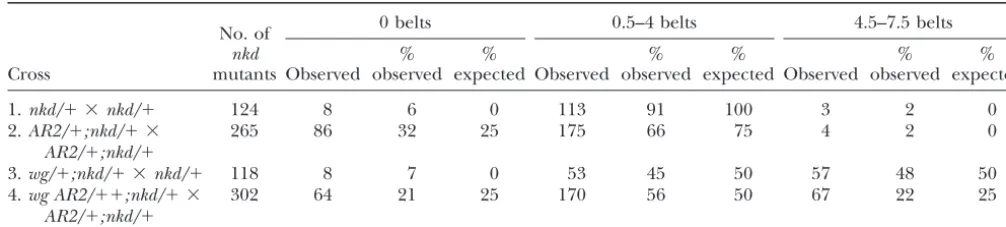
TABLE 1
Genetic interactions betweenAR2andnaked
0 belts 0.5–4 belts 4.5–7.5 belts
No. of
nkd % % % % % %
Cross mutants Observed observed expected Observed observed expected Observed observed expected
1.nkd/⫹ ⫻nkd/⫹ 124 8 6 0 113 91 100 3 2 0
2.AR2/⫹;nkd/⫹ ⫻ 265 86 32 25 175 66 75 4 2 0
AR2/⫹;nkd/⫹
3.wg/⫹;nkd/⫹ ⫻nkd/⫹ 118 8 7 0 53 45 50 57 48 50
4.wg AR2/⫹⫹;nkd/⫹ ⫻ 302 64 21 25 170 56 50 67 22 25
AR2/⫹;nkd/⫹
Onlynkdhomozygous-mutant embryos are categorized; these representedⵑ25% of the total fertilized eggs laid in each cross. Expected percentages for crosses 2 and 4 are based on our hypothesis thatAR2homozygosity enhances the severity of thenkd
mutant phenotype. Expected percentages for cross 3 are based on previous observations thatwgheterozygosity suppresses the
nkdmutant phenotype (Bejsovecand Wieschaus 1993). Note that variability in the nkd single-mutant phenotype (cross 1) accounts for the divergence between observed and expected frequencies in crosses 2 and 3; when this is taken into consideration, the observed and expected numbers are not significantly different. This does not appear to be true for cross 4, suggesting that reducedwggene dose slightly diminishes the ability ofRacGap50Cmutations to enhance thenkdmutant phenotype.
to rescue the cuticle pattern phenotype (Figure 3C). ing, even though Wg protein levels are unaffected (not shown). Furthermore, overexpression of a dominant-The rescued homozygous-mutant embryos have 4.81⫾
0.60 rows of denticles/belt (n ⫽ 160). This rescue is negative form ofRac1,UAS-RacN17(Luoet al.1994), with
most embryonic drivers tested does not produce any not as complete as that observed for the wild-type
Rac-Gap50Cconstruct (5.23⫾ 0.60 rows of denticles/belt, disruption of ventral epidermal patterning, although dorsal closure is clearly disrupted as previously reported above) and does not include any rescue of the
embry-onic lethality as was observed for the wild-type construct. (Figure 3E). We conclude that RacGap50C does not act through Rac in promoting its effects on embryonic However, the cuticle phenotype is significantly different
from the unrescued RacGap50C mutant (P ⫽ 0.001). pattern formation.
RacGap50C interacts with negative regulators of the
Overexpressing theUAS-RacGap50C⌬EIE transgene in a
wild-type embryo does not produce any detectable pat- Wg pathway:The increased specification of naked cuti-cle inAR2 andDH15 mutant embryos suggests an in-terning defect nor does it appear to affect larval viability
(data not shown). These results suggest thatRacGap50C crease in Wg pathway activity similar to that observed in mutants disrupting known negative pathway regulators. has a novel function in epidermal patterning that does
not involve interaction with a GTPase. Most of these negative regulator mutations have a strong maternal effect, and the excess naked cuticle phenotype To further confirm that the GTPase-activating
func-tion of RacGap50C is dispensable for epidermal pat- is observed only when maternal contribution is reduced (Siegfriedet al.1992;Hamadaet al.1999;McCartney terning, we tested the effects of Rac activity in
pat-terning. Since GTPase activation would be expected to et al.1999). The exception isnkd, which acts zygotically (Ju¨ rgens et al. 1984) as do the AR2 andDH15 muta-turn Rac off, a constitutively active Rac would be
ex-pected to produce phenotypes similar to loss of Rac- tions.nkdencodes a protein that interacts with the Wg pathway at the level of Dsh, to which it binds through Gap50Cin processes where its GAP activity is relevant.
We therefore tested whether the patterning defects of the Dsh basic-PDZ region (Zenget al.2000;Roussetet al.2001).nkdmutant embryos show an excess of naked ourRacGap50Cmutants could be mimicked by
expres-sion of the constitutively activatedRac1transgene,UAS- cuticle at the expense of denticle belts, and this pheno-type is enhanced by RacGap50C mutations. There is RacV12(Luoet al.1994). We used several different
embry-onic Gal4 drivers to express theUAS-RacV12 transgene, some variability in thenkd mutant phenotype, but on
average nkd mutants produce 1.5 abdominal denticle but most caused the embryos to die prior to secretion of
the cuticle, making it impossible to score cuticle pattern belts (Figure 4A; Table 1), as opposed to the 8 abdomi-nal belts seen in wild type. The denticles formed in the alterations. ExpressingRacV12 in the spatially restricted
wgdomain in each segment, using thewg-Gal4driver, fewnkdmutant belts are normally patterned, with typical denticle morphologies (BejsovecandWieschaus1993). does not block cuticle secretion but these embryos
pro-duce a cuticle pattern very different from theRacGap50C In contrast, the average phenotype ofRacGap50C;nkd doubly homozygous mutants is uniform naked cuticle, loss-of-function phenotype (Figure 3D). Rather than the
signal-Figure5.—RacGap50Cmutant embryos have normal Wg levels, but show elevated Arm protein accumulation. (A) Anti-Wg antibody staining in wild-type stage 10 embryos shows segmental stripes, with a slightly punctate appearance due to secretion and endocytosis of the protein. (B) Anti-Wg antibody staining inRacGap50Chomozygous embryos is indistinguishable from that of wild type. (C) Anti-Arm antibody staining in wild-type stage 10 embryos shows broad stripes of higher accumulation, reflecting the domain of cells responding to the Wg signal in each segment. (D) The segmental striping of Arm is still observed inRacGap50C
homozygous-mutant embryos, but accumulation of Arm appears to be higher throughout the epidermis. All embryos shown are siblings from the AR2/Kr-Gal4 UAS-GFP CyOstock; both antibody reactions were double labelings with the GFP antibody to distinguish homozygous mutants from theirCyO-bearing heterozygous or homozygous wild-type siblings. Embryo pairs [(A and B) and (C and D)] are from the same slide preparations and confocal images were captured under identical conditions. (E) Immunoblotting lysates of hand-selected embryos confirms the impression that Arm levels are higher in the homozygous mutants. Comparison of Arm levels normalized to the tubulin loading control indicates that Arm levels are 25% higher in the AR2 mutant homozygotes than in their wild-type,CyO-bearing siblings.
dosage: heterozygosity for awgnull allele partially sup- that reducing the dose ofRacGap50Creverses this effect. Embryos heterozygous for wgCX4and RacGap50C show
presses the ectopic naked cuticle specification of nkd
homozygotes (Bejsovec and Wieschaus 1993). Rac- a wild-type cuticle pattern when nkd is overexpressed (Figure 4F). This series of experiments demonstrates Gap50C mutations remove the ability of lowered Wg
dose to suppress the nkd mutant phenotype. Embryos thatRacGap50Chas a synergistic interaction with Nkd, a negative regulator of the Wg pathway, suggesting that homozygous fornkdand heterozygous forwgCX4typically
show a range of between 4.5 and 7.5 abdominal denticle RacGap50Calso is required for negative pathway regula-tion.
belts (Figure 4C; Table 1), as opposed to the 1.5 average
fornkdsingle mutants. This rescue is reversed when the We find similar interactions with Axin, another nega-tive regulator of the Wg pathway. Overexpression of a AR2 or DH15 mutation is placed in the background.
Embryos homozygous for bothRacGap50Candnkd, and GFP-tagged Axin transgene causes cuticle pattern de-fects consistent with severely compromised Wg signal heterozygous for wgCX4, secrete uniform naked cuticle
with no denticle belts (Figure 4D; Table 1). ThusRac- transduction. The embryos show a “lawn of denticles” pattern similar to wg loss-of-function mutants (Figure Gap50C activity is required for the wg dose sensitivity
ofnkd. 4G). However, when Axin is overexpressed in
Rac-Gap50Cmutant embryos, the resulting phenotype is not SinceRacGap50Cmutations are enhancers of thenkd
loss-of-function phenotype, we wondered how they would as severe. Some aspects of the segmental pattern are rescued, with more naked cuticle separating the denti-behave in nkdgain-of-function experiments. Ubiquitous
overexpression of nkd in a wild-type embryo produces cle belts (Figure 4H). Thus loss of RacGap50C gene activity can partially suppress Axin overexpression phe-no cuticle pattern defect unless the gene dosage ofwg
is reduced (Zeng et al. 2000). In wgCX4 heterozygous notypes, suggesting that theRacGap50Cmutations
dis-rupt a pathway component that either is a limiting cofac-embryos, overexpressingnkdproduces fusions between
denticle belts due to loss of the intervening naked cuti- tor for Axin or acts downstream of Axin in the Wg signaling pathway.
cle (Figure 4E). Thus, when Wg levels are limiting,
determine where in the Wg pathway RacGap50C acts, The epidermal patterning defects that we observe are not, however, a secondary consequence of late defects we analyzed molecular markers of Wg signaling. The
wg gene is expressed in a one-cell-wide stripe in each in cytokinesis. First, we observe changes in Armadillo stabilization beginning at stage 9, whereas the cell divi-segment of the developing embryo.wgitself is a target
gene activated by Wg signaling: disruption of various sion defects observed by the Saint laboratory do not become apparent until stage 11. Second, we find that the pathway components can alter wg gene expression or
Wg protein secretion or distribution. However, we find cuticle pattern defect is rescued by ectopic expression of theUAS-RacGap50C⌬EIEtransgene (Figure 3C), whereas
that Wg protein distribution is indistinguishable from
wild type in theRacGap50Cmutant embryos (Figure 5, the cytokinesis defect is not (SomersandSaint2003). Third, we have found another experimental condition A and B), indicating that the mutations disrupt neither
expression nor protein accumulation. We also exam- that rescues the epidermal patterning defects of Rac-Gap50Chomozygotes without rescuing the cytokinesis ined expression ofengrailed, another target gene for Wg
activity (DiNardo et al. 1988; Martinez Arias et al. defects. Antagonizing Wg pathway activity by ectopically overexpressingnkdsignificantly reverses the cuticle pat-1988), and found no significant change in its pattern
or level compared with wild type (not shown). tern defects of RacGap50Cmutant embryos (Figure 6, A and B), although it does not alter their embryonic In contrast, the levels of Arm protein accumulation
are significantly altered in RacGap50C mutants com- lethality.RacGap50Chomozygous embryos overexpress-ingnkdproduce 5.25⫾0.47 rows of denticles/belt (n⫽ pared with wild type.armmRNA is expressed at uniform
levels throughout the epidermis (Riggleman et al. 80), comparable to the measurements obtained for mu-tant embryos rescued with the wild-type RacGap50C 1989), but Arm protein accumulates in a striped pattern
in wild-type embryos, reflecting the segmental stripes transgene. Thus ectopic Nkd activity can partially com-pensate for loss of theRacGap50Cactivity in Wg-medi-of high Wg signaling activity (Riggleman et al. 1990;
Peiferet al.1994). InRacGap50Cmutant embryos, Arm ated patterning events and allows RacGap50C mutant embryos to secrete a pattern more similar to that of the accumulation appears to be elevated compared to wild
type (Figure 5, C and D). This increase in Arm protein wild-type state (Figure 6C). However, we observe large, binucleate cells accumulating in nkd-overexpressing is confirmed by immunoblot analysis. TheRacGap50C
mutant chromosomes were balanced over aCyO chro- RacGap50Cmutant embryos at the same frequency as they do in theRacGap50Chomozygotes alone (Figure mosome bearing aKruppel-drivenGFPtransgene insert.
This allows identification and selection of homozygous- 6, D and E), even though epidermal patterning defects are substantially rescued in thenkd-overexpressing em-mutant embryos by their failure to fluoresce. At stage
10, homozygous-mutant embryos show between 20 and bryos. Wild-type embryos at the same stage (Figure 6F) do not accumulate binucleate cells and show a higher 25% higher steady-state levels of Arm protein compared
to their fluorescing wild-type siblings (Figure 5E). Al- cell density in the epidermal epithelium than do the RacGap50C mutant embryos. Thus the role of Rac-though these increases are not as extreme as those
ob-served for maternal and zygotic loss ofzw3, the principal Gap50Cin Wg pathway modulation is separable from its role in forming the contractile ring during cytokinesis. agent of Arm destruction (Peiferet al.1994), they
repre-sent the most dramatic zygotic phenotype documented.
The RacGap50C cell cycle defects are unrelated to
DISCUSSION
epidermal patterning defects:Previously, the Saint lab
has shown by RNA interference thatRacGap50Cis re- Involvement of a Rac GTPase-activating protein ho-molog in Wg signaling is unexpected and unprece-quired for cytokinesis in cell culture and in imaginal
disc tissue (SomersandSaint2003). This requirement dented and may reveal a novel function that does not involve a Rho family GTPase. We find thatRacGap50C for RacGap50C in cell division explains why we have
been unable to obtain sizable clones ofRacGap50Cmu- interacts genetically withnkdand appears to act at the same level or downstream of Axin in the control of tant tissue in germline and somatic mosaic experiments
(data not shown). This has prevented us from assessing Arm stabilization. Our data indicate that RacGap50C probably does not act through Rac1 to negatively regu-the mutant effects of reducing maternal contribution
for theRacGap50C gene product. The abundant Rac- late Wg activity, nor are other GTPases likely to be in-volved in this aspect of epidermal patterning since the Gap50CmRNA detected in early stage embryos (Figure
2B) suggests that substantial maternal product is con- cuticle defects of mutant embryos can be rescued by a form of RacGap50C that lacks catalytic residues in the tributed to the egg. This maternal product most likely
accounts for the relatively normal cell division that we GTPase-activating domain. Moreover, previous work shows that other Rho family members are unlikely to observe in the RacGap50C mutant embryos through
most of development. Work on our mutant lines in the be involved in Wg-mediated patterning. Overexpressing either constitutively active or dominant-negative Rho, Saint laboratory indicates that cell division defects can
be detected in late stage embryos, with binucleate cells Rac, orcdc42transgenes disrupts dorsal closure but does not appear to affect ventral patterning (Luoet al.1994; accumulating in the epidermis during stage 11 (M.
Figure6.—Naked overexpression res-cues the RacGap50Ccuticle pattern de-fect without afde-fecting the cytokinesis defect. (A)AR2mutants show the char-acteristic loss of denticles, particularly in the more anterior rows of the denticle belt. (B) Driving theUAS-nkdtransgene ubiquitously withE22C-Gal4significantly rescues the cuticle pattern defect, to a pattern much more closely resembling that of wild type (C). TheUAS-nkdand theE22C-Gal4transgenes were indepen-dently recombined onto theAR2mutant chromosome, and these lines were then crossed to each other. Therefore allAR2
homozygotes in this experiment overex-press nkd. (D) The AR2 homozygous-mutant embryos accumulate large, bi-nucleate cells (arrows) during stage 11, visualized with DAPI staining in blue to show nuclei and anti-Coracle staining (Fehonet al.1994) in red to outline the cell membranes. During stage 11, the segmental furrows begin to form; one is shown here and in E and F as a vertical cleft in the field of epidermal cells. (E) The accumulation of binucleate cells is unaffected inAR2mutant homozygotes that are overexpressing nkd. Thus the
RacGap50Ccytokinesis defects are unre-lated to the epidermal patterning de-fects, which are rescued by this treat-ment (B). (F) The epidermal cell density is higher in stage 11 embryos that have wild-type cytokinesis. No binucleate cells are apparent in the wild-type,CyO -bear-ing sibl-bear-ings nor in Oregon-R embryos of the same stage, shown here.
been found to alter embryonic segmental pattern, but tons. This adaptor function appears critical for the proper positioning of the acto-myosin contractile ring this is due to an early effect on establishing
segmenta-tion gene expression patterns (Magieet al.1999). Ras at the end of mitosis (SomersandSaint 2003). One could imagine that a structural role for Rac-activation through the EGF signaling cascade has been
found to affect epidermal patterning, but in a way that Gap50C in linking the microtubule and actin cytoskele-tons might be relevant to its regulation of Wg pathway counteracts Wg signaling (O’Keefe et al. 1997;Szuts et
al.1997). Thus a GTPase-activating protein would be ex- activity. Apc2, a scaffolding molecule that is an essential component of the destruction complex, is known to pected to positively influence Wg-mediated patterning if
it acted through Ras, rather than the negative influence interact with both microtubules and the cortical actin cytoskeleton (McCartneyet al.1999, 2001). Mutations we observe forRacGap50C.
For these reasons, we believe that the role of Rac- that disrupt the cortical localization of Apc2 compro-mise function of the destruction complex (McCartney Gap50Cin Wg signaling may instead parallel its role in
cytokinesis, where it seems to function primarily as an et al. 1999; A. Bejsovec, unpublished results), sug-gesting that subcellular localization of the complex may adaptor molecule. RacGap50C was identified by the
Saint laboratory through a yeast two-hybrid screen for be critical. Furthermore, recent work from the Bienz and Wieschaus laboratories demonstrates that Axin, an-molecules that interact with pebble, a RhoGEF that is
essential for cytokinesis (SomersandSaint2003). Sub- other scaffolding component in the complex, changes its subcellular localization in response to Wg signaling sequently, they showed that RacGap50C protein also
cytoskele-Brunner, E., O. Peter, L. SchweizerandK. Basler, 1997 pangolin tion complex and/or some of its subunits may play a
encodes a Lef-1 homolog that acts downstream of Armadillo to critical role in regulating its Arm-degrading activity. Rac- transduce the Wingless signal. Nature385:829–833.
Cadigan, K. M., and R. Nusse, 1997 Wnt signaling: a common Gap50C may be involved directly in linking the
destruc-theme in animal development. Genes Dev.11:3286–3305. tion complex to the cell cortex to promote its proper
Chao, A. T., H. A. Dierick, T. M. AddyandA. Bejsovec, 2003 Muta-activity or may restrict movement of Axin to the cortex tions in eukaryotic release factors 1 and 3 act as general nonsense
suppressors in Drosophila. Genetics165:601–612. for its Wg-mediated destruction. In either case, loss of
Chen, B., T. Chu, E. Harms, J. P. GergenandS. Strickland, 1998 RacGap50Cfunction would reduce the normal
degrada-Mapping of Drosophila mutations using site-specific male recom-tion of Arm and thereby cause ectopic Wg pathway bination. Genetics149:157–163.
Cliffe, A., F. HamadaandM. Bienz, 2003 A role of Dishevelled activity.
in recruiting Axin to the plasma membrane during Wingless Another possible explanation for RacGap50C’s
ef-signaling. Curr. Biol.13:960–966.
fects on Wg pathway activity would not require direct Dierick, H. A., andA. Bejsovec, 1998 Functional analysis of Wing-less reveals a link between intercellular ligand transport and dor-interaction with any pathway component. Rather, some
sal-cell-specific signaling. Development125:4729–4738. coordination between the microtubule and actin
cy-Dierick, H., andA. Bejsovec, 1999 Cellular mechanisms of Wing-toskeletons may be generally required for many differ- less/Wnt signaling activity. Curr. Top. Dev. Biol.43:153–190.
DiNardo, S., E. Sher, J. Heemskerk-Jongens, J. A. Kassis and ent cellular processes. The loss of this adaptor molecule
P. O’Farrell, 1988 Two-tiered regulation of spatially patterned would “loosen” the connection between these two
fila-engrailedgene expression duringDrosophilaembryogenesis. Na-mentous networks and compromise many cellular events ture322:604–609.
Fehon, R. G., I. A. DawsonandS. Artavanis-Tsakonas, 1994 A indirectly. It may be that cytokinesis and Wg signal
trans-Drosophilahomolog of membrane-skeleton protein 4.1 is associ-duction are particularly sensitive to such perturbations
ated with septate junctions and is encoded by thecoraclegene. or that they simply produce the earliest or most easily Development120:545–557.
Hakeda-Suzuki, S., J. Ng, J. Tzu, G. Dietzl, Y. Sunet al., 2002 Rac detected phenotypes in response to them. A general
function and regulation during Drosophila development. Nature requirement for microtubule and actin network
coordi-416:438–442.
nation in destruction complex function could be of Hall, A., 1998 Rho GTPases and the actin cytoskeleton. Science
279:509–514. great importance in understanding oncogenic Wnt
Hamada, F., Y. Tomoyasu, Y. Takatsu, M. Nakamura, S. Nagaiet pathway activity. Current work in the laboratory focuses
al., 1999 Negative regulation of Wingless signaling by D-axin, on distinguishing whether RacGap50C interacts spe- aDrosophilahomolog of axin. Science283:1739–1742.
Harden, N., M. Ricos, Y. M. Ong, W. ChiaandL. Lim, 1999 Partici-cifically with the destruction complex or acts more
gen-pation of small GTPases in dorsal closure of theDrosophilaembryo: erally by controlling cellular architecture.
distinct roles for Rho subfamily members in epithelial morpho-genesis. J. Cell Sci.112:273–284.
We thank E. Wieschaus, R. Selinger, R. Leung, R. Hays, and H.
Jones, W. M., andA. Bejsovec, 2003 Wingless signaling: an axin to Dierick for their contributions to early phases of this work; T. Addy
grind. Curr. Biol.13:R479–R481. for technical assistance; and A. Chao and other members of the
Ju¨ rgens, G., E. Wieschaus, C. Nu¨ sslein-VolhardandH. Kluding, Bejsovec laboratory for insightful discussions and comments on the
1984 Mutations affecting the pattern of the larval cuticle in manuscript. We are grateful to the Fehon laboratory for their cheerful
Drosophila melanogaster. II. Zygotic loci on the third chromosome. help and advice, as well as their generosity with reagents and equip- Roux’s Arch. Dev. Biol.193:283–295.
ment. We also thank Robert Saint and Michael Zavortink for helpful Logan, C. Y., andR. Nusse, 2004 The Wnt signaling pathway in suggestions and for communicating information before publication. development and disease. Annu. Rev. Cell Dev. Biol.20:781–810. As always we are deeply indebted to the dedicated staff at the Lohs-Schardin, M., C. Cremer andC. Nu¨ sslein-Volhard, 1979 A fate map for the larval epidermis ofDrosophila melanogaster: Bloomington Stock Center and FlyBase. This work was supported by
localized cuticle defects following irradiation of the blastoderm National Institutes of Health grant GM59068 to A.B.
with a UV laser microbeam. Dev. Biol.73:239–255.
Luo, L., Y. J. Liao, L. Y. JanandY. N. Jan, 1994 Distinct morphoge-netic functions of similar small GTPases: Drosophila Drac1 is involved in axonal outgrowth and myoblast fusion. Genes Dev. LITERATURE CITED
8:1787–1802.
Magie, C. R., M. R. Meyer, M. S. GorsuchandS. M. Parkhurst,
Adams, M. D., S. E. Celniker, R. E. Holt, C. A. Evans, J. D. Gocayne
et al., 2000 The genome sequence of Drosophila melanogaster. 1999 Mutations in the Rho1 small GTPase disrupt morphogene-sis and segmentation during early Drosophila development. De-Science287:2185–2195.
Ashburner, M., 1989 Drosophila: A Laboratory Manual. Cold Spring velopment126:5353–5364.
Martinez Arias, A., N. BakerandP. Ingham, 1988 Role of the Harbor Laboratory Press, Cold Spring Harbor, NY.
Bejsovec, A., andA. Martinez-Arias, 1991 Roles of wingless in segment polarity genes in the definition and maintenance of cell states in theDrosophilaembryo. Development103:157–170. patterning the larval epidermis ofDrosophila.Development113:
471–485. McCartney, B. M., H. A. Dierick, C. Kirkpatrick, M. M. Moline, A. Baaset al., 1999 DrosophilaAPC2 is a cytoskeletally-associated
Bejsovec, A., andE. Wieschaus, 1993 Segment polarity gene
inter-actions modulate epidermal patterning in Drosophila embryos. protein that regulates Wingless signaling in the embryonic epider-mis. J. Cell Biol.146:1303–1318.
Development119:501–517.
Bejsovec, A., andE. Wieschaus, 1995 Signaling activities of the McCartney, B. M., D. G. McEwen, E. Grevengoed, P. Maddox, A. Bejsovecet al., 2001 DrosophilaAPC2 and Armadillo participate Drosophilawinglessgene are separately mutable and appear to
be transduced at the cell surface. Genetics139:309–320. in tethering mitotic spindles to cortical actin. Nat. Cell Biol.3:
933–938.
Bergeret, E., I. Pignot-Paintrand, A. Guichard, K. Raymond,
M. O. Fauvarqueet al., 2001 RotundRacGAP functions with Ras Moline, M. M., C. SouthernandA. Bejsovec, 1999 Directionality of Wingless protein transport influences epidermal patterning during spermatogenesis and retinal differentiation in Drosophila
melanogaster. Mol. Cell. Biol.21:6280–6291. in theDrosophilaembryo. Development126:4375–4384.
Moline, M. M., H. A. Dierick, C. SouthernandA. Bejsovec, 2000
Bernards, A., 2003 GAPs galore! A survey of putative Ras
Ng, J., T. Nardine, M. Harms, J. Tzu, A. Goldsteinet al., 2002 Rac thase kinase-3, to regulateengrailedand establish cell fate. Cell71:
1167–1179. GTPases control axon growth, guidance and branching. Nature
416:442–447. Somers, W. G., andR. Saint, 2003 A RhoGEF and Rho family GTPase-activating protein complex links the contractile ring to
Noordermeer, J., P. Johnston, F. Rijsewijk, R. Nusse andP. A.
Lawrence, 1992 The consequences of ubiquitous expression cortical microtubules at the onset of cytokinesis. Dev. Cell 4:
29–39. of thewinglessgene in theDrosophilaembryo. Development116:
711–719. Sotillos, S., andS. Campuzano, 2000 DRacGap, a novelDrosophila gene inhibits EGFR/Ras signalling in the developing imaginal
Nu¨ sslein-Volhard, C., E. WieschausandH. Kluding, 1984
Muta-tions affecting the pattern of the larval cuticle inDrosophila melano- wing disc. Development127:5427–5438.
Szuts, D., M. FreemanandM. Bienz, 1997 Antagonism between gaster:I. Zygotic loci on the second chromosome. Roux’s Arch.
Dev. Biol.193:267–282. EGFR and Wingless signalling in the larval cuticle of Drosophila. Development124:3209–3219.
O’Keefe, L., S. T. Dougan, L. Gabay, E. Raz, B.-Z. Shiloet al., 1997
Spitz and Wingless, emanating from distinct borders, cooperate Tautz, D., andC. Pfeifle, 1989 A non-radioactivein situ hybridiza-tion method for the localizahybridiza-tion of specific RNAs inDrosophila to establish cell fate across the Engrailed domain in theDrosophila
epidermis. Development124:4837–4845. embryos reveals translational control of the segmentation gene hunchback.Chromosoma98:81–85.
Peifer, M., andP. Polakis, 2000 Wnt signaling in oncogenesis and
embryogenesis—a look outside the nucleus. Science287:1606– Tolwinski, N. S., M. Wehrli, A. Rives, N. Erdeniz, S. DiNardoet al., 2003 Wg/Wnt signal can be transmitted through Arrow/ 1609.
Peifer, M., D. Sweeton, M. CaseyandE. Wieschaus, 1994 wingless LRP5,6 and Axin independently of Zw3/Gsk3 activity. Dev. Cell
4:407–418. signal and Zeste-white 3 kinase trigger opposing changes in the
intracellular distribution of Armadillo. Development120:369– van de Wetering, M., R. Cavallo, D. Dooijes, M. van Beest, J. van Eset al., 1997 Armadillo co-activates transcription driven 380.
Riggleman, B., E. WieschausandP. Schedl, 1989 Molecular analy- by the product of theDrosophilasegment polarity genedTCF.Cell sis of thearmadillolocus: uniformly distributed transcripts and a 88:789–799.
protein with novel internal repeats are associated with aDrosophila Wieschaus, E., and C. Nu¨ sslein-Volhard, 1986 Looking at em-segment polarity gene. Genes Dev.3:96–113. bryos, pp. 199–227 inDrosophila: A Practical Approach, edited by
Riggleman, B., P. SchedlandE. Wieschaus, 1990 Spatial expres- D. B.Roberts. IRL Press, Oxford.
sion of theDrosophila segment polarity genearmadillo is post- Wodarz, A., andR. Nusse, 1998 Mechanisms of Wnt signaling in transcriptionally regulated bywingless.Cell63:549–560. development. Annu. Rev. Cell Dev. Biol.14:59–88.
Rousset, R., J. Mack, K. Wharton, J. Axelrod, K. Cadiganet al., Zeng, W., K. A. J. Wharton, J. A. Mack, K. Wang, M. Gadbawet 2001 naked cuticletargetsdishevelled to antagonize Wnt signal al., 2000 naked cuticleencodes an inducible antagonist of Wnt transduction. Genes Dev.15:658–671. signalling. Nature402:789–795.
Siegfried, E., T. ChouandN. Perrimon, 1992 winglesssignaling