©
DOI: 10.1534/genetics.104.037630
Processivity Clamp gp45 and ssDNA-Binding-Protein gp32 Modulate the Fidelity
of Bacteriophage RB69 DNA Polymerase in a Sequence-Specific Manner,
Sometimes Enhancing and Sometimes Compromising Accuracy
Anna Bebenek,*
,†Geraldine T. Carver,
†Farid A. Kadyrov,
†,1Grace E. Kissling
‡and John W. Drake
†,2*Institute of Biochemistry and Biophysics, Polish Academy of Science, 02-106 Warsaw, Poland and†Laboratory of Molecular Genetics and ‡Biostatistics Branch, National Institute of Environmental Health Sciences, Research Triangle Park, North Carolina 27709-2233
Manuscript received October 15, 2004 Accepted for publication January 3, 2005
ABSTRACT
Numerous studies of the impact of accessory proteins upon the fidelity of DNA synthesis have provided a complex and sometimes discordant picture. We previously described such an analysis conductedin vitro using various bacteriophage RB69 gp43 mutator DNA polymerases with or without the accessory proteins gp32 (which binds single-stranded DNA) plus gp45/44/62 (processivity clamp and its loaders). Mutations were scored at many sites in thelacZ␣mutation reporter sequence. Unexpectedly, the accessory proteins sometimes decreased and sometimes increased fidelity at a handful of specific sites. Here, we enlarge our analysis with one particular mutator polymerase compromised in both insertion accuracy and proofreading and also extend the analysis to reactions supplemented only with gp32 or only with gp45/44/62. An overall 1.56-fold increase in mutation frequencies was produced by adding single or multiple accessory proteins and was driven mainly by increased Ttemplate•Gprimermispairs. Evidence was found for many addi-tional sites where the accessory proteins influence fidelity, indicating the generality of the effect. Thus, accessory proteins contribute to the site-specific variability in mutation rates characteristically seen in mutational spectra.
T
HE first mutational spectrum (Benzer1961) revealed mutation-reporter system was usually the reversion ofrIImutations. Taken together (DrakeandRipley1983, strikingly different mutabilities of sites within a gene,
1994; Sinha and Goodman 1983), these studies re-and specific transition mutation rates were soon
ob-ported small mutator effects from mutations in genes served to vary vastly across sites (SaltsandRonen1971).
32,44,45, and62, whereas mutations in gene43(which When a mutation-reporter sequence was copied by
dif-encodes gp43, the DNA polymerase/proofreading exo-ferent DNA polymerases, site-specific mutabilities varied
nuclease itself) could produce huge mutator factors. bothin vitro(Kunkel1985a,b;KunkelandAlexander
It remains unclear whether the small mutator effects 1986) andin vivo(Dressman et al.1997).
resulted simply from diminished protein function or The contributions of polymerase accessory proteins to
from a modified function that would not have been the accuracy of DNA synthesis have also been explored,
seen had it been possible to test null mutations. Some bothin vivoand in vitro. Because null mutations were
Escherichia coli SSB mutants also displayed mutator almost always lethal, studies in vivofocused on
condi-activities, although these may have been mediated by tional-lethal mutations using temperature-sensitive
mu-the SOS system (MeyerandLaine1990). In
Saccharo-tants at semipermissive temperatures or amber muSaccharo-tants
myces cerevisiae, mutator mutations were found inPOL30
suppressed by the insertion of non-wild-type amino acids.
(which encodes a gp45-like clamp) and inCDC44(which The bacteriophage T4 accessory proteins (Nossal1994)
encodes a gp44/62-like clamp loader). While many of are gp32 (the single-strand DNA-binding or SSB
pro-these mutations seemed to act by impairing DNA mis-tein), gp45 (the canonical circular processivity clamp),
match repair rather than DNA synthesis itself, some and gp44/62 (the complex that loads gp45 onto DNA);
POL30mutators may act more directly to enhance dele-encoded by genes32,45,44, and62, respectively. The
tion or base substitution mutagenesis (Chenet al.1999 and references therein).
Because unassisted DNA polymerases often sufficein 1Present address:Department of Biochemistry, Duke University
Medi-vitro in a simple gap-closing mutation-reporter assay
cal Center, Durham, NC 27710.
such aslacZ␣(BebenekandKunkel1995), it is possible
2Corresponding author:Laboratory of Molecular Genetics E3-01,
Na-to probe the specific contributions of accessory proteins
tional Institute of Environmental Health Sciences, Research Triangle
Park, North Carolina 27709-2233. E-mail: [email protected] to the accuracy of DNA synthesis. The fidelity of yeast
Pol␣copying alacZ␣reporter sequence was not improved others, particularly those arising as G•G. Rates of single-base deletions in short repeats were unaffected, but by RF-A (a complex SSB analog;Kunkelet al.1991). The
fidelity of aThermus thermophiluspolymerase was increased larger deletions were strongly prevented by the acces-sory proteins. In a similar study of mammalian mito-slightly by a cognate SSB (Peraleset al.2003). TheE. coli
processivity clamp had little effect on Pol III in a single chondrial Pol ␥, adding its processivity subunit in-creased rates for most kinds of base mispairs and base context in a primer-extension assay, increasing fidelity
twofold for one mispair and decreasing it 1.5-fold and additions and deletions but reduced rates for a few others (Longleyet al.2001).
twofold for two other mispairs (Bloomet al.1997), and
had no effect on the average fidelity of the lesion-bypass At this point, the impacts of SSBs and processivity clamps on fidelity presented an inconsistent picture, polymerase Pol IV in a lacZ␣ assay (Kobayashi et al.
2002). The fidelity of yeast Pol␦ for a T•G mispair in with both increases and decreases and hints of base-specific differences. The hypothesis that processivity a single context in a primer-extension assay was
unaf-fected by the processivity factor (Chenet al.2000). The clamps might increase mutation rates by improving the extension of primer strands terminating in mispairs was fidelity of a mammalian mitochondrial Pol ␥ was
en-hanced by an order of magnitude in a single context in provocative and was supported in some sequence con-texts but not others. A possible determinant of such a primer-extension assay (JohnsonandJohnson2001)
but was reduced at many sites in a mutation-spectrum complexity then emerged in a study using the gp43 of phage RB69, a relative of phage T4. Several gp43 analysis (Longleyet al.2001 and see below). The fidelity
of a herpes simplex virus polymerase was enhanced a derivatives were used that displayed sharply increased mutation rates because of a defect in proofreading, an few fold by its processivity factor UL42 in a single context
in a primer-extension assay (Chaudhuri et al. 2003). alteration of a residue at the polymerase site, or both. Spectra were obtained in vitrowith the lacZ␣ reporter In contrast to these results, the frequency with which
mammalian Pol␦generated Gtemplate•Tprimermispairs was either using a gp43 alone or with gp32 and gp45 (plus
the gp44/62 clamp loader complex;Bebeneket al.2002). enhanced ⵑ27-fold in a primer-extension assay by the
processivity clamp (Mozzherinet al.1996) and the fre- With roughly similar numbers oflacZ␣mutations for each polymerase, roughly five sites per polymerase showed sig-quencies of all three possible mispairs with G were
en-hanced from slightly to a few fold with both Pol␦and nificantly different numbers of mutations in the pres-encevs. the absence of accessory proteins. This result its proofreading-deficient mutant encoded by pol3-01
(Hashimotoet al.2003). suggested that these accessory proteins produce site-specific impacts on fidelity, but it remained unclear how Just as forward-mutation assays coupled with
sequenc-ing often provide different insights than do reversion many sites might be affected altogether and whether the impacts were driven by gp32, gp45, or both. To ex-tests, the lacZ␣ system soon began to reveal a picture
even more complicated than that sketched above. The amine these issues, we have now generated much more extensive mutational spectra for one of these polymer-phage T7 DNA polymerase uses a tightly bound host
protein, thioredoxin, as a processivity factor. While thi- ases in four combinations of accessory proteins: none, gp32 alone, gp45/44/62, and both SSB and processivity oredoxin strongly increased accuracy for base addition
mutations, itdecreasedaccuracy about threefold for base- clamp. substitution errors and severalfold for deletions of one
or two bases, suggesting that certain mutational
interme-MATERIALS AND METHODS
diates might be produced in the absence of thioredoxin
but then poorly extended and eventually lost (Kunkel RB69 DNA polymerases and accessory proteins:Starting from an overproducing plasmid (Bebeneket al.2001), RB69 et al.1994). On the other hand, whenE. coliPol III was
gp43 Y567A D222A D327A (PolMExo⫺) was purified as for T4
examinedin vitrousing alacI forward-mutation system,
gp43 (KadyrovandDrake2001), estimating the gp43
con-the mutation rate (with 1 mmdNTPs) was about
three-centration using an A280extinction coefficient of 135,800. T4
fold lower with the complex holoenzyme that also con- gp32, which supports RB69 DNA replication (Borjac1997), tains the processivity clamp than with the catalytic␣-sub- was prepared as described (KadyrovandDrake2001). RB69
gp45 and gp44/62 were a gift from Lu-Shu Yeh and Jim Karam
unit alone (MoandSchaaper1996;Phamet al.1998);
(Tulane University). The gp44/62 preparation contained traces
including the SSB protein in the reaction did not affect
of 3⬘-exonuclease and DNA polymerase activities, perhaps
accuracy. A combined kinetic andlacZ␣mutational
anal-fromE. coliPol I, but at levels below those able to influence the
ysis of phage T4 proofreading-deficient gp43 (Kroutil present experiments because even by 15 min, only 9% of the et al.1998) found that gp32 and gp45 had little effect primer had been extended (vs.close to 100% in the presence
of gp43 with or without accessory proteins) and no extensions
on misincorporation or on the Km to extend a T•T
⬎15 nt were detected, whereas the primer starts 63 nt before
mispair but increased thekcatfor extension, thus
promot-encountering the firstlacZ␣site where a detectable mutation
ing stable misincorporation. The accessory proteins may
can occur.
have increased thelacZ␣mutation rate by up to twofold. Mutation assays:ThelacZ␣mutation assays and subsequent InlacZ␣reversion tests, the accessory proteins had little sequencing were conducted as described previously (Bebenek
andKunkel1995;Bebeneket al.2002) with minor
tions: gp43 was at 40 nmalone or at 20 nmwith accessory pro- cies are shown in Table 1. The historical background teins [gp32 at 4m, gp45 at 80 nm(as a monomer), gp44/62 mutation frequency isⵑ6⫻10⫺4(BebenekandKunkel at 15.7 nm] and the DNA substrate was at 2 nmin a reaction
1995;Bebeneket al.2002) and the frequencies in Table
volume of 30l. Mutation frequencies, kinds, and spectra are
1 are all sufficiently far above this value for background
based exclusively on mutations that are detectable in thelacZ␣
mutations not to have affected our analyses. Frequency
assay, which means mutations that have arisen at least twice
as single mutations in experiments over about two decades. variations in replicate experiments wereⱕ1.35-fold,
typ-Statistical analyses:To determine the extent to which the ical of thelacZ␣ system. The summed frequencies for distribution of mutations across the mutation-bearing sites all three experiments in which some combination of was similar in the various reactions, a chi-square statistic was
accessory proteins was present are very close (251–257⫻
calculated on the basis of the observed distributions. However,
10⫺4), and these values areⵑ1.56-fold higher than the because of the low expected mutation frequencies at each site,
frequency with no accessory proteins. Thus, both the
this statistic was not compared to standard chi-square tables.
Instead, using a described approach (PiegorschandBailer SSB and the processivity clamp modestly decrease
fidel-1994), a Monte Carlo simulation was performed, conditional ityin vitro, but in a nonadditive manner.
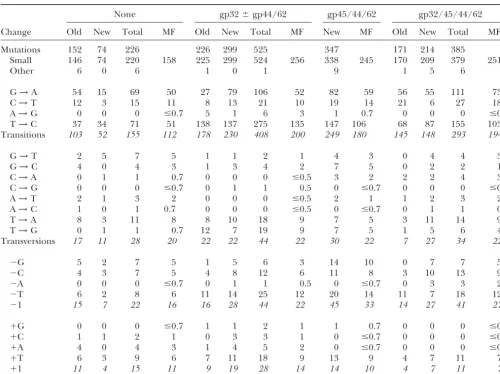
upon the observed totals of mutations from the several reac- Table 2 shows the kinds of mutations produced under tions and the numbers of mutations at each site. The overall
each combination of accessory proteins and in replicate
significance of the differences among reactions with regard
experiments and their frequencies after pooling the
to the observed pattern of mutation frequencies was
deter-old and new data. Historical experience with thelacZ␣ mined by comparing the observed square statistic to
chi-square statistics from 10,000 simulated data sets. Comparisons system indicates that stored DNA substrates tend to
accu-of mutation frequencies at each site were made by two-sided mulate mutations of two types, C→ T (presumably by Fisher’s exact tests. The number of tests expected to be signifi- cytosine deamination) and G→T (presumably by gua-cant by sampling variation alone was calculated from the
distri-nine oxidation) (BebenekandKunkel1995). The
im-bution of Fisher’s exact test.
pact of any such mutations must be small or nil in the present case because of the high mutation frequencies produced by the double-mutator gp43, and because C→
RESULTS T mutations areⱕ10% of all mutations (average 5.5%)
and G→T mutations areⱕ3% of all mutations (average RB69 gp43 drives T4 DNA replication in vivo
effi-1.1%). Statistical testing for differences between “old” ciently and with the same high fidelity as does T4 gp43
and “new” entries revealed several instances in which (Dressmanet al.1997). For generating mutational
spec-replicate experiments produced somewhat different tra, we used a double-mutator version of RB69 gp43 (PolM
fractions of particular kinds of mutations atP ⬍ 0.05. Exo⫺) containing the replacement Y567A at the
poly-For mutants from reactions with no accessory proteins, merase site, which sharply reduces the fidelity of
in-they were the entries for G→ A (old vs. new rates of corporation, and the replacements D222A and D327A,
58vs.38 per 104, respectively), T →C (39vs.85), and
which completely inactivate the proofreading
exonu-G→ T (2vs.13); from reactions with gp32, they were clease (Bebeneket al.2001, 2002). This gp43 was chosen
the entries for G→A (33vs.62) and T→C (171vs.108); over either single-mutator version because it previously
and from reactions with gp45, they were the entries for displayed somewhat more and somewhat stronger
im-C→T (30vs.9) and⫺G (ⱕ1.4 and 11). In each case, pacts on site-specific mutabilities by accessory proteins.
the number of such differences expected from sam-The wild-type polymerase cannot be used with thelacZ␣
pling variations alone wasⵑ0.4. Thus, of the seven dif-system because its fidelity is too high to produce a signal
ferences, roughly six may represent unrecognized dif-against the high background of spontaneous mutations
ferences in either purification procedures or reaction in phage M13 (Drake1991;Bebeneket al.2002). conditions. Because the numbers of differences with no
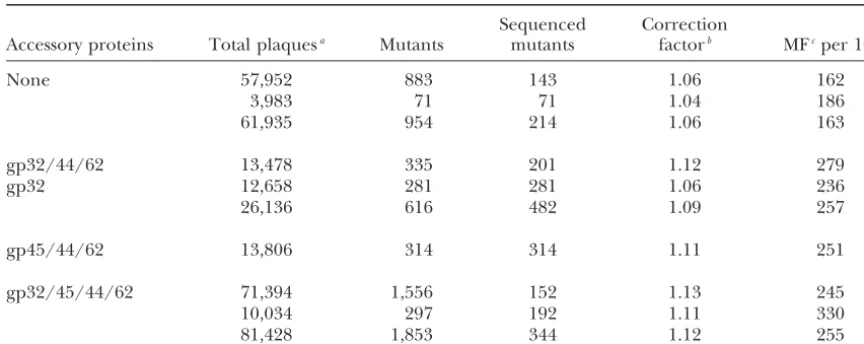
Frequencies and kinds of mutations:Our mutational accessory proteins, with gp32 ⫾gp44/62, and with all
analyses in vitro used the lacZ␣ system, in which gap- four accessory proteins were similar (3, 2, and 2, respec-filling synthesis of a mutation-reporter sequence can be tively), it is possible that the presence of gp44/62 in the conducted with or without accessory proteins, in marked old reactions with gp32 reflects unrecognized variables. contrast to DNA replicationin vivo. Mutants of indepen- However, gp44/62 binds better to single-stranded DNA dent origin were collected in the PolMExo⫺background
coated with gp32, thus increasing the ability of gp44/62 in the presence of four different combinations of acces- to compete with gp43 in binding to the 3⬘ end of the sory proteins: none, gp32 (either alone or in the pres- primer strand (e.g.,Capsonet al.1991), although this ence of gp44/62), gp45 plus gp44/62, or gp32/45/44/62. effect seems unlikely to affect fidelity in the present The mutation frequencies, rates, and kinds were ob- reactions.
frequen-TABLE 1
Mutation frequencies
Sequenced Correction
Accessory proteins Total plaquesa Mutants mutants factorb MFcper 104
None 57,952 883 143 1.06 162
3,983 71 71 1.04 186
61,935 954 214 1.06 163
gp32/44/62 13,478 335 201 1.12 279
gp32 12,658 281 281 1.06 236
26,136 616 482 1.09 257
gp45/44/62 13,806 314 314 1.11 251
gp32/45/44/62 71,394 1,556 152 1.13 245
10,034 297 192 1.11 330
81,428 1,853 344 1.12 255
aTriple entries record two experiments followed by their total. The first values for no and for all four accessory proteins are from the previous study (Bebeneket al.2002).
bCorrection factor for mutants with no mutation inlacZ␣and for mutants with more than one detectable mutation.
cMutation frequency (MF)⫽ (mutants)(correction factor)/(total plaques). The values from the previous collection (Bebeneket al.2002) for no and for all four accessory proteins have changed minutely (from 164 and 247, respectively) due to small corrections.
merase produces few deletions larger than a single base, tants in most other classes are small and their rate varia-tions may represent only sampling variavaria-tions.
it is impossible to ascertain whether the accessory
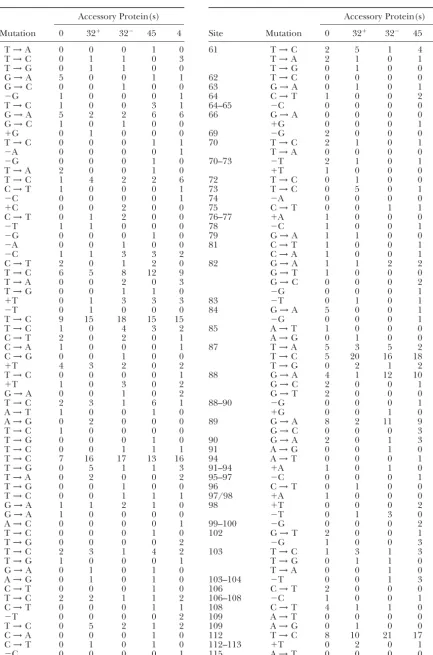
pro-teins restrained deletion mutagenesis, as was observed Mutational spectra:All of the mutations are listed in Table 3 except those classified as undetectable (
Bebe-in a study usBebe-ing entirely T4 proteBebe-ins (Kroutil et al.
1998). A statistical analysis was then performed to detect nekandKunkel1995;Bebeneket al.2002), which are typically observed as hitchhikers in mutants that also variations in the frequencies of kinds of mutations across
accessory-protein configurations. Of the 20 kinds of mu- contain a detectable mutation.
In this study, we were interested in the impacts of tations in Table 2, 7 varied across accessory-protein
con-figuration withP⬍0.05, whereas only 0.8 were expected accessory proteins on frequencies of specific kinds of mutations at specific sites. We observed nine site-specific to vary by sampling variations alone. The ratios of
(maxi-mum frequency)/(mini(maxi-mum frequency) across all ac- differences (atP⬍0.10) between the gp32 spectra with (32⫹) and without (32⫺) gp44/62: T →G at position cessory-protein combinations for 2 of these (G→A and
T→C) were only 1.6-fold and were also associated with ⫺7; T→C at 61, 73, and 87; G→A at 88 and 89; T→ C at 139; and G→A at 148 and 149, with the difference mutations at sites for which there was variation between
replicate experiments. In 5 infrequent kinds of muta- at position 88 being especially strong. Sampling alone could have generated 2.5 differences at P ⱕ 0.10, so tions (G→T, A→T, T→G,⫺G, and⫹A) the ratios
were 3.6- to 8-fold (with two ⱖ7-fold); with reference ⵑ6.5 of the differences were likely to have been the result either of an unexpected impact of the gp44/62 to the no-accessory-protein value, 3 of these represented
reductions, 1 represented an increase, and 1 repre- clamp loader or of undefined experimental differences. However, the impact of gp44/62 in the absence of gp32 sented a mixed response to accessory proteins.
The impact of accessory proteins on rates of specific and gp45 was not investigated. To concentrate on the central issue of the extent of influence of gp32 and kinds of mutations can be ascertained from the
muta-tion-frequency (MF) columns of Table 2. Compared to gp45 on fidelity, we then merged the two gp32 spectra for subsequent analyses.
the rates with no accessory proteins, the G→A
transi-tion rate is ⵑ46% higher with gp45 and the T → C When the total number of mutations at a site is small, even a substantial accessory-protein impact may be im-transition rate is more than doubled by any combination
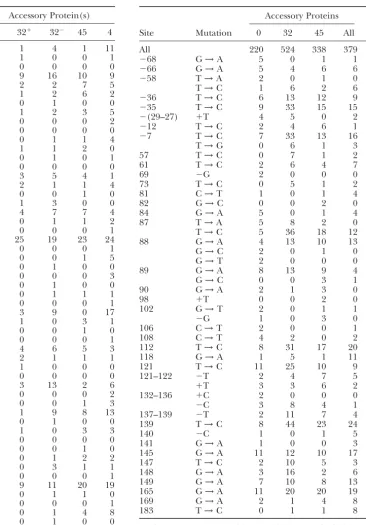
of accessory proteins. The only other marked change possible to validate statistically. Therefore, we gathered all sites from Table 3 at whicheitherat least five muta-is the T → G transversion rate, which is increased on
average 8.5-fold (range 5.5- to 13-fold) by the three tions appeared in at least one of the four spectraorthe distribution of mutations was nonrandom withP⬍0.10 combinations of accessory proteins. Despite the large
TABLE 2
Kinds of mutations producedin vitrodepending on accessory proteins
None gp32⫾gp44/62 gp45/44/62 gp32/45/44/62
Change Old New Total MF Old New Total MF New MF Old New Total MF
Mutations 152 74 226 226 299 525 347 171 214 385
Small 146 74 220 158 225 299 524 256 338 245 170 209 379 251
Other 6 0 6 1 0 1 9 1 5 6
G→A 54 15 69 50 27 79 106 52 82 59 56 55 111 73
C→T 12 3 15 11 8 13 21 10 19 14 21 6 27 18
A→G 0 0 0 ⱕ0.7 5 1 6 3 1 0.7 0 0 0 ⱕ0.7
T→C 37 34 71 51 138 137 275 135 147 106 68 87 155 103
Transitions 103 52 155 112 178 230 408 200 249 180 145 148 293 194
G→T 2 5 7 5 1 1 2 1 4 3 0 4 4 3
G→C 4 0 4 3 1 3 4 2 7 5 0 2 2 1
C→A 0 1 1 0.7 0 0 0 ⱕ0.5 3 2 2 2 4 3
C→G 0 0 0 ⱕ0.7 0 1 1 0.5 0 ⱕ0.7 0 0 0 ⱕ0.7
A→T 2 1 3 2 0 0 0 ⱕ0.5 2 1 1 2 3 2
A→C 1 0 1 0.7 0 0 0 ⱕ0.5 0 ⱕ0.7 0 1 1 0.7
T→A 8 3 11 8 8 10 18 9 7 5 3 11 14 9
T→G 0 1 1 0.7 12 7 19 9 7 5 1 5 6 4
Transversions 17 11 28 20 22 22 44 22 30 22 7 27 34 22
⫺G 5 2 7 5 1 5 6 3 14 10 0 7 7 5
⫺C 4 3 7 5 4 8 12 6 11 8 3 10 13 9
⫺A 0 0 0 ⱕ0.7 0 1 1 0.5 0 ⱕ0.7 0 3 3 2
⫺T 6 2 8 6 11 14 25 12 20 14 11 7 18 12
⫺1 15 7 22 16 16 28 44 22 45 33 14 27 41 27
⫹G 0 0 0 ⱕ0.7 1 1 2 1 1 0.7 0 0 0 ⱕ0.7
⫹C 1 1 2 1 0 3 3 1 0 ⱕ0.7 0 0 0 ⱕ0.7
⫹A 4 0 4 3 1 4 5 2 0 ⱕ0.7 0 0 0 ⱕ0.7
⫹T 6 3 9 6 7 11 18 9 13 9 4 7 11 7
⫹1 11 4 15 11 9 19 28 14 14 10 4 7 11 7
Most Old entries are fromBebeneket al.(2002). The New entries are from more recent reaction experiments, Total is the sum of the Old and New values, and MF is the mutation frequency⫻104for the Total column (the product of the pooled MF values from Table 1 times the fraction of mutations of each type). Note, however, that the Old gp32 entries are from reactions performed in the presence of gp44/62 while the New gp32 entries are from reactions with gp32 alone. The Other mutations include complex mutations and indels (mostly deletions) ofⱖ2 nucleotides and were not included in the spectral analyses. “ⱕ” values are as if 1 mutation had been observed. Numbers in italics are subtotals.
are displayed in Table 4 together with indicators for nificant variation across accessory-protein configura-tions could be observed.
both 0.05⬍P ⬍0.10 andPⱕ0.05.
In Table 4,P ⬍0.10 for 25 entries (P ⱕ0.05 for 15 The 11 of 25 entries probably generated by sampling variations alone render more detailed analysis difficult. entries). The number expected from sampling
varia-tions alone was 11/25. In the previous study (Bebenek Putting this uncertainty aside, the largest class of re-sponses comprises the 13 instances in which all three
et al.2002),Pⱕ 0.10 in seven instances, of which only
two were expected from sampling variations. Thus, the combinations of accessory proteins resulted in fewer mutations than predicted by the number of mutations expanded collection of mutations revealed 25⫺ 11⫽
14 valid entriesvs.the previous 7⫺2⫽5. However, the in the no-accessory-protein reactions (G → A at ⫺68, T →A at ⫺58,⫹T at ⫺(29–27),⫺G at 69, G →A at increased resolving power came at a price: the predicted
proportions of valid identifications fell from 5/7 to 14/ 84, T → A at 87, G→ C and G→ T at 88, G →A at 90, G→T at 102, C→T at 106, C→T at 108, and⫹C 25. (The expanded study reidentified five out of the seven
previously identified candidate sites, namely⫺68, 87, at 132–136). In contrast, there were only two entries (T→C at 87 and T→C at 183) in which all accessory-89, 118, and 183.) Table 4 also illustrates a similar
TABLE 3 TABLE 3
Mutations arising in reactions depending on accessory proteins (Continued)
Accessory Protein(s) Accessory Protein(s)
Site Mutation 0 32⫹ 32⫺ 45 4
Site Mutation 0 32⫹ 32⫺ 45 4
⫺69 T→A 0 0 0 1 0 61 T→C 2 5 1 4 7
T→A 2 1 0 1 1
T→C 0 1 1 0 3
T→G 0 1 1 0 0 T→G 0 1 0 0 0
62 T→C 0 0 0 0 1
⫺68 G→A 5 0 0 1 1
G→C 0 0 1 0 0 63 G→A 0 1 0 1 1
64 C→T 1 0 0 2 1
⫺G 1 0 0 0 1
⫺67 T→C 1 0 0 3 1 64–65 ⫺C 0 0 0 0 1
66 G→A 0 0 0 0 1
⫺66 G→A 5 2 2 6 6
G→C 1 0 1 0 0 ⫹G 0 0 0 1 0
69 ⫺G 2 0 0 0 0
⫹G 0 1 0 0 0
⫺62 T→C 0 0 0 1 1 70 T→C 2 1 0 1 1
T→A 0 0 0 0 1
⫺61 ⫺A 0 0 0 0 1
⫺60 ⫺G 0 0 0 1 0 70–73 ⫺T 2 1 0 1 2
⫹T 1 0 0 0 0
⫺58 T→A 2 0 0 1 0
T→C 1 4 2 2 6 72 T→C 0 1 0 0 3
73 T→C 0 5 0 1 2
⫺57 C→T 1 0 0 0 1
⫺C 0 0 0 0 1 74 ⫺A 0 0 0 0 1
75 C→T 0 0 1 1 1
⫹C 0 0 2 0 0
⫺55 C→T 0 1 2 0 0 76–77 ⫹A 1 0 0 0 0
78 ⫺C 1 0 0 1 0
⫺(51–50) ⫺T 1 1 0 0 0
⫺(48–47) ⫺G 0 0 0 1 0 79 G→A 1 1 0 0 0
81 C→T 1 0 0 1 4
⫺45 ⫺A 0 0 1 0 0
⫺(44–41) ⫺C 1 1 3 3 2 C→A 1 0 0 1 0
82 G→A 1 1 2 2 0
⫺37 C→T 2 0 1 2 0
⫺36 T→C 6 5 8 12 9 G→T 1 0 0 0 0
G→C 0 0 0 2 0
T→A 0 0 2 0 3
T→G 0 0 1 1 0 ⫺G 0 0 0 1 0
83 ⫺T 0 1 0 1 1
⫺(36–34) ⫹T 0 1 3 3 3
⫺T 0 1 0 0 0 84 G→A 5 0 0 1 4
⫺G 0 0 0 1 0
⫺35 T→C 9 15 18 15 15
⫺34 T→C 1 0 4 3 2 85 A→T 1 0 0 0 0
A→G 0 1 0 0 0
⫺32 C→T 2 0 2 0 1
C→A 1 0 0 0 1 87 T→A 5 3 5 2 0
T→C 5 20 16 18 12
C→G 0 0 1 0 0
⫺(29–27) ⫹T 4 3 2 0 2 T→G 0 2 1 2 0
88 G→A 4 1 12 10 13
⫺25 T→C 0 0 0 0 1
⫺(22–21) ⫹T 1 0 3 0 2 G→C 2 0 0 1 0
G→T 2 0 0 0 0
⫺13 G→A 0 0 1 0 2
⫺12 T→C 2 3 1 6 1 88–90 ⫺G 0 0 0 1 0
⫹G 0 0 1 0 0
⫺11 A→T 1 0 0 1 0
A→G 0 2 0 0 0 89 G→A 8 2 11 9 4
G→C 0 0 0 3 1
⫺10 T→C 1 0 0 0 0
T→G 0 0 0 1 0 90 G→A 2 0 1 3 0
91 A→G 0 0 1 0 0
⫺8 T→C 0 0 1 1 1
⫺7 T→C 7 16 17 13 16 94 A→T 0 0 0 1 0
91–94 ⫹A 1 0 1 0 0
T→G 0 5 1 1 3
T→A 0 2 0 0 2 95–97 ⫺C 0 0 0 1 1
96 C→T 0 1 0 0 0
20 T→G 0 0 1 0 0
21 T→C 0 0 1 1 1 97/98 ⫹A 1 0 0 0 0
98 ⫹T 0 0 0 2 0
29 G→A 1 1 2 1 0
30 G→A 1 0 0 0 0 ⫺T 0 1 3 0 2
99–100 ⫺G 0 0 0 2 1
35 A→C 0 0 0 0 1
38 T→C 0 0 0 1 0 102 G→T 2 0 0 1 1
⫺G 1 0 0 3 0
T→G 0 0 0 0 2
40 T→C 2 3 1 4 2 103 T→C 1 3 1 3 2
T→G 0 1 1 0 0
T→G 1 0 0 0 1
41 G→A 0 1 0 1 0 T→A 0 0 1 0 0
103–104 ⫺T 0 0 1 3 0
42 A→G 0 1 0 1 0
43 C→T 0 0 0 1 0 106 C→T 2 0 0 0 1
106–108 ⫺C 1 0 0 1 0
49 T→C 2 2 1 1 2
52 C→T 0 0 0 1 1 108 C→T 4 1 1 0 2
109 A→T 0 0 0 0 1
56–57 ⫺T 0 0 0 0 2
57 T→C 0 5 2 1 2 109 A→G 0 1 0 0 0
112 T→C 8 10 21 17 20
58 C→A 0 0 0 1 0
C→T 0 1 0 1 0 112–113 ⫹T 0 2 0 1 0
115 A→T 0 0 0 0 1
⫺C 0 0 0 0 1
TABLE 4 TABLE 3
(Continued) Impacts of accessory proteins on fidelity
Accessory Protein(s) Accessory Proteins
Site Mutation 0 32⫹ 32⫺ 45 4 Site Mutation 0 32 45 All P
118 G→A 1 1 4 1 11 All 220 524 338 379
G→C 0 1 0 0 1 ⫺68 G→A 5 0 1 1 **
⫺G 1 0 0 0 0 ⫺66 G→A 5 4 6 6
121 T→C 11 9 16 10 9 ⫺58 T→A 2 0 1 0 **
121–122 ⫺T 2 2 2 7 5 T→C 1 6 2 6
⫹T 3 1 2 6 2 ⫺36 T→C 6 13 12 9
127 C→T 0 0 1 0 0 ⫺35 T→C 9 33 15 15
129 C→T 0 1 2 3 5 ⫺(29–27) ⫹T 4 5 0 2 *
C→A 0 0 0 0 2 ⫺
12 T→C 2 4 6 1
130 A→T 1 0 0 0 0 ⫺
7 T→C 7 33 13 16
131 T→A 1 0 1 1 4
T→G 0 6 1 3
T→G 0 1 1 2 0
57 T→C 0 7 1 2
⫺T 1 0 1 0 1
61 T→C 2 6 4 7
132–136 ⫹C 2 0 0 0 0
69 ⫺G 2 0 0 0 **
⫺C 3 3 5 4 1
73 T→C 0 5 1 2
133 C→T 2 2 1 1 4
81 C→T 1 0 1 4 *
136 C→T 0 0 0 1 0
136/137 ⫹A 1 1 3 0 0 82 G→C 0 0 2 0 *
137–139 ⫺T 2 4 7 7 4 84 G→A 5 0 1 4 **
⫹T 0 0 1 1 2 87 T→A 5 8 2 0 **
138 T→A 1 0 0 0 1 T→C 5 36 18 12 **
139 T→C 8 25 19 23 24 88 G→A 4 13 10 13
T→A 0 0 0 0 1 G→C 2 0 1 0 **
140 ⫺C 1 0 0 1 5 G→T 2 0 0 0 **
⫹C 0 0 1 0 0 89 G→A 8 13 9 4
141 G→A 1 0 0 0 3 G→C 0 0 3 1 *
⫺G 0 0 1 0 0 90 G→A 2 1 3 0 *
142 C→T 0 0 1 1 1 98 ⫹T 0 0 2 0 *
144 A→T 0 0 0 0 1
102 G→T 2 0 1 1 *
145 G→A 11 3 9 0 17 ⫺
G 1 0 3 0 **
G→T 1 1 0 3 1
106 C→T 2 0 0 1 *
146 C→A 0 0 0 1 0
108 C→T 4 2 0 2 **
⫺C 0 0 0 0 1
112 T→C 8 31 17 20
147 T→C 2 4 6 5 3
118 G→A 1 5 1 11 **
T→A 0 2 1 1 1
121 T→C 11 25 10 9
T→G 0 1 0 0 0
148 G→C 1 0 0 0 0 121–122 ⫺T 2 4 7 5
G→A 3 3 13 2 6 ⫹T 3 3 6 2
G→T 0 0 0 0 2 132–136 ⫹C 2 0 0 0 **
148–149 ⫺G 1 0 0 1 3 ⫺C 3 8 4 1
149 G→A 7 1 9 8 13 137–139 ⫺T 2 11 7 4
G→T 0 0 1 0 0 139 T→C 8 44 23 24
150 C→T 0 1 0 3 3 140 ⫺C 1 0 1 5 **
151 G→T 1 0 0 0 0 141 G→A 1 0 0 3 *
G→C 0 0 0 1 0 145 G→A 11 12 10 17
G→A 0 0 1 2 2 147 T→C 2 10 5 3
⫺G 1 0 3 1 1
148 G→A 3 16 2 6 *
163 ⫺A 0 0 0 0 1
149 G→A 7 10 8 13
165 G→A 11 9 11 20 19
165 G→A 11 20 20 19
166 C→T 0 0 1 1 0
169 G→A 2 1 4 8 **
168 C→T 0 0 0 0 1
183 T→C 0 1 1 8 **
169 G→A 2 0 1 4 8
G→C 0 0 1 0 0
Those entries from Table 3 are shown for which the
proba-⫺G 0 1 1 1 0
bility of a nonrandom distribution wasP⬍0.10 or for which
182–183 ⫺T 0 0 0 1 1
P⬎0.10 and at least five mutants arose in at least one category.
183 T→C 0 1 0 1 8
184 C→A 0 0 0 0 1 *0.05⬍P⬍0.10; **Pⱕ0.05.
184–186 ⫺C 1 0 0 0 0
186 C→T 0 0 0 0 1
191 ⫺G 0 0 0 1 1
and four entries (at sites 82, 89, 98, and 118) in which
The sites are those of the standard lacZ␣ sequence. Only
mutations detectable as single mutations are shown (Bebenek at least one accessory protein increased the mutation
et al.2002). The accessory proteins are none (0); gp32 either frequency but none decreased it. There was no easily in the presence of gp44/62 (32⫹) or alone (32⫺); gp45 plus discernible correlation between the accessory-protein gp44/62 (45); or gp32, pg45, and gp44/62 (4). The total
num-impact pattern and the kind of mutation.
bers of mutants in each category are 220, 524, 338, and 379,
One goal of these experiments was to determine the
TABLE 5 creased mutation frequencies by close to 1.56-fold (Ta-ble 1). (In the lacZ␣ system, frequencies can be
con-Sequence context of sites displaying mutation rates
verted to rates by the factor 1/0.6 if desired.) Because
subject to modulation by accessory proteins TA
G→A and T→C transitions together compose 63–72% of the mutations produced by this mutator gp43, most
Mutation Site Context
of the 1.56-fold increase must have affected these
muta-G→A ⫺68 ATTAATGTGAGTT
tions. However, G→A mutations (modulated by Gtemplate•
84 CGTCGTGACTGGG
90 GACTGGGAAAACC Tprimer mispairs) were only slightly affected (Table 2),
118 TTAATCGCCTTGC their frequencies increasing from 50 per 104 without
141 CCTTTCGCCAGCT
accessory proteins to 52, 59, and 73 per 104in the
pres-148 CAGCTGGCGTAAT
ence of accessory proteins. In contrast, T→C mutations
169 AGGCCCGCACCGA
G→T 88 GTGACTGGGAAAA (modulated by Ttemplate•Gprimer mispairs) increased from
102 CCTGGCGTTACCC 51 per 104 without accessory proteins to 135, 106, and
G→C 82 AACGTCGTGACTG
103 per 104 in the presence of accessory proteins. (In
88 GTGACTGGGAAAA
addition, the only two T→C sites highlighted in Table
89 TGACTGGGAAAAC
⫺G 69 GCCGTCGTTTTAC 4 both show increased mutation frequencies in the
pres-102 CCTGGCGTTACCC ence of any combination of accessory proteins.) Both
T•G and G•T are usually among the most easily
ex-T→C 87 CGTGACTGGGAAA
tended mispairs (Kunkeland Bebenek2000), so it is
183 CGCCCTTCCCAAC
T→A ⫺58 GTTAGCTCACTCA perhaps surprising that only the former is affected by
87 CGTGACTGGGAAA accessory proteins in the present system, an observation
⫹T ⫺(29–27) TACACTTTATGCT
deserving of structural analysis. Frequencies of T→G
98 AAACCCTGGCGTT
and ⫺T were also increased, by ⵑ9-fold and ⵑ2-fold,
C→T 81 CAACGTCGTGACT respectively. The impact on total frequencies from
in-106 GCGTTACCCAACT
creases in these mutations was negligible in our spectra
108 GTTACCCAACTTA
because of their low initial proportions, but could be
⫺C 140 CCCTTTCGCCAGC
⫹C 132–136 ACATCCCCCTTTC large in other spectra if they were more common.
The joint impact of gp32 and gp45 on average
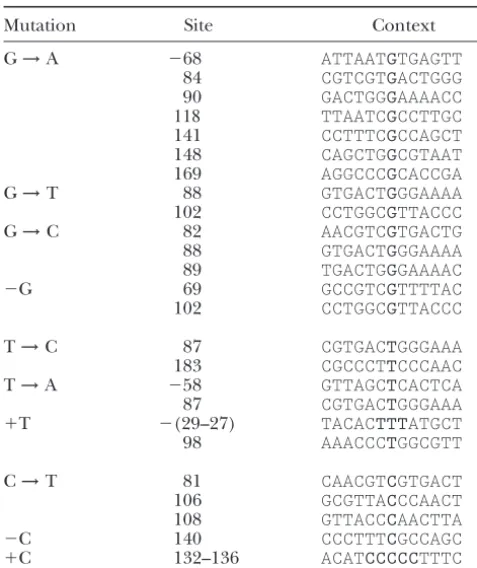
muta-The sites are those from Table 4 at which effects were
ob-tion frequencies was determined previously for the two
served atPⱕ0.1 and includeⵑ11 sites detected from sampling
single-mutator polymerases and was either negligible or
variation alone and also 5 sites (⫺68, 87, 89, 118, and 183)
de-tected previously (Bebeneket al. 2002) and confirmed here. small (Bebeneket al.2002). The ratios (with accessory proteins)/(without accessory proteins) for total muta-tion frequencies and for frequencies adjusted for the extent to which only gp32 or only gp45 (plus gp44/62) (somewhat uncertain)lacZ␣backgrounds were 0.89 and affected mutation frequencies. Patterns consistent with 1.07 for Pol⫹Exo⫺and were 1.27 and 1.41 for PolMExo⫹.
the former were infrequent (at sites 90 and 118) or miss- Thus, the impacts of the accessory proteins on average ing. The pattern at site 183 was that expected if both mutation rates depend not only on specific sites but proteins were needed for any effect. The patterns at 11 also on the polymerase itself.
other sites were mixed in a manner that suggested antag- We have confirmed our earlier observation that the onistic impacts. However, these assignments are blurred accessory proteins produce discernible effects in both by the fact that ⵑ44% of the statistically highlighted directions on mutation frequencies at specific sites, and entries were probably simple sampling accidents. we have substantially enlarged the number of sites at Finally, we attempted to determine whether the sites which the impact was detected (from 5 toⵑ14). How-at which fidelity was differentially affected by accessory ever, the cost of enlargement was an increase in the proteins exhibited common sequence contexts. The 25 fraction of highlighted sites, from 2/7 to 11/25, at which sites highlighted in Table 4, probably comprising 14 the effect could be attributed to sampling variations real sites plus 11 false positives, are gathered together alone. At many of the highlighted sites, changes were in Table 5 by kind of mutation and with the six flanking produced by either gp32 or gp45 alone to about the residues on either side. Visual screening reveals no se- same extent as by both together, but sampling uncer-quence characteristics among these sites. Further analy- tainties prevented us from specifying sites at which only sis was not attempted because of the small and uncertain gp32 or only gp45 affected fidelity or at which they ex-sample. hibited additive or antagonistic effects. The major con-clusion to be drawn from the present enlargement of the spectra is that continued sampling would produce
DISCUSSION
still more net sites at which the accessory proteins affect fidelity. For instance, T→C mutation frequencies were
Impacts of accessory proteins on fidelity: Overall,
of 1.56-fold in total mutation frequencies by all three of formation of Gtemplate•Tprimermispairs by 180-fold (the
reverse configuration being untested) butdecreased ex-combinations of accessory proteins, yet only 2 sites were
highlighted statistically (both showing increases). How- tension from the Ttemplate•Gprimermispair by⬎30-fold, at
least in a single sequence context (Bebeneket al.2001). ever, of the 29 sites at which T → C mutations were
observed, 21 showed increases for the average of the The balance between such kinetic factors is one measure of fidelity and is worthy of investigation using more three accessory-protein combinations compared to the
value with no accessory proteins, while 3 showed no extensive and more complex kinetic methods in a vari-ety of sequence contexts.
change and only 5 showed a decrease. Although only 2
of the 21 were highlighted statistically, probably most At the evolutionary level, one should consider the selective forces acting on gp43. Fidelity is one compo-of the other 19 would be highlighted in a sufficiently
massive study. In contrast, several of the sites in Table 4 nent, but the universal genomic mutation rate indepen-dent of genome size for DNA-based microbes (Drake
that were not statistically highlighted contain numerous
mutations in proportions closely similar to those of total 1991; Dressman et al. 1997; Grogan et al. 2001) sets limits on the extent to which organisms will invest re-mutants. Thus, there are sites at which the impact of
accessory proteins on fidelity is at most quite small. sources to evolve ever-lower mutation rates, and muta-tion rates in T4 are determined primarily by gp43 A qualifier to these conclusions is that the RB69 PolM
Exo⫺ gp43 differs from the cognate wild-type enzyme (Drake and Ripley 1994). Velocity of replication is another component, and multiple origins of replica-in bereplica-ing deficient both replica-in the accuracy of base replica-insertion
and in proofreading. The mutant gp43 is strongly biased tion and the processivity clamp both contribute to rapid DNA replication. Other DNA transactions, such as the toward the production of transitions in vitro via G•T
and T•G mispairs (Bebeneket al. 2002), whereas the resolution of recombinational intermediates and inter-actions between replication and transcription machiner-wild-type enzyme produces twice as many transversions
as transitionsin vivo(Bebeneket al.2001). Within the ies, must also lay constraints on the evolution of gp43 function. Finally, mutation rates vary hugely from site limits imposed by sample sizes, the kinds of mutations
arising at sites affected by accessory proteins tended to to site in this as in all mutational spectra, necessarily as a function of local DNA sequences. Thus, evolution will reflect these specificities for all three mutant enzymes,
and the PolMExo⫺gp43 affected transitions almost ex- tend to optimize the impacts of accessory proteins on
fidelity while at the same time tending to optimize at clusively (Bebeneket al.2002 and this report).
There-fore, using this gp43 alone, it is impossible to learn least the factors just noted, including a vast number of local DNA sequences. It is impossible that the point-much more about the site specificity of the impact of
accessory proteins on transversions and insertions/dele- to-point balance that we measure as fidelity should be the same for all the sequences. Thus, it was likely from tions (indels) except for the already noted increases in
frequencies of T → G and ⫺T. In addition, because the start that different impacts, extending to both in-creases and dein-creases in fidelity, would be observed. the high background of the assay system prevents the
detection of mutations produced by the wild-type en- In this context, two interesting questions arise. First, does a replicase coevolve with its cognate genome to zyme, it is a formal possibility that impacts occur only
with enzymes with the Y567A polymerase or the D222A minimize such variation? Because thelacZ␣template is not a cognate sequence for RB69 gp43,lacZ␣ may dis-D327A proofreading exonuclease defects.
Mechanisms: The mechanistic basis of these results play more site-to-site variation of the kind studied here than would be observed with a template such as the can be considered at two levels, the enzymological and
the evolutionary. At the enzymological level, the modest T4 rI gene (Bebenek et al. 2001). Second, is there a counterpart to the accessory-protein impacts in vivo? overall decrease in fidelity (seen with gp43 PolM Exo⫺
and perhaps PolMExo⫹but not with Pol⫹Exo⫺) might There are clear-cut differences (as well as similarities)
between the kinds of mutations producedin vivo(
Bebe-result from an increase in the formation of mispairs
and misalignments, a decrease in the efficiency of proof- neket al.2001) and in vitro(Bebeneket al.2002), im-plying either the operationin vivoof fidelity factors yet reading, or an increase in the efficiency of extensions
from mispairs and misalignments. In the present case to be discovered or important physiological differences such as molecular crowding.
the proofreading function is disabled and cannot
con-tribute catalytically, but kinetic partitioning between the We thank Lu-Shu Yeh and Jim Karam of Tulane University for the Pol and Exo sites may nevertheless be modulated by the gift of RB69 gp45 and gp44/62 and Kasia Bebenek and Matt Longley
for critical comments on the manuscript.
accessory proteins in a manner affecting extension from mispairs. As summarized in the Introduction, the avail-able information about insertion fidelities as a function
of gp43 accessory proteins is limited, directing attention LITERATURE CITED instead to their ability to promote the extension of
mis-Bebenek, K., andT. A. Kunkel, 1995 Analyzing fidelity of DNA
pairs. In limited kinetic analyses, the PolMExo⫺gp43
mu-polymerases. Methods Enzymol.262:217–232.
Bebenek, A., H. K. Dressman, G. T. Carver, S. Ng, V. Petrovet al.,
2001 Interacting fidelity defects in the replicative DNA polymer- Kobayashi, S., M. R. Valentine, P. Pham, M. O’DonnellandM. F. Goodman, 2002 Fidelity of Escherichia coli DNA Polymerase ase of bacteriophage RB69. J. Biol. Chem.276:10387–10397.
IV. Preferential generation of small deletion mutations by
dNTP-Bebenek, A., G. T. Carver, H. K. Dressman, F. A. Kadyrov, J. K.
stabilized misalignment. J. Biol. Chem.277:34198–34207.
Hasemanet al., 2002 Dissecting the fidelity of bacteriophage
Kroutil, L. C., M. W. Frey, B. F. Kaboord, T. A. KunkelandS. J.
RB69 DNA polymerase: site-specific modulation of fidelity by
Benkovic, 1998 Effect of accessory proteins on T4 DNA poly-polymerase accessory proteins. Genetics162:1003–1018.
merase replication fidelity. J. Mol. Biol.278:135–146.
Benzer, S., 1961 On the topography of the genetic fine structure.
Kunkel, T. A., 1985a The mutational specificity of DNA polymerase-Proc. Natl. Acad. Sci. USA47:403–415.
duringin vitroDNA synthesis. J. Biol. Chem.260:5787–5796.
Bloom, L. B., X. Chen, D. K. Fygenson, J. Turner, M. O’Donnell
Kunkel, T. A., 1985b The mutational specificity of DNA
polymer-et al., 1997 Fidelity ofEscherichia coliDNA polymerase III
holoen-ases-␣and -␥duringin vitroDNA synthesis. J. Biol. Chem.260: zyme. The effects of ,␥complex processivity proteins andε
12866–12874. proofreading exonuclease on nucleotide misincorporation
effi-Kunkel, T. A., andP. S. Alexander, 1986 The base substitution ciencies. J. Biol. Chem.272:27919–27930.
fidelity of eucaryotic DNA polymerases. Mispairing frequencies,
Borjac, J., 1997 RNA determinants of specificity of two
phylogeneti-site preferences, insertion preferences, and base substitution by cally related single-stranded DNA binding proteins. Ph.D. Thesis,
dislocation. J. Biol. Chem.261:160–166. Tulane University, New Orleans.
Kunkel, T. A., andK. Bebenek, 2000 DNA replication fidelity. Annu.
Capson, T. L., S. J. BenkovicandN. G. Nossal, 1991 Protein-DNA
Rev. Biochem.69:497–529. cross-linking demonstrates stepwise ATP-dependent assembly of
Kunkel, T. A., J. D. RobertsandA. Sugino, 1991 The fidelity of T4 DNA polymerase and its accessory proteins on the
primer-DNA synthesis by the catalytic subunit of yeast primer-DNA polymerase template. Cell65:249–258.
␣alone and with accessory proteins. Mutat. Res.250:175–182.
Chaudhuri, M., L. SongandD. S. Parris, 2003 The herpes simplex Kunkel, T. A., S. S. PatelandK. A. Johnson, 1994 Error-prone virus type 1 DNA polymerase processivity factor increases fidelity replication of repeated DNA sequences by T7 DNA polymerase without altering pre-steady-state rate constants for polymerization in the absence of its processivity subunit. Proc. Natl. Acad. Sci.
or excision. J. Biol. Chem.278:8996–9004. USA91:6830–6834.
Chen, C., B. J. Merrill, P. J. Lau, C. HolmandR. D. Kolodner, Longley, M. J., D. Nguyen, T. A. KunkelandW. C. Copeland, 2001 1999 Saccharomyces cerevisiae pol30(proliferating cell nuclear an- The fidelity of human DNA polymerase␥with and without exo-tigen) mutations impair replication fidelity and mismatch repair. nucleolytic proofreading and the p55 accessory subunit. J. Biol.
Mol. Cell. Biol.19:7801–7815. Chem.276:38555–38562.
Chen, X., S. Zuo, Z. Kelman, M. O’Donnell, J. Hurwitzet al., 2000 Meyer, R. R., andP. S. Laine, 1990 The single-stranded DNA-bind-Fidelity of eucaryotic DNA polymerase␦holoenzyme fromSchizo- ing protein ofEscherichia coli.Microbiol. Rev.54:342–380.
saccharomyces pombe.J Biol. Chem.275:17677–17682. Mo, J.-Y., andR. M. Schaaper, 1996 Fidelity and error specificity
Drake, J. W., 1991 A constant rate of spontaneous mutation in DNA- of the a catalytic subunit ofEscherichia coliDNA polymerase III. based microbes. Proc. Natl. Acad. Sci. USA88:7160–7164. J. Biol. Chem.271:18947–18953.
Drake, J. W., andL. S. Ripley, 1983 The analysis of mutation in Mozzherin, D. J., M. McConnell, M. V. Jasko, A. A. Krayevsky, C.-K. Tan et al., 1996 Proliferating cell nuclear antigen promotes bacteriophage T4: delights, dilemmas, and disasters, pp. 312–320
misincorporation catalyzed by calf thymus DNA polymerase␦. inBacteriophage T4, edited by C. K.Mathews, E. M.Kutter, G.
J. Biol. Chem.271:31711–31717.
Mosig and P. B.Berget. American Society for Microbiology,
Nossal, N. G., 1994 The DNA replication fork, pp. 43–53 in
Molecu-Washington, DC.
lar Biology of Bacteriophage T4, edited by J. D.Karam. American
Drake, J. W., andL. S. Ripley, 1994 Mutagenesis, pp. 43–53 in
Society for Microbiology, Washington, DC.
Molecular Biology of Bacteriophage T4, edited by J. D.Karam.
Ameri-Perales, C., F. Cava, W. J. J. MeijerandJ. Berenguer, 2003 En-can Society for Microbiology, Washington, DC.
hancement of DNA, cDNA synthesis and fidelity at high
tempera-Dressman, H., C.-C. Wang, J. D. KaramandJ. W. Drake, 1997
Re-tures by a dimeric single-stranded DNA-binding protein. Nucleic tention of replication fidelity by a DNA polymerase in a
homeolo-Acids Res.31:6473–6480. gous environment. Proc. Natl. Acad. Sci. USA94:8042–8046.
Pham, P. T., M. W. Olson, C. S. McHenryandR. M. Schaaper,
Grogan, D. W., G. T. CarverandJ. W. Drake, 2001 Genetic fidelity
1998 The base substitution and frameshift fidelity ofEscherichia
under harsh conditions: analysis of spontaneous mutation in the
coliDNA polymerase III holoenzymein vitro.J. Biol. Chem.273: thermoacidophilic archaeonSulfolobus acidocaldarius.Proc. Natl.
23575–23584. Acad. Sci. USA98:7928–7933.
Piegorsch, W. W., andA. J. Bailer, 1994 Statistical approaches for
Hashimoto, K., K. Shimizu, N. NakashimaandA. Sugino, 2003
analyzing mutational spectra: some recommendations for cate-Fidelity of DNA polymerase ␦holoenzyme from Saccharomyces gorical data. Genetics136:403–416.
cerevisiae: the sliding clamp proliferating cell nuclear antigen Salts, Y., andA. Ronen, 1971 Neighbor effects in the mutation of decreases its fidelity. Biochemistry42:14207–14213. ochretriplets in the T4rIIgene. Mutat. Res.13:109–113.
Johnson, A. A., andK. A. Johnson, 2001 Fidelity of nucleotide Sinha, N., andM. F. Goodman, 1983 Fidelity of DNA replication, incorporation by human mitochondrial DNA polymerase. J. Biol. pp. 131–137 inBacteriophage T4, edited by C. K.Mathews, E. M.
Chem.276:38090–38096. Kutter, G.Mosigand P. B.Berget. American Society for
Micro-Kadyrov, F. A., and J. W. Drake, 2001 Conditional coupling of biology, Washington, DC. leading-strand and lagging-strand DNA synthesis at