Parametric Optimization of Abrasive Jet
Micromachining through Genetic Algorithm
Sunil Kumar Bhati1, Dilip Gehlot2, Kamal Singh3
Guest Faculty, Department of Mechanical, Govt. Women's Egg. College, Ajmer, India1
Assistant Professor, Department of Mechanical, Govt. Egg. College, Ajmer, India 2
P.G. Scholar, Department of Mechanical, Govt. Egg. College, Ajmer, India 3
ABSTRACT: Abrasive jet micro machining (AJMM) is an advanced machining process for machining of hard and brittle materials. This article deals with the experimental study of process parameters of AJMM to achieve an optimized Material removal rate (MRR). Some input factors for above study are considered in the level of experiments such as Pressure, nozzle tip distance (NTD), the size of abrasives (SOA), and nozzle diameter. These parameters are varied during the experimentation. The comprehensive impact of the process parameter is examined and a Mathematical model for MRR is likewise developed by response surface methodology (RSM). In addition, a Genetic algorithm (GA) is implemented to optimize the MRR in MATLAB. Error estimation is done by comparing the Simulation result of GA with the experimental result and observed that there is no significant error in the estimation of simulation results.
KEYWORDS: RSM, GA, Abrasive jet micro machining (AJMM)
I. INTRODUCTION
Abrasive Jet Micro Machining (AJMM) is a recently developed advanced machining process, which is suitable for the cutting, grooving or drilling process. AJMM is mainly used for machining the hard and brittle materials, such as glass, silicon, ceramics, and wood. In this process, abrasive particles mixed with compressed air in an appropriate ratio. The mixture of an abrasive particle with air is accelerated through a nozzle which strikes on the workpiece surface. As a result, the material is removed by the collision of abrasive air mixture to the workpiece.
The elements of AJMM are the compressor, mixing chamber, flow control valve, nozzle, machining chamber etc. The performance of AJMM can be regulated by various parameters i.e. pressure, nozzle tip distance, types & size of abrasives, flow rate, mixing ratio and nozzle diameter. The accuracy of the process is judged by material removal rate (MRR), surface roughness, taper produced and over cut. These parameters are considered as responses. An optimum value of process parameters provides the desired performance with the lowest machining cost. To achieve the optimum values of responses various tools and techniques used for analysis or optimization.
II. CONTROLLABLEPARAMETERSANDDESIGNMATRIX
TABLE I
ACTUAL VALUES OF PROCESS PARAMETERS AND CODED LEVELS
S.N. Process Parameters
Unit Levels
-1 1
1. Pressure Kgf/cm2 1 6
2. NTD Mm 3 35
3. SOA Microns 60 100
(i)
Response Analysis
Material removal rate (MRR) is the ratio of the volume of material is to be removed per unit time in mm3/sec. The MRR is material removal per unit time can calculate by:
MRR = A*t T
Here A = Area of drilling of workpiece (mm2) t = Thickness of workpiece (mm)
T = Machining time of drill (sec.)
Table II presents the experimental set as well as MRR for each run.
TABLE II
CCD RUNS RESPONSE VALUES WITH THE INPUT PARAMETER
Run
Input Variable Response Pressure Kgf/cm2 NTD mm SOA Microns MRR mm3/sec
1. 3.5 3 80 0.794182
2. 6 3 60 6.49461
3. 1 3 100 0.19968
4. 3.5 19 80 1.72258
5. 3.5 19 80 3.37362
6. 1 35 100 0.348862
7. 6 35 60 4.57233
III. GENETICALGORITHM(GA)METHODOLOGY
Genetic algorithm (GA) is a modified optimization tool which depends on the principles of genes and natural selection. GA can optimize difficult problem of continuous or discrete variables and it can be dealing with a large number of variables. GA is mainly suitable for solving maximization problems. Minimization problems are solved by changing into maximization.
The GA technique is the natural process of evolution to solve optimization and search problems towards better solutions. GA has three main operators‟ reproduction, crossover, and mutation. For implementing GA in an optimization of the machining parameters, the process parameters are encoded as genes by using binary string encoding.
For a researcher, it is important to choose suitable GA parameters which differ from factors and constraints in order to the algorithm to perform circumspective solutions. The main idea of selection is to prefer better solutions. Many selection procedures have been proposed to accomplish this idea, including stochastic universal selection, roulette wheel selection, ranking selection and tournament selection etc.
(i) Problem Formulation
The optimization problem for maximization of MRR is formulated as: Max. MRR
Sub. to: MRR>0 Where:
MRR=+4.78758-1.30555*Pressure+0.57965*NTD-0.092351*SOA -0.049680* Pressure*NTD+0.039078* Pressure*
SOA -4.59167E -003* NTD * SOA and
Pressure∈ [1-6] Kgf/cm2 NTD∈ [3-35] mm SOA∈ [60-100] Microns
Fig. 1. Variation in Population Best and Population Average with Generation for Maximization of MRR
Fig. 3. Range of MRR at Different Generations
It demonstrates the maximum, minimum and mean values of MRR in the form of a range. The variation of MRR changes at each individual run, maximum MRR Obtained from the curve is 0.73208 mm3/sec. The plot for the genealogy of individuals is shown in figure 4. This plot shows that the account of descents from ancestors so it gives the complete history of optimization of MRR.
The lines from one generation to next generation are color coded as follows: 1. Mutation children are indicated by red line.
2. Crossover children are indicated by a blue line. 3. Elite individuals indicated by the black line.
(ii) Model Checking for Single Objective Optimization
TABLE III Input Variables
Pressure 1.0 kgf/cm2
NTD 3.0 mm
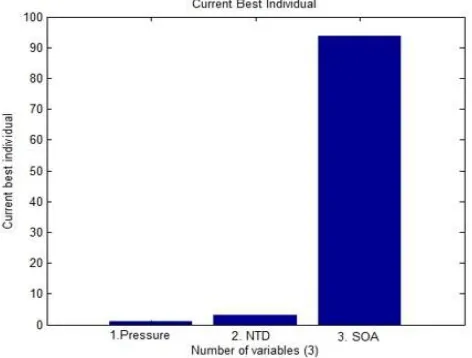
SOA 93.82698789703296
Microns
Response Parameter
GA Predicted MRR 0.73208mm3/sec.
Experimental MRR 0.6222 mm3/sec
% Prediction Error 15
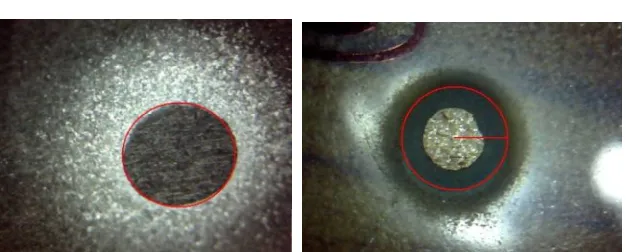
Validation of GA predicted results is required to know the variation from the actual experimental results. The difference in results is measured by the factor percentage of prediction results. The percentage of the prediction error is determined as:
= − × 100
Fig. 5. Hole image for validity for MRR model
(iii) Effect of Parameters on MRR
IV. CONCLUSION
In present work, the optimal process parameters for glass material in AJMM is developed by GA approach. Therefore, single objective optimization is being done. The whole experimental study emphasizes on the formulation of the regression model for MRR and further optimize by GA that gives a most favourable result. The optimum values of an input parameter for MRR are 1 kgf/cm2 pressure, 3 mm NTD, 93.85 microns SOA. Error estimation is done by comparing the Simulation result of GA with the experimental result. It is observed that 11% error in the estimation of simulation results which does not consider an as significant error. The formulated result of single objective optimization demonstrates suitable area in the design region of the process variable that can be preferred to augmentation of desired output during machining. The optimized process variable at which material removal rate obtain maximum is almost equivalent to experimental results.
REFERENCES
1. Sunil Kumar Bhati, Dilip Gehlot “Fabrication and parametric optimization of AJMM setup by Taguchi Robust design method”, AIMTDR,2016
2. Neelesh K. Jain, V.K. Jain, Kalyanmoy Deb “Optimization of process parameters of mechanical type advanced machining processes using genetic algorithms”, IJMTM 47 (2007) 900–919.
3. Pankaj Balkrishna Tambe, Mukul Shukla “Genetic Algorithm Based Optimization of Material Removal Rate of Abrasive Waterjet Cutting of Polymer Composites”, AIJSTPME (2011) 4(2): 37-42.
4. K.S.Jai Aultrin, M. Dev Anand and P.Jerald Jose " Modelling the cutting process and cutting performance in Abrasive Waterjet Machining using Genetic-Fuzzy Approach"International conference on modeling optimization and computing (ICMOC-2012).
5. Pandu R. Vundavilli, M.B. Parappagoudar, S.P. Kodali, Surekha Benguluri “Fuzzy Logic based Expert System for prediction of Depth of cut in Abrasive Water Jet Machining Process” Knowledge-Based Systems 27 (2012) 456– 464.
6. Mahesh Todkar, Jyoti Patkure “Fuzzy Modelling and GA Optimization for optimal selection of Process Parameters to maximize MRR in Abrasive Water Jet Machining” ISSN (Print): 2319-3182, Volume -3, January 2014.
7. B. Bhattacharyya and J. Munda, "Experimental investigation on the influence of Electro-chemical machining parameters on machining rate and accuracy in Micromachining domain", International Journal of Machine Tools & Manufacture, 2003, pp.1301–1310.
8. Sourabh Kumar Saha, “Experimental Investigation of the Dry Electric Discharge Machining (Dry EDM) Process”, A thesis submitted for M. Tech. at Indian IIT Kanpur, 2008, pp. 1-125.
9. Azlan Mohd Zain et al., "Evolutionary technique in optimizing machining parameters: Review and recent application (2007-2011)”, ELSEVIER at Expert System with Applications, 2012, pp. 9909-9927.
10. Genetic Algorithm Tom V. Mathew Indian Institute of Technology Bombay, Mumbai 400076.
11. Randy L. Haput and Sue Ellen Haupt "Practical Genetic Algorithms" ISBN 0-471- 455652, Jhon Wiley & Sons, INC., 2004. 12. Prof. V. K. Jain “Advance Machining Process”, ISBN8177642944, 9788177642940, Allied Publishers, 2009.
13. P. C. Pandey, H. S. Shan “Modern Machining Process”, ISBN0070965536, 9780070965539, Tata McGraw-Hill Education, 1980- 2008. 14. Kalyanmoy Deb “Optimization for Engineering Design”, ISBN9788120309432, PHI Learning, 2010.