Optimization of Construction Sequence Using
Genetic Algorithm
Mohammed Naveed1, B.Harish Naik2
P.G. Student, Dept. of CE, Shri Shirdi Sai Institute of Science and Engineering, Ananthapuram, India1 Assistant Professor, HOD, Dept. of CE, Shri Shirdi Sai Institute of Science and Engineering, Ananthapuram, India2
ABSTRACT: The construction project schedule is one of the most important tools for project managers in the Architecture, Engineering, and Construction (AEC) industry that makes them able to track and manage the time, cost, and quality (a.k.a. Project Management Triangle) of projects. Developing project schedules is almost always troublesome, since it is heavily dependent on project planners’ knowledge of work often estimated by other information included in the project schedule of resource allocation, budget, task duration, and linkages of dependencies and
scheduled events. Having a thorough understanding of the project geometries and their internal interacting stability
relations plays a significant role in generating practical construction sequencing.On the other hand, the new concept of embedding all the project information into a 3-dimensional representation of a project (a.k.a. Building Information Model or BIM) has recently drawn attention to the construction industry. This paper, focuses on a novel approach of retrieving enough information from the BIM of a project and then develop construction sequencing for the installation of the project elements. For this reason, a computer application is developed that can automatically derive a structurally (statically) stable construction sequence, using the concept of the Genetic Algorithm (GA). The Genetic Algorithm is an optimization tool that uses a heuristic search that mimics the natural evolutionary process. This project is more interested in knowing the optimization of construction sequence using genetic algorithm based on Building Information Modelling. A 3D model of a building is created using Autodesk software REVIT for studying the relationships and dependencies of the project elements and to create a Directed Design Structure Matrix. To reach a set of fully stable project schedules, the stability score can be assigned to each possible solution.
I. INTRODUCTION
CONSTRUCTION RESOURCE SCHEDULING Traditionally, resource scheduling problems in construction project networks have been solved either as resource leveling or as resource allocation problems. The objective in the resource leveling problem is to reduce peak resource requirements and smooth out period-to-period assignments within the required project duration. with the premise of unlimited resource availability. The resource allocation problem starts off with the assumption that resource availability is constrained to some maximum value and the objective is to allocate the available resources to project activities in an attempt to find the shortest project duration. Each class of problem has its own specialized solution algorithm that takes into account the objectives, constraints. and premises of the problem. The division is to facilitate ease of solution of what would otherwise be a difficult combinatorial optimization problem. In practice. the distinction between the two problem types is not so clear since a decision maker is likely to desire both objectives of resource leveling and minimum project duration. and will certainly consider a trade-off between increasing resource availability and the prospect of shorter project durations. Early attempts to solve these problems used mathematical models such as linear programming and dynamic programming to obtain an optimal solution. The efficiency of the algorithms in searching for solutions depended on making strong assumptions about the objective functions and constraints employed in the model, which may depart from real-world situations.Other attempts used heuristic rules to overcome the problem of combinatorial explosion. A single rule or a hierarchy of rules (to break ties) is used to decide the order of resource allocation among competing. These rules have been shown to perform well over a variety of problems and are widely used in actual practice because of their simplicity and efficiency in application. We have incorporated ideas from the aforementioned in a new approach using GAs to overcome some of the previously mentioned difficulties associated with mathematical and heuristic methods. The GA model schedules the starts of activities in a single project (and hence performs resource allocation) using a serial model of allocation, with the objective of minimizing the difference between resource availability and utilization. An ancillary objective is to minimize the project duration under limited resource constraints. By taking the view that the objective is minimization of the deviation of that required from available resources, the model is able to handle both resource allocation and leveling as well as "due-date" problems without extensive modifications. This paper follows a precise definition of the construction resource scheduling problem being addressed. Then followed by a brief review of GAs and their use in scheduling problems. The key to success in a GA application often lies in the design of the problem representation, good interfacing with the task environment, and determining suitable GA operating parameters.
PROBLEM STATEMENT The traditional scheduling methods such as Critical Path Method (CPM) are not enough
for scheduling because they cannot take resource constraints into account. In a resource constrained project, the amount of resources needed during one or more time periods is limited to less than required by two or more activities occurring simultaneously.
OBJECTIVE OF THE PROJECT In this project, an optimization technique was developed using Genetic
Algorithms (GA) to optimize the schedule of construction project activities in order to minimize the total duration of the project, subjected to both precedence and resources constraints. It, demonstrate a novel approach of retrieving enough information from the BIM of a project and then develop construction sequencing for the installation of the project elements. To determine and calculate the relationships and dependencies of the project elements from the Matrix of Constructability Constraints (MoCC). For this reason, a computer application is developed that can automatically derive a structurally (statically) stable construction sequence, using the concept of the Genetic Algorithm (GA) by using MATLAB global optimization tool.
The term ‘‘structurally stable sequencing’’ refers to the sequencing order of erection in which thestructure remains statically stable locally and globally during the entire installation process
.
II. LITERATURE REVIEW
adequately represent actual (construction) projects. In this work, an optimization model is developed for multi-objective resource-constrained scheduling which evaluates several resource-duration alternatives within each activity. The optimization aims at minimizing the total cost that is associated with (a) resource over allocation, (b) project deadline exceedance, and (c) day-by-day resource fluctuations. All three sub-objectives are represented by cost functions and the whole optimization parameter is a pure cost variable avoiding thus the need for subjectively setting importance weights among dissimilar parameters. Due to the large number of activity execution alternatives, a genetic algorithm has been employed for the optimization. The algorithm has been extensively tested with several test cases and the results have been compared to those developed by the Microsoft Project. The evaluation indicated that the proposed algorithm can provide adequate and balanced solutions with regard to the three objectives and that these solutions are better than those provided by commercial project scheduling software.
Ahmed B. Senouci and Neil N. Eldin (2004) orates a mathematical resource-leveling model for construction projects was presented. Various relationships, multiple crew strategies, and time-cost trade-off were considered in the model. An optimization formulation with the objective of minimizing the total construction cost was presented. The model allows any linear or nonlinear function for the presentation of cost-duration and resource duration relationships. The nonlinear optimization problem is solved using a hybrid genetic algorithm model. For specified resource limits, the model yields the optimum or near optimum total construction cost. The presented hybrid genetic algorithm model complements the traditional CPM approach by optimizing project schedule and total cost as it performs resource leveling. The model is capable of handling a wide range of project sizes including large construction projects involving a large number of activities. The new model has been implemented in a FORTRAN computer program and used to perform the resource scheduling for a number of construction projects. It performed resource scheduling efficiently. It is anticipated that it will be of value to practitioners.
III. METHODOLOGY
INTRODUCTION Operation Research (O.R) is a professional discipline still without a fixed content or boundaries.
Broadly speaking, it consists of using scientific methods and techniques for decision making in a variety of real life situations. A key word associated withO.R is “Optimization”. Optimization means determining the best course of action amongst the different alternatives available in a decision making problem. Optimization problems arise in almost every sphere of human activity. These occur in almost every engineering discipline such as civil engineering.
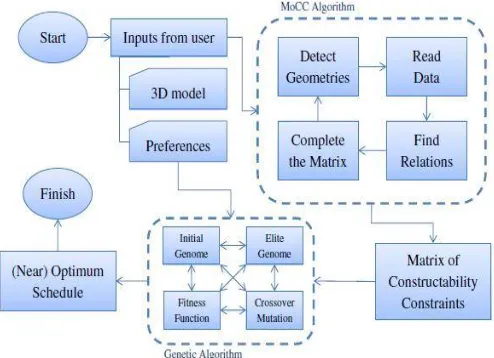
Fig 3.1 Methodology of the study
BUILDING INFORMATION MODELLING Building Information Modeling (BIM) is an intelligent 3D
model-based process that equips architecture, engineering, and construction professionals with the insight and tools to more efficiently plan, design, construct, and manage buildings and infrastructure. Current BIM software is used by
infrastructures, such as water, wastewater, electricity, gas, refuse and communication utilities, roads, bridges and ports,
houses, apartments, schools and shops, offices, factories, warehouses and prisons.Revit software is specifically built for
Building Information Modeling (BIM), empowering design and construction professionals to bring ideas from concept to construction with a coordinated and consistent model-based approach. It includes the functionality of all of the Revit disciplines (architecture, MEP, and structure) in one unified interface.
MATRIX OF CONSTRUCTABILITY CONSTRAINTS Considering Graph Theory and definitions of the matrices,
the MoCC is a Directed Adjacency Matrix or a Directed Design Structure Matrix (Directed DSM). The Directed DSM is a matrix representing the project network. The Genetic Algorithm will later use this project network (or MoCC) to generate construction schedule for the given 3D model. MoCC, is generated based on the spatial relations of the geometry elements in the 3D model considering the previously mentioned common knowledge of stability. By having this matrix, as a numerical representation of the stability relations in a BIM, the next step will be generating a constructible and stable project schedule for that specific 3D model.
Fig 3.2 Matrix of Constructability Constraints where:
Ai: is the project tasks (geometric elements in the 3D model or the activities to be scheduled),
Sj,i: is dependencies between elements (that could be either 0 or 1 showing not dependent or dependent respectively)
READING GEOMETRY Here, the 3D model input to the algorithm is in a standard text-based format, called Industry Foundation Classes (IFC)
GENETIC ALGORITHM
INTRODUCTION TO GENETIC ALGORITHM Several strategies have been developed to solve optimization
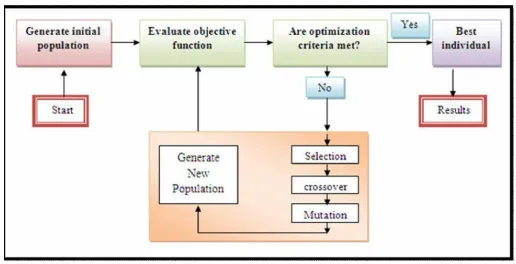
COMPONENTS OF A BASIC GENETIC ALGORITHM The GA begins like any other optimization algorithm, by defining the optimization variables, the cost function, and the cost. It ends like other optimization algorithms too, by testing for convergence. In between, however, this algorithm is quite different. A path through the components of the GA is shown in the flowchart The proposed algorithm in this research can be used to produce the construction schedule from scratch and for this reason a fitness function is required. To fulfill this requirement, using the derived stability matrix from the BIM of the project will help. The defined objective in this GA optimization is maximizing the constructability of the project, which means that the GA would try to find constructible project schedules for the given project 3D model. The constructability of a project schedule herein is defined as having all the elements statically stable during and after the installation process. For example, the installation of a beam is considered constructible and stable only if the two end structural supports (columns or beams) have been installed earlier. These genetic algorithm functions are performed in MATLAB software as an optimization tool.
Fig 3.5 Flowchart of Genetic Algorithm
IV. GENETIC ALGORITHM
GENETIC ALGORITHM FUNCTIONSThe following sections describe how the important functions of the
proposed Genetic Algorithm are defined and working. There are less important functions running in the process to facilitate the calculations and transferring of genomes form one population to another; however, they are not mentioned in here.
GENOME CREATIONIn this approach the genomes consist of lists of elements to be installed in each time-unit (e.g.
day, week, or month) throughout the total project duration. By this definition, a genome can be shown in either of the following two ways. The Matrix of Genome (MoG), as shown in figure 4.1, consists of n rows, each of which represents a single element from the 3D model, and k columns, indicating total installation duration. The non-zero value of gi,j shows the installation time j, for the element, i. For example, if g5,3 = 1, it means that element number 5 is scheduled to be installed in the third time-unit (which could be either hour, day, or week based on user definition). If all the rows of this matrix are put in a single row in a way that the first column of a row gets placed after the last column of the previous row, then a single string of matrix values is generated and is ready to be used in a GA population.
Matrix of Genome (MoG)
CALCULATION TERMINATION Similar to all the Genetic Algorithm applications, this proposed method will
V. RESEARCH VALIDATION
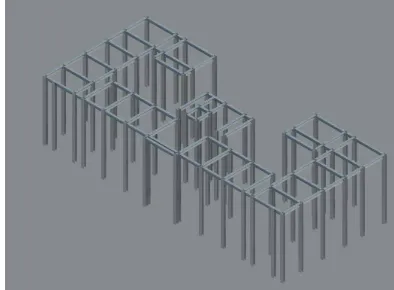
EXPERIMENTAL DESIGN A 3D model of a simple building plan is created using Autodesk REVIT which
represents its project elements. Matrix of Constructability Constraints is created from the 3D model.
Fig 5.1 3D model of a simple building Fig 5.2 Matrix of constructability constraints
This model consists of 68 beams and 86 columns with a total of 154 elements. Corresponding Matrix of constructability constraints is created for the 3D model. This matrix is created by based on the spatial relations of the geometry elements in the 3D model considering the previously mentioned common knowledge of stability.
The next step is the apply Genetic Algorithm on the formatted genes from Matrix of Constructability Constraints. The variables selected to be changed in this research are as follows:
Changing the Complexity of the input 3D BIM: Number of elements Connection types
Changing Genetic Algorithm parameters: Elite member percentage Mutation rate
Number of genomes per population (population size) Construction duration range
In this project, a range from 20 to 100 genomes per population to cover almost all the mentioned population sizes. Similarly, the range from 5% to 20% for the Mutation rate and 5% to 30% for the Elite member rate are selected as the parameters of the experimental design.
Table 5.1 GA parameters changes
Ex No Name Elite Mutation Population Duration
Number Rate size range
1 10G,10T 20% 10% 20 15 ±20% 2 20G,20T 10% 15% 40 10 ± 20% 3 30G,30T 15% 20% 50 20 ± 20%
To design the experiment to prove the benefits of the proposed methodology for developing project schedules, the projects is executed 3 different combinations of parameter changes.The total 154 elements are being divided in to 3 models as
30G, 30T model with 154 elements that consist of 68 columns and 84 beams.
VI. RESULTS
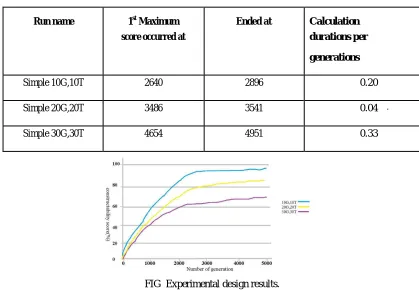
As defined in the last section, different sets of inputs have been created and imported to the proposed algorithm to see how they could generate completely constructible project schedules. As described earlier, the constructability objective is defined as, having the elements of the project scheduled for the construction in a way that the local and global stability of the project (model) is preserved. This stability of the elements and the model is controlled by the Matrix of Constructability Constraints that is calculated earlier. More details on how these different runs reach the objective. The execution of this methodology was performed on regular personal computer
(CPU: Intel Core™ i5- 3210 @ 2.5 GHz, RAM: 6 GB, OS: Windows 7 Enterprise 64-bit). Table 6.1 Completion results for different runs of the experimental design.
Run name 1st Maximum Ended at Calculation
score occurred at durations per
generations
Simple 10G,10T 2640 2896 0.20 Simple 20G,20T 3486 3541 0.04 Simple 30G,30T 4654 4951 0.33
FIG Experimental design results.
In that field, the label G is showing the number of genomes in each population for that specific run and the label T represents the mean of the initial duration range
VII. CONCLUSION
A new approach was developed to create the population of the genetic algorithm individuals, that is the “feasible solutions developer operator” that enables the user to create completely feasible solutions that satisfy all constraints, and this helps in getting a quick convergence toward the best solution during GA stages, without losing the GA feature of searching global maximum or minimum.
In this research, a new usage for the Genetic Algorithm for developing and generating construction schedules using the geometric information of a project .
Iterations in the GA calculation shows that even in deferent sets of input parameters the results always merge to the maximum constructability score (100%) from randomly generated schedules, proving that the methodology is working as expected.
Later development of this research methodology can be useful to do the following list of tasks for enhancing construction related processes such as Scheduling Learning Tool, Customized Schedule Template and Installation Starting Poin
REFERENCES
[1] Sofia Kaiafa , Athanasios P. Chassiakos, (2014). “A genetic algorithm for optimal resource-driven project scheduling”, Procedia Engineering Journal, Science
[2] Cheol Min Joo , Byung Soo Kim, (2013). “Genetic algorithms for single machine scheduling with time-dependent deterioration and rate-modifying activities”,Expert Systems with Applications, Science Direct , 40 , 3036–3043
[3] Xinyu Li, Liang Gao , Xinyu Shao, (2012). “Anactive learning genetic algorithm for integrated process planning and scheduling”, Expert Systems with Applications, Science Direct, 39 ,6683–6691
[4] J.F. Goncalves, J.J.M. Mendes.M.G.C. Resende, (2008). “A genetic algorithm for the resource constrained multi-project scheduling problem”, European Journal of Operational Research ,Science Direct, 189, 1171–1190
[5] Piotr Jaśkowski and Anna Sobotka, (2006). “Scheduling Construction Projects Using Evolutionary Algorithm”, Journal Of Construction Engineering and Management, ASCE, 132(8): 861-870
[6] Ahmed B. Senouci and Neil N. Eldin, M, (2004). “Use of Genetic Algorithms in Resource Scheduling of Construction Projects”, Journal Of Construction Engineering and Management, ASCE, 130(6): 869-877