ISSN(Online): 2319-8753 ISSN (Print): 2347-6710
I
nternational
J
ournal of
I
nnovative
R
esearch in
S
cience,
E
ngineering and
T
echnology
(An ISO 3297: 2007 Certified Organization)
Website: www.ijirset.com
Vol. 6, Issue 5, May 2017
User Identity Verification for Secure Login
Session
Pooja R. Gawali1, Chaitali D. Gheware2, Prachi B. Rohokale3, Swati C. Kashid4
BE. Students, Dept. of Computer Engineering, JSPM’S ICOER, Wagholi, Pune, Maharashtra, India1,2,3,4
ABSTRACT: In web applications, user authentication is normally based on username and password, come forth biometric solutions allow biometric data during session establishment. But in Unimodal biometric approaches only use a single verification is considered and the identity of the user is permanent during the entire session. A secure protocol is defined for constant authentication through continuous user verification. Biometric techniques suggest solution for secure, trusted and protected authentication. In between the logging session time, the one-time-password (OTP) is send on users registered email id and also randomly one questions will be asked to the user between the 5-10 mints. The user’s identity has been verified, the system resources are available for fixed period of time and identity of the user is constant during entire session. The proposed system detects misuses of computer resources and prevents malicious activities based on multi-modal biometric continuous authentication. Biometric and user information’s are stored in smart phones and web services
KEYWORDS: Aauthentication, Security, Mobile environments, web servers
I. INTRODUCTION
In this technology era security of web-based applications is a serious concern, due to the recent increase in the frequency and complexity of cyber-attacks, biometric techniques offer emerging solution for secure and trusted user identity verification, where username and password are replaced by bio-metric traits, Gmail OTP verification and users personal information. Biometrics is the science and technology of determining identity based on physiological and behavioural traits. Biometrics includes retinal scans, finger and handprint recognition, and face recognition, handwriting analysis, voice recognition and Keyboard biometrics. Also, parallel to the spreading usage of biometric systems, the incentive in their misuse is also growing, especially in the financial and banking sectors
ISSN(Online): 2319-8753 ISSN (Print): 2347-6710
I
nternational
J
ournal of
I
nnovative
R
esearch in
S
cience,
E
ngineering and
T
echnology
(An ISO 3297: 2007 Certified Organization)
Website: www.ijirset.com
Vol. 6, Issue 5, May 2017
II. RELATED WORK
1. Andrea Ceccarelli, Leonardo Montecchi “Continuous and Transparent User Identity Verification for Secure Internet Services” IEEE TRANSACTIONS MAY/JUNE 2015
This paper explores promising alternatives offered by applying biometrics in the management of sessions. A secure protocol is defined for perpetual authentication through continuous user verification. The protocol determines adaptive timeouts based on the quality, frequency and type of biometric data transparently acquired from the user. The functional behavior of the protocol is illustrated through Matlab simulations, while model-based quantitative analysis is carried out to assess the ability of the protocol to contrast security attacks exercised by different kinds of attackers.
2. Elizabeth LeMay, Willard Unkenholz, “Adversary-Driven State-Based System Security Evaluation” MetriSec2010 September 15, 2010, Bolzano-Bozen, Italy.
This paper describes the system and adversary characterization data that are collected as input for the executable model. This paper also describes the simulation algorithms for adversary attack behavior and the computation for the probability that an attack attempt is successful. A simple case study illustrates how to analyze system security using the ADVISE method. A tool is currently under development to facilitate automatic model generation and simulation. The ADVISE method aggregates security-relevant information about a system and its adversaries to produce a quantitative security analysis useful for holistic system security decisions.
3. S.kumar, T.sim “Using Continuous Biometric Verification to Protect Interactive Login Sessions”, 2012
This paper we describe the theory, architecture, implementation, and performance of a multi-modal passive biometric verification system that continually verifies the presence/participation of a logged-in user. We assume that the user logged in using strong authentication prior to the starting of the continuous verification process.While the implementation described in the paper combines a digital camera-based face verification with a mouse-based fingerprint reader, the architecture is generic enough to accommodate additional biometric devices with different accuracy of classifying a given user from an imposter
4. D.M.Nicol,W.H.Sanders, “Model-Based Evaluation: From Dependability to Security”, IEEE TRANSACTIONS 2004
In this work, we survey existing model-basedtechniques for evaluating system dependability, and summarize How they are now being extended to evaluate system security.We find that many techniques from dependability evaluation canbe applied in the security domain, but that significant challengesremain, largely due to fundamental differences between the accidentalnature of the faults commonly assumed in dependabilityevaluation, and the intentional, human nature of cyber-attacks.
5. T. Sim, S. Zhang, R. Janakiraman, and S. Kumar, “Continuous Verification Using Multimodal Biometrics,” IEEE Trans. Apr. 2007.
In this paper we describe a system that continually verifiesthe presence/participation of a logged-in user. This is done by integratingmultimodal passive biometrics in a Bayesian framework that combinesboth temporal and modality information holistically, rather than sequentially.This allows our system to output the probability that the user isstill present even when there is no observation.Our implementation of the continuous verification system is distributedand extensible, so it is easy to plug in additional asynchronousmodalities, even when they are remotely generated. Based on real dataresulting from our implementation, we find the results to be promising.
III.PROPOSED SYSTEM
ISSN(Online): 2319-8753 ISSN (Print): 2347-6710
I
nternational
J
ournal of
I
nnovative
R
esearch in
S
cience,
E
ngineering and
T
echnology
(An ISO 3297: 2007 Certified Organization)
Website: www.ijirset.com
Vol. 6, Issue 5, May 2017
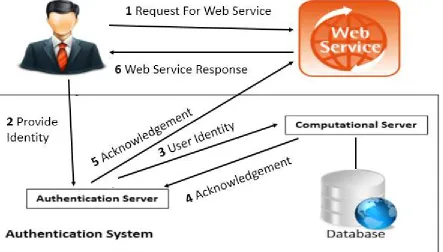
Fig 1: System Architecture
Algorithm for Bio- Metric verification
for x = 0 to image.size: for y = 0 to image.size:
diff += abs (image1.get(x, y).red - image2.get(x, y).red) diff += abs (image1.get(x, y).blue - image2.get(x, y).blue) diff += abs (image1.get(x, y).green - image2.get(x, y).green) end
end
return ((float)(diff)) / ( x * y * 3)
IV.SYSTEM REQUIREMENT
V. EXPECTED RESULTS
ISSN(Online): 2319-8753 ISSN (Print): 2347-6710
I
nternational
J
ournal of
I
nnovative
R
esearch in
S
cience,
E
ngineering and
T
echnology
(An ISO 3297: 2007 Certified Organization)
Website: www.ijirset.com
Vol. 6, Issue 5, May 2017
Figure1.how much time require for session start
When the user login, System ask user how much time require for session start? The user can input time in minute.
Figure2. Home Page
ISSN(Online): 2319-8753 ISSN (Print): 2347-6710
I
nternational
J
ournal of
I
nnovative
R
esearch in
S
cience,
E
ngineering and
T
echnology
(An ISO 3297: 2007 Certified Organization)
Website: www.ijirset.com
Vol. 6, Issue 5, May 2017
If system stay idle for one minute then it raises user validation is user authorised or not. If user fails to answer the security parameter, then system will take out of the system to the user.
Figure4. Ask finger print image
In this type of user verification, in which user has to provide biometric trades such as iris and finger print. This identify will get matched with the biometric trades submitted at time of registration.
Figure5. Ask questions.
This is another kinds of verification method, in this user have to answer the security question. The answer should get match with answer submitted at time of registration. In answer matched then user will redirected to current working page else it will get log out from system.
VI.CONCLUSION
INthis paper we studied system which provides various existing methods used for continuous authentication using
username & password, OTP verification, figure print biometrics, random questions. Initial one time login verification is inadequate to address the risk involved in post logged in session. Therefore this system attempts to provide a comprehensive survey of research on the underlying building blocks required to build a biometric authentication continuous OTP and Random question system by choosing bio-metric. Continuous authentication verification with multi-modal biometrics improves security and usability of user session.
REFERENCES
1. CASHMA-Context Aware Security by Hierarchical Multilevel Architectures, MIUR FIRB, 2005.
2. L. Hong, A. Jain, and S. Pankanti, “Can Multibiometrics Improve Performance?” Proc. Workshop on Automatic Identification Advances Technologies (AutoID ’99) Summit, pp. 59-64, 1999.
ISSN(Online): 2319-8753 ISSN (Print): 2347-6710
I
nternational
J
ournal of
I
nnovative
R
esearch in
S
cience,
E
ngineering and
T
echnology
(An ISO 3297: 2007 Certified Organization)
Website: www.ijirset.com
Vol. 6, Issue 5, May 2017
4. (SCS ’08), pp. 1-6, Nov. 2008.[4] BioID “Biometric Authentication as a Service (BaaS),” BioID Press Release, https://www.bioid.com, Mar. 2011.
5. T. Sim, S. Zhang, R. Janakiraman, and S. Kumar, “Continuous Verification Using Multimodal Biometrics,” IEEE Trans. Pattern Analysis and Machine Intelligence, vol. 29, no. 4, pp. 687-700, Apr.2007.
6. L. Montecchi, P. Lollini, A. Bondavalli, and E. La Mattina, “Quantitative Security Evaluation of a Multi-Biometric Authentication System,” Proc. Int’l Conf. Computer Safety, Reliability and Security, pp. 209-221, 2012.
7. S. Kumar, T. Sim, R. Janakiraman, and S. Zhang, “Using Continuous Biometric Verification to Protect Interactive Login Sessions,” Proc. 21st Ann. Computer Security Applications Conf. (ACSAC ’05), pp. 441-450, 2005.
8. A. Altinok and M. Turk, “Temporal Integration for Continuous Multimodal Biometrics,” Proc. Workshop Multimodal User Authentication, pp. 11-12, 2003.