ISSN(Online): 2319-8753 ISSN (Print) : 2347-6710
I
nternational
J
ournal of
I
nnovative
R
esearch in
S
cience,
E
ngineering and
T
echnology
(A High Impact Factor, Monthly, Peer Reviewed Journal)
Visit: www.ijirset.com
Vol. 6, Issue 11, November 2017
Design of Zero Turn with Pneumatic
Material Handling System
Digvijay N. Chavan
Student, Department of Mechanical Engineering, Jayawantrao Sawant College of Engineering, Pune,
Maharashtra, India
ABSTRACT: Nowadays many vehicles are in our city and in our country. There is also the problem of parking the vehicle in less space, thereby reducing the complexity and complexity by introducing the concept of zero rotation and rotating the vehicle in less space as required. In the industry, the working space is sometimes less or compact. This problem occurs due to the lower floor space. Thus, the zero-turn radius concept can be used in material handling by making a 360 ° turn of the system by machining it all around. We can change the position of the wheels through the DC motor. The vehicle can turn 360 ° in the middle. Such a vehicle can also be used in industry for material handling in a compact space with multiple applications.
KEYWORDS:zero turn mechanism, gear motor system, and turn the vehicle in circular path, material handling system
I.INTRODUCTION
This project is linked to the human safety. Due to the multinational collaboration of national companies with foreign countries around 40% of these organizations have their own production facilities in India. Then, after globalization, many clauses relating to factory acts have been modified by the Government of India, the Ministry of the Department of Human Resources, Society and Labor of 1957.For all these national and multinational companies, these rules and regulations are identical in the organization that has a machinery of rotation and movement. Employee safety is provided with the first reference. According to the Japanese concepts under ISO and the procedures and clauses, there are several laws on employee training and safety. We are focusing on a very important clause to maintain the height of operation, work and movement of the person inside and outside the company's campus.
1)If a material needs to be moved from one place to another, the workers require a lot of effort and strength to perform the treatment of the material, so using this system the material can be collected and placed on the work surface of the working area with the adjustment height and can take more weight than human strength.
2)It can also be used for heavy structures in the manufacturing industry.
II.RELATED WORK
ISSN(Online): 2319-8753 ISSN (Print) : 2347-6710
I
nternational
J
ournal of
I
nnovative
R
esearch in
S
cience,
E
ngineering and
T
echnology
(A High Impact Factor, Monthly, Peer Reviewed Journal)
Visit: www.ijirset.com
Vol. 6, Issue 11, November 2017
industries in India. The types of models are designed and produced by these companies to meet the market demand and satisfaction requirements.
[2]Automobiles have become a basic necessity in the current world of industrialization and the growing population. An automobile is a self-propelled vehicle, which is used for passenger and freight transport. The self-propelled vehicle for propulsion, for example, cars, jeeps, nozzles, trucks, and so on. The world's first car was produced in 1892. General Motors India Ltd. started its factory in Mumbai in 1928 for car and truck assembly. In 1930, the Ford Motor Corporation of India Limited started assembling in Madras and in 1931 in Mumbai and Calcutta. The first Indian-owned automotive factory began operating in 1947 when Premier Automobiles Ltd. under the direction of Aero Auto drove Dodge, De Soto and Forgo trucks and nozzles.
[3]A zero turn, if taken literally, means that the tractor must be able to turn around a fixed point / axis of rotation. A minimum turning radius means that the tractor rotation envelope should be as small as possible. In other words, the minimum distance between the wall and the wall where the vehicle can turn should be as small as possible. Prerequisites Knowledge tractors perform fast driving with brake assist. This means that if a tractor has to turn to the left, the driver can press the left brake to reduce the speed of the left drive wheel while the right wheel continues to move undisturbed. The same can be done for the right curves. This independent braking system allows the tractor to make narrow curves.
III.PROBLEM STATEMENT
The most commonly used type of steering is the front two wheels of the vehicle. This type of steering suffers from the comparatively larger turning circle and the extra effort required by the driver to negotiate the turn. So the Zero turn vehicle is used which takes the sharp turn around a vertical axis passing through its center of gravity. For zero turn vehicle there is no need for additional space. The vehicle rotates in the circle having a diameter equal to its length of additional space is neglected.
ISSN(Online): 2319-8753 ISSN (Print) : 2347-6710
I
nternational
J
ournal of
I
nnovative
R
esearch in
S
cience,
E
ngineering and
T
echnology
(A High Impact Factor, Monthly, Peer Reviewed Journal)
Visit: www.ijirset.com
Vol. 6, Issue 11, November 2017
V.CONSTRUCTIONAND WORKING
This project mainly consist of i. Frame ii. Motors iii. Wheels iv. Arm
v. Rope and Pulley Arrangement
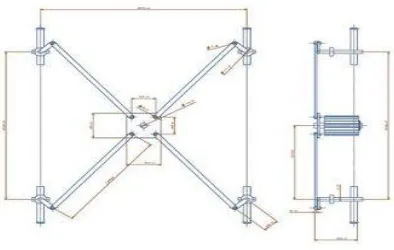
WORKING PRINCIPLE: It is based on the principle of a geared motor system in which the engine is used to turn all the wheels of a vehicle to turn the vehicle along a circular path. A zero-turn car means a car that makes a sharp turn with a zero turning radius and follows a circular path without leaving a vertical axis passing through the center.
Fig.2 Zero turn with pneumatic material handling
ISSN(Online): 2319-8753 ISSN (Print) : 2347-6710
I
nternational
J
ournal of
I
nnovative
R
esearch in
S
cience,
E
ngineering and
T
echnology
(A High Impact Factor, Monthly, Peer Reviewed Journal)
Visit: www.ijirset.com
Vol. 6, Issue 11, November 2017
Fig. 3 Link Mechanism
VI.DESIGN
The total design work has been divided into two parts mainly, 1. System design
2. Mechanical design
The design of the system mainly concerns the various physical and ergonomic concerns, the space requirements, the provisions of the various components on the main frame of the machine, the number of controls, the positions of these controls, the ease of maintenance, the range improvements. Ground etc.
In mechanical design, the components are classified in two parts. 1. Design parts
2. Parts to buy
For the structural parts, the detailed design is created and the dimensions thus obtained are compared with the immediately larger dimensions readily available on the market. This simplifies both the assembly and the post-processing. The different tolerances of the parts are given in the production drawing. The process sheets are prepared and transferred to production. Parts that are to be purchased directly are specified and selected in standard catalogs.
ISSN(Online): 2319-8753 ISSN (Print) : 2347-6710
I
nternational
J
ournal of
I
nnovative
R
esearch in
S
cience,
E
ngineering and
T
echnology
(A High Impact Factor, Monthly, Peer Reviewed Journal)
Visit: www.ijirset.com
Vol. 6, Issue 11, November 2017
Consider weight of the upper part of robot = 5kg
Weight of the link & gear motor = 5kg &
Required rpm= 30
2π NT
P = 60
2π x 30 x (15 x 9.81) P =
60 x 1000
P = 1.0786 kW
P = 1.446 hp.
VII.FUTURE SCOPE
This vehicle is manually enabled. Therefore, the employee needs full attention to the use of the robot. This robot can be customized with fully automated robot programming. This automated robot can perform the specified jobs in the shortest possible time and with great precision. It can be used to transfer work from one workstation to another if the path of the operation is provided through programming.
VIII.CONCLUSION
A vehicle with a low-cost and user-friendly steering mechanism has been introduced. Without spinning the wheels, there can be no rotation. Material transport takes into account safety and comfort.A zero lap beam with pneumatic material with a low cost and user friendly link mechanism.It can turn to zero without pulling the wheels. Material handling is taken to take into account safety and comfort.We can easily handle the material in a small space.
REFERENCES
1) Bansode SP, Gaikwad AA, Salgude PS, Tiwari TD, Prof. Avhad NV, Prof. Bhane A..B, Zero Turn Vehicle, International Journal of Emerging Technology and Advanced Engineering (ISSN 2250-2459, ISO 9001: 2008 Certified Journal), Volume 5, Issue 3, March 2015.
2) Salvi B.L., Maherchandani J.K., Dr.Nandwana B.P., Automatic Reverse Radar Reduction System, International Journal of Technology and Innovative Technology (IJEIT), Part 1, Issue 3, March 2012.
3) Er.Amitesh Kumar, Dr.Dinesh.N.Kamble, Zero Turn Wheel Drive System, International Journal of Scientific & Engineering Research (ISSN 2229-5518), Volume 5, Issue 12, December-2014.
4) Machine Elements of Design, 3rd Edition, V.B. Bhandari, McGraw Hill Publication.
5) K. Lohith, dr. S.R. Shankapal, M.H. Monish Gowda, "Development of Four-Wheel Steering for a Car," Volume 12, Issue 1, April 13
6) International Journal of Mechanical Engineering & Robotics Research, National Conference on-New Advances in Mechanical Engineering RAME -2013, Vol. 1, No.1, January 2014.
7) Development of a system for reducing the turning radius of a car B.L. Salvi, J.K. Maherchandani, dr. B.P. Nandwana, March 2012 8) http://auto.howstuffworks.com/jeep-hurricane
9) Basics of Automotive Dynamics, Thomas D. Gillespie, Published by S.A.E., 1992.