Abstract
Lim, Raymond W. Perceptions and Performance for Bilingual Labels as a Function of Native Users of English and Spanish. (Under the direction of Michael S. Wogalter.)
According to the U.S. census, Hispanics are now the largest minority group in the
U.S. Many are Spanish language users who are potentially susceptible to injury or death
from improper handling or use of hazardous products because most warnings on products in
the U.S. are written for English language users. This study focused on several issues that
examined the perceptions and performance of both English and Spanish language product
users towards bilingual labels (labels with two languages). Three studies were conducted;
the latter two involved experimental manipulations of bilingual labels.
The first study consisted of a survey asking English language users about their beliefs
and attitudes in favor of implementing bilingual label products to the mainstream.
Participants were asked to rate various statements involving safety and design issues of
bilingual labels. Participants agreed that bilingual products are useful for Spanish speakers
and that people who intend to live in the U.S. should learn English. Also, participants
believed that bilingual labels are important, because many people in the U.S. do not read
English. Participants disagreed that products bearing bilingual labels should not be sold in
the U.S., and that products with bilingual are lower in quality than English labeled products.
The second study asked English and Spanish language users for ratings on the level of
acceptability, the likelihood of purchasing, and the likelihood of reading of several
manipulated bilingual label designs on actual box and cylinder containers. Examination of
designs having both language displayed side-by-side were rated higher in acceptability than
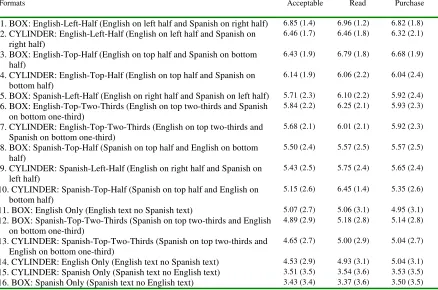
languages displayed on top and bottom. Overall, the design of the English-text on the left
half and the Spanish-text on the right half displayed on a box yielded the highest
acceptability ratings.
The third study tested the salience of several visual enhancements (font size, font
color, and pictograph) to bilingual labels using a time-based performance task with both
Spanish and English language users. The most effective bilingual design was adopted from
Study 2 in which the languages were displayed side-by-side. Labels with the user’s native
language (English-text only for English language users and Spanish-text only for Spanish
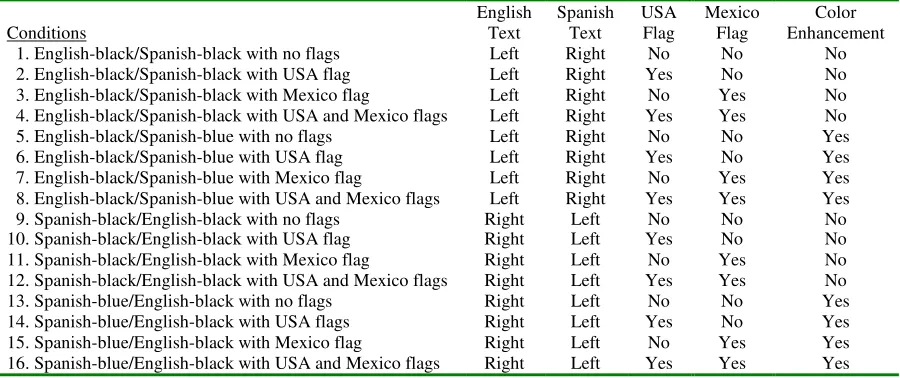
language users) produced the fastest search times. Overall, labels having either two flags or
a single flag had faster search times but labels with colored text and no flags had longer
search times. The English-text Left, Spanish-text Right with both flags, on average, added 76
milliseconds in response time compared to the label with just the user’s native language.
This research provides validation for implementing bilingual labels in the U.S. with
well designed labels, users (both English language and Spanish language) in the U.S. are
more likely to accept bilingual labels on products. By making them more usable through
research such as the present work, it will help consumers to find information that they need.
The results suggested that bilingual labels can be developed to provide important information
to persons who do not use the main language, yet still communicate important information
without detracting persons of the majority language. Implications for manufacturers and
Running head: WARNING’S SALIENCY ON BILINGUAL LABELS
Perceptions and Performance for Bilingual Labels as a
Function of Native Users of English and Spanish
by
Raymond W. Lim
A dissertation submitted to the Graduate Faculty of North Carolina State University In partial fulfillment of the requirements for the
Doctoral Degree of Philosophy in Psychology
Psychology
Raleigh
2005
APPROVED BY
_________________________ _________________________
_________________________ _________________________
Biography
Raymond W. Lim was born in Los Angeles, California. After receiving his dual B.A.
in 1998 from California State University-Los Angeles, he left for North Carolina State
University to pursue his graduate degree. After completion of his M.S. in 2001 he had
various roles as a teacher assistant, research assistant, and human factors intern. He currently
Table of Contents
List of Tables ...vii
Introduction...1
The Role of Bilingualism in Safety...3
Review ...5
Hazard ...5
Three Hierarchical Strategies to Deal with Hazards ...6
The Role of ANSI ...7
The Language of Warnings...7
Assessing Behavior and Compliance on Warning Research ...8
Three Types of Warnings...9
Print/Visual Warnings...9
Pictorial Symbols ...9
Auditory Warnings...11
Brief Summary of Warnings Research Models ...12
Communicative-Human Information Processing (C-HIP) Model ...13
Letho’s Conceptual Model...14
Roger’s Warning Processing Model ...15
Health Belief Model (HBM)...16
Summary...17
Source ...22
Channel ...22
Attention and Noticeability...23
Comprehension/Memory ...24
Environmental Conditions ...24
Print Size...24
Color ...25
Borders ...25
Signal Words and Icons ...25
Pictorial Symbols ...26
Location ...26
Practical Implications...26
Study 1 ...28
Method ...28
Participants...28
Materials and Procedure...29
Results...30
Demographic Differences ...30
Attitude Differences...32
Discussion...34
Study 2 ...35
Participants...38
Materials ...39
Demographic Questionnaire ...40
Formats ...41
Vignette...43
Ratings ...43
Procedures...44
Design ...45
Results...46
Discussion...54
Study 3 ...57
Method ...62
Participants...62
Materials ...62
Consent Form...63
Demographic Questionnaire ...64
Procedure ...64
Response Measures...65
Apparatus ...65
Design ...66
General Discussion ...81
Implications...86
References...88
Appendix A (Bilingual Label Survey) ...94
Appendix B (Study 2 & 3, Informed Consent Form: English and Spanish)...96
Appendix C (Study 2, Vignette & Rating Scale: English and Spanish) ...99
Appendix D (Study 2 & 3, Demographic Questionnaire: English and Spanish) ..102
Appendix E (Study 2, Bilingual Label Formats)...107
Appendix F (Study 3, Bilingual Label Formats) ...117
Appendix G (Study 1, ANOVAS & raw data) ...139
Appendix H (Study 2, ANOVAS & raw data) ...166
Lists of Tables
Table 1 ...31
Table 2 ...32
Table 3. ...42
Table 4 ...47
Table 5 ...48
Table 6 ...51
Table 7 ...52
Table 8 ...53
Table 9 ...54
Table 10 ...64
Table 11 ...68
Table 12 ...69
Table 13 ...69
Table 14 ...70
Table 15 ...70
Table 16 ...71
Table 17 ...71
Table 18 ...72
Table 19 ...72
Table 22 ...75
Table 23 ...76
Introduction
The U.S. Census Bureau projected an increase in Hispanics from 11.5% to 15.8% of
the total U.S. population from 1999 to 2015 (U.S. Census Bureau, 2002). As of July 2001,
the Census Bureau reported that Hispanics to be the largest minority in the U.S., comprising
13% of the total U.S. population, surpassing African-Americans (12%). These figures
account for only those who voluntarily register with the Census Bureau. The actual figure is
higher because the Immigration and Naturalization Service estimates that, in January 2000,
there were 2.7 million undocumented illegal immigrants from Mexico residing in the U.S.
California, Texas, Illinois, Arizona, Georgia, and North Carolina reported to have the
largest numerical increase in undocumented immigrants. The majority of these
undocumented immigrants are from Mexico; however, other Hispanic-origin countries such
as El Salvador, Guatemala, Honduras, Dominican Republic, Nicaragua, Columbia, Ecuador,
and Peru comprise another 912,000 undocumented immigrants (Immigration and
Naturalization Service, 2000).
Immigrants, both legal and illegal, frequently have limited skills in the English
language. About 27 percent of Hispanics in the U.S. (Mexicans, Cubans, Puerto Ricans,
South and Central Americans, and others) overall, have reported to be monoliterate, which is
knowledge of only one language, in this case Spanish (U.S. Department of Education, 1992).
Many take jobs that involve manual labor, which in some cases may include the handling of
potentially dangerous chemicals or operating hazardous equipment. To warn users of
potential hazards, a print warning is usually located on the container of the product or
apprised of labeled hazards written only in English, which could increase their susceptibility
to injuries, illnesses, or death.
In addition, manufacturers may be susceptible to lawsuits for inadequate warnings
because portions of the target audience were not appraised of product hazards. For example,
in one case a manufacturer was sued because the manufacturer publicly advertised a
product’s benefit but without the risks in Spanish to a Hispanic community.
In the case of Ramirez v. Plough Inc., the mother of a child suffering from Reye’s syndrome
sued the manufacturer of an aspirin product. The mother claimed that she was not given full
disclosure to the product’s warning printed on the package. The manufacturer of the aspirin
product was granted summary judgment in the state of California District Court in favor of
the manufacturer. However, the California Court of Appeals reversed the District Court’s
decision on the basis that the manufacturer should have foreseen use by Spanish-language
users (Hubbard-Hall Chemical Company v. Silverman, 1965). This case worked its way up
to the California Supreme Court, where the court’s decision was that manufacturers of
nonprescription drugs in California do not have to mandatorily print warnings in any
language other than English (Ramirez v. Plough, 1992).
Another language-related problem has been described by Rosenthal (1991). On
October 22, 1999 in a remote village in Tauccamarca, Peru, 24 children died and 18 were
sickened as a result of ingesting milk that contained poison. The poison was meant for use as
a pesticide for vegetables at a nearby farm. The package of white powder resembled
powdered milk but had no strong odor. It was labeled in Spanish and displayed pictures of
vegetables. The investigators of this incident suspected that, because of the preparer’s
printed warning that the preparer could not read, the kitchen worker prepared the poison as if
were dry milk powder.
The Role of Bilingualism in Safety
The Occupational Safety and Health Administration (OSHA) requires that “all
employers shall instruct each employee in the recognition and avoidance of unsafe conditions
and the regulations applicable to his work environment to control or eliminate any hazards or
other exposure to illness or injury” (OHSA, 1994). Although bilingual training is not
mentioned in the regulation, requirements for safety instruction would suggest that employers
should train workers in ways that the employees would understand, and that may mean
instruction in a language they know. This issue, among others, has been a major reason why
bilingual training for workers in occupations where many of the workers are
Spanish-language users has been adopted by some manufacturers (Flory, 2001; Stromme, 2001). In
one study, an airport contracted with an insurance company to train construction workers in a
language they understand to try to reduce their injury rate. In a study by Korman (2002),
workers were trained in a language they understood. The results indicated that the injury rate
at the airport was reduced. Also, an analysis compared the cost of the number of injuries
versus the cost of training, and the results showed that training workers in either their native
language or a language they understood was more cost effective than compensating for the
workers’ injuries (Korman, 2002). In another example, bilingual training was applied in the
form of community service. A survey was distributed to Dallas residents in an area heavily
populated with Hispanics. The survey showed that parents of Hispanic preschool-aged
bilingual program to change this practice among Hispanics in the communities. The results
showed that by having instructions in a language they understood, more drivers complied
with using child restraint systems. Educating drivers in a language they understood allowed
them to be conscientious about the health of their children and themselves (Istre, McCoy,
Fanning, Stowe, Womack & Dekat, 2002).
These examples are among the many bilingual training programs that show a benefit
of training or instructing in the user’s language. Employers, community outreach, and other
programs should implement training, especially when it involves preserving safety. Training
in the person’s language may be already applied in the area of construction or in community
services, but there may still be a need for manufacturers to implement this on product labels.
Clearly, there are advantages to labels written for consumers who are
Spanish-language users. In the U.S. where Spanish Spanish-language users are the largest minority, bilingual
labels in English and Spanish may decrease injuries, illnesses, or even death because both
English and Spanish language users will be able to understand the hazards and thus be able to
make better-informed usage decisions.
Although consideration of using other languages such as French, German, Russian,
etc., is probably necessary, this research focuses on the use of Spanish on labels because of
the great number of monolithic Spanish language users in the U.S. Therefore, reference to
bilingual labels in these studies will refer to both English and Spanish.
However, there are also potential disadvantages with bilingual labels. For example,
having two languages on a conventional container label will decrease the surface area
dedicated to warnings and instructions in English and, in turn, will reduce the readability of
Also, products that have both English and Spanish languages may not appeal to the
English-language population because such labeling practice may not be acceptable because
of the belief that the U.S. population should use one primary language to communicate.
Moreover, users may not read the warnings of bilingual labels because the perception of a
bilingual label having too much text may discourage them. This may stem from a legibility
issue where users are frustrated because labels with two languages in small may appear to be
a lot of reading.
Review
One of the objectives of human factors research is to improve safety through
designing safer products (Sanders & McCormick, 1993). The introduction of a second
language to a product’s label may provide to the user, the hazards associated with the
product. However, as with any new or novel design, application of human factors design
principles should be considered. These principles are intended to increase the likelihood for
warning information on labels to be attended to, be comprehended, and motivate users to
comply. In this review, human factors issues and current research are discussed, as well as
the role of human information processing play in the design of bilingual labels.
Hazard
A hazard is defined as a set of circumstances that may result in injury, illness or
property damage. These circumstances may include characteristics of an environment, of a
product, and/or of a task. Abilities, limitations, experience, perceptions, and knowledge of a
person are also included in the system (Laughery & Hammond, 1999).
through influencing the behavior of people in such a way that they comply with the warnings.
Also, through warning individuals, the emphasis is to give the users critical information so
they may make informed decisions. The critical aspect of this depends upon whether the
information given is adequate to deter unsafe behaviors (Laughery & Hammond, 1999).
Three Hierarchical Strategies to Deal with Hazards
The hazard control hierarchy is necessary throughout the design process of any
product. First, the primary focus is to design out or eliminate the hazard out of the product.
One example is discontinuing the removable pull-off tab on earlier aluminum beverage cans.
The contemporary aluminum beverage can has a push-back tab that does not allow the user
to insert the tab back into the can, thus reducing the threat of choking from a young child
inadvertently swallowing the tab.
If designing the hazard out of the product cannot be accomplished, then the second
level should be implemented. The second level of hazard control is to guard against the
hazard, that is, using any type of barrier that prevents the user from being subjected to the
hazard or damaging the product. For example, having a metal guard that keeps fingers out of
the magnetic disk often found in a computer diskette will not allow the user to damage the
product. Another example would be a plastic or metal grill over a box fan to keep hands and
fingers away from the rotating blades.
Warning is the third level of hazard control and is the least desired level of hazard
control for a product. A warning is only implemented when designing the hazard out of the
The Role of ANSI
ANSI is a non-profit organization that coordinates some of the voluntary standards in
the U.S. (ANSI Z535, 2001). Prior to American National Standards Institute (ANSI) product
safety labels regulations (ANSI Z535), two precursors also dealt with product safety labels:
FMC Corporation and Westinghouse (FMC Corporation, 1985; Westinghouse, 1981).
Although the most current ANSI Z535 version to date was published in 2003, it was
first published in 1991. There were also precursor ANSI standards: Z35 and Z58. These
warning designs are in constant development and are made possible through the
recommendations of members of the ANSI. For example, Martin and Deppa (1997)
examined a set of warning design guidelines that affect the content order, grammatical style,
and physical appearance of safety warnings. The expectation is that in application, warning
labels will be more easily recognizable, legible, readable, and understandable.
The Language of Warnings
In the field of warnings, there are several definitions that need to be addressed. First,
a hazard is defined as a set of circumstances that may result in injury, illness, or property
damage (Wogalter, DeJoy & Laughery, 1999). It includes the abilities, limitations,
experience, perception, and knowledge of the person(s) in the system. That is, the definition
relates to situations that are not purely limited to, but include characteristics of, an
environment, a product, and/or a task. The second is danger, a term that is used in a variety
of ways. For example, one way of assessing the level of danger is through a multiplicative
function of the level of a hazard and the likelihood of it occurring (Wogalter et al., 1999).
function does not necessarily mean it is correct in assessing the level of danger. A third term
that is associated with warnings is risk. That is, risk is the overall awareness of hazards,
likelihood, and potential outcomes of a situation or set of circumstances. These three terms
are commonly used whenever discussion of warnings and risk communication is addressed in
the literature (Wogalter et al., 1999). Although these terms are known in the field of
warnings, researchers discovered that people generally do not distinguish between the
expressions “hazardous,” “risky,” “dangerous,” and “hazardous-to-use.” Also, Young,
Brelsford & Wogalter (1990), found that designers of warnings and education materials
should communicate how badly a person can get hurt rather than the likelihood of getting
hurt. Research also indicates that users more readily distinguish severity difference in
warnings as opposed to the likelihood of getting hurt (Wogalter, 2003).
Assessing Behavior and Compliance in Warnings Research
The ultimate criterion of warning effectiveness is actual behavior compliance
(Wogalter & Dingus, 1999). That is, after a warning has been observed and comprehended
by the user, the user’s behavior is to comply with the warning. However, very few studies
have reported using the approach of “compliance research” because it is difficult to set up a
realistic scenario and it is very time consuming. Also, research where participants are
subjected or may be subjected to dangerous conditions may be questioned on ethical grounds.
Generally, self-reports on user intentions are collected through survey methodologies as a
proxy for compliance research. For example, participants may be asked to rate the likelihood
Three Types of Warnings
Print/Visual Warnings
Usually an attention-getting warning word is used so that the warning stands out
relative to the background called “signal words” (Wogalter et al., 1999). These words are
“caution,” “warning,” and “danger.” Within the written warning labels, an explanation is
sometimes given regarding the consequences of not following instructions properly. These
consequences could include descriptors like death, mutilation, injury, blindness, and others.
Also, these warnings communicate procedures for safe operation or proper instruction(s) to
the equipment or product in order to avoid hazard or damage. Moreover, adding informative
and nonredundant statements are effective (Wogalter, Godfrey, Fontenelle, Desaulniers,
Rothstein & Laughery, 1987).
Warning labels are appropriate when certain conditions are met. A written warning
label is better used when (1) the message that needs to be addressed is complex (including
cases where the information has several levels of instructions or objectives), (2) if the
message is long or when a person needs to refer to the message later, (3) when the message
deals with locations in space and does not call for immediate attention, and (4) if the auditory
system of the user is overburdened or the environment is too noisy (as in an environment
where an auditory warning is not useful, such as a loud factory). Finally, if the person’s job
allows him/her to remain in one position, then having a written warning label is best suited
for the environment or product (Sanders & McCormick, 1993).
Pictorial Symbols
is to call the user’s attention to the warning label. One example of an icon is an alert symbol
that is described as an exclamation mark surrounded by an upward pointed triangle,
commonly found on many warning labels. Pictograms are picture-like illustrations that
depict procedures to inform of proper use or hazards of a product. One example is a
pictogram on some medication products that informs a person to not take medication with
milk or dairy products. In this pictogram, a line drawing of a carton of milk and a wedge of
cheese is within a circle with a slash though them. Symbols can also indicate potential
product hazards or consequences from misuse. For example, a symbol where fingers are
crushed may indicate the potential product hazard of misuse, and the skull and crossbones
may represent death resulting from improper product use.
Pictorial symbols are increasingly being used in the area of warning research because
they are believed to be “culturally neutral” (for review, see Cairney & Sless, 1982). It is
argued that those who cannot read are able to comprehend pictorial symbols. Because of this
argument that pictorial symbols are easily comprehended, researchers suggest using pictorial
symbols when communicating information to those whose language is not English
(Edworthy & Adams, 1996). Moreover, in comparing text and pictorial symbols in signs of
the same size, some research indicates that pictorial symbols can be seen at a greater
distances apparently due to their unique features relative to text (Jacobs, Johnston, & Cole,
1975). That is, pictorial symbols can sometimes be identified more quickly and more
accurately than an equivalently worded sign. Pictorial symbols also have good legibility in
Auditory Warnings
An auditory warning generally consists of a simple or complex sound that alerts or
attracts the attention of the user. For sounds that are complex, those that consist of more than
a single tone, the information is either general or specific to the problem at hand. The
uniqueness of complex sounds may give far more information to the user than a simple pure
tone (Patterson, 1982). Auditory warnings can range from simple nonverbal sounds such as
sirens, tones, buzzers, bells, whistles, horns, klaxons, or gongs to verbal messages where the
main job is to alert and startle the user and give the indication of a hazard. These two
categories of auditory warnings are described in the following test.
Nonverbal sounds, such as signals, are common tones and beeps that carry less
information than complex sounds. These simple auditory warnings generally announce that
there is a problem. Conversely, complex sounds can signal specific hazards by using a
combination of different frequencies or temporal arrangements of sounds. However,
regardless of whether the auditory warning is simple or complex, the user must be able to
associate the hazard with the specific sound and its meaning. The benefit of having a
nonverbal sound is that it does not discriminate between cultures, so everyone with healthy
hearing is able to perceive and encode this type of warning. However, one drawback is that
nonverbal sound requires some training or some other experience to understand the warning
(Stanton & Edworthy, 1999).
Verbal or speech warnings are messages that transmit information through the
auditory modality. These warnings, however, do require knowledge of the vernacular to
An auditory warning also has the ability to attract the attention of users who are not
directionally near or in front of the warning indicator. Because of the omnidirectional nature
of most sounds, users can roam within the environment without needing to be in direct
line-of-sight of the warning.
Nonverbal auditory warnings may also be useful in other ways. For example, a tire
screeching will alert an automobile driver that he/she needs to apply the brakes in the car.
This form of auditory warning, known as an auditory icon, has recently been investigated
among human factors practitioners (Belz, Robinson, & Casali, 1999).
When considering the use of auditory warnings, researchers should take several
objectives into account. First, an auditory warning is best used when the message is short
and simple. Second, if the message does not need to be referred to later and calls for
immediate attention, an auditory warning is appropriate. Third, when the warning deals with
events in time, an auditory warning should be used. For example, an auditory warning is
appropriate when immediate attention and a reaction are required to turn on the cooling grids
in a nuclear power plant to avoid a nuclear meltdown. Fourth, an auditory warning should be
used when the visual system is burdened or when the user is in an environment that does not
allow proper lighting (Wogalter & Leonard, 1999).
Brief Summary of Warnings Research Models
The following are brief reviews of four models that are fairly often referred to in the
warning research literature. These reviews summarize each model and compare the stages of
each model with the stages in other models. At the end of the review, presentation of the
(1) Communication-Human Information Processing Model (C-HIP) Model
This model consists of seven stages that are addressed in a linear function with loops
that feed back to each stage (Wogalter, Dejoy, & Laughery, 1999). The first stage is the
source, or in other words, the originator or initial transmitter of hazard and risk information.
It may be composed of various sources, such as manufacturers, the federal government,
nonprofit public service organizations, and industry trade organizations. Consideration for
designing effective communication is necessary so that the receiver will easily decode the
message’s meaning (Cox, 1999)
The second stage is the channel. Relevant here is the way the message is transmitted
from the source to the receiver. There are two approaches to conveying information at this
stage. The transmission of the message through several modalities, such as the visual,
auditory, kinesthetic, olfactory, and so on, is known as the sensory modality. Transmission of
the message though product labels, leaflets, signs, owner’s manuals, mass media, newscasts,
and televised magazine shows is known as the communications medium. Depending upon
the message’s characteristics, such as the length of the message, conveying this message may
be more suitable in a print/visual modality than the auditory modality.
The third stage is noticeability and attention. In this stage there are two processes
involved. A primary goal is the capture of the receiver’s attention by making the warning
stand out (i.e., be salient, prominent, and conspicuous). Also, included in the capturing of the
user’s attention are the physical placement, the stress level, and the ambient noise conditions.
The second process is maintenance, where attention is held while and until information from
The next stage is comprehension and memory. For this stage, the important factor
here is that the message facilitates understanding and retention of the warning by the
receiver. Also, it is important that the receivers not only understand the warning but also
remember the message (Leonard, Otani, & Wogalter, 1999).
The fifth stage of this model is attitudes and beliefs. For this stage, factors such as
individual differences play a role. Also included in this stage are the perceived hazard on
severity of injury anticipated, and familiarity where previous experience with the product
affects the effectiveness of a warning. Another important aspect is expectations. That is,
perceived threat either directly or indirectly shows the most promise for altering expectations
(Dejoy, 1999).
The next stage is motivation. At this stage, the perceived threat or expectation about
adverse consequence is what provides the initial motivation for precautionary behavior. Cost
of compliance also effects one’s motivation such that a warning’s effectiveness is degraded
once the cost of compliance increases. That is, when there is an amount of effort that must
be expended, motivation to comply decreases. Moreover, individual differences such as
familiarity and experience, personal relevance, and risk taking have shown to affect one’s
motivation (Dejoy, 1999).
The last stage is behavior. Compliance behavior is the ultimate desired outcome for a
warning. In a 1997 meta-analytic review article, Cox, Wogalter, Stokes, and Murff showed
that overall that the presence of a warning increases safe behavior.
(2) Lehto’s Conceptual Model
Lehto asserts that there are four fundamental forms of information. These four
form, signals, corresponds to sensory data where signals trigger sensory-motor behavior,
which is at the skill-based level. The next fundamental form, signs, indicates perceived or
named states. At this rule-based level, signs trigger the conscious application of rules (Lehto,
1992). The third fundamental form is symbols- abstract constructs that can be formally
processed in mental models (Rasmussen, 1986). Symbols are at the knowledge-based level,
where symbols are manipulated within mental models to identify system states, formulate
goals, and plan sequences of task-related activity (Lehto, 1992). The last fundamental form,
value, is at the judgment-based level. Here, the priorities of the fundamental form value are
developed on the basis of agreement or disagreement with deeply processed concepts
associated with opinions, attitudes, or beliefs.
(3) Rogers’ Warning Process Model.
In Rogers, Lamson, and Rousseau (2000) framework, the warning process is divided
into four broad components or processes. The first process is notice, where attention is
drawn to the warning. There are several person variables that affect this stage: age,
familiarity, hazard perception, information seeking, and gender. Also, the warning variables
that affect this stage are color, emphasis, interactivity, orientation, placement, shape, signal
word, size, symbols, and tone.
The second process is encode, where external information is translated into some
internal representation. The person variables that affect this stage are familiarity, hazard
perception, gender, and vision. The warning variables that affect this stage are color,
emphasis, font size, interactivity, layout, length, placement, signal word, size, symbology,
The third process is comprehend, or how the meaning of the warning is understood.
The person variables that affect this stage are age, familiarity, and symbol comprehension.
The warning variables are color, explicitness, layout, placement, signal word, symbology,
text complexity, type style, and variations.
The last process is comply, when behavior is in accordance with the warning. The
person variable’s age, control perception, cost of compliance, familiarity, hazard perception,
modeling, and risk-taking style affect the comply stage. Color, interactivity, layout,
placement, provided response, statement of hazard, and symbology effects are warnings
variables of the comply stage.
As indicated, there are many variables that can directly influence each of the four
stages described in this warning process. Although the layout of the four stages is in a linear
fashion, the authors did not imply that the process of these stages is strictly serial. Instead,
the authors mentioned that an overlap of this processing occurs in the various components
and that there are interactions among the components (Rogers, Lamson, & Rousseau, 2000;
Wogalter & Laughery, 1996).
(4) Health Belief Model (HBM)
This model assumes that individuals base their health behavior on rational thinking,
such that individual perceptions and modifying factors determine the likelihood of one’s
action (Schwarzer, 1992). This model has six components. The first component is the
perceived susceptibility to illness and perceived severity of illness. This component
influences the second component, perceived threat, where threat is the susceptibility of
injury, that is, one being at the risk of being injured. The first component (perceived
individual differences, which includes demographic variables, social pressure, and
personality. The third component also influences the fourth component, benefits minus
barriers, in which individuals compare the perceived benefits of a recommended preventive
action with the perceived barriers to this action. The fifth component, cues to action,
influences the second component, perceived threat. The last component to the Health Belief
Model is the likelihood of health action, which is influenced by both the second component,
threat, and fourth component, benefits minus barriers (Schwarzer, 1992).
The desired outcome of modifying the level of threat, factoring the other components,
and demonstrating the benefits minus barriers is to change the receiver’s behavior. For
example, Witte, Stokols, Ituarte, and Schneider (1993) tested this model in a field study to
promote bicycle safety helmet use. Manipulation of the susceptibility and severity was
addressed by mailing pamphlets that address the severity of head injuries for children not
wearing safety helmets. The results showed that the perceived susceptibility and severity had
influenced perceived threat. Also, these researchers tested cues to action (warnings through
communication media) by forming community events, publishing service announcements,
sending direct mailings, making telephone calls, and conducting physician counseling, all of
which had a significant influence on the perceptions of threat. The authors reported that cues
to action had a significant influence on the likelihood of health action where participants
were more likely to comply with wearing a safety helmet.
Summary
Many of the theoretical models mentioned earlier have close ties to basic human
Processing model’s second stage, “channel,” was closely related to Lehto’s first component,
“signals,” Rogers’ “notice,” and the Health Belief Model’s “cues to action” component.
The next common stage is C-HIP’s “noticeability/attention,” which was closely
related to Lethto’s “signals,” Rogers’ “notice,” and HBM’s “cues to action.” Among the
latter three models, the C-HIP model had a clearer discrimination between the stages
“channel” and “noticeability/attention.”
In the C-HIP model, the stage “comprehension/memory” was related to Lethto’s
“signs,” and Rogers’ “encode” and “comprehend” but not any one of HBM’s components.
This stage covered the cognitive components in processing information, but the HBM did not
account for this aspect.
The next common stages were between C-HIP’s “attitude/beliefs,” Lethto’s “values,”
and HBM’s “perceived susceptibility and severity,” “perceived threat,” and “individual
difference,” but not any of Rogers’ components. Rogers’ model relied more on a
perceptual/behavior framework and not so much on individual attitudes.
The C-HIP’s “motivation” stage was closely related to Lehto’s “symbols” and
HBM’s “benefit minus barriers” components; no components in Roger’s model were related
to any of these aspects as Roger’s model does not account for a human’s attitude.
The last stage in the C-HIP’s model is “behavior,” which is closely related to Roger’s
“comply” and HBM’s “likelihood” components. However, neither of these stages was
related to any component in Lethto’s model.
Although the C-HIP component “source” had no relationship with any other
components in these models, it may only mean that the other models did not account for
was very likely that each stage encompasses more than one job. Also, some of these models
lacked the finite resolution demonstrated by the C-HIP model, as the other model’s method
conveyed their steps of warning an individual in a much broader scope.
Although each theory proposes many suggestions about how a warning should be
modeled or designed, the major theme at the early stages of each model is that “the receiver
must notice the information and understand it” (Wogalter et. al., 1999). One overall theme of
the present research is to investigate and design better bilingual labels for consumer products,
in particular pesticides.
There is very little reported research on the design of pesticide warnings, let alone
warnings using both the English and Spanish languages. Moreover, the main goal of this
research is to measure perceptions (attitudes and beliefs) and performance on dual-language
warnings.
There have been several studies investigating factors that influence the effectiveness
of on-product warnings. For example, Laughery, Rowe-Hallbert, Young, Vaubel, and Laux
(1991) investigated the effects of explicitness in conveying severity information in product
warnings. Their research indicated that when the hazard in the warning is explicitly
conveyed, the consumer is more likely to deem the product hazardous. As a result the
consumer will have a heightened inclination to act cautiously in using the product.
Warning messages with greater described injury severity also appear to influence
warning effectiveness. In one experiment, Wogalter and Barlow (1990) found that by
varying the wording of a warning from “mild skin irritation” to “intense skin irritation,”
In another study related to pesticide warnings, Adams and Edworthy (1995)
investigated the effects of basic text display variables on perceived urgency of warning
labels. Their results indicated that text size, when increased by four points, increased the
perceived urgency. Also, urgency was increased when the border width was increased by 2-3
points. Color was also noted to increase urgency of the warning. When the warning was
printed in black, it did not have the same level of perceived urgency as a warning printed in
red. That is, warning in black print had to be twice in size to be equal in the level of
perceived urgency when the warning was in red.
Silver and Kline (1994) reported that particular fonts on warning labels, in particular
pesticides, varied in size and type. Their results showed that Century Schoolbook font was
rated more readable than Bookman and Helvetica. Also, by increasing the font size from
12-point font to 14-12-point font, researchers noticed that participants reported an increase in
perceived readability and perceived hazard.
Wogalter and Young (1994) tested several alternative product label designs. Their
research indicated that individuals were more likely to comply with a warning using a tag
(warning attached to the mouth of the product) over conventional warnings such as those
labeled on the container or another alternative form like “wings” that surrounded the bottle.
Their results indicated that through larger surface area provided by the alternative designs,
the warnings were more likely to capture the user’s attention and thus the user would heed
the warning.
Purpose of the Present Research
In 1989, Leonard, Ponsi, Silver and Wogalter reported that a good warning design
product. They indicated that perceived hazard is an important determinant of willingness for
individuals to read warnings. Thus, increasing the perceptions of hazardousness, warning
understandability, and warning attractiveness appears to increase the likelihood that warnings
will be read.
Although the majority of research in the area of warnings has revolved around font
types, font size, font color, border size, warning location, icons, and choice of words
(explicitness), investigations encompassing several of these features in addition to including
a second language will be the main focus of this research.
Current Label Design in Consumer Products
In 2001, the National Electronic Injury Surveillance System estimated that 118,570
people had suffered from some poison-related injury, and of that total, about half (51,051)
were under the age of 18 years. Only two died from poison-related injury. Whether these
injuries were from inhaling noxious fumes from paint, ingesting large quantities of aspirin, or
exposing oneself to pesticides, proper precautionary measures could have possibly prevented
these injuries. Precautionary include the processes of noticing, reading, and then complying
with the visual/print warning.
In the majority of consumer products, visual/print warnings consist of precautions or
directions a user must heed in order to have safe operation. However in the U.S., such
visual/print warnings currently are only in English. These visual/print warnings do not
account for users who lack knowledge of the English language. Understanding the message
According to the C-HIP model, there are three precursor stages prior to
understanding/comprehension. These will be described in the next section with particular
reference to bilingual labels.
Source
The first factor, “source,” is the initial transmitter of the risk information. That is,
source may be a person(s) or an organization that decides to warn users of hazards when they
believe it is necessary. Source has to believe that warnings, in any form or deviation, are
necessary in order to improve the safety of the individuals. When deciding to warn users,
source bases their judgments upon the safety hierarchy (design, guard, and warn) when
factors such as designing the hazard out and guarding against the hazard have been
exhausted. However, source also has to maintain some credibility in order to have effective
warnings because a less-than-credible source will affect the user’s beliefs and attitude toward
the warning (Wogalter & Laughery, 2004).
Channel
Within the channel stage of the Communication-Human Information Processing
Model there are two main dimensions. The first dimension is concerned with what media are
used to inform the user of the warning. The media consist of warnings presented as product
labels, posters, brochures, audio-video presentations, oral presentations, etc. The second
dimension is concerned with which modality is used to inform the user. The modality
consists of a warning presented though either the visual or auditory dimension. Sometimes,
olfactory and tactile may be other channels through which warnings may be disseminated.
The media that will be used in the present study will be in the form of a product label.
the modality, printed text (visual channel) depicting an actual warning will be used because,
as with most consumer products, the visual modality has been used frequently by most
manufacturers. Moreover, previous research indicated that consumers expect warning
information on the product label (Mazis & Morris, 1999).
Attention and Noticeability
In the warning literature, attention plays an important role in all modalities
(visual/print, auditory, tactile, olfactory, etc.). Print/visual warning labels must be adequately
conspicuous relative to the particular background context for a warning to capture a user’s
attention (Young & Wogalter, 1990). However, capturing one’s attention is only half of the
objective in this stage; the ability to hold the user’s attention fulfills the other half.
Within the attention and noticeability stage, there are two stages that are critical to
capturing and then maintaining the user’s attention. The first stage of attention and
noticeability in the C-HIP model is attention switch. Attention switch is the process of
transferring attention from one visual aspect to another. This process is facilitated by making
an object more conspicuous over another (e.g., color, font size, etc.). The second stage of
attention and noticeability in the C-HIP model is attention maintenance or the process of
holding the attention to the object in this case a warning so that information in it is encoded.
Some issues that affect a warning’s attention maintenance are characteristics of the warning
(legibility, formatting, etc.). For example, if a warning was written for an English-language
user, but the user can only read Spanish, the Spanish-language user’s attention will not be
held because of the failure for the user to comprehend the different language on the label
Comprehension/Memory
One critical state related to warnings is comprehension and memory. Warnings
should be written explicitly so that users at risk are informed about the hazards and
consequences if they do not comply. This critical state is the main point to the current study.
With the design of bilingual labels, this would enable Spanish-language users to receive the
necessary information regarding the hazards associated with the product. This is, even with
the forementioned stages (source, channel, and attention) aiding in the improvements of a
design, without a language that the intended targeted population could comprehend; the
stages leading to this would be a moot point.
Environmental Conditions
Other aspects that affect the processing of warnings in the visual/print modality are
environmental conditions that can adversely affect a warning’s detection and maintenance.
For example, having low illumination or insufficient lighting can affect the visibility and
legibility of the warning. Also, having too much lighting can adversely affect a warning in
that glare may result in an overpowering light source that veils or obscures the surface of the
warning (Dahlstedt & Sverson, 1977).
Brightness contrast also can affect the ability of a user to see a warning. For example,
if the print were too light on a light background, legibility of the text would be reduced
(Sanders & McCormick, 1993).
Print Size
Print size can affect attention switch and maintenance of warnings. Wogalter and
Vigilante (2003) examined labels with manipulated print sizes on medication bottles. Their
print frequently found in various kinds of product literatures compared to younger adults.
Text that is larger will capture and maintain attention better than smaller text. Of course, text
size is proportional to the surface area, and such constraints need to be considered.
Color
Color contrast plays a role in which text and background should be near opposite of
each other on the color spectrum. If the color of the text is dark and the background is also
dark, then identification of the letters is made more difficult (Sumner, 1932). Highlighting
has been one process to increase attention capture. Having words that are highlighted by
color will help make the text stand out. As Strawbridge (1986) and Young and Wogalter
(1990) indicated, participants were more likely to notice a warning that is highlighted.
Borders
Borders surrounding warnings can make the warning more distinctive and thus will
capture the user’s attention. Rashid and Wogalter (1997) indicated that border characteristics,
such as thickness and diagonal stripes, were more attention capturing than other plain border
characteristics.
Signal Words and Icons
The signal word panels (e.g., words with color and alert symbols) are believed to
capture a user’s attention. Such signal word panels are used on signs and label warnings.
The American National Safety Institute (ANSI Z535, 2001) deemed the use of signal word
panels to be a standard on signs and label warnings. Signal icons have been shown to
increase the noticeability of a warning. For example, Laughery, Young, Vaubel, and
Pictorial Symbols
The addition of pictorial symbols can enhance a warning’s noticeability. Research
has indicated that by adding a pictorial symbol, participants rated a warning as being more
noticeable than without the pictorial symbol (Sojourner & Wogalter, 1998). In addition,
Wogalter, Sojourner, and Brelsford (1997) indicated that comprehension of pictorial symbols
could be enhanced with brief training. As such in order to have the pictorial symbols easily
comprehended by the target audience, Laughery and Brelsford (1991) indicated that
knowledge of the user is critical prior to constructing a pictorial symbol.
Location
The location of the warning may affect its effectiveness. That is, by having a warning
located at the beginning of the set of instructions, it was more effective than at the end of the
set of instructions (Wogalter, Godfrey, Fontenelle, Desaulniers, Rothstein, & Laughery,
1987). Also, in increasing the noticeability of a visual/print warning, warnings need to go
through a task analyses in order to determine the best location (Frantz & Rhodes, 1993).
Several researchers (e.g., Wogalter, Barlow, & Murphy, 1995) recommended that placement
of warnings should be near the hazard versus elsewhere (e.g., owner’s manual).
Practical Implications.
As indicted earlier, with the growing population of Hispanics in the U.S., there is a
need to create warnings that will accommodate these users. Currently, most hazardous
products are without an adequate warning for users whose primary language is Spanish.
With the rise of Hispanics living in the U.S., it is expected that their susceptibility to
able to make informed decisions when using hazardous products. Although including a
translated version of text placed aside the English text may be applied, observation of current
bilingual labels designs have been deemed poor.
Therefore, the current research evaluated issues regarding bilingual labels and
investigated alternative factors that may be implemented in bilingual labels. The first study
and second study addresses the attitudes and beliefs of both Spanish-language users and
English-language users. The first study examined agreement to various statements
concerning bilingual labels in the U.S. The second study examined the perception of both
users’ attitudes toward several systematically manipulated bilingual label designs. The
results of such label designs may indicate whether comprehension will effectively prompt the
user to comply with the warning (Silver, Leonard, Ponsi, & Wogalter, 1991).
Also, the current research investigated limitations that may be encountered when
implementing two languages on a limited surface area. For example, having two languages
will decrease the size of the font on a label. Moreover, will specific placement (top vs.
bottom, left vs. right) of the two languages affect the ability for a user to attend, notice, and
comprehend the label? Size of the font may be another factor in whether users of the
minority group would accept having their font smaller than the majority group’s font.
The third study examined several visual enhancements to enable the user, both
English-language and Spanish-language, to effectively locate the portion of the label for their
native language. Having two languages on a label may deter the user from reading the text
alphanumeric. Through implementing various visual enhancements in Study 3, investigation
of three different visual enhancements (e.g., a national flag, format, color font) was examined
to aid users to locate their native language on bilingual labels.
Study 1
Study 1 assessed English-language users’ perception regarding implementating
bilingual labels for the mainstream. This study established whether there was a practical
need to implement bilingual labels in the U.S. by assessing the beliefs and attitude of only
English-language users. The vignette in this study addressed safety reasons why bilingual
labels are necessary for non-English speakers especially when products are of hazardous in
nature. Study 1 measured the ratings of English-language users regarding products
displaying bilingual labels (English and Spanish-text).
Hypothesis. It is hypothesized that, given the nature of the vignette, participants
believed bilingual labels are necessary because many people in the U.S. do not read English.
Also, it is hypothesized that English-language users believed that bilingual label products
will be helpful, especially those whose language is Spanish. Lastly, it is hypothesized that
most English-language users believes that people who intend to stay in the U.S. should learn
English because English is widely spoken in the U.S.
Method
Participants. A questionnaire was distributed to a total of 342 (158 males and 184
females) individuals at various locales in the Raleigh-Durham area of North Carolina (279
individuals) and in the Los Angeles area of California (63 individuals). The sample was
collected as part of class projects at two universities. Ages of the participants ranged from 17
average age was 21.7 (SD = 3.8). Non-students made up 27% of the sample and their
average age was 39.4 (SD = 14.2). All participants reported having completed at least the
9th grade with the average education level attained being 2.7 years of college. All
participants reported being fluent in English, but for 16%, English was not the first language
they learned.
Racial/ethnic group composition was 73% Caucasians, 10% Hispanic or Latinos,
4.5% African-Americans, 3.5% Asians, 2% Middle Easterners, and 7% Other.
Materials and Procedure. A multipage questionnaire was distributed containing
items asking participants for their opinions about current technology. One section requested
demographic information such as age, gender, etc. Another section contained 14 statements
concerning beliefs and attitudes about bilingual labels. These statements are shown in Table
1. There were two versions of the questionnaire, each with a different random order of
statements. Each version was given to approximately half of the participants. A short
vignette preceded the statements:
There will be an increase of Spanish speakers in the United States. Manufacturers may begin to use bilingual labels to communicate directions for use, and any warnings of potential hazards. Use the 0 to 8 point scale to rate the statements as to how much you disagree or agree with them. Assume that bilingual labels have both English and Spanish text.
Participants were then asked to rate the level of agreement and disagreement of
statements on a 9-point rating scale ranging from 0 to 8 with the even-numbered points
having the following word anchors: 0 (Very strongly disagree), 1 (Strongly disagree), 2
(Disagree), 3 (Slightly disagree), 4 (No opinion- neither agree or disagree), 5 (Slightly
Results
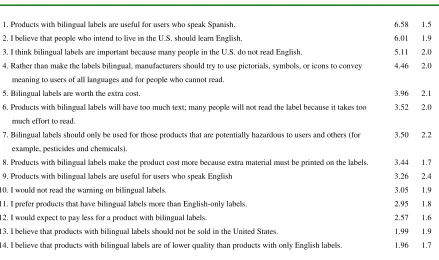
The mean agreement ratings (and standard deviations) for each of the 14 statements
are shown in order from highest to lowest in Table 1. Initially, a repeated-measures analysis
of variance (ANOVA) was conducted on the statement ratings. Comparisons among the
means using Tukey’s Honestly Significant Difference (HSD) of .497 at p =.05 indicates that
many of the statement means were significantly different from one another, particularly at the
high and low ends of the scale.
As can be seen in the table, the three highest statements in rated agreement were: (1)
Bilingual products are useful for Spanish speakers; (2) People who intend to live in the U.S.
should learn English; and (3) Bilingual labels are important, because many people in the U.S.
do not read English. At the other end the three statements with the lowest agreement ratings
(i.e., most disagreement with) were: (12) I would expect to pay less for a product with
bilingual labels; (13) Bilingual products should not be sold in the United States; and (14)
Bilingual products are lower quality than English labeled products.
Demographic Differences. Additional analyses examined the relationship of
demographic category of participants and beliefs and attitudes about bilingual labels to
determine if there were differences. These analyses used a mixed-model design using single
demographic category as the between-subjects factor and statement as the within-subjects
(repeated-measures) factor. The categories examined were: age, gender, student status
(student vs. non-student), users of Los Angeles vs. North Carolina, ethnicity (Hispanic vs.
non-Hispanic) and English as a first language vs. English as a second language. As
described in the next two respective paragraphs, only the latter two demographic categories
A 2 (Hispanic vs. Non-Hispanic) X 14 (statement) mixed-model ANOVA showed a
significant interaction, F(13, 4420) = 4.72, p < .0001. The means are shown in Table 2.
Simple effects analysis indicated that several of the statements significantly differed as a
function of demographic category. Hispanics gave significantly higher ratings than
non-Hispanics to the statements: (5) Bilingual labels are worth the extra cost; and (3) I believe
that bilingual labels are important because many people in the U.S. do not read English.
Also, Hispanics gave significantly lower agreement ratings (i.e., great disagreement with)
than non-Hispanics to the statements: (13) I believe that products with bilingual labels are of
lower quality than products with only English labels; (2) I believe that people who intend to
live in the U.S. should learn English;
Table 1.
Mean agreement ratings and standard deviations for the 14 statements.
Statements Mean (SD)
1. Products with bilingual labels are useful for users who speak Spanish. 6.58 1.5 2. I believe that people who intend to live in the U.S. should learn English. 6.01 1.9 3. I think bilingual labels are important because many people in the U.S. do not read English. 5.11 2.0 4. Rather than make the labels bilingual, manufacturers should try to use pictorials, symbols, or icons to convey
meaning to users of all languages and for people who cannot read.
4.46 2.0
5. Bilingual labels are worth the extra cost. 3.96 2.1
6. Products with bilingual labels will have too much text; many people will not read the label because it takes too much effort to read.
3.52 2.0
7. Bilingual labels should only be used for those products that are potentially hazardous to users and others (for example, pesticides and chemicals).
3.50 2.2
8. Products with bilingual labels make the product cost more because extra material must be printed on the labels. 3.44 1.7 9. Products with bilingual labels are useful for users who speak English 3.26 2.4
10. I would not read the warning on bilingual labels. 3.05 1.9
11. I prefer products that have bilingual labels more than English-only labels. 2.95 1.8 12. I would expect to pay less for a product with bilingual labels. 2.57 1.6 13. I believe that products with bilingual labels should not be sold in the United States. 1.99 1.9 14. I believe that products with bilingual labels are of lower quality than products with only English labels. 1.96 1.7
and (6) Products with bilingual labels will have too much text; many people will not read the
label because it takes too much effort to read.
A 2 (English as a first language vs. English as a second language) X 14 (statement)
mixed-model ANOVA showed a significant interaction, F(13, 4420) = 1.79, p< .05. The
means are shown in Table 2. A similar, although somewhat weaker, pattern of mean
differences as the above-mentioned Hispanic vs. non-Hispanic by statement interaction can
be seen in the table.
Table 2.
Mean agreement ratings for two-way interactions between Hispanics vs. non-Hispanics and English-as-first language for the 14 statements.
Statements Non-Hispanics Hispanics English 1st English 2nd
1. Products with bilingual labels are useful for users who speak Spanish. 6.53 7.05 6.57 6.64 2. I believe that people who intend to live in the U.S. should learn English. 6.10* 5.17 6.12* 5.39 3. I think bilingual labels are important because many people in the U.S. do
not read English.
5.01 6.00* 5.07 5.34
4. Rather than make the labels bilingual, manufacturers should try to use pictorials, symbols, or icons to convey meaning to users of all languages and for people who cannot read.
4.50 4.08 4.50 4.22
5. Bilingual labels are worth the extra cost. 3.88 4.70* 3.92 4.18
6. Products with bilingual labels will have too much text; many people will not read the label because it takes too much effort to read.
3.64* 2.35 3.59 3.13
7. Products with bilingual labels make the product cost more because extra material must be printed on the labels.
3.50 2.44 3.48 3.22
8. Bilingual labels should only be used for those products that are potentially hazardous to users and others (for example, pesticides and chemicals).
3.53 3.29 3.48 3.66
9. Products with bilingual labels are useful for users who speak English 3.26 3.29 3.31 2.98 10. I would not read the warning on bilingual labels. 3.04 3.14 3.02 3.22 11. I prefer products that have bilingual labels more than English-only labels. 2.88 3.58* 2.90 3.18 12. I would expect to pay less for a product with bilingual labels. 2.58 2.47 2.56 2.62 13. I believe that products with bilingual labels are of lower quality than
products with only English labels.
2.10* 0.70 2.10* 1.22
14. I believe that products with bilingual labels should not be sold in the United States.
2.05 1.44 2.06 1.62
* Indicates significant difference (p <. 05).
Attitude Difference. To determine whether persons who are strongly in favor of
examined. A median split at the rating of 6 (agree) was performed on statement: “I believe
that people who intend to live in the U.S. should learn English. Those that rated the “learn
English” statement with a 7 or above were grouped as having strong indication thatEnglish is
necessary for those who intend to live in the U.S., whereas those that rated the “learn
English” statement with a 5 or below were grouped as having a strong indication that English
was not necessary for those who intend to live in the U.S. Those that rated the “learn
English” statements with a 6 were randomly placed either in the first or second group, to
distribute participants in equal numbers in the 2 groups. A mixed model design similar to
that described for the demographic analyses showed a significant interaction in a 2 (lower vs.
higher on the statement “I believe that people who intend to live in the U.S. should learn
English”) X 13 (statements) ANOVA, F(12, 4080) = 12.82, p < .0001. Simple effects
analyses showed several statements to differ significantly (p <.05). Participants who more
strongly agreed to the “intend to live in the U.S., should learn English” (compared to those
who more strongly disagreed) also gave significantly higher agreement ratings to the
statements: “I believe that products with bilingual labels should not be sold in the United
States” (M= 2.39 vs.1.40), and “Products with bilingual labels will have too much text; many
people will not read the label because it takes too much effort to read” (M= 3.88 vs. 3.03).
Those who more strongly disagreed with the “learn English” statement (compared to those
who more strongly agreed) also tended to agree with the statement “I prefer products that
have bilingual labels more than English-only labels” (M= 3.49 vs. 2.53), and “I think
bilingual labels are important because many people in the U.S. do not read English” (M=