Application of Hybrid BF-PSO Technique in
Multi-objective Test Suite Optimization
Renu1
M.Tech, Department of Computer Science, DCRUST Murthal, India
ABSTARCT: In order to optimize the large test suites produced by the existing approaches, in this paper hybrid BF-PSO Technique is introduced for multi-objective test optimization. The algorithm for hybrid BF-BF-PSO is defined for the problem. The BF-PSO combines both algorithms BF and PSO. The aim is to make use of PSO ability to exchange social information and BF ability in finding a new solution by elimination and dispersal. In the BF-PSO, the unit length random direction of tumble behaviour can be decided by the global best position and the best position of each bacteria.
KEYWORDS: Test Suite Optimization, Bacterial Foraging, Particle Swarm Optimization.
I. INTRODUCTION
Most approaches generate a large number of test cases for a particular model until a test adequacy criterion is achieved. The cost of executing, storing, and maintaining these large test suites can be reduced through test suite optimization techniques. Utilizing the available resources as much as possible is called optimization. Optimization process is an incremental problem. At each and every evolution the solution leads to the target function[5]. The test suite optimization produces a subset of the initial test suite that preserves the original test adequacy criterion by removing the redundant test cases with respect to the considered criterion. However, in real testing problems, there exist multiple test criteria, because a single ideal criterion is simply impossible to be formulated and achieved. Single-objective test suite optimization is not useful in practical, because testers typically have many different objectives. For example, a frequently optimization problem is to produce a minimal test suite which achieves maximal coverage of the model entities with a minimal execution cost.
This paper introduces hybrid bacterial foraging[8] and particle swarm optimization[7] for solving the multi-objective test suite optimization problem. Due to the complexity of this problem (it is exponentially related to the original test suite size), we chose the Multi-Objective Evolutionary Algorithms for solving them. Evolutionary algorithms (EAs) are population-based meta-heuristic optimization algorithms that use biology-inspired mechanisms like mutation, crossover, natural selection, and survival of the fittest in order to refine a set of solution candidates iteratively[6].
II. RELATED WORK
Greedy Technique[1]: Given the original test suite T and test requirements R, the greedy technique iteratively selects a test case that satisfies the maximum number of unsatisfied test requirements until all the test requirements satisfied by T have been satisfied.
Harrold et al.’s proposed heuristic[2] algorithm is to find the minimum size of representative set of the test suite. The basis of this algorithm is to find essential test cases, which are defined as those test cases that when removed, some test requirements can never be satisfied. The algorithm repeatedly selects the most essential test case from the test suite, until the selected test cases can satisfy all the requirements of the original test suite.
The test cases with optimum fitness were selected. Test cases which violate fitness constraint were rejected. Their approach reduced the test suite size with same coverage as original test suite.
A Kaur, D. Bhatt[4] proposed a hybrid algorithm of Particle swarm optimization and mutation. Tests with maximum fault coverage and lesser time execution are selected. The main focus of this approach is to find a test suite that finds maximum faults in minimum time
.
III. HYBRID BF-PSO ALGORITHM
The BF-PSO combines both algorithms BF and PSO. The aim is to make use of PSO ability to exchange social information and BF ability in finding a new solution by elimination and dispersal. In BFOA, a unit length direction of tumble behaviour is randomly generated. Random direction may lead to delay in reaching the global solution. In the BF-PSO, the unit length random direction of tumble behaviour can be decided by the global best position and the best position of each bacteria.
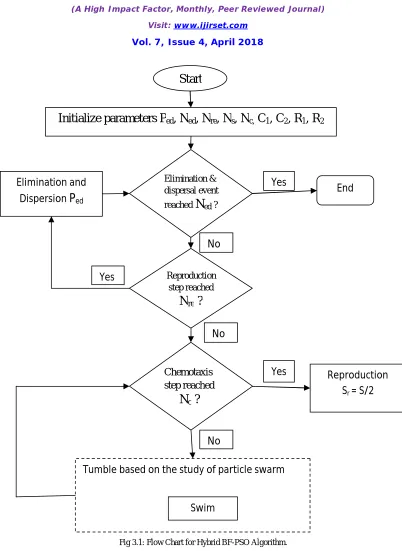
Flow Chart for Hybrid BF-PSO algorithm is shown below in fig 3.1. This algorithm consists of four prime steps: 1. Chemo taxis: Here, swimming and tumbling are the two prime ways which define the manner in which bacteria
search for food. Swimming means moving in a pre-specified direction. Tumbling means moving in a completely new direction.
2. Swarming: For the algorithm to converge at the optimal solution, it is required that the optimum bacteria attract other bacteria so that together they converge at the solution point quickly. To achieve this, a penalty function is added to the original cost function on the basis of relative distances of each bacterium from the fittest one. Penalty function becomes zero when all the bacteria have reached to the solution point.
3. Reproduction: Here, the fittest bacteria are divided into two groups. The weaker set of bacteria are replaced by other more fit set of bacteria. This keeps the population of bacteria constant throughout the evolution process.
Fig 3.1: Flow Chart for Hybrid BF-PSO Algorithm.
IV. EXPERIMENTAL RESULTS
In Proposed work we used the combination of bacterial foraging and particle swarm optimization(BF-PSO) algorithms
Start
Initialize parameters P
ed, N
ed, N
re, N
s, N
c,C
1, C
2, R
1, R
2Elimination & dispersal event reached
N
ed ?Reproduction step reached
N
re?
Chemotaxis step reached
N
c?
Tumble based on the study of particle swarm
Swim
Reproduction Sr = S/2 Elimination and
Dispersion
P
edEnd
No
No
No
Yes Yes
Test Case No. of faults covered Execution Time(ET)
T1 4 7
T2 2 3
T3 3 5
T4 4 5
T5 3 3
T6 3 6
T7 3 3
T8 2 2
Table 4.1: Test cases, no. of faults covered, their execution time
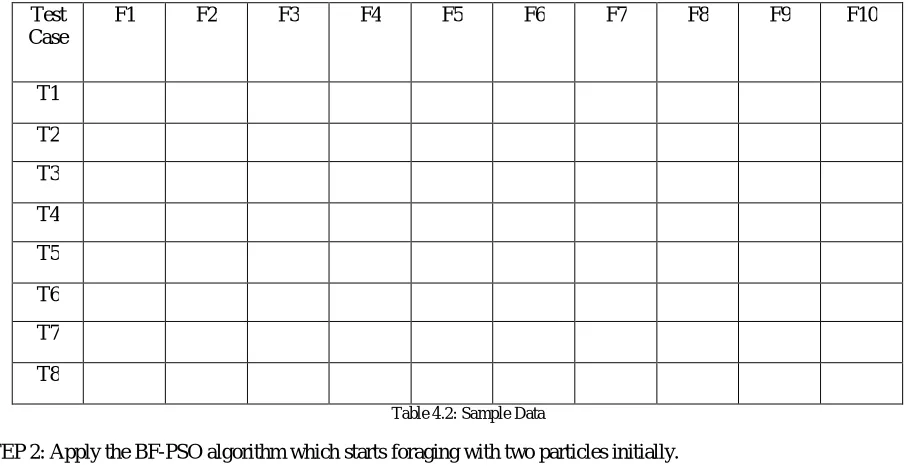
STEP 1: Initialize all the parameters of the Hybrid Algorithms and give the Test case Requirement matrix as input to the program.
Test Case
F1 F2 F3 F4 F5 F6 F7 F8 F9 F10
T1
T2
T3
T4
T5
T6
T7
T8
Table 4.2: Sample Data
STEP 2: Apply the BF-PSO algorithm which starts foraging with two particles initially.
Particles B0 B1
Test Case Selected T1 T4 Total Faults Covered 4 4 Total Execution Time 7 5
Table 4.3: Initial Selection of Test Cases
The test cases which covers maximum number of faults will be selected first.
STEP 3: In next iteration, the particles further choose the test cases as shown in table below :
Particles B0 B1 B2 B3
Test Case Selected T1, T3 T4, T3 T5, T3 T7, T3
Total Faults Covered 7 7 5 5
Total Execution Time 12 10 8 8
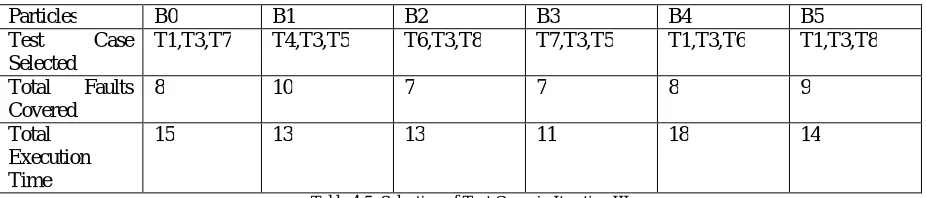
STEP 4: In next iteration, particles choose next test cases that further covers the uncovered faults till now. Particles B0 B1 B2 B3 B4 B5 Test Case
Selected
T1,T3,T7 T4,T3,T5 T6,T3,T8 T7,T3,T5 T1,T3,T6 T1,T3,T8 Total Faults
Covered
8 10 7 7 8 9
Total Execution Time
15 13 13 11 18 14
Table 4.5: Selection of Test Cases in Iteration III
In iteration III, it is found that particle B1 has detected one path in 13 seconds that can cover all the faults.
STEP 5: Stopping Criteria- Algorithm will stop when either it has found a test suite which contains minimum number of test cases which covers all the faults or number of iterations are completed.
Percentage of Test Suite Size Reduction
If „n‟ is size of a test suite and „s‟ be the selected test suite using hybrid approach, then the value for percentage reduction in test suite has been calculated using:
% reduction in test suite= (n-s)/n*100
Percentage of Execution Time Reduction
Let „T‟ be the total execution time of the original test suite, ‟Tb‟ be the running time of HBG_Tool and „Ts‟ be the
total time foe executing the selected test suite .The percentage reduction in execution time using hybrid approach is computed as:
% reduction in Execution Time= (T-(Tb+Ts)/T*100
V. CONCLUSION
In recent years, biological intelligent heuristic optimization algorithms have become one of the mainstream methods to solve the non-linear, non-differential, multi-peak and complex problems. In this dissertation we have used the hybrid BF-PSO optimization algorithm to minimize the number of test cases in a test suite. This algorithm is capable of producing an optimal sized test-suite taking execution time and coverage factors into account that can be inferred from the experimentation and analysis section. The results shows that coverage is not compensated in the reduced test set. Also, the reduced test-suite has the test cases that cover all the requirement of the program under test at least once.
REFERENCES
[1] Lingming Zhang, Darko Marinov, Lu Zhang, Sarfraz Khurshid, “An Empirical Study of JUnit Test-Suite Reduction”, 22nd IEEE International Symposium on Software Reliability Engineering, 2011.
[2] D. Binkley, “Semantics guided regression test cost reduction”, IEEE Transactions on Software Engineering 23 (8), 498–516, 1997. [3] S.Nachiyappan,A.Vimaladevi, C.B.Selva Lakshmi, “An Evolutionary Algorithm for Regression Test Suite Reduction”, Proceedings of the
International Conference on Communication and Computational Intelligence – 2010, pp.503-508, ©2010 IEEE.
[4] A. Kaur, D. Bhatt “Hybrid Particle Swarm Optimization for Regression Testing”, International Journal on Computer Science and Engineering, Vol. 3 No. 5 (May-11), pp1815~1824, ISSN: 0975-3397
[5] Siba Prasada Tripathy, Debananda Kanhar, “Optimization of Software Testing for Discrete Test suite using Genetic Algorithm and Sampling Technique”, International Journal of Computer Applications (0975 – 8887), Volume 63– No.7, February 2013.
[6] Thomas Wiese, Global Optimization Algorithms-Theory and Applications, Version-2009-06-26.