A Study of the Application of Kolb’s Theory of
Experiential Learning and Differential Type
of Studio in Teaching of Architecture.
Abdul Ahad
Assistant Professor, WSU University, Ministry of Higher Education, Ethiopia
ABSTRACT: Severely it is observed there are controversies with regard to providing of right set skills by schools of architecture. Even then they often try defending teaching practices so as to bring about creative and aesthetics capabilities which produce good designers and good building. The general aim of study is to critical examines the value of different pedagogical theories and live projects. The specific objective of study is Kolb’s theory of experiential learning and differential type of studio in teaching of architecture and alternative pedagogical approaches.
The hypothesis of study is Acquisition of knowledge and theories of learning specifically, the Application of Kolb’s theory of experiential learning and differential type of studio in teaching of architecture. Since the Kolb’s theory is not dealt properly scientifically and systematically there is variation of attainment of factors such as Concrete Experience, Reflective Observation. Data is interpreted and the result of this research analysis is interpreted.
KEYWORDS:Impact of Kolb’s theory, experiential learning, concrete experience, active experimentation...
I. INTRODUCTION
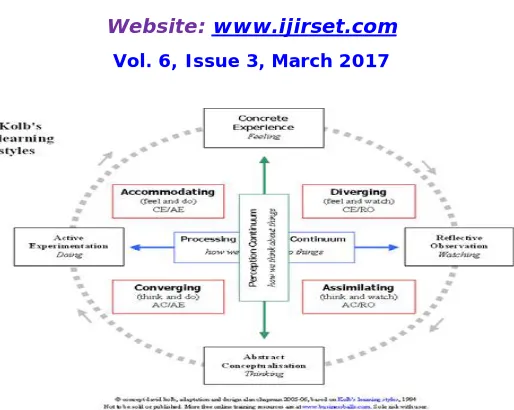
Teaching of architecture is not transformation of oral skills into just and simple skills .Teaching architecture is engineering activities which are short through variety pragmatism in learning, Kolb’s theory of experiential learning and finally latest instructional methodology in design & rehabilitation. Therefore in this research paper serious attempt is made to understand the practical concept certain specific theories of educational background .This background knowledge enable student to go down the grassroots level for utilizing knowledge of these theories. The design based on Kolb’s dynamic and multidimensional theory. It embraces concrete experience, reflective observation, abstract conceptualization, and active experimentation, which also contains multiple learning styles. This paper envisages a learner-centered, integrative theory-studio pedagogy design that enhances cognitive learning processes, both declarative and procedural, by applying the four dimensions of David Kolb’s experiential learning model (kolb1984). Cognitive psychologists make distinctions between declarative recalling of factual knowledge and procedural knowledge of knowing to perform activities (burning, schraw, and ronning 2004:46-48). The model further demonstrates how assessment of each type of knowledge and learning is embedded in the cognitive Original and evolving approaches to course development and syllabus design generate a relevant discourse within design education.
review of multidisciplinary literatures and its various applications reveals limited study of Kolb’s model’s potentials and promising applications to architectural education.
This study approaches the disciplines of architecture, urban design, and landscape architecture as nonlinear and “ill-structured” domains. Therefore, architectural education and design problem solving differ from well-structured linear disciplines such as the sciences or engineering. An “ill structured knowledge domain is defined as one that has the following characteristics: in a In “ill-structured” fields, “learner-centered (Weimer 2002)” instruction, including course development and syllabus design, should reflect the non-linear nature of the field. The course designs and syllabus are the first learning environments and elements students encounter. Hence, more effective and productive time can be spent on the actual applications and implications of the previously learnt concepts. Within the Project-Based studio structure, Kolb’s theory flexibly houses diverse instructional activities. Design projects can be defined based on both “accessible” and “remote” site type projects and a variety of relevant pedagogical strategies can be utilized to further advance the experiential learning experience.
The concept of line project and types of line project and community partnership and design and build participation is also explained so as to make concepts descriptive in nature and adoptive in purpose .The knowledge of this theories will enable to develop practice paradigm which can generate live low cost by government and real original work horizons to architects. By applying Kolb’s model to theory-studio design, the diverse learning styles of all learners are incorporated and a step-by-step course design framework enables studio and seminar design instructors to guide learners through each phase of the learning cycle. Additionally, the model further demonstrates how assessment of each type of knowledge and learning is embedded in the cognitive learning processes.
Therefore, to advance emerging design education in professional fields of architecture, landscape architecture, and urban design in the 21st century, it is essential to rethink course design and the syllabus as a critical aspect of improving design education. Together, these aspects should reflect the multidisciplinary nature of the fields and endorse the value of “design mentality.
II.THEAIMANDOBJECTIVEOFTHESTUDY
The general objective of this research paper is to critically examine the value of different pedagogical theories and live projects to the students of architecture particularly shaping of profession. An attempt is also made to bridge knowledge gap b/w pedagogy & practice through the application the knowledge of different theories of pedagogy. Similar, practice of live project in university of Yale building projects have been accomplished.
The specific objectivewill be to examine Kolb’s theory of experiential learning and differential type of studio in teaching of architecture and alternative pedagogical approaches. To reinforce this concept the saying of Confucius is mention “tell me I may forget, show me I may remember. Involve me I will understand”. (Confucius).Here an attempt is made to understand the concept studio teaching and transformative pedagogies in relation to hands on practice and pragmatic learning come us learning by doing. Further under development stages description of live project pedagogy, type of teaching studios and theories are explained to get impact of knowledge of areas of these concepts to students of practice architecture .this study based on course design model to obtain desired knowledge of architecture through different theories. Various knowledge types are integral to learning in architectural education; thus, this paper proposes a course design model that investigates various knowledge implications. Hence there is am impact of the theories of learning on architecture education.
III.RELATEDWORK
.
I.
Fig. 1. Text Detection (Image source: Kolb’s Cycle’s (1984) adaptation and design by Alan Chapman, 2006-05, accessed from website http://www.businessballs.com/kolblearningstyles.htm, date accessed December 20 2010.
1. Based on Kolb’s Theory, Kvan and Yunyan (2005) studied the correlation of students’ learning styles with their performance in architectural design studio. Demirbas and Demirkan (2003) evaluate the effects of learning style preferences on the performance of design students. They conclude that, amongst the students, there were significantly fewer “accommodators” and most were “assimilators” and convergers,” moreover, they indicate significant differences in different stages of the design process between students’ performances with different learning styles. In an analysis of Demirbas and Demirkan’s study, Kvan and Yunyan conclude that:…a design studio can encompass a wide range of learning styles if its programs start from ill-defined design problem, permit a range of communication media and are engaged over a relatively long duration, hence allowing more freedom in learning approaches… there is a significant correlation between learning style and students’ academic performance in particular design studio…. (Kvan & Yunyan 2005:32).
2. Other studies discuss multiple ways in which theory and its applications as design knowledge can be integrated into a learning setting that matches students’ capabilities and learning styles. For example, Salama and Wilkinson’s comprehensive study addresses cognitive styles in studio pedagogy and how learners acquire applied knowledge in design studio.
3. The authors define cognitive styles as individuals’ “aptitude, abilities, attitudes, and working styles.” The importance of these should be “identified and made transparent to the students in order to increase the effectiveness of their education” (189).” They conclude: Design educators should be able to provide their students with fundamental and ethical knowledge through which they can see beyond their own space, time, and culture, and understand the larger structures and processes of human habitation….
IV. SCOPE OF STUDY AND LMITATIONS OF THE STUDY
The scope of studies is that teaching of architecture and world of architecture has no limits .This contains new methodologies and structures with human values. All this dimensions lead to search of innovative ethical architecture. Future values of the application of knowledge of this paper would enable the students of architecture to study the theories of pedagogy and specifically the Kolb’s theory and its application of knowledge in different spheres of architecture education and Kolb’s theory of experiential learning.
This study is limited to the utilization of knowledge of different theories of learning and adopt apply the same them to the studios learning experiences in studio learning. Similar data is collected from different colleges of architecture limited to Delhi metropolitan area of architecture colleges’ shown under data table columns.
V. HYPOTHESIS
The hypothesis of study is to explore the impact of the application of Kolb’s theory of experiential learning
Impact of the acquisition of knowledge and theories of learning specifically application of Kolb’s theory of experiential learning and differential type of studio in teaching of architecture.
Whether there is a need to study skillfully the application of the factors of the Kolb’s theory with reference to:- 1. Comprehended the dynamics and ethical values.
2. Acquisition of architecture skills. 3. Application of skills into practices. 4. Elevation of innovative thinking.
5. To bridge gap between real world problem of architecture from visionary architecture.
VI. POPULATION OF THE STUDY AND DATA COLLECTION.
The total size of the population of the study is limited 440 students from Delhi metropolis having the following schools of architecture is as follows;
Names of colleges No of students Positive answers Negative answers
Jamia university 160 60 100
Apeejay SAP 80 40 40
Dcrust,University Murthal 80 36 54
Sunder deep College of Architecture 80 38 52 Zhcoet,Aligarh Muslim University 20 16 04
Total 440 290 150
65.90% 34.09%
VII. TOOLS OF DATA. Description of questions
1 Which theory of learning interests you much? 2 Which is the abstract concept this theory?
3 Where exactly do you find difficulty in the concepts? 4 Does this theory helps in learning skills?
6 What problem do you face in studio learning setting? 7 Is there a gap between theory and practice and why?
VII. INTERPRETATION OF DATA AND ANALYSIS OF THE STUDY.
Out of 440 students from different colleges 65.90% students have given positive answers which goes if favours of the need for the study of Kolb’s experiential knowledge and arguments promulgated in Kolb’s theory of learning i.e.; They conclude that, amongst the students, there were significantly fewer “accommodators” and most were “assimilators” and converges,” moreover, they indicate significant differences in different stages of the design
a relatively long duration, hence allowing more freedom in learning approaches… there is a significant correlation between learning style and students’ academic performance in particular design studio…. (Kvan & Yunyan 2005:32) The importance of these should be “identified and made transparent to the students in order to increase the effectiveness of their education
VIII. CONCLUSION
They conclude: Design educators should be able to provide their students with fundamental and ethical knowledge through which they can see beyond their own space, time, and culture, and understand the larger structures and processes of human habitation. … This concept can be addressed in studio pedagogy by introducing problems that aim at studying the characteristics of different societies, social classes, and the contextual particularities of different regions (188) architectural education, and Kolb’s theory, numerous architectural, landscape architectural and urban design studio and seminar/lecture course syllabi have been examined and compared. . The Kolb’s theory is a compendium of the following factors given below.
1. Concrete Experience - (a new experience of situation is encountered, or a reinterpretation of existing experience).
2. Reflective Observation (of the new experience. Of particular importance are any inconsistencies between experience and understanding).
3. Abstract Conceptualization (Reflection gives rise to a new idea, or a modification of an existing abstract concept).
4. Active Experimentation (the learner applies them to the world around them to see what results).
REFERENCES
[1] Bloom, B. S. (1956). Taxonomy of educational objectives, handbook I: The cognitive domain. New York: David McKay Co., Inc.
[2] Kolb, A. Y. & Kolb, D.A. (2005a). Learning styles and learning spaces: enhancing experiential learning in higher education. Academy of Management Learning and Education. 4, 193-21
[3] Kolb, A. Y. & Kolb, D.A. (2005b). The Kolb learning style inventory version 3.1 2005 technical specification.Boston: HayGroup [4] Kolb, D. A. (1999). Learning style inventory. Version 3. Boston: Hay/McBer.
[5] Kolb, D. A. (1984). Experiential learning: Experiences as the source of learning and development. Englewood Cliffs,New Jersey: Prentice-Hall.
[6] Kvan, T. and Yunyan, Jia (2005). Students’ learning styles and their correlation with performance in architectural design studio. In Design Studies 26(1), 19-34.
[7] Ledewitz, S (1985), Models of Design in Studio Teaching, In Journal of Architectural Education, 38(2), 2-8. [8] McLaren, P. (1999), Schooling as a Ritualised Performance, New York: Roman and Littlefield.
[9] Newland, P. Powell, J. & Creed, C. (1987). Understanding architectural designers’ selective information handling. In Design Studies, 8, 1-17.
[10] Demirbas, O. O and Demirkan, H. 2003. Focus on architectural design process through learning styles. In DesignStudies 24(5), 437-456.
[11] Diaz Moore, K. (2001). The scientist, the social activist, the practitioner and the cleric: pedagogical explorationtowards pedagogy of practice.
In Journal of Architectural and Planning Research, 18 (1). 59-79.
[12] Healey, M. & Jenkins, A. (2000). Learning cycles and learning styles: Kolb’s experiential learning theory and its application in geography in higher education. In Journal of Geography, 99, 185-195.
[13] Sanoff, H. (2007), Invited Voice of a Three Decade-Experience: Community Based Design Learning: Democracy and Collective Decision Making, In A. M. A. Salama & N. Wilkinson (Eds), Design studio pedagogy: Horizons for the future. Gateshead, U.K: Urban International Press.
[14] Schon, D. (1984). The architectural studio as an exemplar of education for reflection-in-action. In Journal of Architectural Education (1984-), 38(1), 2-9.
[15] Abdulwahed, M. & Nagy, Z.K. (2009). Abdulwahed-Nagy Laboratory Model: Pedagogy Matters!. Retrieved 11 October, 2010 [16] Bransford, J. (2000). How people learn: Brain, mind, experience, and school. Washington, D.C.: National Academy Press
[17] Helena Webster (2003), Facilitating critically reflective learning: excavating the role of the design tutorin architectural education, In Art,
Design & Communication in Higher Education. 2 (3), 101–111.
[18] Richards, S. L. F. (2003), The Interactive Syllabus: A Resources-based, Constructivist Approach To Learning, In The Technology Source, retrieved Nov. 30 2010, from http://technologysource.org/article/interactive_syllabus/.