R E S E A R C H
Open Access
Global and local stability analysis in a
nonlinear discrete-time population model
Özlem Ak Gümü¸s
**Correspondence:
[email protected] Department of Mathematics, Faculty of Arts and Sciences, Adıyaman University, Adıyaman, 02040, Turkey
Abstract
In this article, we investigate the local and global stability conditions of equilibrium points of discrete-time dynamic model with and without Allee effect. We conclude that the Allee effect decreases both the local stability and the global stability of equilibrium points of the population dynamic model. The results are confirmed with a numerical simulation.
MSC: 39A10; 39A30
Keywords: global stability; local stability; Allee effect; population model; equilibrium point; discrete-time models
1 Introduction
It is well known that the Allee effect plays an important role in the stability analysis of equi-librium points of a population dynamics model (see, for instance, [–]). The Allee effect, first introduced by Allee [] in , represents a negative density dependence when the population growth rate is reduced at low population size. It may be due to a number of sources including difficulties in finding mates, inbreeding depression, food exploitation, predator avoidance of defense, and social dysfunction at small population sizes.
Real-world problems can be solved by examining the models created via differential or difference equations. The population models in ecology and biology are generally con-firmed by such equations (see, for instance, [, –]). To examine the dynamics of the population requires stability analysis. For local asymptotic stability, solutions must ap-proach an equilibrium point under initial conditions close to the equilibrium point. In global asymptotic stability, solutions must approach to an equilibrium point under all ini-tial conditions. The global asymptotic stability has been investigated in (see, for instance, [–]). Since a globally attractive equilibrium point is locally attractive, a globally asymp-totically stable equilibrium point is locally asympasymp-totically stable. Also, if the function is continuous, global asymptotic stability and global attractiveness are equivalent. In this study, we are not concerned with global attractiveness, which is derived with the help of solutions of the equation. The purpose of this paper is to investigate the local and global stability of an equilibrium point analytically with and without Allee effect and to compare the stability of these models. Therefore, this article exposes the impact of the Allee effect on the local and global stability of an equilibrium point in a nonlinear discrete-time pop-ulation model. The positive equilibrium point of the model which is subject to an Allee effect can become either one of destabilization (see, for instance, [, ]) or of stabilization
(see, for instance, [, , , ]). Namely, the local stability of a positive equilibrium point can be changed from the stable case to an unstable case or vice versa. It is also possible that even if the model is stable at an equilibrium point, to reach its equilibrium point may take a much longer time. This case has been referred to in the statement that the ‘Allee effect decreases the local stability of the equilibrium point’ (see, for instance, [, , ]).
In [], a linear population model depending on birth and death rates was introduced:
Nt+=rNt.
Here,Ntis the population density at timet, andr(r= +b–d) is a growth rate.
Un-fortunately, this model neglects many important aspects of biological reality, since most of the parameters connected to the interactions among individuals are overlooked. Thus, nonlinear population models offer a more realistic approach than linear population mod-els.
In this paper, we consider the following nonlinear discrete-time population model:
Nt+=rNt+f(Nt) =F(r,Nt), ()
where f(Nt) represents interactions (competitions) among mature individuals, and ris
the growth rate such thatr∈(, ). The following assumptions are imposed on the func-tionf:
(i) f(Nt) < forNt∈[,∞);i.e., as the density increases,f decreases continuously.
Biologically speaking, social dysfunction never increases as the population size increases.
(ii) f()has a finite positive value.
If the population model of () is subject to the Allee effect, the following nonlinear pop-ulation model is used:
Nt+=r∗α(Ni)Nt+f(Nt) =Fα
r∗,α,Nt
. ()
The functionf satisfies the conditions (i) and (ii). Note that sincer∗> is related to the normalizedper capitagrowth rate given byr/α(N∗), () and () have the same equilibrium point. Here,α:=α(Ni) is the Allee function at timet. The following assumptions on the
Allee function are derived from biological facts:
(iii) If there are no partners, there is no reproduction. Mathematically speaking, the Allee function is zero when the population density is zero.
(iv) The Allee effect increases as the density increases. Mathematically speaking, the derivatives of the Allee function are always positive for all positive values.
(v) The Allee effect disappears at high densities. Namely, the limit of the Allee function approaches as the population size increases.
2 Local stability analysis of (1) with and without Allee effect
We will begin by reviewing some definitions and theorems (see, for instance, []) which will be useful in our study of the stability analysis of ().
Definition N∗is defined as an equilibrium point of () if the following equality holds:
N∗=FN∗.
Theorem Let N∗ be a positive equilibrium point of().Assume that Fis continuous
on an open interval I containing an equilibrium point.Then N∗is locally asymptotically stable if
FN∗< ,
and unstable if
FN∗> .
Definition m> is defined as the period for () if
FmN∗=N∗ and FiN∗=N∗, fori= , , . . . ,m– .
We will examine the local stability of the equilibrium point of () with and without the Allee effect. Assume that () and () have an unique positive equilibrium pointN∗. Namely, there is no equilibrium point exceptN∗such thatF(F(N∗))=N∗.
We then obtain the following theorem.
Theorem Let N∗ be a positive equilibrium point of()with respect to r.Then N∗ is locally stable if the inequality
fN∗> – –r ()
holds.
Proof In light of (i)-(ii), we can say thatFis a continuous function. The linearized form of () in a neighborhood ofN∗is given by
ut+=F
N∗ut, F
N∗=r+fN∗,
such thatut=Nt–N∗. By applying Theorem , we find that
– –r<fN∗< –r.
Theorem Let N∗be a positive equilibrium point of()by the Allee effect at time t with respect to r∗.Then N∗is locally stable if the inequality
–r–rN∗α (N∗)
α(N∗) <f
N∗< –r–rN∗α(N∗)
α(N∗) ()
holds.
Proof From (i)-(v), we can say thatFα is a continuous function. The linearized form of ()
in a neighborhood ofN∗is given by
ut+=Fα
N∗ut
such thatut=Nt–N∗. By applying Theorem , we have
Fα
N∗< ⇒ r∗αN∗N∗+r∗αN∗+fN∗<
⇒ – <rN∗α (N∗)
α(N∗) +f
N∗+r<
⇒ – –r<rN∗α (N∗)
α(N∗) +f
N∗< –r. ()
Here,r=r∗α(N∗) andα(N∗) < . The second derivative of the functionf is
f(x) =lim h→
f(x+ h) – f(x+h) +f(x)
h
Sincef decreases, it is written
x+h<x+ h ⇒ f(x+h) >f(x+ h),
x<x+ h ⇒ f(x) >f(x+ h).
From this, we get the following inequality:
f(x+h) +f(x) > f(x+ h),
so thatf(x) > . Let us consider the first and second derivatives of the functionFα as follows:
Fα =r∗α
N∗N∗+r∗αN∗+fN∗,
Fα=r∗α
N∗N∗+ r∗αN∗+fN∗,
such that|α(N∗)|<α(N∗) in the case ofα(N∗) < . Consequently, we getFα> so that
Fαis a convex function. Also it is seen thatFα→ ∞forh→. SinceFαis an increasing function in [N∗,∞), we can writerN∗αα((NN∗∗))+f(N∗) > –r. We then obtain the following:
–r<rN∗α (N∗)
α(N∗) +f
N∗< –r.
Corollary It can be seen from()and()that the Allee effect decreases the local sta-bility of an equilibrium point of().Namely,it is easy to see that the local stability of an equilibrium point of()is stronger than the local stability of an equilibrium point of().
3 Global stability analysis of (1) with and without Allee effect
In this section, we will present the global stability analysis of an equilibrium point of () with and without Allee effect. We shall require the following global stability theorem and definition (see, for instance, []) for ().
Definition N∗is said to be globally asymptotically stable if it is globally attractive and locally stable.
Theorem Let the function F at()be continuous such that F: [,p)→[,p), <p≤ ∞,
if <F(N) <N for all N∈(,p),then the origin is globally asymptotically stable.
We then obtain the following theorem.
Theorem The equilibrium point N∗is globally asymptotically stable if
fN∗> –r. ()
Proof The function ofF at () is continuous such thatF: [,p)→[,p). The linearized equation aboutN∗is
uT+=
r+fN∗uT
such thatuT=Nt–N∗. Let us takeFl=r+f(N∗). Sincef(N∗) < from condition (i) with
<r< , we can write
r+fN∗–r<
⇒ r+fN∗–ru<
⇒ r+fN∗u<ru ⇒ r+fN∗u<u ⇒ Fl(u) <u.
Now, we must satisfy <Fl(u) for the global stability of the zero equilibrium point (origin)
as follows:
r+fN∗u>
⇒ r+fN∗>
⇒ fN∗> –r.
It follows that <Fl(u) <u. By Theorem , the origin is globally asymptotically stable.
3.1 The Allee effect at timet
We will now consider the following nonlinear discrete-time dynamical system with Allee effect at timet, given by ():
According to the information,Fαhas a unique positive equilibrium pointN∗∈(,p). We then obtain the following theorem.
Theorem The equilibrium point N∗of()is globally asymptotically stable if
–r linearized equation aboutN∗is
uT+=
rem that the origin is globally asymptotically stable. ThenN∗is globally asymptotically stable. Note thatFl,a> is always true from Theorem . Namely, –r[ +N∗α
(N∗)
α(N∗)] <f(N∗)
always. Since this inequality is related with [ +N∗αα((NN∗∗))] < , we must take this inequality
Corollary The Allee effect at time t decreases the global stability of an equilibrium
point. (If()and()are considered,it can easily be seen.)
Corollary It is clear from()that N∗is locally stable but not globally stable if the in-equality
– –r<fN∗< –r
holds. (The proof is clear from Theoremsand.)
4 Numerical simulations
In this section, we corroborate our results numerically by using Maple and Matlab. As an example, we consider
f(Nt) :=
Nt+
and α:=α(Nt) = Nt Nt+α
.
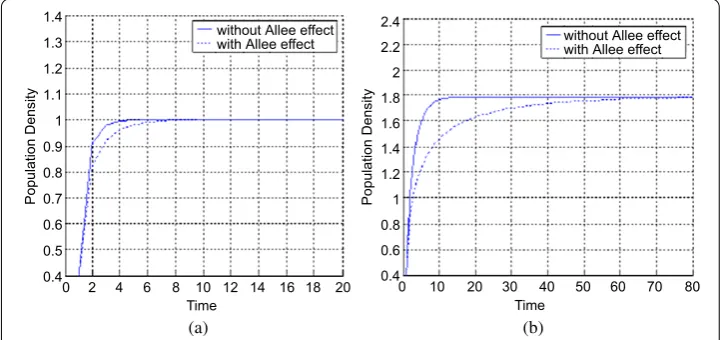
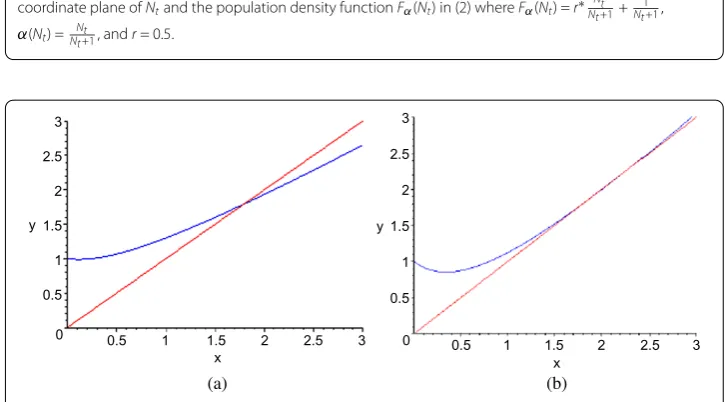
Figure shows a graph which demonstrates the dynamics of the population model based on these functions with and without the Allee effect with respect to time for different values ofr. Figures and show the graphs of the same coordinate plane ofNt and the
population density functionsF(Nt) andFα(Nt) forr= . andr= ., respectively. So,
we confirm that the Allee effect decreases the local stability and global stability of the equilibrium point of the population model. It is clear that () is not globally stable at each locally stable point.
Figure 1 The local stability of models (1) and (2). (a)Density-time graphs of the modelsNt+1=rNt+Nt1+1
andNt+1=r∗
N2t Nt+1+
1
Nt+1whereα:=α(Nt) =NtNt+1andr=r∗α(N∗) with the initial conditionN0= 0.4 and
r= 0.5.(b)Density-time graphs of the modelsNt+1=rNt+Nt1+1andNt+1=r∗
N2t Nt+1+
1
Figure 2 Graphs for functions (1) and (2) withr= 0.5. (a)Graphs of the same coordinate plane ofNtand the population density functionF(Nt) in (1) whereF(Nt) =rNt+ 1
Nt+1andr= 0.5.(b)Graphs of the same coordinate plane ofNtand the population density functionFα(Nt) in (2) whereFα(Nt) =r∗
N2t Nt+1+
1
Nt+1, α(Nt) = Nt
Nt+1, andr= 0.5.
Figure 3 Graphs for functions (1) and (2) withr= 0.8. (a)Graphs of the same coordinate plane ofNtand the population density functionF(Nt) in (1) whereF(Nt) =rNt+ 1
Nt+1andr= 0.8.(b)Graphs of the same coordinate plane ofNtand the population density functionFα(Nt) in (2) whereF(Nt) =r∗
N2t Nt+1+
1
Nt+1, α(Nt) =NtNt+1, andr= 0.8.
5 Conclusions and remarks
This paper focused on the global and local stability analysis of the first-order discrete population models with and without the Allee effect, defined by () and (), respectively. Firstly, local asymptotic stability conditions were investigated for the equilibrium points of both models. Secondly, the global stability of the equilibrium points of the models was also evaluated. Finally, we compared the global and local stability of the equilibrium points of these two models. Consequently, the Allee effect decreases the local stability and the global stability of the equilibrium points of ().
Competing interests
The author declares to have no competing interests.
Author’s contributions
Acknowledgements
The author would like to sincerely thank the anonymous referees for their careful reading of the manuscript and valuable suggestions.
Received: 10 July 2014 Accepted: 17 November 2014 Published:28 Nov 2014 References
1. Fowler, MS, Ruxton, GD: Population dynamics consequences of Allee effects. J. Theor. Biol.215, 39-46 (2002) 2. Jang, SR-J: Allee effects in a discrete-time host-parasitoid model with stage structure in the host. Discrete Contin.
Dyn. Syst., Ser. B8, 145-159 (2007)
3. López-Ruiz, R, Fournier-Prunaret, D: Indirect Allee effect, bistability and chaotic oscillations in a predator-prey discrete model of logistic type. Chaos Solitons Fractals24, 85-101 (2005)
4. McCarthy, MA: The Allee effect, finding mates and theoretical models. Ecol. Model.103, 99-102 (1997)
5. Merdan, H, Duman, O: On the stability analysis of a general discrete-time population model involving predation and Allee effects. Chaos Solitons Fractals40, 1169-1175 (2009)
6. Ak Gümü¸s, Ö, Köse, H: On the stability of delay population dynamics related with Allee effects. Math. Comput. Appl.
17(1), 56-67 (2012)
7. Ak Gümü¸s, Ö, Köse, H: Allee effect on a new delay population model and stability analysis. J. Pure Appl. Math. Adv. Appl.7(1), 21-31 (2012)
8. Merdan, H, Ak Gümü¸s, Ö: Stability analysis of a general discrete-time population model involving delay and Allee effects. Appl. Math. Comput.219, 1821-1832 (2012)
9. Murray, JD: Mathematical Biology. Springer, New York (1993)
10. Scheuring, I: Allee effect increases the dynamical stability of populations. J. Theor. Biol.199, 407-414 (1999) 11. Zhou, SR, Liu, YF, Wang, G: The stability of predator-prey systems subject to the Allee effects. Theor. Popul. Biol.67,
23-31 (2005)
12. Duman, O, Merdan, H: Stability analysis of continuous population model involving predation and Allee effect. Chaos Solitons Fractals41, 1218-1222 (2009)
13. Zu, J, Mimura, M: The impact of Allee effect on a predator-prey system with Holling II functional response. Appl. Math. Comput.217, 3542-3556 (2010)
14. Allee, WC: Animal Aggregations: A Study in General Sociology. University of Chicago Press, Chicago (1931) 15. Allen, LJS: An Introduction to Mathematical Biology. Pearson Education, Upper Saddle River (2007) 16. Elaydi, S: An Introduction to Difference Equations. Springer, New York (2006)
17. Koci´c, VL, Ladas, G: Global Behavior of Nonlinear Difference Equations of Higher Order with Applications (1993) 18. Cull, P: Local and global stability of discrete one-dimensional population models. In: Ricciardi, LM (ed.)
Biomathematics and Related Computational Problems, pp. 271-278. Kluwer Academic, Dordrecht (1988)
19. Nenya, OI, Tkachenko, VI, Trafymchuk, SI: On the global stability of one nonlinear difference equation. Nonlinear Oscil.
7, 473-480 (2004)
20. Brauer, F, Castillo-Chavez, C: Mathematical Models in Population Biology and Epidemiology (2012)
10.1186/1687-1847-2014-299